|
A Glorious Hindu Legacy: Indic influence in Southeast
Asia.
Hinduism in
Cambodia
According
to an ancient Sanskrit inscription, Cambodia was born from the
water. Being the oldest Indianised state in Southeast Asia, its
religion was Hinduism. Cambodia boasts the largest temple
complex in the world, named Ankor, from the Sanskrit meaning
"the capital city".
It was built in the ninth century
C. E. in honor of the Hindu god Lord
Vishnu. The
complex extends over an area more than twice the size of
Manhattan and took thirty-seven years to complete.
 Angkor Wat was
dramatically rediscovered in 1860 by the French naturalist and
explorer Henri Mouhot, 1826
-1861) a French naturalist and explorer, who
exclaimed:
Angkor Wat was
dramatically rediscovered in 1860 by the French naturalist and
explorer Henri Mouhot, 1826
-1861) a French naturalist and explorer, who
exclaimed:
“It is grander than anything
left us by Greece or Rome.”
"At
the sight of this temple, one feels one's spirit crushed, one's
imagination surpassed. One looks, one admires, and, seized with
respect, one is silent. For where are the words to praise a work
of art that may not have its equal anywhere on the globe? ...
What genius this Michalangelo of the East had, that he was
capable of concaving such a work.''
(source: Le Tour du Monde
2-1863-299).
He
was staggered by his discovery. There was a city so vast and so
sophisticated that it must have been built by people with an
advanced knowledge of engineering, science, mathematics and art.
The young Frenchman soon sent word back to Europe
telling of the most beautiful lost city ever to be discovered. The
monumental scale, grandeur and beauty of Angkor justifies its
reputation as one of the world’s great creations.
Mouhot wrote: What
strikes the observer with not less admiration than the grandeur,
regularity, and beauty of these majestic buildings, is the
immense size and prodigious number of the blocks of stone of
which they are constructed. In this temple alone are as many as
1532 columns. What means of transport,
what a multitude of workmen, must this have required, seeing
that the mountain out of which the stone was hewn is thirty
miles distant!...."
(source: Angkor:
Heart of an Asian Empire - By Bruno Dagens p.
140 -141).

The
Majestic Angkor Wat.
“No Sultan’, ‘no Mikado, No Viceroy of India could
offer his guests a comparable spectacle.”
(For
more refer to chapter on Greater
India: Suvarnabhumi and
Sacred
Angkor).
***
 Lord
Alfred Harmsworth Northcliffe (1865 - 1922) remarked
when he went to Cambodia as a reporter for his newspaper, Lord
Alfred Harmsworth Northcliffe (1865 - 1922) remarked
when he went to Cambodia as a reporter for his newspaper,
“No Sultan’, he cabled, ‘no
Mikado, No Viceroy of India could offer his guests a comparable
spectacle.”
(source:
The Road to Angkor - By Christopher
Pym p. 176 - 180).
Christopher Pym, author
of Ancient Civilization of
Angkor and The Road to Angkor
has observed:
"Angkor is the ancient capital of the Khmer empire, a
fabulous city of ruins buried deep in the jungles of Cambodia.
The most striking of Angkor’s ruins are Angkor the Great, a
walled cit with five enormous gateways, and Angkor Wat, a huge
temple with five towers which soar majestically above the
surrounding forest.
The most astonishing thing about Angkor is the size of the
ruined buildings, and the way in which many of them are still
locked in the clasp of giant rain-trees with orchids trailing
above the sculptures and monkeys swinging in the darkness into
sunlight through the deserted galleries. For Angkor was once the
‘lost city’ par excellence, and some of its temples are
still hard to reach and enter.
Both Khmers and Chams were Hinduized
peoples, and their cultures flowered as the result of the
intermarriage between Hindu settlers from India and the
indigenous tribes of the Indo-China peninsula."
(source: The Road to Angkor - By
Christopher Pym p. 1 - 15).

Cambodia
Both Khmers and Chams were Hinduized
peoples, and their cultures flowered as the result of the
intermarriage between Hindu settlers from India and the
indigenous tribes of the Indo-China peninsula."
(image
source: Angkor: Splendors of the Khmer
Civilization - By Marilia Albanese p. 15).
***
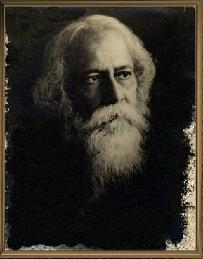 Rabindranath
Tagore (1861-1941) poet,
author, philosopher, Nobel prize laureate. Tagore
was deeply critical of the British Raj in India. Rabindranath
Tagore (1861-1941) poet,
author, philosopher, Nobel prize laureate. Tagore
was deeply critical of the British Raj in India.
He
has remarked:
“To know my country in truth (he
writes) one has to travel to that age when he realized her soul
and thus transcended her physical boundaries.”
Benjamin Rowland
( - 1972) Curator of American Art and author
of The Art and Architecture of India
"Perhaps it might be compared’, ‘to the impression that
would be produced on a wanderer in another millennium coming
suddenly upon the ruins of Manhattan rising silent and empty
above the Hudson."
(source: The Art and Architecture of
India - By Benjamin Rowland and
The Road to Angkor - By Christopher
Pym p. 176 - 180).
Angkor wat is the largest religious monument in the world.
Built by Suryavarman II in the 12th century to honor
Lord Vishnu. Its bas-reliefs show episodes from the life of Rama,
an incarnation of Vishnu, as related in the Indian epic,
Ramayana; scenes from another Indian epic, The Mahabharata; and
some ‘historical’ court scenes. Angkor wat is also an
observatory, the sun rises directly over the temple on the day
of the summer solstice, the beginning of the solar year in the
Hindu calendar. Its dimensions reflect Hindu notions about time.
Beautiful as it is, in its day Angkor wat was even more
impressive, its towers gilded in gold and its exterior painted
white.
(source:
Southeast
Asia – A Concise History – By Mary Somers
Heidues p. 40 – 41).

Lord Shiva.
***
 Sir
Francis Osbert Sacheverell Sitwell (1892- 1969) 5th Baronet, in his book Escape
with Me - an Oriental Sketch Book (1941) has
rated Angkor
as: Sir
Francis Osbert Sacheverell Sitwell (1892- 1969) 5th Baronet, in his book Escape
with Me - an Oriental Sketch Book (1941) has
rated Angkor
as:
"chief wonder of the world today, one of the summits to
which human genius has aspired in stone, infinitely more
impressive, lovely, and, as well, romantic, than anything that
can be seen in China.”
(source:
The Road to Angkor - By Christopher
Pym p. 176 - 180).
“The great edifice of Angkor Wat with its huge
lotus-bud-shaped towers, the glory of Khmer architecture and of
its founder Suryavarman II stands out above them all. It is a
spectacle of beauty, wonder and magnificence. One is struck by
its sheer enormity. It is 5,000 feet by 4,000 feet. What
brilliant scenes in Khmer history had this causeway witnessed.
Armies had marched, cavalry had galloped, priests had walked in
procession with all the ceremonial of their office. “
The bas-reliefs are one of Angkor Wat’s greatest treasures
and outstanding attractions. In the lower terrace they continue
for over half a mile, which gives some idea of the vastness of
the temple. Every stone is decorated. The bas-reliefs are about
8 feet high. The whole effect is that of an almost endless
tapestry in stone. The subjects are principally religious, of
legends and of war.

Angkor
Goddess in Venice Museum.
***
The scenes from Ramayana and Mahabharat
take up nearly half a
mile, and the total number of figures of men, animals and birds
has been calculated to be nearly 20,000. There are combats
between opposing forces who are mounted on elephants. Hundreds
of elephants have been sculptured on the walls, and illustrate
some incidents from these two epics; warriors fighting from
chariots, scenes from the lives of the God Rama and his wife
Sita, who was kidnapped by the demon Ravana, armies of men and
monkeys. Vast stretches depict Khmer victories on land and sea,
naval pageants, victory marches with bands and banners. The God
Vishnu is mounted on a garuda; there are invocations to the
Hindu trinity, goddesses, and guardian deities.
The sculptors were fortunate in being provided with a most
sensitive, ideal and endless canvas upon which to exercise their
talents. This was polished sandstone. They used about 4,000 feet
of it. The bas-reliefs decorate eight panels, four of which are
over 100 yards long.
Everything about Angkor Wat is on a massive and lavish scale,
as if time, expense and labor were of little importance. The bas
reliefs in the majority of cases are executed with exquisite
beauty, and the most minute attention to detail, symmetry and
proportion.

Apsara
dancing in Cambodia today.
In
Hindu sacred stories, Apsaras are heavenly nymphs of great
beauty and
charm, often represented as dancers at the celestial court. In a
number ofstories, the Gods sent Apsaras to earth to distract and seduce
sages practicing
austerities - especially those who are gaining alarming levels
of yogic power
through their concentrated meditation. Apsaras would also reward
heroes
who fell in combat, rushing to the battle site and carrying them
into heaven.
(source: webmaster's own collection of photos taken during a
recent visit).
(For
more refer to chapter on Greater
India: Suvarnabhumi and
Sacred
Angkor).
***
Arnold
Toynbee (1889-1975) the great
British historian. His massive research was published in 12
volumes between 1934 and 1961 as `A Study of History'. Author of
several books, including Christianity:
Among the Religions of the World and One
World and India.
He
wrote
about Angkor in The Observer, he called it 'A Foretaste of
Nirvana', saying that "one could
spend the ret of one's life sitting there."
(source:
The Road to Angkor - By Christopher
Pym p. 176 - 180). Refer
to Cambodia's
Cultural Arts.


Shiva linga -
Preah Kan and Ganesha bronze, Angkorwat.
(image
source: Angkor: Splendors of the Khmer
Civilization - By Marilia Albanese p. 68).
***

(For
more refer to chapter on Greater
India: Suvarnabhumi and
Sacred
Angkor).
***
James
Ferguson author of History
of Indian and Eastern Architecture, wrote in
1876,
"To
the historian of art the wonder is to find temples with such a
singular combination of styles in such a locality - Indian
temples constructed with pillars almost purely classical in
design, and ornamented with bas-relief so strangely Egyptian in
character."
(source: Angkor:
Heart of an Asian Empire p. 43).
S.
Sarin has written: "The Cambodian country, with
its own language, knows Sanskrit as well since the dawn of
history and some learned scholars speak of Indo-Khmer culture,
as the aspects of question are interconnected to one another. So
viewed, the deep cause of the noble sense of gratefulness in
Cambodian behavior is firstly due to the Ramayana,
which had been well-known, for example through the bas-relief of
Angkor Temples." In Cambodian language, Tin
(three) Gun meaning "knowing, acknowledging what
has been done, grateful." In Cambodian way of speaking,
people have Tin, and Gun (guna),
"quality."
(source:
Indian
Epic Values: Ramayana and Its Impact - By G. Pollet
p.222 -228).

Ram killing the
golden deer in the Ramayana, Angkorwat.
(image
source: Sacred Angkor: the Carved
Reliefs of Angkor wat - By Vittorio Roveda p. 98).
***
Cambodia's national
flag, which features the imposing
facade of Angkor Wat, the 12th century Hindu temple
dedicated to Lord Vishnu, is
only one of the symbols of how deeply internalized India is in
the collective consciousness of the Cambodian people.
(source:
Cambodia
embraces India's pride - By Shobori
Ganguli - dailypioneer.com
4//11/02).
Refer
to Angkorwat
image
- World Heritage Tour. For
more refer to chapters on Sacred
Angkor and Glimpses
XVI - Glimpses XIX.
For a documentary
on Hindu temples, refer to The
Lost Temples of India.
Top
of Page
Follow
up history of Cambodia
US
Aggression in Cambodia
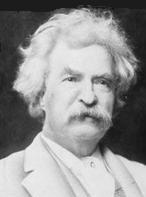 Mark
Twain (1835-1910) also known as Samuel Clemens,
one of the most widely loved and celebrated American writers
since his first books were released in the late 1860s. Mark
Twain (1835-1910) also known as Samuel Clemens,
one of the most widely loved and celebrated American writers
since his first books were released in the late 1860s.
He was also quite vitriolic about missionaries
who justified imperialism as an extension of the religious
duty.
"I bring you the stately matron
named Christendom," he wrote angrily, "returning
bedraggled, besmirched, and dishonored from pirate raids in
Kiao-chou [Tsingtao, China], Manchuria, South Africa, and the
Philippines, with her soul full of meanness, her pocket full of
boodle, and her mouth full of pious hypocrisies."
"Notwithstanding their passioned opposition, the
anti-imperialists were fighting rearguard actions against faits
accompli in the Philippines and elsewhere, leading Theodore
Roosevelt, secretary of the Navy, virile
expansionist, and later president, to deride them as "men
of a by-gone age having to deal with the facts of the
present."
(source:
American
Imperialism - vi.uh.edu).
Watch
We
are Warlike people - By George Carlin.
For
U.S political
and military intervention,
refer
to Perpetual
War for Perpetual Peace – By Gore Vidal
Refer
to World Conquering Creeds in
chapter Glimpses
XVI.
“The
moneyed elite in the United States have long coveted their
neighbors' land, resources, and cheap labor forces. Eager to
invade, annex, and exploit, the plutocracy began to disseminate
the warped notion of Manifest Destiny
in the Nineteenth Century. Purporting
to have the unwavering support of the Almighty, the
"superior" Anglo-Saxons rationalized slavery, the
Native American Genocide, the conquest of half of Mexico, the
annexation of Hawaii, and their eradication of over 300,000
"savages" in conquering the Philippines.”
(source:
Hell
Awaits, America - rense.com).
***
One
might want to recall that American intervention in Cambodia was
a disaster for the Cambodians. American and South Vietnamese
forces invaded Cambodia in April 1970, the North Vietnamese
simply moved westwards, deeper into Cambodian territory. The
chaos of post-invasion Cambodia, which led to the takeover of
power by the murderous Khmer Rouge.
The American role
 The
responsibility for the rising popularity of the Khmer Rouge
rested with the successive US administrations which prosecuted a
protracted and brutal imperialist war throughout Indochina in
the 1960s and 1970s, destroying millions of lives and
devastating industry and agriculture. Prince
Sihanouk had sought to maintain his country's
distance from the war in Vietnam through a policy of neutralism.
He refused to act against Vietnamese supply lines along the Ho
Chi Minh trail, which ran through eastern Cambodia. At the same
time he kept silent about US military actions against Vietnamese
forces operating on Cambodian soil. The
responsibility for the rising popularity of the Khmer Rouge
rested with the successive US administrations which prosecuted a
protracted and brutal imperialist war throughout Indochina in
the 1960s and 1970s, destroying millions of lives and
devastating industry and agriculture. Prince
Sihanouk had sought to maintain his country's
distance from the war in Vietnam through a policy of neutralism.
He refused to act against Vietnamese supply lines along the Ho
Chi Minh trail, which ran through eastern Cambodia. At the same
time he kept silent about US military actions against Vietnamese
forces operating on Cambodian soil.
The
Nixon administration finally broke with Sihanouk in
April 1970, backing a CIA-directed military coup that installed General
Lon Nol and sent Sihanouk into exile in Beijing. One
month later Nixon announced the invasion of Cambodia by 20,000
US and Vietnamese troops.
Cambodia
was transformed into a battlefield with Lon Nol's troops
fighting the Khmer Rouge and American and Saigon troops in
combat with NLF and regular North Vietnamese forces. The
country's population experienced the most intensive saturation
bombing in world history. During nearly five years of bombing
raids, from 1969 to 1973, some 532,000 tons of bombs were
dropped on Cambodia, more than three times the tonnage dropped
on Japan in all of World War II.
 Under
the impact of the bombing and widening warfare, Cambodian
society disintegrated. By 1974, 95 percent of Cambodia's
national income came from US aid, much of it siphoned off into
the pockets of corrupt military officers. Two million out of the
seven million people were homeless. Annual rice production had
plunged from 3.8 million tons to only 655,000 tons. Much of
Cambodia's farmland remains even today untillable because of
bomb craters and unexploded ordnance. Under
the impact of the bombing and widening warfare, Cambodian
society disintegrated. By 1974, 95 percent of Cambodia's
national income came from US aid, much of it siphoned off into
the pockets of corrupt military officers. Two million out of the
seven million people were homeless. Annual rice production had
plunged from 3.8 million tons to only 655,000 tons. Much of
Cambodia's farmland remains even today untillable because of
bomb craters and unexploded ordnance.
The
major responsibility for this social catastrophe lay with Nixon
and his principal foreign policy aide, National
Security Adviser Henry Kissinger.
The
bombing of Cambodia was carried out as a secret and illegal
operation--secret, at least, from the American people, if not
from the victims in Cambodia, or the thousands of American
military personnel who participated in the attacks, or the
American reporters in Vietnam who knew of the bombing raids but
kept silent.
 The
Khmer Rouge in power The
Khmer Rouge in power
It
was only after the American intervention in Cambodia that Pol
Pot and the Khmer Rouge began to win wider
support.
From
a badly organized and poorly equipped force of less than 5,000
men in 1970, it grew to be an army of around 70,000 when, in
April 1975, the Lon Nol dictatorship finally collapsed. Out of a
population of approximately 8 million people, Pol Pot's regime
killed one-quarter.
The
Khmer Rouge targeted Buddhist monks, Western-educated
intellectuals, people who appeared to be intelligent (for
example, individuals with glasses), the crippled and lame, and
ethnic minorities like ethnic Laotians and Vietnamese. They were
thrown into the infamous S-21 camp for interrogation.
(source:
US
aggression in Cambodia - wsws.org and Pol
Pot).
Watch
We
are Warlike people - By George Carlin.
For
U.S political
and military intervention,
refer
to Perpetual
War for Perpetual Peace – By Gore Vidal
Top
of Page
Large
Symbols Like Peruvian Signs Found on Gujarat Hillside
 Vadodara,
Gujarat, India. August 6, 2006: Geologists have discovered a
striking archaeological feature on a hillock in the Kutch
district of the western Indian state of Gujarat. This feature is
shaped like the Roman numeral VI. Each arm of this feature is a
trench that is about two meters wide, two meters deep and more
than 100 meters long. The feature has evoked the curiosity of
archaeologists because such signs have mostly been observed so
far in Peru. The team, led by Dr RV Karanth, a former professor
of geology at the Maharaja Sayajirao University in Vadodara,
Gujarat, has been involved in a palaeoseismological study of the
Kutch region for the past 11 years Palaeoseismology involves the
study of sediments, landforms and other geological evidence of
past earthquakes to unravel their history and determine the
nature and occurrence of present-day earthquakes. This feature
was discovered at a hillock 3km from the sleepy oasis township
of Khavda, which is also known as the gateway to the Rann of
Kutch, an extensive salt marsh of western India and southeast
Pakistan between the Gulf of Kutch and the Indus river delta. Vadodara,
Gujarat, India. August 6, 2006: Geologists have discovered a
striking archaeological feature on a hillock in the Kutch
district of the western Indian state of Gujarat. This feature is
shaped like the Roman numeral VI. Each arm of this feature is a
trench that is about two meters wide, two meters deep and more
than 100 meters long. The feature has evoked the curiosity of
archaeologists because such signs have mostly been observed so
far in Peru. The team, led by Dr RV Karanth, a former professor
of geology at the Maharaja Sayajirao University in Vadodara,
Gujarat, has been involved in a palaeoseismological study of the
Kutch region for the past 11 years Palaeoseismology involves the
study of sediments, landforms and other geological evidence of
past earthquakes to unravel their history and determine the
nature and occurrence of present-day earthquakes. This feature
was discovered at a hillock 3km from the sleepy oasis township
of Khavda, which is also known as the gateway to the Rann of
Kutch, an extensive salt marsh of western India and southeast
Pakistan between the Gulf of Kutch and the Indus river delta.
Dr. Karanth says such trenches have not been noticed elsewhere
in the region. Archaeologists, he says, can now pursue further
research. Geometric lines and animal shapes etched into the
desert plain by people of the Nazca civilisation (AD 1-700) of
Peru are well known. "But such signs on hill-slopes have
not been reported from Peru," says Dr. Karanth. He says
that one of the prominent explanations given for the Peruvian
features is that they may have been constructed to make
astronomical observations and calculations. "The
Tropic of Cancer passes through Kutch. So if this structure is
man-made, it is likely that the slope of the hillock was
utilized for making certain astronomical calculations in the
past," explains the geologist. Interestingly,
there are numerous indications to suggest that Harappans were
well-versed in astronomy. The straight streets of that time were
oriented in the cardinal directions - east, west, north and
south. Linkages between ancient Harappan scripts and latter
Vedic texts also suggest that Harappan priest-astronomers
tracked the progress of various planets and mapped the sky. Dr.
Karanth has also discovered ruins of a fort-wall, houses,
storage tank and a temple on the hilltop.
(source:
Large
Symbols Like Peruvian Signs Found on Gujarat Hillside -
bbcnews.co.uk). For more refer to chapter on India
on Pacific Waves and Vimanas.
Top
of Page
Vedic India
and the Primordial Tradition
Vishnunabhi
is the navel of Lord Vishnu, the emanation point of the cosmos.
According to John Major Jenkins,
a leading independent researcher of ancient cosmology:
 "Our understanding of the true age of the ancient Vedic
civilization has undergone a well-documented revolution. Feuerstein,
Frawley, and Kak have shown conclusively (In
Search of the Cradle of Civilization) that the
long-accepted age of the Vedic culture—erroneously dated by
scholars parading a series of assumptions and unscientific
arguments to roughly 1500 BC—is much too recent. Evidence
comes from geological, archaeological, and literary sources as
well as the astronomical references within Vedic literature. The
corrected dating to eras far prior to 1500 BC was made possible
by recognizing that precessional eras are encoded in Vedic
mythology, and were recorded by ancient Vedic astronomers. As a result, the Indus Valley
civilization appears to be a possible cradle of civilization,
dated conservatively to 7000
BC. Western India may thus be a true
source of the civilizing impulse that fed Anatolia in Turkey,
with its complex Goddess-worshipping city-states of Çatal Hüyük
and Hacilar. However, there are layers upon layers of
even older astronomical references, and legends persist that the
true “cradle” might be found further to the north, in Tibet
or nearby Central Asia. "Our understanding of the true age of the ancient Vedic
civilization has undergone a well-documented revolution. Feuerstein,
Frawley, and Kak have shown conclusively (In
Search of the Cradle of Civilization) that the
long-accepted age of the Vedic culture—erroneously dated by
scholars parading a series of assumptions and unscientific
arguments to roughly 1500 BC—is much too recent. Evidence
comes from geological, archaeological, and literary sources as
well as the astronomical references within Vedic literature. The
corrected dating to eras far prior to 1500 BC was made possible
by recognizing that precessional eras are encoded in Vedic
mythology, and were recorded by ancient Vedic astronomers. As a result, the Indus Valley
civilization appears to be a possible cradle of civilization,
dated conservatively to 7000
BC. Western India may thus be a true
source of the civilizing impulse that fed Anatolia in Turkey,
with its complex Goddess-worshipping city-states of Çatal Hüyük
and Hacilar. However, there are layers upon layers of
even older astronomical references, and legends persist that the
true “cradle” might be found further to the north, in Tibet
or nearby Central Asia.
The work of these three writers shows that biases and
assumptions within scholarly discourse can prevent an accurate
modeling of history and an underestimation of the
accomplishments of ancient cultures. The analogous situation in
modern Egyptology and Mesoamerican studies also requires that
well-documented new theories — often exhaustively argued,
interdisciplinary, and oriented toward a progressive synthesis
of new data — should be appraised fairly and without bias.
Next
to the Australian aborigines, the Vedic civilization is perhaps
the oldest continuous living tradition in the world. Its
extremely ancient doctrines and insights into human spirituality
are unsurpassed. We might expect that its cosmology and science of time has been as misunderstood as its true antiquity. In
looking closely at Vedic doctrines of time, spiritual growth,
calendars, and astronomy, we will see that a central core idea
is that of our periodic alignment to the Galactic Center. And,
according to these ancient Vedic beliefs,
the galactic alignment we are currently experiencing
heralds our shift from a millennia-long descent of deepening
spiritual darkness to a new era of light and ascending
consciousness. "

Lord Vishnu
is the infinite ocean from which the world emerges - Lord is
shown lying down on a thousand-headed snake (named Shesha or
Ananta Nag - Timeless or Ageless snake).
According to ancient Vedic beliefs,
the galactic alignment we are currently experiencing
heralds our shift from a millennia-long descent of deepening
spiritual darkness to a new era of light and ascending
consciousness. "
***
Vishnunabhi:
Yugas and Galactic Center
One of the oldest writings in Vedic literature comes from a
pseudo-historical god-man called Manu. René
Guénon pointed out that Manu belongs to a family of
related archetypal figures, which include Melchezidek, Metatron,
St Michael, Gabriel, and Enoch. As an angelic inspiration for
the rebirth of humanity at the dawn of a new era, or Manvantara, Manu is the primal
law-giver, and his laws were recorded in the extremely ancient
Vedic text called the Laws of Manu. Much of its contents
describe moral and ethical codes of right behavior, but there is
a section that deals with the ancient Vedic doctrine of World
Ages - the
Yugas. Manu indicates that a period of 24,000 years
— clearly a reference to precession — consists of a series
of four yugas or ages, each shorter and spiritually darker than
the last. In one
story this process of increasing limitation is envisioned as a
cosmic cow standing with each leg in one quarter of the world;
with each age that passes a leg is lost, resulting in the absurd
and unstable world we live in today—a cow balancing on one
leg.
According to the information in the Laws of Manu, the morning
and twilight periods between the dawn of each new era equals
one-tenth of its associated yuga, as shown in the following
table:
Dawn
Era Dusk
Total Name
400 + 4000 + 400 = 4800 years. Satya Yuga (Golden Age)
300 + 3000 + 300 = 3600 years. Treta Yuga (Silver Age)
200 + 2000 + 200 = 2400 years. Dwapara Yuga (Bronze Age)
100 + 1000 + 100 = 1200 years. Kali Yuga (Iron Age)
12,000 years
In
Vedic mythology, a fabled dawn time existed in the distant past,
when human beings had direct contact with the divine
intelligence emanating from Brahma—the seat of creative power
and intelligence in the cosmos. This archaic Golden Age (the
Satya Yuga) lasted some 4800 years. After the Golden Age ended,
humanity entered a denser era, that of the Silver Age, lasting
only 3600 years. In this age, humanity’s connection with the
source was dimmed, and sacrifices and spiritual practices became
necessary to preserve it. The
Bronze Age followed, and humanity forgot its divine nature.
Empty dogmas arose, along with indulgence in materialism. Next
we entered the Kali Yuga—in
which we remain today—where the human spirit suffers under
gross materialism, ignorance, warfare, stupidity, arrogance, and
everything contrary to our divine spiritual potential.
As
the teachings tell, Kali, the creator-destroyer Goddess, will
appear at the end of Kali Yuga to sweep away the wasted detritus
of a spirit-dead humanity, making way for a new cycle of light
and peace. Notice that the Manu text takes us from a pinnacle of
light to the ultimate end-point of the process—the darkness of
Kali Yuga. And notice that the four ages, when the overlap
period is added, amounts to only half of the 24,000-year period
of the Vedic Yuga cycle.
(source: Galactic Alignment - By John
Major Jenkins).

Lord Vishnu - 5th
century.
The
Indian astronomers went even further, giving a physical reason
for how the dual star or binary motion might allow the rise and
fall of human consciousness to occur. They said that the Sun
(with the Earth and other planets) traveled along its set
orbital path with its companion start, it would cyclically move
close to, then away from, a point in space referred to as Vishnunabhi,
a supposed magnetic center or "grand center".
***
The
Indian astronomers went even further, giving a physical reason
for how the dual star or binary motion might allow the rise and
fall of human consciousness to occur.
They said that the Sun
(with the Earth and other planets) traveled along its set
orbital path with its companion start, it would cyclically move
close to, then away from, a point in space referred to as Vishnunabhi,
a supposed magnetic center or "grand center". They
implied that being close to this region caused subtle changes in
human consciousness that brought about the Golden Age, and
conversely, our separation from it resulted in an age of great
darkness, the Kali Yuga or Dark Age. "When the Sun in its
revolution around its dual comes to the place nearest to this
grand center, ... (an event which takes place when the autumnal
equinox comes to the first point of Aries), dharma, the mental
virtue, becomes so much developed that man can easily comprehend
all, even the mysteries of the Spirit."
(source:
Lost
Star of Myth and Time - By Walter Cruttenden).
Also refer to Hamlet's
Mill - By Giorgio de Santillana and Hertha von Dechend.
Top
of Page
Ram
Sethu - The Earliest and largest carbon-fiber reinforced civil
engineering structure known to man
Floating stones found in Rameshwaram
Do
stones float in water? The answer would be a certain no. But in
the island of Rameshwaram in Tamil Nadu, stones, it seems, do
float in water. Difficult to believe-but it's a reality.
Floating
stones of Rameshwaram have a mythological twist to it. According
to the Hindu mythological epic Ramayana, which was supposed to
have taken place over 17 million years ago, Lord Rama and his
army of monkeys used stones to build a bridge across the Palk
Strait to link Rameshwaram to Sri Lanka. Legend as well as
archaeological findings indicate the first signs of human
inhabitation in Sri Lanka date back to the primitive age and it
is assumed that the bridge's age is also almost equivalent.

Sign
Petition - Save
Ramar Sethu. Refer
to Save
Ram Sethu and The
Bridge of Ram and Dharmagraha
That is the
memory so beautifully adopted by the Geological
Survey of India in its logo, which describes India in
this line etched at the bottom of its insignia -- Aasetu
Himachal, meaning India is spread between the Bridge
and the Himalayas. That is the Ram Setu Bridge on the southern
tip of our motherland, an identity of the nation, under
destruction now.
For more on
Ramayana, refer to chapters Vimanas,
Hindu Scriptures, Dwaraka,
War in Ancient India,
Survarnabhumi and
Sacred Angkor.
***
G.
Mohan Das,
a local historian and caretaker of the stones in the temple,
said that these stones could have been the kind used to build
the mythological bridge.
"The
history of these floating stones is that when Lord Rama made a
bridge to trek to Lanka to bring back his consort Sita, these
are the same stones used. But today's educated people do not
agree to it. They believe it is a coral which is in Australia,
Chennai, in small islands. We believe there is no difference in
these stones. Both the stones do not have air in them. The
composition is the same and it has 40 kinds of chemicals,"
he said.
Space
images taken by NASA reveal a series of rock outcrops in the
Palk Strait between India and Sri Lanka. Some historians say
these could be the part of the mythological bridge linking
Indian peninsula with Sri Lanka island.
***
NASA
Photos Reveal Bridge to Lanka
NASA’s
statement accompanying the above photograph says:
“The
bridge's unique curvature and composition by age reveals that it
is man-made. Legend as well as Archeological studies reveal that
the first signs of human inhabitants in
Sri Lanka
date back to the primitive age, about 1,750,000 years ago and
the bridge's age is also almost equivalent.”
According to the Ramayana,
Lord Rama built a bridge to Lanka in
ancient times, and the new photos greatly intrigue Hindus.
Space images taken by NASA
reveal a mysterious ancient bridge in the Palk Strait between
India and Sri Lanka. The recently discovered bridge currently
named as Adam´s Bridge is made of chain of shoals, c.18 mi (30
km) long.
The bridge´s unique curvature
and composition by age reveals that it is man made. The legends
as well as Archeological studies reveal that the first signs of
human inhabitants in Sri Lanka date back to the a primitive age,
about 1,750,000 years ago and the bridge´s age is also almost
equivalent.
 This
information is a crucial aspect for an insight into the
mysterious legend called Ramayana, which was supposed to have
taken place in tredha yuga (more than 1,700,000 years ago). This
information is a crucial aspect for an insight into the
mysterious legend called Ramayana, which was supposed to have
taken place in tredha yuga (more than 1,700,000 years ago).
In
this epic, there is a mentioning about a bridge, which was built
between Rameshwaram (India) and Srilankan coast under
the supervision of a dynamic and invincible figure called Rama
who is supposed to be the incarnation of the supreme.
This information may not be of
much importance to the archeologists who are interested in
exploring the origins of man, but it is sure to open the
spiritual gates of the people of the world to have come to know
an ancient history linked to the Indian mythology.
According
to encyclopedia.com (rä´me)
or Rama's Bridge, chain of shoals, c.18 mi (30 km) long, in the
Palk Strait between India and Sri Lanka. At high tide it is
covered by c.4 ft (1.2 m) of water. A steamer ferry links
Rameswaram, India, with Mannar, Sri Lanka. According to Hindu
legend, the bridge was built to transport Rama, hero of the
Ramayana, to the island to rescue his wife from the demon king
Ravanna.
(source: http://www.indolink.com/Religion/r091702-130924.php
and Floating
stones found in Rameshwaram).
15
kg Rameshwaram rock that stays afloat
Weighing
15 kg, the rock does not sink in water. The devotees
believe it is a fragment of the "rocks huge as autumn
clouds'', as described in Valmiki Ramayan, used to built the Ram
Setu by Nala, the son of Vishwakarma.
Mahavir
Mandir Trust secretary Acharya Kishore Kunal said he brought
this "floating'' stone from Hanuman Temple at Rameshwaram.
"I was told that during the devastating cyclone of 1964
many such floating pieces from the Ram Setu were found scattered
near Rameshwaram,'' he said.
"The
availability of these floating stones gives evidence to the
account of Valmiki on the construction of Ram Setu which is
described the Yudha Kand of the Ramayana,'' he said.

Sage (Rishi)
Valmiki writing the Grand epic of The Ramayana.
"Divine
poem, ocean of milk!"
"Whoever
has done or willed too much let him drink from this deep cup a
long draught of life and youth........Everything is narrow in
the West - Greece is small and I stifle; Judea is dry and I
pant. Let me look toward lofty Asia, and the profound East for a
little while. There lies my great poem, as vast as the Indian
ocean, blessed, gilded with the sun, the book of divine harmony
wherein is no dissonance. A serene peace reigns there, and in
the midst of conflict an infinite sweetness, a boundless
fraternity, which spreads over all living things, an ocean
(without bottom or bound) of love, of pity, of clemency."
Such was the
first and enduring impression made on Jules
Michelet (1798
-1874) French writer and historian by the Ramayana.
***
Sage
Valmiki wrote:
"Now
let a wondrous task be done, By Nala, Vishwakarma's son, Who,
born of one of Vanar race, Inherits by his father's grace, a
share of his celestial art, Call Nala to perform his part, And
he, divinely taught and skilled, A bridge athwart the sea shall
build... Then the great bridge of wondrous strength was built...
Rocks huge as autumn clouds bound fast, with cordage from the
shore were cast...''
(source:
15
kg Rameshwaram rock that stays afloat - The Times of
India
Date: October 3, 2007),
 The
Rama Sethu is a man-made formation. The
Rama Sethu is a man-made formation.
S
Badrinarayanan, former director of Geological
Survey of India and a member of the National
Institute of Ocean Technology (NIOT) says the
Adam's Bridge
was not a natural formation.
He
has opined that:
"Coral
reefs are formed only on hard surfaces. But during the study we
found that the formation at
Adam's Bridge
is nothing but boulders of coral reefs. When we drilled for
investigation, we found that there was loose sand two to three
meters below the reefs. Hard rocks were found several meters
below the sand. Such a natural formation is impossible. Unless
somebody has transported them and dumped them there, those reefs
could not have come there. Some boulders were so light that they
could float on water. Apparently, whoever has done it, has
identified light (but strong) boulders to make it easy for
transportation. Since they are strong, they can withstand a lot
of weight. It should be preserved as a national monument."
Such a
natural formation is impossible. Unless somebody has transported
them and dumped them there, those reefs could not have come
there. Some boulders were so light that they could float on
water. Apparently, whoever has done it, has identified light
(but strong) boulders to make it easy for transportation. Since
they are strong, they can withstand a lot of weight. It should
be preserved as a national monument,” he opined.
He also cautioned that once the channel connected the turbulent
Bay of Bengal and the calm Gulf of Mannar, it could spell doom
for the southern Tamil Nadu coastline. During the tsunamis, it
was Adam’s Bridge and Sri Lanka that saved the southern
coastline when Nagapattinam and other northern shores were
ravaged.
“Such comforts would not be there in future if this man-made
barrier is cut open,” he added.
(source: Sethusamudram
Shipping
Canal
Project: A Good Thing Done Badly!
- By Sundara Krishnaswami indiacause.com and Dummy’s
guide to Ramar Bridge - mumbaimirror.com).
Hindu
Baiting and a Cowardly Deed?
A Non-Hindu
Christian Congress Party Union Cabinet Minister for Culture
Mrs. Ambika Soni spoke like
an Occidental Christian Despot of the Middle Ages when she
recently informed the Lok Sabha:
''There
is no archeological or historical evidence regarding the
existence or otherwise of the Rama Sethu Bridge or Adam's Bridge
in Rameswaram''

Ram Sethu
aerial photo.
"rocks
huge as autumn clouds'', as described in Valmiki Ramayan, used
to built the Ram Setu by Nala, the son of Vishwakarma.
(photo
source: Contributed by a visitor this
website).
From
the original Ramayana of Maharishi Valmiki down to Kamba's great
work in Tamil and Tulsidas' Ramcharitmanas, the story of Lord
Ram has been told and retold in almost every language of the
world. The Ramayana's
story was by no means confined to
India
and, "its fragrance has traveled across the whole of South
and
Southeast Asia
."
Hindu
Baiting and a Cowardly deed? - The unsavoury saga of the UPA
Government first denying the existence of Lord Ram
through an affidavit in the Supreme Court, thus unleashing
outrage across the nation, and then hastening to deny its
earlier denial through a fresh affidavit.
***
The Union
Minister for Shipping T.R.Balu
and the Tamil Nadu Chief Minister
Karunanidhi are committed to the supreme Dravidian
cause of destruction of the Rama Sethu Bridge just in order to
deal a death blow to the sacred feelings and susceptibilities of
millions and millions of Hindus in India and the world.
Karunanidhi and T.R.Balu, deathly enemies of Eternal Hinduism,
have shown again and again that they are no less ignorant than
Mrs.Ambika Soni in their Himalyaan ignorance of historically
established facts about the
Rama
Sethu
Bridge
or
Adam's Bridge
.
Historical
Records of Rama Bridge
To
silence if not to outwit the arrogant, irresponsible Cabinet
Ministers in high office in
New Delhi
and
Madras
today, I would like to cite a few references from printed books
and documents where there are textual references to Rama's
Bridge or
Adam's Bridge
or Sethu Bandhana.
Marco
Polo (1254 -1324) was a Venetian trader and explorer
who gained fame for his worldwide travels, recorded in his book
IL MILIONE (''The Million'' or The Travels of Marco Polo). He
visited several ports in India. A book ''On The travels of Marco Polo'' translated by Marsden
into English was published in
England
in 1854. In this book Rama's Bridge has been described as
SETABUND-RAMESWARA which only means Setu-Bandha (page-380).

The Rameswaram
temple
Lord
Ram worshiped Lord Shiva at Rameswaram with Lakshmana and
Hanuman at his side.
(source:
British Library).
***
A
Catalogue of the Mammals in the Museum of the Hon. East-India
Company,
East
India
Company
Museum
written by Thomas Horsfield
(1773-1859), was published in
England
in 1851. In this Catalogue, Rama's Bridge was used as a
reference point to define the expanse of Bharatam. We can see
from this Catalogue, adequate pointers to the rich biodiversity
of the flora and fauna of Rameshwaram and its environs.
Sir
William Jones (1746-1794) in his ''Discourses
delivered before the Asiatic society'' published in
1801 (p. 29) has observed as follows:
“The
characters, in which the languages of
India
were originally written, are called Nagarai, from Nagara, a city
with the word Deva sometimes prefixed, because they are believed
to have been taught by the Divinity himself, who prescribed the
aritificial order of them in a voice from heaven. These letters,
with no greater variation in their form by the change of
straight lines to curves, or conversely, than the Cusick
alphabet has received in its way to India, are still adopted in
more then twenty kingdoms and flates, from the borders of
Cashgar and Khoten, to Rama’s Bridge, and from the “Sindhu
to the river of Siam. Nor can I help believing”
Arnold
Hermann (1835) in his ''Historical
researches into the politics, intercourse, and trade of the
principal nations of antiquity'' translated from the
German into English, Oxford University Press (p.89) wrote:
“Six
years before Christ. The particular object of this inscription
is to record the liberality of a certain renowned conqueror
named Deb Pal Deb, who overran all
India, from the sources of the Ganges to Rama’s bridge at Ceylon, which “is celebrated in the Ramayana.”
William
Yates, 1846, A dictionary of Sanscrit and English,
designed for the use of private students and of Indian colleges
and schools, Baptist Mission Press, (p.821)
"Samudra
m. A Shark, a whale; Rama’s bridge, marine mari"
The entry, samudraaru or samudraarah is given the
meaning: Rama's bridge.

Vanara Sena
Rama Setu Sculpture at
The Prambanan Temple in Indonesia.
The
Ramayana has massively influenced the entire Asian landmass,
there are probably as many versions and interpretations of the
Ramayana as there are Rama-bhaktas. All variants are legitimate,
like myriad paths in quest of the Ultimate Truth. From Sangam
poetics to the bhakti of the Alwar saints, the classical
rendition of Kamban, the grand philosophy of Ramanuja, the
soulful depths of Thiagaraja, and the sheer energy of Therukuttu
(street theatre), 'what was built forever is forever being
built.'
For
more refer to chapters on
Suvarnabhumi,
Sacred Angkor and
Glimpses XII to
Glimpses XIX.
***
Charlotte
Speir Manning, George Scharf, 1856, ''Life in Ancient
India
'',
Oxford
University
Press (p. 117).
“Rama
and all the allied forces marched down to the
Coromandel coast
, and making a bridge by casting rocks into the sea passed
quickly into Lanka. Vestiges of Rama’s bridge may still be
seen, occasionally much inconvenience to navigators, who are
obliged to lighten heavy burdened vessels before they can pass
the rocks and sandbanks of “the Straits of Manaar. After
fighting a few battles, the…”
Lodovico
de Varthema, George Percy Badger, John Winter Jones,
1863, The travels of Ludovico di Varthema in
Egypt
,
Syria
, Arabia Deserta and Arabia Felix, in
Persia
,
India
..., Published for the Hakluyt Society,
London
(Translated into English from the original Italian edition),
(p.185)
''...The
expedition of Ram to Ceylon, and his victory over Rhavan or
Rhaban, King of that island, is one of the fables of Hindu
mythology, but he passed into the island at the strait, since
called, by the Mohamedans, Adam's Bridge. The whole country
round, in consequence of this, preserves the memorial of his
conquest. There is a Ramanad-buram on the continent close to the
Bridge; a Rami-Ceram, or country of Ram, the island close to the
continent; [Rameswaram, called Rammanana Kojel by Baldaeus, and
Ramonan Coil by D'Anville;] and a Point Rama on the continent.
The
Bridge itself, formed by the shoals between Rami-ceram and
Mannar, is Rama's Bridge; and in Rami-ceram is Ramar-Koil, the
temple
of
Ram
. This Koil or temple (Koil means temple in Malayalim) is
undoubtedly the origin of Koru; and the repetition of it three
times in Ptolemy is in perfect correspondence with the allusion
to Ram at the present''
(source:
Rama
Sethu: Historic facts vs political fiction - IV
– By V Sundaram - newstodaynet.com)
 Lord
John Sinclair Pentland (1860 – 1925) was Governor
of Madras from 1912 to 1919. He visited Rameshwaram in 1914 when
Sir Alexander Tottenham
(1873-1946) was the District Collector of Ramanathapuram. Lord
Pentland was so overwhelmed by what he saw in Rameshwaram that
he wrote as follows to Lord Hardinge,
the then Viceroy of India: Lord
John Sinclair Pentland (1860 – 1925) was Governor
of Madras from 1912 to 1919. He visited Rameshwaram in 1914 when
Sir Alexander Tottenham
(1873-1946) was the District Collector of Ramanathapuram. Lord
Pentland was so overwhelmed by what he saw in Rameshwaram that
he wrote as follows to Lord Hardinge,
the then Viceroy of India:
"'For
me Rameshwaram, very much like India as a whole is the real
world. We English men live in a mad house of abstractions. Vital
life in Rameshwaram has not yet withdrawn into the capsule of
the head. It is the whole body that lives. No wonder the English
man feels dreamlike: the complete life of Rameshwaram is
something of which he merely dreams.... I did not see an English
man in
India
who really lived there. They are all living in
England
, that is, in a sort of bottle filled with English air....
History can be events or memory of events.... along the Bay of
Bengal the Madras Presidency runs, with the well-governed city
of
Madras
at its centre and the sublime and glorious temples of Tanjore,
Tiruchi,
Madurai
and Rameshwaram adorning its Southern boundaries. And then
Adam's Bridge- a reef of sunken islands' beckons us across the
Palk Straits to
Ceylon
, where civilisation flourished more than 2000 years ago....Linga
stones may be seen in many places on the highways in my
Presidency. Hindus break upon them the coconuts which they are
about to offer in sacrifice. Usually the phallic ritual is
simple and becoming; it consists in anointing the stone with
consecrated water or oil, and decorating it with leaves. At the
Rameshwaram temple, the Linga stone is daily washed with Ganga
water, which is afterwards sold to the pious, as holy water or
mesmerized water has been sold in
Europe
. All these are a little part of my beloved Presidency - indeed
my favourite
India
. Right from the dawn of history,
India
is extraordinarily continuous in time. In space, on the other
hand, it is extraordinarily discontinuous....from early times in
India
, it is ethnology, philology, and archaeology that give and will
give us some notions of the truth. From archaeology much can be
expected. I would earnestly request you to direct the
Archaeological Survey of India (ASI) to undertake an extensive
and intensive survey of Rameshwaram and its beautiful environs,
particularly with reference to the historic and primordial
Adam's Bridge'.
This
very request of Lord Pentland has been made again by Dr
Subramanian Swamy in his letter to Mrs Ambika Soni last month.
(source:
Rama
Sethu: Historic facts vs political fiction - I
- By V Sundaram - newstodaynet.com). Watch video on Save
Ramsetu
and
Watch History
of Ayodhya - videogoogle.com.
- Hugh
Joseph writes:
-
- "I read the story
headlined above with great interest. This is a story of
major significance, as understanding its implications will
turn the entire world of Science and History on its head.
This bridge, according to accounts in the Ramayana and the
Srimad-Bhagavatam, was constructed in the age know as Treta,
over 2 million years ago.
-
- How
did the writers without super space-ranging satellites know
about the existence of this bridge? In these
ancient accounts, written over 5,000 years ago, we find
discussions of, among other things, space travel, inter
planetary travel, what we call UFOs and what we mistakenly
call ETs. This is not only the History of the planet Earth,
but also of this Universe, (a mediocre universe among many
millions of universes).
-
- Here one can also learn the
real undisguised and uncontaminated truth about God. Our
man-made religions are of little or no value when compared
to the stunning and breathtaking revelations found in the
pages of the Srimad-Bhagavatam, Ramayan, Bhagavad-gita,
etc."
(source:
rense.com.
For more refer to chapter on Vimanas).
***
A
unilateral war to wipe out Hinduism and Hindu
heritage
"In the contemporary world, there is an intensification
of the on going war against Hindus whether by the jehadi
pornographer Artist M F Husain
trashing the most sacred Hindu objects of
veneration, abetted by their own obscene elites, or the brazen denunciation of their
ancient epic, the Ramayana by some ASI low-life."
- Dr.
Gautam Sen, Director of
Gandhi-Einstein Foundation and Professor (retd) politics of the
world economy, London School of Economics and Political Science.
***
Apart from
being the ancient-most sacred symbol of Hindu faith and
heritage, Ram Sethu symbolises Bharat.
Religion
is a matter of faith. And for Hindus, Ram Sethu is the
ancient-most and sacred symbol of their faith, heritage and
history. To save Ram Sethu is to save Bharat. Though as
per Arnold Toynbee, "Civilizations
die from suicide, not murder", a
unilateral war is being waged by anti-Hindu forces to wipe out
Hinduism and Hindu heritage from earth the way other native
cultures and religions have been erased all over the globe. The
proposed demolition of Ram Sethu by the Congress-led UPA
government is a similar assault on symbols of Hindu religion and
Hindu heritage. To save Ram Sethu is to
save vast thorium deposits which can meet Bharat's long term
energy needs. Saving it also saves vast areas of Bharat from
future tsunamis.
Why
this undue haste?
The undue
haste with which the government is proceeding with Sethusamudram
Ship Channel Project (SSCP) shows that it is bent upon
demolishing this holy monument. Surprisingly, while five other
better and cheaper routes which do not destroy this shrine are
available, the route that destroys Ram Sethu has been selected.
Former Supreme
Court Justice V.R. Krishna Iyer has cautioned that
this project would undermine
India
's security concerns with American
presence in Sethusamudram waters. Besides, he has
mentioned that "The callousness
with which such a big project is conceptualized and implemented
is an unpardonable act." Moreover, he has termed the
project as "an open challenge to age old Hindu
beliefs", and has called upon "every Indian to see
that this historic and holy monument is protected."
Remember
Ram's message
Sakand
Puraan has a touching request from Bhagwan Ram to the future
rulers to save Ram Sethu in these words: "Bhooyo bhooyo
bhavino bhoomipaala natva natva yaachte Ramchandrah / Samanyo
ayam DharmaSethur naranaam kaale kaale paalniyo bhaviddhih"
which means, " Ramchandra humbly
and repeatedly requests the future rulers to protect this Dharma
Sethu at all times." Since
instead of protecting Ram Sethu, the present rulers of Bharat
are determined to demolish it, the masses have to protect Ram
Sethu and force the government to halt its outrageous move. As
this world allows only the fittest to survive, only a pro-active
mass movement can force anti-Hindu forces to respect Hindu
sentiments, and save Ram Sethu. We must remember that as per Rig
Veda (4.33.11), "Na ruteh shrantasya sakhayay devaha"
(Gods do not help inactive people).
(source:
Save
Ram Sethu to save Bharat – By
J.G. Arora).
Refer to Stop
political abuse of history – interview with Dr S R Rao
Is
it a conspiracy to destroy Hindu heritage?
In India
we have been callous towards our heritage and legacy.
 But
when PM Manmohan
Singh launched this project, it had under gone
changes, which included destruction of Setu-Samudram. But
when PM Manmohan
Singh launched this project, it had under gone
changes, which included destruction of Setu-Samudram.
The
destruction of setubandh Rameshwaram is being carried out by
foreign contractors. The Ramayana depicts this bandh vividly. It
is a great center of Hindu pilgrimage since it was constructed
by Shri Ram. Hindus are agitated over its ongoing destruction.
Setubandh
might have been dismissed as mythology. But a few years back NASA
based report released by PTI stated,
"The
NASA Shuttle has imaged a mysterious bridge between
India
and
Sri Lanka
, as mentioned in the Ramayana. The evidence, say experts matter
of fact, is in the Digital Image Collection. The recently
discovered bridge, currently named as Adam's Bridge and made of
a chain of shoals, 30 km long, in the Palk Straits between
India
and
Sri Lanka
, reveals mystery behind it. The Bridge's unique curvature and
composition reveals that it is man-made. Legend as well as
Archeological studies reveal that the first signs of human
inhabitants in
Sri Lanka
date back to about 1,750,000 years ago and the bridge's age is
also almost equivalent."
However,
the fact is that Hindu
cosmogony contains descriptions of jal plavan or
pralaya followed by total destruction. A small number of
survivors had to perform the task of recreation unto them. The
tectonic movements of plates also changed geography of the earth
and impacted the history of human civilisation. After the great
revelation of NASA, the Setubandh
Rameshwaram has to be preserved as one of the
greatest human heritage. The UN bodies care for such heritage.
There are a number of international laws to preserve it. In
Australia, the aboriginals as per their faith believe in some
mountains to be as sacred as god. The Australian Government had
to recognise their faith in mountain gods and the construction
of national high way passing over these mountains was shifted.

The Bridge's unique curvature and
composition reveals that it is man-made. Legend as well as
Archeological studies reveal that the first signs of human
inhabitants in
Sri Lanka
date back to about 1,750,000 years ago and the bridge's age is
also almost equivalent."
Had such discovery been related to
any developed country, it would have opened floodgates of
research.
As per Hindu cosmogony it was during
Treta
yuga when the Ram setu was constructed. NASA has
assessed the time frame as 17,50,000
years old.
The
Ram Sethu is a living miracle, and therefore the Government of
India ought to approach UNESCO to get it declared as the 28th
World Heritage Site. The Tourism Ministry should also develop
the area to vest it with the essential infrastructure so that
pilgrims can come from far and wide.
For more on
Ramayana, refer to chapters Vimanas,
Hindu Scriptures, Dwaraka,
War in Ancient India,
Survarnabhumi and
Sacred Angkor.
***
Even
before NASA's discovery, the existence of the setubandh was
known. But NASA's revelations enthralled Indian heart and soul
with a sense of pride in its history and civilisational
development, including science, technology and architecture of
ancient India. Had such discovery been related to
any developed country, it would have opened floodgates of
research. As per Hindu cosmogony it was during Treta
yuga when the Ram setu was constructed. NASA has
assessed the time frame as 17,50,000
years old.
In
India
we have been callous towards our heritage and legacy.
The destruction of setubandh has already started. International
companies have been engaged. One should not be surprised if Ram
setu is totally destroyed in the name of building Tuticorin
sea-port and a sea-canal between the Arabian Sea and the
Bay of Bengal
. There can be ways to save the setubandh as well as go ahead
with the development.
But
who cares for preservation of Hindu - heritage and
sensitivities. About a month back, a person called Krishna
Swarup Pandey came to me and showed me some documents. I was
amazed, as the way the Government did every thing in a hurry.
After Shankaracharyas and other saints started speaking on it,
140 Tamil Nadu organisations launched an agitation to save it.
They are now approaching the Supreme Court with a PIL to save
this great Indian heritage.
(source: Is
it a conspiracy to destroy Hindu heritage?
- By Dina Nath Mishra -
dailypioneer.com). Refer
to
As
justice K. T. Thomas, retired
supreme court justice, says, “India
has a tradition of respecting peoples’ sentiments”.
Swami
Paramatmananda Saraswati, secretary of the Hindu
Dharma Acharya Sabha, points out that for millions of
Hindus,
 “Rama
is deeply personal”. As a non-Hindu or as a non-believer in
God, you may not recognize or acknowledge Rama. That is fine.
However, whether one acknowledges it or not, there is a personal
aspect of Rama in everyone’s life. Because the word “Rama”
denotes “the attractive power” (“ramyathe ithi ramaha”).
Sans this “attractive pull”, we will not be able to orbit
around the sun, will not be able to walk on the earth, will not
be loving our children, will not be attracted to a flower, a
delectable sweet on the table, position of power, wealth,
scholarship or to a word of praise. There is an “attractive
power” prevalent all around, alright! The Hindus believe this
“attractive power” took the human form named Rama, lived a
life illustrating the ideal human and societal conducts and in
the process built the sethu to cross the sea to reach Lanka from
India. “Rama
is deeply personal”. As a non-Hindu or as a non-believer in
God, you may not recognize or acknowledge Rama. That is fine.
However, whether one acknowledges it or not, there is a personal
aspect of Rama in everyone’s life. Because the word “Rama”
denotes “the attractive power” (“ramyathe ithi ramaha”).
Sans this “attractive pull”, we will not be able to orbit
around the sun, will not be able to walk on the earth, will not
be loving our children, will not be attracted to a flower, a
delectable sweet on the table, position of power, wealth,
scholarship or to a word of praise. There is an “attractive
power” prevalent all around, alright! The Hindus believe this
“attractive power” took the human form named Rama, lived a
life illustrating the ideal human and societal conducts and in
the process built the sethu to cross the sea to reach Lanka from
India.
This is described in detail in the Indian history books
– not the version distorted and doctrine by the British and
taught in our schools today - but the history books, called
ithihasas (“ithi ha asah” – “this is the way it was”)
written by our advanced human ancestors. The belief or the
non-belief in the ithihasa is not the issue. It is enough to
understand and appreciate that there are some believers, and
that Rama is deeply personal to them. The courtesy of respecting
the belief of fellow human beings and the aptitude to harmonize
the differences of opinions and beliefs are what give to rise to
a peaceful and civilized society."
Retired
Supreme Court of India justice V.R.Krishna
Iyer has stated in his letter to the Prime Minister
of India that:
“If
the enclosed paper states the facts with scientific objectivity
and national anxiety, my appeal to you to stop building bridge
or any other construction , an action hostile to the nation and
its swaraj.” Another retired Supreme Court justice Mr.
K.T.Thomas states, “ After listening to the opinions of
various experts, I now feel that the expected seriousness has
not been pondered over (by GOI).... We have always been at peace
in this area and no war has been waged in these waters...this
requires a national debate... the project must be stopped”
Justice K.T.Thomas goes on to urge the formation of a
multi-disciplinary panel of experts to consider this issue from
the strategic, oceanic and religious aspects and determine a
proper re-alignment.
(source:
Sethusamudram
Shipping
Canal
Project : A Good Thing Done Badly!
- By Sundara Krishnaswami indiacause.com).
***
Save
Ram Setu
- History, ecology are at stake
When
the Taliban destroyed the Bamiyan statues, the world reacted
with shocked horror at this act of barbarism. What the UPA
Government proposes to do to Ram Setu, also known as
Adam's Bridge
, is no less horrifying.
As
may be recalled, the Setusamudram Ship Channel Project aims to
create a navigable sea route, between the Gulf of Mannar and
Palk
Bay
, by slicing the Ram Setu in order to reduce the sailing
distance between
India
's coasts. Consequently, the Ram Setu, of known spiritual
significance to Hindus, will be destroyed through extensive
dredging. In fact, there are sound reasons for rejecting the
project, as conceived at present, other than the important one
of protecting the site for its cultural and religious worth.
Among them, what are weighty are the objections that pertain to
its wide-ranging environmental impact. For instance, experts
have claimed shifts in the flows of currents would adversely
affect sensitive ecosystems, as would the increasing possibility
of damaging oil spills. It is estimated that fragile marine
life, such as delicate corals, would be destroyed through the
various processes unleashed. Life on the mainland would not
remain unaffected as changes in seawater flows and temperature
would impact climate and affect rainfall in coastal areas even
as erosion could increase. Most importantly, experts inform us,
the Ram Setu forms a barrier that blocks tsunamis, in the
absence of which the entire coasts of Kerala and Tamil Nadu
could be endangered. Were this not reason enough, Thorium
deposits in Kerala and Tamil Nadu may be affected, upsetting
India
's indigenous nuclear programme. It is significant that the Sir
Mudaliar Committee Report of 1956 had recommended the
abandonment of the idea of such a project, finding the channel
alignment unsuitable.
The
argument about the spiritual significance of the site is no less
compelling. It is neither here nor there to argue that there is
little scientific evidence to prove that
Adam's Bridge
is manmade. For, within each spiritual
tradition are matters purely of belief for which no rational
explanations or scientific proofs are available. Thus Christians
believe in the immaculate conception, the Jews that the
Red Sea
parted for Moses, and Muslims that Islam was revealed to the
Prophet through the divine agency of Angel Gabriel.
The Hindu belief that Hanuman's vanar sena built a bridge to
Lanka that allowed Ram to cross over, fell Ravana and rescue
Sita is in a similar vein and should hardly be scoffed at. The
historicity of the event has little relevance to the debate,
though it is possible that, as Indians were prone to oral
narratives rather than written records, facts are likely to be
the basis of the Ramayan. As the
sentiments of hundreds of millions of people are involved, these
cannot be trumped by the views of an individual Minister in a
democracy. Nothing explains the unholy hurry in going ahead with
the project except the need to pander to the crassest financial
interests.
(source: Save
Ram Setu - dailypioneer.com - The Pioneer Edit Desk – June 12
2007).
***
UPA
Government destroying India's Ancient Heritage?
Sir Monier Williams (1860-1888) an Indologist
and head of the Oxford's Boden Chair has identified Nalasetu as the
present day's
Adam's Bridge
(or what we call Ramar-Setu). Here is the description of the
term as found in the Monnier
Williams Sanskrit-English dictionary.
Nalasetu - setu m. 'Nala
bridge', the causeway constructed by the monkey Nala for Rāma
from the continent to Lankā (the modern
Adam's Bridge).
Sign
Petition - Save
Ramar Sethu. Refer to Save
Ram Sethu and The
Bridge of Ram and Dharmagraha
***
The Ram
Sethu (Adam's bridge)
causeway must have been a major engineering feat for its thin
trace is still so clearly visible on the present day satellite
images (Joseph 2004). It has resisted the relentless erosion of
the sea for almost 2 million years and it attests to the great
engineering skills of the ancient Indian people. It is the
earliest and largest carbon-fibre reinforced civil engineering
structure known to man and should be protected as a world
heritage site.

Ram
Sethu - A great engineering skill of ancient Indian people.
Construction
of such a long bridge is a marvel in itself. Even the longest
bridges of today, dwarf against the Rama’s bridge which is
30Kms. It should be regarded as an eight wonder, much
significant than the Pyramids and all others, due to the
bridge’s age as well as it’s longevity which stays to this
day.
(image
source: madhoo.com).
Sign
Petition - Save
Ramar Sethu. Refer
to Save
Ram Sethu and The
Bridge of Ram and Dharmagraha
***
A shallow
seismic survey could be used to detect the strong reflection
acoustic signal of lignite formed from decayed wood in the
framework of the causeway and this will guide later drilling
programs where the actual structure of the causeway could be
investigated.
(source:
Correlations
between Hindu Cosmology, Sea Level Curves and African -Asian
Hominid Dating -
By
Malcolm P.
R. Light).
***
Don't
Touch Rama's Bridge
Historical
facts

Map
showing Ram Setu
No
self-respecting Hindu must permit this vandalism of the Ram
Sethu.
Sign
Petition - Save
Ramar Sethu. Refer to Save
Ram Sethu and The
Bridge of Ram and Dharmagraha
For more on
Ramayana, refer to chapters Vimanas,
Hindu Scriptures, Dwaraka,
War in Ancient India,
Survarnabhumi and
Sacred Angkor.
***
This
structure of close to 48 kilometers which is 3 to 30 feet deep
through its course and was well above the sea level till the
15th century. The oldest recorded map that mentions of Rama’s
Bridge is the Malabar Bowen Map of
Netherlands which is supposed to have been made in
1747, where the map mentions no name to the bridge but has
mention about a place Ramencoil. Further, the same place is
mentioned again in a 1788 Map of Hindoostan available in the Sarasvathi
Mahal Library, Thanjavur.
This
bridge has also been mentioned by James
Rennel (1742-1830), was the First Surveyor General of
the East India Company, in his earliest maps of
India
1788 as Rama’s Bridge. However, Rennel carefully and tactfully
renamed the bridge as
Adam’s Bridge
in his 1804 version of the map.


Ram
Sethu bridge.
On
the basis of Hindu scriptures, it is a widely held opinion that
Rama Setu is the formation to facilitate Vishnu Avatara Maryada
Purushottama Sri Rama and his army to cross the Palk Strait, as
described in detail in Valmiki Ramayana and other scriptures.
This
bridge has also been mentioned by James Rennel in his earliest
maps of
India
1788 as Rama’s Bridge. However, Rennel carefully and tactfully
renamed the bridge as
Adam’s Bridge
in his 1804 version of the map.
For more on
Ramayana, refer to chapters Vimanas,
Hindu Scriptures, Dwaraka,
War in Ancient India,
Survarnabhumi and
Sacred Angkor.
Watch
Video on Save
Ramsetu. Refer
to Save
Ram Sethu and The
Bridge of Ram and Dharmagraha
***
Lying dormant under the waters, the bridge again came into light
after the NASA’s satellite
pictures released in the early 1990s created curiosity among
historians and excitement among Dharmics. Tales started going
around on the date of Rama’s Bridge starting from 1.75 million
years to 3500 years. NASA though accepted the authenticity of
the pictures, however refused to comment on the dating.
Few
dating attempts have been made after that. While
the Sri Lankan Archeological Department dates the bridge to
close to 2 million years old, Centre For Remote Sensing,
Bharathidasan
University
dated it close to 3500 years old.
Few
questions need to be asked:
1)
First and foremost question is that whether the said bridge is man-made or
a geological phenomenon.
2) If it were a geological
phenomenon it would assume a great importance for geologists and
scientists, making it very important for us to preserve it. It
would probably become the oldest natural rock formation in
India
and the biggest and oldest natural rock formation of the world
and the only one under the sea.
3) If it were man-made but not
built by Rama, still it is of extreme importance as an
archeological site. Probably it would classify as one of the
man-made wonders of the world and the oldest ever man-made
bridge to exist.
4) If archeologists and
theologists can prove it to be anywhere closer related to Shri
Rama, the importance would be the greatest, since it has a
religious connotation and probably the biggest find relating the
religion (especially Dharmic) and also of archeological
importance attached with religion.
 Answers
to these questions would certainly direct us to only one
conclusion – the Rama’s Bridge should not be touched for
demolition. It might/might not be a religious site, but it is
certainly beyond even what we call as “precious”. It is a
natural phenomenon which has surprised scientists and geologists
by its sheer existence. Answers
to these questions would certainly direct us to only one
conclusion – the Rama’s Bridge should not be touched for
demolition. It might/might not be a religious site, but it is
certainly beyond even what we call as “precious”. It is a
natural phenomenon which has surprised scientists and geologists
by its sheer existence.
If Indian government tries demolishing Rama’s bridge for
enabling a shipping canal project, I might probably even think
that the government might take Qutab Minar off the place because
it disrupts traffic. I do not think the UPA
(United Progressive ? Alliance) government would want themselves to be equated with
the Taliban who destroyed Bamiyan Budhas while the whole world
witnessed.
In
both cases of Taliban and UPA government the action is the same,
destroying of world heritage, while only the motive is
different.
(source: Don't
Touch Rama's Bridge - By Ashwin Kumar Iyer -
haindavakeralam.org).
Refer to chapter on Suvarnabhumi,
Sacred Angkor and
Glimpses XII to
Glimpses XIX. Prosecute
these atheist bullies (The
Dravida Munnetra Kazhagam (DMK) – By A Surya Prakash.
It
is sadly evident that Ms Sonia
Gandhi is manipulating the UPA to
subordinate
India
to the US-dominated world order. The nuclear deal strips
India
of nuclear autonomy and makes it a pawn in
Washington
's contests with
China
and
Iran
. It targets
India
's right to procure enriched uranium; reprocess fuel in
fast-breeder reactors; and, eventually switch to thorium as
fissile material. The first two stages of our nuclear cycle are
visibly under attack; informed sources say Ram Setu is intended
to destroy our thorium
sources.
Scientists like former President APJ Abdul Kalam believe thorium
is the route to energy independence.
(source:
Deal
dilutes autonomy – By Sandhya Jain – August
21, 2007 Edit page dailypioneer.com).
Mahatma
Gandhi dreamt of Ram Raj
"If
Sonia Gandhi and her children do not have faith in Mahatma
Gandhi, his belief and in Lord Ram, then they should not use his
name along with their names." Ram Raj was Mahatma Gandhi's
"political vision while his spiritual vision was Raghupati
Raghav Raja Ram" and his ultimate belief and the last words
were Hey Ram. "Will the Congress-led UPA, which dared to
question the existence of Lord Ram, do the same for Prophet
Mohammad revered by Muslims or, for that matter, the religious
icon of other faiths." "Neither British rulers nor
Mughal emperors questioned the existence of Lord Ram. But this
Government is doing it. They are doing what even Aurangazeb and
Clive had not done."
Logic
of Stones and Bones?
Sri
Rama, who existed in the hearts of millions and millions of
faithfuls for thousands of years, ceased to exist, and became a
myth for the UPA government.
On Thursday, the secular government
quickly turned round and admitted that Rama was real after all. See the sequence to this somersault. On 9/11, the
UPA Government told the Supreme Court on oath that Sri Rama was
just a myth and the Ramayana,
no more than fable.
The Archaeological
Survey of India (ASI) told us so, swore the
government. Left historians welcomed the government stand as
objective. What is the logic that made Rama a myth? That was the
logic of stones and bones. The ASI needs stones to read history
and historians need, in addition, bones to understand it.
Neither does any stone left by Rama, nor does any bone of Rama,
exist. So, they ask, how could Rama have existed ever without
the bone-stone testimony. Humans do not matter to ASI. And
historians cannot accept that humans are as objective as bones
and stones are. So oral traditions of humans are no evidence to
either of them.
On this
bone-stone objective test, Valmiki and Tulsidas, the government
told the Supreme Court, are all like Joanne K Rowling. And Rama,
just another Harry Potter, the character Rowling has created. Reports say that the government had filed over
400 pages of records to assert this. But why did the government
try to make a Harry Potter out of Rama who resides in the heart
of crores and crores?
If Sri Rama was a myth, Rama Setu was too would be as much a
myth. That is why, on Tuesday, the government declared Sri Rama
as non-est.
This
forced the government to began the disowning game. The
Prime Minister told LK Advani that he was not aware of anything
about the affidavit. This should be taken as true as he is
unaware of most things in the government. The Home
Minister repeated the same thing. And so did even the Law
Minister! In hours, the affidavit saying Rama was a myth stood
orphaned. But then how calm down the tsunami of public reaction?
There entered Sonia Gandhi - an expert on Rama and Ramayana
and also archaeology and history ? - who, the story goes,
directly called the Additional
Solicitor General, Gopal Subramaniam and disapproved
the affidavit declaring Rama as never having existed. Gopal
Subramaniam reported it to the Law Minister. The Law Minister
then held a press conference and announced "Rama is Rama;
he exists like Ganga and
Himalaya
".
When
the government does unpopular things, whether it is petrol price
hike or affidavit on Rama, poor Manmohan Singh and Company will
take the hit. But whenever it does anything popular, like petrol
price cut or employment guarantee announcement, or the
withdrawal of the affidavit on Rama, Sonia
Gandhi
will
take the credit. Now she gets the credit for restoring Rama to
history from mythology.
(source:
Rama
as Harry Potter, Valmiki as JK Rowling – By S.
Gurumurthy).
Blasphemous
affidavit on Ram Setu
What
is ASI's (Archaeological
Survey of India) record?
Consider
a Greek analogy. For centuries, the Illiad and the saga of the
Trojan War were dismissed as Homer's imagination. The Greeks,
under foreign rule, were told the cherished epics they raised
their children on were nonsense; to borrow from the ASI's
affidavit, they "cannot be said to be historical record to
incontrovertibly prove the existence of the characters or the
occurrence of the events depicted therein".
 It
took Heinrich
Schliemann (1822 -
1890) a classical history buff and
amateur archaeologist, 20 years of excavation in the 1870s and
1880s to establish that Achilles and Hector did actually fight
to the death outside the gates of
Troy. Where are
India
's Schliemanns? It
took Heinrich
Schliemann (1822 -
1890) a classical history buff and
amateur archaeologist, 20 years of excavation in the 1870s and
1880s to establish that Achilles and Hector did actually fight
to the death outside the gates of
Troy. Where are
India
's Schliemanns?
Not in the
ASI.
Professional
integrity demands archaeologists and historians attempt to
authenticate popular legends. From the life of Jesus to the
times of David and Moses, the Bible has lent itself to such
endeavour in the Christian and Judaic worlds. In
Britain
, identifying the real King Arthur and mapping his kingdom has
been an honest intellectual pursuit.
What is the ASI's record?
A
serious, rigorous archaeological expedition that attempts to
cross-verify the story as told in the Ramayan will take years,
perhaps decades. The ASI has not even begun the task.
Nevertheless it is happy to announce Ram is a fabrication. The
case of
India
's other great folk hero,
Krishna
, is illuminating. Even after evidence is available of a city
submerged off the coast of
Gujarat
-- roughly corresponding to scriptural accounts of the
destruction of Dwaraka
by a tsunami-like wave -- attempts are made to undermine the
findings. There is cussed insistence that the "underwater
city" is not, in fact,
Krishna
's capital. It may not be; but how do the Culture Ministry's
bureaucrats know?
Many
Hindus remember the Saraswati
in their daily prayers. Even so, the search for the river is as
much a secular imperative as a faith-based one. The Saraswati
and the societies and cultures that grew and fell by its side
are a part of our legacy; a forensic examination of these, if
possible, would tell us how our ancestors lived and worked, ate
and entertained. This should be a national enterprise, with
ample resources and time dedicated to it; it should not be a
political football.
(source:
Faith,
fact and fiction - By Ashok Malik
- dailypioneer.com September 15 2007). Refer to
chapters on Dwaraka
and Aryan
Invasion Theory.
Mocking
Hindu Sensibilities?
 Lord
Ram's influence, beyond the narrow confines of religion, is best
explained by Jawaharlal
Nehru, (1889-1964) first
prime minister of free India, who describes the two great
epics -- Ramayan and Mahabharat
-- as the "living force" which have become "a
part of the texture of a people's life". In The Discovery
of India, he says he does not know of any books, anywhere
"which have exercised such a continuous and pervasive
influence" on the mass mind as these two epics. Further,
apart from the influence that these epics have on the national
psyche, they are critical to the integrative process. In Nehru's
opinion, "They (the epics) make us understand somewhat the
secret of the old Indians in holding together a variegated
society divided up in many ways and graded in castes, in
harmonising their discords, and giving them a common background
of heroic tradition and ethical living. Deliberately they tried
to build up a unity of outlook among the people, which was to
survive and over-shadow all diversity". Lord
Ram's influence, beyond the narrow confines of religion, is best
explained by Jawaharlal
Nehru, (1889-1964) first
prime minister of free India, who describes the two great
epics -- Ramayan and Mahabharat
-- as the "living force" which have become "a
part of the texture of a people's life". In The Discovery
of India, he says he does not know of any books, anywhere
"which have exercised such a continuous and pervasive
influence" on the mass mind as these two epics. Further,
apart from the influence that these epics have on the national
psyche, they are critical to the integrative process. In Nehru's
opinion, "They (the epics) make us understand somewhat the
secret of the old Indians in holding together a variegated
society divided up in many ways and graded in castes, in
harmonising their discords, and giving them a common background
of heroic tradition and ethical living. Deliberately they tried
to build up a unity of outlook among the people, which was to
survive and over-shadow all diversity".
 Mahatma Gandhi (1869-1948) was among India's most
fervent nationalists, fighting for Indian independence from
British rule. He had said that he found "the greatest
consolation" from Bhagavad Gita and Tulsidas's Ram Charit
Manas.
Mahatma Gandhi (1869-1948) was among India's most
fervent nationalists, fighting for Indian independence from
British rule. He had said that he found "the greatest
consolation" from Bhagavad Gita and Tulsidas's Ram Charit
Manas.
"I frankly confess that Quran, Bible and the
other scriptures of the world, in spite of my great regard for
them, do not move me as do Gita of
Krishna and Ramayan of Tulsidas."


Guru
Nanak visited Rameswaram in 1511. Lord Rama of Ayodhya.
The
legend of Ram and Ramayana has primal resonances in the
civilization, culture and multiple identities, not only of
India
and among Hindus, but among the people of the entire South and
South-East Asian region.
Sri
Rama, who existed in the hearts of millions and millions of
faithful for thousands of years, ceased to exist, and became a
myth for the UPA government.
Above all we need to
remember: absence of evidence is not evidence of absence.
Refer
to The
first Hindu temple in Communist
China
***
Sri
Guru Nanak (1469 - 1539) visited Rameswaram
in 1511 (according to the Sri Gurunanak
Sat Sangh Sabha and Educational Society, which
maintains the Gurdwara) and stayed for 19 days on his return
journey from Sri Lanka, where he had preached the message of
universal love, brotherhood and compassion.
During his
stay in Rameswaram, Gurunanak found the water in the island to
be saline. But Lo and Behold! The spring that Gurunanak created
by digging the soil produced sweet water. The Sikhs have
preserved till today the small 'Mandapam,' where Sri Gurunanak stayed along with the fresh water
well dug by him.
(source:
A
lion from
Punjab
to protect Rama Sethu – By V Sundaram
- newstodaynet.com).
***
Unabridged
edition of secular extremism
From no Ram
to Jai Shri Ram, the Government does a u-turn and tries to
control the political damage caused by the ASI affidavit on the
Ram Setu.
 The secular-modernist perception is that it was perfectly
legitimate for the ASI to question the historicity of Lord Ram
and that the BJP's protests were governed entirely by electoral
considerations. The Government, they believe, must steadfastly
oppose every attempt to inject issues of faith into economic
policy calculations.
India's path into the global economic powerhouse, or so the argument
goes, must not be cluttered with cultural and religious baggage.
The Hindus, they say, have every right
to worship elephant and monkey Gods and believe in the Ramayan,
but covertly and behind closed doors. After all, they tell us,
that Wall Street
should not get to know that Hindus regard Hanuman as their
answer to Isambard Brunel.
The secular-modernist perception is that it was perfectly
legitimate for the ASI to question the historicity of Lord Ram
and that the BJP's protests were governed entirely by electoral
considerations. The Government, they believe, must steadfastly
oppose every attempt to inject issues of faith into economic
policy calculations.
India's path into the global economic powerhouse, or so the argument
goes, must not be cluttered with cultural and religious baggage.
The Hindus, they say, have every right
to worship elephant and monkey Gods and believe in the Ramayan,
but covertly and behind closed doors. After all, they tell us,
that Wall Street
should not get to know that Hindus regard Hanuman as their
answer to Isambard Brunel.
I
found an example of this mindless
cosmopolitanism in the Style pages of a business
newspaper. According to a woman CEO, the publication projected
as the personification of corporate power: "People see you
as their daughter not as someone who's in charge, if you're
wearing a salwar kameez" (or, presumably, a saree).
Consequently, "her work wardrobe is filled with jackets,
pencil skirts, formal shirts and few shirt dresses." The
philosophy behind this advocacy of a sartorial makeover for
aspiring Indians is quite startling: Deny
your inheritance and nationality. It is underpinned on a
profound sense of inferiority. Equally reprehensible are the
protestations of ignorance: "We didn't realise this would
offend people."
Yet,
we should be grateful to the ASI affidavit for bringing into the
open the average Indian's exasperation with such misplaced
manifestations of secular fundamentalism. For months on end, a
small group of people has been agitating against the demolition
of the Ram Setu on the ground that it is a monument to Lord Ram.
Others have objected to the route of the Sethusamudram project
on ecological and environmental reasons. Neither of these
objections received a hearing in the court of secular
modernisers for the simple reason that they were not couched in
the warped idiom of secularism.
The
furore over the ASI affidavit has forced the secularists to take
note of Hindu outrage.
For
too long, rootless secularism has been allowed to run riot and
trample over popular sensitivities. In
short, it is time to realise that mocking Hindus involves paying
a political price.
(source: Unabridged
edition of secular extremism
- By Swapan Dasgupta - daily pioneer.com
September
16 2007 Top Stories).
Time
for Regime Change?
Destroying India's Spiritual Base?
A
great deal of harm is done to mankind when a regime loses its
commitment to basic spiritual values in
the name of rationalism. The Marxists'
game is the same as that of Karunanidhi, and his DMK to
destroy
India
's spiritual base. But the greatest danger is the
ethnic divide the DMK, with Communist support, is importing into
the Ram Sethu controversy.
But
the greatest danger is the ethnic divide the DMK, with Communist
support, is importing into the Ram Sethu controversy. The Tamil
Nadu CM is giving the whole Ram Sethu controversy the twist of a
Dravidian "war" against an "Aryan
imposition." Apart from being
absurd in his interpretation of the Ramayana (great Tamil poet
Kamba, composer Tyagraja were Lord Ram's devotees), he is thus
threatening national unity. The Marxists are with the
DMK in this dangerous game. It is a sure warning to the nation
that the age old Marxist dogma of
India
not being a nation but a federation of nationalities, is
returning like a demon resurrected. Ravan has rightly been
portrayed by the poet as the ten headed demon whose heads could
regenerate.
(source:
Godless
Left is a threat to unity - By Balbir Punj
Deccan
Chronicle; September 28, 2007).
Ram Sethu affidavit is Cong's gravest mistake: BJP
Foreign
historians have written in Arabic and other languages that Babar
destroyed the
Ram
Temple
in Ayodhya and built the Babri Masjid at the site."
"But it is under
the leadership of Sonia Gandhi and Manmohan Singh that someone
has dared to question the existence of Ram. The greatest leader
of Congress Mahatma Gandhi
talked about Ram and Ram rajya.
(source: Ram
Sethu affidavit is Cong's gravest mistake: BJP - rediff.com).
Hindu
Dharma humiliated
 This
moral dimension (Lakshman rekha) was shaken when a Union
Government-approved affidavit claimed before the Supreme Court
that there is no 'historic' or 'scientific' evidence of the
existence of the maryada purushottam. This
moral dimension (Lakshman rekha) was shaken when a Union
Government-approved affidavit claimed before the Supreme Court
that there is no 'historic' or 'scientific' evidence of the
existence of the maryada purushottam.
This
contemptuous attitude towards Hindu civilisation's greatest
moral exemplar has caused shock all over the Hindu universe,
from Jammu & Kashmir to
Kanyakumari, to Trinidad & Tobago, Fiji, Guyana, Mauritius,
Myanmar, Kampuchea, Indonesia, Bali, Malaysia, Nepal, Java,
Philippines, Sri Lanka, Thailand;
regions whose national culture has been shaped by the benign
presence of Lord Ram.
Refer
to chapter on Suvarnabhumi,
Sacred Angkor and
Glimpses XII to
Glimpses XIX.
Originally
a dispute over a sand and coral formation uniting the Indian
mainland with its island neighbour, Ram Setu has catapulted into
a bridge of India's Hindu identity and nationhood, straddling
centuries of collective sloth and amnesia. The Tamil Kings of
Jaffna (13th to 16th centuries AD) once called themselves "Sethu
Kavalar", protectors of Rameshwaram and the surrounding
seas; south
India
principally reveres Lord Ram as Kodanda-Rama, deity with the
bow.
The
military career of this armed god, born to defeat the forces of
darkness and tyranny and uphold dharma, was a saga of successive
triumphs. He was invincible before the Rakshas and Asurs who
were inimical to Vedic dharma. Even prior to the first century
BC, Lord Krishna identified
Lord Ram as the highest example of a warrior (Bhagavad
Gita, X 31).This
is precisely what is sought to be demeaned by the Archaeological
Survey of India's audacious affidavit, duly vetted by
the Union Law Ministry, declaring Lord
Ram a non-historic figure.
The
backlash over the Ram Setu affidavit may yet teach modern
India
's foreign-born and native-secular rulers that in the Hindu
civilisational ethos, rajdharma (duty of the king) means
embracing and upholding the dharma of the people.
Tukaram
extolled Shivaji's reign as Ram rajya in which ruler and
subjects were all equal and there was all-round welfare.
Interestingly,
the first tsunami of 2004 came soon after the arrest of the Kanchi
Shankaracharya on specious grounds
of conspiracy to murder. The second warning, when the ocean
literally growled and tremors measured eight on the Richter
scale, came within hours of the Centre declaring there was no
historic evidence of Lord Ram and the Setu was a mere
sandbank.
Earth,
water, fire, air, ether, and all creatures within. Contrary to
the Western world-view, man alone is not the measure of all
things, and we have no right to desecrate nature. The
ASI affidavit was a shameful attempt to humiliate Hindu dharma
by belittling a defining feature of Hindu tradition.
Unsurprisingly, this flagrant violation of the Lakshman rekha
roused the languorous Hindu elephant to protest. Let
it now trumpet the regime's fall.
(source:
Hindu
dharma humiliated - By Sandhya Jain - dailypioneer.com). Refer
to chapter on Suvarnabhumi,
Sacred Angkor and
Glimpses XII to
Glimpses XIX. Refer
to
Why
the Ram Setu must not be destroyed
 Professor
Tad Murthy is currently associated with the
University of Manitoba, Canada, is one of the world's most
respected tsunami experts. Till recently, he advised the
Canadian government on tsunamis and played an important role in
the development of the 'Baird' simulation model of the 26
December, 2004 tsunami. Professor
Tad Murthy is currently associated with the
University of Manitoba, Canada, is one of the world's most
respected tsunami experts. Till recently, he advised the
Canadian government on tsunamis and played an important role in
the development of the 'Baird' simulation model of the 26
December, 2004 tsunami.
He is a world renowned tsunami expert, who
advised the Government of India on the tsunami warning system
and edited the Tsunami Journal for
over 20 years, has also warned that the present Setu Samudram
route may result in tsunami waves hitting Kerala more fiercely.
In a reply to a query regarding the Sethusanmudram's impact, he
wrote:
"During
the Indian Ocean tsunami of December 26, 2004, the southern part
of Kerala was generally spared from a major tsunami, mainly
because the tsunami waves from Sumatra region travelling south
of the Sri Lankan island, partially diffracted northward and
affected the central part of the Kerala coast. Since the tsunami
is a long gravity wave (similar to tides and storm surges)
during the diffraction process, the rather wide turn it has to
take spared the south Kerala coast. On the other hand, deepening
the Sethu Canal might provide a more direct route for the
tsunami and this could impact south Kerala."
(source: Why
the Ram Setu must not be destroyed - by Tarun Vijay -
rediff.com). Refer to SSCP
- A Monument of Fraud and Infamy - By V Sundaram -
boloji.com.
Save
Shri Ram Setu
Jamal Ansari makes a passionate case for preserving India's cultural heritage
In
1860, Edi Tailor, a Britisher, was sailing between India and
Ceylon but was forced to change his ship's course due to Shri
Ram Setu, the legendary bridge built by Shri Ram Chandra Ji. Edi
Tailor had placed a proposal before Queen
Victoria
for destroying the bridge but the Britishers did not touch it.
In 1955, Pandit Jawaharlal Nehru appointed Ramaswami Mudaliar
Committee to work out the shortest route to
Sri Lanka
. The Mudaliar Committee recommended that Sri Ram Setu should be
broken but Nehru's Government could not gather enough courage to
do so.
NASA
on October 10, 2002 released satellite photographs which show
that a bridge built of stone and mortar lies under the sea. Its
length is 31 km and it is seventeen-and-a-half lakh years old.
Shri Ram Chandra Ji was born at Ayodhya in Tretayug which dates
back to the same time. It is common belief among Hindus that
this bridge was erected for Shri Ramchandra Ji to attack Lanka
to rescue Sita from the clutches of Ravan. Based upon this
belief, the bridge was named Shri Ram Setu, Shri Ram Pul or
Setubandh. One may agree or disagree with the thesis, but one
point is clear - the bridge is a
heritage and pride of
India
.
The
opening ceremony of the Setu Samudram Project was conducted
jointly by Prime Minister Manmohan Singh, UPA chairperson Sonia
Gandhi and Chief Minister of Tamil Nadu M Karunanidhi on July 2,
2005. On the eve of the opening ceremony, a mass movement was
launched by fishermen of Rameshwaram to oppose the project.
Thirty-five lakh people signed a memorandum against the project
on the initiative of the founder of Hindu Munnani, Ramgopalan.
On September 27, 2006, Ramgopalan met President APJ Abdul Kalam
and submitted the "People's Memorandum".
If
we leave religious sentiments attached to the bridge aside, then
also the bridge should be preserved on environmental
considerations. The 2004 tsunami played havoc on this coastal
belt. After that several NGOs and environmentalists conducted a
study on the region. Based on their findings, they have
expressed fears that if the existing Shri Ram Setu is destroyed,
then the dangers of tsunami will increase manifold in this
region. Between
India
and
Sri Lanka
, at least 3,300 plants, a large number of fish and 450 species
of animals may be found under the sea. Their existence will also
be in danger.
We
must not forget that
China
is spending a large amount on preserving the 2,700-year-old '
Great Wall of China
'.
Egypt
is proud of its 4,500-year-old pyramids. In a happy development,
30 manuscripts of the Rig
Veda, dating back to 1800-1500
BC, have been added to the UN's heritage list.
Likewise,
India
should feel proud of its marvellous engineering and
architectural achievement buried under the sea. Shri Ram Setu
should also be included in the heritage list of UNESCO - this
can be done with a little effort. Development should take place
but not at the cost of religious sentiments and destruction of
culture and heritage.
(source:
Save
Shri Ram Setu - By Jamal Ansari - dailypioneer.com Op-ed
– June 27 2007).
***
Ramar
Sethu, A World Heritage Centre
"Do
you want to be like the Taliban who destroyed the Buddha statues
in Bamiyan by calling it mere pieces of stone?
 Dr
S Kalayanaraman, eminent research scholar who has
earlier done signal work in locating the mythical river
Saraswathi, has been associated with the move to prevent the
dredging of Ramar Sethu. He has been researching Indian civilisation and Indian
languages for quite some time, and is a former employee of the
Asian Development Bank. Dr
S Kalayanaraman, eminent research scholar who has
earlier done signal work in locating the mythical river
Saraswathi, has been associated with the move to prevent the
dredging of Ramar Sethu. He has been researching Indian civilisation and Indian
languages for quite some time, and is a former employee of the
Asian Development Bank.
He
says the project should not progress as it is and argues his
point citing archaeological, scientific, textual and
cartographic evidence to show that
Adam's Bridge
is actually Ramar Sethu and it is several centuries old. He says
it is indeed a world heritage site and should be declared as one
at the earliest.
But
what Kalyanaraman wants to clarify is that the Sethu, or bridge,
is centuries old. "Sethu in Tamil
means "manmade bund" and this bund is called Sethuband.
Asiatic Society, 1799, refers to the bridge that is
broken at three places. It also says "people call it a
bridge; or otherwise it appears to have wood growing on it, and
to be inhabited."
"The
Sethupatis of Ramanathapuram are called so because they were
expected to protect the Sethu."
He
further adds two other evidences, "The
Madras Presidency Administration Report 1903
refers to the bridge as a glossary entry: 'Adam's Bridge is
called the
bridge
of
Rama
. It really joined
Ceylon
to
India
until 1480, when a breach was made through rocks during a storm.
A subsequent storm enlarged this and foot traffic then ceased.'
"The
next is a book written by Alexander
Hamilton in 1744, A New
Account of the East Indies which describes his visit
to 'Zeloan' by walking on the bridge." "In the Aganaanooru
Sangam literature text also, there is a reference to
Sethu and there are hundreds of references to Rama,"
Kalyanaraman added.
All
these were put together by Schwartzberg and the University of
Chicago as Schwartzberg Atlas
that have around 100 maps showing Sethu (in bracket, it is
written Adam's Bridge) clearly and the maps are dated back to
the seventh and the twelfth centuries. In 1788, Joseph Parks, a
Botanical explorer from
Australia
marks the structure as Rama's Bridge. But it is renamed as
Adam's Bridge
in the 1804 Survey of India map.
Kalyanaraman
also speaks about thousands of copper, gold and silver coins
with the word Sethu on them that have been recovered in
Jaffna
. They were issued circa the twelfth to fifteenth century. Paranthaka
Chola of the tenth century copper plates and the copper plates
indicate that Aparajitavarman went to Sethutirtha.
"Krishnadevaraya's
epigraph mentions that his territory extended from Sethu to
Vijayanagaram."
Another
important reason cited by Kalyanaraman why a canal should not be
built in the region is because Sankha or Turbinella pyrum is
found in the region and not found anywhere else in the world.
"In a place called Keezhakarai, a surviving industry which
is 8500 years old is that of sankha. Divers go into the shallow
depths of water and pick up sankha. No Bengali or Oriya marriage
is complete without the Sankha bangle. The heritage of this
place is linked to the Saraswathi civilisation."
When
the Survey of India was first set up in 1767, the logo said "From
Sethu to
Himalayas
."
"So,
Sethu was looked upon as a boundary of India
even then," said Kalyanaraman.
Kalyanaraman
asks, "Do you want to be like the
Taliban who destroyed the Buddha statues in Bamiyan by calling
it mere pieces of stone? Section 295 of the Indian
Penal Code says sentiments of the people about sacredness should
be respected. If anybody hurts the sentiments of people, it is a
cognisable offence. But here, the state says a monument does not
exist and is trying to destroy it instead of protecting it. With
all these evidences to back my point, I say that Ramar Sethu
should be declared a world heritage site."
(source:
Ramar
Sethu, a world heritage centre - rediff.com). Refer
to chapter on Suvarnabhumi,
Sacred Angkor and
Glimpses XII to
Glimpses XIX. Refer
to Rameswaram
fishermen oppose Sethusamudram project
- yahoonews.com and Prosecute
these atheist bullies (The
Dravida Munnetra Kazhagam (DMK) – By A Surya Prakash
Has
Democratic India outgrown the Nehru-Gandhi dynasty? - Refer
to 'No
Gandhi will lead the country' - says astrologer Guruswamy
Nagendra Rao
State-sponsored
Hindu Cultural Genocide
Communal UPA Government's savage attack on Lord Rama &
Ramayana
Political
Marginalization of Hindus in India
The UPA
Government in
New Delhi
has under the stranglehold of a Catholic
Lady from
Italy
as Islam-embracing, Christianity-coveting and Hindu-hating. Her
main agenda, owing her allegiance to the Pope
in
Rome
and not to the Indian Constitution, is to destroy Hinduism and
Sanatana Dharma in
India
and the world. The UPA Government born as an illegitimate
political baby conceived without any national passion out of the
unscrupulous marriage of political convenience between the Sonia
Congress party and the Communist Parties and a host of other
Parties (of course, including the anti-North, anti-Hindu and
atheistic DMK Party from Tamilnadu)
is totally committed to the political
marginalisation of Hindus, social debasement of
Hindus, cultural devaluation of Hindus, religious decimation of
Hindus and above all to the national de-recognition of Hindus as
the main pith and core of our nation.

 
A
Catholic Christian lady from Italy - Sonia Gandhi, Minister
for Shipping and Transport, T R Baalu,
Christian Congress Party Union Cabinet Minister for Culture Mrs. Ambika Soni
denied the existence of Ram
Sethu and
the bizarre antics by Dravida
Munnetra Kazhagam
leader
Tamil
Nadu Chief Minister Karunanidhi whose son was named M
K Stalin, all Committed
to Political Marginalization of Hindus in India.
The
Jallianwala Bagh massacre of British Raj was put to
political shame on 14 September, 2007 when the Central
Government filed an affidavit in the Supreme Court to the effect
that Lord Rama is a myth. Tulsi Das's Ramcharitmanas is only a mythological
text, etc. etc. Thus the Central Government gave a death blow to
the cherished feelings, emotions and sentiments of millions of
Hindus in India
and abroad for whom Lord Rama is an incomparable God and a
timeless Hero.
Swami
Vivekananda and Mahatma Gandhi have written about their outrage
at the abuse heaped on Hindu beliefs by European missionaries.
Like Karunanidhi, the offensive Christian evangelists often
relied on literal readings of religious texts to belittle other
faiths.
Refer
to The
first Hindu temple in Communist
China
***
This
Government of India, consisting of political toadies and touts
randomly drawn from a conglomeration of political parties
without any public ideology, is letting loose some of the worst
and most soul-destroying forms of Hindu discrimination and
blatant violation of Hindu Human Rights in an organised manner.
Their only aim is to destroy Hindu Religion, Hindu Culture and
Hindu Society in the next decade and thus 'convert' all the
living Hindu Gods of India like Lord Rama, Lord Krishna, Lord
Vishnu, Lord Shiva, Lord Brahma, Goddess Durga, Goddess Lakshmi,
Goddess Saraswati and several other Hindu Gods into dead
artefacts of history like the dead Gods of Greece and Rome.
The
most glaring and dramatic example of this catastrophe of
State-sponsored Hindu cultural genocide is the affidavit that
was filed by The Archaeological Survey of India (ASI) in the
Supreme Court stating that there is no historical and scientific
evidence to establish the existence of Lord Rama or the other
characters of the Ramayana. Denying that the Ram Setu or
Adams
Bridge
is a man-made structure, the ASI said Ramcharitmanas by Tulsidas
cannot be taken as a historical record to 'prove the existence
of the characters or occurrence of events' depicted in it. C
Dorjee, Director ASI (Monuments), fully
brain-washed by the anti-Hindu and non-Hindu Christian Minister
for Culture, Ambika Soni,
atheistic and anti-Hindu Minister for Shipping and Transport, T
R Baalu and ably assisted and abetted by the Union
Minister for Law(-lessness?). Finally on 14 September, 2007
(Friday) Dr Subramaniam Swamy
had the last laugh. The Central Government prostrated
itself before the Supreme Court and withdrew its two affidavits including
the controversial one filed by Archaeological Survey of India (ASI)
on the Sethu Samudram Ship Canal Project issue.
All
the Hindus of India and the world have become fully aware of the
proven fact that the greatest threat to the survival of Hindus,
Hinduism and Sanatana Dharma today comes from no other quarter
than the Government of India which is nothing but the Government
of Sonia, by Sonia, and for Sonia and her family.
To
quote the brilliant words of B R Haran:
'If
Lord Rama is a myth, then Lord Venkateswara must also be a myth!
That being the case, why did this Italian woman Sonia visit
Tirupati on her Sixtieth Birth Day? When a government can fight
for the inclusion of Taj Mahal in the list of wonders of the
world, why can't it do the same for the inclusion of Rama
Sethu in the list of World Heritage Sites?'
If
Sonia has absolute faith in the Pope in Rome, if Karunanidhi and
T R Baalu have absolute faith in the perversity of Periyarana,
if Congressmen have faith in the cosmic greatness of Sonia
Gandhi, then the Hindus have their own historic and inalienable
right to put their total invincible faith in the grace of Lord
Rama and the Rama-Setu Bridge created by him. The Hindus of
India have their total, indivisible and invincible faith in
their epics like the Ramayana and the Mahabharata.
(source:
Communal
govt's savage attack on Lord Rama & Ramayana - By V
Sundaram -Newstoday September 17, 2007 and Butchers
of Lord Rama and Jallianwala Bagh - By V Sundaram - Newstoday).
A
Warped Secularism in India
"I
am not afraid to say that a devout and God-fearing man is
superior as a human specimen to a restless mocker who is glad to
style himself an 'intellectual,' proud of his cleverness in
using ideas which he claims as his own though he acquired them
in a pawnshop in exchange for simplicity of heart . . . . The
sacred exists and is stronger than all our rebellions."
- Czeslaw
Milosz (1911 - 2004), a Polish poet, writer,
academic, and winner of Nobel Prize in Literature in 1980 (a
staunch Catholic) had to say about Religious Faith.
Refer to In
Rome
, Goddess Durga is not welcome - By Kanchan Gupta
***
During
the Ram Janmabhoomi movement, the BJP was accused of communalism
because the movement was about Lord Ram. The 'secularists'
charged the party for mixing religion with politics and using
Lord Ram's name to garner votes. That artificial label,
'communal', is conveniently used by the 'secularists' to forge
and break political alliances and is also the UPA's
raison d'etre.
For
'secularists', mentioning Lord Ram's name is 'communal' but
abusing him for political ends is not. A movement for the
reconstruction of the Ram temple at Ayodhya is considered a
threat to the 'secular' fabric of the country. But they happily
extend their covert and overt support to a state-funded project
to demolish Ram Setu.
The
'secularists' selectively
apply a perverse logic of 'rationality'. The mere theft of an
Islamic relic from the Hazratbal shrine in the 1960s had led to
countrywide riots till the relic was restored. Lal Bahadur
Shastri was sent in haste to
Srinagar
to pacify the community. Nobody at that point in time spoke
about rationality. The
pseudo-secularists believe that Hindus can be easily pacified no
matter how much they are offended. The same thinking
enables the Government to ignore the protests against a famous
painter portraying Hindu goddesses naked, while it hastens to
ban books, portrayals and representations of what Muslims
consider blasphemy.

Saint
Thyagaraja (1767 - 1847)
The
great Chola dynasty (Chola is the Tamil form of Sanskrit
'Surya') claimed kinship with the Suryavanshi kings of Ayodhya.
Rajaraja I's inscriptions (tenth-early eleventh century) trace
the family tree from Vijayalaya whose son Aditya was famous as
Kodanda Rama. Their early ancestors were Surya, Manu, Ikshvaku,
Kakutstha, Mandhata, Sagar, Bhagiratha, Dilipa and Rama.
Saint
Thyagaraja is at the heart of Tamil culture and almost all his
thousands of kritis (compositions) of devotional songs are sung
in honor of his beloved deity, Lord Ram.
Our
'secularists' are adept at denouncing their own culture: Forget
Kalidas and Kautilya and study Marx and Gorky or Shakespeare and
Burke. The establishment of independent India, moulded in the mindset of the British, has shown little
interest in finding evidence to substantiate Indian traditions.
***
The secular mascot of southern India, Mr Karunanidhi, spearheading the Ram Setu demolition squad,
has forgotten one important thing. Carnatic music is dominated
by saint composer Thyagaraja.
Almost all his thousands of kritis (compositions) of
devotional songs are sung in honour of his beloved deity,
Thyagaraja or Lord Ram. The Lord is named as the king of
sacrifices because he readily agreed to give up his claims to
the throne as the eldest son to honour a promise that his father
had made to one of his three queens. Saint
Thyagaraja is at the heart of Tamil culture that Mr
Karunanidhi praises so much. So by opposing Lord Ram, Mr
Karunandhi has contradicted himself.
Compare
this to the interest Western archaeologists showed in finding
out whether the Biblical reference to a flood and Noah building
an arc in anticipation of it and stocking it with birds and
beasts, one pair of each species as directed by god, was true or
not. Lots of money was spent and ultimately some evidence was
dug out that showed that there indeed was a flood and that a
huge boat was really built whose remnants were found. The
Western scholars did not dismiss the Noah story as mere 'faith'
because they were completely absorbed in the Biblical tradition.
They respected their tradition and sought to enrich it. Our
'secularists' are adept at denouncing their own culture: Forget
Kalidas and Kautilya and study Marx and Gorky or Shakespeare and
Burke.
Mr
Karunanidhi and several other dyed-in-the-wool secularists of
his ilk frequently ask for evidence supporting Hindu beliefs and
the events mentioned in Mahabharat and Ramayan. How
will the evidence surface? Over
1,000 years of Muslim rule witnessed massive destruction of
countless symbols of Hindu culture and traditions. The British
did some archaeological studies but they were usually
subordinated to their imperial interests.
The
establishment of independent
India
, moulded in the mindset of the British, has shown little
interest in finding evidence to substantiate Indian traditions.
(source:
Kalaignar
has lost the plot – By Balbir
K Punj The
Pioneer; September 21, 2007).
Tamil
Nadu Chief Minister, M Karunanidhi's controversial
remark which questioned the very existence of Lord Rama and his
ridiculous and offensive observation "from where Rama
acquired his engineering degree" has started creating
ripples of protest in the South.
More
outrageous is the insults he is heaping on Ram who is revered by
countless Hindus around the world. His obnoxious
comments—“Who was Ram? In which engineering college did he
get the degree to build a bridge”—need to be condemned by
all right thinking persons. He needs to be told that though the
Hindu society is tolerant, it would not take these insults lying
down. His comment that Ramayana was a “fiction” that
allegorically represented the conflict between Aryan and
Dravidians is ridiculous. The man claims to be a “rationalist” but
conveniently ignores the scientific research that proves on the
basis of DNA tests that there is no Aryan-Dravidian divide in
Indian society. Is this anti-God and anti-Brahmin leader so
ignorant or arrogant that he doesn’t know that Ravana was a
Shaivite Brahamin who had deviated from the path of Dharma?
 Dr
Karan Singh (1931 - ) who was denied the Congress
party’s nomination for the high office of the Head of the
State not because he was not eminently qualified for the job but
because of his association with certain Hindu causes, hit the
nail on the head by saying that the ASI by making “sweeping
obiter dicta” that questioned the very existence of Ram as a
historical figure had shocked the nation. Dr
Karan Singh (1931 - ) who was denied the Congress
party’s nomination for the high office of the Head of the
State not because he was not eminently qualified for the job but
because of his association with certain Hindu causes, hit the
nail on the head by saying that the ASI by making “sweeping
obiter dicta” that questioned the very existence of Ram as a
historical figure had shocked the nation.
He
has written that the
ASI affidavit was unfortunate, unfair and downright derogatory
not only to Hindus in
India
and around the world but to all those who treasure our unique
pluralistic cultural heritage.
"It
is remarkable that the Ramayana story is by no means confined to
India
. Its fragrance has travelled across the whole of south and
south-east
Asia
. The magnificent
temple
of
Angkor Vat
in Cambodia, the world's largest place of religious worship, displays on
its walls magnificent sculptures telling the whole Ramayana and
Mahabharata stories. In
Indonesia
, the Ramlila is performed with a grace and sensitivity far
superior to our somewhat rowdy Ramlilas and, significantly,
almost entirely by Muslim artists. The ruling dynasty in
Thailand
is known as the Ram Dynasty, and there is a shrine named Ayodhya
in that country. Such examples can be multiplied. For the
indentured labourers who were sent by the British to the ends of
the earth and whose descendents now flourish in
Fiji
and
Mauritius
,
Guyana
and
Surinam
, their only source of cultural and spiritual sustenance was
Tulsidas's classic Ramcharitamanas, perhaps the most popular
retelling of the Ramayana epic in the world. Hindus in those and
other countries around the globe look upon Ram as an incarnation
of God, as the Maryada Purshotam, the ideal man. When Gandhiji
envisaged his ideal society, he went back to invoking Ram Rajya."
(source:
The
Ram I know
- By Karan Singh Indian Express September
14, 2007).
To
doubt the existence of Rama is to doubt all literature. There
is no archaeological or epigraphic evidence for either Jesus
Christ or Prophet Mohammed, who are known only from the Bible
and Koran respectively. Does it mean they did not exist? If
Rama performs miracles such as liberating Ahalya, the Biblical
story of Jesus walking on water or the Koranic tale of Mohammed
flying to heaven on a horse are equally miraculous. Such stories
reinforce divinity, not fact.
The
Ramayana is geographically
very correct. Every site on Rama's route is still identifiable
and has continuing traditions or temples to commemorate Rama's
visit.
Rama's
memory lives on because of his extraordinary life and his reign,
which was obviously a period of great peace and prosperity,
making Ramarajya a reference point. People only remember the
very good or the very bad. Leftist
historians have chosen to rubbish archaeology,
literature and local tradition. So how do we prove that Rama did
exist?
(source:
Did
Rama exist? – By Nanditha
Krishna - newindpress.com).
In
the corridor of royalty
'Sethupatis', the royal family who
guarded the Rama Sethu
Today when
the description of Rama and creation of the Rama Sethu as a myth
is creating a furore, it is interesting to note that for
thousands of years, there was a royal family in
South India
with its headquarters at Ramanathapuram near Rameshwaram, known
as the Sethupati Rajas or the guardians of the Sethu. Like the
Maharajas of Kashi in
North India
, the specific task of these kings was to guard the sanctity of
Rameshwaram temple and protect the Sethu - now so much under the
limelight.


Chola
King Raja raja.
In
in the 11th century AD, Chola king Rajaraja made the head of
Marava community as Sethupati to protect the pilgrims to
Rameshwaram temple and the Rama Sethu.
***
Detailed information about the Sethupathis is
available in the 'Ramnad Manual' maintained by Tamil Nadu
archives. It states that, "The Sethupatis built several
chattrams (dharmsalas) along the main roads of the pilgrimage to
Rameshwaram.
In in
the 11th century AD,
Chola king Rajaraja made the head of Marava
community as Sethupati to protect the pilgrims to Rameshwaram
temple and the Rama Sethu.
The
temple complex itself was built by Sethupati rulers in the 12th
century, with Sethupathy Maravar beginning the construction of
the grand Ramanathaswamy temple. Then again reference is made in
A D1434 to the repair of the temple walls by the head of the
Sethupati clan, known as Udayan Sethupati. Geologists state that
till AD1480, when a tsunami damaged the present Rama Sethu, one
could walk from
India
to
Sri Lanka
on the Sethu!
The most important of these
monarchs was the Raghunatha Sethupati II alias Kilavan Sethupati
(1671 AD to 1710 AD), who ensured that Sethupatis with their
fiefdom over the area known as Ramnad, remained all powerful. It
was during his time, that the magnificent still existing
palace
of
Ramlingavilasam
was created as the residence of the Sethupatis.
But
in the18th century, the British
entered the politics of
South India
and as a measure to reduce the importance of the Sethupatis,
they were demoted as mere zamindars under the British in1803. Of
all the services, this royal family has done to
India
, the most important was that of financing the visit of Swami
Vivekananda in 1893 to
Chicago
, to address the World Religions Conference. Swami Vivekananda
reached Ramnathapuram in 1892 and met the then scion, Bhaskara
Sethupati at his palace, and stayed there as the official guest
for eight days.
(source: In
the corridor of royalty - By Dhananjaya
Bhat
Deccan
Herald September 30, 2007).
Destroying
bridges of faith
Did Jesus
Christ walk on water? Did he convert water into wine with his
touch? Did the
Red Sea
part allowing Moses to lead his followers to the Promised Land?
Is the relic preserved and worshipped at
Srinagar
's Hazratbal mosque genuinely a strand of the Prophet's hair? Is
the tooth on display at the
Anuradhapura
temple in
Sri Lanka
indeed that of Lord Buddha? Did Mother Teresa or her many
predecessors actually perform the miracles associated with them?
So-called rationalists would scoff at each of these
"myths". But religion is not mere philosophy; it is
also a body of beliefs passed on from generation to generation.
This composite belief system is a matter of both
individual and collective faith and does not lend itself to
dissection through the scalpel of cold logic or modern science.
In any case, science has no answer for some of the universe's
greatest mysteries. So,
when some babus and lawyers on the Government's payroll
nonchalantly proclaim that Lord Rama and his Vanar Sena
never existed, it is bound to outrage public sentiment.
The Sonia
Gandhi-led regime at the Centre has
much to answer for, despite its abrupt somersault following the
eruption of public anger. Mr LK Advani is right to ask why the
Government treats Hindu sentiment with such disdain while it is
ultra-sensitive to the concerns of other communities. However,
the UPA Government has thrown all caution to the winds and
systematically promoted policies aimed at deepening communal
divisions in the country. And
now, by officially ridiculing people's faith in Lord Ram, it has
rubbed salt on the wounded Hindu psyche. .
By compounding this with an assault on Hindu sensitivities, the Manmohan Singh
Government
is guilty of brazenly pursuing a communal agenda.
This
is what comes out of perverse secularism, which flies in the
face of genuine secularism that enjoins the state to be neutral
in matters of religion. Only if the babus
paused to think about the magnificent Ramlilas
annually staged by Muslim artistes throughout
Indonesia
, the country with the largest number of adherents to the
Islamic faith! Only if they recalled Allama Iqbal, the
celebrated writer of Saare jahan se achchha who turned a votary
of
Pakistan
, describing Lord Ram as Imam-e-Hind!
(source: Destroying
bridges of faith - By Chandan
Mitra - dailypioneer.com).
Selective
Atheism and Karunanidhi's Dravidian politics?
His
vitriolic
remarks against Lord Ram

Anti-God and
anti-Brahmin Dravida
Munnetra Kazhagam
leader
Tamil
Nadu Chief Minister Karunanidhi whose son was named M
K Stalin after the Soviet dictator, and mathematician, computer
scientist and linguist and historian of science Dr N S Rajaram.
The
DMK's rant against Lord Ram is inspired by commerce, its
ideology of atheism and political expediency. Right from the days of EV Ramaswami Naicker, the
DMK cadre have been fed on an anti-Hindu diet.
Mr
Karunanidhi is caught in a time warp and believes he is still
living in the 1950s when Ram-bashing was a rage among
'rationalists' in that State.
The
Dravidian Kazhagam, a British imperialist stooge organisation,
has recently threatened to burn the Ramyana in a public protest
against "Aryan Supremacy" for opposing the destruction
of the Ram Sethu in the implementation of the Sethusamudram
Canal Project. The Dravida Movement which includes DMK, MDMK,
PMK, and DK parties, is a movement of atheists, which has turned
its ire on Bhagwan Sri Ram, the King of Ayodhya, and wants the
Ram Sethu to be demolished because it is a symbol of "North
Indian" domination. This shows the bias and malice behind
the determination to destruct the Ram Sethu "The
theory of Rama as an Aryan God pitted against Dravidians, has
been discredited. However, Dravidian parties still have to go
back to it because that's the founding doctrine of the Dravidian
movement".
Tamil
Nadu Chief Minister Karunanidhi claims to be a “rationalist” but conveniently
ignores the scientific research that proves on the basis of DNA
tests that there is no Aryan-Dravidian divide in Indian society.
Is this anti-God and anti-Brahmin leader so ignorant or arrogant
that he doesn’t know that Ravana was a Shaivite Brahamin who
had deviated from the path of Dharma?
His
admirers, among them our Marxists who revel in denouncing all
things Hindu, are no doubt thrilled by Mr Karunanidhi's
unrestrained diatribe.
Money
induced pride, power induced madness, political-fame induced
arrogance - when all these come together in a person, his mouth
will speak like this. This speaker of Rama's engineering
qualification, on what qualifications, hold the office of the
Chief Minister? By the votes of the people; the very same three
fourths who worship Rama as the Divine manifestation.
Refer
to
Refer to
chapter on Aryan
Invasion Theory.
***
An
ulterior political-economic agenda was driving the Tamil Nadu
Chief Minister Karunanidhi, to deny the existence of Rama.
Dr.
N S Rajaram (1943 - ) is a mathematician,
computer scientist and linguist and historian of science. He has
taught in several universities in the United States. Since 1984
he has been an advisor to the National Aeronautical and Space
Administration (NASA). Has observed:
"The
theory of Rama as an Aryan God pitted against Dravidians, has
been discredited. However, Dravidian parties still have to go
back to it because that's the founding doctrine of the Dravidian
movement".
(source:
Secularism
as insulting Hindus
- By Shyam Khosla
and Sethusamudram
controversy - centralchronicle.com). Refer to Ram
Sethu is our heritage, We shall protect it – By Dr.
Subramanian Swamy
.
Refer to
chapter on Aryan
Invasion Theory.
The
Archaeological Survey of India - ASI and the
DMK are both adherents of the Aryan
Invasion Theory. DMK's whole philosophy is based on
this theory and therefore the hatred of the Dravidian against
the north. And for the ASI this theory
is an article of faith because it was propounded by the British.
ASI's science does not ask for proof of this theory. But the
scientific Science requires proof before accepting the Aryan
Invasion Theory which really has no proof archaeological,
epigraphic or literary. In fact the literary proof negates this
theory and provides proof of migration in the opposite
direction.
(source: Historicity
of Ram – By Dr.
Murlidhar H. Pahoja).

Lord
Ram installing Shivalinga at Rameswaram with Lakshmana and
Hanuman at his side.
There
is nothing more ridiculous than calling Ravan a Dravidian hero.
Ravan is in fact a top-of-the drawer Brahmin. He is the great
grandson of Brahma himself, the grandson of Pulastya Maharishi
and the son of Visravas, another rishi.
The
beautiful temple at Rameswaram is dedicated to Shiva. According
to the Sthalapurana the Shivalinga in the temple is supposed to
have been installed by Ram himself for worship. Why did he want
to worship Shiva? It was to expiate the sin of Brahmahatya
(killing a Brahmin).
***
Mr
Karunanidhi would have been wiser to respect the faith of the
millions who have prayed in the temple
at Rameshwaram, the offshore island also called the
Kashi of the South: no prizes for guessing that Rameshwaram is
named after Lord Ram. It is interesting that a Sri Lankan, King
Parakrama Bahu, built the sanctum sanctorum of the
Ramanathswamy temple. Incidentally,
"mythology" has an answer to Mr Karunanidhi's question
about whether Lord Ram was an engineer: the bridge between the
mainland and
Sri Lanka
was constructed by Nala, the son of Vishwakarma.
I
cannot 'prove' that Allah exists; a Jew cannot 'prove' that
Jehovah exists; a Christian cannot prove that 'God' exists. This
may be, for all I know, less a reflection on divinity, and more
an indication of human limitations. It is arrogance to believe
that truth is merely the little that the human brain
comprehends.
(source:
Amoral
Code – By M.J.
Akbar
- Deccan Chronicle).
Anti-Brahmanism
as a credo… like Anti-Semitism in Europe
The
lynching of Captain
Alfred Dreyfuss
(1859 - 1935) in
Paris
was said to be an indication of
simmering anti-Semitism
in
Europe
, which led David Ben Gurion
to seriously contemplate the need for a separate Jewish
state.


Captain
Alfred Dreyfuss and Anti-Semitism in Europe.


Bishop
Caldwell, (1814 -1891) the Bishop of
Tirunelveli, had a strong anti-Brahmin bias, Brahmins
from South India and E.
V. Ramaswamy Naicker ("Periyar")
(1879 - 1973) the doyen of Dravidian politics and
iconoclast. Founder of the Dravidian
movement.
Christian
missionaries and the British were responsible for the Anti
Brahminism and the myth of Aryan Invasion Theory.
Anti-Hinduism
has become the world's new anti-Semitism.
While
most of the timid secular media remained a mute spectator, The
Statesman of Kolkota was the one newspaper, which
exhibited courage, objectivity and balance in questioning the
arrest of Jayendra
Saraswati.
For
more refer to chapters on European
Imperialism, First
Indologists, Aryan
Invasion Theory and Glimpses
XI
***
The roots
of anti-Brahmanism in Tamil
Nadu are not clear but may have something to do with Christian
missionary work. In any case it gave Ramaswami
Naicker a handle to beat
Brahmins with holding them responsible for all ills
of the society although they have, if at all, only exceptionally
wielded political power.
The Dravidian
movement made persecution of Brahmins its ideological
plank to seize political power. The tufts that they wore as a
religious symbol were pulled causing acute pain, the holy tilak
they wore was licked or forcibly erased, their customs ridiculed
and their women molested. The situation of Brahmins during most
of the twentieth century in the state was similar to that of the
Kashmiri Pundits in J & K
during the last decades of the century. The cream of them
emigrated to other states or nations. Those who remain have to
struggle for their existence in a state in which they are
overtly not wanted. The reservation policy, an instrument of
positive discrimination that gave a handicap to the downtrodden
in other states, is an oxymoron
in Tamil Nadu, as at 69%, it is designed to only exclude
Brahmins from jobs, educational institutions and
parliamentary democracy. There was a time when political
persecution was extended to institutions owned by Brahmins as
well and The Hindu, it was said, contemplated moving to
Bangalore
. Indira Gandhi’s infamous
emergency was a godsend for Tamil Nadu and more for the paper as
she dismissed the Karunanidhi government based on charges of
possible secession and corruption.
As
the Hindu religion and rituals are considered a part of
Brahminical culture it was portrayed as a north Indian import
and the myth of the Aryan north and the Dravidian south was
fuelled as a continuous tool to achieve political ends. Although
later archaeological and other scientific evidence negated the
‘Aryan-as-an-alien’
theory, originally propounded
by Christian missionaries to drive
a wedge in the Hindu society, it
suits the Dravidian parties to continue with its perpetuation. The
recent remarks of Karunanidhi, the secular chief minister of
Tamil Nadu, posing an existential dilemma about Sri Rama whom
millions of Indians worship fits into the general scheme of
Dravidian politics, exhibiting if not ignorance of advances in
scientific knowledge, low animal cunning, pandering to a
constituency that may be slowly slipping away as the imaginary
enemy, the emasculated Brahmin is no longer a perceptible
threat.
An
apology will only enhance Karunanidhi’s stature…
When his
predecessor, for personal or political reasons resorted to
having the Shankaracharya of Kanchi arrested, there were no
violent protests in the state, mostly because the Hindu pontiff
was perceived as an icon of the Brahmin community, known for its
stoic forbearance of hardships and not given to violent
expressions of anger.
While most
of the secular media remained a mute
spectator, The
Statesman of Kolkota was the one newspaper, which
exhibited courage, objectivity and balance in questioning it. In
an editorial entitled “God, man, law
- Is
India
principled, secular enough?” the paper asked, “Jayendra
Saraswati is acknowledged as a
pontiff of
India
’s majority community, and that hasn’t stopped his arrest.
But it could be asked, could the law go as far with religious
leaders of the minority community - that, too, is a test of
secularism.”
Could one
ask whether Karunanidhi who wanted to know which engineering
college Sri Rama attended for constructing the Sethu, would be
bold enough to ask people of other faiths to proffer proofs of
their messiahs and their credentials? And by the same token
could one ask an atheist to obtain a postgraduate degree in
genetics and prove the legitimacy of his birth? According to the
scripture, Sri Rama respected the word of a lowly citizen as
more venerable than familial ties. Would
the erudite Karunanidhi be gracious enough to respect the
sentiments of millions of his own citizens and apologise for
hurting their sentiments? It will only enhance his
stature as a great leader.
(source: Sri
Rama Sethu’ and Karunanidhi’s existential dilemma!
- By U. Narayana Das - india-forum.com).
Rant
against Ram
EV
Ramaswami Naicker, who made a fetish
of his claimed atheism but never quite
had the guts to attack any other religion apart from Hinduism,
took out a procession in 1956 with Lord Ram's picture garlanded
with slippers before making an elaborate show of destroying the
portrait in public. Mr Karunanidhi and
others of his ilk may remember 'Periyar' for so boldly
denouncing Hindu faith (without uttering so much as a squeak on
either Islam or Christianity), many others remember 'EVR'
as the author of The Ramayana: A True
Reading, a particularly vicious
and scurrilous attack on the Ramayan tradition that was
published in 1959. In a sense, Mr Karunanidhi's
uncalled for denigration of Lord Ram and Ramayan is an extension
of his idol's vituperative denunciation of the man whom millions
of Hindus, including in Tamil Nadu, consider to be Maryada
Purushottam and who inspires nothing but the noblest
of thoughts.
(source:
Karunanidhi
is inflaming passion - Editorial
The
Pioneer September
22, 2007).
Karunanidhi
wrong, Ram an ancient Tamil icon
So
called historian
said Ram had never been a popular god in Tamil Nadu and he was
more a literary figure than a religious one. The
Ramayan finds a mention in at least two places in the Sangam
corpus, which is traditionally dated between 200 BC
and 200 AD. In one reference, Ram orders chirping birds to
silence. In another, the monkeys wear, in a monkey-like manner,
the jewels discarded by Sita while she was being abducted by
Ravan. It is worthwhile to note here that both these incidents
find no mention in the Valmiki Ramayan. The ease with which
these incidents have been woven into the poems indicates that
the Ramayan story was well known in the Tamil country during the
Sangam period.
The next reference to Ram occurs in the epic Silappadikaram
- "The Tale of an Anklet". It was written in the
Second Century AD by Ilango Adigal, a prince who became a Jain
monk. .
In this epic, shepherdesses sing ballads in praise of both Ram
and
Krishna
, clearly identifying them as avatar s of Vishnu.
The works of the Vaishnava saints the Alwars,
collectively known as "The Sacred Four Thousand," have
innumerable allusions to Ram and the Ramayan. The Alwars
prospered between the Sixth and the Tenth Centuries AD. As
Vasudha Narayanan points out in her excellent essay on the
Ramayan (available at www.ramanuja.org), in the work of one
Alwar alone there are 106 allusions to Ram and the Ramayan and
there are six "sets" of poems (about 63 verses) where
the words are spoken by the Alwar in the guise of a character
form the Ramayan. This Alwar, it must be noted, is not a
Brahmin.

Lord
Ram -
Maryada Purushottam
Some of the greatest Chola bronzes are of Lord
Ram
- a few of them are on display at the
National
Museum
in Delhi.
Kavi
Kamban born in 9th Century in Therazhundur. His Ramayan is correctly considered the acme of Tamil literary
achievement.
It
bears mention that
Sri Lanka
is a Buddhist-majority country. Still they have left the sites
associated with Ram untouched. In fact, the Ramayan trail is
being rediscovered in areas where 90 per cent of the residents
are Sinhalese Buddhists. "Ramayan
is a special feature of the bond that we have with
India
. This circuit aims to offer opportunities to our friends in
India
to visit, explore, absorb and enjoy places of epic significance.
We at Sri Lanka Tourism believe that Ramayan has brought us
together through the exploration of its backdrop, which begins
with Ayodhya in
India
and climaxes at Lankapura or
Sri Lanka
. We want Indians to participate in the Lankan leg of the epic.
A massive restoration and maintenance drive is on at these
religious sites," said
S Kalaiselvam
, director-general of Sri Lanka Tourism.
***
The Saiva
saints, the Nayanmars, most of whom are contemporaries of the
Alwars, also stud their verses with episodes from the Ramayan.
 Then we have the greatest Tamil poet of them all, Kamban. Then we have the greatest Tamil poet of them all, Kamban.
His
Ramayana is correctly considered the acme of Tamil literary
achievement. In about 10,000 verses Kamban, who, again, is not a
Brahmin and is a grand scholar of Sanskrit and an unabashed
admirer of Valmiki, establishes that, for his bhakta s, Rama is
the One who is the origin of all. This, it must be remembered,
is a sure departure from Valmiki, for whom Rama was only a
Maryada Purushottam. Thus, it is clear that the Tamil country
has an uninterrupted tradition of worshipping Ram at least right
from the Second Century AD.
The iconographic evidence of Ram in Tamil Nadu is
too numerous to narrate here. There are temples to Ram that date
back at least to the Ninth Century AD. Some of the greatest Chola
bronzes are of Ram - a few of them are on display at
the
National
Museum
in Delhi.
There
is nothing more ridiculous than calling Ravan a Dravidian hero.
Ravan is in fact a top-of-the drawer Brahmin. He is the great
grandson of Brahma himself, the grandson of Pulastya Maharishi
and the son of Visravas, another rishi. There is another point
to be made here. The beautiful temple at Rameswaram is dedicated
to Shiva. According to the Sthalapurana the Shivalinga in the
temple is supposed to have been installed by Ram himself for
worship. Why did he want to worship Shiva? It was to expiate the
sin of Brahmahatya (killing a Brahmin).
(source:
Karunanidhi
wrong, Ram an ancient Tamil icon - By P. Ananthakrishnan).
Blabbering Chief minister
of
Tamil
Nadu
Arrogance, Thy name is Karunanidhi!
It is not new for the Tamil
Nadu Chief Minister to hate-speak and hurt religious Hindus.
In
his outrage, the CM has spewed venom using the Tamil singular
phrases indicative of disrespect, "Who is this Raman? In
which engineering college did he study to become an Engineer?
When did he build that bridge? Is there any evidence?"
Hatred filled, he has, in reality, blabbered, thinking that he
is talking smart. Common sense will infer that "Rama built
the bridge" does not mean that Rama actually put stones one
over the other and built it with his own hands. When we say,
"An emperor built a temple" or "created
sculptures", does that mean he actually chiseled the stones
with his hands? All it means is that on his command, or at his
desire, craftsmen completed those works. But, those works are
not known by the names of the sculptors involved, but are
renowned only by the names of the kings.
It was the
king of the oceans, Samudra Raja,
who guided Rama in making the bridge. It is he who also
suggested the name of the expert Nala. "Nala
is the expert son of divine craftsman Vishwakarma;
bestowed with divine powers and knowledge of the profession from
his father; He came forward and requested Sugriva, 'O great
among Vanaras, let the materials be collected for the
construction of the bridge'. "In
which Engineering college did Nala study?" If thus asked,
our answer would be "Nala learnt it from his father and he
was renowned as an expert in his field".
Vanaras
spread out to collect the materials requested by Nala. ("Vanaras"
do not mean what the English word "monkey" means; they
are not monkeys. As per Valmiki Ramayana, they are great
warriors; learned men; built palaces and lived in the city).
"With the help of Vanaras, boulders are made, trees were
uprooted and brought. Trees, boulders and other such material
were all brought to the seashore. To keep the boulders upright
during the construction of the bridge, strong ropes were used.
As per Nala's command, Vanaras worked swiftly, pushing the
boulders into the ocean and placing the wood over them. The
constructed bridge resembled that of the galaxy of stars on the
celestial sky. From the sky the bridge looked like the parting
that splits a lady's longhair into two parts, on which the
Vanaras and others climbed and crossed the ocean".
 The CM
wrote commentary for the ancient Tamil grammar treatise Tholkappiyam.
Will he ask, "In which college did Tholkappiyar study
grammar? Who taught grammar to the one considered as the very
originator of Tamil grammar?". We won't question it,
because we understand that there lived great sages in ancient
times, endowed with wisdom and expertise that might not be
comprehensible to our limited knowledge. The CM
wrote commentary for the ancient Tamil grammar treatise Tholkappiyam.
Will he ask, "In which college did Tholkappiyar study
grammar? Who taught grammar to the one considered as the very
originator of Tamil grammar?". We won't question it,
because we understand that there lived great sages in ancient
times, endowed with wisdom and expertise that might not be
comprehensible to our limited knowledge.
"It is said that Thiruvalluvar
authored the Thirukkural.
Where did he learn the methods of composing poetry? Where did he
learn Tamil? Where did he learn the philosophical querying known
as philosophy?" will the CM ask such questions? We won't
question, because we know that Thiruvalluvar is a divine blessed
saint.
Has the CM
spoken anything about the much revered hair of Prophet Mohammed
that is claimed to be present in the Hazratbal Mosque of
Kashmir
? Will he ask, "How do you know it is the hair of Mohammed?
What is the evidence?" We won't question it, because we
have learnt to respect the beliefs of other religions; and we
believe that speaking insolently about sages revered by people
of other religions is a crass and mean act. "It is said that Jesus Christ died at the
cross and then came alive. In which laboratory did he learn that
art?
Money
induced pride, power induced madness, political-fame induced
arrogance - when all these come together in a person, his mouth
will speak like this. This speaker of Rama's engineering
qualification, on what qualifications, hold the office of the
Chief Minister? By the votes of the people; the very same three
fourths who worship Rama as the Divine manifestation.
(source:
Arrogance, Thy name is Karunanidhi! - By Cho
Ramaswamy Tamil Weekly Tughlak September
20, 2007).
Conspiracy to Belittle
Hinduism by the UPA Government?
No evidence to prove existence of Ram, Centre to SC
Frank
Fernandes a journalist from Mumbai, opined that the
controversy of Ram Sethu has more a political
connotation than religious one in as much as a group of
politicians would like them to be seen hammering majority Hindus
so that they can easily class themselves as champions of
minority.
Nand
Kapoor, National Vice President of the Association
of Indians in
America
lambasted the politicians reigning in
New Delhi
as incompetent and unqualified to hold the good offices they are
presently holding. "Leaders,
who are insensitive and blind to the age-old noble traditions of
the majority of the people should be debarred from holding the
office by an act of Parliament."
''In
this case the people at the helm of affairs at the top are like
the head of the families and when they commit such irresponsible
as negating the sanctity of an emotionally and spiritually
revered symbol or icon, whether real or imaginary, must be
removed from the office. "I would say rather they must
resign. Person behind all these evil who designs as the President
of the Congress, Sonia Gandhi
must
resign instead of taking credit for withdrawing the case."
Feroz
Bhakt Ahmed, Great-Nephew of Maulana Abul Kalam Azad,
he said that he was in total agreement with Feroz Bhakt when he
said, "Historical evidence of most of the religious figures
would be difficult to find. In fact applications of their life
and principles are universal. Rama's reality cannot be doubted
as numerous places in
India
and Lanka are closely linked to his life including Ayodhya,
Janakpuri, Dhanushkodi and Rameshwaram.
He added
that Ram is entrenched deeply in the minds of a vast majority of
people of all faiths including Muslims of Indonesia. Prof.
Dr. Ghanashyam Pandey of the University of Chicago, Illinois
Campus said that "It is
inconceivable to believe that people claiming all kinds of
educational background including P.M. Man Mohan Singh,
Chidambaram and others who have known history at least
understand the spiritual and literary traditions of India can
even think of the stupidity they fell into by doubting the
historicity and his relevant to the Hindu Social and cultural
firmament. It is grievously wrong."
Inder Mohan Singh producer of Sikh TV in
Chicago
and a long time photo-journalist was extremely vociferous when
he said he was indeed shocked and aggrieved at the short sighted
policies of the high-ended people like the P.M., Sonia Gandhi
and many so called illustrious members of elite families, most
of them claiming themselves Hindus. "Is
it a plot to blow up one of the most revered icon of Hindu
spirituality?"
(source:
Ram
Sethu - A controversy uncalled for - Surendra
Ullal & Ramesh Soparawala India Post October
7, 2007).
Perversity
as secularism
 The
individuals concerned at every level of the drafting and
approval of this pernicious affidavit need to be clearly and
publicly identified and penalised for causing unnecessary
offence to Hindus - the majority community in this country, and
one that is evidently not regarded as a vote-bank by the
so-called 'secular' parties - and, indeed, to many non-Hindus
who share in the vibrant collective and cultural consciousness
of India's variegated civilisation. The
individuals concerned at every level of the drafting and
approval of this pernicious affidavit need to be clearly and
publicly identified and penalised for causing unnecessary
offence to Hindus - the majority community in this country, and
one that is evidently not regarded as a vote-bank by the
so-called 'secular' parties - and, indeed, to many non-Hindus
who share in the vibrant collective and cultural consciousness
of India's variegated civilisation.
There is a new and escalating insensitivity in
Indian secular thought, which not only insistently neglects the
sensibilities of the majority community, but, worse, appears
eager to cause injury to such sentiments.
India
's opportunistic political secularists - By
contrast, the most extraordinary sensitivity - often
transgressing not only the limits of good sense, but even
considerations of national interest - is prominently displayed
towards the Muslim minority vote-bank.
The
legend of Ram and Ramayan - archaeological evidence or no
archaeological evidence - has primal resonances in the
civilisation, culture and multiple identities, not only of
India
and among Hindus, but among the people of the entire South and
South-East Asian region, and occasionally well beyond. I recall
watching films and theatrical performances - Ram Lilas - based
on Ramayan from earliest childhood, and one of the most exciting
scenes was the vaanar sena building the bridge to Lanka with
rocks inscribed with the name of their Lord. These are images
embedded in the consciousness of millions across
India
and beyond, and to trivialise this is to misunderstand the very
nature of governance.
(source:
Perversity
as secularism – By KPS Gill dailypioneer.com -
Edit
page September 15th 2007).
Refer
to chapter on Suvarnabhumi,
Sacred Angkor and
Glimpses XII to
Glimpses XIX.
Refer
to The
first Hindu temple in Communist
China
In
the midst of a political controversy over the Sethusamudram
project, the Centre on Wednesday told the Supreme
Court of India that there was no historical evidence
to establish the existence of Lord Ram or the other characters
in Ramayana.
Visitor's
comment on rediff:
"Contrast
this brazen insult to the Hindu majority to the deferential
treatment accorded to adherents of predatory Semitic cults.
After all, would any Babu dare to question the "Virgin
birth" of the Mythical Jesus or the crucifiction story. If
Christ was not born, then why the conversion in the North east
and rest of India?"
(source: No
evidence to prove existence of Ram, Centre to SC - rediff.com). Refer
to
Nationwide
protests over Sethusamudram project.
Sign
Petition - Save
Ramar Sethu and Refer
to Save
Ram Sethu and The
Bridge of Ram and Dharmagraha
Refer
to UPA
planned destruction of Rama Sethu bridge
- By V Sundaram - newstodaynet.com. Refer
to SSCP
- A monument of fraud and infamy-III - By V Sundaram -
newstodaynet.com. Watch Video
on Save
Ramsetu and refer
to Massive
conversions under R. Reddy in Andhra.
Watch History
of Ayodhya - videogoogle.com. Refer to chapter on Glilmpses
IV and
source:
http://www.indolink.com/Religion/r091702-130924.php
and Floating
stones found in Rameshwaram).
Ram sethu - http://www.mithilaonline.com/nasa.html
I have
found Hindu scriptural stories far more fascinating than that of
any other religion, including Christianity and Islam. The drama,
the intensity, the conflict and the denouement that are integral
to any Hindu myth are missing in Biblical stories. Turning
water into wine, curing a leprosy patient, giving life to the
dead or restoring the sight of a blind man that Jesus is
believed to have done comes nowhere near the feats accomplished
by a Hindu god who drank all the waters of all the oceans or who
brought a whole mountain on His palm, instead of the medicinal
plant He had gone to pluck.
Of course, the Old Testament has stories like Moses turning a
stick into a snake or dividing the ocean into two to give
passage to his people but they come nowhere near what
Krishna
or Hanuman did routinely. Small wonder that the Mahabharata and
the Ramayana are considered epics in the true sense.
(source:
Bridge
of love – By A.J.
Philip -
The Tribune September
22, 2007).
Refer
to US
Professor fired for saying Adam & Eve is Myth
- fox news.com - An Iowa
college professor claims he was fired over the phone after he
called the story of Adam and Eve a "fairy tale."
Steve Bitterman, 60, a
Southwestern
Community College
instructor who told his students that the biblical story should
not be literally interpreted, says school officials sided with
students who threatened legal action over the remarks.
The students claim the lesson was "denigrating their
religion."
Subramanian
Swamy for dismantling of Sethusamudram experts panel
 Janata
Party president Subramanian Swamy on Tuesday moved
the Supreme Court seeking dismantling of the 10-member experts
committee on the Sethusamudram canal project alleging
"anti-Hindu" and "anti-Ram Setu bias" among
some of the panel's members, including its chairman
S Ramachandran. Janata
Party president Subramanian Swamy on Tuesday moved
the Supreme Court seeking dismantling of the 10-member experts
committee on the Sethusamudram canal project alleging
"anti-Hindu" and "anti-Ram Setu bias" among
some of the panel's members, including its chairman
S Ramachandran.
Swamy also sought junking of the panel on the grounds that it
did not have any reputed archaeologist or scientists from
reputed bodies like the National Institute of Ocean Technology
or the Geological Survey of India.
(source:
Subramanian
Swamy for dismantling of Sethusamudram experts panel
- hindustantimes.com).
Top
of Page
Trace
Ram's footsteps on Lanka's Ramayan trail
We
couldn't have had a better justification for keeping the Ram
Setu intact at a better time. Sri Lanka Tourism is now
aggressively selling the Ramayan trail, worked mostly around
events of the Lankakand in the epic, to attract thousands of
pilgrims and believers from
India
.
It
bears mention that
Sri Lanka
is a Buddhist-majority country and neither the political nor the
religious elite there has any interest in perpetuating the
historicity or cultural legacy of Ram. Still they have left the
sites associated with Ram untouched. In fact, the Ramayan trail
is being rediscovered in areas where 90 per cent of the
residents are Sinhalese Buddhists. "Ramayan is a special
feature of the bond that we have with
India. This circuit aims to offer opportunities to our friends in
India
to visit, explore, absorb and enjoy places of epic significance.
We at Sri Lanka Tourism believe that Ramayan has brought us
together through the exploration of its backdrop, which begins
with Ayodhya in
India
and climaxes at Lankapura or
Sri Lanka
. We want Indians to participate in the Lankan leg of the epic.
A massive restoration and maintenance drive is on at these
religious sites," said
S Kalaiselvam
, director-general of Sri Lanka Tourism.
"There
are still many caves like Katirgama and the black mountain that
have to be identified. This requires good researchers and
spiritual scholars but we will not stop our journey of
rediscovering the Ramayana," he added."People living
in and around the historical areas are the most reliable sources
of information about the Ramayan in
Sri Lanka
. They have heard and believed in these stories through
generations," said Kalaiselvam.

Map
of Sri Lanka
Sri Lanka
is a Buddhist-majority country and neither the political nor the
religious elite there has any interest in perpetuating the
historicity or cultural legacy of Ram. Still they have left the
sites associated with Ram untouched. In fact, the Ramayan trail
is being rediscovered in areas where 90 per cent of the
residents are Sinhalese Buddhists.
"Ramayan is a special
feature of the bond that we have with India".
***
According
to Ramayan, Ravana brought
Sita to Sri Lanka
by a vehicle called Pushpaka Vimanam
by the Hindus and Dandu Monara Yanthraya by the Sinhalese
Buddhists. This vehicle is said to have landed at Werangatota,
about 10 km from Mahiyangana, east of the hill station of Nuwara
Eliya, in central
Sri Lanka
. In the north-central region of
Sri Lanka
are Ramboda, Pussellawa, Kondakale and Mankkettather -- towns
over which Ravana's air chariot flew with Sita. Interestingly, a
clear path runs through the densely forested areas there even
today, marking Ravana's trail. There is even a small pond, in
the shape of an eye, where the tears of Sita fell. Surprisingly,
this pond never dries though others around it do.
Sita
was taken to Goorulupota, now known as Sitakotuwa, where
Ravana's wife, Mandodari, lived. Sitakotuwa is about 10 km from
Mahiyangana on the road to
Kandy
. Sita
was housed in a cave at Sita Eliya, on the Colombo-Nuwara Eliya
road. There is a temple for her there. She is believed to have
bathed in the mountain stream flowing beside the temple. Ashok
Vatika, where Sita was kept captive and which was later
destroyed by Hanumana, is now in ruins but there is a temple
with ancient statues that seem to depict images from the epic.
Hakgala is the exotic pleasure garden where Ravana insisted Sita
should marry him. It was here that Hanumana brought her Rama's
ring. Part of the garden still exits. In
Colombo
stands Kotte, one of the many places to which Ravana took Sita
to confuse Rama. Located in the suburb of
Colombo
is the Anjaneyar temple dedicated to Hanumana.
The
ancient airports - Ussangoda,
Wariyapola and Kurunegala - are where the magical flying
chariots landed and took off. North of Nuwara Eliya, in Matale
district, is Yudhaganapitiya, where the Rama-Ravana battle took
place. The destination is now a wildlife sanctuary but not
cultivable. Locals believe it's the curse of the soldiers who
fell there during the war. A tunnel network leading to palaces
and battle fields was created by Ravana, who was an expert in
underground transport system. Locals claim some of these tunnels
still exist in parts of
Sri Lanka
.
According
to a Sinhalese legend, Dunuwila is the
place from where Rama shot the Bramhashira arrow that killed
Ravana. The Sri Lankan king was chalking out his
battle plans in a place called Lakgala when the killer arrow
struck him. Lakgala is a rock from the top of which Ravana could
see north
Sri Lanka
clearly. It served as a watch tower following the expectation
that Rama would invade the island to rescue his consort. Since
Ravana was a Brahmin, it was considered a sin to kill him, even
in battle. To wash off the sin, Rama performed puja at the
Munneswaram temple at Chilaw, 80 km north of
Colombo
. Legend has it that the Koneswaram
temple, in the eastern district of Trincomalee, was
gifted by Lord Shiva to Ravana,
as he was an ardent devotee. Yahangala, meaning rock bed, is
believed to be the site where Ravana's body was laid to rest for
his country men to pay their last respect. According to another
legend from the southern part of
Sri Lanka
, Sita was actually detained in the mountainous forest area of
Rumassala near
Galle
. When she fell ill, Hanumana wanted to bring some medicinal
plants from the
Himalayas
to cure her. Since he could not find the plants, he brought the
whole mountain and dropped it at Unawatuna, which is near the
present
Galle
harbour. Unawatuna means "here it fell." Indeed, the
area is known for its medicinal plants. In the famous Buddha
Vihara at Kelani, near
Colombo
, there is a representation of Rama handing over captured
Sri Lanka
to Ravana's brother, Vibheeshana, who sided with him in his
conflict with Ravana. Diwaurumpola is
the place where Sita performed her Agni Pariksha (fire test) to
return to Rama. Continuing the practice, the villagers there
still pledge their fidelity by walking over burning coals.
(source:
Trace Ram's footsteps on Lanka's
Ramayan trail - By Ekatmata Sharma Jan 18 2007 top
stories dailypioneer.com).
Top
of Page
Are Brahmins the Dalits of today?
 Mahatma
Gandhi (1869-1948) He
was among India's most fervent nationalists, fighting for Indian
independence from British rule. He said that the caste
system or varnashrama is "inherent
in human nature, and Hinduism has simply made a science of
it." Mahatma
Gandhi (1869-1948) He
was among India's most fervent nationalists, fighting for Indian
independence from British rule. He said that the caste
system or varnashrama is "inherent
in human nature, and Hinduism has simply made a science of
it."
He
defended the
"much-maligned Brahman" and entertains " not a
shadow of doubt" that "if Brahmanism does not revive,
Hinduism will perish".
“I
have not a shadow of doubts,” he declared,
“that Hinduism owes its all to the great traditions that the
Brahmins have left for Hinduism. They have left a legacy for
India, for which every nation, no matter to what varna he may
belong owes a deep gratitude. Having studied the history of
almost every religion in the world it is my settled conviction
that there is no class in the world that has accepted poverty
and self-effacement as its lot. "
(source: Hindu
Dharma - M. K. Gandhi p. 7-374 and Harijan
28-3-1936 and
The
Collected Works of Mahatma Gandhi volume
19 p. 546).
Watch
An
Invasion through Conversion
- videoyahoo.com.
Watch the Bloody
History of Communism
-
videogoogle.com.
Watch
video - Brahmins
in
India
have become a minority
***
At a time
when the Congress government wants to raise the quota for Other
Backward Classes to 49.5 per cent in private and public sectors,
nobody talks about the plight of the
upper castes. The public image of the Brahmins, for instance, is
that of an affluent, pampered class. But is it so today?
 There are 50
Sulabh Shauchalayas (public
toilets) in Delhi; all of them are cleaned and looked after by
Brahmins (this very welcome public institution was started by a
Brahmin). A far cry from the elitist image that Brahmins have! There are 50
Sulabh Shauchalayas (public
toilets) in Delhi; all of them are cleaned and looked after by
Brahmins (this very welcome public institution was started by a
Brahmin). A far cry from the elitist image that Brahmins have!
Did you know
that you also stumble upon a number of Brahmins working as
coolies at Delhi's railway stations? One of them, Kripa Shankar
Sharma, says while his daughter is doing her Bachelors in
Science he is not sure if she will secure a job.
"Dalits
often have five to six kids, but they are confident of placing
them easily and well," he says. As a result, the Dalit
population is increasing in villages. He adds: "Dalits are
provided with housing, even their pigs have spaces; whereas
there is no provision for gaushalas (cowsheds) for the cows of
the Brahmins."
You also
find Brahmin rickshaw pullers in Delhi. 50 per cent of Patel
Nagar's rickshaw pullers are Brahmins who like their brethren
have moved to the city looking for jobs for lack of employment
opportunities and poor education in their villages.
Did
you also know that most rickshaw pullers in Banaras are
Brahmins?
This reverse discrimination is also found in
bureaucracy and politics. Most of the intellectual Brahmin Tamil
class has emigrated outside Tamil Nadu.
Only 5 seats
out of 600 in the combined UP and Bihar assembly are held by
Brahmins -- the rest are in the hands of the Yadavs.
400,000
Brahmins of the Kashmir valley, the once respected Kashmiri
Pandits, now live as refugees in their own country, sometimes in
refugee camps in Jammu and Delhi in appalling conditions. But
who gives a damn about them? Their vote bank is negligible.
And this is
not limited to the North alone. 75 per cent of domestic help and
cooks in Andhra Pradesh are Brahmins. A study of the Brahmin
community in a district in Andhra Pradesh (Brahmins
of India by J Radhakrishna,
published by Chugh Publications) reveals that today all
purohits live below the poverty line.
Anti-Brahminism
originated in, and still prospers in anti-Hindu circles. It is
particularly welcome among Marxists, missionaries, Muslims,
separatists and Christian-backed Dalit movements of different
hues. When they attack Brahmins, their target is unmistakably Hinduism.
So
the question has to be asked: are the Brahmins (and other upper
castes) of yesterday becoming the Dalits of today?
(source: Are
Brahmins the Dalits of today? - By Francois Gautier
- rediff.com). Watch the Bloody
History of Communism
-
videogoogle.com.
Watch
video - Brahmins
in
India
have become a minority
***
Poverty
and Brahmins in India
Poverty
knows no caste. Many Brahmins eke out a
living cleaning toilets, pulling rickshaws.
Not all Brahmins are
successful technocrats or bureaucrats. Across the country the
poor among the upper-most Hindu caste have to eke out a
miserable existence like the rest of humanity's economically
deprived.
Forty of
Sulabh's toilet cleaners are Brahmins, most of them from
Bihar
. Says Kashinath Jha, a maintenance engineer at Sulabh:
"This is largely because of the abject poverty in
Bihar
." The Brahmin sanitation staff are from what is believed
to be a large Brahmin migrant labour population in
Delhi
consisting of rickshaw-pullers, coolies and vegetable vendors.
Kamlesh
Chaudhary, one of the Brahmin sanitation workers at Sulabh's
toilet complex inside Azadpur vegetable market in
Delhi
, says: "Our income from farming is meagre as the region
where we come from is prone to floods and drought. Most people
like us leave in search of jobs and come to the cities."
Jha left home in Samastipur and joined Sulabh six years ago
after he heard of it from one of his relatives, another Brahmin,
who also works for the NGO. Kamlesh and others like him earn Rs
2,500 per month. Since they are provided food and lodging, they
save enough money to send back home. This, they say, is more
than what they can earn working as casual labourers.
Ramesh
Jha, a Brahmin from Darbhanga in
Bihar
, is also an employee at Sulabh. He came to
Delhi
seven years ago but had to struggle. "I worked at a factory
in Wazirpur for two months. I was paid Rs 1,200 a month and I
found it very difficult to survive." Ramesh then switched
to Sulabh after a chance meeting with one of its employees and
is currently employed at the second toilet complex inside the
Azadpur mandi. Doesn't the nature of his work upset him? "I
have never had second thoughts about working at Sulabh. Why
should I? I am not stealing or committing any crime. I have to
earn my living and I am doing that here with my hard work,"
he says.
Not
just in
Delhi
. In Benares, Mumbai, Chennai and
Jammu
the plight of the poor Brahmin is the same. Poverty obviously
knows no caste.
(source:
For
Work Is Worship -
By Anuradha
Raman & Debarshi Dasgupta Outlook
June 4, 2007).
***
Affirmative
action in India flips caste roles
Years
of affirmative action have upended India's caste system to the
point where some upper-caste Brahmins are reduced to working as
porters and pedaling rickshaws, while almost half the places in
universities will soon be reserved for lower castes and tribal
people.
Ramesh
Jha, a Brahmin, came to New Delhi because he could not find work
in his village in eastern Bihar state, where farming jobs have
disappeared and almost all the government jobs are reserved for
lower castes. He now cleans toilets,
performing a job once done by only the lowest of castes --
"untouchable" scavengers who cleaned excreta with
their bare hands.
Now the government, using data
from a caste census taken in 1931, is on its way to increasing
the number of university admissions reserved for lower castes
and tribal people to 49.5 percent from 22.5 percent.
This
year, large groups of medical and engineering students went on
hunger strikes, faced tear gas and left hospitals unmanned for
days to participate in protests. The
demonstrators say the quota system will squelch merit in India's
most respected universities and further fracture Indian society.
Since
caste cannot always be determined by looks, corrupt
government officials are known to create fake
lower-caste certificates for anyone who pays. Recently, the
Indian Express newspaper obtained a backward-caste certificate
for Atal Behari Vajpayee -- a Brahmin and former prime minister
-- simply by paying a bribe of less than $10. Meanwhile,
the status of Brahmins in many states is abysmal. In Andhra
Pradesh, 44 percent of Brahmins in the 5 to 18 age group dropped
out of school at the primary level, according to a book by J.
Radhakrishna. And hundreds of thousands of Brahmins who were
forced to leave insurgency-hit Kashmir now live as refugees in
other parts of India.
(source:
Affirmative
action in India flips caste roles - By
Erica Lee Nelson
- The Washington Times).
Refer
to Genocide and
Ethnic Cleansing of Kashmiri Hindu Pandits - And the World
Remained Silent - Movie http://www.jaia-bharati.org/films/and-the-world.mpg.
Reversal
of Fortune Isolates
India
's Brahmins
Brahmins,
as Hinduism's priestly and scholarly
caste,
have traditionally occupied a place of privilege in
India
. Brahmins have been advisers to Maharajas, Mughals and military
rulers. Under British rule, they served as administrators, a
position they kept after Indian independence in 1947. But
in today's
India
, high-caste privileges are dwindling, and with the government
giving extensive preferences to the lower-caste majority, many
Brahmins are feeling left out of the economy's rapid expansion.
The
reverse discrimination is rooted in Indian history and politics.
For decades, Brahmins were resented for their dominance of the
government, economy and culture. Indeed,
political parties in Tamil Nadu sprang from anti-Brahmin
feelings. "If you see a Brahmin and a snake, kill the
Brahmin first" was an old slogan.
In Tamil Nadu, nearly 70% of government jobs and
public-college slots are reserved for people from lower castes
and other historically disadvantaged groups. A
national constitution adopted in 1950 reserved more than 20% of
government jobs for lower castes. In 1990, an additional 27%
were set aside for what were called "other backward
castes." Some states set higher quotas, including Tamil
Nadu, which reserves 69% of government jobs for lower castes and
other needy groups.
The ugliest Brahmin bashing in
India
ended years ago, but Mr. Parameswaran says that in college in
the late 1990s, he still faced ridicule as a Brahmin. He says
one student tried to break his sacred thread, a simple circle of
twine Brahmins wear under their clothes.
The
percentage of Brahmin households in India that earned less than
$100 a month was about 50% in 2007 and 65% in 2004, according to
the Center for the Study of Developing Societies. This article
fails to note that the study mentioned in the article was from
2007, while the statistics in the accompanying chart were from
2004.
(source: Reversal
of Fortune Isolates
India
's Brahmins - Eric
Bellman - The Wall Street Journal
December 29, 2007).
Top
of Page
Tsunami
reveals ancient temple sites
Archaeologists
say they have discovered the site of an ancient temple in the
southern Indian state of Tamil Nadu.
It
is the latest in a series of archaeological discoveries in the
area struck by December's tsunami, which desilted large areas of
the coastline.
 The
brick temple dates back more than 2,000 years to the late Tamil
Sangam period and was discovered on the beachfront near
Saluvankuppam, just north of a famous
World Heritage site at
Mahabalipuram. The
brick temple dates back more than 2,000 years to the late Tamil
Sangam period and was discovered on the beachfront near
Saluvankuppam, just north of a famous
World Heritage site at
Mahabalipuram.
The
discovery lends more weight to growing evidence that a huge
tsunami hit the east coast of India during this period,
obliterating large habitations along the coastline.
***
The discovery of a late Tamil Sangam age
temple 50 km from Chennai strengthens the view that a string of
Seven Pagodas existed along the Mamallapuram coast.
THE
remains of an ancient brick temple, possibly 2,000 years old,
have been discovered on the beach near Tiger Cave in
Mamallapuram, 50 km from Chennai. According to archaeologists
involved in the excavation, the temple; dedicated to Muruga,
also known as Karthikeya, may date back to the late Tamil Sangam
age, between 1st century B.C. and 2nd century A.D. An
inscription in Tamil on a rock near the excavated site led to
the discovery of the temple. The rock, lodged in sand, was
exposed fully by the tsunami that struck Mammalapuram on
December 26, 2004.
The
original temple was damaged severely by what archaeologists
think was a tsunami or a massive tidal wave action.
Subsequently, the Pallava kings converted it into a granite
temple in the 8th and 9th century A.D., which too fell to tidal
waves or a tsunami.
(source:
Tsunami
reveals ancient temple sites
- BBC news.com).
A
search for our lost cities
Letter to Indian Prime Minister
Dear
Dr Manmohan Singh-ji,
This
pertains to a special project, which I had conceived when I was
working as Culture and Tourism Minister. The project, I thought,
would have enlarged the dimensions of tourism, provided new
insight into the origin of our civilisation, and attracted a
number of scholars and archaeologists to study the unexplored
layers of our past. Unfortunately, it has since been given up.
 Through
this letter, I am approaching you with the request to intervene
and ensure that the project is viewed in the right perspective
and revived. I give below a brief backdrop of the project and
the course that it intended to follow. From
the point of view of culture, the project was named as “A
search For Lost Cities, A Lost Civilisation and A Lost River”,
and from the tourism point of view it was titled, “Travels
Around Lost Cities, A Lost Civilisation and a Lost River”. The
river was Sarasvati and the civilisation was the one known as
Harappan/Indus-Sarasvati. Through
this letter, I am approaching you with the request to intervene
and ensure that the project is viewed in the right perspective
and revived. I give below a brief backdrop of the project and
the course that it intended to follow. From
the point of view of culture, the project was named as “A
search For Lost Cities, A Lost Civilisation and A Lost River”,
and from the tourism point of view it was titled, “Travels
Around Lost Cities, A Lost Civilisation and a Lost River”. The
river was Sarasvati and the civilisation was the one known as
Harappan/Indus-Sarasvati.
Was
there an Aryan invasion?
It
has been propagated by Western scholars and their Indian
disciples that between 1,500 to 1,000 BC, there was an invasion
of India by light-skinned nomadic tribes, the Aryans, which gave
birth to the Vedic civilisation of India. But this hypothesis
has no legs to stand upon. The study of Colin
Renfrew, a noted archaeologist at Cambridge
University, not only debunks the theory propounded by Mortimer
Wheeler but also points at the similarities between the Aryan
Vedic civilisation and the Harappan one. Nor can the theory of
invasion/migration provide answers to pertinent questions like:
How come the ‘Aryans’, who showed strong attachment to
lands, did not carry with them the memories of their previous
homeland and nurse no nostalgia about their past? Is it not
clear that the Rig-Vedic expressions like ‘sabha’, ‘samiti’,
‘samrat’, ‘ranjan’, ‘rajaka’, which indicate the
existence of organised assemblies and rulers of different ranks,
are relevant not to the nomadic invaders, but to the advanced
urban society of the Vedic Aryans who were indigenous
inhabitants of Harappan settlements? Was not the evolution of
chariot more likely in the flat lands of North India rather than
in the uneven terrain of the Central Asia?

It
has been propagated by Western scholars and their Indian
disciples that between 1,500 to 1,000 BC, there was an invasion
of India by light-skinned nomadic tribes, the Aryans, which gave
birth to the Vedic civilisation of India.
***
The
last nail in the coffin of the invasion/migration theory has
been hammered in by the recent genetic studies, conducted by
scientists in Calcutta with foreign scientists. They analysed
the Y-Chromosomes of 936 men and 77 castes, and referred to the
work of the international research teams that found that the
earliest modern human arrived in India from Africa, trudging
along the Indian Ocean coast about 60,000 years ago. They
concluded: “Our findings suggest that most modern Indians have
genetic affinities to the earlier settlers and subsequent
migrants and not to central Asians or ‘Aryans’, as they are
called”.
Nature
of Civilisation
When,
in 1922, the Harappan civilisation was discovered, only two
major settlements — Mohenjo-daro and
Harappa — had been excavated and that too
partially. On this basis, views were formulated about the origin
of these advanced urban civilisations. It was given out that its
roots lay in Mesopotamia. Subsequent excavations of more
Harappan sites have shown that these views and assertions were
made without adequate evidence. John
Reader, a noted scholar of anthropology and
geography, has pointed out that emergence of cities and
civilisations in six widely separated places around the world
— Mesopotamia, India, Egypt, China, Central America and Peru
— was spontaneous and none resulted from contact with one
another.
 Excavations
carried out by a French team, headed by Jean-Francois
Jarrige, during the last 15 years, at Mehrgarh,
Pakistan, have pin-pointed the beginnings of civilisation
in India and shown that Indus-Sarasvati civilisation had no
moorings in Mesopotamia or any civilisation outside India.
It has been rightly observed: “The people in Mehrgarh
tradition are the people of India today”. There are
similarities between the social and religious practices of the
Harappan people and the people of present-day India. For
example, the spiralled bangles of the type found around the
figurine of the Harappan dancing girl can still be seen on the
arms of women in Haryana, Rajasthan, Gujarat, etc. Again, as was
the case with Harappan women, ‘sindoor’ is applied by
married women of Hindu families. Some other common features of
the two periods are: the practice of worshipping trees, putting
of Svastika symbol at the entrance of the houses etc. Excavations
carried out by a French team, headed by Jean-Francois
Jarrige, during the last 15 years, at Mehrgarh,
Pakistan, have pin-pointed the beginnings of civilisation
in India and shown that Indus-Sarasvati civilisation had no
moorings in Mesopotamia or any civilisation outside India.
It has been rightly observed: “The people in Mehrgarh
tradition are the people of India today”. There are
similarities between the social and religious practices of the
Harappan people and the people of present-day India. For
example, the spiralled bangles of the type found around the
figurine of the Harappan dancing girl can still be seen on the
arms of women in Haryana, Rajasthan, Gujarat, etc. Again, as was
the case with Harappan women, ‘sindoor’ is applied by
married women of Hindu families. Some other common features of
the two periods are: the practice of worshipping trees, putting
of Svastika symbol at the entrance of the houses etc.
Did Sarasvati exist?
There is ample evidence that supports the view that
river Sarasvati once existed.
Literary: The
Rig Veda mentions the Sarasvati about 50 times,
describing it as “the best mother, the best river, the best
goddess”. The famous Nadi-stuti hymn mentions a set of rivers,
including Ganga, Yamuna, Sarasvati and Sutudori (Sutlej) and
places Sarasvati between Yamuna and Sutlej. Its origin is
indicated in the hymn that says:
“Purest among all
rivers and vibrant, the Sarasvati moves on from the mountains to
the ocean, manifesting immense riches of the world…”
She is also called the seventh “Indus Mother”.
Ancient literature also talks of when Sarasvati began to
decline. The Mahabharata, the Aitareya and the Satapatha
Brahamana refer to its disappearance in the desert.
Archaeological: In
1872, C. F. Oldham and R.D. Oldham
undertook a detailed survey of the area where the Sarasvati and
its tributaries were said to be flowing in earlier times. They
concluded that it was once fed by the Sutlej and the Yamuna, and
that it disappeared after the westward movement of the former
and eastward movement of the latter.
Geological: A group
of scientists led by V. M. K. Puri and
B.C. Verma, made a detailed
study of the areas from which Sarasvati could have originated.
They observed: “This river was in existence during the upper
Pleistocene period as it was fed by glaciers that had descended
to much lower limits in Garhwal Himalaya than the present day
level due to the influence of Pleistocene Ice Age.”
Hydrological: After
the Pokhran nuclear explosion on
May 11, 1998, the Bhabha Atomic
Research Centre conducted tests to assess the impact
of the explosions on the quality of water in the area around.
These tests, interalia, revealed that the water in the area was
potable, about 8,000 to 14,000 years old, came from the
Himalayan glaciers and was being slowly recharged through
acquifers from somewhere in the north. Separately, the Central
Ground Water Commission dug a number of wells on and along the
dry bed. Out of 24 wells dug, 23 yielded potable water.


“Purest among all rivers and vibrant, the
Sarasvati moves on from the mountains to the ocean, manifesting
immense riches of the world…”
***
If all that I have said is viewed in entirety, this is
the picture that will emerge: the period 6,500-3,100 BC saw the
growth of pre-Harappan/Indus-Sarasvati civilisation,
corresponding broadly to the times when the Rig Veda was
composed; that during the period 3,100 to 1,900 BC, the Harappan/Indus-Sarasvati
civilisation prevailed and these were the times when the hymns
of four Vedas were composed; and that 1,900 to 1,000 BC was the
time of the late Harappan/Indus-Sarasvati civilisation which saw
the decline and ultimate disappearance of the surface water of
the Sarasvati, forcing the people to move eastward towards the
Gangetic plain.
While the puzzles of archaeology and ancient Indian
history cannot be resolved with certainty, particularly with
regard to Harappa where the script has not so far been
deciphered, it could be stated with a fair degree of accuracy
that the Harappan/Indus-Sarasvati civilisation was born and
brought up on the soil of India and its people and Vedic people
were one and the same. A lot of additional work needs to be done
to unravel a number of features of one of the most significant
civilisations of the ancient world. Hundreds of sites in the
basin of now the submerged Sarasvati need to be excavated. It
was this need that the special project intended to meet.
(source: A
search for our lost cities - By Jagmohan
- hindustantimes.com May 7 2006). For more refer to
chapter on Aryan Invasion Theory.
Refer
to Panel
finds fault with Saraswati project
- However,
the project had fallen foul of some historians, perceived to be pro-Left.
They had dubbed the project as a “waste of time and money”.
They had asserted that the project was part of an agenda of the
RSS to prove that the Harappan civilisation was a Hindu
civilisation.
Now, in
its recent report, the Parliamentary Committee, which is headed
by Mr Sitaram Yechury of the CPM,
has observed that no academic body or university had recommended
the project.
Top
of Page
Christian
Fundamentalism? Intolerance in America ?
Hindu
Society of Minnesota Temple in USA Vandalized
On
the night of April 5, 2006, the new temple being constructed in
Maple Grove by the Hindu Society of Minnesota was vandalized.
Vandals broke in to the 43,000 square feet facility and damaged
the religious deities and several other areas of the temple,
including the auditorium, dining hall and classrooms. The
temple, in its final stage of construction, was scheduled to
open to the public in June 2006. In light of the recent
vandalism, however, this date is being reevaluated by the
leadership team of the Hindu Society of Minnesota.
Numerous
architects have been working for over two years on the
traditional Hindu design of the temple. Many pieces of the
temple have been handcrafted in India and shipped to Minnesota
for use.

The
Hindu Deities in the religious altar, located on the sec
ond floor of the facility, were constructed in India and were
destroyed as a result of the vandalism.


Severed head of
a deity desecrated in the attack. One example of the devastating
damage done to the deities that shocked the entire Minneapolis
Hindu community.
(source: Hindu
American Foundation).
***
The Deities in the religious altar, located on the second floor of the facility, were constructed in India and were
destroyed as a result of the vandalism. These uniquely crafted
pieces will be difficult to replace. The City of Maple Grove has
been enthusiastically involved in the planning and construction
of the new temple and is extremely distressed about the acts of
vandalism. The City is actively working with authorities on the
investigation of the vandalism. While the Hindu community of
Minnesota is deeply saddened at the destruction of their place
of worship and the center of their community, they are confident
that they will be able to repair the damage done to the
building. "We remain positive that our temple will be
restored and that this case of vandalism will not affect the
healthy and established relationship between the Hindu Society
of Minnesota and the greater community," states Dr.
Shashikant Sane, Chair of the Board of Trustees of the Hindu
Society of Minnesota.
(source:
Hindu
Society of Minnesota Temple Vandalized - hpi.list@hindu.org)
For
The
Rise of Christian Nationalism
in USA
-
Refer
to Kingdom
Coming: The Rise of Christian Nationalism - By Michelle Goldberg
and Righteous:
Dispatches from the Evangelical Youth
- By Lauren Sandler
and
God
And Country: How Evangelicals Have Become America's New
Mainstream - By Monique El-Faizy
and The
Baptizing of America: The Religious Right's Plans for the Rest
of Us - By James Rudin and Divine
Destruction: Dominion Theology and American Environmental Policy
- By Stephenie
Hendricks.
Refer
to Rapture
or Rupture? and Rapture
Ready and Christian
Fundamentalism Agenda in USA and watch
Jesus
Camp movie
and Book:
Bush told reporter Jews are 'all going to hell' -
rawstory.com.
Refer
to The
multi-million dollar business called evangelism - By
David Barnett. Refer
to Vindicated
by Time: The Niyogi Committee Report On Christian
Missionary Activities Introduction - By Sita
Ram Goel
- voi.org.
Watch the
movie - Indoctrination
in Jesus Camp.
Bible
Burning Row Ignites Israeli Jews
- Orthodox
Jews have burned hundreds of New Testaments in the latest act of
violence against Christian missionaries in
Israel
. Proselytizing is frowned upon in
Israel
.
New Testament seeks to convert all non-Christians, not just
Jews. Proselytizing
is illegal, trying to change Jews into being Christians is
illegal, to hand out bibles is illegal. This
theft
of Jewish souls by
Christian missionaries can
lead to genocide, loss of Judaic culture and religion or the
extinction of a race.
Hindu
Americans Protest Call to Convert to Christianity By Republican
Candidate in Minnesota
Harry
Sinclair Lewis
(1885 - 1951) was an
American novelist and playwright. In 1930 he became the first
American to win the Nobel Prize in Literature. His works are
known for their insightful and critical views of American
society and capitalist values. He has observed that:
"When Fascism
comes to America, it will be wrapped in the Flag, carrying a
Cross."
Christian
Nationalism – For more watch Silhouette
city - a
new documentary by Michael Wilson that investigates apocalyptic
Christian nationalism. The film tracks the rise of this
religious fervor over the last three decades, from fringe
Christian survivalist groups of the 1970's to today's mainstream
movement. As you can see from this clip, the current leaders of
apocalyptic Christian nationalism include Rev.
Rod Parsley and Rev. John Hagee.
(source: Apocalyptic
Christian Nationalism at Its Scariest - alternet.org).
***
Hindu
Americans, still reeling from an election season that saw high
profile Republican Party candidates scorn adherents of minority
faiths in the United States, were treated to another attack on
pluralism from a state senate candidate in Minnesota. Republican
Rae Hart Anderson, who was defeated by a margin of
nearly 40% in her bid to unseat Sen. Satveer Chaudhary of
District 50, wrote a rambling concession
email over a week after
the election in which she called on the senator to convert to
her Christian faith as she said he needed to be “forgiven.”
Sen. Chaudhary is a practicing Hindu.
“The race of your life is more important than this one--and it
is my sincere wish that you'll get to know Jesus Christ as Lord
and Savior,” wrote Anderson in her email. “Jesus is the way,
the truth and offers His life to you and each human being. Pay
attention...this is very important, Satveer. Have you noticed
Jesus for yourself...at some moment in time, yet???”


Republican
Rae Hart Anderson and Sen. Satveer Chaudhary.
The first-ever Hindu Senator of the Minnesota State legislature has
been told by his defeated opponent that he needs to find his
soul by getting to know Jesus. Sen. Chaudhary was stunned when
he received an email from his Republican opponent Rae Hart
Anderson that sounded like a bid to convert his religious
beliefs.
***
Anderson continued on the same message for another five
paragraphs beseeching Sen. Chaudhary to convert without
discussing the electoral race they had just completed. Local
print and broadcast media picked up the story of the conversion
call and the email was roundly derided in the blogosphere. In
response to an inquiry from the Star Tribune newspaper in
Minneapolis, Anderson’s campaign manager said, “Chaudhary
is not Christian. He needs to find his soul.”
“But
at HAF, we are distressed by the intolerance and disrespect for
Hinduism and other minority faiths displayed by a few prominent
Republican candidates this year in pandering to the right wing
Christian conservative vote—a clear and present danger to the
pluralistic ethos our founding fathers valued so much.”
Anderson’s
insinuations of her religion’s superiority took on new meaning
in light of events earlier this year in the Minneapolis suburbs.
The main Hindu temple, situated on nearly 30 acres, was heavily
vandalized in the spring by a group of rampaging youths. HAF
members expressed concern that when politicians demean and
dismiss their faith and heritage without reaching out to
understand its precepts, Hindus and their institutions become
easy targets when the prevailing mood is of intolerance.
(source:
Hindu
Americans Protest Call to Convert to Christianity By Republican
Candidate in Minnesota - HAF
and Hindu
Senator told to find soul in Jesus
- Deccan Herald.com. Refer
to Christian
Preacher claims Hinduism and Buddhism is Satanic -
mediamatters.org.
Also
refer to Christian
Evangelists Denying Scientific Evidence - youtube.com
and Evangelical
Right. Refer
to I
Am Macaca - By S.R. Sidarth and
Fairfax
Native Says Allen's Words Stung
Top
of Page
Return
of the Goddess
Mother
Goddess has been prominent in cultures throughout history. But
during the past two millennia, the female aspect of the Creator
has been excluded by a world that has focused exclusively on the
male dominated religions of Judaism, Christianity
and Islam. But
lately the Goddess is reasserting Herself. She is telling humanity
it is time to clean up our act. The survival of life as we know it
depends upon our willingness to listen to Her and honor Her.
To
worship the Goddess is to honor the Earth and all the creatures.
In
India, too, there is renewed enthusiasm in worshipping the Divine
Mother. Hindus believe that the energy that created the universe
stems from the female energy of God. Divine Mother here is known
and worshiped in Her many forms or aspects. Adhi Parashakti: Devi
Mahatmya tells the story of how shaktis (energies) emerged from
each of the devas to aid the Supreme Goddess in fighting the
asuras. Each possessed the form, ornament, and mount of the
particular deva. Adhi Parashakti is one who rules this world,
performs the tasks (creation, preservation and destruction) of the
Tri-Murti—Brahma, Vishnu and Mahesh.


Goddess Laxshmi
and Bhudevi 13th century bronze.
To
worship the Goddess is to honor the Earth and all the creatures.
The female aspect of the Creator
has been excluded by a world that has focused exclusively on the
male dominated religions of Judaism, Christianity and Islam.
***
Shakti:
Tantras say the female principle antedates and includes the male
principle, and is the Supreme Divinity. Its doctrine says mortal
women are life itself, and goddess-like, because they embody the
Shakti principle.
Durga:
Warrior Goddess, rode a tiger into battle defending Her children,
the devas.
Kali:
Black Earth Mother, Goddess of fertility, death and regeneration.
Her mantras brought into being the very things whose names She
spoke for the first time, Also known as Jagdamba.
Lakshmi:
Goddess of fortune, wealth and abundance as well as beauty. Golden
skinned and sitting or standing on a lotus, aka Padma, Lady Lotus.
Saraswati:
Goddess of poetry, music, science and learning. As Savitri,
deity of the Gayatri mantra.
(source: Return
of the Goddess - By
SS
Sundaram -
dnaindia.com).
Top
of Page
A
German tourist cremated as per Hindu rituals in Varanasi
Since
time immemorial the Hindu culture has captivated a lot of
foreigners who have been influenced with its rich history and
significance in human life. While commencing his world tour, Scader
Hanee Pulric, a German tourist may have hardly
anticipated that it's going to be his ultimate journey. While
touring India he felt so drawn that he wished to be cremated
according to Hindu rites.
Pulric
died on Thursday night due to blood cancer. But before dying he
repeated his last wish about cremation as per Hindu rituals. His
friends fulfilled his wish. They cremated him as per Hindu
rituals in Varanasi, the holy city, on Friday (November 17) at Harishchandra
Ghat. (Note:
In Hindu sacred stories it is believed that if a person is
cremated at the Harish Chandra Ghat, that person gets salvation
or "moksha").

In
Hindu sacred stories it is believed that if a person is cremated
at the Harish Chandra Ghat,
that person gets salvation or "moksha".
There
are over 100 ghats in Varanasi that line the western bank of the
River Ganges.
***
It was sometime back that Pulric learnt from
his doctors that he would not live beyond three months as he had
blood cancer. Thereafter Pulric came to Varanasi to die on the
pious land." His last wish was to be cremated in Varanasi
and so we did this" were the only words Joies one of Pulric
friends said.
As a part of Pulric's last wish, his ash will be
immersed in the River Ganga as a part Hindu death ritual.
(source: A
German tourist cremated as per Hindu rituals in Varanasi -
dailyindia.com).
Top
of Page
Lessons
for Hindus - Extinction of Native Hawaiian Culture
Christian Missionary modus operandi - Destroy ancient world
religions and put their cultural artifacts in museums and
amusement parks for profit?
"Christianity’s
ruthless evangelization efforts that resulted in the destruction
of countless religious traditions has caused a spiritual erosion
of sorts around the world."
-
By Tim Mitchell - Freedom
of Religion, Freedom of Destiny.
Christianity's
Holy Crusade to Homogenize Humanity and destroy ancient
cultures?
 Geert
(Gerard Hendrik) Hofstede (1928 - ) the management expert considers in his very well known
book "Cultures
and Organizations" Geert
(Gerard Hendrik) Hofstede (1928 - ) the management expert considers in his very well known
book "Cultures
and Organizations"
"that
the
culture of both South Asia and
East Asia
are authoritarian and closed whereas the Western culture is
democratic and open."
Perhaps
Mr Hofsted should ponder if
so why is the Pope trying to kill all non-Christian religions
and spiritual democracy?
Is that being open and democratic?
If
Western cultures were democratic and open why were they colonizing
and terrorizing the non-white countries of Asia, Africa and the
Americas?
Pope
Benedict XVI
said Saturday that the Roman Catholic Church has the
indisputable right and duty to convert anyone to Christianity.
Jesus Christ, as recorded in the Gospels, called on the conversion of
“all nations,” Benedict said,” and this commission remains
“an obligatory mandate for the entire Church and for every
believer in Christ.”
(source: Basu and Pope
Affirms Right to Convert Non-Believers to Christianity -
crusadewatch.org).
Refer to chapters on
European
Imperialism and Conversion.
 By the 1860s, By the 1860s,
"in
Hawai'i the Reverend Rufus Anderson
(1796 - 1880) surveyed the carnage that by then had reduced
those islands' native population by 90 percent or more,
and he declined to see it as tragedy; the expected total die-off
of the Hawaiian population was only natural, this missionary
said, somewhat equivalent to 'the amputation of diseased members
of the body'."
- author
D.
Stannard in American
Holocaust.
Historical
Information
How
the
United States
Stole the Legacy of the Hawaiian Nation
“I am
an anti-imperialist. I am opposed to having the eagle put its
talons on any other land.”
–
Mark Twain quoted in A Pen Warmed Up in
Hell.
***
Bible
and the Land of Hawaii
Fair Exchange?
"When the missionaries
arrived, the Africans had the land and the missionaries had the
Bible. They taught us to pray with our eyes closed. When we
opened them, they had the land and we had the Bible."
- Jomo Kenyatta (1897?-1978),
first prime minister (1963-1964) and then first president
(1964-1978) of Kenya.
Comparative Dates
1778
- Captain
James Cook
(1728 - 1779) arrives in
Hawaii
, the first record of a Westerner visiting the islands.
1819
- The first Christian
missionaries sent to
Hawaii
in 1819 by the American Board of Commissioners for Foreign
Missions consisted of two ministers, two teachers, an apprentice
printer and a farmer, along with their spouses. The two
ministers were Hiram Bingham and Asa Thurston, a 32 year-old
graduate of Yale University and the Andover Seminary. After a
voyage of 164 days and 18,000 miles their ship, the Thaddeus
arrived on the Big Island of Hawaii. The
first Christian church in
Hawaii
was built at
Kailua
at Kona on the Big Island of Hawaii.
1893
- Hawaiian
Kingdom
overthrown by businessmen supported by U.S. Marines.
1900
- Territory
of
Hawai'i
established by
U.S.
In 1778
there was a total of 800,000 native-born Hawaiians; within a
mere fifty years 80% of the native
population would perish. Largely as a result of the
"diseases of foreign contact," such as alcoholism and
diseases for which the native people had no native immunity. This
is the same basic pattern that took place in north America too,
some estimates putting the native population at the time
Columbus
discovered the "
New World
" as high as fifty million. Many of them died before ever
seeing a white man, from diseases like smallpox, that the first
natives brought back with them, who had contact with the
Europeans. The missionaries openly
used their influence to westernize the traditional society of
Hawaii. The
Hawaiian Islands
were unknown in the west before 1778. As early as 1843 the
United States
asserted that it would not allow any European power to possess
Hawaii
, probably after an abortive attempt by the British
to annex it. This was in accordance to the Monroe
Doctrine, which established the American colonial
sphere of influence over the
Western Hemisphere, in order to rival the influence of the European powers.
(source:
How
the
United States
Stole the Legacy of the Hawaiian Nation). Watch video - A
People's History of American Empire by Howard Zinn.
***
Crippled
by western disease and stripped of its land, language and
culture by 167 years of determined Christian
missionaries, the old Hawaiian
inner way of the life is lost forever. In 1820, the first of
fifteen companies of Puritan missionaries arrived from
Boston
anxious to "save
the heathens from the pit of darkness." A
small, traumatized Hawaiian
population was easy prey. Churches were built, the Bible
preached, English aggressively taught, and the melodic, soulful
Hawaiian language soon vanished.
So
the missionaries penned their own portrait of the Hawaiians - a
bizarre caricature of unclothed savages who needed the Word of
God. These writing bled the Hawaiians of their own self-respect
and stigmatized them "uncivilized and pre-Christian."
 
Hawaiian Gods
at Pu'uhonua o Honaunau.
In
1820, the first of fifteen companies of Puritan missionaries
arrived from
Boston
anxious to "save the heathens from the pit of
darkness."
A small, traumatized
Hawaiian population was easy prey. Churches were built, the
Bible preached, English aggressively taught, and the melodic,
soulful Hawaiian language soon vanished. So
the missionaries penned their own portrait of the Hawaiians - a
bizarre caricature of unclothed savages who needed the Word of
God. These writing bled the Hawaiians of their own self-respect
and stigmatized them "uncivilized and pre-Christian."
Victims
of egregious cultural appropriation
- In Hawaii native
rituals are now shown merely as tourist attractions. Prior
to European interference and modern tourism, the Hawaiian Hula
dance was strictly a religious tradition to the native
Hawaiians. Due to the influx of foreigners to
Hawaii
via tourism, Hula has gone from being a sacred religious rite to
being the icon for tropical kitsch.
Lessons
for Hindus - Christian
Missionary modus operandi: Destroy ancient world religions and
put their cultural artifacts in museums and amusement parks for
profit.
Retaining
some cultural symbols of a way of life, while hollowing out its
core religious center
and replacing it with Semitic teachings is a very powerful way
of destroying Non-Semitic religions. Modern day
crypto-Christians in India are the same -- they use Hindu
sounding names and key Hindu traditions (e.g sporting a bindi)
but are Semites to the core.
These are the
most dangerous Trojan horses for Hindus.
Refer
to Slokas
On The Mount – ‘Christianisation of
India
’ - Outlook
India
Magazine May 12, 2008.
(image
source: Editor's collection of photos taken in recent
visit).
***
Queen
Lili'uokalani ascended the throne after the death
of her brother in 1891, she began work on a new constitution
that would have effectively reversed the 1887 document. Two
years later, under threat of U.S. troops, she yielded her
authority, saying, "Until such time as the Government of
the United States shall ... undo the action of its
representative and reinstate me in the authority which I claim
as the constitutional sovereign of the Hawaiian Islands."
The queen was later imprisoned in Iolani
Palace for eight months for her
participation in an attempted 1895 revolt, until she
relinquished her claim to the throne in return for her release.
She died in 1917 at 79.
(source: "We're
Not Extinct!" - Say Mystical Native Hawaiians -
Hinduism Today). Watch documentary of Noho
Hewa: The Wrongful Occupation of Hawai'i.
Watch
Why
we fight
(2005)
documentary
- Imperial
and technological arrogance of world's Super power:
describes the rise and maintenance of the
United States
military-industrial complex and its involvement in the wars led
by the
United States
during the last fifty years, and in particular in the 2003
Invasion of Iraq.
The
film reveals that in every decade since World War II, the
American public has been told a lie to bring it into war to fuel
the military-economic machine, which in turn maintains American
dominance in the world.

Hawaiian Goddess Pele of the Volcanoes.
"Pele,
the sacred living deity of Hawaii's volcanoes,
controls the limitless power of creation through her
perseverance, molten strength, and unearthly beauty.
Her passion emanates from her ancient existence.
Revered and honored is the fire goddess. She is my
spiritual guardian and forever the heartbeat of my soul,
continuously giving life to her land and its people."
-
Composed by Pele Honoa, woman named after Pele, on her 81st
birthday.
(image source: Hawai'i Volcanoes
National Park).
***
India's
Hawaiian connection
Recently, an Indian scholar, B.
C. Chhabra, in his "Vestiges of Indian Culture
in
Hawaii
", has noticed certain resemblances between the symbols
found in the petroglyphs from the
Hawaiian Islands
and those on the Harappan seals. Some of the symbols in the
petroglyphs are described as akin to early Brahmi script.
(source:
Findings
in Indian Archaeology - By Dr. B. Ch. Chhabra).
Victims
of egregious cultural appropriation?
Hawaiian
culture in Amusement/cultural theme parks?
In Hawaii native
rituals are now shown merely as tourist attractions. Prior
to European interference and modern tourism, the Hawaiian Hula
dance was strictly a religious tradition to the native
Hawaiians. Due to the influx of foreigners to
Hawaii
via tourism, Hula has gone from being a sacred religious rite to
being the icon for tropical kitsch. The
Polynesian
Cultural
Center
representing the island people and nations of
Hawaii
, Samoa, Maori New Zealand (Aotearoa),
Fiji, Tonga, Easter Island, Tahiti and the Marquesas (French
Polynesia)—spread over approximately 12 million square miles
of
Pacific Ocean. The
Church of Jesus Christ of Latter-day Saints
opened the Polynesian
Cultural
Center, considered one of the world's most successful cultural theme
attractions, on October 12, 1963.
Refer to Native
Hawaiian and To
Steal a Kingdom - By Michael Dougherty and Media
Downplay
Hawaii
Uprising, Back Hawaiian Apartheid Bill
and
refer to Stolen
Kingdom: An American Conspiracy
- By Budnick, Rich
(1992).
Honolulu
: Aloha Press.
Refer
to Slokas
On The Mount – ‘Christianisation of
India' - Outlook
India
Magazine May 12, 2008 and Freedom
of Religion, Freedom of Destiny - By Tim Mitchell -
crusadewatch.org. Refer
to Holy
warriors in the
US
armed forces
and Christian
embassy
and
Officers
Christian fellowship
and Ambassadors
for Christian Dominion in Uniform.
Bible
Burning Row Ignites Israeli Jews
- Orthodox
Jews have burned hundreds of New Testaments in the latest act of
violence against Christian missionaries in Israel. Proselytizing is frowned upon in
Israel.
New Testament seeks to convert all non-Christians, not just
Jews. Proselytizing
is illegal, trying to change Jews into being Christians is
illegal, to hand out bibles is illegal. This
theft
of Jewish souls by
Christian missionaries can
lead to genocide, loss of Judaic culture and religion or the
extinction of a race.
Top
of Page
Impressing
the Whites
Deepa Mehta: Godmother of Anti
Hinduism
 ''I have come to India as a pilgrim.''
- Dwight D Eisenhower (1953-1961)
American President, said about India.
"The
West, then, appears to me as a juggernaut which crushes people
and cultures for insensate reasons."
– Serge Latrouche, The
Westernization of the World.
***
In 1994, an outbreak of plague struck Gujurat.
Its scale was tiny, but the Western
media reacted with hysteria. Ever
eager to debase India, a journalist discovered a remote village
where the inhabitants fed rats in the local temple. Pictures of
these rats soon found their way into newspapers, and rumors
spread that plague was being spread by Hindu `rat-worshippers`.
Thus, an obscure practice in an insignificant corner was used to
convey contempt and bigotry about a nation and civilization to
millions of viewers globally.
Enormous resources are devoted to
spreading lies and perpetuating negative stereotypes about
Hindus. Missionaries like Pat
Robertson, and Islamic fundamentalists
have a vested interest in destroying the self-esteem of Hindus,
and they enjoy great success. Much of their success
is due to self-hating Hindus who collaborate with foreign
interests and advance their cause. Our media and entertainment
industries are dominated by these entities, and it is not
difficult to see why negative influences abound in this fetid
environment. `Bollywood`
is awash with Middle Eastern money and mafia interests, and many
`producers` and `directors` of films and plays are bought and
paid for by those whose primary motivation is to destroy India.


Pat
Robertson and Deepa Mehta. Enormous resources are devoted to
spreading lies and perpetuating negative stereotypes about
Hindus thus facilitating religious conversion by Christian
missionaries. Ms Mehta is a self-appointed
conveyor of anti Hindu hatred. Her paymasters are the Western
film festivals, ‘artistic community’, and media entities who
transform a person with little talent and feverishly perverted
imagination into a celebrity of substance. For
more refer to chapter on Women in
Hinduism and Refer
to
Proving
that Bible is Repulsive video - godisimaginary.com.
Watch
video - Brahmins
in
India
have become a minority Watch
the movie - The
Magdalene Sisters (2002) treatment of
"wayward women" run by the by Catholic Church in
Ireland in 1964. Refer to Christian
Pastor had sex with daughters
- Sydney Morning Herald.
Refer
to Examine
God's sexism
in
the Bible - godisimaginary.com and article on Iranian-born
founder Mina Ahadi.
Refer
to Congress
protests against Deepa Mehta’s Water. ***
Deepa Mehta has recently
been feted and elevated by Western film
aficionados, with star status conferred at the Toronto
International Film Festival. (Refer
to Hidden
From History: Canadian Holocaust). The media, both Western
and Indian, have bestowed breathless adulation and rave reviews.
It is hard to see why. In Fire, she projects the idea that Hindu
traditions of abstinence drive neglected housewives into lesbian
relationships. In her new film Water, she links sexual
exploitation of widows to the ancient Hindu traditions of
abstinence involving widows. Both films delve into bizarre,
obscure, and virtually non-existent practices in India. Much
like the mythical `rat-worshipping Hindus`, the practices
depicted have little basis in reality and are specifically
designed to project a false and derogatory image of Hindu
culture.
Clearly, Ms Mehta is a self-appointed
conveyor of anti Hindu hatred. Her paymasters are the Western
film festivals, ‘artistic community’, and media entities who
transform a person with little talent and feverishly perverted
imagination into a celebrity of substance.
We understand
the motivations of foreign entities to project as negative an
image of Hinduism as possible: we have seen this in the 1994
‘plague scare’, we have seen it when Pat Robertson and other
missionaries call Hinduism ‘demonic’, and we have
experienced it throughout history. What
is astounding is the slavish adulation of Deepa Mehta by the
Indian press and Hindus who ought to know better. It
seems that all it takes for us to worship someone who acts
against our interests is for foreign pundits to bless and confer
legitimacy on this person. We must develop the ability to
critically analyze the motivations of foreigners, and make
informed judgments as to whether or not films and news reports
financed or produced by their minions are biased or realistic.
(source:
Deepa
Mehta: Godmother of Anti Hinduism - By Ron Banerjee -
indiacause.com).
Ron Banerjee is a graduate of Dalhousie
University in Canada, and has been employed as a
telecommunications consultant for Fortune 500 companies. As a
co-founder and Director of the non-profit Hindu Conference of
Canada. For
how Native Canadians were treated refer
to Hidden
From History: Canadian Holocaust. Refer to Refer
to Shunned
from society, widows flock to city to die
- By Arwa Damon - CNN - July 5 2007.
Refer
to Columbus,
The Indians, and Human Progress
- By Howard Zinn.
Refer
to Pedophiles
and Priests: Anatomy of a Contemporary Crisis - By Philip Jenkins). Refer
to Women's
Inferior Status in the Bible. Watch
Sex
Crimes and the Vatican
video.
Watch the
movie - Indoctrination
in Jesus Camp. *** “Water”
and Distorted Perceptions about Hinduism...
A letter written by Vrndavan Parker
to the "Seattle Weekly" "regarding their review
of (Deepa) Mehta's Hindu-Bashing hate film 'Water.'”
Reproduced below:
To: Seattle Weekly Dear Editor,
The statement "But the light it casts on Indian
traditions is decidedly dark," is accurate. This is the
goal of Mehta's films.


Katherine Mayo, author of
Mother India and Mahatma
Gandhi.
Katherine Mayo (1867-1940 ) was
ardently Anglophile and believed in Rudyard Kipling's doctrine of the
White Man's Burden. Behind much of her advocacy, however, lay her own preoccupations
with Anglo-Saxon racial superiority.
This kind of portrayal will
always be negative at best. In the words of Mahatma Gandhi, when he labeled the
book," Mother
India." by Katherine Mayo (published in 1927), as "Drain
Inspector's Report" and a calculated smear on India's face with malice
pre-determined. Incidentally, Katherine Mayo, was no big fan of Mahatma Gandhi
or Hinduism!
***
Katherine Mayo's 1927 book
"Mother
India,” was a betrayal of her friend, Mahatma
Gandhi. Calling her
book, "...a Sewer Inspector's Report," "...a
sensational book designed to create contempt for India and
justify the continuation of British rule." Though the
controversy led to the Child Marriage Restraint Act of 1929,
Gandhi rejected the idea that such social ills were authentic
Hindu tradition.
Similarly, Mehta's films highlight extreme
cases as Indian culture. The term, 'Rich Evil Brahmins' is an
oxymoron. To be a Brahmin means to be humane and live simply.
The Brahmins are why 85% of India is still Hindu. The British
made all efforts to destroy this Brahminical influence over
India. Mehta is continuing this agenda. Hinduism represents
humanity's most ancient, largest and ongoing cultural sequence
and oppression is unsustainable. India has a billion
people…(It) is preserving Tibetan culture. Hinduism is the
fertile ground of Buddhism, Jainism, Sikhism and only India
hosts all 73 schools of Islam*. To learn about a culture we
contact those from that culture. Yet when voices hostile to a
tradition are accepted as authentic, hate, hostility and
extremist views are nourished. 'Water' represents the antithesis
to Hinduism. Mehta's views are unjust extremism. Its as if she
found someone's trash and concluded that everything about that
person is trashy. Mehta intentionally
casts a dark light in order to demonize Hindus.
(source: “Water”
and Distorted Perceptions about Hinduism...-
B Shantanu's Blog). Refer
to Water
is Canada’s official Oscar entry
-
tribuneindia.com. Refer
to
Proving
that Bible is Repulsive video - godisimaginary.com.
Refer
to Shunned
from society, widows flock to city to die
- By Arwa Damon - CNN - July 5 2007.
Refer
to Christian
Pastor had sex with daughters
- Sydney Morning Herald.
Refer to World
Conquering Creeds in chapter Glimpses
XVI.
Refer to chapter on European
Imperialism and First
Indologists Top
of Page
Mantra for Mother Earth
Louis
Jaccoliot, the celebrated French author of the Bible
in India: Hindoo Origin of Hebrew and Christian Revelation
wrote:
"India
of the Vedas entertained a respect for women amounting to
worship.."
(source: India
And Her People - By Swami Abhedananda
p. 253).
***
It
is significant to note that only Hindus worship God in the form
of Divine
Mother. In Hinduism the deities for knowledge,
learning and material wealth are female and not male.
 In
religious matters, Hindus have elevated women to the level of
divinity. It is a culture whose only words for strength and
power are feminine -- "shakti'' means "power'' and
``strength.'' All male power comes from the feminine. Such
respect for the feminine has not been as readily visible in the
history of the Western world, unfortunately. In
religious matters, Hindus have elevated women to the level of
divinity. It is a culture whose only words for strength and
power are feminine -- "shakti'' means "power'' and
``strength.'' All male power comes from the feminine. Such
respect for the feminine has not been as readily visible in the
history of the Western world, unfortunately.
The
documented treatment of women in the Western
religions has been a truly
horrendous record - to state the situation quite lightly.
And
more, an increasing number of both theologians and lay-persons
alike are beginning to see nature as being distinctly feminine
in essence – a fact that Sanatana Dharma and Yoga philosophy
has known and taught for over 5000 years. The
Earth is not a static dead rock floating in space that exists
solely for man's economic purposes.
The
Earth was not created by God to be partitioned into artificial
geographic regions, over which men will then foolishly war with
one another. Rather, she is a living being, a mother, a woman, a
Goddess, whom we are to love, respect and nurture - as she so
patiently nurtures us. In the Hindu tradition, Mother Earth even
has a name: Bhu-devi.
Om Dharayei Namaha
Om and salutations to the Divine
Mother, who is the earth.
Om Dah-rah Dah-rah-yea Nah-mah-hah
Om and Salutations to the Divine
Mother, who supports the earth.
Most of the time, we humans take and use what we want from
the earth without considering the consequences.
These mantras act as a counterbalance.
When we chant them, we salute the goddess Lakshmi (in this
case, as the representation of Mother Earth) and invoke shakti
(feminine energy) to support her. We summon the divine energy
that aids the earth’s evolution and helps balance the impact
of human life.
(source : Healing
Mantras and Shakti mantras – Thomas Ashley-Ferrand and
Yoga journal p. 22 May 2006).

"To
see the World in a grain of sand,
And Heaven in a wild flower,
Hold Infinity in the palm of your hand,
And Eternity in an hour ..."
William Blake (1757 -
1827) English poet. For more refer to chapter on Quotes.
(photo
source:
Webmaster's own homegrown wildflower collection).
***
Paganism
vs Western
Civilization's Alienation from Nature
 Helen
Ellerbe
a
researcher, writer, and public speaker, has observed in her
book, The
Dark Side of Christian History that: Helen
Ellerbe
a
researcher, writer, and public speaker, has observed in her
book, The
Dark Side of Christian History that:
Christianity has distanced humanity
from nature. Time, once thought to be cyclical like the seasons,
was perceived to be linear. In their rejection of the cyclical
nature of life, orthodox Christians came to focus more upon
death than upon life.
Earthliness is synonymous with
sinfulness throughout much of the Bible. For example,
Colossians states:
“Put to death therefore what is earthly in you; immorality,
passion, evil desire, and covetousness, which is idolatry. On
account of these the wrath of God is coming.”
The message is clear: The Earth is ungodly.
The Bible suggests that it was God Himself who ordained the
antagonism between humanity and nature. God punishes Adam for
having eaten from the forbidden tree of knowledge. In sharp
contrast to earlier traditions in which harmony with nature was
a sign of godliness, orthodox Christians understood God to have
ordered that the earth became alien and hostile.
Nature was instead seen as the realm of the devil. The Church
chose the image of Pan, the Greek God
of nature, to portray the devil. The perceived
separation of nature from God affected the treatment of animals.
The canonized 13th century scholar, Thomas
Aquinas, declared that animals had no afterlife, have
no inherent rights, and that “by a most just ordinance of the
Creator, both their life and their death are subject to our
use.”


The
Greek God Pan was associated with Nature and fertility before
Christians vilified his image as that of the devil.
This
medieval woodcut suggests that the type of story spread by the
Church in hopes of persuading people to abandon their veneration
of nature. In such stories, Christians would cut down sacred
trees with impunity in order to illustrate how the power of
nature had submitted to that of the Christian God.
(image
source: The
Dark Side of Christian History)
Refer
to chapter on Nature Worship
and India and Greece.
***
The Inquisition spread the frightening belief in werewolves.
And in 1484 Pope Innocent VII (1336
- 1406) officially
ordered pet cats to be burned together with witches, a practice
which continued throughout the centuries of witch-burning.
Efforts to abolish paganism centered upon doing away with
reverence and enjoyment of both nature and feminine energy.
Francis Bacon, whose aim was “to endeavor to establish the
power and dominion of the human race itself over the universe”
frequently used such imagery. In his book The
Rebirth of Nature, Rupert
Sheldrake (1942 - ) writes,
“…Nature
was to be bound into service and made a ‘slave’ and ‘put
in constraint. "
Nature was to be conquered, not enjoyed and certainly not
revered.
Reformational Christians adopted
St. Augustine’s idea
of linear time. Like the theory of reincarnation, the idea of
cyclical time denied the uniqueness and finality of Jesus
Christ. If time spirals around, providing repeated opportunities
to grow and change, then the spirit of Jesus’s life and
resurrection could theoretically be experienced by anyone at
anytime, regardless of apostolic succession or hierarchical
rank. Moreover, if time is cyclical, life might not consist of
just one frightening chance to repent or else to be forever
damned, but rather of unlimited opportunities to develop a
closer relationship with God. Controlling people is more
difficult when they believe that there are many means and
opportunities to return to God other than simply the one that
the Church offers.
Christians expected God to revisit the earth in a second
coming to usher in the end times. During the Reformation in
England, for example, eighty books were published on the subject
of the world’s end.

A
Hindu devotee (paganism) worshipping God's creation.
A
farmer prostrates himself in prayer beneath a sacred peepul tree
his village worships as the Goddess-Spirit of their community in
South India.
(image source: Meeting
God: Elements of Hindu Devotion - By Stephen P Huyler
p 91).
***
Orthodox Christianity changed the way people think about the
earth and the natural environment. When God is believed to reign
from above, nature is understood to be distant from, if not
devoid of God’s presence. Such a
world view led to dramatic changes in the meaning of holidays,
the character of those holidays, and the perception of time, all
of which were alienated from the earth’s seasonal cycles. The
facets of human life which speak of a connection to cycles, such
as birth, sex and death were disparaged. Rather than
appreciating the natural life cycle, orthodox Christians denied
that cycle entirely and became preoccupied with death.
(source: The
Dark Side of Christian History
- By Helen Ellerbe p. 139 - 164). For
more refer to Christianity
and Violence - atheism.about.com. Watch
An
Invasion through Conversion
- videoyahoo.com
and
Refer
to World Conquering Creeds in
chapter Glimpses
XVI.
Refer
to Columbus,
The Indians, and Human Progress
- By Howard Zinn.
Refer
to Proving
that Bible is Repulsive video - godisimaginary.com.
Watch
Sex
Crimes and the Vatican
video. Watch
the movie - The
Magdalene Sisters (2002) treatment of
"wayward women" run by the by Catholic Church in
Ireland in 1964.
For
more on Nature refer to chapter on Nature
Worship. Also
refer to Global
Warming - An
Inconvenient Truth - by Al Gore.
Top
of Page
World's
Only Hindu Kingdom Is No More
Secularism raises its ugly head in Nepal
This
chapter is in no way anti-Christian but rather anti-conversion.
It provides information about the insidious campaign that is
taking place to reduce and wipeout Hinduism, Buddhism, Jainism
and other Vedic traditions that are followed by large sections
of humanity in India and around the world.
 Mahatma
Gandhi (1869-1948)
was the Father of the Nation and among India's most fervent nationalists, fighting for Indian
independence from British rule. A devout
Hindu, he has remarked: Mahatma
Gandhi (1869-1948)
was the Father of the Nation and among India's most fervent nationalists, fighting for Indian
independence from British rule. A devout
Hindu, he has remarked:
"Hindu
Dharma is like a boundless ocean teeming with priceless gems. The
deeper you dive the more treasures you find."
"Hinduism
has made marvelous discoveries in things of religion, of the spirit,
of the soul.
"
I have no other wish in this world but to find light and joy and
peace through Hinduism."
" I
am a Hindu because it is Hinduism which makes the world worth living."
(source:
Young India
1-12-26). For more refer to chapter on Quotes
and Outlines
of Hinduism - By T. M. P. Mahadevan - p. foreword). (source:
The
Essence of Hinduism - By M. K. Gandhi p. 205). Watch
An
Invasion through Conversion
- videoyahoo.com
Watch
The
Bible is Bullshit - Penn
& Teller examine the Bible.
Refer
to Bush-sponsored
Evangelisation of
India
-I - By V
Sundaram
Refer to Bush-sponsored
Evangelisation of
India
-II – By V Sundaram
Refer to Bush-sponsored
Evangelisation of
India
-III – By V Sundaram
Bible
Burning Row Ignites Israeli Jews
- Orthodox
Jews have burned hundreds of New Testaments in the latest act of
violence against Christian missionaries in
Israel
. Proselytizing is frowned upon in
Israel
.
New Testament seeks to convert all non-Christians, not just
Jews. Proselytizing
is illegal, trying to change Jews into being Christians is
illegal, to hand out bibles is illegal.
Refer
to Former
Hindu kingdom gets its first bishop -
Earlier
this month, Pope Benedict XVI elevated
Nepal
from a prefecture to vicariate and named Father Anthony Francis
Sharma as the kingdom's first bishop. For more refer to
chapter on Conversion.
 Gore
Vidal
(1925 - ) well
known American writer, the eminent historian, and a public
figure for over fifty years, in his Lowell Lecture at Harvard
University given April 20, 1996 observed: Gore
Vidal
(1925 - ) well
known American writer, the eminent historian, and a public
figure for over fifty years, in his Lowell Lecture at Harvard
University given April 20, 1996 observed:
“When
the white race broke out of Europe 500 years ago,… inspired by
a raging sky-god, the whites were able to pretend that their
conquests were in order to bring the One God to everyone,
particularly those with older and subtler religions.
………"
“I
regard monotheism as the greatest disaster ever to befall the
human race. I see no good in Judaism, Christianity, or Islam --
good people, yes, but any religion based on a single, well,
frenzied and virulent god,
is not as useful to the human race …”
“More
people have been killed in the name of Jesus Christ than any
other name in the history of the world.”
"Christianity
is such a silly religion."
(source:
Lowell
Lecture at Harvard University given - By Gore Vidal - April
20, 1996 and positiveatheism.com
and Gore
Vidal, in Time
magazine,
September 28, 1992, p. 66, from James
A Haught, ed., 2000 Years of Disbelief).
Refer
to chapter on European
Invasion and refer
to Jesus
Christ: Artifice for Aggression - By Sita Ram Goel and
Watch
The
Crescent and the Cross.
Refer
to QuickTime trailer and Part One of the film The
God Awful Truth. Refer
to World Conquering Creeds - By Dr.
Koenraad Elst - chapter on Glimpses
XVI.
Refer to Christian
persecution against the Hellenes -
ethnicoi.org.
Refer
to Columbus,
The Indians, and Human Progress
- By Howard Zinn
***
Secularists,
Communists, liberals and Christian
Missionaries are happy that
Nepal has and elsewhere and other Hindu-haters in our country
become ‘secular.’ For, in their scheme of things, nothing is
more horrendous than anything Hindu; and a Hindu state was
indubitably an abomination. Nothing could have been better than
the end of the only Hindu state.


Map
of Nepal and Lord
Pashupatinath
temple, Nepal.
The
fact that Hindus worshipped at Buddhist temples and Buddhists
worshipped at Hindu temples has been one of the principal
reasons adherents of the two dominant groups in Nepal have never
engaged in any overt religious conflicts.
Christian Missionaries Hopeful With Nepal's "Secular
State" Declaration. Secularism
has become a convenient tool for religious conversion.
Refer
to Pashupatinath
temple image
- world heritage tour.
Refer
to The
Dark Side of KP Yohannan & Gospel for Asia, Inc.
Refer
to Former
Hindu kingdom gets its first bishop.
***
We, however, can only mourn the end of Nepal as a Hindu state.
Earlier, we had mentioned (on October 19, 2005, in the essay
“Do we need secularism?” in the Politics section of our
website) that the concept of secularism is deeply flawed.
Especially in its application in India, it has become an
instrument to indulge in Muslim appeasement and pamper
anti-Hindu intellectuals and academics. We wrote:
The meaning of ‘secularism’ has
been debauched; it is perceived as a synonym of anything that is
good, noble, or exalted. Concomitantly, ‘communalism’ is
taken as the antonym of secularism.
State
Religions across the World
| Roman
Catholic |
Anglican |
Lutheran |
Eastern
Orthodox |
Reformed |
Islamic |
Buddhist |
| Argentina |
England |
Norway |
Greece |
Switzerland |
Afghanistan |
Bhutan |
| Bolivia |
Wales |
Denmark |
Georgia |
Scotland |
Algeria |
Cambodia |
| Costa Rica |
|
Iceland |
Cyprus |
Netherlands |
Bahrain |
Thailand |
| El Salvador |
|
|
|
|
Bangladesh |
|
| Malta |
|
|
|
|
Brunei |
|
| Monaco |
|
|
|
|
Egypt |
|
| Vatican City |
|
|
|
|
Iran |
|
| Haiti |
|
|
|
|
Iraq |
|
| |
|
|
|
|
Jordan |
|
| |
|
|
|
|
Kuwait |
|
| |
|
|
|
|
Libya |
|
| |
|
|
|
|
Malaysia |
|
| |
|
|
|
|
Oman |
|
| |
|
|
|
|
Pakistan |
|
| |
|
|
|
|
Saudi Arabia |
|
| |
|
|
|
|
Syria |
|
Hinduism is the
world's third largest religion. Yet there are no
countries that explicitly recognize Hinduism as their official
religion
In the Constitution of Nepal, however, the country was
referred to as the "Hindu Kingdom". As of May 2006,
Nepal has officially been declared a secular state. Officially,
Israel has no state religion or established church. As the
Jewish state, however, its de facto state religion is Judaism.
***
Needless to say, any person or organization talking about Hindu
interests are dubbed as communal, bigoted, fascistic, etc. But
what is the truth? We found: In no way the two words, ‘secularism’
and ‘communalism,’ are related, notwithstanding
Indianism. And, again, in no way the former can be considered as
synonymous with good, noble, or virtuous.


Stalin,
Adolf Hitler and Mao tse-tung.
Stalin
was responsible for the death of 40 million people. Another
great secularist was Mao, another great butcher of the twentieth
century. Mao, a recent book claims, killed 70 million people.
Ditto with Pol Pot of Cambodia. A secularist who wanted to
create a new society ended up murdering every seventh citizen of
the small south-east Asian country. Hitler who was a Christian
killed six million Jews, but this was not because they were
non-Christians; he got them eliminated because they belonged to
what he thought was an “inferior race.”
Watch
the Bloody
History of Communism
-
videogoogle.com.
***
All
this is not a futile semantic exercise. It is well known that Stalin
was responsible for the death of 40 million people; yet, he was
secular. In fact, his secularism, a by-product of the Marxian
dogma, was so aggressive that the erstwhile Soviet Union set up
a museum of atheism. Nor does his secularism make a champion of
religious harmony; his hatred for Jews is not the creation of
any “bourgeois propaganda.”
Another great secularist was Mao, another great butcher of the
twentieth century. Mao, a
recent book claims, killed 70 million people. Ditto with Pol
Pot of Cambodia. A secularist who wanted to create a
new society ended up murdering every seventh citizen of the
small south-east Asian country.
Among non-communist mass murderers, the
greatest was Adolf Hitler.
He killed six million Jews, but this was not because they were
non-Christians; he got them eliminated because they belonged to
what he thought was an “inferior race.” But he also
established his “secular credentials” by also killing
millions of Christians—Poles, Czechs, Russians, and members of
other “inferior races”!

Secularism
is a ploy to divide Hindus in India and Nepal and to facilitate
conversion.
Refer
to Former
Hindu kingdom gets its first bishop. Refer
to Hindus
challenge Nepal Constitution, demand Hindu state
Refer to Jesus
never existed. Watch
The
Bible is Bullshit - Penn
& Teller examine the Bible.
Refer
to The
Dark Side of KP Yohannan & Gospel for Asia, Inc.
Refer to Christians
should stop evangelising in
India
- religiousintelligence.co.uk.
Refer
to Crusader
arrested in US for disrupting peaceful Hindu protest
and
Save
Temples in India.
Refer to In
Rome
, Goddess Durga is not welcome - By Kanchan Gupta
***
It is unfortunate that the Hindus in
India and Nepal have still not realized that secularism is a
ploy to divide even the Ramakrishna mission. It has fragmented
India since Independence into sects and the process continues.
Ramakrishna Mission, the Arya Samaj, and the Jains claim to be
minorities continues unabated. The same process will start in
Nepal, especially since the communists are calling the shots
within the government and outside it.
(source:
Secularism
raises its ugly head in Nepal -
indiaright.org). Refer
to World Conquering Creeds in
chapter Glimpses
XVI.
Refer to The
Concept of Hindu Nation - By Abhas Chatterjee and
Paramount
cry for a Hindu nation - I
- By V Sundaram - indiatodaynet.com).
Secularism
is bad in Canada but good in Asia?
Refer to
Pope
says low birth rates in Canada due to 'pervasive effects of
secularism'
Nepal
: Cultural whirlwind -
By Sandhya Jain
The Western-Christian agenda in
Kathmandu
is meanwhile becoming increasingly apparent. Buoyed by the
success in making
Nepal
a secular state, thereby improving the climate for conversions
under the Christian leadership of the Maoists, the
Vatican
has moved swiftly to appoint a Bishop for the country. Last
month, Pope Benedict XVI not only elevated
Nepal
from a Prefecture to a Vicariate, he appointed Father Anthony
Francis Sharma, 69, as the former Hindu kingdom’s first
bishop.
If
Nepal is to be saved from becoming a cultural
wasteland like Thailand (best known for casinos and
child prostitution), the Nepali people and non-Maoist political
parties would do well to ensure that elections to the
constituent assembly are preceded by a fair delimitation of
seats, with the Terai getting its legitimate share in proportion
to its population. They should also scrutinise the activities of
the evangelicals closely, particularly the drastic and often
deleterious cultural changes introduced in the lives of
communities where missionaries are active. Above all, they
should ensure that Maoist terrorising tactics during and prior
to the elections are met with fierce resistance. The bells are
tolling, not just for the Nepalese monarchy, but also for the
Hindu culture and civilisation of the nation.
(source:
Nepal
: Cultural whirlwind -
By Sandhya Jain
- organiser.org). Watch
The
Bible is Bullshit - Penn
& Teller examine the Bible.
***
Hindu
seer flays Nepal's new 'secular' status
Puri
Shankaracharya warns “It is going to be ruined without
Hinduism”
The Shankaracharya of
Puri, Swami Nischalananda Saraswati, has deplored the
declaration of Nepal as a secular state and said the
neighbouring country will be "ruined" if Hinduism is
divorced from its administrative set-up.

Lord
Indra, 16th century, Nepal.
Puri
Shankaracharya warns “It is going to be ruined without
Hinduism”
Destroying
Nepal's Ancient culture
- Refer to Former
Hindu kingdom gets its first bishop.
Refer to Jesus
never existed
***
"Hindutva is the soul of
Nepal. It has been a Hindu Rashtra (nation) since its evolution.
None can save it from destruction if Hinduism and Hindu culture
is removed from the country's administrative set-up. The only
way to save Nepal is the promotion of Hindu Dharma, otherwise it
will be ruined," the pontiff was quoted as saying.
Criticising India's stand on the matter, he said it was
"suicidal" for New Delhi to remain mum on the issue.
"The Indian Government is cutting its own leg with
its own axe. We should not keep our fingers crossed while our
cousins are suffering in Nepal. The Hindus of India must come
forward to protect them. The Government should create
international pressure to uphold Hinduism in the Himalayan
Kingdom.
"If Nepal goes out of hand, Hindus will have no
other alternative land for them," the Seer said. Puri is
considered one of the holiest mutts established by Adi Shankara.
The Shankaracharya is perhaps the senior most Hindu religious
leader to have spoken out against the recent Nepal Parliament
declaration making the kingdom a secular state. He, however, did
not comment on the monarchy in the neighbouring country losing
its absolute powers.


The
Shankaracharya of Puri, Swami Nischalananda Saraswati and
Christian missionary K P Yohannan of Gospel for Asia.
Hindutva
is facing severe jolts all over the world. Muslim
fundamentalists and Christian missionaries are the age old
enemies of Hinduism. Next to them the communists have come
forward to squeeze the throat of this great way of life. As per
their organised plan, they are going to hijack Nepal, the only
Hindu Rastra from the map of the world.
Destroying
Nepal's Ancient culture - Refer to Evangelical activities in
Nepal - Nepal's
New peacemakers - Christianitytoday.com.
Refer
to Victims
of Christian Faith and Christianity's
Criminal History
- By Karlheinz
Deschner.
Refer to
The
Inquisition in Goa. Refer
to World Conquering Creeds - By Dr.
Koenraad Elst - chapter on Glimpses
XVI and Watch
An
Invasion through Conversion -
videoyahoo.com. Refer
to Columbus,
The Indians, and Human Progress
-
By Howard Zinn
and
Refer
to
A
History of the Warfare of Science with Theology in Christendom
- By Andrew Dickinson White - umich.edu.
Watch
Sex
crimes and the Vatican - videogoogle.com.
Refer to Things
They Don't Tell you about Christianity.
***
Swamijee said,
“Hindutva is facing severe jolts all over the world. Muslim
fundamentalists and Christian missionaries are
the age old enemies of Hinduism. Next to them the communists
have come forward to squeeze the throat of this great way of
life. As per their organised plan, they are going to hijack
Nepal, the only Hindu Rastra from the map of the world.
They have also chalked a notorious plan to convert it into a
land of terror. Bharat is going to be their next target. It will
be more easy for them to nab Bharat into their poisonous net
after capturing Nepal. They have also walked a long way in this
deadly mission.”
(source: Hindu
seer flays Nepal's new 'secular' status
- organiser.org and
hindu.com). Refer
to World Conquering Creeds in
chapter Glimpses
XVI.
Refer
to Columbus,
The Indians, and Human Progress
- By Howard Zinn.
Hindus
challenge Nepal Constitution, demand Hindu state
A pro-king Hindu organisation on Sunday demanded that a referendum be
held to gauge the people's opinion before declaring
Nepal
a secular state. The interim constitution, promulgated by the
eight political parties including the CPN-Maoists, has already
declared
Nepal
a secular state.
World Hindu Federation president Bharat Keshar Singh said
Hindus, a majority in the Himalayan country, cannot accept the
decision of the political parties to convert
Nepal
into a secular state without knowing the popular verdict. He
said the international convention of the World Hindu Federation,
held in
India
's
Gorakhpur
area from December 22-24 last year, had passed a number of
resolutions, including maintaining
Nepal
as a Hindu kingdom, retaining the institution of monarchy and
prohibiting cow slaughter. Cows are considered sacred and
revered by Hindus.
"If
Nepal
is to be declared a secular state, that can only be done through
referendum and we will accept whatever the verdict says,"
he said. He also claimed that the international Hindu community
has backed their resolution. "We not only want to retain a
Hindu state but also the institution of monarchy. We want the
world's only Hindu kingdom to retain its status," he said.
(source: Hindus
challenge Nepal Constitution, demand Hindu state
- zeenews.com). Refer
to The
Dark Side of KP Yohannan & Gospel for Asia, Inc
Christian Missionaries Hopeful With Nepal's "Secular
State" Declaration
Described by some observers as a "21st century Magna
Carta," the sweeping political changes decreed yesterday by
Nepal's parliament are being met with prayerful caution by Gospel
for Asia leaders in the region. "To
experience this historic change for this nation is truly an
answer to prayers," declared Narayan Sharma, Gospel
for Asia's national leader for Nepal. "For the
last 10 years there has been no prayer meeting or worship
service in our churches without specific prayer for the
nation." "This is definitely welcome news," said GFA
President K.P. Yohannan. "It is the first time
in the history of Nepal that there has been a democratic,
secular government." If the changes passed by the
parliament stand, they will indeed be a peaceful revolution for
the mountain kingdom. "May 18, 2006--the day a new Nepal
was born," declared the Nepali Times. It explained that
Thursday was "the day the parliament restored by 'people
power' declared itself supreme and decided to save the monarchy
from a king who nearly took it down with him." In the new
Nepal, decisions on royal succession and other palace matters
will be made by the parliament's State Affairs Committee. The
parliament, taking power on the strength of recent massive
street demonstrations, also passed laws to: 1. Slash royal
allowances; 2. Tax royal income; 3. Allow court trial of royal
family members in court in criminal cases; 4. Strip the king's
command of the army; 5. Replace the royal household with civil
servants; 6. Declare Nepal a secular
state instead of "the world's only Hindu kingdom"
It is this last provision that is of most interest to Nepal's
long-oppressed Christian minority.
(source:
Christians
Hopeful With Nepal's "Secular State" Declaration -
hinduismtoday.com). Refer
to Christian
Atrocities and Inquisitions - The Burning Cross. Refer
to World Conquering Creeds in
chapter Glimpses
XVI.
Refer
to Columbus,
The Indians, and Human Progress
- By Howard Zinn.
Destroying
Nepal's Ancient culture - Refer
to Former
Hindu kingdom gets its first bishop
Secularism
is bad in Canada but good in Asia?
Refer to Pope
says low birth rates in Canada due to 'pervasive effects of
secularism'
Top
of Page
The
On going War against Hindus
Hindus,
like the doomed Bourbons of France, have learnt nothing and
forgotten nothing
Petting
a goat before its slaughter is a well-known routine before the
kill?
  Hindus need to understand
that Islamo-Christianity
is essentially hostile
to their survival as an autonomous
culture and political society.
Hindus need to understand
that Islamo-Christianity
is essentially hostile
to their survival as an autonomous
culture and political society.
What
is taking place is a war of extermination, which is
simultaneously social, political and biological, and Hindus are
its victims. They will be converted, subjugated or destroyed as
the two Semitic religions have unfailingly done to all rivals or
any group that happens to differ from them. Christians and
Muslims will eventually engage in even deadlier conflict with
each other than they are already, but they will destroy the weak
Hindus first because it is too tempting an opportunity to
disdain.
***
Hindu
understanding of the world they inhabit and their associated
political activity sadly give the impression of missing the wood
for the trees. Running around like headless chickens
disconsolate Hindus protest a myriad of slights, insults and
assaults. But they are failing to grasp the alarming
interconnectedness of outwardly disparate events and how
profoundly consequential they are for the destiny of Hindus.
For more than a thousand years luck (being relatively numerous
at a time when the physical reach of predators was limited) and
fierce intermittent resistance combined to prolong fragile Hindu
survival. In the contemporary world, there is an intensification
of the on going war against Hindus whether by the jehadi
pornographer Artist M F Husain
trashing the most sacred Hindu objects of
veneration, abetted by
their own obscene elites, or
the brazen denunciation of their
ancient epic, the Ramayana by some ASI low-life.


Shivaji
Maharaj, Swami Vivekananda and Sri Aurobindo.
That the Mahatma
(Gandhi) is the guiding light of Hindus
rather than a Shivaji, Vivekananda
or Aurobindo is a final testament
to their degradation and impending demise.
Engaging
in interfaith dialogue is like petting a goat
before its slaughter is a well-known routine before the kill.
***
Hindus are apparently failing to grasp that these persistent
attacks constitute a prelude to the kill of a grievously injured
prey. Disputing the veracity of the unremitting libel and abuse
against them, as if it was all an unfortunate misunderstanding
that could be dispelled by reason and logic, merely confirms
that Hindus, like the doomed Bourbons
of France, have learnt nothing and
forgotten nothing. The Mahatma
(Gandhi) has indeed reached out from his
samadhi to ensure that an instinct of ‘collective suicide’,
as he constantly enjoined, remains the default setting in the
Hindu psyche. That the Mahatma is the guiding light of Hindus
rather than a Shivaji, Vivekananda
or Aurobindo is a final testament
to their degradation and impending demise.
The world is going to be apportioned
between Christians and Muslims, with
China
the outlier entering the fray in competition with them at some
future date. However, Islamo-Christian conflict has constituted
the unfolding history of the world for the past 1500 years, with
the religion of love coming into deadly conflict with the
religion of peace after 571 AD. Christian imperialism advanced
with spectacular brutality after Emperor Constantine turned it
into the political ideology of the
Roman
State
and the Islamic reprise that earlier swept all in its path ended
at the gates of
Vienna
in 1683. Hindus have simply remained the
last frontier until the
counterparts of the Red Indians
are finally erased and the domination of the white Christians or
the execrable bearded clergy becomes unassailable. (Refer
to
Winter
of the World –The Terrible Cost of "Christendom"
and Christianity's
Triumph - Putting Dark in the Dark Ages
Of course, an ideologically intransigent and demographically
expansionist Islam may terrorise Hindus into complete submission
at an opportune moment. Women of the defeated fancied by the
conquerors will be consigned to their notorious harems and a
surge in religious conversion will occur in the name of the
religion of peace and tolerance. They will then resume their
world-historical struggle against white Christian societies of
European origin. But it is the
Christians, who are militarily pre-eminent at present and they
have also cornered the current market in intellectual thought,
ideas and moral purpose. They will duplicitously eulogise and
lament the passing of the creative Hindus, having wreaked havoc
on them in the first place themselves. To destroy and then ceremoniously
shed tears as you do so
dramatically signifies a civilisation’s complete political
dominion.
The
lure of money seems to breed stupidity and instil self-righteous
confidence; attributes instantly observable in the political
activists concerned despite feigned phoney self-deprecation,
White
Christians have achieved this remarkably blessed status by truly
making their own industries that fabricate human knowledge and
the world’s media that disseminates it. This is why the
insistence of various so-called Hindutva surrogates abroad on engaging
in interfaith dialogue is baffling in the extreme. Such
a devious stratagem only highlights utter contempt and
disrespect for Hindus with whom they engage in the charade of
interfaith dialogue. Petting a goat
before its slaughter is a well-known routine before the kill.

The East
India House.
Educated
Indians were embittered when India was made to pay the entire
cost of the India Office building in Whitehall, England.
Hindus cannot seem to fathom
the
diabolical role the British
played in their history. After inflicting on them famines and
mass death in the 1760s, resulting in seven million dead
(quarter of Bengal’s population) because of rapacious
looting immediately after Battle
of Plassey, they caused the deaths of untold millions
in the same
Bengal
on the eve of their departure almost exactly 180 years later.
Refer to chapter on European
Imperialism, First
Indologists and Conversion.
***
The
other wood Hindus cannot seem to fathom amid the trees is the
diabolical role the British
played in their history. After inflicting on them famines and
mass death in the 1760s, resulting in seven million dead
(quarter of Bengal’s population) because of rapacious
looting immediately after Battle
of Plassey, they caused the deaths of untold millions
in the same
Bengal
on the eve of their departure almost exactly 180 years later. Yet
many Indians exhibit an embarrassing infatuation for all things
British. India
’s allegedly Rightist journalists swear by inferred British
values, which only ever apply to the white British of course.
Indeed the most ‘celebrated’ among them once notoriously
dubbed
Britain
’s Queen India’s monarch too! The Left playing havoc with
India’s future imbibed their half-baked, bankrupt ideas and
political whims from British universities in which intelligence
agents routinely masquerade as Leftist radicals.
(source:
Hindus
missing the wood for the trees - By Dr
Gautam Sen- organizer.org). Refer to chapter on European
Imperialism, First
Indologists and Conversion.
***
Hindu-Christian
dialog turns out one-sided in Boston, USA
Entrapping
Gullible Hindus? - Petting
a goat before its slaughter is a well-known routine before the
kill?
Waltham,
MA
–
Approximately 60 people crowded into the ground floor of a local
church on a recent Saturday for one of the first Hindu-Christian
dialogues in the area, but nobody from the Hindu community
showed up.
Boston
Bengali Church Pastor Paul Biswas, a Hindu
convert to Christianity from Bangladesh, who organized the
event, said he sent email invitations on two different occasions
to 15 Massachusetts Hindu temples and societies, but had not
heard back from any of them. “Maybe they’re busy, or maybe
they have no interest, who knows,” he said.


Boston
Bangladeshi "Rice Christian" Pastor Rev. Paul Biswas
and Ashland's Sri Lakshmi temple, Boston, MA.
The charade
of Hindu-Christian
Interfaith dialogue or Entrapping
Gullible Hindus? Another lecture
of conversion, praising God, and praising Christianity?
Such
a devious stratagem only highlights utter contempt and
disrespect for Hindus with whom they engage in the charade of
interfaith dialogue. Petting a goat
before its slaughter is a well-known routine before the kill.
Refer to In
Rome
, Goddess Durga is not welcome - By Kanchan Gupta
***
The
president of
Ashland
’s
Sri
Lakshmi
Temple
said he never received the invitation to participate in the
Hindu-Christian dialogue. “This is the first time I’m
hearing about it,” said Temple
president Avu Chokalingam, when interviewed by phone
a few days after the church event. He added that email
invitations might not be the best way to reach him.
He
said he would have attended the dialogue if he had received the
invitation and if the event did not conflict with any other
commitments. “If I knew of a Hindu
who converted to Christianity, I would be curious to find out
what made him become a Christian, to understand what we in the
Hindu temple could do to avoid that,” he said. “If there was
anything we failed to do, I want to understand that.”
 The
two Hindu panelists were alone in a room
of white-American Christians, East-Asian Christians,
and South Asian converts to Christianity in Waltham’s Hope
International Church on Saturday, Sept. 22, as they answered
questions in a discussion that quickly turned into a debate over
which religion is better. The
two Hindu panelists were alone in a room
of white-American Christians, East-Asian Christians,
and South Asian converts to Christianity in Waltham’s Hope
International Church on Saturday, Sept. 22, as they answered
questions in a discussion that quickly turned into a debate over
which religion is better.
“I
would have preferred to have it in an impersonal place, not a
church,” said
Cambridge
resident Manisha Roy, who
presented the Hindu perspective at the event, after the
conclusion of the discussion. “Places have energy. ... It’s
not a good thing because it’s organized by a church.”
She
said Hindus did not attend the event because they probably
thought it would be “another lecture
of conversion, praising God, and praising Christianity."
Quincy
resident
Benoy Pul, the other Hindu panelist, who raised his voice
several times during the discussion, said he would not
participate in such an event again if it was organized in the
same manner.
(source: Hindu-Christian
dialog turns out one-sided - By Julie Masis
- indianewengland.com).
***
Brown
University graduate and Rhodes scholar too
Crazy to be McCain's VP
?
Watch
video - Bobby
Jindal a miracle worker - young turks.com
 How
convert Bobby "Rice Christian" Jindal has prospered
mightily - To
succeed in American politics - Bobby
"Rice Christian" Jindal figured out early on that
to thrive in White America, he
had to drop either his race or his religion. The first being
difficult, he has prospered as a 'born-again' man. How
convert Bobby "Rice Christian" Jindal has prospered
mightily - To
succeed in American politics - Bobby
"Rice Christian" Jindal figured out early on that
to thrive in White America, he
had to drop either his race or his religion. The first being
difficult, he has prospered as a 'born-again' man.
The
only thing "Indian" about this guy is his last name.
Nobody in India will highlight the fact that he wants to teach
"intelligent design"
in school, or that he has had to give up his religion to get
where he is - no - the talk will be all of the 'immigrant'
friendly USA. The guy is as Indian as Billy Graham. Too bad he
was only able to change his religion, not his skin colour. There
is no Christian more fanatic than a convert who wants to
desperately prove something. Louisiana is a notoriously
fundamentalist Christian State. I think the state's religiosity
is in direct proportion to its backwardness. The Christian Right
has reason to celebrate Jindal's win. Indians shouldn't care
less.
(source: Convert
Jindal wins Louisiana elections). Refer to chapter on European
Imperialism, First
Indologists and Conversion.
Bobby
Jindal The Story They Don't Want You to Read - “Beating
a Demon”:
Exorcism. Of the Collected Works of Bobby Jindal, one story, in
particular, has been the subject of intense scrutiny. The story
concerns Mr. Jindal, as an undergraduate, participating in a
strange type of exorcism ceremony. This experience, claims Mr.
Jindal, helped to underscore his nascent Catholic faith.
I
Can’t Like Bobby Jindal - Jindal
has embraced a really conservative version of Christianity,
which he converted to as a teenager. He launched his first,
failed gubernatorial bid in 2003 while standing besides
Louisiana Christian Coalition leader Billy McCormack. One of his
radio ads in that campaign asked, "What's so wrong with the
Ten Commandments?" He has stated that he is “100 percent
against abortion, no exceptions.” He has supported the
teaching of intelligent design and opposed stem-cell research.
His ultra-conservative outlook is not limited to
faith-related issues. He is adamantly pro-gun, for instance, and
favors a constitutional amendment to ban flag-burning.
“Anti-abortion, pro-gun, anti-secular, pro-war, anti-science .
. . the list is endless,” wrote Professor Vijay Prashad for
the Progressive Media Project when Jindal was sworn in as
governor a few months ago. “Jindal is not only at the extreme
end of the Republican spectrum, but he continues to be a loyal
soldier in the Bush army.” And Jindal has run away from his
Indian heritage as a way to ingratiate himself with the
majority. Shashi Tharoor, former U.N. undersecretary general,
reveals that Jindal once mangled the pronunciation of his own
brother’s name while accepting an award. As a Congressman,
Jindal pointedly skipped a function organized by the Indian
community to commemorate Diwali,
the festival of lights, the biggest
religious celebration among Hindus. (Not that this
has stopped him from showing up at Indian-American fundraising
events.). What
would be his foreign policy agenda?
What
will he have to say about Hindus and Indians challenging the
“right to proselytize” in
India
?
Refer
to “Living
in
America
! The Agony and Ecstasy of Bobby Jindal”
Gruesome
Murder of Indian doctoral students
Silent Christian Jindal jolts university: Governor
sticks to policy of Indians at arm’s length
Dec.
17, 2007: The bodies of the two Indian students murdered on the Louisiana
State University (LSU) campus last week are
expected to be repatriated to
Hyderabad
on Tuesday or Wednesday, notwithstanding a complete lack of
support in the case by the incoming state administration headed
by Indian-American Bobby Jindal. Three-and-a-half days after the
bodies of Komma Chandrasekhar Reddy and
Allam Kiran Kumar were discovered in Reddy’s campus
apartment, till the time of writing, Jindal has not issued a
statement condoling the deaths or nudging investigators into
action to solve the case. This is despite the fact that Jindal
campaigned against crime as the number one issue for his
election as governor in October and devotes several pages of his
transition site to this problem in
Louisiana
.
(source:
Silent
Jindal jolts university: Governor
sticks to policy of Indians at arm’s length -
telegraphindia.com).
Top
of Page
Israel Invites 300 Pandits to Pray
for National Security
Israel invites 300 Vaidik Hindu Pandits
to undertake collective chanting (Samuhik Namajap) for National
Security.
 Israel
has invited 300 Hindu Pandits to undertake collective chanting (Samuhik
Namajap) for protecting of
Israel
. They are waiting for their visas. These Pandits are not just
knowledgeable in Vedas and Sanskrit, but they are also followers
of the Vedic lifestyle. jpost.com has already published a news
article relating to this. Israel
has invited 300 Hindu Pandits to undertake collective chanting (Samuhik
Namajap) for protecting of
Israel
. They are waiting for their visas. These Pandits are not just
knowledgeable in Vedas and Sanskrit, but they are also followers
of the Vedic lifestyle. jpost.com has already published a news
article relating to this.
Compare Israeli Government that tries every possible alternative with an
open mind for National Security, to the Nidharmi Bharat Sarkaar
which ignores the treasures of knowledge hidden within its own
land! Why must God grace this Government and the people that
have elected it ?
Spiritual Science Research Foundation has done extensive
research in various types of such collective chanting.
Dr. Alex Kutei, an
expert in "Technology and Nature's laws" in the Institute
for Science and Creative Intelligence at
Hozen
,
Israel
has been doing Spiritual Practice
as mentioned in the Vedas for the past 31 years.
"I will soon establish
Israel
as an invincible Nation with the help of Vedanta. Yoga and
Namajap especially collective Namajap mentioned in the Vedas
has the capacity of creating frequencies which foster National
Unity and Peace, besides physical fitness." says Dr.
Kutei.
The planned collective chanting has to be done in
exact manner prescribed in the Vedas. The number of priests
doing the chant should be 1% that of 0.01% of total population
of the Nation. In case of
Israel
the number comes to 300.
This is in fact just the peak of the whole mountain
range. H.H. Dr. Jayant Athavale, founder, Sanatan Sanstha has
said that the demand for Vaidik Sanskrit knowing Spiritual
Seekers would exponentially increase globally from 2006 onwards
right upto 2018. After 2018 sanskrit knowing people would have
to be sent all over the world to spread the message of
Spirituality and Gurukrupayoga.
(source:
Israel Invites
300 Pandits to Pray for National Security -
haindavakeralam.org).
Watch
video - Brahmins
in
India
have become a minority
Top
of Page
Ascent
of the anti-Hindus
 Barely
a month after his visit to New Delhi for support in rebuilding
his Maoist-ravaged country, Nepal's appointed interim Prime
Minister GP Koirala has delivered his unhappy nation into the
hands of its worst tormentor and retired to a hospital bed.
Whispers from Kathmandu suggest that Prachanda,
would-be President-King of the former Hindu kingdom, is
a Christian.
There is little reason to doubt these voices, as similar
murmurings about LTTE supremo V Prabhakaran proved correct, and
Sri Lanka's Tamil Hindus admit that the organisation does not
serve their political, economic or cultural interests in any
way. Its objective is to provide its covert Western backers a
foothold in the region. Barely
a month after his visit to New Delhi for support in rebuilding
his Maoist-ravaged country, Nepal's appointed interim Prime
Minister GP Koirala has delivered his unhappy nation into the
hands of its worst tormentor and retired to a hospital bed.
Whispers from Kathmandu suggest that Prachanda,
would-be President-King of the former Hindu kingdom, is
a Christian.
There is little reason to doubt these voices, as similar
murmurings about LTTE supremo V Prabhakaran proved correct, and
Sri Lanka's Tamil Hindus admit that the organisation does not
serve their political, economic or cultural interests in any
way. Its objective is to provide its covert Western backers a
foothold in the region.
With Prachanda's
ascent
in India's hinterland, the West has executed a far greater coup
than the secession of East Timor from Indonesia. If South Block
is unmoved, it is only because an Italian
Roman Catholic has
successfully subverted the national ethos and subjugated the
country to American geo-strategic interests.
Instead
of supporting Hindu Nepal,
its civilisational ally, the Sonia
Gandhi-dominated UPA regime is
shamelessly working to accomplish the West-sponsored Maoist
agenda. The centuries-old Hindu character of the country has
been tossed aside, and the monarchy and the Royal Nepal Army
which symbolise the nation discredited.
America
is seeking to enthrone Christian
stooges wherever it has strategic
interests. Ideology is a ruse, mere washable distemper. This
will become apparent when the new constitution officially
abolishes the Hindu nature of the State and espouses minority
rights, despite the fact that there were no minorities in Nepal
until the West and the ISI jointly
evangelised the region as part of a policy of containing India.
Nepal's new constitution will offer freedom of religion (sic), a
euphemism for the freedom to convert Nepalis to Christianity.
Eradication
of the Hindu character of Nepal is the sole raison d'etre for
the present de facto regime change, and its instigators are the
American-led West, operating through anti-Hindu communist groups
in both India and Nepal. Notwithstanding their pretended
anti-imperialist rhetoric, there should be no misunderstanding
that Communists serve any power other than the West. Russia is
officially non-Communist and China is Communist in name only.
Left radicals enjoy untold luxury and wealth solely in America,
populating its elite universities and NGOs. They are Christian
America's natural allies in hurting the native civilisational
ethos in non-Christian countries targetted by the West, and are
doing a thorough job in Nepal.
The great Pashupatinath
mandir, as
critical to Nepal's cultural traditions as India's Vishwanath
temple at Varanasi,
has been singled out for secular assault
(source: Ascent
of the anti-Hindus - By Sandhya Jain - July
11 06
Edit
page – pioneer.com).
Refer
to Columbus,
The Indians, and Human Progress
- By Howard Zinn
and Refer
to Proving
that Bible is Repulsive video - godisimaginary.com.
Watch
Sex
Crimes and the Vatican
video.
Watch the
movie - Indoctrination
in Jesus Camp.
Top
of Page
Tendulkar's
visit to temple stirs up interest in Hindu rituals
Sachin
Tendulkar's private visit to the famous Kukke
Subramanya temple in Dakshina Kannada district of
Karnataka has stirred up a wave of interest in the temple and
its rituals.


Sri
Submramaya worshipped in the form of a cobra and world
renowned Cricketeer, Sachin Tendulkar.
***
"kukkesubramanya.Com",
a website on the temple and rituals performed there and other
information relating to it, received some 17.50 lakh hits from 6
am to 1 pm yesterday," Raghavendra Shastri, who manages the
website, said.
He
said the site gets about 1,000 to 1,500 hits every day and on
the first day of Tendulkar's visit on Sunday when he performed
various rituals, the number went up to 47,000 hits. "Some
17,50,220 hits were received (on Monday) resulting in the system
crashing," but it was set right later in the afternoon,
Shastri, the Corporate President of Getit Yellow Pages, said.
He
said it was also flooded with inquiries about the various poojas
and rituals in the temple, particularly about those performed by
Tendulkar and his wife Anjali. The inquiries were directed to
the temple authorities. Shastri also manages nine other websites
including those on temples at Udupi, Dharmasthala, Katil and
Kollur as a non-commercial venture. Tendulkar concluded his
two-day spiritual sojourn at the temple yesterday.
(source:
Tendulkar's
visit to temple stirs up interest in rituals - NewKerala.com
May 9, 2006).
Top
of Page
Ploy
to divide Hindus and Jains ?
We are part of Hindu community, don’t need minority status:
Jains
“Resist
ploy to divide in the name of Hindu, Jain and Buddhist” “All religions born in India have the same roots,
message and mission. They are one.”
-
Jain Muni Acharya Vijay Ratnasunder Surishwar Maharaj -
(source: organiser.org).
***
The Centre
may be mulling over according Jains the status of a religious
minority, but several leaders of the community have opposed the
decision saying that Jains are a part of the Hindu community.
Their argument: ‘Hindus are not in
the minority and thus there is no question of Jains accepting
the minority status.’


A Jain Monk and
Hindu devotees at the Ganga.
Ploy
to divide Hindus and Jains ? We are part of Hindu community, don’t need minority status:
Jains.
Refer to World
Conquering Creeds in chapter Glimpses
XVI
and chapter on Conversion.
***
Sheth Ananji
Kalyanji, a religious charitable trust representing All India
Jain Shwetamber Murtipujak Shree Sangh, claims that a majority
of Jains in Gujarat, Rajasthan and Maharashtra are not in favour
of being declared a religious minority.
‘‘We
are separate as believers of a religion but as a community we
are Hindus only...this is a ploy to divide Hindus and Jains, and
nothing else,’’ said an official on terms of
anonymity, adding that the heads of the sect had the ultimate
right to take a public stand on this.
Mehta said the Centre seems to
have taken the consensus of some like-minded Jain religious
leaders and others have been neglected in the process, and added
that a handful of religious leaders could not decide the fate of
the entire community in the country.
Srenik Vidani, leader of the
Akhil Bharatiya Sanskruti Rakshak Dal termed the Centre’s plan
as a political arrangement. He said, ‘‘Jains are a part of
the Hindu community and we have been living with this identity
for centuries. We do not want to divide ourselves from the Hindu
fold. The Centre is trying to divide Hindu unity by giving Jains
the status of a religious minority.’’
Nirav Shah, president of the
Shwetamber Murtipujak Jain Yuva Mahasangh said, ‘‘This issue
should be discussed in the entire Jain sangh and not with just a
handful of Jain leaders. Those who have favoured the minority
status are senseless people. We do not believe in minority
politics because we are part of the Hindu community and will
continue to remain so.’’
(source: We
are part of Hindu community, don’t need minority status: Jains
- indianexpress.com).
Top
of Page
Jainas, cream
of Hindu society - says Sandhya Jain
The
Union Minister for Minority Affairs' determination to impose
minority status upon Jainas has come as a shock to a community
that has long regarded itself as the cream of Hindu society.
Obviously, Mr AR Antulay is only continuing the UPA policy of
fragmenting the nation by offering reservations to Muslims in
Congress-ruled states and extending 27 per cent reservations to
OBCs in higher education. Coupled with the Prime
Minister's hints that the private sector should open its doors
to caste-based employment, this has made Ms Sonia Gandhi's
supremacy in Indian politics the most implosive period in the
nation's modern history.
Barring
some wealthy Digambara Jaina families with ambitions for maulvi-like
control over the community, Jainas have neither sought nor
desired minority status.
Jainas have
never shirked hard work or competition, and therefore excel in
all spheres of life, from trade and industry to professions
where merit alone assures ascendance. Far from furthering their
cause, minority status could actually deprive them of access to
institutions of higher education as Jainas are a minuscule
community, never having crossed even half percent of the
population. With merit criteria removed, minority status will
push Jainas from the penthouse to the basement.
Despite
their size, Jainas enjoy disproportionate influence over the
Hindu community and are perceived as the pinnacle of Indic
spirituality. Jainas share common roots with Hindus and aver
that 22
Tirthankaras hailed from the Iksvaku dynasty of Shri Rama, while
two belonged to the Hari clan of Shri Krishna.
No wonder the Indian constitution classifies Jainas and other
native spiritual traditions as 'Hindu,' though like the others,
Jainas retain their distinction on the Indic spectrum, adhering
to particular forms of belief and worship. This is hardly the
same as being 'separate,' a mischievous colonial concept
invented to promote opposition and division.


Lord
Mahavira on lion throne and Lord Mahavira's sermon.
22
Tirthankaras hailed from the Iksvaku dynasty of Shri Rama, while
two belonged to the Hari clan of Shri Krishna. Hindu
and Jaina traditions are like the weft and woof of the
unstitched garment favoured by our saints; they cannot be
separated without severe haemorrhage to both.
Despite
their size, Jainas enjoy disproportionate influence over the
Hindu community and are perceived as the pinnacle of Indic
spirituality. Barring
some wealthy Digambara Jaina families with ambitions for maulvi-like
control over the community, Jainas have neither sought nor
desired minority status.
***
Jainas profoundly influenced India's
cultural and social life. Early on, they compelled
Hindus and Bauddhas to accept the supremacy of ahimsa
(non-injury to all creatures) and vegetarianism, and fashioned
these into cornerstones of Indian culture. According to Jaina
theology, the universe and everything in it, even rocks and
stones considered inanimate in other traditions, is a living
organism with a soul (jiva, atma). Long
before modern science accepted that plants are living organisms
with senses, Jainas were aware that plants were living beings
worthy of respect. The knowledge that plants breathe oxygen at
night is behind the Indian sentiment against plucking flowers or
cutting trees after sunset. Jaina awareness of nigoda (single celled) life-forms led to
the injunction against animal sacrifice and consumption of meat.
Meat is a perfect breeding ground for nigodas, hence consumption
of meat leads to a fall in spiritual evolution. Sufferings
inflicted upon living creatures are revisited upon one through
the karmic trajectory, and man suffers for misdeeds committed in
any lifetime. Jaina tradition emphasizes man's personal
responsibility for other species ("parasparopagraho jivanam")
and the environment. This compassion towards lesser beings made
Jainas pioneers in setting up hospitals for birds and animals. Jaina
tradition does not bestow special sanctity on the cow as it
respects all life without distinction, but Jainas tend to take
the lead in movements against cow slaughter as it is
historically and culturally a humiliation of the Indic tradition
and Jainas cannot stay aloof from such a flagrant act of
violence for this gentle animal. Among Hindus, Vaishnavas became
vegetarian. Devotees of Devi continued to practice animal
sacrifice on ritual occasions and many coastal and other groups
retained meat in their diet. However, once the vegetarian ethos
was entrenched as morally superior, it could never be dislodged
through the centuries that followed.
Jainas similarly absorbed Hindu
beliefs, even if these did not enter the official theology.
The Mahabharata expounds
four debts that the individual must discharge: deva rna by
worship; pitr rna by continuing the family; rsi rna by acquiring
and disseminating knowledge; and manava rna by service to
humanity. Jainas have a story that Aristanemi, the twenty-second
Tirthankara, wished to
renounce the world without getting married. His paternal cousin,
Sri Krishna (himself the
avatara of Vishnu), reminded him that all previous world
Saviours had married and raised families before renouncing the
world in pursuit of the spiritual quest; hence he should marry
and please his father.
Hindu and Jaina traditions are like
the weft and woof of the unstitched garment favoured by our
saints; they cannot be separated without severe haemorrhage to
both.
The shared spirituality of the Indic
tradition is like an unstitched garment - whole, inclusive,
interlinked, and unthreatened by the inevitable loss of culture,
tradition and diversity that accompanies monotheistic
traditions. The latter may be compared to stitched garments -
elegant, structured, appealing, but ever haunted by the inward
sense of loss that accompanies the rejection of diversity in
divinity.
Minority status is a historical
millstone round the nation's neck, caused by the fact
that the Constituent Assembly offered some privileges to the
Muslims in order to avert partition, but retained the provisions
despite partition. Sardar Vallabhbhai
Patel had the vision to
foresee that a political minefield lay ahead on this route; he
favoured a seamless society without religious barricades.
In fact, there is a serious flaw in
the argument that India's religious minorities need special
constitutional guarantees to preserve themselves. Unlike
monotheistic faiths, the Sanatana Dharma accords space to other
creeds and India has been a civilisational haven to persecuted
communities such as Jews, Syrian Christians, Parsis, Tibetans
and Bahai's. It has also sought to accommodate historically
aggressive communities.


Sardar
Vallabhai Patel, Mahatma Gandhi, Sonia Gandhi and Supreme Court
Justice R C Lahoti.
Sardar Vallabhbhai Patel had the vision to foresee that a
political minefield lay ahead on this route; he favoured a
seamless society without religious barricades.
Ploy
to divide Hindus and Jains ? by Sonia Gandhi led UPA
Government.
Refer to In
Rome
, Goddess Durga is not welcome - By Kanchan Gupta
***
These communities have received an unwarranted bonanza from
the Sonia Gandhi-led UPA, in
the form of exemption from implementing the 27 per cent OBC
quota in educational institutions run by them. This will give
minority-run educational institutions an unfair political and
economic clout, while aggravating social divisions in the larger
society by inducing competition on the basis of caste, rather
than merit.
As recently as August 2005, a Supreme
Court Bench comprising then Chief
Justice Mr RC Lahoti
and Justices Mr DM Dharmadhikari
and Mr PK Balasubramnyan, had
directed the national and State level Minorities Commissions to
find ways of reducing and ultimately ending the list of notified
minorities, rather than increasing them. The court warned
against encouraging fissiparous tendencies in the nation; it
seems the warning fell on deaf ears.
(source:
Jainas,
cream of Hindu society - By Sandhya Jain - dailypioneer.com). Refer to
Lord
Mahavira and His Philosophy
Top
of Page
Lessons
I learnt from the Bhagavad Gita
-
By Nirmal Jain
Bhagavad Gita is
the most influential book I've ever read. It operates at multiple
levels and imparts wholesome learning about human life in general.
The book teaches one to do one's duty without expecting anything
in return.
Over
the years, however, I realised how difficult it is to put this
lesson into practice. When we had just started India Infoline, we
struggled to raise the next round of funding from venture
capitalists. Somehow we managed to raise to the required funds
together and life continued.

Lord Vishnu.
The
great thing about the Bhagavad Gita is
that it has something for everyone. It has lessons in strategy,
talks about human emotions, weaknesses, deceit, friendship and
much more.
For
more refer to chapter on Hindu
Scriptures.
***
But
when the dot-com bust happened, it put things in perspective. It
was the best and the worst phase. The worst phase as far as
finances go. But the best phase since that was the time the true
depth of the Bhagavad Gita's lesson - to do one's duty without
expecting anything in return - dawned on me. We had faith in our
model and kept fighting.
The
great thing about the Bhagavad Gita is
that it has something for everyone. It has lessons in strategy,
talks about human emotions, weaknesses, deceit, friendship and
much more.
It
also teaches that everything is transient and it is not right to
hold on to things, since tomorrow they may simply not be around.
(source: Lessons
I learnt from the Bhagavad Gita - By
Nirmal Jain
-
rediff.com).
Nirmal Jain, chairman & managing director, India
Infoline.
For more refer to chapter on Hindu
Scriptures
Top
of Page
American
devotee builds Hindu temple in Orissa
Bhadrak (Orissa): As the Jagannath
rath yatra draws near, there are thousands of
devotees waiting to participate. But in the Jagannath
temple in Puri,
non-Hindus are not allowed to enter.

Etching
of the Ancient temple of Jaganath Puri.
The
celebrated Temple of Lord Jagannath now existent at Puri was
constructed by Raja Ananta Varman Chodaganga Dev in 12th century
A.D.
***
So, an American devotee has now built another Jagannath
temple in the Bhadrak district of Orissa, which allows entry to
all.
Thirty-year-old Julian Parker
is the son of a doctor in Los Angeles. Since childhood, Parker
has been a devotee of Lord Jagannath and that is what led him to
come to India in 1993 and embrace Sanatan
Dharma.


Julian
Parker aka Nitai Das and Japannath temple deities. The
wooden images of Jagannath (Sri Krishna) Balabhadra and Subhadra
were installed in that temple.
***
Parker then changed his name to Nitai Das. He was
disheartened when he wasn't allowed entry into the Jagannath
temple in Puri. After more than 10 years of perseverance, the
35-feet-high temple is ready in the Kuansh village. The total
expenses amounted to around Rs 26 lakh and half of this amount
was donated by Parker himself. The rest came through donations.
"There are so many Jagannath bhakts (devotees) across
the world. When they are not allowed inside the temple, they
feel bad like I did. So I have built this temple," says
Parker.In the quest to realise his dream , Parker has been
staying in Bhadrak since 1994. Here he married a Hindu girl,
Tapaswini Sahoo.
Tapaswini is more than glad to have Parker in her life and
says his American descent has in no way affected his religious
sentiments.
"He is highly religious and follows all Hindu
traditions. I am very happy with him and I never felt he is a
foreigner. After marrying him, I feel I am a lucky woman,"
says Tapaswini. Next year, Parker is planning to conduct the
traditional rath yatra from this temple. And his plans do not
end here. If this temple gains popularity among foreigners and
non-Hindus, Parker has even bigger plans. In a few years' time,
he plans to build another massive Jagannath temple.
(source: American
devotee builds temple - ibn.com).
Top
of Page
India's
secular lobby
Secularism,
by its very definition, hinges on a non-partisan approach to all
religions. But, sadly, in the lexicon of the Indian
secular lobby, the term is
generally equated with Hindu-baiting and Muslim minorityism.
Other minority groups such as Sikhs, Jains and Buddhists tend to
be ignored, since their worldview derives from Hindu dialectics.
This may account for the indifference here among activists and
politicos to reports of the Sindh Government's proposed plan of
demolishing the sole gurdwara in Karachi.
None
have deemed it fit to join the Sikh organisations in condemning
the move, sanctioned by the Education Ministry of Sindh on
receiving a request for such action from the principal of the
Nabi Bux Government College in Karachi. The college is located
in the compound of Gurdwara Ratan Tala, which was built in 1932.
The college came up much later, in 1984. The
Sri Guru Sikh Sabha formerly owned the complex. It was later
taken over by the Sindh Education Department.

Goddess Ganga
puja.
Refer to In
Rome
, Goddess Durga is not welcome - By Kanchan Gupta
***
A
similar take over by the state would be unthinkable in India,
with even the demand to restore important usurped pilgrimages to
the majority community being dismissed as a Hindutva ploy,
irrespective of the merits of the case. India continues to be
polarised on this issue at critical moments, and, the status of
the disputed site in Ayodhya is subject to fresh controversies.
The aftermath of the assault was marked by a brutal reprisal,
whereby Hindus in Pakistan, Bangladesh and distant London were
attacked and their places of worship vandalised.
In
Teheran, the Indian Embassy was targeted by a mob of rampaging
Muslims from the subcontinent. The
liberal intelligentsia and media reserve their sympathies for a
people, besieged by theocratic tyrants, for whom usurped Hindu
shrines remain a symbol of Muslim sovereignty. Any attempt to
reclaim them amounts to an assault on the dominion of
Islam.
The
Sikhs deserve to be heard on the basis of the principle of
reciprocity. For, Pakistan never hesitates to react to emotive
issues such as restoring usurped pilgrimages in India.
Coincidentally, India has a Sikh Prime Minister. He has been
instrumental in restoring his community's faith in the polity,
badly shattered by the 1984 anti-Sikh riots. He might now prove
their saviour in Pakistan by interceding on their behalf.
(source: Sikhs
unsafe in Pakistan - By Anuradha
Dutt
- The
Pioneer Date:
March 25, 2006).
Top
of Page
Be
open to learning
Lord Dattatreya, a major
deity in Maharashtra, has
been one of the great seers in Indian mythology. One day when he
was young, a king saw him and, impressed by his radiance, asked,
“My son, you are only a boy yet filled with great peace and
joy. Who is your teacher?”
The boy replied, “I have many teachers. I learn from all of
them.” He elaborated: “The earth is my first teacher. She
teaches me to love and give to even those who hurt me. Water is
my second teacher. It gives life to whoever drinks it and it
cleans whatever it touches and if it stops flowing, it
stagnates. My third teacher is fire. Whatever fire burns, it
purifies. It also gives warmth and light. My fourth teacher is
the wind. It caresses flowers and thorns alike.”
From the waxing and waning of the moon, Dattatreya said, he
learnt that success and failure, pleasure and pain come in
phases. From the sun, centre of the water cycle, he learnt that
we must gather knowledge from everywhere, transforming it into
practical wisdom to be shared with all.


Lord
Dattatreya, the avatara of Lord Visnu. The great sage Atri
prayed for offspring, and the Lord, being satisfied with him,
promised to incarnate as his son, Dattatreya.
Lord
Dattatreya, a major
deity in Maharashtra, has
been one of the great seers in Indian mythology.
***
The boy also mentioned a pigeon that was caught in a hunter’s
net. Hearing its cries, others of her flock tried to rescue her,
getting caught in the net too. “From this, I have learnt,”
he said, “that any reaction on my part, which is born out of
attachment or out of emotion, is a trap for me.”
The boy went on to name 24 teachers in all, including the
python, who is contented easily; the ever-joyful and ever-giving
bumble-bee; the court dancer, who does not expect any fulfilment
from this world and has to find it inside herself; and the
snake, which never builds a permanent home, putting the least
burden on the environment.
Dattatreya concluded, “I’ve learnt that the whole world is a
school. We can learn something from everything we see or from
anyone who crosses our path, provided we have developed the
qualities of a true student, an open heart and an open mind,
determination to learn what is useful and to discard the rest.
(source: Be
open to learning
- dnaindia.com).
Top
of Page
Friends of India
Rosenthal and Galbraith
Rosenthal was the last of Titans----With
the passing away of the Pulitzer prize winning former editor of
the New York Times, Abraham M Rosenthal,
on May 11, India has lost yet another
friend shortly after the demise of John
Kenneth Galbraith in Massachusetts on May 1. While
the late lamented Galbraith had served as the American
Ambassador to India during the Nehru years in the early 1960s,
Abe Rosenthal was posted as The Time's Delhi correspondent
between 1954 and 1958. Much like Galbraith, Rosenthal developed
a strong sense of bonding with India and was, in the decades to
come, often the lone Western voice of consequence arguing our
case. His love for India stemmed primarily from the fact that it
was among the only major post-colonial nations that believed and
practised genuine democracy.


Abraham
Rosenthal and John Kenneth Galbraith.
Much like Galbraith, Rosenthal developed a strong sense of
bonding with India. His love for India stemmed primarily from the fact that it
was among the only major post-colonial nations that believed and
practised genuine democracy. In its course, Rosenthal never
hesitated from criticising successive US Administrations'
hypocrisy in equating India with Pakistan - an
"asymmetry" long held as a pillar of American policy
towards South Asia.
***
In its course, Rosenthal never
hesitated from criticising successive US Administrations'
hypocrisy in equating India with Pakistan - an
"asymmetry" long held as a pillar of American policy
towards South Asia.
He stood up for India long before
it became fashionable to do so in the stuffy corridors of
Capitol Hill and the Pentagon, and the fact that the US
re-adjusted its prism on New Delhi during his lifetime -
President George Bush signed a historic civil nuclear deal with
the Indian leadership in March this year - was, if nothing, a
vindication of the legendary editor's critical understanding of
India. Indeed, when the rest of the Western media was
aggressively demanding sanctions against New Delhi for the Pokhran-II
tests in May 1998, Rosenthal
alone saw merit in India going nuclear which he said was a
"Shout from India". He
emphatically stated that much of the dismay in Washington
following India's nuclear tests was clouded by the usual
American ignorance laced with condescension - something that, as
an old India hand, he could not countenance.
(source: Friend
of India - The Pioneer - Edit Desk May 13 06).
Top
of Page
Christian
CM Rajasekhara Reddy Plans to Demolish Part of Tirumala Temple
Varanasi
and Tirumala are always on the hit list of Christian
evangelicals.
 Soon after assuming
power as Chief Minister of Andhra
Pradesh, Mr. Samuel
Rajasekhar Reddy, himself a fundamentalist
Christian and an
evangelical Protestant of the Seventh Day Adventist church, appointed Christians and sold-out Hindus to
the executive board of Tirumala Tirupati Devasthanam (TTD). Soon after assuming
power as Chief Minister of Andhra
Pradesh, Mr. Samuel
Rajasekhar Reddy, himself a fundamentalist
Christian and an
evangelical Protestant of the Seventh Day Adventist church, appointed Christians and sold-out Hindus to
the executive board of Tirumala Tirupati Devasthanam (TTD).
Mr.
Samuel Rajasekhar Reddy originally a street goon, whose father
was killed in a gang-war has at least 4 family members heading
south-India chapters of major American missionary organizations.
This evangelized TTD team now wants to demolish the original
temple structure in the main temple in Tirumala and construct
netra dwaralu (hatchways). Though the priests objected to this
citing Agama Sastras and highlighted temple security
mismanagement, the evangelized team is going ahead with its
plan. The same TTD team was responsible for destroying 1000
pillar structure and allowing 7 churches to be built on 7 hills.
Senior archakas and Agama Sastra pundits are up in arms against
the proposal of Tirumala Tirupati Devasthanams to demolish the
original temple structure in the main temple in Tirumala and
construct netra dwaralu (hatchways) to relax the movement of
pilgrims. TTD top brass seem to be determined to go ahead with
the proposal despite the suggestions of Agama Sastra Advisory
Committee, the top body where the Agama is concerned. The
committee has voiced its opinion against the netra dwaralu twice
at TTD trust board meetings.

Sri
Venkantesvara on Surya Vahana.
Varanasi
and Tirumala are always on the hit list of Christian
evangelicals.
(source:
http://www.tirupatitimes.com/holyPhotos.asp).
Refer
to Massive
conversions under R. Reddy in Andhra. Watch
An
Invasion through Conversion
- videoyahoo.com.
***
Sources say the firm stance of the TTD officials comes after the
laxity of the official machinery was exposed when a new team
took charge. Recent incident like stampedes and over-crowding
inside the temple were blamed on lack of proper planning. The officials feel that the netra dwaralu are the only way to
prevent bottlenecks in the queues, which are imminent especially
during the Maha Laghu darshan (shortcut darshan). The pilgrims
get stagnated at Vendi Vakili since this same door is used for
both entry and exit.


Hindus
protesting YRS Reddy's visit to Chicago, USA.
(source: Protesting
Reddy visit in
USA)
Refer
to Christians
'should stop evangelising in
India
' - religiousintelligence.co.uk.
***
The question that arises is why this arrangement has become
necessary when the previous arrangements had raised no
inconvenience. “The netra dwaralu is just a means of covering
up the failure of the officials,” said a priest on the
condition of anonymity.
The issue has been burning for the past four months and the TTD
officials made a bid to prove their point by involving Mr
Subrahmanyam, the TTD chief security advisor. He inspected the
temple and while leaving said that the netra dwaralu were a must
despite what the pundits thought. Mr
Subrahmanyam opined that Vaastu and Agama Sastras are man-made
and can be altered. Though the Agama pundits refuted his
statement, his comment added fuel to the fire.
(source: Christian
CM Rajasekhara Reddy Plans to Demolish Part of Tirumala Temple
- christianaggression.org). Refer to World
Conquering Creeds in chapter Glimpses
XVI
and chapter on Conversion.
Indian
Christian leader attempts to kill a protestor
Dr.
Jayachand Pallekonda,
President
of Federation of Indian American Christian Organizations in
North America,
FIANCONA
tried to choke one of the protesters Mr
Praveen Gandhi unprovoked. The Chicago
police who are on high alert pounced on and arrested the
Christian leader. The court proceeding are pending against him.
Here is his photo of the assaulter felicitating Mr. YS
Rajasekhar Reddy in the reception.

Dr.
Jayachand Pallekonda,
President
of Federation of Indian American Christian Organizations in
North America,
tried to choke one of the protesters.
Refer
to Crusader
arrested in US for disrupting peaceful Hindu protest
and Save
Temples in India
***
More
info on Jayachand Pellekonda can be found at: The picture below is found at rediff.com
The victim developed complications next
day morning and had to be admitted to Emergency ward. Here is
the photo of the 70 year old victim in emergency ward.
(source:
Indian
Christian leader attempts to kill a protestor
- crusadewatch.org).
Refer to Christians
'should stop evangelising in
India
' - religiousintelligence.co.uk.
Refer
to Crusader
arrested in US for disrupting peaceful Hindu protest
and
Save
Temples in India
Top
of Page
Imperial
Whitewash?
"Every aspect of the
Empire was an aspect of Christ"
- James
Morris ( ? ) author of Pax
Britannica: Climax of an Empire.
***
 Author
Paul
William Roberts
taught
at Oxford for a year before setting off around the world,
stopping in India before settling in Canada, where he has been
an award-winning television writer and producer, university
lecturer, journalist, film and book critic and novelist. He
has observed: Author
Paul
William Roberts
taught
at Oxford for a year before setting off around the world,
stopping in India before settling in Canada, where he has been
an award-winning television writer and producer, university
lecturer, journalist, film and book critic and novelist. He
has observed:
"The
British were more cunning at the game than the Portuguese,
careful to show respect for Indian religions. Yet they sneered
at the pagans behind their back, educated the Indian elite in
British-run schools, or at Eton and Cambridge - which, if it did
not guarantee conversion to Christianity, resulted in lapsed
Hinduism, agnosticism, or an intellectual humanism. In
India, Anglo indoctrination produced a generation of "brown
sahibs" who looked down on the religion of the masses, the
opium of the people. Such is the power of colonization that a
whole generation must pass before the paralyzing spell wears
off."
(source:
Empire
of the Soul: Some journeys in India - By Paul William
Roberts
ASIN 1573226351 p. 323-325). Refer
to Jesus
Christ: Artifice for Aggression - By Sita Ram Goel.
Watch
An
Invasion through Conversion
- videoyahoo.com.
Refer
to Columbus,
The Indians, and Human Progress
- By Howard Zinn.
 Vinay
Lal professor at UCLA has observed: Vinay
Lal professor at UCLA has observed:
"Some
apologists for the British empire, whose numbers have increased
rapidly in recent years under aggressive cheerleaders
such as Niall Ferguson, Max Boot, and Robert
Kaplan, have long argued
that British colonial rule was, on balance, something of a
gentlemanly affair. The British liked their tea and gin and
tonic, cricket and polo, and dealing with the natives was
something of a nuisance."
(source:
Jolly
Good Fellows and Their
Nasty Ways
-
By Vinay Lal).
 Author
John
Newsinger
has written: Author
John
Newsinger
has written:
"In
2003, Niall Fergusson published his Empire: How Britain
Made the Modern World, a volume intended to capture the spirit
of the times. Empires and imperialism were being celebrated as a
duty that powerful states owed to their weaker breathren.
This
duty was to be put into effect with catastrophic consequences
with the invasion of
Iraq. Ferguson
followed this best selling volume with another one, Colossus:
The Rise and Fall of the American Empire, urging
the American ruling class to take up “the white man’s
burden.”
(source:
The
Blood Never Dried: A People’s History of the
British Empire - By John
Newsinger
p.
7).
Refer
to chapters on European
Imperialism and First
Indologists and Conversion.
Britannia,
a lion at her feet, examines a string of pearls she has taken
from a cushion held up by an Indian woman.
Soon
India
would be depicted as a naked black female submissively offering
her rich jewels to Britannia.
India
now entered
in the cataclysmic epoch which has left few native cultures of
the world intact – the Era
of Colonialism. The Indians, bearers of the
world’s oldest civilizations were treated like children by
people who thought themselves as superior race.
(image
source: British
Library. Refer to India:
Empire of the Spirit - By Michael Wood).
Watch
the documentary The
Barbarian West - By Michael
Wood
***
Cheer
leaders for the British Empire?
Feel
good versions of British history are blinding us to the ways in
which we are even now repeating it.
What is most disturbing, however, is the
treatment of the
British
Empire.
While the Atlantic slave trade
is condemned unequivocally as "evil", the empire is
given a positive gloss:
"For
many indigenous peoples in Africa, the Indian subcontinent, and
elsewhere, the British empire often brought more regular,
acceptable and impartial systems of law and order ... The spread
of English helped unite disparate tribal areas ... Public
health, peace, and access to education can mean more to ordinary
people than precisely who are their rulers ... "


Cheer
leaders for the British Empire? Professor
Sir Bernard Crick and Niall Fergusson.
Imperial
Whitewash: It
is noted that the British did not try to impose Christianity on
India, which leads to the observation that "the English
tolerance of different national cultures in the United Kingdom
itself may have influenced the character of their imperial rule
in India."
Refer
to chapters on European
Imperialism and First
Indologists and Conversion.
Lord
Mayo (1822 - 1872) declared, "We are all British gentlemen
engaged in the magnificent work of governing an inferior race in
India."
(source:
Imperial
Lives in the Victorian Raj - By
David Gimour and Late
Victorian Holocausts - By Mike Davis).
Also refer to White
Man's Burden - By Rudyard Kipling. "White man's
burden" as a euphemism for imperialism.Watch
We
are Warlike people - By George Carlin. Watch
the movie -
Indoctrination
in Jesus Camp.
***
"It
is noted that the British did not try to impose Christianity
on India, which leads to the
observation that "the English tolerance of different
national cultures in the United Kingdom itself may have
influenced the character of their imperial rule in India."
So, apparently, there was no policy of divide and rule and no
racial discrimination against the natives. "
(Refer to Lindsay
Commission
on Christian
Education in
India
in 1931).
There's
not a single mention of the empire carrying out acts of
repression or exploitation - anywhere, ever; no mention of the
famines that killed millions in British-ruled India; and, crucially, not a word about resistance to
empire, except for a passing reference to "liberation or
self-government movements that had been growing in India in the
1930s". In Professor
Bernard Crick's account, the empire
came to a peaceful end after the second world war simply because
the British public was not interested in it and "the Labour
party believed in establishing self-government in the former
colonies."
The great majority of those who will take the
new citizenship test come from countries once ruled by the
British or other European empires, and their view of empire is
likely to be better informed and more critical than Crick's.
What is also worrying is that his kid-glove approach is part of
a wider trend, in which rightwing commentators like Niall
Fergusson and Robert
Kaplan have sought to resuscitate the idea of
imperial rule, ignoring or minimising its ill effects while
exaggerating its beneficence.
(source: Imperial
whitewash
- By Mike Marqusee - guardian.co.uk).


A
cartoon of British rule in India and Ireland. Britannia
Goddess of War.
Britannia, the spirit of Britain is also a
goddess of war: she represents the nation marching to conquer
the world, the words and music of Rule Britannia the crash of
drums and boots; the frenzy of Britain’s empire-building, and
the sunburnt sahib’s White Man’s Burden.
***
The British Empire installed white
supremacist systems in Southern Africa, India and the Australian
sphere. It was believed that the British gentleman was superior
to the colored savages. Also, like many other colonial powers
also did, the British used the 'divide and rule' policy in order
to make ruling easier. Britain deliberately set Muslims and
Hindus up against each other in India to prevent any unification
of those 2 groups against their colonial oppressors, the
British.
Top
of Page
First US Nepali Temple in Colorado,
USA.
Nepal,
Colorado: The first Nepali Sanatan
Community Temple has established in USA at Denver, Colorado by
the active Nepali community who lives Colorado, according to
this press release received from "source." The temple
is located in Brighton, (Denver), Colorado, USA on 218 N. 6th
Avenue and occupies about 14,000 square feet of land. It was
established by the inspiration of His Holiness Shree 108 Swami
Tahal Kishorji Maharaj, who is a President of Radha Krishna
Organization. Born in Nepal, Maharajji grew up and got his
education from India who always has deep affection towards all
Nepali people. Mr. Shyam Shrestha, Mrs. Shanti Shrestha, Mr.
Jeevan Shrestha and Mrs. Renu Shrestha got an opportunity to
become the Board of Trustees of the Sanatan Temple. They jointly
took the initial financial burden of US$350,000 to purchase the
building plus land, thereby establishing the first Nepali Hindu
temple in America.
A statue of Lord Pashupatinath will be
ordered from Nepal while the marble statues of Lord Radha
Krishna, Jai Jagadamba, Ram Darbar and Shiva Darbar will be
ordered from Jaipur, India. Programs like Murti Sthapna and
Pranapartisha rituals of the statues will be conducted according
to Vedas in upcoming Janmasthami.
The inauguration ceremony of the temple was recently performed
by Maharaji on the auspicious festival of Mahashivaratri. In
order to make all devotees a donator of the temple and to pay
off the loan of the temple as soon as possible, Maharajji formed
a project called "Bhumidan" (donation of land). Each
person who will donate $1001 will be a donor of 40 square foot
of temple land. 86 people have already donated the land in their
own name or in the remembrance of their friends & family.
The total amounts of $86,086 were collected on that day. The
maximum 350 people can be a donor in this project. Maharajji and
Trustees of Nepali Sanatan Temple thanks everyone who
participated in the Bhumidan project. The participant also
enjoyed the delicious meal after the program. Since past three
years, Mr. Janak Baral has been trying hard to uplift the local
Nepali community of Denver spiritually and trying to convince
them about the need of a Nepali Hindu Temple in US. Thus he
became the head priest and Prabandhak of this first Nepali
Sanatan Temple.
(source: First
US Nepali Temple in Colorado - hinduismtoday.com).
Top
of Page
Gold Statues found in Tripura pond
Agartala, March 16: Two gold idols have been recovered
from a pond in Tripura, triggering a debate among experts that
Buddhism and Hinduism co-existed in the state in ancient times.
The idols were found by labourers Wednesday at Bishramganj in
west Tripura, about 35 km from here. One of the idols is a
nine-inch Buddha flanked by two dancing girls while the other is
an eight-inch image of Vishnu in a standing position.
The idols are being kept at the local magistrate's office
before officials of the Archaeological Survey of India (ASI)
take possession of them for ascertaining details regarding age
and history. Local historians and archaeological experts say
there might have been some relation between Buddhism and
Hinduism in Tripura till the 13th century.
A huge number of Buddha and Hindu idols have been recovered
from north and south Tripura districts. The ASI is taking steps
to protect them as national treasures.
(source: Gold
idols found in Tripura pond - yahoo.com).
Top
of Page
Christian Missionary Hate remarks on
Hinduism and
Buddhism (excerpts)
"Our Bible reveals to us the character of our god with
minute and remorseless exactness... It is perhaps the most
damnatory biography that exists in print anywhere. It makes Nero
an angel of light and leading by contrast"
– Mark Twain -
Reflections on Religion, 1906.
"It's rather ironic that a religion which so publicly
proclaims Absolute Love as its basis should, over the course of
history, spawn so much unmitigated hatred and violence. Violent
inclinations in Christianity are apparent right from the
beginning. Although it is often argued that violence during
Christian history is simply an aberration which results from
people who twisted the original Christian message, that may not
be entirely true. The Crusades, The Inquisition, Witch hunt,
Colonization, Slavery, The Holocaust, anti-abortion,
anti-homosexuals..."
- Austine Cline - atheism.about.com.
***
Increase of Wickedness in
Hindu Temples
While no good advice is given, there is much to corrupt the
worshippers. The managers of temples vie with each other in
getting up entertainment to attract masses. Crowds of
prostitutes collect at great festivals to ply their trade. Some
people go on pilgrimage, because they can indulge in acts of
wickedness which they are afraid to do at home.
It is notorious that great places of pilgrimage are the
wickedest cities in India. The chief occupation of the
inhabitants is to cheat and plunder pilgrims. Temples are cars
are often ornamented with figures. Although unobjectionable for
the most part, in some cases they are very obscene.
The sight of such objects must awaken impure feelings. That
such an exception is necessary, is a terrible disgrace to
Hinduism. There is probably no other religion now existing in
the world requiring it. The most degraded savage does not
so offend decency. In not a few temples, the worshippers are
also corrupted by dancing girls, professedly married to the
gods, called Deva Dasis, but who are simply prostitutes.
The most celebrated idol in India is that of Jagannath
at Puri, "a most
hideous caricature of the human face divine' But idolatry is to
be condemned, however beautiful the image.
The mode of
worship is revolting
How is it that every Mohammedan in Turkey and every
Protestant Christian, from he highest to the lowest, can worship
God without images? The very idea that men should pretend to
awake God in the morning, and put Him to sleep as if He were a
child, or that women should dance for His amusement as if He
were a sensual Hindu Raja. At Bhuvaneswara, a block of granite
is worshipped as a linga of the Svayambhu class. The god's teeth
are cleaned by pouring water and rubbing a stick about a foot
long on the stone. Does not this seem awful mockery?

The
Ancient Bhuvaneswar
Temple.
***
Whom do the Hindus worship instead of the great Creator?
Idols which can neither see nor hear; cows, monkeys, snakes; the
blocks of stone; the tools they use; anything except the great
Being whom they ought to worship. God's first command is not to
worship any other than Himself. The second is not to bow down to
images. Hindus disobey both commands, and thus render themselves
liable to the severest punishment.
Christian worship consists of prayer, the singing of hymns,
the reading of the Scriptures, and addresses. These are
intelligible to all, and fitted to have a very beneficial
influence.'
Compare also the characters of the objects of worship. Vishnu
and Shiva, the two principal Hindu gods, are represented in
their own Puranas as guilty of lying, theft, adultery, murder.
There is a proverb, yatha devah, tatha bkaktha, 'As is the god,l
so is the worshipper' On the other hand, the one true God
worshipped in Christian Churches is spotlessly holy: true
worshippers gradually become like Him. But there are no such
beings as Vishnu and Shiva. They are inventions of men who
conceived gods after their own evil hearts. Let them no longer
be worshipped; but let all, with deep sorrow for past sins, cast
themselves at the feet of the one true God, the Creator and
rightful Lord of the Universe, their Father in heaven, imploring
forgiveness in he name of the Savior.
Appeal to Buddhists
"Hinduism is God without
Morality, Buddhism is Morality without God" Buddhism
has been well described as a proud attempt to create a religion
without God, and in which man is his own savior. It is entirely
silent about our duty to God. Christianity is God with Morality.
Its first command is love to God. There
is no salvation in Buddhism. Buddhism has no pardon of Sin. Christianity
offers us everlasting happiness.
It is trite to saying that
"history repeats itself". Christianity
is now seeking to become the religion of India, as it sought,
eighteen centuries ago, to become the religion of Europe. The
circumstances are very much alike, and so will be the final
result. It is remarkable in how many respects India, at present,
resembles Europe when the Gospel was first brought to its
shores.
Like the temples of Jupiter in
Europe have fallen in ruins, the temples of Vishnu and Shiva
will be as deserted as hose of Jupiter and Diana. The Eastern
and Western Aryans will yet kneel at the same footstool, and
offer the same grand old prayer, beginning, "Our Father
which art in heaven."
(source:
The
Great Temples of India, Ceylon, and Burma – Asian
Education Services New Delhi, Madras 1988. First
published in 1904 p. 83 - 96).
Top
of Page
Was
Buddhism driven out of India?
No. It is a canard. A lie propagated
by vested interests.
What are the facts? Buddhism was a reaction to the growing
permissiveness and distortions of Aryan society. It was,
therefore, puritanical. But by banning drinking, dancing,
singing and theatre, Buddhism sowed the seeds of opposition.
But Buddhism was also revolutionary. It was “the logical
development of the religion of the Hindus,” says Dr.
S
Radhakrishnan. It played a significant role in human
history.
On this, Northcote Cyril Parkinson
(1909 - 1993) British historian says:
“In
the rallying of Asia against western pressure, Buddhism played a
central role like no other religion before or since; its
influence extended to the whole of Asia. It lent vigour to all
that was attractive in Hinduism.”


Was
Buddhism driven out of India?
No. It is a canard. A lie propagated
by vested interests.
The conquest of Central Asia and
Afghanistan by the Muslims was a major blow to Buddhism.
Muslim invaders made it a point to extirpate Buddhism from
India. They destroyed every vihara, where the monks lived and
taught.
Brahmanism
never opposed
Buddhism. The first disciples of the enlightened one were all
Brahmins, like Maha
Muggalanna, Sariputta, Maha Kashyapa, Asita, Kaundinya. In Fact,
the kings gave equal protection to both Hinduism and Buddhism. For example, the Gupta
Empire, although Hindu, gave full
protection to Buddhism. So did Harsha’s empire. Lalitaditya,
the greatest king of Kashmir, although not a Buddhist, built the
largest Vihara for the Buddhists.
(For
more refer to chapter on Greater
India: Suvarnabhumi and
Sacred
Angkor).
***
Naturally, for about a thousand years (from 3rd century BC to
6th century AD), Buddhism was the dominant religion of India,
although it broke up into two—Mahayana and Hinayana. It had
little opposition. When Fa Hien, the Chinese student, visited
India in the 5th century AD, Buddhism was flourishing along with
Hinduism. But by the 6th century AD, Buddhism had broken up into
18 sects. So, when Hieun Tsang, the Chinese pilgrim visited
India in the 7th century AD, Buddhism was in decline. What is
more, by distorting the Master’s message and reverting in some
ways to Hindu beliefs and practices, Mahayana had lost its
attraction. Buddha himself had anticipated the decline in one of
his talks with Ananda, his chief disciple.
The conquest of Central Asia and
Afghanistan by the Muslims was a major blow to Buddhism. Historian,
Pramanath Bose
writes that
“Buddhism...got so engulfed in the
superstitions of Turanians that it transformed itself into some
of the grossest forms of Scythian idolatry.” Buddhism as an
ethical system had little impact on Central Asia, which explains
how Islam was able to overwhelm this huge region in so short a
time.
It was this decline of Buddhism which brought up the resurgence
of Saivism and Vaishnavism. And Adi Shankara, by incorporating
many of the Buddhist doctrines into Hinduism, made Buddhism
redundant. But the final blow to
Buddhism came with the advent of Islam in India.
Muslim invaders made it a point to extirpate Buddhism from
India. They destroyed every vihara, where the monks lived and
taught. Thus, the 500 viharas built by Ashoka in Kashmir and the
600 feet high stupa built by Kanishka were the first to be
destroyed. Historian Vincent Smith says that the monks, who
survived the holocaust, fled to south and to the Himalayas
(Nepal, Tibet). In short, few dared to stay in India. The
invaders also destroyed Taxila and Nalanda, the two great
Buddhist universities. The cream of Buddhist scholarship lived
here. Thus, every symbol of Buddhism was destroyed as part of a
deliberate policy.
It is not true that Brahmanism opposed
Buddhism. The first disciples of the enlightened one were all
Brahmins. For example, Maha Muggalanna, Sariputta, Maha
Kashyapa, Asita, Kaundinya. Buddha rejected only the Brahminical
rituals, the authority of the Vedas and the oppressive caste
system.

Vaishava
Brahmins.
"Jesus Christ was a Jew, and Shâkya Muni (Buddha) was a
Hindu. The Jews rejected Jesus Christ, nay, crucified him, and
the Hindus have accepted Shâkya Muni as God and worship him."
- Swami Vivekanada.
Watch
video - Brahmins
in
India
have become a minority
***
According to Caroline Augusta Foley Rhys Davids
(1857 - 1942) among the 246 poet-authors mentioned in the Thera Gatha,
113
were Brahmins, 70 Kshatriyas. Thus, it
is clear that Buddhism had no real opposition in India. In Fact,
the kings gave equal protection to both Hinduism and Buddhism.
For example, the Gupta Empire, although Hindu, gave full
protection to Buddhism. So did Harsha’s empire. Lalitaditya,
the greatest king of Kashmir, although not a Buddhist, built the
largest Vihara for the Buddhists.
If Buddhism was brought down by anyone
(which is not the case) it was done by the Buddhist monks. The
hasya literature in Sanskrit is full of humour and satire
against the Buddhist monks—of how they took to meat, drinks
and women. Naturally, Buddhism lost the respect in which it was
held earlier.
It may be a digression, but let us see how the Buddhists fared
in China. In China, it was the growing monkish population that
forced the emperor to ban Buddhist activities. In 477 AD there
were as many as 6,478 monasteries in northern China. It grew to
30,000 by 534 AD. And there were as many as 77,258 monks. To the
industrious Chinese, this growing parasitic population was a
drag on their economy and a danger to their way of life.
Buddhism never recovered from that blow. But it is also true
that, as in India, Taoism absorbed what was noble in Buddhism.
Although the Buddha did not advocate a monastic life, the monks
propagated that only a monastic life could attain nirvana with
any measure of certainty. Thus millions of Hindus took to
monastic life. It became a way of life among Buddhists.
With focus on nirvana, life itself came to be secondary, not to
speak of defence and security matters. India was thus least
prepared to meet the onslaught of the Muslims. In the event, the
Hindus closed their ranks against the Muslims. And they were not
prepared to be tolerant to any divisive criticism from the
Buddhists and Jains. Which explains why Buddhism almost
disappeared from India.
But where did the Buddhists disappear?
They went back to their ancient faith—Hinduism—to resist the
Muslims.
(source:
Was
Buddhism driven out of India? - By M. S. N. Menon
- organiser.org).
 Swami
Vivekanada has observed: Swami
Vivekanada has observed:
"Jesus Christ was a Jew, and Shâkya Muni (Buddha) was a
Hindu. The Jews rejected Jesus Christ, nay, crucified him, and
the Hindus have accepted Shâkya Muni as God and worship him.
Some
of his disciples were Brahmins. Again, I repeat, Shâkya Muni
came not to destroy, but he was the fulfillment, the logical
conclusion, the logical development of the religion of the
Hindus. "Hinduism cannot live without
Buddhism, nor Buddhism without Hinduism. Then realize
what the separation has shown to us, that the Buddhists
cannot stand without the brain and philosophy of the Brahmins,
nor the Brahmin without the heart of the Buddhist."
(source:
Buddhism,
the Fulfillment of Hinduism - By Swami Vivekananda -
Illumining Talks.org).
Refer
to Columbus,
The Indians, and Human Progress
- By Howard Zinn
.
"Why
are there absolutely no Buddhist temples left in Afghanistan, in
Turkestan? Nor Hindu or Zorastrian or Manichaen temples, for
that matter? Secularist scholars do not seem to know that the
Buddhist monasteries and universities were destroyed and
exterminated to the last, in India just as well as in Central
Asia, by none other than the Muslim armies. So, the answer is
that, while, Buddhism had been partly reabsorbed into Hinduism,
and had partly continued as a separate tradition under Hindu
dynasties, the Muslim conquerors finished it off totally."
(source: Ayodhya
and After - By Koenraad Elst Voice of India
SKU: INBK2650 p. 103). For more refer to chapter on Islamic
Onslaught.
Top
of Page
Colonial Imprints in India?
A hundred years later, at least,
we can see how gratuitous those assumptions were. Yet
the colonial imprint remains present at many levels. On
a very basic one, it is almost amusing to note that Pune is
sometimes called "the Oxford of the East," while
Ahmedabad is "the Manchester of India"-and since
Coimbatore is often dubbed "the Manchester of South
India," we have at least out-Manchestered England herself !
The Nilgiris are flatteringly compared to Scotland (never mind
that Kotagiri, where I live, is called "the second
Switzerland"), and I understand that tourist guides refer
to your own Alappuzha as "the Venice of the East."
Pondicherry, also to attract tourists, calls itself
"India's Little France" or "the French Riviera of
the East." India's map seems dotted with European places.
And "east" of what, incidentally? This is something
like India's learned "Oriental" institutes-what
"orient" do they refer to? Thailand or Japan, perhaps?

Things become more troublesome
when Kalidasa is called "the Shakespeare of India,"
when Bankim Chatterji needs to be compared to Walter Scott or
Tagore to Shelley, and Kautilya becomes India's very own
Machiavelli. We begin to see how our compass is set due
west.
Would
the British call Shakespeare "England's Kalidasa," let
alone Manchester "the Coimbatore of Northwest
England"?
(source: Effects of Colonization on Indian
Thought
- By Michel Danino).
Abuse of the
Sacred? Vote back politics of Indian Government
M
F Hussain's hate-filled depictions of Hindu goddesses
"When
Muslims had protested against Salman
Rushdie (The
Satanic Verses)
Government of India was the first Government to ban the book!
Why not have the same regard for Hindu Sentiments when 80%
population of India is Hindu?"
***
 Unlike
in Denmark
(Danish
Mohammad cartoonists fear for their lives) in
India we have a Government which promotes not true
‘secularism’ but ‘pseudo secularism’, not to protect the
Indian polity but to protect the political interest of the
Indian National Congress. In this context it becomes relevant to
point out that some years ago when M.F. Hussein painted an image
of Goddess Saraswati in the nude, there were protests from the
Hindus in all parts of India and the world. Several Hindu
organisations like the Vishwa Hindu Parishad complained that
Hussein`s paintings hurt Hindu sentiments, promoted enmity
between different religious groups and were against the dignity
of women. Unlike
in Denmark
(Danish
Mohammad cartoonists fear for their lives) in
India we have a Government which promotes not true
‘secularism’ but ‘pseudo secularism’, not to protect the
Indian polity but to protect the political interest of the
Indian National Congress. In this context it becomes relevant to
point out that some years ago when M.F. Hussein painted an image
of Goddess Saraswati in the nude, there were protests from the
Hindus in all parts of India and the world. Several Hindu
organisations like the Vishwa Hindu Parishad complained that
Hussein`s paintings hurt Hindu sentiments, promoted enmity
between different religious groups and were against the dignity
of women.
Refer to Jyllands-Posten
Muhammad cartoons controversy.
The
mafia of mass
media in India
completely ignored the feelings and sentiments of more than 800
millions of Hindus.
Fortunately, there have not been virulent protests in India
against the publication of cartoons of the Prophet Mohammed,
though close to 150 million Muslims reside in the country.
However, attention is being drawn to Hindu fundamentalists
taking umbrage at India's top artist, M F Husain, who has been
booked by police for "hurting sentiments of people"
with paintings that depict nude gods.
The fact Husain is a Muslim
who chooses to depict Hindu gods the way he wants has always
angered Hindu extremists. This time the fury is over a painting
that depicts Bharatmata ("Mother
India") in the nude.

Bharat Mata:
Mother India - By Abanindranath Tagore's watercolor
(source: Indian
Art - By Vidya Dehejia).
***
Freedom vs. Responsibility?
The silence of the nation on the demeaning portrayal of Bharat
Mata by painter Maqbool Fida
Hussain and the outrage over Prophet Mohammad's
cartoons published in a distant Danish daily, reflects
the mindset of India's political class, driven singularly by
considerations of votebank politics. Narrow, secretarian and
divisive issues take precedence over commitment to the nation
and its prestige
While
the UPA Government has gone to the extent of writing to Danish
authorities, condemning the publication of the cartoons, it has
chosen to turn a blind eye to the insult heaped on the nation by
a painter who, in the past, has lampooned Hindu goddesses.


Goddess
Saraswati in ivory. Benzai-ten, Japanese Saraswati. For
more refer to chapter on Glimpses
XVII
In Japan,
Benzai-ten to give her complete name originally personified the
waters of the Indian river, Saraswati,
which murmured so melodiously that it was
thought to evoke the accents of speech or music was introduced
into Japan with Buddhism and associated with the arts and music.
M F Husain's his naked and
provocative paintings of various Hindu deities (Durga, Sita,
Draupadi, Saraswati).
The
UPA Governmnt of India has
chosen to turn a blind eye to the insult heaped on the nation by
a painter who, in the past, has lampooned Hindu goddesses.
(For
more refer to chapter on Greater
India: Suvarnabhumi and
Sacred
Angkor).
***
Party Minister announcing a Rs 51 crore award and gold
equivalent to his body weight to anyone who kills the Danish
cartoonist, depicts how the political class is using a
completely foreign issue to further its political objectives.
The act of UP Minority Affairs Minister Haji
Yaqoob Khan, in announcing the unprecedented supari is a crime
for which he should be arrested. But so far, the UP Government
has not even sought an explanation from him. Needless to say, if
a similar offer had been made for Hussain's head, he would have
been either on the run or put behind bars long back.
"The BJP disapproves such caricatures, whether Danish or
Indian. The so-called secularists have shown no opposition to
the caricature of noted painter M F Hussain," he said in
Chennai. "This is cheap tactics and an attempt at votebank
politics", he added. The
BJP has now decided to raise the issue of the insult of Bharat
Mata by Hussian in Parliament.
"We condemn the Prophet's
cartoons, are equally appalled at the conspicuous silence of the
UPA Government over the demeaning depiction of Bharat Mata.
(source:
Why draw a line at the other Hussain?
- By Navin
Upadhyay New Delhi Februray 18 06. and Secularism
in Denmark Vs Pseudo-Secularism in India - By V Sundaram -
indiacause.com and Mohammad
Cartoon vs. Hindu paintings by MF Husain. Also
refer to other controversies - The
Last Temptation of Christ and Piss
Christ and Bloody
Mary and Corpus
Christi and Jesus
with erection' ignites outrage -
worldnetdaily.com and
The Da Vinci
Code.
Refer
to chapter on Glimpses XVII and
Glimpses XVI for the Da
Vinci Code controversy.
Top
of Page
Iyengar
calling
 Estes
Park is a pristine resort in Colorado, wedged between Rocky
Mountain National Park and Roosevelt National Forest. Tourists
co-me here for gorgeous mountain scenery, great trails and
teeming wildlife. Estes
Park is a pristine resort in Colorado, wedged between Rocky
Mountain National Park and Roosevelt National Forest. Tourists
co-me here for gorgeous mountain scenery, great trails and
teeming wildlife.
Last week though, hundreds of visitors, mostly
Americans, trooped into the hill town for a different purpose:
an indoors communion with a man who more than anyone else is
credited with popularising yoga across the world.
The legendary B
K S Iyengar is in America these days.
Thousands
of instructors in the US, where yoga has become a multi-billion
dollar industry, are lining up to get their fill. Every Iyengar
event is sold out. Americans love the spiritual side of India.
Mahatma Gandhi, who never visited the US, once said he received
more mail and had more followers here than any other country in
the world.
 BKS
Iyengar is in that category. The Pune-based Iyengar is a gruff
but gung-ho guru. A wizened man with bushy white eyebrows you
can plait, a shock of shoulder length white hair, and a vast
forehead lined with a single vertical red streak (the Iyengar
nama), he looks like an aged Hanuman. BKS
Iyengar is in that category. The Pune-based Iyengar is a gruff
but gung-ho guru. A wizened man with bushy white eyebrows you
can plait, a shock of shoulder length white hair, and a vast
forehead lined with a single vertical red streak (the Iyengar
nama), he looks like an aged Hanuman.
He
holds audiences in thrall with stentorian commands interspersed
with wisecracks. "People think I am a very strict
guru," he told the workshop at Estes Park. "But you
should have seen my guru. He had no students except me and maybe
three or four others."
Paramahamsa
Yogananda was hosted at the White House (by President Calvin
Coolidge) long before any Indian leader got the honour. The
Ravi
Shankars (both Sri Sri and Pandit), Zubin Mehta, and Mata
Amritanandamayi among others will say that they receive more
adulation here than any other country.
(source: Iyengar
calling - By Chidanand Rajghatta
- timesofindia.com).
Yoga
trend catching on with American soldiers
Zarracina,
a 24-year-old Naval Academy graduate and flight student, admits
he would have a hard time explaining the scene to other Marines.
Each class ends with a chant for peace. Then, instructor Nancy
La Nasa hands students incense sticks as a gift for their 90
minutes of back bends, shoulder stands and other challenging
positions. Zarracina has tried to drag some of his military
friends to class, but they make fun of him. "It's not
necessarily considered masculine," he said. Still,
the popular classes, based on ancient Hindu practices of
meditation through controlled breathing, balancing and
stretching, are catching on in military circles as a way to
improve flexibility, balance and concentration.
The
August edition of Fit Yoga,
the nation's second-largest yoga magazine with a circulation of
100,000, features a photo of two Naval aviators doing yoga poses
in full combat gear aboard an aircraft carrier. "At first
it seemed a little shocking — soldiers practicing such a
peaceful art," writes editor Rita Trieger. Upon closer
inspection, she said, she noticed "a sense of inner
calm" on the aviators' faces. "War is hell, and if yoga
can help them find a little solace, that's good," said
Trieger, a longtime New York yoga instructor. Retired Adm.
Tom
Steffens, who spent 34 years as a Navy SEAL and served as the
director of the elite corps' training, regularly practices yoga
at his home in Norfolk, Va. "The yoga cured all kinds of
back pains," he said. "Being a SEAL, you beat up your
body. "Yoga breathing exercises can help SEALs with their
diving, and learning to control the body by remaining in unusual
positions can help members stay in confined spaces for long
periods, he said. "The ability to stay focused on something,
whether on breathing or on the yoga practice, and not be drawn
off course, that has a lot of connection to the military,"
he said. "In our SEAL basic training, there are many things
that are yoga-like in nature."
(source:
Yoga
trend catching on with soldiers - yahoonews.com). Refer
to chapter on Yoga
and Hindu Philosophy
Top
of Page
Maoists biggest threat to India
 A war being waged by Maoist rebels represents the
gravest threat to India’s internal security since independence,
according to Manmohan Singh, the Prime Minister.
A war being waged by Maoist rebels represents the
gravest threat to India’s internal security since independence,
according to Manmohan Singh, the Prime Minister.
Calling for a dramatic escalation in states’ efforts to counter
the rebellion, Mr Singh said that it threatened “our democracy,
our way of life”. He told ministers from 13 states that they
needed to improve intelligence-gathering and security operations
and update their police forces. He said that India’s failure to
deliver social justice and development to its poorest regions had
alienated people and helped the rebellion.
“The
problem of Naxalism
is the single biggest internal security challenge ever faced by
our country,” Mr Singh said.
The
Naxal movement, named after Naxalbari in West Bengal where it
began in 1967, had spread to 160 districts, he said. Police say
there are more than 20,000 rebels operating in a “Red
Corridor” from India’s southern tip to Nepal. (Reuters)
(source: Maoists
biggest threat to India - timesonline.com).
Gunpowder of poverty
While the whole of national and most of international media
went overboard with the coverage of Mr Bush's visit, a terrible
event got more or less submerged in the process. On February 28,
when India was gearing up to receive the US President, Maoists
killed 26 tribals and injured 50 others in Bastar, Chhattisgarh.
There were perfunctory reports that appeared in newspapers
the following day, and a couple of raging editorials followed. The
incident got washed away from public memory amidst the hype
surrounding the Bush visit. But what was equally reprehensible was
that after a few days, Maoists struck
again at police parties as well as innocent tribals with impunity.
The Maoists' act was dastardly. The perpetrators of violence
ought to be handled with an iron fist. Successive governments have
failed to check Maoism; on the contrary, their policies have
actually fuelled rebellion. It is more than a law and order
problem; therefore, guns and batons are not enough to curb the
menace.
(source: Gunpowder of poverty - Mohd
Asim Edit page March 11 06 dailypioneer.com).
Top
of Page
 Did You Know?
Ancient India Produced the First
Dentists
 According
to the New
York Times, (April 5, 2006) man’s first known
trip to the dentist occurred as early as 9,000 years ago, when
at least nine people living in a Neolithic village in ancient
India had holes drilled into their molars. According
to the New
York Times, (April 5, 2006) man’s first known
trip to the dentist occurred as early as 9,000 years ago, when
at least nine people living in a Neolithic village in ancient
India had holes drilled into their molars.
The findings, reported in the scientific review Nature,
push back the dawn of dentistry by 4,000 years to around 7,000
BC.
The drilled molars come from a sample of 300 individuals
buried in graves at the Mehrgarh site in what is now western
Pakistan, believed to be the oldest Stone Age complex in the
Indus River valley.
“This is certainly the first case of drilling a
person’s teeth,” said David Frayer,
professor of anthropology at the University of Kansas. “But
even more significant, this practice lasted some 1,500 years and
was a tradition at this site. It wasn’t a sporadic event.”
Most of the drilling was done on the chewing surfaces of
their molars, probably using a flint point attached to a bow
that made a high-speed drill, the researchers say. Concentric
ridges carved by the drilling device were found inside the
holes.
Dental health was poor at Mehrgarh, though the problems were
less often tooth decay that brutal wear and tear. Roberto
Macchiarelli, professor at the University of Poitiers,
France, attributed the bad teeth to the Neolithic diet, which
included newly domesticated wheat and barley.
“A lot of abrasive mineral material was introduced
when grains were ground on a stone,” Professor Machiarelli
said, “and as these people moved to a grain diet, their teeth
wore down.”
(source: Hinduism Today -
July/August/September 2006 p. 15).
Top
of Page
|