|
A Glorious Hindu Legacy: Indic influence in Southeast Asia.
Greater India - The Asianization of
Indian Culture
Introduction:
Before
the term Southeast Asia became common usage, the region was often described as Further
or Greater India, and
it was common to describe the Indonesian region or Malay Archipelago as the East
Indies. The reason may be found in the fact that, prior to Western dominance,
Southeast Asia was closely allied to India culturally and commercially. The
Ramayana reveals some
knowledge of the eastern regions beyond the seas; for instance Sugriva
dispatched his men to Yavadvipa, the island of Java or Sumatra, in search of
Sita. It speaks of Burma as the land of silver mines. Towards the end of
the fifth century, Aryabhatta,
the Indian astronomer, wrote that when the sun rose in Ceylon it was midday in Yavakoti
(Java) and midnight in the Roman land. In the Surya
Siddhanta reference is also made to the Nagari
Yavakoti with golden walls and gates.
The Agni
Purana, along with many
other Puranas, calls India proper as Jambudvipa as distinguished from Dvipantara
or India of the islands or overseas India. Seldom has the world seen such a
protracted and pervasive cultural diffusion. It stands a monument to the
vitality and magnetism of Indian civilization.
(Note: Recently an
Ancient
statue of Lord Vishnu
has been found in Russian town of the
Volga region. For
more refer to chapter on Suvarnabhumi).
The ancient city of Polonnaruwa in Sri Lanka, the Thousand
Pagodas at Pagan in Burma, the colonnaded gallery of Angkor Wat in Cambodia –
these relics of past grandeur – bear mute testimony
to one of the least known yet most glorious chapters in the history of mankind:
that of the classical cultures of ‘Greater India’.
It was India, at the apogee of her
glory and ranking with China and Rome as the three great centers of world
culture that brought the flame of civilization to all three areas and imposed
the indelible stamp of her religious, philosophical, technical and artistic
heritage.
 
The Prambanan
temple in Java displays an elegance and majesty which is surely unsurpassed anywhere in
South East Asia
Many people respond with an equal or
greater joy to Prambanan, a temple complex than Borobudur.
The first temple was dedicated to Brahma, the second and largest
to Siva, and the third to Vishnu.
(For
more refer to chapter on Greater
India: Suvarnabhumi and
Sacred Angkor).
Watch
Prambanan
Temple
- Global treasures video
***
The eastward expansion of Hindu
civilization has not yet been fully traced. Western scholars
were mainly stimulated by their own colonial involvement in the area and
generally concentrated attention on their own activities. An idea of the extent
of knowledge about Southeast Asia may be gained from an European scholar who
wrote in 1861, that, except for Burma, “Indian
countries situated beyond the Ganges hardly deserve the attention of History.”
Burma was presumably excepted because the British by that
time had fought two successful wars against her and had annexed Lower Burma to
their Indian Empire, and a few British administrators, such as John Crawford,
Henry Yule, and Arthur Phayre, had written accounts of their missions and the
country. Stamford Raffles in 1817 produced A History of Java from materials
collected by a staff of collaborators, but it does not seem to have stimulated
much interest among British writers who remained, almost until the end of World
War II, excessively preoccupied with the British in India. Neither the
realization of the close and ancient Indian cultural contact with Southeast Asia
nor the fact that Burma, Malaya, and their other territorial possessions in
eastern Asia were tied to Indian administration, evoked British interest in the
study of early Southeast Asia. Even today, with the exception of a few notable
orientalistss and scholars of cultural history such as Richard Winstedt, G H
Luce, H G Quaritch Wales, Reginald Le May, and Roland Braddet, British
historians have made little serious inquiry into the cultural past of these
Asian countries. A people with no long cultural history of their own perhaps
could not be expected to be attracted by the ancient cultural past of the people
they dominated.
Equally strange is the attitude of
Indian historians towards the cultural past of Southeast Asia. But on the whole
they have remained generally indifferent, not even attempting to integrate their
own ancient history with that of their neighbors.
The history of
Indian expansion covers a period of more than fifteen hundred years.
George Coedes says, “I
am convinced that such research will reveal numerous facts which will indicate a
much deeper Indianization of the mass of the population
than the sociologists will at present admit.”
The advent of Indians in Southeast
Asia has hardly a parallel in history. It cannot be equated with the
arrival of Europeans in America, because the Indians did not go to Southeast
Asia as strangers. In view of the ethnic affinities between the prehistoric
Austro-Asiatic races of India and those of Suvarnabhumi, contact between the two
regions may well go back to the remotest antiquity. References to Suvarnabhumi
are found in the Ramayana, the Jatakas, Kathakosa, Niddesa.
The Ramayana reveals some
knowledge of the eastern regions beyond the seas; for instance Sugriva
dispatched his men to Yavadvipa, the island of Java or Sumatra, in search of
Sita. It speaks of Burma as the land of silver mines. The
Kathakosa tells the story of Nagadatta who went to Suvarnadvipa with
five hundred ships to conduct a profitable trade. The
Jatakas tell many stories of enterprising merchants and princes,
sailing to Suvarnabhumi for trade. The
Agni Purana, along with many other Puranas, calls India proper as
Jambudvipa as distinguished from Dvipantara or India of the islands or overseas
India. Seldom has the world seen such a protracted and pervasive cultural
diffusion. It stands a monument to the vitality and magnetism of Indian
civilization.
(source:
India
and World Civilization By D. P. Singhal
Pan Macmillan Limited. 1993 Part II p. 80 - 95 and Lost
Cities of Asia - By Wim Swaan p. 13).
***
Java,
Indonesia -
The Prambanan Temple
During the
early years of the Common era Indonesia became increasingly influenced by Indian
civilization and culture. Hindu and Buddhist kingdoms
grew up in Java, Sumatra and Kalimantan (Borneo). In the 6th and 7th
centuries A.D. the great trading empire of Sri Vijaya,
with a powerful centre at Palembang in eastern Sumatra, dominated the Malay
Peninsula and much of the Indonesian Archipelago.
Build
around the middle of the ninth century, the great temple of Loro Jonggrang at
Prambanan, near Yogyakarta, is arguably Central Java's greatest architectural
achievement. While not so large as the famous Borobudur, Prambanan displays an
elegance and majesty which is surely unsurpassed anywhere in South East Asia
Many people respond with an equal or
greater joy to Prambanan, a temple complex (16 km east
of Yogya) than Borobudur. Prambanan is best seen shortly after dawn or in the
late afternoon when slanting sunlight picks out details with a
rounding, golden touch. But it is still beautiful at any time.
Prambanan was completed about 900 A.D. The highest courtyard
contains the principal edifices. Entering from the south you pass
a small “court temple.” On your left (west) are three larger
temples: the first was dedicated to Brahma, the second and largest
to Siva, and the third to Vishnu. Opposite these are three smaller
temples which contained the “vehicles” of the gods: the gander
(hamsa) of Brahma; Siva’s bull (nandi), a monolithic, amazingly
relaxed beast carved with consummate skill, and unfortunately the
only “vehicle” remaining; the sun-bird (garuda) of Visnu.
The largest temple, the masterpiece dedicated to Siva, is
also known as Loro Jonggrang a
name sometimes given to the whole Prambanan temple complex. As
legend tells it, Loro Jonggrang was the daughter of Ratu Boko. She
remains at Prambanan as Siva’s consort, Durga, a statue in the
northern chamber of the main temple. Other major statues include
Agstya, the “Divine Teacher,” in the main temple’s southern
chamber; Ganesa, Siva’s son, in the western chamber; an
outstanding 3 metre figure of Siva in the central chamber. There
is also a multi-faced Brahma in the Brahma temple.

One aspect of Loro Jonggrang’s (Prambanan Temple) appeal is its glorious symmetry and grace. Another is its wealth
of sculptural detail.
(image
sourece: Java - Insight Guides - By
Peter Hutton).
***
 
A wealth
of sculptural detail: on the base of the main terrace, the
so-called “Prambabab motif." Durga in the main chamber of
temple.

A
perfectly preserved guardian of one of the cardinal directions on
the wall of the Brahma temple.
***

Nandi
***
One aspect of Loro Jonggrang’s
appeal is its glorious symmetry and grace. Another is its wealth
of sculptural detail: on the base of the main terrace, the
so-called “Prambabab motif” in which little lions in niches
are flanked by trees of life and lively menagerie of kinnaras,
hares, geese, birds, deer and a host of other endearing creatures:
on the outer balustrade of the terrace, animated groups of singers
and dancers, and panels of relaxed, beautiful celestial beings; on
the main wall of the temple, the regents of the heavenly quarters;
and finally, on the inner wall of the balustrade, the wonderfully
vital and utterly engrossing Ramayana
episodes which end (on the Siva temple) with the arrival of Langka
of Hanuman and his ape army.


Lord
Ganesha and Rishi Agastya


(image
source:
The
Art of Southeast Asia - By Philip
Rawson p. 252 - 254).
***
The positioning of the reliefs is formal. The movement within
each panel is free flowing, filled with fascinating detail. Even
the most tumultuous scenes include lovingly rendered touches:
monkeys in a fruit tree, birds robbing a grain bin, kitchen
scenes. Prambanan’s beauty and variety demand more than one
visit.
(source: Java - Insight Guides - By
Peter Hutton p. 185 - 190).
(For
more refer to chapter on Greater
India: Suvarnabhumi and
Sacred Angkor).
Prambanan
Temple
Prambanan
Indonesias largest Hindu holy place is Prambanan, in
Central Java
, a religious treasure that dates back to the 9th century and originally
included 232 temples. An earthquake struck and for many centuries the buildings
lay buried beneath the ground until, in1918, archaeologists began to reconstruct
the main temples. The individual sections of the Chandi Lorojongrang were
rebuilt like pieces of a jigsaw puzzle, which made the reconstruction process
particularly laborious, but in 1953 the rebuilding of the central temples was
completed. The
Chandi
Siva
Temple
rises 47 metres into the sky and is the tallest in Prambanan and contains four
inner chambers that face the four points of the compass. The main Hindu god,
Shiva, is depicted in the southern chamber, whilst the sculpture of his reborn
wife, Durga, is located within the temples northern chamber. Thankfully,
due to the hard work and determination of many archaeologists, the symbolic
meaning of the old Hindu god, Shiva, God of Destruction and Renewal, is well on
its way to being fully realized.
(source:
Prambanan
Temple
- Global treasures video).
A
Colossal
work
The
last great monument of the Central Javanese period is indeed a colossal
work,
built when the kings retreated from central to eastern Java. This monument is
dedicated to Lord Shiva, and represents the shrine in the form of the cosmic
mountain. There were originally no less than 232 temples incorporated into the
design. The plan was centred on a square court with four gates containing the
eight principal temples. The central one, the largest, about 120 feet high, was
devoted to Shiva and faces east. To north and south it is flanked by slightly
smaller temples to the two members of the Hindu trinity, Vishnu and Brahma.
Facing it is the pavilion containing a statue of Nandi, Shiva's bull-emblem. The
walls have splendidly lively reliefs of deities and of scenes from the great
Hindu classics, especially the Ramayana. One series of the 'guardians of the
directions' is especially beautiful in the manner in which ornamental motifs are
integrated with the plastic forms of the bodies; both are derived from the same
thematic motifs. A motif peculiar to Prambanam is the lion in an ornamental
niche flanked by a pair of panels with ornate jewelled trees.

Chandi Lara
Jonggrang, Prambanam model
(For
more refer to chapter on Greater
India: Suvarnabhumi and
Sacred Angkor).
***
(source:
The
Art of Southeast Asia - By Philip
Rawson p. 252 - 254).
The Indonesian Ramayana
The archaeological evidence of the Rama story in Indonesia
dates back to the ninth century AD, the period of the Sri
Vijaya Empire. It consists of the bas-reliefs at Prambanan
in Central Java. These bas-reliefs, considered to be the most splendid depiction
of the Rama story in sculpture, do not follow the Valmiki Ramayana. Other
reliefs, dating back to the Majapahit period
(13th and 14th centuries AD) are at Panataran in East
Java. These reliefs have greater affinity with the Valmiki story.
Indonesia thus presents evidence of both the Valmiki and
non-Valmiki versions of the Rama story. The various written versions in
Indonesia are the Kakawin Ramayana, the Serat Ram, the Javanese Uttarakanda, the
Carit Ramayana the Serat Kanda, and the Rama King.
The Kakawin Ramayana of Yogisvara
is considered to be the oldest written version of Rama story in Indonesia. It is
placed between the 10th and 13th centuries AD. The story,
with some variations, follows the traditional version given by Valmiki. Its
source, however, is considered to be the Bhaatikavya, a Sanskrit work on the
Rama story written in Kashmir in the 5th century AD. The Kakawin,
like the Bhattikavya, does not contain the Uttarkanda (the last book of the
Valmiki Ramayana), nor does it give a detailed account of the Balakanda. This
suggests that the Kakawin is based on a version of the Rama story which existed
before the First and Last Books of Valmiki were added.
The Serat Ram and the Carit Ramayana are the modern
adaptations of the Kakawin. The Javanese Uttarkanda is a separate work
describing the genealogy of Raksasas (demons) and monkeys. The Uttarakanda,
although it exists as a separate work, complete the Kakawin Ramayana, which ends
only with the Yudhakanda (The Book on War). These works, along with the Kalawin,
constitute one of the groups of Ramayana which, with slight variations, follow
the Valmiki story.
In the beginning of the Yuddhakanda (the Book of War), the
author disgresses from the main story and begins to relate the life of the
Pandavas, the characters of the Mahabharata. He then resumes the Rama story. An interesting observation in Indonesia is that while the
oldest written version is the Kakawin, the oldest bas-reliefs at Prambanan do
not agree with the Kakawin story, which follows the Valmiki
Ramayana.
(source:
Hinduism in Thai Life - By Santosh N Desai p 102 – 105).
Top of Page
Is UPA Government anti-Hindu?
A Muslim President, A Catholic Super PM and a Sikh PM
At a time, when the term secular in India seems largely to be
equated with Hindu-baiting, much disquiet is being generated by some events that
appear in the nature of an assault on the Sanatan Dharma. Whether
by design or coincidence, after the ascent to power of the Congress-led UPA
Government at the Centre, and the party in states like Andhra Pradesh and
Karnataka, there has been an increase in Christian missionary activities in the
south.
 Synchronous with this development is the offensive against the
Kanchi peeth and its custodians, the senior and junior Shankaracharyas
and their
aides. These events, along with the revival of the Ayodhya demolition case
against BJP President L K Advani and the UC Banerjee report on the Godhra
disaster, fosters the impression that the present regime is anti-Hindu. Synchronous with this development is the offensive against the
Kanchi peeth and its custodians, the senior and junior Shankaracharyas
and their
aides. These events, along with the revival of the Ayodhya demolition case
against BJP President L K Advani and the UC Banerjee report on the Godhra
disaster, fosters the impression that the present regime is anti-Hindu.
If its predecessor was seen by many to
be selectively pursuing a communal agenda for political ends, the UPA Government
has recoursed to the old game of majority bashing. Much
to the dismay of their detractors, Hindus still comprise 80.5 per cent of the
population, as per the 2001 census. Their numbers then totaled 827.5 million.
Muslims, at 138.2 million, comprised 13.4 per cent, the second largest group but
minuscule when compared to the majority community. The 24 million Christians
were placed third, at 2.3 per cent. Sikhs, at 1.9 per cent, numbered 19 million.
In view of this data, the civilisational ethos of the country remains
overwhelmingly Hindu, despite most of the northeast and many tribals becoming
Christian.
Yet, there is good reason to believe that there is no one at
the helm to take care of the interests of Hindus, or feel their pain when their
beliefs or gurus are assailed. The two top positions in the Indian state - those
of President and Prime Minister - are currently occupied by non-Hindus.
 The UPA
chairperson's religious affiliation remains ambiguous, since Ms Sonia Gandhi was
born a Roman Catholic and presumably nurtures sentiments for her natal faith.
Andhra Pradesh Chief Minister YS Rajasekhara Reddy being Christian, he could not
have been expected to rush to the Shankaracharya, Sri Jayendra Saraswati's aid
when the Tamil Nadu police arrested him in his state. The UPA
chairperson's religious affiliation remains ambiguous, since Ms Sonia Gandhi was
born a Roman Catholic and presumably nurtures sentiments for her natal faith.
Andhra Pradesh Chief Minister YS Rajasekhara Reddy being Christian, he could not
have been expected to rush to the Shankaracharya, Sri Jayendra Saraswati's aid
when the Tamil Nadu police arrested him in his state.
(From Filipe
Neri Rodrigues in Goa to Stephan Marandi
in Jharkhand -loyally assisted in the holy crusade against the satanic BJP by Margaret
Alva, Ajit Jogi, Oscar Fernandes, Rajashekhar Reddy, Ahmed Patel, Jamir
and Razi - Sonia was all set to turn the
hand into a clenched fist, to muzzle democracy and attain absolute authority.
(source:
Holy
Roman Empire in Delhi - indiacause.com - newsletter). Refer to Of
Course She Needs the Left to Christianize India and
Coercive
Religious Conversion: A Crime against Humanity - By Dr. Babu Suseelan). Refer
to She
became loyal to
India
a trifle late, by 16 years!
- By S Gurumurthy. Refer
to The
Swami Devananda Saraswati Interview with Rajeev Srinivasan -
christianaggression.org and The
Burningcross
Sonia Gandhi
(the Congress President), attending Ramakrishna
Mission function, propounded that "India remained secular
because Hinduism, both as a religion and a way of life, respected other
religions and people. Truth is one, the wise pursue it variously."
If truth is
one, what is the justification for conversion? Does not conversion by external
means constitute violence? Surely Ms. Sonia Gandhi realizes that people need
freedom to pursue the truth variously; that attempts at conversion deny this
basic freedom; and proselytization, however subtle or coarse (as in the Dangs),
is ultimately an assault on the integrity and dignity of other faiths."
(source: Conversion
to Christianity: Aggression in India - By Dr. M S Srinivasan p. 96).
Refer to of Crimes
of Christianity
- By G
W Foote and J M Wheeler Progressive Publishing Co. London. 1887. and
Christian
Supremacy: Pushing the Dhimmitude of Non-Christians in America.
Lalu
Seeks Christian Missionary's Aid For Win
 Railway
minister Lalu Prasad Yadav is now seeking help from a famous
Christian preacher to ensure the Rashtriya Janata Dal’s return to power in the
crucial October-November Assembly polls. Railway
minister Lalu Prasad Yadav is now seeking help from a famous
Christian preacher to ensure the Rashtriya Janata Dal’s return to power in the
crucial October-November Assembly polls.
 Mr
Yadav had a meeting with Brother
D.G.S. Dinakaran, who runs the Christian
faith centre "Jesus Calls" in Chennai, in his hotel room,
where he sought his blessings and requested him to pray for his success in the
polls, sources close to him said. The preacher was in Patna to address a mass
prayer on Saturday and Sunday. "Dinakaran told him (Mr Lalu Yadav) that the
RJD would storm back to power but advised him not to eye the chief minister’s
chair this time," a senior RJD leader and close confidant of Mr Yadav said.
The RJD chief was accompanied by Jharkhand United Progressive Alliance convenor Stephen
Marandi, who is known for his long association with Dinakaran. The
preacher reportedly asked Mr Lalu Yadav to continue with his secular policies
and work for the poor and downtrodden. Mr
Yadav had a meeting with Brother
D.G.S. Dinakaran, who runs the Christian
faith centre "Jesus Calls" in Chennai, in his hotel room,
where he sought his blessings and requested him to pray for his success in the
polls, sources close to him said. The preacher was in Patna to address a mass
prayer on Saturday and Sunday. "Dinakaran told him (Mr Lalu Yadav) that the
RJD would storm back to power but advised him not to eye the chief minister’s
chair this time," a senior RJD leader and close confidant of Mr Yadav said.
The RJD chief was accompanied by Jharkhand United Progressive Alliance convenor Stephen
Marandi, who is known for his long association with Dinakaran. The
preacher reportedly asked Mr Lalu Yadav to continue with his secular policies
and work for the poor and downtrodden.
(source: Lalu
Seeks Missionary's Aid For Win -
asianage.com and christianaggression.org). For
Cruelty inflicted by Christianity - Watch Constantine's
Sword movie
The Centre's Communist
allies have made a career out of zealously guarding
minority interests, however recondite, while its Bihari socialist component, the
RJD, survives on Muslim-OBC support. They both thrive on populism, that
challenges the status quo. The disturbing conclusion is that the ruling
coalition's policies are subversive in the context of the dominant ethos.
Two events, in particular, fuel
suspicion of a hidden design to alter India's religious and cultural identity.
The first is the rapid descent of Christian missionaries
in tsunami-hit areas in
the south, and their shameful attempts to trade charity for conversions among
the victims of the natural disaster. A January 24 report of
Rediff on the Net is edifying. The writer, at the site of temporary shelters,
built for tsunami victims in Pattancherry village in Nagapattinam, witnessed
"a minor scuffle in a corner" between some inmates and a Christian
priest and two nuns. The former were resisting the missionaries' attempts to
convert them. Eventually, the three were forced to leave the place.
 Elsewhere, said the reporter, the locals complained to the
police that a missionary group had taken away their belongings and the relief
they had got from NGOs and the Government, which they had kept inside the
temple. There was immense anger over the effort to capitalise on their
misfortune. At Karakkalmedu village in Karaikkal, for instance, the fact that
they had survived the disaster had led to a resurgence of faith in local Hindus.
Their faith in their goddess was stronger than before. Elsewhere, said the reporter, the locals complained to the
police that a missionary group had taken away their belongings and the relief
they had got from NGOs and the Government, which they had kept inside the
temple. There was immense anger over the effort to capitalise on their
misfortune. At Karakkalmedu village in Karaikkal, for instance, the fact that
they had survived the disaster had led to a resurgence of faith in local Hindus.
Their faith in their goddess was stronger than before.
The second such episode concerns the American evangelist Benny
Hinn's healing mission in Bangalore, that saw Chief Minister Dharam
Singh gracing the event with his presence. Either the Chief Minister was in need
of the preacher's intercession himself, or had been instructed to attend the
jamboree. There could be no other reason for Karnataka's political supremo to
take time out of his busy schedule to give his seal of approval to an exercise,
aimed against Hindu idolatry. Why the evangelist was allowed the freedom to
launch such an attack begs an answer. It was left to the media to highlight his
excesses and force his hasty exit from the country.
Watch
Benny
Hinn examined -
youtube.com.
As its indifference, if not
hostility, to the majority community's feelings becomes evident, the Congress
and its allies may soon have to brave Hindu anger.
(source:
Is UPA Government anti-Hindu? by Anuradha Dutt -
dailypioneer.com - January 26 2005).
Refer to Christian
Supremacy: Pushing the Dhimmitude of Non-Christians in America.
For
more on Benny
Hinn - refer to Benny
Hinn Exposed
Note:
Contrast this with the treatment given to Baba
Ramdev by CPI
member Brinda Karat wife of Prakash
Karat, India's most influential Communist today, general secretary of
the Communist Party of India-Marxist versus the one
given to fake faith healer
Evangelist Benny
Hinn. Baba Ramdev is the
latest victim of the Congress-Communist campaign to defame and denigrate the
symbols of Hindu pride.
Ms. Karat, one of the
most Radical Feminists India ever produced, has accused famous Yoga Guru Baba
Ramdev.
When
Marxist leader Brinda
Karat attacks Swami Ramdev, she is not attacking Ramdev in particular, she
is attacking Hinduism in general.
Hindu
gurus are all vulnerable in today's India: The Kanchi
Shankaracharya has already been hit. So has Satya
Sai Baba. Amritanandamayi
has to live under the constant shadow of a hostile Kerala Communist-dominated
government. Dhirendra Brahmachari is dead and Sri
Sri Ravi Shankar is periodically targeted as the 'Guru of the rich', the
'Glib Godman' etc.


Baba Ramdev
doing yoga and Communist party - Brinda Karat.
Baba Ramdev is the
latest victim of the Congress-Communist campaign to defame and denigrate the
symbols of Hindu pride.
Accusations against Hinduism of superstition,
brainwashing, ritualistic ignorance, date back from British missionaries and
have been taken up today by the Communists.
Watch
Swami
Ramdev Interview in London
- hinduvoice.co.uk.
***
May I be forgiven my arrogance,
but what Indian gurus have to understand is that for Indian Communists, Hinduism
is the Number 1 enemy.
 Accusations against Hinduism of superstition,
brainwashing, ritualistic ignorance, date back from British missionaries and
have been taken up today by the Communists. Accusations against Hinduism of superstition,
brainwashing, ritualistic ignorance, date back from British missionaries and
have been taken up today by the Communists.
Baba
Ramdev and his Yoga technique have attracted adherents from across the globe.
His approach is in line with Indian scientific tradition. Hundreds of people
vouch for the benefits they experienced by following his teachings. He has
become a cult figure with millions, who practice his healthy way to life as a
religion. Along with popularising the ancient Indian wisdom of Yoga, he has been
tirelessly preaching Indian values, swadeshi and the art to live a life of
contentment. In the process, he has contributed to create a commune of patriots
in every nook and corner of the country.
It
is not his medicine but his mission that is the target of the tirade. The
Uttaranchal government under Shri N.D. Tiwari has not found anything wrong with
the Baba. The Uttar Pradesh Chief Minister Shri Mulayam
Singh Yadav has seen through the game. He said he was with Baba
Ramdev. He added, “Guru Ramdev promoted indigenous medicines.” Nationalist
Congress Party chief Sharad Pawar. He said:
"I appreciate the work done [by Baba Ramdev] to propagate yoga in a
scientific way."
"The
way Baba Ramdev is imparting knowledge in Yoga, the entire world was respecting
India. Even his medicines are hugely popular and Indians are proud of him.
Communists have attacked him because they have always been against the nation.
They cannot substantiate their claims.
(source:
In
defence of Hindu gurus - By Francois Gautier - rediff.com
and Brinda
on Baba’s toes -
organiser.org and
Uma
Bharati slams Left charges on Yoga Guru Baba Ramdev and
Pawar
appreciates work of Ramdev. Also
refer to chapter on Nature
Worship).
We need a Nationalist Front –
says Subramanian Swamy
Swamy calls for nationalist front
against Congress. The Janata Party President, Subramanian Swamy, on
Thursday called for the formation of a nationalist front, which would include
political parties and organisations such as the RSS and the VHP, to oppose and
defeat the Congress. Dr. Swamy, a former Union Minister, said here that the
fundamental danger today is "to the Hindus in the Indian nation."
"There is a need to trounce the Congress and its allies. For this I am
trying to assist in the formation of a nationalist front which will include the
RSS and the VHP," he told presspersons.
(source:
We
need a Nationalist Front – says Subramanian Swamy -
hindu.com).
Refer
to VINDICATED BY TIME: The Niyogi Committee Report On
Christian Missionary Activities -
Christianity
Missionary Activities Enquiry Committee 1956
and
Catholic
Priests Molest Third World Nuns to Avoid AIDS
and
The
Sunshine of Secularism. Also refer to Christianity
Dying In The West?
- By M S N Menon - organiser.org). Also refer to Dinosaurs,
evangelicals and the state - By Justin Webb - BBC). Refer
to Can
Hinduism face the onslaught of Project Thessalonica?
-
By Alex Pomero
and Refer
to Bible
thumpers: Americans
are being increasingly stereotyped as stupid - By Arvind Kumar -
indiareacts.com).
Refer
to The
Republican War on Science - By Chris Mooney
 Thomas
Jefferson (1743-1826) a liberal Christian President of the
US, recognized very early the deleterious impact of religion on a pluralistic
America which was then getting established. Writing about religion, he said that
its negative potential “has been severely felt by mankind, and has filled the
history of ten or twelve centuries with too many atrocities not to merit a
proscription from meddling with government" Thomas
Jefferson (1743-1826) a liberal Christian President of the
US, recognized very early the deleterious impact of religion on a pluralistic
America which was then getting established. Writing about religion, he said that
its negative potential “has been severely felt by mankind, and has filled the
history of ten or twelve centuries with too many atrocities not to merit a
proscription from meddling with government"
He also objected
to religious conversions rather strongly when he said that:
“were
the Pope, or his allies, to send in mission to us some thousands of Jesuit
priests to convert us to their orthodoxy, I suspect that we should deem and
treat it as a national aggression on our peace and faith."
(source:
Proselytization
In India: An Indian Christian's Perspective - By C. Alex Alexander). Refer
to
Indian
Identity in American Schools
- By C Alex Alexander - sulkeha.com.
Refer to
Christian
Supremacy: Pushing the Dhimmitude of Non-Christians in America
.
Why this war
on Hinduism?-
These
two (Christianity and Islam) hostile ideologies, flawed because they are not
based on human experience but on spurious and fantastic literature, are based on
a priori illusion that human beings are genetically flawed and can be redeemed
only by symbolic conversion and the acceptance of their bookish deity. For
instance, if the Christian and Islamic clergy do not propagate and force their
sterile ideologies down the throats of unsuspecting or helpless people through
dubious means, or do not force them to stay on with censure and punishment,
their religions would be wiped out in decades. Europe is a primary example.
(source:
Why
this war on Hinduism? - By
George Thundiparambil
- christianaggression.org). Refer to From
De Nobili to Clooney: The Christian Methods of Inculturation
and
Missionary's
Dark Legacy
and Dutch
Christians Target Hindus for Conversion. Refer to Who
Killed Our Culture? We Did - By Youki Kudoh
- time.com
May 3 1999. Refer
to
Indian
Identity in American Schools
- By C Alex Alexander - sulkeha.com. Refer
to The
Swami Devananda Saraswati Interview with Rajeev Srinivasan -
christianaggression.org and The
Burningcross
Top of Page
India
is now 6% Christian: according to World
Christian Database
Destruction of Native Cultures of India ?
 Since
first arriving in the New World, resource-hungry invaders have been
systematically persecuting indigenous tribal peoples – all in the name of God. Since
first arriving in the New World, resource-hungry invaders have been
systematically persecuting indigenous tribal peoples – all in the name of God.
As author Norman Lewis (1908 - 2003) notes:
“The
great human tragedy of the missionary conquest of the Pacific is being repeated
now in all ‘untouched’ parts of the world. In another thirty years no trace
of aboriginal life anywhere will have survived. Many Christian missionaries have
perpetrated the destruction of native cultures through their ruthless and
relentless practices – from the stripping of forests and theft of land to the
wholesale enslavement of populations."
(source:
The Missionaries: God Against the Indians – By
Norman Lewis - back cover). For more refer to Christian
Missionaries and
The
Burningcross.
***
The
2005 edition of the World Christian Database (http://www.worldchristiandatabase.org/)
says that India is now 6% Christian.
The government of India last conducted a census on the Indian population in 2001
said that Hindus were 81.4% of the population followed by Muslims at 12.4% and
Christians at 2.3%. However, the more recent data from the World Christian
Database states that Hindus are now 74% of the population and Christians are 6%
of the population. The new survey claims that Catholics have grown from 1.52% of
the population in 1970 to 1.66% in 2005.
Religious breakdown in India according the World
Christian Database:
Hindu: 74%
Muslim: 12%
Other Christian: 4%
Catholic: 2%
Sikh: 2%
All other: 5%
Not religious: 1%
Catholic population:
1970: 8,432,713 (1.52%)
2005: 18,250,000 (1.66%).
The
recent data suggests that the rampant and aggressive conversion by Christian
missionaries is much more widespread than previously acknowledged.
(source:
India
is now 6% Christian: World Christian Database -
christianaggression.org).
Refer
to VINDICATED BY TIME: The Niyogi Committee Report On
Christian Missionary Activities -
Christianity
Missionary Activities Enquiry Committee 1956
and
The
Sunshine of Secularism.
Refer
to Why
this war on Hinduism?
- By
George
Thundiparambil.
Refer to Who
Killed Our Culture? We Did
- By Youki
Kudoh
- time.com
May 3 1999. Refer to of Crimes
of Christianity
- By G
W Foote and J M Wheeler Progressive Publishing Co. London. 1887.
Christianity
Dying In The West? - By M S N Menon
Christianity is dying
in the West. But it is springtime for Christianity in
Asia and elsewhere. A Paradox? No. The Pope himself says so.
According to Pope Benedict, "there is no longer evidence in the western
world for a need of God, even less of Christ."
Dear Hindu reader, are
you listening? Do you know the implications of what he says?
Perhaps not. But you should know-Christianity is in decline in the West
because the West is ashamed of the Christian God Yahweh, who used to drink human
blood, and it is flourishing in Asia because Asians are still under the spell of
religion. A commission of Bishops (of York and Canterbury), after 16
years of research, declared that the Bible story of the crucifixion and
resurrection of Christ was incorrect. It is this lack of proper
evidence of his life and work, which made Ian Wilson,
author of Jesus:
The Evidence
conclude: "There is scarcely a crumb of information to compel a belief
in Jesus' existence." Rudolf
Bultmann, the greatest New Testament theologian of the 20th
century, almost said the same thing. Ernest Kasemann,
a specialist on the New Testament at the Tubingen University, says of the
research on the life of Jesus: "One is overwhelmed by how little of the
accounts about Jesus in the New Testament can be called authentic! Among the
distinguished theologians, who authored the book was Prof.
Canon
Maurice Wiles, Professor of Divinity at the University of Oxford.
They said; "The historical Jesus never presented himself as
incarnate."
(source: Christianity
Dying In The West?
- By M S N Menon - organiser.org). Refer to Can
Hinduism face the onslaught of Project Thessalonica?
-
By Alex Pomero and Christians
have Destroyed Various Ethnic Cultures of the World -
christianaggression.org. Refer
to Bible
thumpers: Americans
are being increasingly stereotyped as stupid - By Arvind Kumar -
indiareacts.com). Also
refer to Dinosaurs,
evangelicals and the state - By Justin Webb - BBC).
Refer to From
De Nobili to Clooney: The Christian Methods of Inculturation
and
Missionary's
Dark Legacy
and Dutch
Christians Target Hindus for Conversion. Refer
to
Christian
Supremacy: Pushing the Dhimmitude of Non-Christians in America. Refer
to The
Swami Devananda Saraswati Interview with Rajeev Srinivasan -
christianaggression.org and
The
Burningcross
Top of Page
Can
Hinduism survive such an onslaught? - By J. G. Arora
 Sir
John Woodroffe (1865-1936) the well known scholar,
Advocate-General of Bengal and sometime Legal Member of the Government of India.
He served with competence for eighteen years and in 1915 officiated as Chief
Justice. He had predicted in his book, Is
India Civilized: Essays on Indian Culture p. xlviii, that: Sir
John Woodroffe (1865-1936) the well known scholar,
Advocate-General of Bengal and sometime Legal Member of the Government of India.
He served with competence for eighteen years and in 1915 officiated as Chief
Justice. He had predicted in his book, Is
India Civilized: Essays on Indian Culture p. xlviii, that:
“In every way, the coming assault
on Hindu civilization will be the greatest which it has ever had to endure in
the whole course of its long history.”
Ibn
Warraq put it, "Historically
speaking, Monotheism has often shown itself to be ferociously intolerant, in
contrast to polytheism on behalf of which religious wars have never been
waged."
John P Jones has
observed (1908) in his book - India:
Its Life and Thought:
"Be it remembered, Christianity never met with so doughty a foe as that
which confronts it in this land. The ancient faith of
Greece and Rome, which Christianity overcame, were infantile and imbecile as
compared with the subtle wisdom and mighty resistance of Brahminism. The
conditions of the conflict in India are different from those eve met before by
our militant faith. The subtle and deadening philosophy of the land,
the haughty pride of its religious leaders, the great inertia of the people, the
mighty tyranny of caste, the debasing ritual of Hinduism and its debauching
idolatry - all these constitute a resisting fortress whose overthrow seems all
but impossible."
(source:
India:
Its Life and Thought - By John P Jones p. 424). Refer to of
Crimes
of Christianity
- By G
W Foote and J M Wheeler Progressive Publishing Co. London. 1887 and
The
Burningcross
Laxminarayan Sarma – author of Will
the next Pope be an Indian Roman Catholic?
"It
is a fact that White
colonialism and Christian evangelism are two
sides of the same coin. Sword in one hand and the Bible in the other, the white
nations sent out marauders into the civilised Orient to enslave, exploit and
loot the nations and send the booty home to feed their impoverished populations.
And to maintain their stranglehold, the clerics accompanying the marauders
converted the colonised populations wholesale, and alienated them from their
social, religious and cultural roots. The brain washed and mentally shackled the
unconverted sections through their educational institutions, creating a cadre of
pro western elite who kept the colonial wheels turning. Circumstances arising
out of World War II compelled the white Christian powers to take to their heels
leaving behind ruined, impoverished colonies, A large number of former colonies
remained backward and impoverished due to the seeds of dissension the colonisers
had sown between ethnic groups and communities."
-
***
Spiritual Imperialism ?
Western obsession for promoting
religious conversions under the aegis of India's
Constitutional guarantee of religious freedom.
 In
1984, the then Episcopal Bishop of Newark (NJ), John
Shelby Spong visited India and wrote the following: In
1984, the then Episcopal Bishop of Newark (NJ), John
Shelby Spong visited India and wrote the following:
“what I learned about Hinduism
enhanced my appreciation for this ancient religious tradition. I saw a beauty in
it that was enviable, and I found many points where Christians and
Hindus are seeking to deal with the same human needs in remarkably similar
ways”.
He admired the absence of the
“spirit of missionary imperialism” in Hinduism and questioned
whether or not the “Christian claims to possess
infallibility or ultimate truth are not signs of a brittle pettiness that cannot
endure”.
(source:
Proselytization
In India: An Indian Christian's Perspective - By C. Alex Alexander).
Refer
to
Christian
Supremacy: Pushing the Dhimmitude of Non-Christians in America. Refer
to The
Swami Devananda Saraswati Interview with Rajeev Srinivasan -
christianaggression.org.
Save
Hinduism - By J G Arora
A unilateral war against Hinduism is being waged by
anti-Hindu forces to wipe out Hinduism from the face of the earth the way other
native cultures and religions have been obliterated from the world.

Trimurti:
Three aspects of the Supreme One.
It is tragic that
Hinduism, the faith proclaiming universal brotherhood and one-ness of humanity
is the target of vexatious attacks, and is threatened with extinction.
(Artwork
courtesy of The Bhaktivedanta Book Trust International, Inc. www.krishna.com).
***
It is tragic that Hinduism, the faith proclaiming universal brotherhood and
one-ness of humanity is the target of vexatious attacks, and is threatened with
extinction.
Indian sub-continent including the present day India,
Pakistan, Bangladesh, Nepal, Afghanistan and even Zabol in Iran was Hindu land
till Muslims attacked the sub-continent in 8th century. Hindus lost Afghanistan
to Muslims in 987 in a fiercely fought battle. After many centuries,
Muslims got Pakistan in 1947. In 1971, East Pakistan became Bangladesh. Though
India is a Secular Republic, Pakistan and Bangladesh are Islamic Republics and
have driven out most of the Hindus and Sikhs from their land.

And
in independent India, Hindus have undergone genocide and eviction from Kashmir
to become refugees in their own country. And even this tragedy has not stirred
India's secular souls.
(For
more refer to chapter on Greater
India: Suvarnabhumi and
Sacred Angkor).
***
It is a sad spectacle to see glorious Hindu religion that once
stretched from Afghanistan to Indonesia being reduced to its present pitiable
plight. Yet Hinduism can be saved; and will be saved.
Entire Indian sub-continent was Hindu land with no Muslim presence
till Muslim attack in 8th century. Hindus lost Afghanistan to Muslims in 987,
and Pakistan in 1947. At present, just five thousand Hindus and Sikhs are
left in Afghanistan. And Pakistan and Bangladesh too present a dismal picture.
In 1947, Hindus accounted for 24 per cent of the then Pakistan's population, but
now number under two per cent. In Bangladesh Hindus numbered 30 per cent in
1947; but now number nine per cent. Nevertheless, in India, the present
percentage of Muslim population is much higher than that in 1947. And
independent India has seen genocide and eviction of Hindus from Kashmir to
become refugees in their own country.
And in independent India, Hindus have undergone
genocide and eviction from Kashmir to become refugees in their own country. And
even this tragedy has not stirred India's secular souls.
And
under the pretext of bringing democracy to Nepal, anti-Hindu forces,
missionaries and Maoists want to shatter the Hindu identity of Nepal, the only
Hindu nation in the world.
Apart from discriminatory government control of all prominent Hindu
temples (whereas no Christian church or Muslim mosque has been touched by
government control), discriminatory Article 30 of the Constitution of India is
also demolishing Hinduism. Many Hindus just surrender to attacks on Hinduism since they have
been de-Hinduised by Macaulayan education, and brain-washed by anti-Hindu media.
And some Hindus indulge in self-flagellation. Since self-pity or
self-flagellation or abject surrender has never helped any victim, Hindus
will continue to be attacked till they confront their tormentors.
But
Hindus can confront their tormentors only if they have the basic weapons of an
unbiased media and a strong nationalist political party.
In
India, many of print and electronic media are controlled by anti-Hindu forces.
They are denigrating Hinduism, spreading misinformation about Hindu scriptures,
dividing Hindu society and hurting Hindu sentiments. Hindus are being
brain-washed to forget their religion, heritage and history; and Hinduism is
being derided, distorted and destroyed by anti-Hindu media.
Killing
of thousands of Hindus in Kashmir and eviction of several lacs of Hindus from
Kashmir are no news whereas Gujarat riots which started after Hindu rail
passengers were torched at Godhra are always in the news in anti-Hindu media.
Infiltration of crores of Pak-Bangla nationals threatening to create one more
Islamic country on Indian soil finds no space in media. Similarly, conversion of
poorer Hindus to Christianity by fraud, inducement and coercion creates no
ripples in anti-Hindu media. Congress-led
UPA government has no plan to end discrimination
against Hindus, or to confront terrorism and demographic invasion.
And
the right effort is bound to bring success as Atharva
Veda (7.52.8) proclaims, "Kritam may dakhshine
haste, jayo may savya aahitah" ("Effort is in my right hand, and
victory in my left").
(source:
Save
Hinduism - By J G Arora - centralchronicle.com).
Refer
to
Indian
Identity in American Schools
- By C Alex Alexander - sulkeha.com.
Refer to of
Crimes
of Christianity
- By G
W Foote and J M Wheeler Progressive Publishing Co. London. 1887. Refer
to The
Swami Devananda Saraswati Interview with Rajeev Srinivasan -
christianaggression.org and
The
Burningcross.
***
Missionaries' target - 'Preying
upon'
 Karl
Kautsky (1854 – 1938) the leading Marxist thinker of the Second
International, defined imperialism as the political domination of underdeveloped
countries by developed nations. Karl
Kautsky (1854 – 1938) the leading Marxist thinker of the Second
International, defined imperialism as the political domination of underdeveloped
countries by developed nations.
Christian mission is merely the
religious component of a general program of domination by the West.
(source: Evangelism
and the Future of Christianity – by Alister McGrath
p. 163).
Refer
to
Christian
Supremacy: Pushing the Dhimmitude of Non-Christians in America and
The
Burningcross
George Henry Lane Fox Pitt-Rivers
(1795-1869), the famous anthropologist writes:
“The public at home probably does not appreciate how
strongly the majority of field ethnographers, sympathetically anxious to learn
all about the customs and religion of the people and working in all parts of the
world, have been driven, often against their inclination, to the conclusion that
Christian proselytism had done irretrievable harm to
native races by disintegrating their culture and to us also by the unrest and
antagonism the process evokes.”
(source: The
Clash of Culture and Contact of Races - By George Henry Lane Fox Pitt-Rivers
p. 240). Also refer to
Dinosaurs,
evangelicals and the state - By Justin Webb - BBC). Refer
to of Crimes
of Christianity
- By G
W Foote and J M Wheeler Progressive Publishing Co. London. 1887. and
The
Burningcross
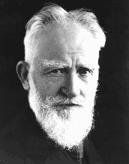 While
commenting upon Biblical Science, George Bernard Shaw
(1856-1950) the famous playwright, critic and essayist who was awarded the Nobel
Prize for literature in 1925, observes: While
commenting upon Biblical Science, George Bernard Shaw
(1856-1950) the famous playwright, critic and essayist who was awarded the Nobel
Prize for literature in 1925, observes:
“Bible
is hopelessly pre-evolutionary; its descriptions of the origin of life and
morals are obviously fairy tales; its astronomy is terracentric; its notions of
the starry universe are childish; its history is epical and legendary: in short,
people whose education in these departments is derived from the Bible are so
absurdly misinformed as to be unfit for public employment, parental
responsibility, or the franchise.”
(source:
voice
of dharma).
***
Over seventy years
ago, Mahatma Gandhi stated that: “proselytizing
under the cloak of humanitarian work is unhealthy, to say the least. It is most
resented by people here."
(source:
Gandhi,
Mohandas K: In Young India, April 23, 1931).
Refer
to Why
this war on Hinduism?
- By
George
Thundiparambil.
Refer
to Who
Killed Our Culture? We Did
- By Youki
Kudoh
- time.com
May 3 1999. Refer to of Crimes
of Christianity
- By G
W Foote and J M Wheeler Progressive Publishing Co. London. 1887. Refer
to The
Swami Devananda Saraswati Interview with Rajeev Srinivasan -
christianaggression.org. For
Cruelty inflicted by Christianity - Watch Constantine's
Sword movie
"Evangelism
is an irrational impulse, a form of tyranny over the mind. " - Dr.
Babu Suseelan.
 If
Pakistan and Bangladesh are focused to Islamize India, missionaries are
determined to Christianize India. If
Pakistan and Bangladesh are focused to Islamize India, missionaries are
determined to Christianize India.
While addressing Bishops and priests in New
Delhi on 7th November, 1999 (which happened to be Diwali, an important Hindu
festival), Pope
John Paul
II gave a call to convert Asia to Christianity as follows:
"Just as the first millennium saw the Cross firmly
planted in the soil of Europe, and the second in that of America and Africa, so
may the Third Christian Millennium witness a great harvest of faith on this vast
and vital continent."
Hindus and India are favourite targets for this harvest of faith. Missionaries
have already conquered North-East India. Every where else in India, missionaries
and their Non Government Organizations (N.G.O.s) having large funds at their
disposal are aggressively busy converting poorer Hindus to Christianity under
pretence of charitable social service. Reinhard Bonnke, the global evangelist
famous for his crusades in Africa, is reported to have stated that during 20
years of his activity in Africa, Christian population rose from 2 percent to 40
percent, and now India tops his conversion agenda.
With each passing day, India is becoming more Islamic
and more Christian; and less Hindu.
The only solution
Though for several centuries, Hindus fought the invaders bravely to defend their
faith and motherland, Macaulay's education has made Hindus ignorant of their
religion, heritage and history; and indifferent to attacks on Hinduism. Hindus
have to re-invent themselves, become pro-active, and tackle this attack at
political, social and religious levels.
Genuine
secularism ?
Though a sublime concept, 'secularism' has been wrongly
equated with anti-Hinduism in India. Since in the name of secularism, sectarian
and anti-Hindu agenda is being followed, Hindus and their
organizations have to assert themselves and force the government to act as
follows.
Article 30 of the Indian Constitution giving
special privileges to minorities regarding educational institutions is
fragmenting Hindu society since various Hindu sects claim non-Hindu status to
get benefit of Article 30. Vide the Supreme Court's judgement reported as
Bramchari Sidheswar Shai & Others versus State of West Bengal (AIR 1995
Supreme Court 2089), even Ramakrishna Mission,
a leading Hindu organization, unsuccessfully claimed a minority (non-Hindu)
status to fall under Article 30. Justice demands that fundamental right under
Article 30 must be extended to every community, whether majority or minority.
Government control over Hindu temples is another aberration. Since secularism
implies separation of State and religion, government control over Hindu temples
is anti-secular, and deprives temples of their income. Besides, it is
discriminatory since only Hindu places of worship have been brought under
government control.
Why conversions?
 Any
attempt at conversion from one religion to another by fraud, inducement or
coercion is horrible, and must be defeated. Any
attempt at conversion from one religion to another by fraud, inducement or
coercion is horrible, and must be defeated.
Apart from helping needy sections of society, Hindus and their organizations
have to confront and thwart those who are bent upon converting Hindus to
Christianity by deception, enticement or force. Inflow of foreign funds meant
for subversion and conversion has to be barred. Conversion by fraud, allurement
or coercion must be banned. Besides thwarting questionable conversion, all
efforts to welcome the converts back to Hindu fold have to be made.
Hindu unity
And only a united Hindu society can tackle anti-Hindu
forces.
There is a misconception in some minds that Hindu scriptures sanction the caste
system. Vedas, the foundation of Hinduism, are all-embracing and stipulate a
casteless and classless society. Innumerable Mantras of Vedas emphasize
one-ness, universal brotherhood, harmony, happiness, affection and commonality
of entire humanity. All-embracing message of Vedas has to be practised and
propagated to foster unity in Hindu society.
Besides, there is an urgent need for a strong global
Hindu Forum covering all Hindu sects.
Four Vedas containing 20,416 verses, many Upanishads,
Ramayana with 24,000 stanzas, Mahabharata with 1,00,000 stanzas, and several
other holy books are the sources of Hinduism. Codification of Hinduism in one
book is indispensable to widen its reach. For this codification, appropriate
Vedic Mantras and Shlokas of Ramayana, Mahabharata (which contains Bhagvad Gita),
and Tirukkural etc. will provide basic material.
As per Mahabharata, Samvibhaga (sharing of wealth) is an important attribute of
Dharma. Many Vedic Mantras direct humans to share their wealth with others. Rig
Veda (1-15-8) stipulates, "Let us become God's instruments and
distribute fortune to the poor and needy." Similarly, Atharva
Veda (3-30-7) commands humans to share their comforts with others.
Apart from helping the needy, practice of Samvibhaga will unite Hindu society.
If affluent Hindus utilize one per cent of their income to help vulnerable
sections, expansionist religions will be unable to prey upon Hindu society.
Besides, every Hindu family has to devote time to defend Hinduism. As per Mahabharata,
Dharmo rakshiti rakshitaha (Dharma protects those who
protect Dharma).

Remember your history
Hindus need to remember valour of
Dahir, Lalitaditya, Bappa Rawal, Raja Bhoja, Jayapala, Vidyadhar Chandel,
Bhimadeva, Govindachandra, Prithiviraj Chauhan, Lakshman Sen, Pratap Rudra,
Hakka (Harihara), Bukka (Bukkaraya), Kota Rani, Rana Pratap, Chhatrapati Shiva
Ji, Hari Singh Nalwa and many others who defended their faith and
every inch of motherland.
Today,
Hindus in India can fight and defeat the invaders. But tomorrow it will be too
late, and Hindus will be crushed in India as they have been crushed in
Afghanistan, Pakistan and Bangladesh which too used to be Hindu lands. Unless
Hindus confront their tormentors, and take the above-mentioned measures
immediately, Hinduism, also known as eternal religion (Sanatan Dharma) will
vanish from this earth just in a few decades. Any further delay or reluctance in
fighting the attack will hasten disappearance of Hinduism from the world.
(source: Can
Hinduism survive such an onslaught? - By J. G. Arora
- Author is the former Chief Commissioner of Income Tax).
Refer
to VINDICATED BY TIME: The Niyogi Committee Report On
Christian Missionary Activities -
Christianity
Missionary Activities Enquiry Committee 1956
and
Catholic
Priests Molest Third World Nuns to Avoid AIDS
and The
Sunshine of Secularism. Refer to Christianity
Dying In The West?
- By M S N Menon - organiser.org and
The
Burningcross
Refer
to Can
Hinduism face the onslaught of Project Thessalonica?
-
By Alex Pomero and Christians
have Destroyed Various Ethnic Cultures of the World -
christianaggression.org.
Why this war
on Hinduism?-
These
two (Christianity and Islam) hostile ideologies, flawed because they are not
based on human experience but on spurious and fantastic literature, are based on
a priori illusion that human beings are genetically flawed and can be redeemed
only by symbolic conversion and the acceptance of their bookish deity. For
instance, if the Christian and Islamic clergy do not propagate and force their
sterile ideologies down the throats of unsuspecting or helpless people through
dubious means, or do not force them to stay on with censure and punishment,
their religions would be wiped out in decades. Europe is a primary example.
(source:
Why
this war on Hinduism? - By
George Thundiparambil
- christianaggression.org). Refer to From
De Nobili to Clooney: The Christian Methods of Inculturation
and
Missionary's
Dark Legacy
and Dutch
Christians Target Hindus for Conversion. Refer
to Who
Killed Our Culture? We Did
- By Youki
Kudoh
- time.com
May 3 1999. Refer
to
Christian
Supremacy: Pushing the Dhimmitude of Non-Christians in America. Refer
to The
Swami Devananda Saraswati Interview with Rajeev Srinivasan -
christianaggression.org.
Top of Page
Kali Yuga - The Cosmology of Decay
According
to to Vedic scriptures, we are now living in the Kaliyuga, the age of Kali. We
are given to using the term Kaliyuga quite freely and frequently, not quite
knowing its import or significance.
In the Cosmic
timetable, Kaliyuga is the
last of the four yugas (ages) - Satya yuga, Treta yuga, Dwaparyuga and Kali yuga -
called chaturyuga. The duration of Kaliyuga is said to be 432,000 years; of
Dvaparayuga 864,000 years; of Tretayuga 1,296,000 and of Satyayuga 17,280,000
years.

Life
of Brahma: The four Yugas.
(For
more refer to chapter on Greater
India: Suvarnabhumi and
Sacred Angkor).
***
Kali
Yuga
is so called because it is dominated by Kali, the embodiment of evil.
According to Hindu scripture, Kali Yuga began at the end of
Krishna's bodily lifespan (approximately 5100 years ago, 3102 BC and will last
exactly 432,000 years — placing its conclusion in the year AD 428899. Kali
Yuga began at the midnight beginning of 18 February 3102 BC. according to the
Surya Siddhanta, which is an astronomical treatise that forms the basis of all
Hindu and Buddhist calendars.Kali Yuga is the last of four Yuga; upon its
conclusion, the world will 'reboot’ into a new Satya Yuga (Golden Age.) This
involves the end of the worldas we know it and the return of Earth to a state of
paradise
Kali Yuga began at the midnight beginning of 18 February 3102 BC. according to
the Surya Siddhanta, which is an astronomical treatise that forms the basis of
all Hindu and Buddhist calendars. Kalki the 10th and final avatar of Vishnu, is expected to
appear at this time, riding a white horse and wielding a flaming sword with
which to strike down the wicked.

Kalki the 10th and
final avatar of Vishnu, is expected to appear at this time, riding a white horse
and wielding a flaming sword with which to strike down the wicked.
***
The Srimad-Bhagavatam (12.2.19-20)
describes Lord Kalki's activities as follows: "Lord Kalki, the Lord of the
universe, will mount His swift white horse Devadatta and, sword in hand, travel
over the earth exhibiting His eight mystic opulences and eight special qualities
of Godhead. Displaying His unequaled effulgence and riding with great speed, He
will kill by the millions those thieves who have dared dress as kings."
We should make note here that, as the Vedic
literature explains, when the Supreme kills anyone, that person is immediately
spiritually purified by His touch and because the person is focused on the
Supreme Being while leaving his body. Thus, that person attains the same
destination as those yogis who spend years steadying the mind in order
to meditate and leave their bodies while focused on the Supreme. So being killed
by the Supreme is a great advantage for those of a demoniac mentality who would
otherwise enter lower realms of existence or even the hellish planets in their
next lives.
The Return of the Golden Age
Herein
we can understand that Lord Kalki will simply chastise by killing all of the
evil kings and rogues and thereby bring in a new era of enlightened beings, a
race whose minds will be as clear as crystal. They will produce offspring that
will follow the tendencies of real human beings as found in the age of
Satya-yuga.
(source:
The Vedic Universe: Hinduism
- alien-ufos.com/forum and Notes
on the End of a World - By Rene Guenon). Also refer to Kalki
and The
concept of Age).
Top of Page
The Puranas: Down to Earth?
Alone in the Universe?
 The
Vedas consider Earth as just one station for the train of life – one stop in a
universe teeming with life forms and intelligent species. The
Vedas consider Earth as just one station for the train of life – one stop in a
universe teeming with life forms and intelligent species.
The Vedic
literature known as the Puranas
particularly intrigues forward-thinking readers. The Puranic challenges leads
straight to the heart of the cosmic mystery. Besides realizing that we are not
alone in the universe, we also become acquainted with our duties and
responsibilities as citizens of a universe packed with diversity. Earthy
problems of gender and ethnicity seem
quite infantile when compared to Puranic concerns of interplanetary and
interspecies relationships.
Sadly, for so long, Western
small-mindedness has banished the Puranas to the Siberia of preposterous myths.
According to prevailing minds of
modernity the zenith of either God’s creation in six days or Darwinian
evolution over millions of years, humans on earth were the sole recipients of
intelligence in the universe. Therefore, with an erudite knee-jerk
reaction, most scholars politely overlooked on vehemently rejected any
references by the ancients that might indicate nonhuman intelligence on other
planets.
Outside of the academic establishment, non-mainstream
thinkers and researchers ache to know who are the extraterrestrials?
Here, is a summary of Vedic extraterrestrial themes,
especially as presented in the Puranas:
- Intelligent
life abounds on other planets, many of which have civilizations far more
advanced than anything Earth ever had.
- The
sun is indeed the center of the universe – amid many planets that cannot
be detected by human eyes or instruments.
- Interplanetary
communication and traveling is as routine as calling from a street payphone
or cycling to a neighborhood shop. Previous civilizations on Earth were in
constant contact with other planets.
- Countless
universes exist, like bubbles in sea foam. They vary in size and are walled
off from one another by immense layers of gross and subtle matter.

Intelligent
life abounds on other planets, many of which have civilizations far more
advanced than anything Earth ever had. Countless
universes exist, like bubbles in sea foam.
***
Roswell,
New Mexico, in 1947, is a festering sore of government mistrust.
It also currently reigns as the world’s most famous UFO event. The French
report dares to chastise the USA for an “impressive repressive arsenal” on
the UFO issue, and it acknowledges the
successful American policy of disinformation.
 Premier
science writer Paul
Davies, a theoretical physicist, predicts, that if
Intelligent life is found on other planets: Premier
science writer Paul
Davies, a theoretical physicist, predicts, that if
Intelligent life is found on other planets:
“Almost certainly Christianity
would not survive the discovery of advanced alien beings.”
Often traditional Christianity have recoiled at the
possibility of non-earthly civilizations. Perhaps more than other religions. Christianity,
as conventionally known, runs smack into severe doctrinal difficulties. Jesus
Christ is accepted as the exclusive Redeemer of only Earth-domiciled humans.
If life equally as intelligent or more exists elsewhere, how does it fit into
the New testament plan for salvation? A special new millennium edition of the Wall
Street Journal neatly summarized the problem:
“The Christian creed that God so loved the world he gave it
his only son simply assumes that this world alone received God’s main
attention. But what if a culture on a different planet harbors a similar belief
– or doesn’t?
"Of all the world's major religions,
Christianity is the most species-specific. Jesus Christ was humanity's savior
and redeemer. He did not die for the dolphins or the gorillas, and certainly not
for the proverbial little green men.
But what of deeply spiritual aliens? Are they not
to be saved? Can we contemplate a universe that contains perhaps a trillion
worlds of saintly beings, but in which the only beings eligible for salvation
inhabit a planet where murder, rape, and other evils remain rife?"
After
all, in the Christian view of the world,
Jesus was God's only
son. Would God have
the same person born, killed, and resurrected in endless succession on planet
after planet?
This scenario was lampooned as long ago as 1794, by Thomas
Paine. "The Son of God," he wrote in The
Age of Reason, "and
sometimes God himself, would have nothing else to do than to travel from world
to world, in an endless succession of death, with scarcely a momentary interval
of life." Paine went on to argue that Christianity
was simply incompatible with the
existence of extraterrestrial beings, writing, "He who thinks he
believes in both has thought but little of either."
Catholics tend to regard
the idea of multiple incarnations as verging on heresy,
not because of its somewhat comic aspect but because it would seem to automate
an act that is supposed to be God's singular gift. "God
chose a very specific way to redeem human beings," writes George Coyne, a Jesuit priest and the
director of the Vatican Observatory, whose own research includes astrobiology. "He sent his only son, Jesus, to them, and
Jesus gave up his life so that human beings would be saved from their sin. Did
God do this for extraterrestrials? ... The theological implications about God
are getting ever more serious."
Ernan
McMullin, a professor emeritus of philosophy at
Notre Dame
University
, affirms that the central difficulty stems from Christianity's
roots in a pre-scientific cosmology.
"It was easier to accept the idea of God's becoming man," he has
written, "when humans and their abode both held a unique place in the
universe."
(source: E.T.
and God
- By Paul Davies - the atlantic.com).
 One
of the most powerful leaders of America’s
Fundamentalist Protestants sounded a
more ominous note. One
of the most powerful leaders of America’s
Fundamentalist Protestants sounded a
more ominous note.
On a national broadcast, Pat
Robertson (the
founder and chairman of the Christian
Coalition -- a group dedicated to becoming the most powerful
political force in America)
advocated that, according to God’s
instructions in the old Testament, UFO enthusiasts should be stoned. Denouncing
extraterrestrialism, the televangelist charged, “It’s a clear violation of
God’s word.”
(source: Searching
for Vedic India – By Devamrita Swami p. 497 -
508). For more refer to Pat
Robertson wants stoning for UFO seekers - greatdreams.com).
Refer
to Bible
thumpers: Americans
are being increasingly stereotyped as stupid - By Arvind Kumar -
indiareacts.com).
Quotes
from The American Taliban and Christian
Fundamentalists to Push Bible as Classroom "Knowledge" and
Bush,
the Neocons and Evangelical Christian Fiction: America "Left Behind"
- By Hugh Urban and The
Christian Right, Dominionism, and Theocracy
- publiceye.org. The
Crusaders:
Christian evangelicals are plotting to remake America in their own image
- By Bob Moser - rollingstone.com and Dominionist.
Refer
to The
Republican War on Science - By Chris Mooney.
(Note:
Refer to A
conflict between science and God - By Martin Kettle - Crusade against
science in Modern America - Three-quarters
of Americans, in other words, still do not accept what Darwin established 150
years ago. Just under half of all Americans believe the natural world was
created in its present form by God in six days as described in Genesis. They
believe, incredibly, that the earth is only a few thousand years old).
Top of Page
Airlangga,
Hindu Prince of Java
Airlangga (also spelled Erlangga) lived in East Java from 1001
to 1049 and is regarded as a
national hero of Indonesia
because he
wrested control of his homeland from Sumatran overlords. His
23-year reign as king launched an economic, literary and artistic renaissance
in Java and Bali.
During his reign, a court poet named Mpu Kanwa composed the
Javanese epic "Arjunavivaha," as an allegory of
Airlangga's life. The story takes place on the day the prince,
called Arjuna, goes to war. As he faces his enemies, he realizes
they are his own family. Grief overwhelms him, and he doesn't know
what to do. So he seeks divine knowledge. Then Krishna reveals
himself as a vision of transcendental light.

God Vishnu seated on his
bird-vehicle, Garuda.
***
Airlangga was buried at a place called Belahan, an ancient
brick bathing place surrounded by temples on Mt Penanggungan.
Carved in red tufa stone against the back wall of the bathing tank
is one of east Java's greatest icons,
God Vishnu
seated on his
bird-vehicle, Garuda.
Historians believe this image represents the
ascended King Airlangga.
Airlangga
is known to have been a keen patron of the arts, notably
literature. In around 1035, the court poet Mpu Kanwa produced the Arjuna
Wiwaha,
which has to this day remained one of Java's most popular
classical stories. Adapted from the Indian
Mahabharata
epic,
the poem recounts episodes in the life of the hero sage Arjuna,
who was an incarnation of the Hindu god Vishnu. There are reasons
to believe that the poem was a portrait of the life of Airlangga
himself. He, like Arjuna, was seen as a divine incarnation,
apparently laid to rest at Candi Belahan, where he was portrayed
in stone as Vishnu on Garuda.

Airlangga,
Hindu Prince of Java, as Vishnu on Garuda.
His
23-year reign as king launched an economic, literary and artistic
rennaissance in Java and Bali.
(For
more refer to chapter on Greater
India: Suvarnabhumi and
Sacred Angkor).
***
Towards the end of his life, Airlangga was faced with the problem
of succession. The rightful heir, the princess Sanggramawijaya,
refused the throne, preferring to live her life as a hermit. She
is traditionally associated with the legend of Dewi Kilisuci and
the cave of Selomangleng at Kediri.
Airlangga's realm was, as a result, eventually divided between two
of his sons, giving rise to the separate kingdoms of Janggala and
Kediri. It was Kediri, however, which was to become the dominant
power until the rise of Singosari in the early 13th century.
An
Excerpt from "Arjunavivaha"
Then Arjuna saw the entire universe, infinitely divided, and
yet one all-embracing mind. Frightened and overcome with awe,
Arjuna bowed his head and prayed.
"Lord Krishna…I see beings without number inside your
shining form. You have no beginning, nor middle, nor end. You
shimmer with brilliant, glowing crowns. I cannot see through the
blazing fire of your sunlight."
Airlangga is remembered in today's Indonesia as a model of
religious tolerance. He spent his early years living in the
forests as an ascetic.
(source: Airlangga
- eastjava.com and Airlangga,
Prince of Java).
Top of Page
Western Media’s
Negative Vision of India – By Francois Gautier
Kumbh Mela a Freak Fair?
 Western journalism, when it is
applied to India, harps on the anecdotal, the superfluous, the derogatory,
deforms everything and transforms what is beautiful and noble into a show of
freaks.. Western journalism, when it is
applied to India, harps on the anecdotal, the superfluous, the derogatory,
deforms everything and transforms what is beautiful and noble into a show of
freaks..
The Kumbh
Mela which is taking place at the moment in Allahabad, demonstrates
once again to which extent Western journalism, when it is applied to India,
harps on the anecdotal, the superfluous, the derogatory, deforms everything and
transforms what is beautiful and noble into a show of freaks and fanatics. And
wasn't that the headline of The
Independent
of London "A freak fair? "
News agencies in Europe and
the US are only interested in the photos of Hollywood stars (Madonna, Demi
Moore, Richard Gere, Pierce Brosnan, etc) who are going to descend on the Kumbh
Mela, even if they will be totally lost amongst the millions of (real) devotees.
Isn't it strange that at the
time of globalisation and standardisation of the whole world, at a time when the
civilisation of Coca-Cola And MTV reigns supreme from Rio de Janeiro to Manilla,
from Paris to Shanghai, at a time when man's collective
consciousness is universally lowered to an idiotic level by American television
soaps -- Bold and
Beautiful or
or
Friends -- nobody in the West finds it extraordinary
that 80 million souls converge by plane, by car, on horseback, on foot towards a
place which they consider sacred, to pray to That which is beyond us, to this
immanent Force towards which men have aspired to since millenniums?

Nobody in the West finds it extraordinary
that 80 million souls converge by plane, by car, on horseback, on foot towards a
place which they consider sacred, to pray to That which is beyond us, to this
immanent Force towards which men have aspired to since millenniums?
***

Always
these images which denigrate India, always this colonial superior spirit which
perpetuates itself in the negative vision which Western journalists have of the
Indian subcontinent.
O sadness, O despair that at
the beginning of this third millennium, the West
remains obsessed by the caste system, or the rise of Indian 'nationalism'
(which does not exist) and does not realize the extraordinary miracle that is
India, which not only is becoming a great power in Asia, but maybe holds within
herself the key to French writer André Malraux's
famous (and accurate) prediction: 'the 21st century will be spiritual or will
not be.'
(source:
Western
Media’s Negative vision of India – By Francois Gautier - rediff.com).
For
more on
Francois Gautier refer to chapter on Quotes
and visit his website - Francois
Gautier).
Refer
to A
conflict between science and God - By Martin Kettle - Crusade against
science in Modern America - Three-quarters
of Americans, in other words, still do not accept what Darwin established 150
years ago. Just under half of all Americans believe the natural world was
created in its present form by God in six days as described in Genesis. They
believe, incredibly, that the earth is only a few thousand years old).
Refer
to Can
Hinduism face the onslaught of Project Thessalonica?
-
By Alex Pomero and Refer
to Bible
thumpers: Americans
are being increasingly stereotyped as stupid - By Arvind Kumar -
indiareacts.com).
Also refer to Dinosaurs,
evangelicals and the state - By Justin Webb - BBC). Refer
to of Crimes
of Christianity
- By G
W Foote and J M Wheeler Progressive Publishing Co. London. 1887. and
The
Burningcross
Top of Page
Hindu Revival in Indonesia
Ibn
Warraq: "Yes, many of these Muslims who
converted back to Hinduism, of course, were originally
Hindus. So they were sort of going back, as it were,
to their ancestral faith."
***
Hindu empires had
flourished in Java for a millennium until they were replaced by
expanding Islamic polities in the 15th century, setting the
stage for Indonesia becoming the world's largest Muslim nation. . Earlier indigenous
Javanese and Hindu traditions were retained by the rural
population and even within the immediate sphere of the royal
courts, especially in a context of ritual practice. In this
sense, the victory of Islam has remained incomplete until today.

Goddess Durga.
The majority of
Balinese consider themselves descendants of noble warriors from
the Hindu Javanese empire Majapahit who conquered Bali in the
14th century.
(For
more refer to chapter on Greater
India: Suvarnabhumi and
Sacred Angkor).
***
In the 1970s, however, a new Hindu revival movement began
to sweep across the archipelago. Hinduism is gaining even
greater popularity at this time of national crisis, most notably
in Java, the political heart of Indonesia.
The majority of
Balinese consider themselves descendants of noble warriors from
the Hindu Javanese empire Majapahit who conquered Bali in the
14th century. A growing number of Balinese are conducting
pilgrimages to Hindu temples in Java, most of which have been
built in places identified as sacred sites in traditional
Balinese texts (often written in Old-Javanese language).
Balinese have been heavily involved in the construction and
ritual maintenance of these new Hindu temples in Java. They
further dominate organizations representing Hinduism at a
national level. Finally, many Javanese Hindu priests have been
trained in Bali.
Most thought-provoking, perhaps, were the emotional accounts of
events since 1965 leading up to a resurgence of Hinduism, and
the constant references to the famous Javanese prophesies of Sabdapalon
and Jayabaya.
A glance at one of the many ancient monuments scattered across
its landscape would suffice to remind one of a very different
Java, where a succession of smaller and larger Hindu kingdoms
flourished for more than a millennium, producing a unique and
dynamic mixture of Indic and indigenous Austronesian culture. At
the peak of its influence in the 14th century the last and
largest among Hindu Javanese empires, Majapahit, reached far
across the Indonesian archipelago. This accomplishment is
interpreted in modern nationalist discourses as an early
historical beacon of Indonesian unity and nationhood, a nation
with Java still at its center.

The
Hindu Epic of Ramayana in Java.
To a large and growing number of equally 'modern' Javanese,
however, their ancient Hindu past is still very present indeed,
and prophesied to come alive once more in the near future.
(For
more refer to chapter on Greater
India: Suvarnabhumi and
Sacred Angkor).
***
To a large and growing number of equally 'modern' Javanese,
however, their ancient Hindu past is still very present indeed,
and prophesied to come alive once more in the near future. A
utopian Hindu revival movement has emerged in Java over the last
three decades of the twentieth century, and is gathering
momentum in the turmoil of Indonesia's continuing economic and
political crisis. Drawing on ancient prophesies, many of its
members believe that a great natural cataclysm or final battle
is at hand in which Islam will be swept from the island to
conclude the current age of darkness. Thereafter, they say,
Hindu civilization will be restored to its former glory - with
Java as the political center of a new world order that will last
for a thousand years.
In terms of their political affiliation, many contemporary
Javanists and recent converts to Hinduism had been members of
the old PNI, and have now joined the new nationalist party of
Megawati Sukarnoputri. Informants from among this group
portrayed their return to the 'religion of Majapahit' (Hinduism)
as a matter of nationalist pride, and displayed a new sense
political self-confidence.
A common feature among
new Hindu communities in Java is that they tend to rally around
recently built temples (pura) or around archaeological temple
sites (chandi) which are being reclaimed as places of Hindu
worship. One of several new Hindu temples in eastern Java is
Pura Mandaragiri Sumeru Agung, located on the slope of Mt Sumeru,
Java's highest mountain. A common feature among new Hindu
communities in Java is that they tend to rally around recently
built temples (pura) or around archaeological temple sites (chandi)
which are being reclaimed as places of Hindu worship. One of
several new Hindu temples in eastern Java is Pura Mandaragiri
Sumeru Agung, located on the slope of Mt Sumeru, Java's highest
mountain. Pondering with some envy on the secret to the economic
success of their Balinese neighbors, several local informants
concluded that "Hindu culture may be more conducive to the
development of an international tourism industry than is
Islam".
(source: Hindu Revival in Indonesia -
By Dr Thomas Reuter is Queen
Elizabeth II Research Fellow at the University of Melbourne's
School of Anthropology, Geography & Environmental Studies.
This paper was published in The Australian Journal of Anthropology
and is being reproduced with their permission.).
***
The
prophecies of Sabdapalon and Sri Mapanji Jayabaya
Sabdapalon
was a priest and adviser to Brawijaya V, the last ruler of the Hindu
empire Majapahit in Java. He is also said to have cursed his king
upon the conversion of the latter to Islam in 1478. Sabdapalon
then promised to return, after 500 years and at a time of
widespread political corruption and natural disasters, to sweep
Islam from the island and restore Hindu-Javanese religion and
civilization. Some of the first new Hindu temples built in Java
were indeed completed around 1978, for example Pura Blambangan in
the regency of Banyuwangi. As the prophesies foretold, Mt
Sumeru erupted around the same time. All this is taken as
evidence of the accuracy of Sabdapalon's predictions.
Together
with the prophecy of Sabdapalon
to return, after 500 years and at a time of widespread political
corruption and natural disasters (in 1978), to sweep Islam from
the island and restore Hindu-Javanese religion and civilization,
Jayabaya's prophecy has given much heart to the Indonesian Hindu
communities.

Chandi
Mendut, Java, Indonesia bas relief: Kuvera, on the north wall of
an antechamber. Kuvera is the God of Wealth, the merchants' deity
and has sacks of gold under his feet and wish granting trees
besides him.
(For
more refer to chapter on Greater
India: Suvarnabhumi and
Sacred Angkor).
***
Sri Mapanji
Jayabaya reigned
over the kingdom of Kediri in East Java
from 1135 to 1157 AD. He reunified Java after a split that
occurred with the death of his predecessor Airlangga.
He is also remembered for his just and prosperous rule, and
reputed to have been an incarnation of the Hindu
deity Vishnu.
He is the archetypal 'just king' (ratu adil) who is reborn during
the dark age of reversal (jaman edan) at the end of each cosmic
cycle to restore social justice, order, and harmony in the world.
When Japan took Java, in the
first weeks of 1942, Indonesians danced in the streets, welcoming
the Japanese army as the fulfillment of a prophecy made by King
Jayabaya, who foretold the day when white men would one day
establish their rule on Java and tyrannize the people for many
years – but they would be driven out by the arrival of yellow
men from the north. These yellow men, Jayabaya predicted, would
remain for one crop cycle, and after that Java would be freed from
foreign domination. To most of the Javanese, Japan was a
liberator: the prophecy had been fulfilled. The Japanese not only
freed Indonesian nationalists from Dutch dungeons, but hired them
on as civil servants and administrators. In the waning days of
1944, however, it was clear that Japan could not win the war. The
Japanese officially granted Indonesia its independence on August
9, 1945, and the commander of Japan's southeast Asian forces
appointed future President Sukarno
as chairman of the preparatory committee for Indonesian
independence. As one account of Indonesian history puts it,
"With the minor exception that three crops had been
harvested, Jayabaya's prophecy had been realized."
(source:
http://en.wikipedia.org/wiki/Sabdapalon
and http://en.wikipedia.org/wiki/Jayabaya).
Followers and
opponents alike explain the sudden rise of a Hindu revival
movement in Java by referring to the well-known prophecies of
Sabdapalon and Jayabaya. Sabdapalon is said to have been a priest
and an adviser to Brawijaya V, the last ruler of the Hindu empire
Majapahit. He is also said to have cursed his king upon the
conversion of the latter to Islam in 1478. Sabdapalon then
promised to return, after 500 years and at a time of widespread
political corruption and natural disasters, to sweep Islam from
the island and restore Hindu-Javanese religion and civilization.
Some of the first new Hindu temples built in Java were indeed
completed around 1978, for example Pura Blambangan in the regency
of Banyuwangi. As the prophesies foretold, Mt Sumeru erupted
around the same time. All this is taken as evidence of the
accuracy of Sabdapalon's predictions.
A further prophesy,
well-known throughout Java and Indonesia, is the Ramalan (or
Jangka) Jayabaya. The predictions of Jayabaya are also discussed
frequently in daily newspapers. These ancient prophesies, indeed,
are very much a part of a current public debate on the ideal shape
of a new and genuinely democratic Indonesia.The historical
personage Sri Mapanji Jayabaya reigned over the kingdom of Kediri
in East Java from 1135 to 1157 AD (Buchari 1968:19). He is known
for his efforts to reunify Java after a split had occurred with
the death of his predecessor Airlangga,
for his just and prosperous rule, and for his dedication to the
welfare of the common people. Reputed to have been an incarnation
of the Hindu deity Vishnu, Jayabaya is also the archetypal image
of the 'just king' (ratu adil) who is reborn during the dark age
of reversal (jaman edan) at the end of each cosmic cycle to
restore social justice, order, and harmony in the world. Many
believe that the time for the arrival of a new ratu adil is near
(as the prophesies put it, "when iron wagons drive without
horses and ships sail through the sky [i.e. cars and
airplanes]"), and that he will come to rescue and reunite
Indonesia after an acute crisis, ushering in the dawn of a new
golden age.
Hindu
Javanese emphasize with pride that their ancestors Sabdapalon and
Jayabaya represent a golden pre-Islamic age.
(source:
Hindu Revival in Indonesia
- By Dr Thomas Reuter is Queen Elizabeth II Research Fellow at the
University of Melbourne's School of Anthropology, Geography &
Environmental Studies. This paper was published in The Australian
Journal of Anthropology and is being reproduced with their
permission.
source: 'Great
expectations: Hindu revival movements in Java' - By
Thomas A Reuter 2001 The Australian Journal of
Anthropology 12(3): 327-338 and The
Religion Report).
Top of Page
Endless
Demonizing of Hinduism in Western Press and Academia
Three Cs stereotypes - Cow, Caste and Curry - Hurting the Hindu psyche?
Debunking
someone else’s faith legitimizes one’s own ?
Caste
system, untouchables, cow worship, sati, dowry deaths, widows,
brahmanical, communal violence are
constantly in the news in the West.
It is ironic that when
Western academia write about Hindu traditions, it is termed
freedom of expression however hurtful it is. When Hindus protest
the hurt, it is then termed as the rise of Hindu extremism and
fundamentalism.

Just
about every scourge under the sun blamed on Hinduism. The
motives behind much "human rights" is to perpetuate what
has been called "white privileges".
US
Schools
of Divinity have ulterior motives in offering degrading
interpretations of non-Abrahamic faiths. They have no interest
what so ever in teaching any student the virtues of India or its
predominant Hindu civilization...
***
Just
about every scourge under the sun blamed on Hinduism. The
motives behind much "Human rights" is to perpetuate what
has been called "White privileges". Even when
someone criticizes sati/dowry, the goal frequently is not to
produce genuine benefit to others, but is a divisive strategy that
benefits the dominant culture. Their goal is to weaken the fabric
of Indian society through funding/championing internal cleavages,
so as to rule over the third world.
Most Americans
know
about India’s 3 Cs: Caste, Curry and Cows and the 3 Ps: Polytheism,
Poverty and Population!
Not
too long ago, there were many articles in the US and Indian media
about the denigration of Ganesha,
Ramakrishna Paramahams, Shivaji etc
by the sophomoric writings of Eurocentric American Professors
associated with US
Schools of Divinity.
Complaints about such
writings were lodged by both Indian scholars in India as well as
scholars from among the NRI communities here in the US and UK. But
the latter (critics) were often unfairly caricatured by a few
Judeo-Christian as well as Indian “intellectuals”
characterizing the critics as Hindu fundamentalists or ignoramuses
who are unfamiliar with our Bill of Rights, which guarantees
freedom of expression.
These
Schools of Divinity have ulterior
motives in offering degrading
interpretations of non-Abrahamic faiths. They have no interest
what so ever in teaching any student the virtues of India or its
predominant Hindu civilization, which has contributed, to the
evolution of Buddhism, Jainism and Sikhism. Hinduism’s core
value of pluralism and its tolerance of all faiths are seldom
highlighted, nor discussed.
They also may not have
heard from their teachers that India is the seventh most
industrialized country in the world, and that it contributed a
great deal to ancient mathematics, astronomy, bronze casting,
surgery, and vaccination, Yoga,
Ayurveda etc
(source:
Indian
Identity in American Schools
- By C Alex Alexander - sulkeha.com).
Refer to
Christian
Supremacy: Pushing the Dhimmitude of Non-Christians in America. Refer
to The
Swami Devananda Saraswati Interview with Rajeev Srinivasan -
christianaggression.org. and
The
Burningcross
***
There
is an aggressive push by Christian conservatives, particularly in
America, to convert the world. Part of that process is to demonize
all other religions and ideologies.
(Refer
to Arrogance
of Faith - By Forrrest
G Wood
and to
Bible
thumpers: Americans
are being increasingly stereotyped as stupid - By Arvind Kumar
- indiareacts.com).
Refer
to
Indian
Identity in American Schools
- By C Alex Alexander - sulkeha.com.
Refer to of
Crimes
of Christianity
- By G
W Foote and J M Wheeler Progressive Publishing Co. London. 1887.
Who
Killed Our Culture? Aping the West?
Lessons for Indians?
 A
Japanese actress mourns her country's obsession with American
values. A
Japanese actress mourns her country's obsession with American
values.
The
Americans, meanwhile, had Coca-Cola, chocolate, family life, music
and dance--all the pleasures we lacked. The goal of post-war Japan
was to catch up with America by every means available. The economy
took off; we ran up the ladder and became a first-class economic
power, pretending all the while not to see the huge hole in the
mind, the distrust of our own country.
Most of today's young
people grew up in the absence of some important values. They
aren't positive about being Japanese, nor about their own
identity. But
at the same time we have to hold on to our own culture. We have
become polluted by American culture, contaminated by materialism.
We don't love our country, don't respect it.
We
are negative about our culture: traditional things are seen as
old-fashioned, and everything new is good. Social order and moral
standards have disappeared. Some people are even obsessed with
denying their Japaneseness. Many girls dye their hair and tan
their skin. The streets and towns of Japan are made to look like
France or America. Our cities were destroyed and re-created to
resemble a foreign country. Traditional culture is not even
accessible to most of us; it is disappearing into oblivion. This
makes me very sad. We are copying everything about America just
because it is American.
(source:
Who
Killed Our Culture? We Did - By Youki Kudoh
- time.com
May 3 1999).
***
Hate Literature by Christian Evangelicals in India ?
 Bertrand
Russell (1872 - 1970) English logician and
philosopher, best known for his work in mathematical logic and for
his social and political campaigns, including his advocacy of both
pacifism and nuclear disarmament. He received the Nobel Prize for
Literature in 1950.He wrote in
1954, Bertrand
Russell (1872 - 1970) English logician and
philosopher, best known for his work in mathematical logic and for
his social and political campaigns, including his advocacy of both
pacifism and nuclear disarmament. He received the Nobel Prize for
Literature in 1950.He wrote in
1954,
"Christianity has been
distinguished from other religions by its greater readiness for
persecution. “The whole contention that Christianity has had an
elevating moral influence can only be maintained by wholesale
ignorance or falsification of the historical evidence.”
(source: Arrogance
of Faith - By Forrrest
G Wood
p.
26). Refer to of
Crimes
of Christianity
- By G
W Foote and J M Wheeler Progressive Publishing Co. London. 1887. Refer
to
Christian
Supremacy: Pushing the Dhimmitude of Non-Christians in America. Refer
to The
Swami Devananda Saraswati Interview with Rajeev Srinivasan -
christianaggression.org. and
The
Burningcross
***
The
magazine Indian Messenger (September 1998) calls the great
Kumbha
Mela, which attracts millions of Hindu devotees, a superstitious
deception. “The belief that the mud of sins in human souls can
be purified for ultimate liberation through Ganga, Yamuna and
Saraswati is superstitious. The Kumbha Mela represents this
superstitious deception,” it says. But strangely in a
superstitious tone and words it claims: “Liberation from sins
can be attained only by the unpolluted blood of Christ the
virtuous.” Note not only the superstitions but also the audacity
of the suggestion.
Shri Sai Baba, to these Christian fundamentalists, is a satanic
spirit and Mata Amritanandamayi a mentally retarded woman.
To
quote: “The miracles said to have been performed by Sai Baba is
mere magic. Satanic spirit dwells in him. Mata Amritanandamayi is
a mentally retarded woman. She is half mad and what she does is
stupidity”.
Again, the Haindava Suvishesheekaranam says: “No Hindu gods and
goddesses exists who have not surrendered to Christ. If Krishna,
Rama and Indra surrendered before Christ, what other evidence is
necessary to prove that he is the only true God” (p. 181-182).
This Christian fundamentalist propaganda literature often
describes Bharat as a “State of Devil”. Dr
K. P. Yohannan in
his book Anant Prakash mein Jeevan Vyatheeth Karain writes:
“Every time a Hindu is baptized and converted to Christianity,
there is a great disturbance in the State of Devil” (p. 114).
Hindu religious and community leaders have been termed as
“devils” and “satanic” powers by the same author.
Dr. Yohannan’s is not the solitary instance. In fact, he is one
of the many who project such views. Another statement in a book
named Samvaad: Kyon and Kaisai (Masibi Drishtikon Se) by Dr
Benzami Khan are equally inciting: “Moral values play a
negligible role in Hindu religion” (p. 98).
If these literatures are to be believed, then all the good things
and positive aspects of Hinduism have come from Christianity
because it is deeply influenced by the preaching of Christ-be it
the Bhakti movement or the stories of Krishna or even that of
Shiva! They claim abrasively that the stories of Krishna have been
taken from the story of Christ with minor changes! “In fact
Christ became Krishna in India,” says the book of Dr Benzamin
(p. 71).

***
Common Hindu traditions are always ridiculed. For example
application of bindi, tilak sindoor are jeered at as devil eye and
related to satanic spirits. “Even though tilak is considered a
symbol of Shiva by the Hindus, the use of these symbols is
dangerous and gives them an opportunity to come under the
influence of satanic spirit. Thus girls beware,” says the book
published by Masihi Sahitya Sanstha (see Hindi translation of.
Sex, Love and Marriage by Zac. Poonen, p. 102).
For obvious reasons, the missionaries have always been trying to
mislead people on the census data. But certain reports, which they
do for their internal consumption, are highly revealing and
equally disturbing. For example the Church Growth Centre reports
that by the end of the 20th century the Christian population will
increase 13 times as compared to that at the beginning of the
century. It further clarifies that the increase of the
non-Christian population would be only 4.6 times during the same
period. “In 1900 there were 60 non-Christians for one Christian
and by the end of the century there will be only 20 non-Christian
to every Christian. Christians’ estimated population in the year
2000 will be 50 million,” the report says.
According to the report entitled Trends and Issues in
Evangelisation in India by Augustine Kanjamala SVD, a CBCI
Secretary: “In the North-East, conversions among the tribals
continue. During the last 30 years the Catholic population has
increased nine fold to nine lakhs. In Arunachal Pradesh about
10,000 people join the Church per year, half of them into Catholic
Church. In West India more than 45,000 Bhils have joined the
Church (The Church In’ India: Its Missions
Tomorrow, p. 40).
The same report reveals: “Amri, Kerbi tribal people in Assam
have totally declared to become Christians for the prosperity of
the tribe.” According to it every day 4,000 new Christians are
added to the Church, and 35 new congregations are formed every
week. One can very well imagine the aggressive nature of the
“harvesting plan”.
In their “hate and insinuation” literature, even Sikhs are not
spared. A section of the Sikh community is often compared to
thieves and dacoits. (Page 180 of Uttar Bharat tatha Pakistan main
Masihi Dharma by Bishop Deendayal and published by Hindi
Theological Literature Committee, Jabalpur). To substantiate its
point the author refers to “historical instance” when Sikh
soldiers allegedly attacked the enemy from behind and indulged in
looting.
The missionary propaganda literature has throughout indulged in
spreading canards against the Hindu society. It also twists and
misrepresents the facts. For instance: “The old Hindu political,
economic and philosophical writings like Kautilya’s Artha Sastra
and Manu Samiti did not count the dalits and the tribes as human
being. The Vedas treated them as Chandals, Gita and Mahabharata
showed them as wild animals like monkeys and Rawanas.” This is
what you read in Bishop Nirmal Minz’s book
Rise Up, My People,
And Claim the Promise. He goes on to write: “In the past they
(tribes) have been treated as something less than human, according
to Hindu attitudes and understanding.”
Finally, if these propagandists are to be believed, the majority
of the Hindus are slaves, untouchables, Poor, looters, thieves and
nonbelievers. A book Confusion called Conversion by Sunder Raj is
entirely devoted to malign the Hindu people.
Now tell us who are
the haters of the other religionists?
(source:
Hate
Literature by Christian Evangelicals in India -
saag forum.com).
Refer to Quotes
from The American Taliban.
Refer
to VINDICATED BY TIME: The Niyogi Committee Report On
Christian Missionary Activities -
Christianity
Missionary Activities Enquiry Committee 1956
and
The
Sunshine of Secularism. Refer
to Can
Hinduism face the onslaught of Project Thessalonica?
-
By Alex Pomero and Christians
have Destroyed Various Ethnic Cultures of the World -
christianaggression.org.
Why
this war on Hinduism?-
These
two (Christianity and Islam) hostile ideologies, flawed because
they are not based on human experience but on spurious and
fantastic literature, are based on a priori illusion that human
beings are genetically flawed and can be redeemed only by symbolic
conversion and the acceptance of their bookish deity. For
instance, if the Christian and Islamic clergy do not propagate and
force their sterile ideologies down the throats of unsuspecting or
helpless people through dubious means, or do not force them to
stay on with censure and punishment, their religions would be
wiped out in decades. Europe is a primary example.
(source:
Why
this war on Hinduism? - By
George Thundiparambil
- christianaggression.org). Refer to From
De Nobili to Clooney: The Christian Methods of Inculturation
and
Missionary's
Dark Legacy
and Dutch
Christians Target Hindus for Conversion.
Also refer to Dinosaurs,
evangelicals and the state - By Justin Webb - BBC).
Refer to A
conflict between science and God - By Martin Kettle - Crusade
against science in Modern America - Three-quarters
of Americans, in other words, still do not accept what Darwin
established 150 years ago. Just under half of all Americans
believe the natural world was created in its present form by God
in six days as described in Genesis. They believe, incredibly,
that the earth is only a few thousand years old).
Refer
to The
Republican War on Science - By Chris Mooney
and The
Crusaders:
Christian
evangelicals are plotting to remake America in their own image
- By
Bob Moser - rollingstone.com and
Dominionist.
Refer
to Who
Killed Our Culture? We Did - By Youki
Kudoh
- time.com
May 3 1999. Refer to of Crimes
of Christianity
- By G
W Foote and J M Wheeler Progressive Publishing Co. London. 1887. and
The
Burningcross
Top of Page
Taste of Their Own Medicine ? Judaism threatens Church in Mizoram, Manipur
Nearly
111 years after its advent in Mizoram and Manipur, Christianity has now waken up
to the potent threat that the star of David posed to the Cross in the two
north-eastern states.The Christian theologians and researchers have of late launched a campaign to
counter the growing affinity of some Mizos and Kukis (a tribe of Manipur)
towards Judaism.
 The
synagogues in Aizawl and Imphal have a number of regulars since ages. But what
have alarmed the Christian scholars in the two states are recent media reports
from Jerusalem that a team of Rabbis from Israel would soon land in the region
to conduct mass conversions. The
synagogues in Aizawl and Imphal have a number of regulars since ages. But what
have alarmed the Christian scholars in the two states are recent media reports
from Jerusalem that a team of Rabbis from Israel would soon land in the region
to conduct mass conversions.
“Such mass conversion of people from Christianity to Judaism will destroy the
social fabric of both the tribes. It is the need of the hour that we launch a
social movement against any such move,” said P C Biaksiama of the Christian
Research Centre in Aizawl.
Although
almost all Mizos, who earlier practised indigenous faiths, embraced Christianity
by mid 1940s, some of them in early 1970s noticed that many of their traditional
customs and rituals matched with those of the Jews. This made them believe that
their ancestors had been Jews and lived in Israel.
“The
Church has never been convinced with what they (Bnei Menashes)
say. They have never been taken seriously. Theirs is a small
community, at least till now,” said Rev Colney of the Mizoram
Presbyterian Church Synod.
‘Religious invasion’
 But Dr Biaksiama said not only the Church, but also the Centre and
state government should now wake up to this “religious and
cultural invasion”, as the promise of a “better living
standards” in Israel may tempt many more to join the Bnei
Menashes. But Dr Biaksiama said not only the Church, but also the Centre and
state government should now wake up to this “religious and
cultural invasion”, as the promise of a “better living
standards” in Israel may tempt many more to join the Bnei
Menashes.
“The mass conversion by foreign priests
will pose a threat not only to social stability in the region, but
also to national security. A large number of people will forsake
loyalty to the Union of India, as they all will become eligible
for a foreign citizenship,” he said.
(source:
Taste
of Their Own Medicine: Judaism threatens Church in Mizoram,
Manipur - christianaggression.org). For more refer
to chapter on Conversion.
Refer
to Christianity
Dying In The West?
- By M S N Menon - organiser.org.
Top of Page
Ricky
Williams - From NFL to Ayurveda
 He's no
longer Ricky Williams the football player. He plans to become Ricky Williams the
holistic healer. It's been more than 10 months since Williams, one of the
premier running backs in the National Football League, last ran off tackle for
the Miami Dolphins and four months since he suddenly announced his retirement at
age 27. He's no
longer Ricky Williams the football player. He plans to become Ricky Williams the
holistic healer. It's been more than 10 months since Williams, one of the
premier running backs in the National Football League, last ran off tackle for
the Miami Dolphins and four months since he suddenly announced his retirement at
age 27.
Then he dropped from sight. But now Williams has
turned up about as far away from professional football as you can get, as
a student of the ancient Indian medical system known as Ayurveda.
In the Sierra foothills, no less. Williams is
now a month into a 17-month course at the California
College of Ayurveda (pronounced I-yur-vay-da) in Grass Valley, a city
of 12,000 in the Gold Country, about 45 miles northeast of Sacramento.
Harmonious pursuits
"Ayurveda deals with using your environment
to put yourself in balance,'' he said. "I've realized, both on a
psychological and physical level, that the things we do in football don't bring
more harmony to your life. They just bring more disharmony."
The 5-foot-10
Williams weighs 210 pounds, about 25 fewer than his playing weight. He looks
healthy and happy. As part of his Ayurveda studies, he said, "I try to give
foods and herbs attributes and find out which ones balance me out.''
(source: Ricky
Williams: From NFL to Ayurveda - SFGate.com and
Former
running back turns up at holistic medicine school
Top of Page
Ayurveda:
Ancient Medicine of India - by Jonathan Klemens
Dhanvantri
is also the name of several historical figures who are very important to the
development of Ayurveda.
Ayurveda,
claimed to be the oldest and most complete medical art, is the 7,000 year old
Indian art of healing and rejuvenation that is recently becoming widely
available and popular in the West. Texts dating back before the Christian
era attest to the skills of Ayurvedic practitioners in minor and major surgery
including cosmetic surgery, and the removal of gallbladders and tumors.
Due to the extreme complexities of this art, this chapter will present only an
introduction to the art. To fully appreciate the many facets of
this ancient healing art, one must consult a certified Ayurvedic practitioner.
Ayurveda is one of the most complete holistic types of medicine in the world
including everything from herbal therapy, diet, aromatherapy, therapeutic
emesis, blood letting, oil massage, steam baths, fasting, astrology, Yoga,
mudras (hand yoga), meditation, gem stone therapy, color therapy, and metal
therapy. Ayurveda is a holistic soundness of body (shrira), mind (manos) and
self (autman). In 1947, the newly independent Indian government
established national councils to oversee Ayurvedic training, practice, and
research. I will just discuss Ayurvedic herbal therapy, gem stone therapy
and color therapy since Yoga, meditation, mudras, aromatherapy and massage are
covered in other chapters. Ayurveda and Yoga are interconnected.
 The origin of Ayurveda is based on ancient Hindu texts (Vedas) compiled by
Rishis, or holy men. The word is derived from the Sanskrit words "ayur"
(life) and "veda" (knowledge). It includes natural therapies like
proper breathing, nutrition, meditation, and aromatherapy in a manner that
involves the interrelationship of the mind, body and spirit. Common
therapies include herbal, animal and mineral remedies, oil massages and steam
baths. The goal of Ayurveda medicine if the purification of body and mind
and the balancing of the body’s vital energies - to develop a personal
knowledge of life. The body’s vital energy is moved through the seven
major chakras, or energy centers (refer to the next chapter on Yoga for a more
detailed discussion of chakras). Disease occurs from uncorrected imbalances
brought about by stress, poor lifestyle choices, and poor diet. A recent
study in the "Journal of Social Behavior and Personality," said that
Ayurvedic purification, including body massage and an herbal enema, reduced free
radicals in the blood, increased energy, improved digestion, and reduced
symptoms of illness.
The origin of Ayurveda is based on ancient Hindu texts (Vedas) compiled by
Rishis, or holy men. The word is derived from the Sanskrit words "ayur"
(life) and "veda" (knowledge). It includes natural therapies like
proper breathing, nutrition, meditation, and aromatherapy in a manner that
involves the interrelationship of the mind, body and spirit. Common
therapies include herbal, animal and mineral remedies, oil massages and steam
baths. The goal of Ayurveda medicine if the purification of body and mind
and the balancing of the body’s vital energies - to develop a personal
knowledge of life. The body’s vital energy is moved through the seven
major chakras, or energy centers (refer to the next chapter on Yoga for a more
detailed discussion of chakras). Disease occurs from uncorrected imbalances
brought about by stress, poor lifestyle choices, and poor diet. A recent
study in the "Journal of Social Behavior and Personality," said that
Ayurvedic purification, including body massage and an herbal enema, reduced free
radicals in the blood, increased energy, improved digestion, and reduced
symptoms of illness.
This ancient art is based on the premise that everyone is born with a basic,
genetically determined constitution. Each constitutional type is an
expression of the five elements or basic qualities that exist in the universe.
Practitioners diagnose patients by observation, questions, touch and taking
pulses. The diagnosis is very detailed using the radial pulse, tongue,
face, lip, nails, and eyes. The information obtained is used to assign the
patient to one of three main constitutional types and then to various subtypes.
The determined classification dictates dietary modifications and selection of
remedies tailored to the patient’s specific constitution.
The identification, and subsequent treatment, of an individual’s unique
constitution is determined by their tridosha, which is composed of varying
amounts of the three doshas: vata, pitta and kapha. Vata is the biological
combination of ether and air - it involves the principle of bodily movement.
Pitta is fire and water - it governs digestion and metabolism. Kapha is
earth and water - the structural matter and lubrication of the body.
Everyone has a unique constitution, or “prakruti,” which is a special
combination of the three doshas.
(source:
Ayurveda:
Ancient Medicine of India
- by Jonathan Klemens -
naturalhealthweb.com).
Top of Page
The
Dieng Temples of Java, Indonesia
Chandi: The art of Indianized Java
The
religious structures in Java are commonly called Chandis, a term
which originally meant a commemorative building.
One particular term for a temple most often seen in Java is
called the chandi. It refers to a structure based on the Indian
type of single celled shrine, with a pyramidal tower above it, and
a portico. Later chandis may have additional external cells on the
three walls. A chandi served as a cult focus, housing a potent
icon or a group of icons. As in other countries, these were often
identified with particular royal persons. The chandi was, like the
temple-mountains of Cambodia, a representation of the cosmic Mount
Meru, an epitome of the universe. The names of Javanese chandis
bear are those of the Hindu epics heroes, such as Arjuna and
Bhima.
(source:
The
Art of Southeast Asia - By Philip
Rawson p 208).

Chandi Arjun and Chandi Sumar – Dieng plateau. 8th
to 9th century. These early temples follow the same
pattern of diminishing storeys as the early shrines in Cambodia
and Champa.
The
religious structures in Java are commonly called Chandis, a term
which originally meant a commemorative building.
(image
source: The
Art of Southeast Asia - By Philip
Rawson).
***
Indianization
of the Archipelago
A
highly sophisticated civilization emerged in Southeast Asia, whose
cosmology, literature, architecture and political organization
were all closely patterned on Indian models. These kingdoms are
best known for the wonderful architectural monuments which they
created: Prambanan, Borobudar, Angkor, Pagan and others. Java was
known by Indian chroniclers as early as 600 BC. It was known as
"Yavadvipa" India was to have a profound influence on
Java.
The great Indian poet Rabindranath
Tagore, visiting Java,
said: "I see India everywhere, but I do not recognize
it."

5th
century Inscription of a Hindu ruler of west Java, King
Purnavarman.
***
The eerie strangeness of
Dieng Plateau, its proximity to the heavens, may have been
among the reasons that men labored there to erect the series of
temples that still dominate the plateau. Built to honor
Shiva, and
probably constructed in the early decades of the 8th
century, the Dieng temples are remarkable for their simplicity and
their sparse ornament.
The main group of temples is named after the heroes and
heroines of the Mahabharata. Arjuna, Puntadewa, Srikhandi,
Subhadra,
Gatokacha and Bhima
stand in the centre of a flat field. A millennium ago the
marsh was drained by a complex series of tunnels; the remains can
still be seen on the northwest corner of the field, but they no
longer work.

Shiva
from Dieng plateau.
(image
source: The
Art of Southeast Asia - By Philip
Rawson).
***
Chandi Gedung Songo – is dedicated to Siva. This
temple was built around the same time as the one on the Dieng
Plateau in the early 8th century.
Candi Sukuh – Built in the middle of the
twilight years of the glorious Majapahit dynasty, it strikes a
disquieting alien chord with its flat topped Egyptian step pyramid
and its Mayan calendar carvings. Its reliefs are crude after the
sculptural finesse of Loro Jonggrang. In its setting of steep,
pine clad hills, Sukuh possesses an impressive grandeur. In the
main courtyard are interesting sculptures, enhanced by the
eclectic styles. Three enormous flat-backed tortoises stand on a
stone flagged courtyard. A sharp beaked garuda is hovering, an
anthropomorphic elephant.

Candi
Sukuh strikes a
disquieting alien chord with its flat topped Egyptian step pyramid
and its Mayan calendar carvings.
The
religious structures in Java are commonly called Chandis, a term
which originally meant a commemorative building.
For more refer to chapter on
India
on Pacific Waves? and
on Greater
India: Suvarnabhumi and
Sacred Angkor.
***

Chandi
Banon

Sage
Agastya - divine teacher and Lord Vishnu from Chandi Banon, Java.
9th century.

(image
source: The
Art of Southeast Asia - By Philip
Rawson).
***
One of the finest statues of
Ganesha from Chandi Banon is now housed in the Djakarta Museum
Practically nothing now remains of Chandi Banon, a Saivite
monument near Borobudur.
(source: Java - Insight Guides - By
Peter Hutton and The
Art of Southeast Asia - By Philip
Rawson). (For
more refer to chapter on Greater
India: Suvarnabhumi and
Sacred Angkor).
(Note: Recently an
Ancient
statue of Lord Vishnu
has been found in Russian
town of the Volga region.
For more refer
to chapter on Suvarnabhumi).
Top
of Page
The
story of another Shankaracharya during British Raj - By Krishnanand Sagar
This reminds me of the
inspiring story of another Shankaracharya during the British Raj.
He was His Holiness Shri Bharati Krishna Teertha
(1884-1960) the then Shankaracharya of Sharada Peeth, Dwarka, who
later on in 1925 became the Shankaracharya of Goverdhana Peeth,
Puri (and the renowned founder of Vedic
mathematics).
At the time of the non-violent cooperation movement in 1921,
Bharati Krishna Teertha delivered a speech in the Khilafat
Conference held at Karachi. The subject of the speech was
‘Rajadharma and Prajadharma’. The speech was
considered to be seditious by the government of the day and so he
was arrested and kept in the Karachi central jail.
The warrant of arrest served on him stated: “Venkataraman alias
Bharati Krishna Teertha, a Hindu, who calls himself a
Shankaracharya.”
Assailing this in his address to the jury, His Holiness thundered:
“The veriest Tyro in Indian religious technique knows that while
an English commoner on being raised to peerage has the liberty to
and does often voluntarily, assume a new name, a Hindu on entering
Holy Orders, has not the liberty to but must necessarily and as a
religious rule discard the old name, and not assume but accept the
name newly conferred on him by his guru, in accordance with the
rules celebrately laid down for this purpose in the Hindu
scriptures. Thus, whereas Sir Rufus Issac had the liberty to and
actually did assume the name Lord Reading, Prof. Venkataraman
Shastri on taking sanyas had not the liberty to assume
but had perforced to and did therefore accept the new name ‘Swami,
Shri Bharati Krishna Teertha bestowed on him by his guru. Under
these circumstances, it was obvious that to speak of us as ‘one
Venkataraman alias Bharati Krishna Teertha, a Hindu, who calls
himself (or has assumed the title) Shankaracharya’ is no less
reprehensible than to speak of ‘one Rufus Issac alias Reading, a
Jew, who calls himself (or has assumed the title) Viceroy of India’.”
Ultimately the government had to release him. Again in December
1922, Bharati Krishna delivered a series of public lectures in
Monghyr (Bihar) on ‘Dynamic Hinduism’. The topic of one of the
lectures of the series was ‘Dharma, Swarajya, Raj Bhakti
and the heinousness of British Raj’. British officials were very
perturbed over it and arrested him on December 26, 1922. As a
Dharma guru of Hindus, he was offered a chair to sit upon in the
court, but he told bluntly that as the post of Shankaracharya was
much higher than that of a magistrate, his seat should also be
higher and if that was not possible, he would prefer to stand. He
then carried on his arguments in the court, standing all the time.
He defended his actions for three weeks. He was asked to give a
surety not to deliver lecture for one year or undergo imprisonment
for a year. Shankaracharya preferred to undergo imprisonment. He
was kept in Bhagalpur jail, from where he was released in 1924.
In 1925 Prince of Wales visited Bharat. The British government
wrote to Shankaracharya that the Hindus considered the king of the
country the representative of Lord Vishnu, therefore he should ask
his disciples to welcome the Prince of Wales as such.
Shankaracharya fearlessly wrote back:
“The work of Vishnu is to work after the well-being of his
people. One who can do so can only be called a representative of
Vishnu according to Hindu shastras. A king, who instead of looking
after the welfare of his subjects, exploits them can never be the
representative of Lord Vishnu.”
The government was terribly annoyed at
this bold answer.
High government officials complained about this to the
aged head of Goverdhana Peeth, Shri Madhusudan Teertha. But
Madhusudan Teertha replied that he also accepted the views of
Bharati Krishna as authentic as far as Hindu Dharma was
concerned. At that time Bharat was under foreign rule.
Shankaracharya Bharati Krishna stood against foreign rule and did
not bow his head even in those adverse circumstances. That is the
tradition of our dharmacharyas.
Now the time has changed and we have our own government. People
expect from this government not to toe the line of foreign rulers.
It should behave according to the Indian traditions and try to
become the representative of Lord Vishnu by its deeds. Lord Vishnu
gives full respect to the dharmacharyas;
he gave respect even to Bhrigu Rishi who strode with his foot on
the chest of Lord Vishnu.
Unfortunately, in the present context, the behaviour of the Tamil
Nadu government and the Central Government towards Shankara-charya
Shri Jayendra Saraswati is un-Vishnu like. They should stop to
denigrate him.
(source: The
story of another Shankaracharya during British Raj - By Krishnanand Sagar - oraganiser.org).
Top of Page
Ramayana
Murals - Silver Pagoda/Royal Palace of Cambodia


The
walls surrounding the compound – the oldest part of the palace – are covered
with frescos depicting episodes from the Khmer version of Ramayana, the Reamker.
(For
more refer to chapter on Greater
India: Suvarnabhumi and
Sacred Angkor).
***
The
Reamker - the Khmer version of Ramayana -
has always been a cornerstone of Cambodian culture, and pagodas have
traditionally commissioned artists to paint the epic on their walls, Ly Daravuth
said.
The
Reamker tells the story of Rama who, with the help of his brother and the monkey
Hanuman, tries to rescue his wife Sita from a 10-head and 20-arm demon. In the
Reamker, Rama becomes Preah Ream and his wife Neang Seda. The 12 years it takes
him to free her from the island of Langka are filled with battles between
supporters of the demon and of Preah Ream.
Once reunited, Preah Ream orders his wife killed, doubting her love for him. His
brother decides to let her escape to the forest, where she gives birth and
raises her son. Years later, the son is reunited with Preah Ream-his father-who
attempts to win back Neang Seda's heart and eventually succeeds.
Throughout the story, gods and goddesses come in aid of people, and magic is
ever present. For instance, Hanuman can shift shape and, at one point, makes
himself huge so that his tail can form a bridge for Preah Ream's soldiers to
reach the island of Langka. The god Preah En changes himself into a water
buffalo and leads Neang Seda to a safe haven when she is left to fend for
herself in the forest.
"This is no ordinary tale," said Ang Choulean, an anthropologist and
the director of the Department of Culture for the Apsara Authority. "In
traditional Cambodia, characters [of the Reamker] were considered deities."
(source:
unknown).
Top of Page
Saraswati
River and Political Prejudice in India - By Surajit
Dasgupta
"Ambitame,
naditame, devitame, Sarasvati"- "O best of mothers, O best of rivers,
O best of goddesses, Sarasvati"
-
About 4,500 years ago the
Sarasvati was eulogized thus in the Rig Veda.
***
Satellite
images taken by the Geographic Information Systems of the National Geographic
Society concur with the Rig Veda. Geological records indicate that during the
late Pleistocene period, the Himalayas constituted a frozen mass and there were
glaciers in place of rivers. When the climate warmed, these glaciers began to
break up and the frozen water trapped within surged forth in great floods to
inundate the alluvial plains below. The
Rig Veda refers to
this first interglacial period in the Holocene era as marking the break-up of
glaciers and the release of pent up waters that flowed out to form seven mighty
river channels referred to as the “Sapta Sindhu”
— traced from east to west.
The “Sapta Sindhu” refers to the Saraswati,
Satadru (Sutlej), Vipasa (Beas), Asikni (Chenab), Parosni (Ravi), Vitasta (Jhelum)
and Sindhu (Indus) rivers. Among these, the Saraswati and the Sindhu were major
rivers that flowed from the mountains right down to the sea.
The
hymns in praise of the Saraswati are probably some of the oldest, composed more
than 8,000 years ago.
For 2,000 years, between 6,000 and 4,000 BC, the
Saraswati flowed as a great river. R D Oldham (1886) was the first geologist who
argued logically, pointing to the great changes in the drainage pattern of the
rivers of Punjab and western Rajasthan that served to convert a once fertile
region into a desert. According to geological and glaciological studies, the
Saraswati was supposed to have originated in the Bandapunch massif (the
Saraswati-Rupin glacier confluence at Naitwar in western Garhwal).
The
river, which had originated from Kapal teerth in the Himalayas in the west of
Kailash, flowed southward to Mansarovar and then took a turn towards the west.
Even today, the Saraswati flows from the south of Mana pass which meets the
Alaknanda river, three kilometres away in the south of Mana village. Descending
through Adibadri, Bhavanipur and Balchapur in the foothills to the plains, the
river took a roughly south-westerly course, passing through the plains of
Punjab, Haryana, Rajasthan and Gujarat before finally debouching, it is
believed, into the ancient Arabian Sea at the Great Rann of Kutch.

The
hymns in praise of the Saraswati are probably some of the oldest, composed more
than 8,000 years ago.
The
Saraswati was obliterated within a short span in the Quaternary period of the
Cenozoic era through a combination of destructive catastrophic events. Unfortunately, we believe what or who we are only when
the West says we are so. In this case, if it helps, so be it. The spirit of
science rests in challenging every idea, no matter how established it has been.
***
In its long journey, the Saraswati is believed to have
had three tributaries — the Shatadru (Sutlej) originating from Mount Kailas,
the Drishadwati from the Shiwalik Hills and the old Yamuna. These flowed
together along a channel presently known as the Ghaggar river — also known as
the Hakra River in Rajasthan and the Nara in Sindh. Some experts consider these
two rivers to be a single course whereas others consider the upper stretch of
the Saraswati as the Ghaggar and the lower course as the Hakra. Still others
refer to the Ghaggar as the Saraswati’s weak and declining stage.
The
Saraswati was obliterated within a short span in the Quaternary period of the
Cenozoic era through a combination of destructive catastrophic events. Its
decline appears to have started any time between 5,000 and 3,000 BC, probably
precipitated by a major tectonic event in the Shiwalik Hills of Sirmur region. Geological
studies reveal that the massive landslides and avalanches were caused by
destabilising tectonic events that occurred around the beginning of Pleistocene
period, about 1.7 million years ago in the Shivalik domain extending from Potwar
in Pakistan to Assam in India. Those disturbances, linked to the uplift of the
Himalayas, continued intermittently. Presumably, one of these events must have
severed the glacier connection and cut off the supply of water from the melting
glaciers to this river. As a result, the Saraswati became non-perennial and
dependent on monsoon rains. The diversion of its waters through the separation
of its tributaries led to the Saraswati’s breaking up into disconnected lakes
and pools and, ultimately, to being reduced to a dry channel bed. But the
Saraswati hasn’t disappeared, it has merely dried up in some stretches.
Archaeological
evidence: Most of the archaeological sites of the erstwhile
civilisation are located on the Saraswati river basin. There are four Harappan
and pre-Harappan sites in Punjab, in addition to the sites in Rajasthan and
Uttar Pradesh. These sites are located at Rupar (present Ropar), Nihang Khan,
Bara and Sirsa valley. Harappan culture flourished in the western part of Punjab
around 2500 BC. It is believed that the Harappans entered through the Indus
Valley into Kalibangan valley on the left bank of Ghaggar (erstwhile Saraswati)
and spread to Punjab along the Saraswati river. Carbon dating of the material at
Kalibangan suggests that Harappan culture flourished around 2500 BC in India and
existed for 1,000 years. So the present day geomorphologic set-up did not exist
till 1500 BC and the Indus, the Sutlej and the Beas followed independent courses
to the sea.
Evidence
from Remote Sensing and Geographic Information Systems of the National
Geographic Society, USA: A remote sensing study of the Indian desert
reveals numerous signatures of palaeochannels in the form of curvilinear and
meandering courses, which is identified by the tonal variations. The Saraswati
river could be traced through these palaeochannels as a migratory river. Its
initial course flowed close to the Aravalli ranges and the successive six stages
took west and north-westerly shifts till it coincides with the dry bed of the
Ghaggar river.
Renowned
meteorologist Yash Pal and others have found that the course of the Saraswati in
Punjab, Haryana and Rajasthan is clearly highlighted in the Landsat imagery by
the vegetation cover thriving on the rich residual loamy soil along its earlier
course. Digital enhancement studies of IRS-1C data (1995), combined with Radar
imagery from European Remote Sensing satellites ERS 1/2 identified subsurface
features and recognised the palaeochannels beneath the sands of the Thar desert.
A study by NRSA, based on satellite-derived data, has revealed no palaeochannel
link between the Indus and the Saraswati, confirming that the two were
independent rivers.
The Bhabha
Atomic Research Centre, Mumbai, has made a breakthrough in its
research on the existence and probable location of the mythical Saraswati. The
Rajasthan Ground Water Department undertook the task to “unearth” the river
with the collaboration of BARC and the Physical Research Laboratory, Ahmedabad
(a wing of ISRO) in 1998. If the effort is successful, those living in the
desert belt of Rajasthan will hopefully be supplied more than 3,500-year-old
water derived from palaeochannels believed to be the mythical Saraswati. But
just because the project was initiated by the politically
incorrect BJP-led government, should we turn
a blind eye to what the geologists of the West, too, support?
Unfortunately, we believe what or who we are only when
the West says we are so. In this case, if it helps, so be it. The spirit of
science rests in challenging every idea, no matter how established it has been.
And history and geography, of all things, if held hostage by political
prejudice, become the ilk of Doordarshan of the Rajiv Gandhi era, if not the
Tass agency of the Soviet regime.
(source:
Because
it helps, so be it
- By Surajit
Dasgupta - thestatesman.net). For more refer to the chapter on Aryan
Invasion Theory.
Top of Page
I
am inspired by India’s heritage says
Valentino, Italy’s top designer
 Couturier Valentino
Garavani is Italy’s most famous designer. And for this year’s Festa Italiana,
the annual cultural festival put together by the Indo-Italian Chamber of
Commerce, Valentino is sending down his latest fashion collection. Valentino’s
show will be staged at the beautiful environs of the 200-year-old Asiatic
Society in Mumbai, on December 5, and at New Delhi’s Purana Qila on December
8. Couturier Valentino
Garavani is Italy’s most famous designer. And for this year’s Festa Italiana,
the annual cultural festival put together by the Indo-Italian Chamber of
Commerce, Valentino is sending down his latest fashion collection. Valentino’s
show will be staged at the beautiful environs of the 200-year-old Asiatic
Society in Mumbai, on December 5, and at New Delhi’s Purana Qila on December
8.
‘‘I love India and have
been there many times, but this time I had previous commitments I could not
possibly postpone,’’ says the 72-year-old designer in an exclusive email
interview. ‘‘A catwalk show is the most powerful and emotionally involving
way of presenting my work.’’
The maker of elegant and
glamourous clothes is quite the traditionalist. ‘‘India’s
heritage is one of the most fascinating and inspirational of all,’’ he
says. ‘‘My 2002 haute couture collection was
entirely inspired by India. But there have always been Indian themes running
through all my collections. It’s definitely a reference for my idea of beauty
and grace.’’
Though he claims to not follow Indian
fashion or other designers, Valentino
says India should not fall prey to a global Euro-centric
fashion, like Japan and
China have. ‘‘I consider the sari deeply elegant—it is one of the most
grounding elements of what haute couture is all about,’’ he adds. ‘‘In
India, modernity and tradition can find a fine balance without erasing a unique
heritage. Homogeneity is never a good thing.’’
(source: I
am inspired by India’s heritage says
Valentino, Italy’s top designer - expressindia.com).
Top of Page
Jealous
God and Historicity
For the Advaitinis, reality is one, undifferentiated,
unchanging, formless entity. That is the point of ultimate reference.
By
contrast, for the Old Testament, as for the Quran, the point of ultimate
reference is God or Allah. Many attributes are ascribed to this ultimate entity,
none as sternly as those of the ‘Jealous God’ – the God whose principal
concern is whether or not you and I acknowledge His supremacy. Who proclaims
that He shall condone every transgression but not one – namely, our failure to
recognize and acclaim that He is supreme.
Contrast this attitude – The historicity or lack of it of
Avatars is of no consequence at all, says Swami Vivekananda. Nor does the
doctrine owe it greatness and truth to the fact that it was expounded by or
revealed by them. On the contrary; the Vedas do not owe their authority to
Krishna, Swami Vivekananda affirms repeatedly, Krishna derives his authority
from the fact that he was the finest teacher of the Vedanta. ‘Krishna of the
Gita is perfection and right knowledge personified’, writes Gandhiji, ‘but
the picture is imaginary. That does not mean that Krishna, the adored of his
people, never lived. But perfection is imagined. The idea of a perfect
incarnation is an aftergrowth.’ It is just that he performed extraordinary
service for humanity, that he lived an extraordinarily religious life, says
Gandhiji.
As this is the perspective, Swami
Vivekananda says with the greatest naturalness:
…”There is that most wonderful theory of Ishta which gives you the
fullest and freest choice possible among these great religious personalities.
You may take up any one of the prophets or teachers as your guide and the object
of your special adoration; you are even allowed to think that he whom you have
chosen is the greatest of the prophets, greatest of all the Avatars. There is no
harm in that, but you must keep to a firm background of eternally true
principles. The strange fact here is that the power of our incarnations has been
holding good with us only so far as they are illustrations of the principles of
the Vedas..” And the Vedas exclude nothing, indeed they include that Nothing
too. The ‘eternally true principles’ Vivekananda is referring to are as
non-sectarian, as non-denominational as, say, the Buddha’s sermons on
meditation. A return to fundamentals in this case cannot but spell tolerance and
inclusiveness.
Next, comes the attitude of the religions to The
Book, the repository of that ultimate revelation. Is the Book just an aid – as
the Upanishads are and the Sutras of the Buddhists – books that contain
suggestions – of the greatest possible insight, pearls of great price, of
course – as to how we may proceed, but books which themselves say that they
must be transcended? Or is The Book itself an idol, one that, like the Quarn,
contains everything, one that must be believed in every particular because God
sent it down, one that may never be questioned, one in which nothing will ever
date, one to which nothing will ever need to be added? The contrast is vivid as
it is consequential....
(source:
Indian Controversies – by Arun Shourie p. 616 - 624). Refer
to The
War of Religions and The
Saint Bartholomew's Day Massacre.
Top
of Page
Astronomy
and Cosmology at Angkor Wat
The Solar Numbers at Angkor Wat
"The great
Vishnu temple at Angkor Wat is known to have been built according
to an astronomical plan. A little understood solar formula of the
temple is identical to the one in the 2nd millennium BC
Indian text called Shatapatha Brahmana. It was an expression of
the Shatapatha astronomy."
- says Dr
Subhask Kak

The great
Vishnu temple at Angkor Wat is known to have been built according
to an astronomical plan.
(image
source: webmaster's own collection of
photos taken during a recent visit).
***
Architectural plans published by Nafilyan (1969) were
examined to Assess possible astronomical alignments in context of
written records of the Khmer empire and specifically the reign of
Suryavarman II (1113-1150AD) during which the complex was built. Twenty-two possible alignments are identified and their
relationship to bas relief and Hindu time cycles examined.
Conclusions: 1. The rising sun appears aligned on equinox and solstice
days with the western entrance of Angkor Wat.2. The movements of
the moon can be observed from a variety of positions within the
temple, and lunar cycles may have been recorded in the three sets
of libraries.3. The bas reliefs of the third gallery can be
understood in relation to the movements of the sun, which
establish their counterclockwise direction. 4. The measurements of
the temple appear proportional to calendric and cosmological time
cycles.
(source: http://arxiv.org/abs/physics/9811040
and http://www.du.edu/~rstencel/Courses/angkor.htm).
(For
more refer to chapter on Greater
India: Suvarnabhumi and
Sacred Angkor).
Top
of Page
Does
Hinduism Teach That All Religions Are The Same? - By Dr. Frank Gaetano Morales
Historically,
pre-colonial classical Hinduism never taught that all religions are the same.
This is not to say, however, that Hinduism has not
believed in tolerance or freedom of religious thought and expression. It has
very clearly always been a religion that has taught tolerance of other valid
religious traditions. However, the assertion that a) we should have tolerance
for the beliefs of other religions, is a radically different claim from the
overreaching declaration that b) all religions are the same. And this confusion
between two thoroughly separate assertions may be one reason why so many modern
Hindus believe that Hindu tolerance is synonymous with Radical Universalism. To
maintain a healthy tolerance of another person’s religion does not mean that
we have to then adopt that person’s religion!
In keeping with the Vedic adage that
the guest in one’s home is to be treated with as much hospitality as one would
treat as a visiting divinity, Hinduism has always been
gracious to the followers of non-Hindu religions, and respectful of the gods,
scriptures and customs of others. The tolerance and openness of Hinduism has
been historically unprecedented among the wider community of world religions,
universally acclaimed, and very well attested.
The common mistake that is often
made, however, is to mistake the long-held Hindu tradition of tolerating other
religions with the mistaken notion that Hinduism consequently encourages us to
believe that all religions are exactly the same. We have mistaken Hindu
tolerance with Radical Universalism. The leap from tolerance of other faiths to
a belief that all religions are equal is not a leap that is grounded in logic.
Nor is it grounded in the history, literature or philosophy of the Hindu
tradition itself.

Historically, pre-colonial
classical Hinduism never taught that all religions are the same.
Hinduism has always been
gracious to the followers of non-Hindu religions, and respectful of the gods,
scriptures and customs of others. The tolerance and openness of Hinduism has
been historically unprecedented among the wider community of world religions,
universally acclaimed, and very well attested.
***
A tragic occurrence in the very long
history of Hinduism was witnessed throughout the 19th century, the destructive
magnitude of which Hindu leaders and scholars today are only beginning to
adequately assess and address. This development both altered and weakened
Hinduism to such a tremendous degree that Hinduism has not yet even begun to
recover. The classical, traditional Hinduism that had
been responsible for the continuous development of thousands of years of
sophisticated culture, architecture, music, philosophy, ritual and theology came
under devastating assault during the 19th century British colonial rule like at
no other time in India’s history. For a thousand years previous to
the British Raj,
foreign marauders had repeatedly attempted to destroy Hinduism through overt
physical genocide and the systematic destruction of Hindu temples and sacred
places. Traditional Hinduism’s wise sages and noble warriors had fought
bravely to stem this anti-Hindu holocaust to the best of their ability, more
often than not paying for their bravery with their lives. What the Hindu
community experienced under British
Christian domination, however, was an ominously innovative form
of cultural genocide. What they experienced was not an attempt at the physical
annihilation of their culture, but a deceivingly more subtle program of
intellectual and spiritual annihilation. It is easy for a people to understand
the urgent threat posed by an enemy that seeks to literary kill them. It is much
harder, though, to understand the threat of an enemy who, while remaining just
as deadly, claims to seek only to serve a subjugated people’s best interests.
'
During this short span of time in
the 19th century, the ancient grandeur and beauty of a classical Hinduism that
had stood the test of thousands of years, came under direct ideological attack.
What makes this period in Hindu history most especially tragic is that the main
apparatus that the British used in their attempts to destroy traditional
Hinduism were the British educated, spiritually co-opted sons and daughters of
Hinduism itself. Seeing traditional Hinduism through the eyes of their British
masters, a pandemic wave of 19th century Anglicized Hindu intellectuals saw it
as their solemn duty to "Westernize" and "modernize"
traditional Hinduism to make it more palatable to their new European overlords.
One of the phenomena that occurred during this historic period was the
fabrication of a new movement known as "neo-Hinduism". Neo-Hinduism
was an artificial religious construct used as a paradigmatic juxtaposition to
the legitimate traditional Hinduism that had been the religion and culture of
the people for thousands of years. Neo-Hinduism was used as an effective weapon
to replace authentic Hinduism with a British invented version designed to make a
subjugated people easier to manage and control.
(source: Does
Hinduism Teach That All Religions Are The Same? - By Dr. Frank Gaetano
Morales, Ph.D. - darmacentral.com). Refer
to Who
Killed Our Culture? We Did - By Youki
Kudoh
- time.com
May 3 1999.
Top
of Page
My
religion takes you to heaven, yours to Hell. Can God be so
partial?
Arrogant and Offensive claims to Sole possession of Truth?
This chapter
is in no way anti-Christian but rather anti-conversion. It
provides information about the insidious campaign that is taking
place to reduce and wipeout Hinduism, Buddhism, Jainism and other
Vedic traditions that are followed by large sections of humanity
in India and around the world.
***
 George
H Smith,
in one of his many
polemics against Christianity, pointed out that: George
H Smith,
in one of his many
polemics against Christianity, pointed out that:
"the concept
of Hell" has resulted in an incalculable amount of
psychological torture, especially among children where it is
employed as a terror tactic to prompt obedience."
"It cannot be
emphasised too strongly that Christianity has a vested interest in
human misery. Christianity, more than any religion before or
since, capitalized on human suffering; and it was enormously
successful in insuring its own existence through the perpetuation
of human suffering."
(source:
Atheism:
The Case Against God - By George H Smith (Prometheus, 1989) p. 299). George mith is
a Senior Research Fellow at the Institute for Humane Studies,
California. Refer to of
Crimes
of Christianity
- By G
W Foote and J M Wheeler Progressive Publishing Co. London. 1887. Refer
to
Christian
Supremacy: Pushing the Dhimmitude of Non-Christians in America. For
Cruelty inflicted by Christianity - Watch Constantine's
Sword movie
***
Monopoly
over God?
 Jewish
Leader blasts Evangelical "zealots" - Rabbi
Eric Yoffie, president of the liberal Union
for Reform Judaism, said "religious
right" leaders believe "unless
you attend my church, accept my God and study my sacred text you
cannot be a moral person." Jewish
Leader blasts Evangelical "zealots" - Rabbi
Eric Yoffie, president of the liberal Union
for Reform Judaism, said "religious
right" leaders believe "unless
you attend my church, accept my God and study my sacred text you
cannot be a moral person."
"What could be more bigoted than to claim that you have a
monopoly on God?"
(source: Jewish
Leader blasts Evangelical "zealots" - yahoonews.com).
Also refer to Dinosaurs,
evangelicals and the state - By Justin Webb - BBC).
Refer
to The
War of Religions and The
Saint Bartholomew's Day Massacre. Refer
to of Crimes
of Christianity
- By G
W Foote and J M Wheeler Progressive Publishing Co. London. 1887. Refer
to
Christian
Supremacy: Pushing the Dhimmitude of Non-Christians in America. and
The
Burningcross
Pope
Benedict Solves Mystery of Pedophile Priests ?
On April 19, 2005, in an arcane
rite of “transubstantiation” known only to the College of Cardinals, the rabid Rottweiler
Ratzinger became, with
a puff of white smoke, the kindly, thoughtful Pope Benedict XVI, the 265th Bishop of Rome and leader of one
billion Catholics worldwide.
During Benedict’s million-dollar-a-day junket to the
United States
, a trip that the
Vatican
admits is a P.R. opportunity to change a German Rottweiler into an
American Golden Retriever, the mystery of pedophile priests was
cleared up . . . sort of. According
to Benedict, it is
America
’s “increasingly secular and materialistic culture” that
caused priests to fondle and rape children. Keep in mind that the “materialistic”
remark is coming from a guy who has been seen sporting a pair of
custom-cobbled red shoes, Gucci
sunglasses, ceremonial gowns by Gamarelli,
and listening to an iPod Nano
while tens of millions of Catholics worldwide struggle to feed
their families, much less put shoes on their feet or sunglasses on
their faces.
(source:
Pope
Benedict Solves Mystery of Pedophile Priests . . . Sort of
- By Robert
Weitzel).
***
Truth
(God) is one but the wise call it by many names
In
India, for thousands of years, one type of worship or way of
realization of God never infringed upon other gods. It was because
of this reason that the Indian mindset was moulded/shaped by the
rishis [great teachers] who presented a worldview of lokah samasta
sukhino vabantu and proclaimed the unity and oneness of God. That
is why there are four authoritative texts of the Hindus—Vedas,
adhering to the message of monism/Advaitam/unitarianism or the
strong foundation of monotheism. Hence, each Veda proclaimed the
message of monotheism of first degree without any obscurity: Rig
Veda proclaims pranjanam Brahma; Yajur Veda highlights aham
Brahmasmi; Sama Veda announces tatvamasi; and Atharva Veda
confirms ayammathma Brahma.
Above all, the Rig Veda mantra of
eakam sat vipra bahuta vadanti (Truth is one but the
wise call it by many names) became the basis of the Hindu
approach to other faiths. Thus, in the light of this Hindu
approach, let us examine the recent controversies on the question
of proselytism.
According
to Sri
Aurobindo,
in his book, India's
Rebirth (ISBN
2-902776-32-2) page 141, says:
"The
mentality of the West has long cherished the aggressive and quite
illogical idea of a single religion for all mankind, a religion
universal by the very force of its narrowness, one set of dogmas,
one cult, one system of ceremonies, one array of prohibitions and
injunctions, one ecclesiastical ordinance. That narrow absurdity
prances about as the one true religion which all must accept on
peril of persecution by men here and spiritual rejection or fierce
eternal punishment by God in other worlds. This grotesque creation
of human unreason, the parent of so much intolerance, cruelty,
obscurantism and aggressive fanaticism, have never been able to
take firm hold of the free and supple mind of India".
(source: India's
Rebirth - By Sri Aurobindo p.
141).
The Rig Veda mantra of
eakam sat vipra bahuta vadanti (Truth is one but the
wise call it by many names) became the basis of the Hindu
approach to other faiths.
"The
mentality of the West has long cherished the aggressive and quite
illogical idea of a single religion for all mankind, a religion
universal by the very force of its narrowness, one set of dogmas,
one cult. This grotesque creation of human unreason, the parent of
so much intolerance, cruelty, obscurantism and aggressive
fanaticism, have never been able to take firm hold of the free and
supple mind of India".
***
Sarvepalli
Radhakrishnan did not consent with the Christian notion
of true and false religion. In fact, he went so far as to say that
the idea of one single religion for the humankind is illogical:
"The
illogical idea of one single religion for all mankind, one set of
dogmas, one cult, one system of ceremonies which all individuals
must accept on pain of persecution by the people and punishment by
God, is the product of unreason and intolerance. A religion
represents the soul of the people, its peculiar spirit, thought,
and temperament. It is not a mere theory of the supernatural which
we can put on or off as we please. It is an expression of the
spiritual experience of the race, a record of its social
evolution, an integral element of the society in which it is found
[Radhakrishnan 1969:81-82]."
Sri
Ramakrishna is recorded to have made the same point
about the variety of paths:
“God
can be realised through all paths. It is like your coming to
Dakshineswar by carriage, by boat, by steamer or on foot. You have
chosen the way according to your convenience and taste; but the
destination is the same. Some of you have arrived earlier than
others, but all have arrived” (cited in Neufeldt
1987:67). And he also presented the claim that all religions are
true as the equivalent of this point: “God can be realised
through all paths. All religions are true. The
important thing is to reach the roof. You can reach it by stone
stairs or wooden stairs or by bamboo steps or by a rope. You can
also climb up by a bamboo pole” (cited in Neufeldt
1987:68).
(source: The
Question of Conversion in India
- By Sarah Claerhout, Jakob De Roover
and
The
Burningcross
On
the contrary, On
November 6, 1999 Pope John Paul II in his sermon at the Sacred
Heart Cathedral of New Delhi, openly stated,
“Just as in the
first millennium the Cross was planted on the soil of Europe, and
in the second on that of the Americas and Africa, we can pray that
in the third Christian millennium, a great harvest of faith will
be reaped in this vast and vital continent [Asia]”.
We should take this
call on its face value as the Pope is the head of a big Christian faction. No
doubt this call was an open challenge upon the sovereignty of a democratic
country and its people, while considering the political statuesque of the Pope,
i.e. the head of another sovereign country [even though its area is below 250
acres], the Vatican city. No doubt it was part of a conspiracy going on in
Christendom all over. On the basis of the sermon of Pope, we should see the
American President George Bush’s Asian Christianisation project worth one
thousand crore dollars.
The World Christian
Encyclopaedia, Vol. I, 2nd edition, 2001, p. 366 of OUP, New York
reads on India as follows: “Christians and Muslims
will probably both find room to grow in the mosaic of India’s peoples so that
by 2025, Christians account for 7.4 per cent and Muslims for 12.2 per cent while
Hindus decline under 73 per cent [down from 80 per cent in 1900]... With
sustained growth over the next few decades, Christianity could grow to nearly 10
per cent of India’s population by a.d. 2050. Hindus will potentially decline
as a percentage of India’s population as other religions continue to win
adherents over the next few decades.”
In
the light of this insight, one should see the Hindu antipathy over the minority
approach of en masse dismemberment of a community/culture. No
doubt this proselytisation process is suicidal insofar as a civilisation is
concerned. Under the guise of charitable service, a Kenyan national, Brother
Bernard, on a visiting visa and some nuns of the above missionary
organisation in an economically backward Hindu settlement, were opposed and
blockaded at the entrance of the hamlet by some youth hailing from all
non-communal political parties. This piece of news is being vocally debated upon
in the mainstream newspapers of Kerala. One year back
another US citizen, named Rev. Joseph Cooper,
with a visiting visa, publicly ridiculed and belittled Hindu gods and goddesses
in a Christian convention at Kilimannoor, near Trivandrum. The public however
managed to control the situation and the state government along with the ruling
and opposition front paved the escape route for the missionary, who violated
visa norms from the eyes of law as had happened in the case of Brother Bernard
recently. Both were engaged in conversion of Hindus, but those who are
responsible to bring them before law, closed their eyes wilfully.
 Sister
Nirmala, the Mother Superior of the Missionaries of Charity,
who pretends to respect secularist values, clearly explained their
approach towards other religions in the following words: Sister
Nirmala, the Mother Superior of the Missionaries of Charity,
who pretends to respect secularist values, clearly explained their
approach towards other religions in the following words:
“Christianity
is the only religion which is totally true; the other religions
are true only partially.”
The
CMI, the monastic order of the Catholic church, in their document
relating to their education policy published in 1991 for private
circulation, states that the ultimate aim of their education
service in India is “to grant acquaintance with the persona of
Jesus Christ and His Gospel” to the Hindu boys.
It
is interesting to see that Francis
Xavier, who was responsible for
the establishment of the ‘Holy Inquisition of Goa’, in which
Hindu women were raped and immolated alive and Hindu places of
worship were desecrated, has been elevated to sainthood, and
Christian educational institutions in India are being established
in his name. The same Francis Xavier wrote to his monastic
authorities at Portugal about his ‘heroic deeds’ in India in
the following words: “I order everywhere the temples to be
pulled down and idols broken. I know not how to describe in words
the joy I feel before the spectacle of pulling down and destroying
the idols.” [Kanayalal M. Talreja: Holy Vedas and Holy Bible, p.
18].
 Jawaharlal Nehru pictures
the vulgar face of the ‘Holy Inquisition’ in his work Glimpses
of World History, p. 191 as follows: Jawaharlal Nehru pictures
the vulgar face of the ‘Holy Inquisition’ in his work Glimpses
of World History, p. 191 as follows:
“About this time, the Inquisition, that terrible weapon which
Roman Church forged to crush all who did not bow down to it, was
established in Spain. Jews, who had prospered under the Saracens,
were now forced to change their religion, and many were burnt to
death. Women and children were not spared.”
At
present, several regions in India have begun to stomach such an
abnormal level of Muslim/Christian population growth and all these
places are becoming the epicentres for divisive as well as
subversive activities.
All
the Christian-dominated states of north-east are labouring for the
cause of our national disintegration. What a paradox it is! In
short, one thing is clear that wherever in India, minority
religious groups secure a decisive role, they turn against the
national interest.
They
cannot digest other faiths. Their religion and God is not for
peaceful coexistence. Let me quote the Bible: “Think not that I
am came to send peace on earth; I came not to send peace, but a
sword. For I am come to set a man at variance against his father;
and the daughter against her mother; and daughter-in-law against
her mother-in-law.” [Mathew, Ch. X, Aphorisms 34, 35].
Christianity is looking too smart with its concealed biting teeth,
posing a potential threat, seemingly different from that of Islam.
They are not ready to reread their theology on the basis of time
and space. This means they are not ready for any compromise on the
question of conversion. This is also very clear from the words of
the Pope. Now the Christians have a 31 per cent share in the world
population, Muslims have 19.6 per cent and the Hindus have 14 per
cent. Both of them are targeting the Hindus—the most unorganised
religious/ethnic section in the world.
(source: My
religion takes you to heaven, yours to hell. Can God be so
partial? - By Dr
C. I.
Issac).
Refer
to VINDICATED BY TIME: The Niyogi Committee Report On
Christian Missionary Activities -
Christianity
Missionary Activities Enquiry Committee 1956
and
The
Sunshine of Secularism.and
Catholic
Priests Molest Third World Nuns to Avoid AIDS.
Refer
to The
Republican War on Science - By Chris Mooney.
Refer
to
Christian
Supremacy: Pushing the Dhimmitude of Non-Christians in American and
The
Burningcross
Refer
to Christianity
Dying In The West?
- By M S N Menon - organiser.org. Refer to Can
Hinduism face the onslaught of Project Thessalonica?
-
By Alex Pomero and Christians
have Destroyed Various Ethnic Cultures of the World -
christianaggression.org and refer
to Bible
thumpers: Americans
are being increasingly stereotyped as stupid - By Arvind Kumar
- indiareacts.com
and Quotes
from The American Taliban.
Also
refer to Missionary's
Dark Legacy
and Dutch
Christians Target Hindus for Conversion. The
Crusaders:
Christian
evangelicals are plotting to remake America in their own image
- By
Bob Moser - rollingstone.com and
Dominionist.
Refer to From
De Nobili to Clooney: The Christian Methods of Inculturation
and American
Christian Fundamentalist Leader Calls for Global War
- By Yoginder Sikand - christianaggression.org).
Refer to A
conflict between science and God - By Martin Kettle - Crusade against
science in Modern America - Three-quarters
of Americans, in other words, still do not accept what Darwin established 150
years ago. Just under half of all Americans believe the natural world was
created in its present form by God in six days as described in Genesis. They
believe, incredibly, that the earth is only a few thousand years old).
Top
of Page
'Ma Ganga' becomes Mekong
 The
mighty river Mekong that flows through six Southeast Asian countries gets its
name from India's holiest and biggest river, the Ganges. The
mighty river Mekong that flows through six Southeast Asian countries gets its
name from India's holiest and biggest river, the Ganges.
"Me is a shorter version of mae or
mother and Kong is from Ganga," Pradeep Kumar Kapur, India's ambassador to
Cambodia, told IANS after welcoming the first India-ASEAN car rally into the
country.
The 4,350-km Mekong is the longest river in Southeast Asia, the seventh longest
in Asia and the 12th longest in the world.
Cambodia
has ancient and historic ties with India and some of its oldest rulers came from
India. The name Cambodia comes from the Indian king Kumbha who married a
Cambodian princess Mera. The old name of Cambodia is Kampuchea.
A caravan of 60 cars carrying 240 people are part of the 8,000-km, 20-day car
rally which is tracing a historic land route across southeast Asia from India's
northeast to Indonesia. The rally ends at Batam, Indonesia Dec 11.
(source:
'Ma
Ganga' becomes Mekong).
(For
more refer to chapter on Greater
India: Suvarnabhumi and
Sacred Angkor
and Seafaring
in Ancient India).
Top
of Page
Academic Researchers Versus Hindu
Civilisation - By Gautam Sen
Indian
studies in the West (especially the US and the UK) are overwhelmingly hostile
to their object of study. In the first
place, ethnocentric and parochial perceptions will usually dominate when one
culture critically evaluates another. And once the resulting interpretative
canon becomes firmly established through common consent, prolonged practice and
appropriate imprimaturs, it becomes painfully difficult to dislodge, even if it
is motivated by an intellectually disingenuous political rationale. In the case
of the contemporary Western critique of India, and increasingly Hinduism, its
rationale and sheer perversity can be attributed to mundane
political reasons and international power politics.
'Scorched earth' techniques of
'academic' investigation are typified by the disgraceful and (as it also
happens) dubious scholarly methods employed by an
American academic, who engaged in gross abuse of the Indian Saint
Ramakrishna.
Some morally bankrupt Hindu psychoanalyst (the closest modern social science
gets to witchcraft) supported this author deviously, though without the courage
to do so explicitly. He took out political insurance for himself by
confessing that he had portrayed a fictional character inspired by Ramakrishna
sympathetically, in a novel. Such scholarly discourse is equivalent to stripping
someone's mother naked in public because it merely violates the taboo of shame
and causes no actual bodily injury.
British colonial roots of Cold
War hostility towards India
The long-standing Anglo-Saxon critique of Hindu
society and independent India has roots in the visceral British hatred of the
educated Hindu elites of late nineteenth century Bengal that they themselves had
originally sponsored. The resulting confluence of British imperial interests and
subsequent Muslim politics in India is too well known to require detailed
recounting.

An unbroken straight line can
be drawn, from this burgeoning British
hostility towards Hindus over a hundred years ago to the constant fabrications
of British journalists and editors in the print media and television about India
today.
***
An unbroken
straight line can be drawn, from this burgeoning British
hostility towards Hindus over a hundred years ago to the constant fabrications
of British journalists and editors in the print media and television about India
today. These contemporary lies will one day transmute into
'unassailable' archival material, cited in journals by academics to assert the
superiority of their research methodology and dismiss the amateur investigator.
Attempts by academics to
injure Hindu civilisation
The 'expose' of Indian Hindu 'mumbo jumbo', the
irrationality of its licentious and sensual religion also serves to defuse
India's significance in the public imagination. The exotic may be fascinating,
but it is not a legitimate way of life recommended for imitation in the sane
real world. But when a supreme interpreter (Wendy
Doniger) of myth, with vast evident
knowledge of Hinduism and Hindu society, casually espouses the oxymoron of Hindu
fundamentalism as a conceptual category one's confidence in her wider
scholarly competence begins to waver. Hindus may be bad people, their politics
may be reprehensible, they may be extremists, violent, but the notion of
religious fundamentalism, which has a very specific meaning about the
relationship between literal textual interpretation and behavioural norms, does
not advance the understanding of Indian society and politics.
The collaborationist Indian
left and the West
Allied to the designs of US Cold War politics and
its academics an overwhelming majority of India's English speaking scholars has
been mobilised in a veritable campaign against the alleged dangers of a Hindu
awakening in India. These native scholars and their
assorted domestic allies wield influence disproportionate to their numbers, a
counterpart of the Anglicised consumer, who, despite numerical paucity,
generates vast advertising revenues for India's English newspapers, though this
too is changing as the pockets of the 'untutored' bulge with cash. What are
their motives?
(source: Academic
Researchers Versus Hindu Civilisation - By Gautam Sen - sulekha.com). Refer
to Christianity
Dying In The West?
- By M S N Menon - organiser.org. Refer
to Bible
thumpers: Americans
are being increasingly stereotyped as stupid - By Arvind Kumar -
indiareacts.com).
Refer
to Who
Killed Our Culture? We Did - By Youki
Kudoh
- time.com
May 3 1999. Refer
to Communismwatch
and cpmterror.
Top
of Page
Why India has had
an anti-Hindu tendency since Independence
Nehru's Marxist attitude toward religion
Arrogance
and elitism are the hallmarks of the India's leftist intellectuals.
 Jawaharlal Nehru had a word of caution for
those mixing religion with politics: it is a kind of self-intoxication which
dulls the mind and prevents clear thinking. Jawaharlal Nehru had a word of caution for
those mixing religion with politics: it is a kind of self-intoxication which
dulls the mind and prevents clear thinking.
"I do not take to religion; I
resent its ways and outlook. I see no escape from any conflict of the mind in
that fashion. Nor do I approve of allowing my mind to sink into a sentimental
morass, which is soothing no doubt and often helps in a small way, but which is
not good enough," says Nehru, in a letter written on May 22, 1944, from
Ahmadnagar fort to his sister, Vijayalakshmi Pandit. "It is a kind of
self-intoxication which dulls the mind and prevents clear thinking. It is indeed
the sentimentalism and emotionalism about religion which I dislike; I do not
mind the philosophic aspect of it," he says. Nehru saw religion overladen
with this sickly sentimentality and spurious emotion. "The relief it gives
may be compared to the relief obtained from some intoxicating drug or alcoholic
drink," he says in the letter, published in a new book, "Nehru's
letters to his sister before freedom (1909-1947)." "Most people find
some adjustment, consciously or unconsciously, in religion and the ways and
practice of some kind of religion, added on to life's daily tasks," writes
Nehru but adds "that is hardly an adjustment of thought and action; it is a
kind of surrender, or so I think, and thus a way of escape from the problem.
(source: Why
India has had an anti-Hindu tendency since Independence - hinduismtoday.com).
Refer
to Who
Killed Our Culture? We Did - By Youki
Kudoh
- time.com
May 3 1999. Refer
to Communismwatch
and cpmterror.
Top
of Page
Deconstructing Indian Secularism
Secular
Fundamentalism?
The
phenomenon of 'Secular
Fundamentalism'
itself is the result of an ideology replacing a religion. The
fervor that these secular creatures possess is like that of a
religious zealot. One can see this kind of fervor in converts (for
example, a Hindu converted to Christianity or Islam would tend to
over-compensate by being more zealous and fundamental than the
ones who are natively of that religion) -- which in turn unleashes
the process of conversions and so on.
Steeped
in the 'high' traditions of religious denigration (since religion
is a dirty word for them), these secular zealots -- specifically
those Hindus with the brown sahib mentality and education, do not
realize that what they denigrate.
It is a culture and not a
religion
(as Ms.
Burkha Dutt
so eloquently puts it ..."we
were blind to the idea that for most in India, religion is about
culture, inextricably linked to the everydayness of their
lives…").
It is an entire way of life [there are other cultures and other
countries with similar traditions -- the real Chinese (not the red
brigands, but the Taoists, the Buddhists, the traditionally alive
Chinese), or the Japanese]. By
rejecting the validity of the religion, these secularists rejected
an entire way of life (for 95% of their brethren).
They
take extreme pleasure in denigrating Indian heritage (at least
anything that did not stem from the Mogul or other Islamic
empires).
They
make comments similar to Macaulay's: “Even a library full of
Indian classical literature does not match up to a single book in
English”. They believe in the 'Aryan
Invasion Theory'
or if a little more sensible 'The Aryan Migration Theory' (neither
of which are worth even a second look and have been proven to be
suspect imperialistic propaganda initiated in the 19th Century by
European Christian philologists) and try to maintain the Aryan-Dravidian
divide myth, fanning anti-Brahminical hatred.
They
generically label everything Hindu as evil, propagating the myth
that social phenomena such as the Varna and Jati systems are
actually results of Sanatana Dharma.
And this misconception thus established to be factual is used to
browbeat anyone who tries to speak in favor of Sanatana Dharma (in
defiance of the Church of Secularism in India).
They harp on and
on about the 'intolerance' of the Hindus (because there have been
occurrences of Hindu-Moslem riots). Why, have they ever stopped to
think of the fact that one cannot clap with a single hand (more
effective in Hindi 'ek haath se taali nahi bajti hai)?
Moreover,
if one were to dig deep enough, I guess they'd find some very
'secular' politicians behind the outbreak of these riots. The
average Indian has enough troubles as it is, and does not need to
exacerbate these by adding rioting to it.
(source: Deconstructing
Indian Secularism - By Rudra - sulekha.com). Refer
to Communismwatch
and cpmterror.
***
Indian ‘peculiar’ Secularists
The Indian Secularists are the most
peculiar creatures on earth! I think they are not even sure of
what they are arguing for. While, on the one hand, they denigrate
religion (read " Hindu") saying that it is the opium of
masses, they themselves have become inebriated with an even more
potently intoxicating opium, namely secularism! Today,
ironically, all these secularists,
communists, progressives, modernists (and what have you)
rally behind, and espouse, the cause of INTOLERANCE, and the real
danger to India comes, not from the Hindus, but from these very
same people. I strongly argue that the
need of the hour is not this dirty word anymore, but Tolerance,
and Co-existence, which the Sanatana Dharma never lacked.
Secularism is just another
monotheism.
Show
me a Hindu radio station or Hindu favoring newspaper that has
enough circulation to reach all Hindus. The national newspapers
won't even publish letters sympathetic to Hindus. The true threat to Indian secularism is the thunderous
silence maintained by the secularists on any issue regarding
Abrahamic religions. Even the slightest criticism of these
religions is considered as anti-secular. On the other hand
continuous criticism of Hindu dharma is in their view essential
for the welfare of secularism. It is this
double standard that is eroding support for secularism.
Take
the example of the mosque in the Kolkata airport. The issue has
reached such a pass that a mosque in the middle of Kolkata airport
can not be removed even though the Government acknowledges that it
is a security risk and is preventing the airport from extending
their runways. Union
minister of state for North-East states, Tapan
Sikdar on Tuesday blamed the West
Bengal government for not doing much to shift a mosque located
close to the runway at the N.S.C Bose International Airport in
Kolkata. “The state government had no hesitation in removing
three temples on Jessore Road that were coming in the way of
development of the airport, but for the mosque, it kept silent,”
Sikdar said while replying to queries of members of the Swadeshi
Research Institute.
(source:
unknown).
Refer
to Who
Killed Our Culture? We Did - By Youki
Kudoh
- time.com
May 3 1999. Refer to
My
People, Uprooted: "A
Saga of the Hindus of Eastern Bengal"
- By Tathagata Roy
Top
of Page
How to become a Hindu? - By
Michael Moore
 "Since
we cannot create, we have no right to kill any living entity, and
therefore man-made laws that distinguish between killing a man and
killing an animal are imperfect" "Since
we cannot create, we have no right to kill any living entity, and
therefore man-made laws that distinguish between killing a man and
killing an animal are imperfect"
~ Swami
Prabhupada - Founder of ISKON
***
The
Sanctity of Life
The Isa
Upanishad tells us that everything, from a blade of
grass to the whole cosmos, is the home of God. God lives in every
corner of existence. Therefore the whole creation is sacred. The
Ganga is the symbol of that holy spirit that permeates every river
and holy mountain. Kailash is the holy mountain, but all mountains
are holy because God lives there. The cow is holy because
ultimately all the animal kingdom is holy. This sense of the
sacred in the whole of creation is fundamental to our relationship
with nature.
Western civilization considers human life to be sacred,
but Hindus have gone much further and said that not only human
life but all life is sacred. Therefore all life forms, not just
human beings, must be revered and respected. This is the reason
for being vegeterian, which is ecological in the deepest
sense.
(source:
Vedic
Ecology: Practical Wisdom for Surviving the 21st century - By
Ranchor Prime p. 96). For more refer to chapter on Nature
Worship
 Michael
Moore author and filmmaker of Fahrenheit
9/11 has written: Michael
Moore author and filmmaker of Fahrenheit
9/11 has written:
"Entering Hinduism has traditionally required little more than
accepting and living according to Hindu beliefs. Among those
beliefs is that the cow should be revered as a mother to all
because of the nourishing milk it provides. Therefore slaughter of
cows is sacrilegious. "
(Note: More than 25 billion animals are killed for food every
year in the United States. This video shows the lives and deaths
of chickens, cows, and pigs and makes a poignant case for vegetarianism
and humane legislation. For more on animal slaughter -
refer to http://www.meetyourmeat.com/).
Generally, the steps to becoming a Hindu are:
-
Join a Hindu worship community (you could find one near you
at www.hindu.org/temples-ashrams/
-
Complete a course of study comparing Hinduism to other beliefs.
-
Discuss your changed beliefs with representatives of your former
faith, and if needed, obtain a letter of release from your former
religious organization.
-
Adopt a Hindu name at a name-giving ceremony.
-
Run an announcement in a local newspaper for three days explaining
that you have severed your ties with your former faith and have
adopted a new name.
-
Obtain a certificate testifying that an authorized Hindu priest
has approved your entrance into the faith.
(source: Stupid
White Men ...and Other Sorry Excuses for the State of the Nation!
– Michael Moore
p. 133). Refer
to Bible
thumpers: Americans
are being increasingly stereotyped as stupid - By Arvind Kumar
- indiareacts.com). Refer
to The
Republican War on Science - By Chris Mooney.
For
more refer to How
to Become a Hindu - By Hinduism Today publisher Satguru Sivaya
Subramuniyaswami).
Top of Page
What's in a Name? It is about Hindu
Identity and Pride?
Many non-Hindus are completely ignorant of Hinduism, as a
religion, and Hindus, equally are confused of their identity, and
not only shirking to introduce themselves as Hindus, but also
unable to give any definition of Hinduism, and one comes across
several “Jacksons”, “Pauls”, “Siegals”, and
“Auroras”, who suffer from their religious ignorance, try to hide
their Hindu names respectively as Jai Kishans, Pals, Sehgals, and
Aroras, in order to improve their images by identifying themselves
with “whites” of similar names.
(source: The
Philosophy of Hinduism - By Galav). Refer
to Who
Killed Our Culture? We Did - By Youki
Kudoh
- time.com
May 3 1999.
Top of Page
OM say Germans as
they take to Yoga
From Berlin to
Cologne, Hamburg to Munich, modern-day Germans are using yoga to
get fit and explore the body-mind connection, according to German
radio Deutsche Welle.
Yoga
has long since been transformed from a flaky pursuit of
ex-hippies into one of the West's most pervasive fitness trends.
Throw a stone on any New York or Los Angeles street, and it seems
you'll hit someone on the way to a yoga class, exercise mat in
tow. Stars like Madonna, Sting and
Gwyneth Paltrow have praised
its virtues, and new yoga studios are sprouting in US cities like
mushrooms after a rain.
Now, yoga's rocketing popularity has crossed the ocean. In all its
styles and variations, Germans can't seem to get enough of yoga.
Kumud Schramm, spokeswoman for Germany's Yoga Teachers'
Association, said more than three million Germans do yoga on a
regular basis, and there are over 8,000 teachers to serve them.
"We're really experiencing a boom in yoga," said
Schramm. "Our lives are hectic, demanding, and take us to the
limits of our physical and psychological limits. "People are
seeking quiet, relaxation, and a look inside themselves. That's
what they get with yoga."
Germany's latest fitness trend has its roots in a Vedic
3,500-year-old system that seeks to join the body and mind, using
breathing techniques and meditation mixed with a series of
physical postures, or Asanas. Today, however, yoga has moved more
into the mainstream, and its focus is often just as much physical
fitness as mental well-being. Yoga today is just as often seen as
a good workout or a relaxation method as a stop on the road to
enlightenment.
(source: OM
say Germans as they take to Yoga - newindpress.com. Refer
to chapter on Yoga
and Hindu Philosophy.
Top
of Page
Life
and Letters of Lord Macaulay
“The
Races of Men. the means by which, in my judgment, the Asiatic, the African and
the Indian will be brought into the Christian fold, will be by the propagation
and extension of the White Races, carrying with them the Christian religion and
European culture, with the untold blessings which follow in their train.
The Greeks, in ancient times, propagated themselves by colonization - the Romans
by conquest. From these two sources have originated all the great impulses which
have been given to the civilization of the World. In one or the other of these
ways have the blood and culture of the superior been diffused among the inferior
races...The mission of the White Races upon the earth, seems to have been, as I
have said, to civilize and Christianize it. For this the Creator has specially
endowed them. Iie has given them powerful intellects; frames and constitutions
wonderfully adapted to the vicissitudes of climate the extremes of heat and
cold. He has made them ambitious, discerning and reckless of danger. Above all,
he seems to have implanted in their bosoms an instinct which, in spite of
themselves, drives them forward to the fulfillment of their lofty mission.”
(source: Life
and Letters of Lord Macaulay
- By George Otto Trevelyan).
Refer
to The
War of Religions and The
Saint Bartholomew's Day Massacre.
Top
of Page
Hindu
Mythbusters
Do Hindus eat
monkey brains? You would think so if you saw the film "Indiana
Jones and the Temple of Doom." Though some western viewers might have taken this Hollywood
excess with a pinch of salt,
many still have misperceptions about Hinduism--from
the horrors of caste to the burning of widows. Yes, and don’t forget rat
worship, arranged child marriages, female infanticide, dowry and the killing of
young brides.
 As
always, sensational aspects are magnified, and a deeply complex religion is seen
as some sort of a primitive idol-worshipping cult. As
always, sensational aspects are magnified, and a deeply complex religion is seen
as some sort of a primitive idol-worshipping cult.
So who will set
the record straight in the West? After all, here in America, Hinduism is not
organized religion with a huge PR machine and official spokespeople. It is
simply a way of life, a philosophy of living practiced by individuals in
whichever way they choose, each working toward salvation.
In a small town
in rural Pennsylvania, yet another Hindu is debunking myths for non-Hindus. Dr.
Jeffery D. Long is an Assistant Professor of Religious Studies at Elizabethtown
College and received his PhD in comparative religious studies at the University
of Chicago, focusing on Hinduism, Buddhism and Jainism. Long, who is 34, has
been involved with informal study of Hinduism since his childhood and ultimately
embraced it. The most common
misconception of Hinduism that he has encountered has to do with cows and Gods:
“There is a commonly held view that if people in India ate their cows, their
hunger problem would vanish. This is, of course, absurd.” He explains to these
skeptics the symbolic importance of the cow in Hinduism, as well as the fact
that respect for the cow is really emblematic of respect for all life. As
for the perception that Hindus are idol-worshippers, Long explains the symbolism
involved in murtipuja and the respects in which the many Gods are simultaneously
One God.
Michael W. Smith, 61, of St. Francis, Minnesota, has been teaching high
schoolers, college students and adults about Hinduism for 30 years. Smith, who
acquired knowledge through reading and from his gurus, says:
“Christians
generally think of Hinduism in terms of idol-worship, a belief in false gods
rather than a single God, cults, devil worship, primitive superstitions and the
abuses of the caste system and ill-treatment of women."
(source:
Hindu
Mythbusters - beliefnet.com). Refer
to Bible
thumpers: Americans
are being increasingly stereotyped as stupid - By Arvind Kumar -
indiareacts.com).
Top
of Page
India under
Islamic threat?
Listening to Sufi music as thousands
are murdered - By Arun Shourie
Islamic
fundamentalism and its ally Left-wing extremism are responsible for grave
threats to India. The State remains in denial.
Since
1989, more than 13,500 civilians and 5,250 security personnel have
been killed by terrorists in Jammu and Kashmir. By contrast, over
the same period, 29 persons have been indicted for terrorism in
the state — 13 between 1989 and December 2002; since then, 16.
A
symptom of the way things are. The courts won’t deliver. When
someone — at the greatest risk to his life — acts to save the
country, they shriek, ‘‘human rights violation’’. During
the last 20 years, about 64,000 have been killed in
terrorist-related violence.
All
of them have been killed within the territory of India.
(source: Listening
to Sufi music as thousands are murdered
- By Arun Shourie - indianexpress.com).
Top
of Page
Hindu
Influence in Java - Chandi
Penataran
Penataran
is the largest and most important Hindu temple complex in East
Java. It lies Just 10 kilometres north of Blitar on the lower
slopes of Mt Kelud. Dedicated to the God
Siva, the temple was in
use for at least three hundred years, from the 14th to 16th
centuries. Most of the buildings which can be seen today, however,
were constructed during Majapahit's golden century. The layout of
the temple is similar to that found in the Balinese pura today.
A number of small buildings are scattered within a sacred, walled
enclosure, with the largest and most important temple at the rear
of the complex. Hindu legends, among them the Ramayana epic, are
carved in relief on the temple walls and terrace foundations.

The heavy sinous snakes of the Naga temple envelop the
squat, square structure with the palpability of living pythons.
The
religious structures in Java are commonly called Chandis, a term
which originally meant a commemorative building.
(image
source: Java
- Insight Guides - By Peter Hutton).
***
The Chandi Penataran complex, is in Broadway’s patois, a
sleeper. It gathers momentum slowly, gradually dissolving the
feeling of anticlimax which is a typical first reaction: it has no
soaring Loro Jonggrang pinnacle, no stupendous mass like Borobudur.
The heavy sinous snakes of the Naga temple envelop the squat,
square structure with the palpability of living pythons. Another
level, and the magnificent boldness and bravura of the main temple
commands the vision. And then there are the enthralling Ramayana
reliefs. Suddenly it all fits. The flat vista of the beginning
becomes a wonderland of new details, new discoveries.
Penataran's
stones were cut and carved and assembled over a period of 250
years though most of the surviving buildings date from the great
years of Majapahit during the 1300s.


Ramayana relief
at Chandi Pantaran.
(image
source: Java
- Insight Guides - By Peter Hutton).
(For
more refer to chapter on Greater
India: Suvarnabhumi and
Sacred Angkor).
***
The superb reliefs on
the base of the sanctuary tell only part of the Ramayana story,
but happily a part which is filled with action and excitement:
followed anticlockwise the panels (interspersed with medallions of
birds and animals) unfold the drama of Hanuman's secret mission to
Ravana's palace on the island of Lanka, his capture, his escape,
and finally his ferocious battle in which the death of the giant
Kumbhakarna anticipates the eventual demise of Ravana on the sharp
end of one of Rama's arrows.
A hundred meters or so
to the rear of the temple there's a small bathing place. Steps
lead to cool, inviting water, and the walls of the pool are lushly
carved with birds, beasts and flowers. It bears the date 1415,
which probably makes it the oldest still used bathtub in Java.
Chandhi
Sangosari
was the last monuments
to be erected by the Singosari dynasty. The main structure of the
temple was compeleted, but not all decoration was completed. Of
the statues which once inhabited the temple's chambers only one
remains: Agastya, the Divine tEacher and mentor of Shiva.

Dwarapala - door
guardian
(source: Java
- Insight Guides - By Peter Hutton).
Top
of Page
Catholic
Ashrams ?
Indianization of Christianity ?
Catholic adoption and adaptation of those things
that Hindus regard as their sacred heritage and spirituality, a
policy the Catholics have named "inculturation." It is a
complex issue involving doctrine, cultural camouflage, allegedly
deceptive conversion tactics and more
The Shantivanam ashram looks like a rishi's home
transported from Vedic times to the banks of the sacred Cauvery
River at a forested place near Trichy in South India. A pilgrim's
first impressions are strong, and very Hindu: the elaborately
colorful Hindu shrine; the bearded, saffron-robed
"swami" seated cross-legged on a straw mat; devotees
practicing yogic meditations, even chanting Hindu scriptures.
 But these impressions gradually prove false. First, the eye
detects that the courtyard shrine is for Saint Paul and that
"puja" is actually a daily Mass, complete with incense,
arati lamps, flower offerings and prasadam. Finally, one meets the
"swami", learning he is Father Bede "Dayananda"
Griffiths, a Christian "sannyasin" of impeccable British
background.
But these impressions gradually prove false. First, the eye
detects that the courtyard shrine is for Saint Paul and that
"puja" is actually a daily Mass, complete with incense,
arati lamps, flower offerings and prasadam. Finally, one meets the
"swami", learning he is Father Bede "Dayananda"
Griffiths, a Christian "sannyasin" of impeccable British
background.
This is a Christian ashram, one of more than 50 in India, which
are variously described as "experiments in cross-cultural
communication," "contemplative hermitages that revolve
around both Christian and Hindu ideas," or (less charitably)
"institutions to brainwash and convert India's unwary
masses." Are these places to be endorsed by Hindus as worthy
attempts to share each other's spirituality? Or are they a
spiritual oxymoron, a contradiction of terms, because the
Christians are interested in sharing - dialogue is the term they
use - only as a means to conversion?
Hindu leaders are more and more aware
that the Indianization of Christianity is a serious matter. They
remember the fate of the American Indian religion and the native
spiritual traditions of Africa and South America. More recently
they recall that the Hawaiian people who numbered nearly 500,000 a
century ago, are now less than 50,000 - their culture gone, their
language spoken by a mere 500 people and their gods worshipped by
a dying handful of kahuna priests. All this was
the effective and intentional bequest of a few dedicated Christian
missionaries - good people who thought their work necessary and
divinely ordained. The purpose which
drove these early missionaries to eliminate non-Christian faiths
and cultures has not changed. It has become more subtle, more
articulately argued. It is certainly more of a problem to
Africans, but India's Hindus would do well to remain alert and
informed. That is why it is essential to examine and understand
such places as Father Bede's
Shantivanam.
Father Griffiths is an anomaly - a Hindu on the outside, a
Catholic on the inside. And he's not the only one.
G.M. Jagtiani
of Bombay wrote: "A
mischievous attempt is being made by some Christian missionaries
to wear the saffron robe, put tilak on their forehead, recite the
Gita, and convert the Hindus to Christianity." S.Shanmukham
of the Hindu Munnani, Kanyakumari, states: "Once I met an
orange-robed sannyasin. I took her to be a Hindu sannyasin. When
asked, she said 'I have put on this dress so that I can come in
contact with Hindus very easily and tell them about
Christianity.'" R.Chidambasaksiamma, Kanyakumari said.
"It seems to be a sinister plan to make people accept Christ
as God, the only God. They adopt all the philosophies and
practices of Hindus but would accept only Jesus as God. It is only
a development of their original plan of Indianisation of
Christianity."
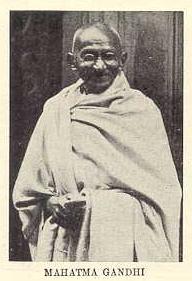 At the root of these criticisms is a deep
distrust of the Christians in India. Imposed by force from the
outside, Christianity is still considered an unwelcome intrusion
from the West. Even Mahatma Gandhi
stated that from the time Christianity was established in Rome in
the third century, "it became an imperialist faith as it
remains to this day." This unfortunate legacy has
never been forgotten by the Hindus. Though the military backing is
no longer present, enormous sums of money are sent into India for
the use of missionaries. A well-monied and successful missionary
is regarded as a threat to the national stability. At the root of these criticisms is a deep
distrust of the Christians in India. Imposed by force from the
outside, Christianity is still considered an unwelcome intrusion
from the West. Even Mahatma Gandhi
stated that from the time Christianity was established in Rome in
the third century, "it became an imperialist faith as it
remains to this day." This unfortunate legacy has
never been forgotten by the Hindus. Though the military backing is
no longer present, enormous sums of money are sent into India for
the use of missionaries. A well-monied and successful missionary
is regarded as a threat to the national stability.
The official government document, Madhya
Pradesh Report on Christian Missionary Activities (1956) stated,
"evangelization in India appears to
be a part of the uniform world policy to revive Christendom for
re-establishing Western supremacy and is not prompted by spiritual
motives. The objective is apparently to create Christian minority
pockets with a view to disrupt the solidarity of the non-Christian
societies. The ulterior motive is fraught with danger to the
security of the State."
Christians are only three percent of
India's population, yet they control 25% of all schools and 40% of
all social service organizations. Their
Western affiliations give them political entree and cultural clout
beyond their numbers. Christians
are widely viewed as not necessarily strongly loyal to the nation,
the Catholics in particular being thought to be under the direct
rule of the Vatican. The Madhya Pradesh report also says,
"Because conversion muddles the convert's sense of unity and
solidarity with his society, there is a danger of his loyalty to
his country and state being undermined."
(source:
Catholic
Ashrams - hinduismtoday.com). Refer
to VINDICATED BY TIME: The Niyogi Committee Report On
Christian Missionary Activities -
Christianity
Missionary Activities Enquiry Committee 1956
and
The
Sunshine of Secularism and and
Catholic
Priests Molest Third World Nuns to Avoid AIDS.
Refer
to Christianity
Dying In The West?
- By M S N Menon - organiser.org. and
Christians
have Destroyed Various Ethnic Cultures of the World -
christianaggression.org.
Refer to From
De Nobili to Clooney: The Christian Methods of Inculturation.
Refer to of Crimes
of Christianity
- By G
W Foote and J M Wheeler Progressive Publishing Co. London. 1887.
Catholic Church Expands Deceptive Program of "Indianization"
(Note:
Catholic Church in India is making clever
adjustments to make itself more palatable to Indians.
This continues a process begun hundreds of years ago when some of
the first Catholic missionaries to the country pretended to be
like Hindu sadhus. The external adaptations, however, were not
accompanied by any change in the Catholic philosophy that all
non-Catholics are denied heaven.)
The Catholic church will take up the
study of Sanskrit, adapt to monastic life in an ashram and adopt
the Hindu ritual of aarti during mass if the movement towards
Indianisation of the church gets the nod from 400
priests and five bishops congregating in Pune. The
Catholic church has already adopted a number of Indian traditions
and practices and has come a long way, four decades after the
historic Second Vatican Council (1962-65) brought an epochal shift
in the modern church through its declaration on religious liberty.
Pune's Papal Seminary, which has ordained over 1,250 priests
during the past 50 years, has continued with its modernisation
effort along with its associate institutions such as the
Jnana-Deepa Vidyapeeth (JDV), formerly the Pontifical Anthenaeum,
and the De Nobili College. Pune-based Catholic leaders such as
Joseph Neuner, Kurien Kunnumpuram, Francis X D'Sa, John Vattanky
and Subhash Anand have been stressing for lesser control from the
Vatican, to make the church "truly Indian and genuinely
Christian."
Pandikattu Kuruvilla, teacher of philosophy at JDV and the Papal
Seminary's rector, Ornellas Coutinho, explained that a number of
Indian religious customs and practices have already been embraced
by the Catholic church to become truly Indian. "A
number of Christian priests, for example, strictly follow the
ancient Indian ashram system of monastic life, such as those at
the Bethany Vedavijnana Peeth (Pune), Satchitananda Ashram (Trichy),
Kurusumala Ashram (Kerala) and the Sameskshna Ashram (Kalady,
Kerala)," said Kuruvilla.
"Practising vegetarianism, organizing satsangs and reading
Bhagvad Gita are some of the changes that have taken place,"
he said.
(source:
Catholic
Church Expands Deceptive Program of "Indianization"
- hinduismtoday.com).
Why
this war on Hinduism?-
These
two (Christianity and Islam) hostile ideologies, flawed because
they are not based on human experience but on spurious and
fantastic literature, are based on a priori illusion that human
beings are genetically flawed and can be redeemed only by symbolic
conversion and the acceptance of their bookish deity. For
instance, if the Christian and Islamic clergy do not propagate and
force their sterile ideologies down the throats of unsuspecting or
helpless people through dubious means, or do not force them to
stay on with censure and punishment, their religions would be
wiped out in decades. Europe is a primary example.
(source:
Why
this war on Hinduism? - By
George Thundiparambil
- christianaggression.org). Refer
to The
Swami Devananda Saraswati Interview with Rajeev Srinivasan -
christianaggression.org.
Top
of Page
Tsunami
hit
South India:
Calamity of epic
proportions
Death, devastation, tears, relief
"
Nature's
majesty is even more awesome deep in the universe, where suns
explode and black holes swallow entire solar systems.
"
Hindus
believe just as construction is important, so is devastation.
Nothing is permanent except the Soul."
***
Imagine going for a
morning walk along the sea as you do every morning. The sea is a
Pacific influence and you perhaps dip your toe in the water. But
before you realize what’s happening, you are caught in one of
the worst natural calamities in living memory. For hundreds in
Chennai’s Marina Beach on Sunday morning, it was nightmarishly
like this. For thousands of fisherfolk, who had gone like every
morning into the sea, it was again the same story — suddenly
being caught in a phenomenon, tsunami, which struck India for the
first time in recorded history.
The country was still coming to grips with the nature and scale of
the disaster. The toll, according to the government, was 2,000 and
rising, but other estimates put the toll at over 3,000. And
there’s no news yet of 45,000 people in Car Nicobar and Greater
Nicobar where a quake of 7.5 magnitude hit early in the morning.
The trigger for the tsunami — a destructive wave train created
by an undersea disturbance — was an 8.9 magnitude earthquake,
just off the northern tip of Indonesia's Sumatra island.
There were a series of aftershocks, creating mammoth waves that
hit coastal Tamil Nadu, where the toll was the highest, Kerala,
Andhra Pradesh and Pondicherry. Orissa and West Bengal escaped
relatively unscathed, with only two deaths reported till evening.
Over a thousand deaths are feared in the Andaman and Nicobar
Islands, with extensive damage to the airport at Car Nicobar, just
115 nautical miles (about 300 km) from Sumatra, and Campbell Bay.
The airport at Port Blair was damaged too, but a couple of flights
took off later with fleeing tourists. Many more are still
stranded.
In Tamil Nadu, the toll is expected to touch 2,500, with one
report putting the figure at over 1,000 in Nagapattinam district
alone. Cuddalore and Kanyakumari were the other badly-hit
districts. Hundreds of pilgrims, including SC Judge GP Mathur,
were left stranded on Vivekananda Rock near Kanyakumari. Hundreds
of fishermen were missing and Chennai was inundated by what
witnesses called six-metre-high waves. The Kalpakkam nuclear power
also reported an influx of sea water, but officials said it was
"fully safe"

“All
the planet is vibrating” from the quake, said Enzo Boschi, the
head of Italy’s National Geophysics Institute.
.
Most Powerful
Quake in 40 Years Triggers Death and Destruction
Dec. 26 - The most powerful
earthquake in 40 years struck south Asia this morning, triggering
tsunamis that smashed into villages, resorts and tourist isles,
killing thousands and leaving hundreds missing. Sri Lanka, India
and Indonesia were hit hardest as the tsunamis, some 30 feet high,
washed away fishermen, tourists, cars and beachside stalls. The
earthquake, which generated tidal surges that could be felt as far
away as Africa, hit at 6:58 a.m. local time about 100 miles off
the northern Indonesian island of Sumatra. It measured 8.9 on the
Richter scale, which made it the largest in the world since 1964
and the fifth largest since 1900, according to the National
Earthquake Information Center at the United States Geological
Survey.
“All
the planet is vibrating” from the quake, said Enzo Boschi, the
head of Italy’s National Geophysics Institute. Speaking on SKY
TG24 TV, Boschi said the quake even disturbed the Earth’s
rotation.
The
quake occurred at a place where several huge geological plates
push against each other with massive force. The survey said a
620-mile section along the boundary of the plates shifted, motion
that triggered the sudden displacement of a huge volume of water.
http://www.msnbc.msn.com/id/6754820/
Top
of Page
“A
creed religion like Christianity... is constantly competing
against all other religions — and, what is more, doing so on
their own home grounds. Its success is measured in terms of the
number of converts it makes."
~ Michael Arnheim author
of Is
Christianity True (Skeptic's Bookshelf Series). Refer
to
Christian
Supremacy: Pushing the Dhimmitude of Non-Christians in America
and
The
Burningcross
***
Natural Disaster -
"a phenomenal
opportunity"
to convert the Hindu Heathens?
Purses with string attached?
Christianity
Condition for Tsunami Aid
The
Swedish Save the Children organization is concerned that many
tsunami victims in Thailand aren’t being given help unless they
convert to Christianity.
The pressure comes from
Christian charities, primarily from the United States.
Complains about the situation are reflected in a survey conducted
by the Swedish and British Save the Children organizations,
together with the United Nations children’s fund, UNICEF.
Speaking to the newspaper “Svenska Dagbladet” the head of
Swedish Save the Children’s tsunami relief in southeast Asia
says in some places it feels like the 19th century, when
missionaries demanded conversion as a condition for food and
clothing.
The newspaper reports that when its
reporters visited several orphanages, the children, who were
Buddhist, were wearing t-shirts with slogans like “God loves
you” and “Jesus is the way”.
(source:
Christianity
Condition for Tsunami Aid).
Refer to of
Crimes
of Christianity
- By G
W Foote and J M Wheeler Progressive Publishing Co. London. 1887.
***
Christian
Organizations Reach Out to Tsunami Victims
The
Christian website, Crosswalk.com,
published a long story about Christian relief efforts following
the tsunami ("source"). While
the Christian charity exhibited by the rapid response of Christian
organizations is admirable, the ulterior motives of conversion
expressed by some are disturbing:
Some excerpts:
...."Doctor Ajith Fernando, who is considered by some to be
the "Billy Graham of Sri Lanka,' heads up the Youth for
Christ (YFC) office there. A long-time friend and partner of NDI,
he wrote to Williams from Sri Lanka: 'What a sad day this has
been! We keep hearing of more and more friends and loved ones of
friends who have died or lost much of their belongings. The death
toll for Sri Lanka alone is over 10,000 and keeps rising. We have
prayed and wept for our nation for many years. The most urgent of
my prayers has always been that my people would turn to Jesus. I
pray that this terrible, terrible tragedy might be used by God to
break through into the lives of many of our people.' "

The most urgent of
my prayers has always been that my people would turn to Jesus. I
pray that this terrible, terrible tragedy might be used by God to
break through into the lives of many of our people.' "
***
...."In the wake of this disaster, Gospel For Asia's 1.5
million-member Believers Church in India is rallying support and
deploying its leadership and members to minister to those
suffering both physically and spiritually. 'In times like these,
we know that God opens the hearts of those who suffer, and we pray
that as our workers demonstrate God's love to them, many of them
will come to know for the first time that real security comes only
through Him,' Gospel For Asia president K.P. Yohannon said. He
add, 'We ask that our brothers and sisters in the West take the
time today to pray for these millions of victims, that they will
feel God's presence and grace in a special way.' "
(source:
Christian
Organizations Reach Out to Tsunami Victims
Refer
to
VINDICATED BY TIME: The Niyogi Committee Report On
Christian Missionary Activities - Christianity
Missionary Activities Enquiry Committee 1956
and
The
Sunshine of Secularism and
Catholic
Priests Molest Third World Nuns to Avoid AIDS
Refer
to Christianity
Dying In The West?
- By M S N Menon - organiser.org. and
Christians
have Destroyed Various Ethnic Cultures of the World -
christianaggression.org. Also refer to and
Missionary's
Dark Legacy
and Dutch
Christians Target Hindus for Conversion. Refer
to of Crimes
of Christianity
- By G
W Foote and J M Wheeler Progressive Publishing Co. London. 1887.
and
The
Burningcross
Indian
Missionaries Get Rs.600 crores for Tsunami Conversions from UK
UK-based Disaster
Emergency Committee's Contribution
(to India from its overall Rs 2800 crores)
Contributing Agency Rupees (crores)
Action Aid 60.46
CAFOD 126.31
CARE 18.44
Christian Aid 84.48
Concern India 2.93
Oxfam India 31.57
Save the Children 46.40
Tearfund* 23.02
World Vision 146.40
HelpAge India 36.28
Total 576.29
(*Comprising Discipleship Centre (DC), Evangelical Fellowship of
India Commission on Relief (EFICOR) and Salvation.
(source: Indian
Missionaries Get Rs.600 crores for Tsunami Conversions from UK
- christianaggression.org).
Christian
groups see disaster relief as an opportunity to create converts
As
Western humanitarian organizations unleash an armada of relief
supplies and workers into Asia's crisis zone, some evangelical
Christian groups aim to bring the Gospel to the victims, as well.
Religious groups promise to be a major presence in the massive
relief and reconstruction effort. InterAction, the largest
alliance of U.S.-based non-government organizations, reports that
of its 55 member agencies providing tsunami aid, 22 are
faith-based.
Most of the religious players,
including the Red Cross, the American Jewish World Service, and
Lutheran World Relief, have rules against proselytizing.
At the same time, though,
evangelical groups active in Asia, including the Southern
Baptists' International Mission Board, Gospel for Asia, and the
Christian and Missionary Alliance, say the Bible always impels
them to create converts to the faith.
"This [disaster] is one of the greatest opportunities God has
given us to share his love with people," said K.
P. Yohannan,
president of the Texas-based Gospel for Asia. In an interview,
Yohannan said his 14,500 "native missionaries" in India,
Sri Lanka, and the Andaman Islands are giving survivors Bibles and
booklets about "how to find hope in this time through the
word of
God."
In Krabi, Thailand, a Southern Baptist
church had been
"praying for a way to make inroads" with a particular
ethnic group of fisherman, according to Southern Baptist relief
coordinator Pat Julian. Then came the tsunami, "a phenomenal
opportunity" to provide ministry and care, Julian told the
Baptist Press news service.
In Andhra Pradesh, India, a plan is developing to build
"Christian communities" to replace destroyed seashore
villages. In a dispatch that the evangelical group Focus on the
Family posted on its Family.org Web site, James Rebbavarapu of
India Christian Ministries said a team of U.S. engineers had
agreed to help design villages of up to 400 homes each, "with
a church building
in the center of them."
Yohannan said Sri Lankan officials are "extremely angry"
with Christian missionary work and want to outlaw proselytizing.
Some states in southern India have anti-conversion laws that bar
"fraudulent manipulation," he said, adding: "I
cannot tell you there is a hell awaiting you because it can be
interpreted as a fear tactic." But one of the states, Tamil
Nadu, recently repealed its law, and others don't enforce theirs,
Yohannan said.
(source: Some
Christian groups spread supplies - and the word - By Jim Remsen -
Philadelphia Inquirer - Jan 09,
2005).
For
more on Christian
Fundamentalism Agenda in USA, refer
to:
A
conflict between science and God -
By Martin Kettle - Guardian and
Quotes
from The American Taliban and
Christian
Fundamentalists to Push Bible as Classroom "Knowledge"
and Bush,
the Neocons and Evangelical Christian Fiction: America "Left
Behind" - By Hugh Urban and The
Christian Right, Dominionism, and Theocracy
- publiceye.org.
and
Dinosaurs,
evangelicals and the state - By Justin Webb - BBC. and
Cornell
President Says "Intelligent Design" Religion, Not
Science and
American
Fundamentalists.
Also
refer to Battlefield
Earth - By Bill Moyers and The
Godly Must Be Crazy - By
Glen Scherer
and Rapture
or Rupture? - By Bryan
Zepp Jamieson.
Refer
to The
Republican War on Science - By Chris Mooney and Resurgence
Of Religious Right Among Top Concerns - totallyjewish.com.
More
evangelicals turning up in elite circles, schools - By Laurie
Goodstein and David D. Kirkpatrick
- The
New York Times/May 22, 2005. The
Crusaders:
Christian evangelicals are plotting to remake America in their own
image
- By
Bob Moser - rollingstone.com and
Dominionist.
Refer to of
Crimes
of Christianity
- By G
W Foote and J M Wheeler Progressive Publishing Co. London. 1887.
Refer
to The
Swami Devananda Saraswati Interview with Rajeev Srinivasan -
christianaggression.org and The
Burningcross
Watch
Sewa
or Service work by RSS.
***
Why
Asian Tsunami Is News, But Not The Destruction of Falluja
Writing
in New Zealand's Pacific Media Watch after the Asian tsunami last
year, journalist Mike
Whitney observed: "The
American media has descended on the Asian tsunami with all the
fervour of feral animals in a meat locker. The newspapers and TVs
are plastered with bodies drifting out to sea, battered carcasses
strewn along the beach and bloated babies lying in rows. Every
aspect of the suffering is being scrutinized with microscopic
intensity by the predatory lens of the media".
"This is where the western press really excels: in the
celebratory atmosphere of human catastrophe" he noted,
asking, "where was this 'free press' in Iraq when the death
toll was skyrocketing?"
(source:
Why
Asian Tsunami Is News, But Not The Destruction of Falluja - Kalinga Seneviratne -
christianaggression.org).
***
Physician,
heal thyself first!
The
Aftermath of Hurricane Katrina
There was just a quiet
satisfaction that a country which believes in its divine right to
offer gratuitous advice to everyone on every conceivable subject
was now being shown up with its pants down. BBC
World, the world's most infuriatingly sanctimonious TV channel,
didn't need to lace its footage with the sepulchral voice that
accompanies every calamity in 'Bungler-dish' and sub-Saharan
Africa. The chaos of New Orleans was the
worst advertisement for Western civilization in a very long time.
Yet, what I find
inexplicable is why there weren't armies of volunteers bringing
food, water and medicines into New Orleans. In the aftermath of
every flood or earthquake in India, we see home-grown
organisations such as the Ramakrishna Mission, Bharat Sevasram
Sangh, RSS and assorted Rotary Clubs taking charge of emergency
services and complementing the Government machinery. Have
voluntary agencies disappeared from the US? Are American NGOs only
for export?
More significant was the irrelevance of
Church bodies. The evangelists who litter the landscape of the
Deep South are cash-rich and have an amazing knack of turning up
at odd places promising deliverance. How come we didn't hear of
them providing solace to their flock and engaging in Christian
charity in New Orleans? There are reports that the few charity
workers who turned up beat a hasty retreat after being threatened.
What does this reveal about the supposed importance of Christian
values in the civic life of America? And to imagine US evangelists
have the gumption to preach to Indians.
(source: Physician,
heal thyself first! - By Swapan Dasgupta
- christianaggression.org).
For more refer to
Black
lawmakers angry about federal response to Katrina - cnn.com.
and
The
Poverty of America
-
By
Jeremy Seabrook.
- This is what the poor of India and all the other hopeful
countries of the world have been taught to envy and to long for.
This is the supreme achievement of the richest societies the world
has ever known; and it is the model, not merely preached, but
actually imposed by the International Monetary Fund, the World
Bank, the World Trade Organization and the governments of the G8.
That they are in no position to tell anyone else what to do is the
enduring lesson from the disaster which has befallen, not merely
Mississippi, Louisiana and Alabama, but American society itself,
as it has demonstrated to the world its indifference towards those
for whom the designation 'loser', 'no-hoper', 'failure' is applied
as a stigma of moral, as well as material, incapacity.
Also
refer to
Katrina
Response Problems Spurs Racism Charges -
capitolhillblues.com and New
Orleans Unmasks 'Apartheid - American Style'-
rense.com and Katrina
exposed America's seamy side
- By T V R Shenoy - rediff.com
***
Evangelists are
organizing their resources to help victims in exchange for conversion and we
need to guard victims from this move . Please activate our calendar in the field
and send reports on any conversions by Evangalists. We learnt from our sources
that Vatican has committed huge funds for the purpose of conversions in exchange
of relief aid to victims, their activists are geared to "harvest
souls" . Such incidents are dream come true for Christian
Evangelists,
though they smartly deny their statements convey hidden messages .
Statements of Christian Evangelist soon after Gujarat
Earth Quake :
John Dayal sees a chance to practice his faith: "This is an opportunity to
show the love of the Christ to all the people—but it will be cruel to suggest
that the evangelists or the churches see it as a Christian opportunity of
winning souls."
Peter told ENI that while Christians do not have "an eye on
conversion" as they provide help, if villagers see Christians staying for
the long haul, "it is natural that some of them will approach us later with
a request to become Christians."

"This is a moment for the clergy to turn the pangs of calamity into an
opportunity to show the love of the Christ," said Eduardo M. Faleiro, a
Christian member of the Indian Parliament. "The Christians also need to do
some introspection and see how we can spread the message of Jesus Christ."
***
"This is a moment for the clergy to turn the pangs of calamity into an
opportunity to show the love of the Christ," said Eduardo M. Faleiro, a
Christian member of the Indian Parliament. "The Christians also need to do
some introspection and see how we can spread the message of Jesus Christ."
(source:
saag.org http://www.saag.org/bb/view.asp?msgID=10227).
Watch
Sewa
or Service work by RSS.
Jet
setting Christian
Evangelist comes looking for orphans in a 747 Boeing
'It
is the longest journey I have taken by road during the past many years. In the
time that took for me to reach here from Chennai, I would have made half the
journey from New York to Chennai'. So said jet-setting K A
Paul, an India-born
US-based Christian evangelist, at the coastal village of Thazhanguda in
Cuddalore on Thursday, soon after speaking to a small group of people affected
by the tsunami.
Soon after his Boeing 747 (for the uninitiated he takes pains to explain that
there are just two such planes in the world and the other one is used by the US
President) touched down in Chennai, he had called on the Tamilnadu Chief
Minister Jayalalithaa.
The
group that he has brought to India comprises celebrities like Evander
Holyfield, Miss World runner-up Nazinin Afshin-Jam from Canada, a Fox
TV reporter accompanied by a videographer and several other such
people.

Sri Lankan and
Indonesian authorities have banned the adoption of children affected by the tsunami
***
Driving
in a luxury bus into the deserted beach in Thanzhanguda, where the surging
waters killed at least 38 people and rendered hundreds of others homeless, the
group of foreigners carrying cameras drew the attention of the villagers,
particularly children and women, who almost besieged them. The
condescending Paul finds the crowd that has gathered on the shores an ideal
audience for his sermon. He seeks to drive home the point that they were all
alive because of Jesus Christ through his translator. To that crowd Paul also
makes a appeal to send orphans to his establishment. To the couple of
journalists from Chennai, who were on the beach at that time, he says that he
has Rs 4000 crore ($ 800 million) at his disposal for providing
immediate relief to 10 countries in the next one and a half months.
(source:
Christian
Evangelist comes looking for orphans in a 747 Boeing
- newstodaynet.com - January 7 2004).
Sri
Lanka bans tsunami adoptions
The Sri Lankan
authorities have banned the adoption of children affected by the tsunami until
further notice.
The move follows concern expressed by the UN that some orphans were being
targeted by criminal gangs.
Indonesia bans foreign
adoptions
The head of the United
Nations Children's Fund (UNICEF) hailed Indonesia on Thursday for banning
adoptions of children orphaned in the tsunami disaster, amid growing concerns about human trafficking.
"That's an example of a government taking action to counter a criminal
element," UNICEF executive director Carol Bellamy told reporters in
Jakarta. "These are
countries with a long tradition of extended families. Let's see first if the
extended family is willing and capable of taking in the children," she
said.
(source: Sri
Lanka bans tsunami adoptions and Sri
Lanka bans tsunami adoptions).
Top
of Page
Charity
and Relief work done by Hindu organizations for the Tsunami disaster
"Whatever you do, whatever you eat, whatever you offer
in sacrifice
Whatever charity you give, whatever austerity you practice, do it
as an offering to Me" -
Bhagavad Gita 9.27.
"The only gift is giving to the poor;
All else is exchange." –
Thirukkural 221.
"If
the Parliament of Religions has shown anything to the world it is
this: It has proved to the world that holiness, purity, and
charity are not the exclusive possessions of any church in the
world, and that every system has produced men and women of the
most exalted character."
- Swami Vivekanada.
***
Western
Monopoly over Humanitarian Aid - Are Hindus Victims Only?
Note:
Foreign
& Indian press always mention the Red Cross, Oxfam, Gospel for
Asia or some (other) Christian organization in connection with the
Tsunami relief work, but never the Hindu organizations that are
far more active in the field. As usual, Hindus are good only to be
victims...? However, opposing
Christian missionaries is by default a Hindu radical or Hindu
Nationalists in the Western Press and in India's English Language
Media.
According to our
Shastras, each Hindu is supposed to contribute one-sixth of his
income to the society.
Here is a list of some
organizations:
Vivekananda
Kendra, Kanyakumari
Vivekananda
Kendra, a spiritually oriented service organization with head
quarters at Kanyakumari has taken up a massive relief work for the
rehabilitation of the Tsunami Tidal Wave affected people. Kendra
has taken up relief work in the coastal areas from Tiruvanmiyur to
Mahabalipuram of Chennai, Cuddalore, Nagapattinam and from
Rameswaram to Kanyakumari strip.
Arya Samaj Adopts Three
Villages in Nagapattanam
Senior Arya Samaj leaders from Delhi, Gandhidham
and Mumbai are in Tamil Nadu since Sunday to supervise and
co-ordinate the Relief work being done there by Arya Pratinidhi
Sabha Tamil Nadu. All this work is being done under the auspices
of International Arya League. The fisherman are the worst affected
people of the region but the other thing which nobody has noticed
or is working for is that a lot of agricultural land has been
washed out and is now salty and uncultivable for quite some time.
The farmers will have been left with no means of earning their
livelihood. They will now have to work as labourers.
Arya Samaj has adopted three villages namely
Samundampettai and Puthukupam in the Nagapattam area. The
volunteers of Arya Pratinidhi Sabha Tamil Nadu are working
ceaselessly to provide relief to the affected people. They are
removing the dead bodies and performing their last rites using
Ghee and Havan Samagri. They are also busy in the cleaning up
operations and in helping the affected people in every possible
way.
(source: Arya Samaj Adopts Three
Villages in Nagapattanam).

Collecting funds by Hindu
organizations
***
Art of Living Foundation gives Rs.150 crore tsunami aid
Indian spiritual leader Sri Sri Ravi Shankar, touring
tsunami-hit areas in Sri Lanka, has donated Rs.1.5 billion through
his Art of Living Foundation towards relief operations in Sri
Lanka and India.
The spiritual leader oversaw relief work being done by volunteers
of the Art of Living Foundation in this island nation. The
foundation is planning to set up orphanages and homes for
destitute women in the affected areas in India and Sri Lanka. The
foundation is running a large refugee camp in Port Blair, Andamans.
Two hundred tonnes of relief material has been airlifted to the
Andamans Islands and 300,000 litres of drinking water sent, a
foundation release said.
(source: Art
of Living Foundation gives Rs.150 crore tsunami aid -
newindpress.com).
Seva
Bharathi Tamilnadu
Seva Bharathi, a nationalist
service organization, had undertaken such big task earlier also in
Lattur (Maharashtra), Uttarkasi (UP), Punjab and Gujarat. In
Nagapattinam, Seva Bharathi has started relief work within a
couple of hours atter the Tsunami strike. Swayamsevaks from
various parts of tamilnadu and Karnataka collected relief
materials and sent them to the base camp at nagapattinam. Also
many spiritually oriented service organizations from various parts
of the country sent the materials which they have collected.
AIM
for Seva Disaster Relief Centre - Arsha Vidya Gurukulam, Anaikatti
The next day, 31st of
December 2004, the volunteers went to Seruthur. An eerie silence
greeted them. It was a picture of desolation and destruction in
the wake of the Tsunami. There were over 650 houses in that
village, of which 300 houses had been swept away. Of the 200 dead,
most of them were children and women. One of the local residents
said that in the stretch between Vedaranyam and Tharangampadi, a
whole generation of children has been swept away.
(source:
AIM
for Seva ).
Mata
Amritha announces Rs 100 cr for relief
The
biggest relief measure announced so far, the Mata Amritananda Math
in Kerala has announced a Rs 100 crore tsunami relief for the
affected states.
The
Math also has plans to study the Tsunami phenomenon, the Mata
said. If the government permitted, the Math proposes to
reconstruct all the houses that have been completely destroyed by
the tsunami attack across Kerala. These houses will be built
according to the specifications of the government. The Math
proposes to build houses consisting of two rooms, a kitchen, a
small veranda and a toilet.
Other relief activities to be undertaken pending government
sanction are: Rs 1000 for buying kitchenware for every affected
family in the coastal states
(source: Mata
Amritha announces Rs 100 cr for relief - timesofindia.com).
Top
of Page
The
Usual Biased and mischievous Reporting in Western Press
Shunned,
India's untouchables gather tsunami dead
- By Terry Friel
They are the
"untouchables"; the lowest of the low in India's ancient caste system.
No job is too dirty or too nasty, and they are the ones cleaning up the rotting
corpses from last week's killer tsunami. The overwhelming majority of the 1,000
or so men sweating away in the tropical heat to clear the poor south Indian
fishing town of Nagapattinam, which bore the brunt of the giant wave, are lower
caste dalits from neighbouring villages. Locals too afraid of disease and too
sickened by the smell refuse to join the grim task of digging friends and
neighbours out of the sand and debris. They just stand and watch the dalits
work. "I am only doing what I would do for my own wife and child,"
says M. Mohan, a dalit municipal cleaner as he takes a break to wash off some of
the grime of the day's work. "It is our duty. If a dog is dead, or a
person, we have to clean it up." Mohan and other sanitation workers from
neighbouring municipalities are working around the clock to clear Nagapattinam,
for an extra 50 cents a day and a meal.
Dirty
jobs: Caste still plays a defining role in much of Indian society. Over 16
percent of India's billion plus people are dalits. Despite laws banning caste
discrimination, they are still routinely abused, mistreated and even killed.
They do the jobs others won't -- they clean toilets, they collect garbage, they
skin cows. For Mohan, illiterate, uneducated and low caste, the only way to get
a government job and the security and pension that come with it, was as a
municipal sanitation worker. For some Indians, untouchables are less than human.
Just over two years ago, five dalits were lynched near New Delhi after a rumour
spread that they had killed and skinned a cow, revered as sacred in India.
Comments
on
sulekha.com on this report
"Sickening;
day after day the same crap. This is just voyeuristic reporting. Terry
Friel imports Mexicans to these menial jobs for him. In
short, this chap is hard pressed to find some "good story" - so he
comes up with this Dalit thing. What is odd is - he clearly says they are
government
workers. Why not consider them just that - government workers doing their job?"

"There are people of all castes and
religions (including Muslims) doing burying , burning and cleaning of corpses of
humans and animals. It is sad and sickening that even during a tragic time like
this people want to push their agenda.
What does Mr. Terrry Friel and his like
want ? All Hindus should convert to his brand of book
religion ? What good has that done to the people of Africa, South America or
Philippines ?"
Watch
Sewa
or Service work by RSS.
***
"It is like saying, only Hispanics clean the toilets and
garbage in USA.
This is a biased and vindictive report by Terry Friel who has a history of
twisting facts and throwing in unrelated news items to push whatever agenda he
is selling. It is not just Dalits (untouchables) who are cleaning the
corpses.
How can Mr. Terry Friel say somebody is from Dalit or another caste
when I myself, an Indian, cannot do that just by looking at someone. Does Mr.
Friel speak Tamil , the local language ? Does Mr. Friel know that Nagapattinam
is a predominantly Christian area with a famous church called Velankani.
"There are people of all castes and
religions (including Muslims) doing burying, burning and cleaning of corpses of
humans and animals. It is sad and sickening that even during a tragic time like
this people want to push their agenda. What does Mr. Terrry Friel and his like
want ? All Hindus should convert to his brand of book
religion ? What good has that done to the people of Africa, South America or
Philippines ?
"
Over
4900 bodies buried in worst affected Nagai
The
Red Cross, with the help of RSS
volunteers, has undertaken mass burials all over the district. Even
bodies which could not be identified had been buried as they were highly
decomposed, he said.


Selfless
Service
RSS
volunteers performed funeral rites to 1,100 bodies
recovered from the tsunami-hit areas in this district alone.
The RSS is the Hindu nationalist organization that
everybody in the West loves to hate. Whenever a disaster strikes they are the
first ones to reach the area and do the lowest work that no one else wants to
do. They have members from all castes.
Watch
Sewa
or Service work by RSS.
***
The RSS is the Hindu nationalist organization that
everybody in the West loves to hate. Whenever a disaster strikes they are the
first ones to reach the area and do the lowest work that no one else wants to
do. They have members from all castes.
The
Hindu newspaper is one of the oldest newspapers of India with a marked leftist /
Marxist bias despite its name. They do their best to not report anything good
about Hindu organisations.
Following
an SOS from Nagapattinam district collector, RSS sent volunteers from all over
the State to the affected areas. The volunteers performed funeral rites to 1,100
bodies recovered from the tsunami-hit areas in this district alone. The relief
works in Kanyakumari district were coordinated with the Ramakrishna Mission and
a medical camp is functioning with doctors and volunteers.
Of
course none of the Western press will publish these news items because these go
against their pre-conceived notions of painting Indians as a backward
caste-ridden society.
(source:
Shunned,
India's untouchables gather tsunami dead
- By Terry Friel and Over
4900 bodies buried in worst affected Nagai and
RSS
rushes help to tidal wave victims and
http://www.sulekha.com/news/ThreadComment.aspx?cid=532257
and democraticunderground-
discussion board). Also refer to Black
lawmakers angry about federal response to Katrina - cnn.com. Refer
to of Crimes
of Christianity
- By G
W Foote and J M Wheeler Progressive Publishing Co. London. 1887.
Refer to From
De Nobili to Clooney: The Christian Methods of Inculturation
and American
Christian Fundamentalist Leader Calls for Global War
- By Yoginder Sikand - christianaggression.org). Also
refer to and
Missionary's
Dark Legacy
and Dutch
Christians Target Hindus for Conversion. Refer
to
Christian
Supremacy: Pushing the Dhimmitude of Non-Christians in America. Refer
to The
Swami Devananda Saraswati Interview with Rajeev Srinivasan -
christianaggression.org.
***
US
study clubs RSS, al-Qaeda -
By Rand
Corporation
Demonizing the RSS?
"Naturally Rand will not dare scrutinise American
fanatics like Pat
Robertson, founder of the Christian
Coalition (surely an NRM), who makes no pretense about his espousal
of violence to achieve political ends.

Pat Robertson publicly
asked the US Government to assassinate Venezuelan President Hugo Chavez
***
The renowned tele-evangelist publicly
asked the US Government to assassinate Venezuelan President Hugo Chavez for
posing "a terrific danger" to America by "exporting Communism and
Islamic extremism." Addressing his "The
700 Club" show on August 22, 2005, Robertson proclaimed that if
Chavez feared America was plotting to assassinate him, "we really ought to
go ahead and do it... It's a whole lot cheaper than starting a war."
RSS
is one of the few organized bulwarks against this nefarious (conversion) design;
hence the demonization as violent, terrorist, totalitarian.
(source:
RSS@terrorist.com - By Sandhya Jain
- dailypioneer.com - September 6 2005). Also refer to Exploring
Religious Conflicts? RAND as New Religious Media (NRM)
- By Dr S Kalyanaraman - indiacause.com
and Some
Question Robertson's Katrina Charity - abcnews.com
and Robertson's
rhetoric of entitlement - workingforchange.com and
Robertson's
'fatwa'
- By Eric Margolis - torontosun.com
and
Catholic
Priests Molest Third World Nuns to Avoid AIDS.
Refer to Quotes
from The American Taliban.
Refer
to Christian
Fundamentalism Agenda in USA:
Bible
thumpers: Americans
are being increasingly stereotyped as stupid - By Arvind Kumar -
indiareacts.com and Dinosaurs,
evangelicals and the state - By Justin Webb - BBC).
Refer
to Christian
Fundamentalism Agenda in USA.
Refer to: A
conflict between science and God - By Martin Kettle - Guardian and Quotes
from The American Taliban and Christian
Fundamentalists to Push Bible as Classroom "Knowledge" and Bush,
the Neocons and Evangelical Christian Fiction: America "Left Behind"
- By Hugh Urban and The
Christian Right, Dominionism, and Theocracy
- publiceye.org.
and Dinosaurs,
evangelicals and the state - By Justin Webb - BBC. and Cornell
President Says "Intelligent Design" Religion, Not Science and
American
Fundamentalists. Also refer to Battlefield
Earth - By Bill Moyers and The
Godly Must Be Crazy - By Glen Scherer and Rapture
or Rupture? - By Bryan Zepp Jamieson. Refer to The
Republican War on Science - By Chris Mooney and Resurgence
Of Religious Right Among Top Concerns - totallyjewish.com.
More
evangelicals turning up in elite circles, schools - By Laurie Goodstein and
David D. Kirkpatrick - The New York Times/May 22, 2005. The
Crusaders:
Christian evangelicals are plotting to remake America in their own image - By Bob Moser -
rollingstone.com and Dominionist.
Refer to As
America declines, the Bible thumpers take hold - By Ramesh Rao - indiareacts.com.
How
the Dominionists Are Succeeding in Their Quest for National Control and World
Power - yuricareport.com.
Refer
to Christianity
Dying In The West?
- By M S N Menon - organiser.org. Refer to Can
Hinduism face the onslaught of Project Thessalonica?
-
By Alex Pomero and Christians
have Destroyed Various Ethnic Cultures of the World -
christianaggression.org. Also refer to and
Missionary's
Dark Legacy
and Dutch
Christians Target Hindus for Conversion
Refer to Christian
Pat Robertson Denounces Hinduism as "Demonic - Hinduism Today July
1995.
Refer
to Christian
Televangelist Calls for Venezuelan President's Assassination
and RSS
rescues Christian priests - hindustantimes.com and World
stunned as US struggles with Katrina - yahoo.com and Venezuela
Curbs Missionaries After Robertson's Threat
- By
Patrick Markey CARACAS,
Venezuela 26 Aug 2005 23:24:18 GMT Reuters. The
Crusaders:
Christian evangelicals are plotting to remake America in their own image
- By
Bob Moser - rollingstone.com and
Dominionist.
Invasion
of Iraq and the Ushering in of Global Christendom and Pax-Americana ?
While
the Western press is awash with stories, real and exaggerated, about ‘Islamic
fundamentalists’, rarely is mention made about Christian fundamentalists, who,
with their vast resources and close links with the current American
administration, are a potentially more menacing threat than their Muslim
counterparts. According to newspaper reports more than
a third of Americans are associated with one or the other Christian
fundamentalist outfit, most of which are fiercely
anti-communist, anti-Muslim and are passionate advocates of free-market
capitalism, global American hegemony and the myth of the civilizing mission of
white America. In recent years, these fundamentalist groups have been engaged in
aggressive missionary work in other countries as well, including in the
so-called ‘Third World’. Fired by a passionate hatred for other religions,
which they dismiss as ‘false’ and even ‘Satanic’, they are today among
the most well-funded missionary groups in large parts of Asia and Africa.
(source:
American
Christian Fundamentalist Leader Calls for Global War
- By Yoginder Sikand - christianaggression.org). How
the Dominionists Are Succeeding in Their Quest for National Control and World
Power - yuricareport.com.
 Refer to Pharmaceutical
Giant Pfizer Donates Rs 1 Cr to Missionary Agency - christianaggression.org
- Pharmaceutical major Pfizer
and World Vision India on
Thursday announced a grant of Rs 1 crore (Rs 10 million) under an economic
rehabilitation programme for Tsunami affected communities, which WVI will extend
as micro-finance development loans.
Refer to Pharmaceutical
Giant Pfizer Donates Rs 1 Cr to Missionary Agency - christianaggression.org
- Pharmaceutical major Pfizer
and World Vision India on
Thursday announced a grant of Rs 1 crore (Rs 10 million) under an economic
rehabilitation programme for Tsunami affected communities, which WVI will extend
as micro-finance development loans.
***
RSS rushes help to tidal
wave victims
Volunteers of Rashtriya Swayam Sevak (RSS) are doing their best in relief
operations in coastal districts to help people affected by tidal waves. The
immediate task was to supply food, medicines and clothing.
Another demanding task was the disposal of the dead.
RSS rushed volunteers from Coimbatore, Madurai, Salem, Trichi, Ambur and Erode
and they joined hands with local volunteers in the operations. Students of
Vivekananda College in Thiruvedagam and Madurai have also teamed up with them to
render help.
Following an SOS from Nagapattinam district collector, RSS sent volunteers from
all over the State to the affected areas.
The volunteers performed funeral rites to 1,100 bodies
recovered from the tsunami-hit areas in this district alone.
The relief works in Kanyakumari district were coordinated with the Ramakrishna
Mission and a medical camp is functioning with doctors and
volunteers. The RSS also installed a mineral water plant in Tiruvarur and
distributed 20,000 litres of safe drinking water per day. In Chennai too, the
volunteers swung into action and distributed 20,000 food packets within hours of
the tragedy and provided hundreds of blankets and sarees. The RSS is collecting
rice, utensils and clothes for distribution, a press release from the RSS
headquarters in Chennai said. RSS has appealed to the people to contribute
medicines, clothing and financial assistance to assist fishermen in getting
boats, fishing nets and other infrastructure facilities.
(source: RSS
rushes help to tidal wave victims -
newstodaynet.com).
Watch
Sewa
or Service work by RSS.
Selfless
Sevice:
Note:
In the Bhuj earthquake they were at the forefront,
shoulder to shoulder with the army jawans, carrying out the most difficult part
of the service, of evacuating the dead and providing them the last rites with
dignity and honour. None of those who usually claim to be the most charitable in
India were to be seen there. There was very little acknowledgement of these
services by our biased media then. But selfless service does not need such an
acknowledgement.
Top
of Page
Hindus
Protest Newsweek Magazine Report on Hindu View of Tsunami
The Hindu American
Foundation (website here)
is protesting the article, "Countless Souls Cry
Out to God" by Kenneth L. Woodward, religion editor for Newsweek.
They are concerned that the "Hindu" view of
the disaster, given by a non-Hindu Western academic, does not reflect the actual
views of Hindus.
First we excerpt the article, then give the letter to the editor sent to
Newsweek by HAF.
The article opens:
"The waters that rose up from the deep last week, drowning tens of
thousands of people across a wide arc of South and Southeast Asia, were a
cataclysm of Biblical proportions. But most of those who survived to weep and
mourn--like most of those who died--had never heard of Noah or the Biblical God
of Wrath, figures so familiar to Christians and Jews; they were, instead,
Hindus, Muslims and Buddhists. Caught up in the disaster, they had no time for
religious ceremonies of any kind. In Sri Lanka, as in coastal southern India and
along the beaches of Indonesia, there was only time to dig huge holes in the
ground and shovel in the dead. 'In this kind of tragedy, there is no religion,'
said Syed Abdullah, a local imam in the ancient south Indian port of
Nagapattinam, where Muslims, Hindus and Christians have lived together
peacefully for centuries. 'Let the dead be buried together. They died together
in the sea. Let their souls get peace together.' But no survivor of a disaster
of this magnitude can long avoid asking the Job-like questions, 'Why us? Why
here? Why now?' "
It proceeds next to this explanation:
"HINDUS: Those hardest hit by last week's tsunami
were poor fishing communities whose inhabitants--mostly Hindus--are untutored in
refined theological speculation on life and death. For them, all of life is
controlled by the play of capricious deities. Yet their religious
world views and practices provide a measure of spiritual relief from the toil of
their labor. Along the coast of south India, Hindus tend to worship local
deities, most of them female and far down the Hindu hierarchy of divinities. But
like Shiva and other classic gods and goddesses, these local deities are
ambivalent: they have the power to destroy as well as to create. The ocean
itself is a terrible god who eats people and boats, but also provides fish as
food. 'Hindus use the deities to think about and explain happenings like the
tsunami as destructive acts of god,' says Richard Davis,
a specialist in South Asian Hinduism at Bard College in
New York. 'Relating to the local deity and cooling her anger through
propitiation is more important than thinking about personal or collective guilt
for what has happened.' "
HAF responds:
Dear Newsweek magazine:
We at the Hindu American Foundation have been inundated by Hindu readers of
Newsweek magazine expressing outrage over the perfunctory coverage of the Hindu
perspectives on suffering in the aftermath of the tsunami tragedy in Kenneth
Woodward's article ("Countless Souls Cry Out to God," January 10,
2005). Our respondents feel strongly that the coverage of Buddhism, Islam and
Christianity was appropriate and equitable while the Hindu coverage was
categorically deficient. Below, we have briefly sought to encapsulate the most
basic Hindu understanding of the cause of suffering and how even the most
unschooled Hindu would strive to understand their personal calamities. We
sincerely hope you will begin to address your most inequitable coverage of this
issue by publishing more complete depictions of the Hindu faith such as the
following:
Dear Editor:
Kenneth Woodward's depiction of the Hindu view of suffering after the
devastating South Asian tsunamis was deeply flawed ("Countless Souls Cry
Out to God," January 10, 2005). Mr. Woodward dismissed Hindu victims as
"untutored" animists who viewed the disaster as the hapless
consequence of "capricious deities" and compounded the error by
referring to Hindu perception of God by the lower case "g." In so
doing, Mr. Woodward perpetuated the most obsolete misconceptions of Hinduism.
Followers of panentheistic monotheism, Hindus believe that there is one God who
is omnipotent and omnipresent throughout the universe and worshipped by people
in different forms according to their individual perceptions. Hardly capricious,
Hindus perceive God's grace as always flowing and easily felt by those who open
their minds to receive that blessing.
Multiple millennia before
Buddhism, Hindu scripture defined the relationship between reincarnation and
karma. Recognizing an eternality of existence, Hindus take comfort in the face
of calamity knowing that while the body may die and be shed as old clothes, the
immortal soul continues its journey in the next life along its path towards God.
Individuals are architects of their destiny, and just as every action must have
an equal reaction, Hindus believe and take comfort that in suffering, a karmic
account that may have accumulated many lifetimes before has been cleared.
There is no cosmic interplay of ambivalent, competing gods as the article
implies, and the Hindu view of suffering is much more nuanced and profound then
Mr. Woodward's insulting depiction of an unpropitiated ocean god unleashing
fury. It was a disservice to your readers to provide an erroneous depiction of a
faith that inspires more than a billion people and is a source of comfort to so
many of the tsunami victims.
Aseem R. Shukla, M.D., Member, Board of Directors, Hindu American
Foundation, Inc. Hindus
Protest Newsweek Magazine Report on Hindu View of Tsunami.
Refer to
Countless Souls Cry
Out to God" by Kenneth L.
Woodward
Top
of Page
Questionable
ABC News Report
-
By Frank Gaetano Morales
 ABC
News: January 10 2005 - Dan Harris,
attempted to report on the effects that the recent tsunami disaster is having on
people's faith. While his reports on Islam and Christianity were fair and
sympathetic, he decided to lump Hinduism and Buddhism
together and create a stereotyped and derogatory image of both religions. It was
especially full of inaccuracies about Hinduism, ABC
News: January 10 2005 - Dan Harris,
attempted to report on the effects that the recent tsunami disaster is having on
people's faith. While his reports on Islam and Christianity were fair and
sympathetic, he decided to lump Hinduism and Buddhism
together and create a stereotyped and derogatory image of both religions. It was
especially full of inaccuracies about Hinduism,
While
I am sure that ABC News had the best of intentions in reporting on the nature of
religious faith in the wake of this tragic event, as an academician in the field
of Philosophy of Religion and Hindu Studies, as well as a practicing Hindu, I
was highly dismayed by how Mr. Harris chose to portray the theological teachings
of Hinduism and Buddhism.
In
reporting on the religious response to the tsumani, however, Mr. Harris makes
the mistake of unthinkingly lumping Hinduism and Buddhism into the same
category, and reporting upon these two distinct faiths as if they were one.
Islam and Christianity, on the
other hand, were given the due respect of being
reported upon independently.
Though certainly originating in the same geographic
area, Hinduism and Buddhism are radically different religions, with very
different philosophies, concepts of the Absolute, and approaches to the question
of human suffering, a fact that almost any scholar of South Asian religion, or
even a common follower of either religion, could have easily confirmed.
While respected religious leaders who actually
represent their respective communities are quoted in explaining the Islamic and
Christian perspectives, a professor (Dr. Robert
Thurman) is used as the
"spokesperson" of both Hinduism and Buddhism. Thus actual religious leaders representing these two important
world religions were denied the opportunity of explaining their respective
faiths from an insider perspective.
Mr. Harris makes several assertions about the beliefs of Hinduism and Buddhism
that simply are not factual and that are highly prejudiced in nature. First, Mr.
Harris makes the unfounded proclamation that
neither
religion believes in the concept of one almighty God. While this is arguably
true of Buddhism (which is atheistic by self-definition), Hinduism is recognized
as a religion that is predicated on the belief in one, omnicompetent divine
Being i.e., God.
Further, Mr. Harris makes the stereotypically derogatory and untrue statement
that the concept of karma is based upon a type of "cold logic." To say
that this is a simplistic and uninformed description of a highly complex
philosophical concept would be putting it quite lightly.
Rather than presenting inaccurate and prejudiced caricatures of Hindu and
Buddhist religious principles, Mr. Harris would have done his audience a much
better service had he actually spoken to authentic Hindu and Buddhist leaders,
and done his research into these two ancient and venerable religions a bit
better. Hindus and Buddhists, after all, watch the evening news too.
(source: Questionable
ABC News Report - By Frank Gaetano Morales).
Refer
to
Christian
Supremacy: Pushing the Dhimmitude of Non-Christians in America. Refer
to The
Swami Devananda Saraswati Interview with Rajeev Srinivasan -
christianaggression.org.
Top
of Page
God killed tsunami
victims because they were heathens - says Rev. Kim Hong-do
 Rev. Kim Hong-do
of Seoul’s Kumnan Methodist Church, the
largest Methodist church in Korea, gave on Jan. 2 in which he said that the
victims of Dec. 26’s earthquake and tsunamis that devastated much of South
Asia were killed because they didn’t believe in Jesus. Rev. Kim Hong-do
of Seoul’s Kumnan Methodist Church, the
largest Methodist church in Korea, gave on Jan. 2 in which he said that the
victims of Dec. 26’s earthquake and tsunamis that devastated much of South
Asia were killed because they didn’t believe in Jesus.
It was the judgment of God. In Aceh, Indonesia, where 65,000 people were killed,
two thirds of the people are Muslim, and many Christians have been killed by
rebels. Massacred. In Chennai, India, where 30,000~40,000 were killed, Hindus
had gone on the rampage, killing many Christians and burning chapels.
(source: God killed tsunami
victims because they were heathens - says Rev. Kim Hong-do).
Refer
to 'America's
tsunami' leaves trail of death, chaos
- New Orleans under six metres of water; martial law declared
- In one Mississippi county alone, death toll is at least 100 - Hundreds of
thousands without shelter, food, fresh water - Officials say it could be months
before people can go home.
"This is our
tsunami" said A.
J. Holloway, shellshocked
mayor of Biloxi, Mississippi, after a storm surge churned up by deadly Hurricane
Katrina swallowed up his city.
Refer to Is
Katrina God's punishment for abortion?
- salon.com 8/30/05 - In an e-mail message we
just received, a group calling itself Columbia
Christians for Life alerts us to the fact that a satellite image of
Hurricane Katrina as it hit the Gulf Coast Monday looks just like a six-week-old
fetus.And in case you're not
getting the point, the e-mail message spells it out in black and white:
"Louisiana has 10 child-murder-by-abortion centers," the groups says,
and "five are in New Orleans."
Also refer to
Repent
America.
Also
refer to World
stunned as US struggles
with Katrina
- The world has watched
amazed as the planet's only superpower struggles with the aftermath of Hurricane
Katrina, with some saying the chaos has exposed flaws and deep divisions in
American society.
The pictures of the
catastrophe -- which has killed hundreds and possibly thousands -- have evoked
memories of crises in the world's poorest nations such as last year's tsunami in
Asia, which left more than 230,000 people dead or missing. "Not a single
tourist caught in the tsunami was mugged. Now with all this happening in the
U.S. we can easily see where the civilized part of the world's population
is."
America
- Welcome to the Third World - By Saviat Sarvate - When I first came here
from India nearly 30 years ago, Americans often asked me about floods, droughts
and epidemics in my native country. The patronizing tone of these queries
betrayed most Americans' simple belief that "It could never happen
here." We immigrants too seemed to implicitly believe this dictum.
Ironically, America's response to the predicament and suffering of Katrina's
victims has been eerily reminiscent of that of a Third World country.
You
only have to look at the faces of the victims to understand why they haven't
been instantly helicoptered to dry ground, why they have been allowed to
languish like animals in a crowded Superdome with no sanitation, water, or food,
why there has been no outpouring of offers from concerned citizens to host them
in their homes.
In the meantime,
countries of the so-called "Third World" have learned to take better
care of their citizens, as was demonstrated in India's response to the recent
tsunami. Today, the underclass in India has a loud enough voice that the kind of
neglect of the victims that has been seen on the images broadcast from New
Orleans would create political and social furor in my home country. Of
course, immigrants like me have always been aware of the "caste
system" in America. Though I was a Brahmin in India, upon
arrival in this country I felt part of the margins of society. But Hurricane
Katrina really brought home to me the heartbreaking fact that the poor of the
world happen to be "untouchables" regardless of whether they live in
America or India. (Pacific
News Service, Sep 02, 2005).
Refer
to Black
lawmakers angry about federal response to Katrina - cnn.com and
Our
Homegrown Third World
- commondreams.org and
Catholic
Priests Molest Third World Nuns to Avoid AIDS
and Evangelist
Franklin Graham
Sees 'Revival' for New
Orleans - Evangelist Franklin
Graham told an audience that Hurricane Katrina could lead to a spiritual rebirth
of what he called a sinful New Orleans.``There's been satanic worship. There's
been sexual perversion,'' Graham said Monday in an appearance at Liberty
University. ``God is going to use that storm to bring revival. God has a plan.
God has a purpose.''
Refer
to Christianity
Dying In The West?
- By M S N Menon - organiser.org. and
Christians
have Destroyed Various Ethnic Cultures of the World -
christianaggression.org. Refer
to The
Republican War on Science - By Chris Mooney. Refer
to of Crimes
of Christianity
- By G
W Foote and J M Wheeler Progressive Publishing Co. London. 1887.
Refer
to
Christian
Supremacy: Pushing the Dhimmitude of Non-Christians in America. Refer
to The
Swami Devananda Saraswati Interview with Rajeev Srinivasan -
christianaggression.org.
Donate
to American Hindu Foundation for Hurricane
Victims - AHA's
Katrina Relief Effort
Top
of Page
More
Negative portrayal of Hindu Gods? BBC News
Spreading Hate, Anger and fear in communities
I met Lokesh Pillai, a student from
Nagpur, Maharashtra. Lokesh was at the Christian pilgrim centre of Velanganni
when the tsunami struck
"Twenty of us were on our annual pilgrimage to Velanganni. We came to
worship "Mata" [Virgin Mary].
Then a huge wave came. It was very strong... it was like the Hindu
serpent god, Seshnag. It was tall and wide and kept stinging with
enormous force. Some boats came to help us but they in turn were sunk. I could
not see anything clearly. I could only see the cross.
(source:
Swept
out to sea, unable to swim and survived
-
BBC news.com).
Refer to and
The
Burningcross
***
Velankanni:
Death in the Churchyard!
It was a
watery death for hundreds of pilgrims thronging the Basilica
of Our Lady of Good Health, the famous Catholic pilgrim centre in
Velankanni in coastal south India, on the Sunday after Christmas.
"We are
still pulling out bodies from the beach. It would have been
celebration at this time of the year in our church. But sadly, our
shrine has suddenly turned out to be a burial ground," says
Father P Xavier, rector of the shrine.

"But sadly, our
shrine has suddenly turned out to be a burial ground," says
Father P Xavier, rector of the shrine.
Velankanni temple was taken over from Hindus and converted into a church by the
Portuguese.
Watch
Sewa
or Service work by RSS.
***
Every
year some 20 million pilgrims flock to the shrine from all over
India and abroad. It
was meant to be a day of celebration. It was the beginning of the
holiday season, and thousands, including the sick and the infirm,
had come to pray at the shrine. The Tamil mass in the shrine was
over and the Malayalam mass had begun. Hundreds of Malayalis
from neighouring Kerala were attending mass and tragedy
struck. Those on the shore scurried for cover from the wall of
water. But the force of the waves blew most of them away. Though
the waves receded in the same lightening speed that it had come,
hundreds were caught in the swirling waters and pulled back
into the sea.
(source: Velankanni:
Death in the churchyard! - by George Iype - rediff.com). Refer
to Christianity
Dying In The West?
- By M S N Menon - organiser.org.
Note:
Velankanni Temple was taken over from Hindus and converted into a church by the
Portuguese. The
twin temples dedicated to Mariammman earlier was named as Vel illangu kanni devi
temple and the twin sister's temple is now also called Vel thanda devi located
at near by sikkil.
For
more refer to The
Myth of Saint Thomas and the Mylapore Shiva Temple
- haamsa.org).
Refer to From
De Nobili to Clooney: The Christian Methods of Inculturation.
Also refer to and
Missionary's
Dark Legacy
and Dutch
Christians Target Hindus for Conversion. Refer
to The
Swami Devananda Saraswati Interview with Rajeev Srinivasan -
christianaggression.org
and
The
Burningcross
***
Tiruchendur Temple Escapes Tsunami
Tiruchendur
Lord Murugan Temple is on the sea shore -
within 100 metres of the waves. The temple entrance is near sea level, and the
cave inside is sloping down to the Sanctum Sanctorum of the Lord Subramaniam (Murugan).

In the history of the temple,
it is mentioned that the Water God (Lord Varuna) has promised Lord Murugan that
he will not cross the boundary of the temple. It seems the Water God has kept
his promise.
Jagadguru
Adi Sanakara (8th century) visited the Tiruchendur temple and offered prayers.
The famous hymn Sri Subramanya Bhujangam and Kandar Kali Venpa were composed at
this sacred spot.
Watch
Sewa
or Service work by RSS.
***
When we stand
in front of the deity, the sea water level outside is higher than our heads.
There is every likelihood that tidal waves and tsunamis can rush in and fill the
cave temple with sea water. In the history of the
temple, it is mentioned that the Water God (Lord Varuna) has promised Lord
Murugan that he will not cross the boundary of the temple. It seems the Water
God has kept his promise.
While the
tsunami on has lashed the eastern coast of India and inundated all places near
the coast deeply, the sea water did not enter the temple. At 10:00 Hrs on the
fated day, the sea near the temple receded by a kilometer - people could see
there a big crater with rocks visible - gradually the sea came back to its
original level. But sea water has entered Jeeva Nager located opposite
Tiruchendur Bus stand at 12:30 Hrs. All other coastal areas near Tiruchendur
were affected by the lashing of tsunami. The Temple
area is unaffected as the sea receded there as though to keep the promise given
(source: Tiruchendur
Temple Escapes Tsunami - hinduismtoday.com).
Note: Jagadguru Adi
Sanakara (8th century) visited the Tiruchendur
temple and offered prayers. The famous hymn Sri Subramanya
Bhujangam and Kandar Kali Venpa were composed at this sacred spot.
Top
of Page
Indian
Communists waging War against Hindu Charities but not on Christian or Islamic
Charities ?
They say the
organization, which has raised more than $14 million from Indian Americans since
1989, has sent money to groups allied with Hindu fundamentalists. The
IDRF says it does not discriminate, however. "We are not a
sectarian or religious organization," said Mukund Kute, an engineer from
North Wales and a local volunteer for the group. "We follow this in letter
and spirit."
A
Hindu temple in this area has become ground zero for the local tsunami-relief
efforts of a Maryland nonprofit, the India Development and Relief Fund.
The fund has tapped into distrust for the Indian government by soliciting
donations for nongovernmental organizations instead.
Even so, as the youth group at the Bharatiya Temple in
Montgomeryville ties blue ribbons as insignias of the drive, and as
members talk about leveraging matching funds from employers such as Merck &
Co. Inc., IDRF has its own critics.
"I have not heard about
that criticism. I don't believe in that," said Patri
Prasad, a Bucks County real estate agent and a vice president of the Council of
Indian Organizations, a group that plans to pool donations for IDRF's relief
fund.
A dozen Indian churches in
the area will send money to the Marthoma Church
in India to rebuild one village. The Islamic
Center of South Jersey, a Palmyra mosque with many Indian members, is
considering ICNA Relief, an Islamic organization, to receive its donations.
(source: Confusion: Indians here
wrestle with where to give - By Gaiutra Bahadur - Philadelphia Inquirer -
Sun, Jan. 02, 2005). Note
that this writer is
against "Hindu bias" but not against "Muslim bias" or
"Christian
bias.
For
more refer to FOIL
- Forum for Indian Leftists. Refer
to Christianity
Dying In The West?
- By M S N Menon - organiser.org.
***
Cricket
for Conversion : ICC - World Vision Nexus
It
has been brought to my attention that the International Cricket
Council is holding a benefit match to help tsunami victims --
ticket sales are already proceeding in full swing.
While we should applaud the ICC's social commitment and
compassion, we should strongly question their choice of aid agency
to receive the proceeds from this benefit match. They
have chosen World
Vision International, an
organization with a patently
transparent conversion agenda and track record in third world
nations. I am amazed that the representatives of their Executive
Council including Mr. Jagmohan Dalmia meekly went along with this.
It would be more powerful for Hindu,
Buddhist and progressive organizations of all faiths to protest
this -- rather than isolated individuals. We should unite and
stridently question what possessed the Cricket Council, a promoter
and symbol of diversity and multiculturalism, to designate a
beneficiary like World Vision for its fundraiser.
To offer aid to an organization with an explicit agenda to uproot
people from their native belief systems is to doubly victimize the
victim. Let what the tsunami left behind of the region's cultural
and spiritual diversity not be washed away as well!
(source: Cricket
for Conversion : ICC - World Vision Nexus - saag.org).
World
Vision is a CHRISTIAN relief aid and development organization
serving the poor from all castes and religions in India for 40
years!
Please
Sign Petition: Stop
Cricket Proceeds from Funding Missionaries
http://www.petitiononline.com/Tsumatch/petition.html
***
Vivek Oberoi:
Missionary and Liquor Lobbies Drove Us Out
 Kalaivani knows that Vivek Oberoi
is an actor. But she did not expect him to come to her house at
Pattinacherry near here to inaugurate a computer centre today. Kalaivani knows that Vivek Oberoi
is an actor. But she did not expect him to come to her house at
Pattinacherry near here to inaugurate a computer centre today.
`Project Hope' for tsunami
victims has moved out of Thevanampattinam in Cuddalore district to
Pattinacherry. And Mr. Oberoi is not apologetic about it. "We
have given up," he says. Especially, the project to build
permanent houses at Thevanampattinam. Mr. Oberoi says his donors
slowly backed out as land allotment got delayed and he faced media
backlash for unfulfilled promises. "Nobody bothered to find
out what happened at Thevanampattinam."
He said
pro-conversion and liquor lobbies tried to "discredit"
the effort from day one, when he refused to let them be part of
the project; he found it difficult to explain to the villagers
that he was not abandoning them but was leaving the place to bring
in funds for providing permanent rehabilitation.
(source: Vivek
Oberoi: Missionary and Liquor Lobbies Drove Us Out - By Sandhya
Soman - The
Hindu Karaikal April 2 2005). Watch
Sewa
or Service work by RSS.
Top
of Page
Reaction
to the Tsunami - Wrath of a Vengeful God?
Australian
religious leaders have interpreted the tsunami as a warning from
God. Leaders from several faiths said the killer waves were caused
by God's anger with human immorality. Anglican Dean of Sydney,
Phillip Jensen, said the will of God involved His creation of the
world but it also involved His judgment on the sinfulness of
humanity.
"Disasters
are part of His warning that judgment is coming," Dean Jensen
said.
It was not long ago the
Kerala Christian, T. John,
when he was the civil aviation minister
in Karnataka state, had said that the
Gujarat earthquake, was the punishment of God to the people for
ill-treating Christians in Gujarat.
 On his Web site Watch.org,
Bill Koenig writes: "The Biblical
proportions of this disaster become clearly apparent upon reports
of miraculous Christian survival. Christian persecution in these
countries is some of the worst in the world." Eight of the 12
countries hit -- Malaysia, Burma, Bangladesh, Somalia, Maldives,
Sri Lanka, India and Indonesia, he says -- "are among the top
50 nations who persecute Christians." On his Web site Watch.org,
Bill Koenig writes: "The Biblical
proportions of this disaster become clearly apparent upon reports
of miraculous Christian survival. Christian persecution in these
countries is some of the worst in the world." Eight of the 12
countries hit -- Malaysia, Burma, Bangladesh, Somalia, Maldives,
Sri Lanka, India and Indonesia, he says -- "are among the top
50 nations who persecute Christians."
(Note:
On 9/11 nearly 3500
people died in nation that is predominantly Christian. Can we say
that this was due to the persecution of non-Christians?).
Refer to Biblical
God is Wrathful, Vedic God is Benevolent Friend
Koenig, who lives in Alexandria and started the site in 1996,
sees the South Asian disaster as an example of Christian
exceptionalism. "What happened, and we see this happen over
and over again, was that Christians, supernaturally, have been
able to escape from harm's way," says the self-described
Christian fundamentalist. " 'For then there will be great
tribulation, such as has not been since the beginning of the world
until this time, no, not ever shall be,' " he says, quoting
from Matthew 24:21.
Tarek Fatah, a progressive Muslim leader and television host based
in Toronto. Fatah expressed astonishment that anyone would
consider Tamil Nadu, Aceh, Sri Lanka, Somalia, the Islands of
Nicobar and Andaman to be “beaches of prostitution, tourism,
immorality and nudity. “What sick mind could come up with this
description? The Kuwaitis and Saudi Islamists lecturing the world
about morality is an outrage,” he added. He said the people of
South Asia did not need self-righteous sermons but assistance.
“Or is it that in the eyes of most Kuwaitis and Saudis, the dead
belonged to the despised underclass who live as fourth class
citizens in the Gulf States. “Dark
skinned Indian, Sri Lankan, Indonesian; truck drivers, cooks and
maids; all children of a lesser God in the eyes of these Islamists
of the Gulf,” he said.
But
Islamists continue to curse America, praying Allah to 'strike it
with many tsunamis to wash away the Black (White) House, Wall
Street and all its inhabitants'. Many saw
the fact that numerous mosques remained standing in stricken
countries as a precursor of the victory of Islam.
"God
struck the beaches of debauchery, nudism and prostitution,"
said one internet user. "God warns humanity against
perpetuating injustice," wrote another, while a third
applauded 'the harbinger of the Islamic caliphate'.
Dr
Appupillay Bala, president of the Hindu
Council of Australia, said that he did not believe the
tsunami was a direct result of God's anger.
"I don't think most Hindus would say that
it's a punishment from God. I don't think they'd believe that God
would punish us collectively," Dr Bala said.
(source: unknown).
Another
so called specialist in "South Asian Hinduism" blabbers
on about Hinduism on MSNBC.com
Countless
Souls Cry Out to God
"Hindus tend to worship
local deities, most of them female and far down the Hindu
hierarchy of divinities. But like Shiva and other classic The
ocean itself is a terrible god who eats people and boats, but also
provides fish as food. "Hindus use the deities to think about
and explain happenings like the tsunami as destructive acts of
god," says Richard Davis,
a specialist in South Asian Hinduism at Bard College in New York.
"Relating to the local deity and cooling her anger through
propitiation is more important than thinking about personal or
collective guilt for what has happened."
Comments
on Yahoo group
The article
begins with nonsense such as the following which the writer
evidently learned in his Sunday School sermons
"...
Hindus—are untutored in refined theological speculation on life
and death. For them, all of life is controlled by the play of
capricious deities."
MSNBC could
not find a Hindu to comment on this but they did find a Akbar
Ahmad to render an Islamic perspective.
What
a monumentally ignorant whopper! I guess you don't need to do a
stitch of homework to be a journalist. Not even take a peek at
Google, much less an encyclopedia.
(source: Countless
Souls Cry Out to God - msnbc.com and
Yahoo
group - IndianCivilization).
Refer
to Can
Hinduism face the onslaught of Project Thessalonica?
-
By Alex Pomero. Also
refer to and
Missionary's
Dark Legacy
and Dutch
Christians Target Hindus for Conversion. Refer
to The
Swami Devananda Saraswati Interview with Rajeev Srinivasan -
christianaggression.org
and
The
Burningcross.
Top of Page
Assault
on tradition - By Subhask Kak
 Forrest
G Wood ( ? ) the author of Black
Scare: The Racist Response to Emancipation and Reconstruction,
is Professor of History at California State University. He has
written: Forrest
G Wood ( ? ) the author of Black
Scare: The Racist Response to Emancipation and Reconstruction,
is Professor of History at California State University. He has
written:
"Christianity
– from Richard the Lion Hearted to Billy Graham – has almost
certainly been responsible for more worldwide proselytizing and
obtrusion than any religion in history. One can wonder how many
“infidels” have been killed or enslaved in the name of Christ."
"On the other hand, the biblical mandate to “teach all
nations” led to Christian domination
of Europe and virtually the entire New World, from whence it reached
back across oceans to every continent. By the beginning of the 20th
century there were few corners of the planet that had not been
tapped by the emissaries of Jesus Christ."
(source: Arrogance
of Faith - By Forrrest
G Wood p.
17 - 30). Refer
to Who
Killed Our Culture? We Did
- By Youki
Kudoh
- time.com
May 3 1999. Refer to of
Crimes
of Christianity
- By G
W Foote and J M Wheeler Progressive Publishing Co. London. 1887 and
The
Burningcross.
***
Modernity
is associated with the idea of industrialization, a strong
nation-state system and identity, progress, rationality, reason
and objectivity that emerged in the mid-eighteenth century Western
Europe. All this sounds great, but there is a price to pay.
Mechanistic logic in human affairs results in oppression and
regimentation, objectification of life, and alienation and loss of
freedom. From it arise self-hate and destructive behaviour.
The
end of the Cold War led some to announce the end of history; in
reality, it only intensified the struggle in different societies
between modernity and tradition. In the US, the right has
exploited the deep unhappiness with the oppressive aspects of
modernity by promoting its economic and social agenda as a
palliative, when, in reality, its policies promote further
'industrialization' of human affairs. The right's prescriptions
may be false; but it is winning because the left has not come up
with a consistent argument to counter it. Meanwhile, the
'industrialization' of human affairs marches on, facilitated by
new technologies. This globalization is not only in the spread of
American pop-culture or control of increasing public space by the
multinational corporations, it is also in the practice of law,
which in traditional society was quite decentralized. Modernity in
the legal sense is the notion that only the state or the sovereign
can lay down the body of rules for citizens to follow. Here it
draws from the tradition of the
Christian Church
with its claim to
be the sole interpreter of law.
The
resistance of Muslims to westernizing modernization is natural,
given that it sees itself as a revelation that supersedes
Christianity. But
the agents of westernization have been surprised by the claims of
other non-Western societies for validity of their culture and
attachment to their own social and legal arrangements. This
explains the puzzlement of the westernized elite at the continuing
affirmation of many for the Hindu tradition.

Umamaheshvara.
"Anything
'Hindu' is quickly denigrated in many ways, not only by many
followers of the monotheistic religions, but also those who
imagine and assert that a modern world, by which is often meant a
Western-inspired world, can do without so-called primitive
religion and cultural traditions.
***
The
Matter of Law
The
modernist is puzzled because he does not understand the Hindu
tradition, a situation getting worse due to the declining
knowledge of the classical foundations of this tradition.
According to Werner
Menski in
his path-breaking Hindu
Law: Beyond Tradition and Modernity
(Oxford University Press, 2003), “Hindu
law today must be seen as a postmodern phenomenon, displaying its
internal dynamism and perennial capacity for flexibility and
realignment.” Menski argues that the modernist reading of the
tradition is a caricature, perpetuated because “studying Hindu
law is often seen as regressive activity.”
Menski adds:
"Anything
'Hindu' is quickly denigrated in many ways, not only by many
followers of the monotheistic religions, but also those who
imagine and assert that a modern world, by which is often meant a
Western-inspired world, can do without so-called primitive
religion and cultural traditions. Lawyers (as well as more
recently whole cohorts of diasporic Indian scholars)... have had
specific reasons to argue for modernity. Colonialism added its own
ideologies and arguments to subjugate not only Hindus, but also
Hindu law, all in the name of universalistic legal constructs.
In
the complex process of scholarly manipulation, many scholars have
engaged (often unwittingly) in misleading and sometimes simply
wrong representation of Hindu 'tradition'. Prominent amongst these
misrepresentations is the assumption that ancient Hindu texts
'prescribed' certain rules, which even infects the most intricate
subaltern writing.
The
stakes are very high since they have implications for the manner
in which India will be able to respond to the pressures of
globalization. Menski reminds us:
Arguments
about the inherent political incorrectness and modern irrelevance
of Hindu law have conveniently forgotten that the so-called modern
traditions have their own roots in specific Western cultural and
religious traditions. So how could Indian be called upon to
'modernize', if that simply meant, at one level, shedding the
social and cultural concepts that make up the fabric of the
various hybrid Indian identities? How can hundreds of millions of
Hindus be expected, let alone forced, to abandon Hindu law?
Modernity,
calling on all 'others' to assimilate to the supposedly higher,
apparently secular and 'modern' value system represented by the
West, amounted to thinly veiled pressure to abandon various
indigenous traditions and convert to the supposedly universal
notions of modernity. In other words, modernity expected and
demanded unidirectional assimilation to alien lego-cultural norms
and models, and a stepping outside of one's own inherited
traditions. It
demanded de-Hinduization, abandoning of Hindu customs, habits, and
traditions. While modernity was, at one level, not concerned about
religion, it expected the modern world citizen to be of a secular
disposition, thus seeking to prescribe one particular religious
perspective as appropriate for modernity.
(source: Assault
on tradition - By Subhask Kak - sulekha.com).
Refer to The
Swami Devananda Saraswati Interview with Rajeev Srinivasan -
christianaggression.org.
Top of Page
Christianity
Crumbles in the West while Christian
missions are still in business in the Hindu-Buddhist world
“In an ironical reversal of
roles,” reports Arthur J. Pais,
“priests from India are going out to the West, not so much to
spread the faith as priests from the West journeyed to the East to
do, but to keep the Church’s institutions going.” He finds
“5,000 foreign priests who come on a five-year contract
negotiated between bishops in America and their respective
countries”. Among them 500 are from India. “Another 250
[Indian] priests are either working for their master’s degree or
a Ph.D. and work part-time in churches, hospitals, schools,
prisons and rehabilitation centres, offering religious
instructions and counselling. Several of them work as chaplains in
the American armed forces.”
Indian nuns too are now
increasingly needed in America. “Most of the Indian nuns here
belong to Mother Teresa’s convents, and they work in the slums
in the Bronx and in Chicago... They are venturing into areas most
Americans would rather ignore.” The author concludes,
“Catholicism is still a potent force in developing countries
like India while in the more consumerist West its missionary
fervour has considerably dimmed. Though Indian priests and nuns
may be co-opted to work in the poorer parishes of America, they
seem to be doing their bit to keep the religion alive.”2
I came across quite a few of these Indian priests and nuns during
my travels in Europe and America in 1979 and 1989.
The situation in AD (anno Domini,
year of the Lord) 1980 was summed up by the World
Christian Encyclopaedia after a statistical survey.
“Christianity,” it says, “has experienced massive losses in
the Western and Communist world over the last 60 years. In Europe
and North America, defections from Christianity — converts to
other religions or irreligion — are now running at 1,820,500
former Christians a year. This loss is much higher if we consider
only church numbers: 2,224,800 a year (6,000 a day). It is even
higher if we are speaking only of church attenders: every year
some 2,765,100 church attenders in Europe and North America cease
to be practising Christians within the 12-month period, an average
loss of 7,600 every day...At the global level these losses from
Christianity... outweigh the gains in the Third World.” A large
number of churches all over Europe stand abandoned or uncared for.
Many churches have been made into buildings for non-religious use.
Many others have been sold to non-Christians who have converted
them into their own places of worship.
 Why has it happened? “The point
simply is,” observes Koenraad Elst,
“that we, European Christians of many
generations, have outgrown Christianity. Most people
who left the church have found that they are not missing anything,
and that beliefs which provided a framework for interpreting and
shaping life, were but a bizarre and unnecessary construction
after all. We know that Jesus was not God’s Only-begotten Son,
that he did not save humanity from eternal sin, and that our
happiness in this world or the next does not depend on believing
these or any other dogmas.” In fact, it is wrong to talk any
more of a “Christian West”, as most of us continue to do." Why has it happened? “The point
simply is,” observes Koenraad Elst,
“that we, European Christians of many
generations, have outgrown Christianity. Most people
who left the church have found that they are not missing anything,
and that beliefs which provided a framework for interpreting and
shaping life, were but a bizarre and unnecessary construction
after all. We know that Jesus was not God’s Only-begotten Son,
that he did not save humanity from eternal sin, and that our
happiness in this world or the next does not depend on believing
these or any other dogmas.” In fact, it is wrong to talk any
more of a “Christian West”, as most of us continue to do."
The fact that
Christian missions are still in business in the Hindu-Buddhist
world, should not lead to the inference that the controllers of
the missions in the West care for saving of heathen souls. What it
simply means is that powerful political interests in the West as
also the Western intelligence networks find the missions handy for
destabilizing the governments and disintegrating the social
fabrics in the Hindu-Buddhist world. Yesterday it was the
formidable military might of the West which was maintaining the
crusaders for Christ. Today it is the fabulous wealth of the West
which keeps the merchants of Jesus in business. The merchants have
not only been able to retain the organisational weapons which they
had forged in the heyday of Western imperialism, they have also
kept on multiplying the weapons with the help of mammoth finance
and media power which the West has placed at their disposal. Let
no one make the mistake of seeing religious faith in the sprawling
missions and seminaries and hierarchies in the East. Thorn trees
have never been known to blossom with flowers.
It is, therefore,
sadly surprising that the Jesus of the gospels should continue to
retain his hallow in the land of the
Veda-Vedanga, the Itihasa-Purana, the Dharmasastras, the
Saddarsanas, the Tripitaka, the Jainagama, and the bhakti
literature. Christianity is accepted as a religion not
only by the westernised Hindu elite but also by Hindu saints,
scholars, and political platforms.
“When staying in
India,” says Koenraad Elst, “I find
it sad and sometimes comical to see how these outdated beliefs are
being foisted upon backward sections of the Indian population by
fanatical missionaries. In their aggressive campaign to sell their
product, the missionaries are helped a lot by sentimental
expressions of admiration for Christianity on the part of leading
Hindus. Many Hindus project their own religious categories on the
few Jesus episodes they have heard, and they base their whole
attitude to Christianity on what I know to be a selective,
incoherent and unhistorical version of the available information
on Jesus’s life and teaching...”
(source: Christianity
Crumbles in the West - hamsa.org).
Refer
to Christianity
Dying In The West?
- By M S N Menon - organiser.org. Also
refer to and
Missionary's
Dark Legacy
and Dutch
Christians Target Hindus for Conversion
Refer
to Can
Hinduism face the onslaught of Project Thessalonica?
-
By Alex Pomero. Refer
to Who
Killed Our Culture? We Did
- By Youki
Kudoh
- time.com
May 3 1999. Refer to and
The
Burningcross
Why
this war on Hinduism?-
These
two (Christianity and Islam) hostile ideologies, flawed because they
are not based on human experience but on spurious and fantastic
literature, are based on a priori illusion that human beings are
genetically flawed and can be redeemed only by symbolic conversion
and the acceptance of their bookish deity. For
instance, if the Christian and Islamic clergy do not propagate and
force their sterile ideologies down the throats of unsuspecting or
helpless people through dubious means, or do not force them to stay
on with censure and punishment, their religions would be wiped out
in decades. Europe is a primary example.
(source:
Why
this war on Hinduism? - By
George Thundiparambil
- christianaggression.org). Refer
to The
Swami Devananda Saraswati Interview with Rajeev Srinivasan -
christianaggression.org.
American
Christian Fundamentalist Leader Calls for Global War
- By Yoginder Sikand - christianaggression.org - While the Western
press is awash with stories, real and exaggerated, about ‘Islamic
fundamentalists’, rarely is mention made about Christian
fundamentalists, who, with their vast resources and close links with
the current American administration, are a potentially more menacing
threat than their Muslim counterparts. According
to newspaper reports more than a third of Americans are associated
with one or the other Christian fundamentalist outfit, most of which
are fiercely anti-communist, anti-Muslim and are passionate
advocates of free-market capitalism, global American hegemony and
the myth of the civilizing mission of white America. In recent
years, these fundamentalist groups have been engaged in aggressive
missionary work in other countries as well, including in the
so-called ‘Third World’. Fired by a passionate hatred for other
religions, which they dismiss as ‘false’ and even ‘Satanic’,
they are today among the most well-funded missionary groups in large
parts of Asia
and Africa.
Top of Page
Aishwarya Rai and Lord Ganesha


A
Two hundred year old Siddhivinayak Ganesh temple in Mumbai
***
Unlike some of her Hollywood counterparts, Rai's very much
like the women she portrays: wholesome, dutiful and deeply
religious. So much so, she insisted we visit her favorite temple (Siddhivinayak
Temple) for this interview. It's more than 200 years old and every week
more than 100,000 people come from all over India to make
offerings and pray to Lord Ganesh, the half-elephant/half-man
Hindu god of happiness.
At the temple, Rai started attracting more worshippers than
Lord Ganesh.
She says being treated as sort of a goddess in this way,
"makes me feel guilty. I'll be very honest. When there's a
distraction at the place of worship I kinda get a bit guilty. And
I kind of say, 'Lord, forgive me. This isn't intended.'"
Despite the attention, Rai says she doesn't think much about
the way she looks.
"I am really OK with the way I look, It's fine,"
she says. "All this is transient. I mean, it's really, you
know, it changes with time, and that's the external."
(source: The
World's Most Beautiful Woman? - cbsnews.com/ 60 minutes).
Refer
to Who
Killed Our Culture? We Did
- By Youki
Kudoh
- time.com
May 3 1999.
Top
of Page
 Did
You Know? Did
You Know?
India
Was Once the Richest Country in the World
 According to Economist
Angus Maddison (1926 - ) in The World Economy: A
Millennial Perspective, the region that today comprises
the Indian subcontinent held the largest share of the world's gross
domestic product until the beginning of the 16th century, when it
was rivaled by China, and then again throughout most of the 18th
century. According to Economist
Angus Maddison (1926 - ) in The World Economy: A
Millennial Perspective, the region that today comprises
the Indian subcontinent held the largest share of the world's gross
domestic product until the beginning of the 16th century, when it
was rivaled by China, and then again throughout most of the 18th
century.
At the end of the 16th
century, India's great wealth sustained a population of more than
one hundred million people.
In "India, the Silicon Jewel of the
East" (Digital Journal, May 13, 2004), Paul William Roberts
states, "There was an abundance of arable land, and the state
of Indian agriculture compared favorably with any of the Western
European countries. Right down to the subsistence-oriented peasant,
everyone saw a good return on land and labor. There was a large and
vigorous skilled workforce turning out not just cotton but luxury
items for the barons, courts and ruling classes. Consequently, the
economy produced a fabulous financial surplus."
 From the early 18th
century until the beginnings of the 19th century, when India enjoyed
a 24.4 % share of the world's gross domestic product (see table)
economic historian Paul Bairoch conforms, the region enjoyed a 25 %
share of the global trade in textiles. It was the world's leading
manufacturer of handicrafts and handloom textiles. From the early 18th
century until the beginnings of the 19th century, when India enjoyed
a 24.4 % share of the world's gross domestic product (see table)
economic historian Paul Bairoch conforms, the region enjoyed a 25 %
share of the global trade in textiles. It was the world's leading
manufacturer of handicrafts and handloom textiles.
Bairoch writes,
"More important, there was a large commercialized sector with a
highly sophisticated market and credit structure, manned by a
skilful and in many instances very wealthy commercial class."
Paul William Roberts adds, "Methods of production and of
industrial and commercial organization could stand comparison with
those in vogue in any other parts of the world. India had developed
an indigenous banking system. Merchant capital had emerged with an
elaborate network of agents, brokers and middlemen. Its bills of
exchange were honored in all the major cities of Asia."
Gross
Domestic Product in Millions of Dollars
|
Year |
1000 |
1500 |
1600 |
1700 |
|
India |
33.8 |
60.5 |
74.3 |
90.8 |
| China |
26.6 |
61.8 |
96.0 |
82.8 |
| Western
Europe |
10.2 |
44.3 |
66.0 |
83.4 |
| World
Total |
116.8 |
247.1 |
329.4 |
371.4 |
Maddison studied
numerous sources and derived historical world gross domestic product
(GDP) totals by assembling evidence on changes in population,
retaining the 1990 international dollar as the temporal and spatial
anchor in the estimation of movements in GDP and per capita GDP, and
filling holes in the evidence with proxy estimates.
(source: Hinduism
Today - April/May/June 2005 p. 15). (For
more refer to chapter on Greater
India: Suvarnabhumi and
Sacred Angkor).
Top
of Page
|