|
Baffling Links to Ancient India: History is full of misnomers; one such term is the New World, as
applied to the Americas. The landing of Columbus in 1492 undoubtedly created a new life on
the continents, but it neither created nor discovered a new world. Many centuries ago
Asian migrants had come to the western shore in substantial numbers.
What if the popular idea that Tibetans and American Indians have much in common in terms
of their spiritual culture is largely a result of another historical scenario?
What if Hindus and Hopis, Advantins and Aztecs, Tibetan Monks and Mayans were part of one
world culture - a spiritual one?
Baron Alexander von Humbolt an eminent European
scholar and anthropologist, was one of the first to postulate the Asiatic origin of the
Indian civilizations of the Americas.
Dr. Robert Heine Geldern anthropologist, has
written that: "Those who believe the ancient peoples of Asia were incapable
of crossing the ocean have completely lost sight of what the literary sources
tell us concerning their ships and their navigation. Many of the peoples of
Southeastern Asia had adopted Indian Hindu-Buddhist civilizations. The
influences of the Hindu-Buddhist culture of southeast Asia in Mexico and
particularly, among the Maya, are incredibly strong, and they have already
disturbed some Americanists who don't like to see them but cannot deny
them." "Ships that could cross the Indian Ocean were able to cross the
Pacific too. Moreover, these ships were really larger and probably more
sea-worthy than those of Columbus and Magellan." "Ships of size that
carried Fahien from India to China (through stormy China water) were certainly
capable of proceeding all the way to Mexico and Peru by crossing the Pacific.
One thousand years before the birth of Columbus Indian ships were far superior
to any made in Europe up to the 18th century."
American born Swami B. V. Tripurari asks, "What mysterious psychological law
would have caused Asians, and Americans to both use the umbrella as a sign of royalty, to
invent the same games, imagine similar cosmologies, and attribute the same colors to the
different directions?"
Introduction
Imprint
of Hindu Culture
Ancient
Indians called the Other Hemisphere Pataladesa
Similarities
Conclusion
European Conquest and
Atrocities
Articles:
1.Maya Civilization of Mexico.
2.Master
Builder Uncovers Striking similarities in Indian and Incan/Mayan Sacred
Structures
Introduction
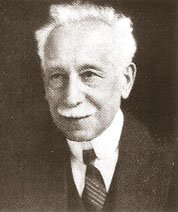 Sylvain
Levi (1863-1935) French scholar, and Orientalist who wrote on
Eastern religion, literature, and history. Levi
was appointed a lecturer at the school of higher studies
in Paris (1886), he taught Sanskrit at the Sorbonne (1889-94) and wrote his
doctoral dissertation, Le Théâtre indien ("The
Indian Theatre"). Sylvain
Levi (1863-1935) French scholar, and Orientalist who wrote on
Eastern religion, literature, and history. Levi
was appointed a lecturer at the school of higher studies
in Paris (1886), he taught Sanskrit at the Sorbonne (1889-94) and wrote his
doctoral dissertation, Le Théâtre indien ("The
Indian Theatre").
In L'Inde
et le monde ("India and the World"), he discussed India's
role among nations. He writes:
"From
Persia to the Chinese Sea, from the icy regions of Siberia to the islands of
Java and Borneo, from Oceania to Socotra, India has propagated her beliefs, her
tales and her civilization. She has left indelible imprints on one-fourth of the
human race in the course of a long succession of centuries."
"She has
the right to reclaim in universal history the rank that ignorance has refused
her for a long time and to hold her place amongst the great nations summarizing
and symbolizing the spirit of Humanity."
(source: Discovery
of India - By Jawaharlal Nehru. p. 200 -210). Refer
to India
once ruled the Americas! – By Gene D Matlock.
 Edward Pococke
(1604–1691) English Orientalist has
asserted that Greek civilization, not accepting its language, is a local
variation of an Indian culture taken to Greece by early colonists from
India. Edward Pococke
(1604–1691) English Orientalist has
asserted that Greek civilization, not accepting its language, is a local
variation of an Indian culture taken to Greece by early colonists from
India.
He has also written that the:
"The Peruvians and their ancestors, the
Indians, are in this point of view at once seen to be the same people."
(source: India
in Greece - By Edward Pococke London.
1852 p. 174).
Colonel
James Tod (1782-1835)
author has said:
"It is ridiculous with all the
knowledge now in our possession, to suppose that the Hindus always confined
themselves within their gigantic barriers, the limits of modern India."
(source: Annals
and Antiquities of Rajasthan: or the Central and Western Rajput States of India
- By James Tod ISBN 8120612892 Volume II p. 218).
Robert Spence
Hardy (1803-1868) says in his book, Eastern
Monachism:
"The ancient edifices of Chichen in Central
America bear a striking resemblance to the topes of India."
(source: Hindu
Superiority - By Har Bilas Sarda p. 187).
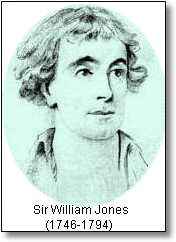 Sir
William Jones (1746-1794) judge of the Supreme Court at Calcutta and
was one who pioneered Sanskrit studies. His admiration for Indian thought and
culture was almost limitless. He has remarked: Sir
William Jones (1746-1794) judge of the Supreme Court at Calcutta and
was one who pioneered Sanskrit studies. His admiration for Indian thought and
culture was almost limitless. He has remarked:
"Rama is represented as a
descendant from the sun, as the husband of Sita, and the son of a princess named
Causelya. It is very remarkable that Peruvians, whose Incas boasted of the same
descent, styled their greatest festival Rama-Sitva; whence we may take it that
South America was peopled by the same race who imported into the farthest of
parts of Asia the rites and the fabulous history of Rama."
(source: Asiatic
Researches Volume I. p. 426). Refer to chapter on Quotes.
"Those
who arrived first on the subcontinent, later to be known as America, were groups
of men driven by that mighty current that set out from India towards the
East."
(source: India: Mother
of Us All - Edited by Chaman Lal - Official
History of Mexico p. 90).
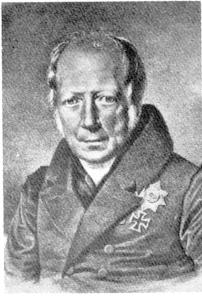 Wilhelm von Humboldt (1767-
1835) Prussian minister of education, a brilliant linguist and
the founder of the science of general linguistics. Wilhelm von Humboldt (1767-
1835) Prussian minister of education, a brilliant linguist and
the founder of the science of general linguistics.
A century and half ago
an eminent a scholar as Alexander Von Humboldt was convinced of the Asiatic
origin of the American Indian high civilization.
However, when, in
the second half of the 19th century, evolutionist (or rather,
pseudo-evolutionist) ideas captured the imagination of anthropologists, it
seemed no longer necessary to have recourse to the supposition of real contacts
in order to explain the similarities between New and Old world
civilization.
These "evolutionist" ideas have long
since been abandoned, but, curiously enough, the belief in the independent
origin of American Indian civilizations was nevertheless retained. This lack of
logic results in a truly paradoxical situation. No archaeologist today would
attribute to prehistoric Europeans the independent invention of bronze casting,
iron work, the wheel, weaving, pottery, writing and so many other cultural
elements derived from the Near East. Thus what is not conceded to the
inhabitants of the British Isles is willingly conceded to the American
Indians.
Isn't our credulity being taxed too much when we
are asked to believe that a whole series of complicated techniques, like casting
by the lost wax method, the extraction of tin from cassiterite, the alloying
copper and tin, the coloring of gold by chemical processes, weaving, tie-dying
and batik were by a real miracle invented twice, once in the Old World and once
in America?
And what mysterious law
of psychology would have caused the peoples of America, as well as those of
Asia, to invent the parasol and to use it as an emblem of rank and royalty, to
invent the same game with rather complicated rules (pachisi in India and
Southeast Asia, patolli in Mexico), to imagine similar cosmological systems, and
to attribute certain colors to the different directions? After all,
the south is not really red, the east not blue, etc, and the idea is singular
enough to make us doubt that it was conceived more than once.
He remarks on the Mexican deity: "It
presents some remarkable and apparently not accidental resemblances with the
Hindu Ganesh."
(source: Hindu
Superiority - By Har Bilas Sarda p. 188).
 Ephraim
George Squier (1821-1888) was United States Charge d'affaires to
Central America in 1849 and author of Peru; Incidents of Travel and Exploration
in the Land of the Incas and The Serpent Symbol, and the Worship of the
Reciprocal Principles of Nature in America. Ephraim
George Squier (1821-1888) was United States Charge d'affaires to
Central America in 1849 and author of Peru; Incidents of Travel and Exploration
in the Land of the Incas and The Serpent Symbol, and the Worship of the
Reciprocal Principles of Nature in America.
Comparing the temples of India, Java and Mexico,
he wrote
nearly a hundred years ago:
"a proper examination of these monuments
would disclose the fact that in their interior as well as their exterior form
and obvious purposes, these buildings (temples in
Palanque, Mexico) correspond
with great exactness to those of
Hindustan..."
Squier further wrote:
"The Buddhist temples of Southern India, and of the
islands of the Indian Archipelago, as described to us by the learned members of
the Asiatic Society and the numerous writers on the religious and antiquities of
the Hindus, correspond with great exactness in all their essential and in many
of their minor features with those of Central America."
(source: The
serpent symbol, and the worship of the reciprocal principles of nature in
America - By Ephraim
George Squier and India: Mother
of Us All - Edited by Chaman Lal p. 91).
 Sir Stamford Raffles
(1781-1826)
the British Governor of Java, and
and founder of Singapore as a British colony and author of the book
History
of Java, expressed a similar view when he wrote: Sir Stamford Raffles
(1781-1826)
the British Governor of Java, and
and founder of Singapore as a British colony and author of the book
History
of Java, expressed a similar view when he wrote:
"the great temple of Borobudur in
Java might readily be mistaken for a Central American temple."
(source: India: Mother
of Us All - Edited by Chaman Lal p. 91).
Dr Baron
Robert Freiherr von Heine Geldern
(1885 - 1968) and
Gordon F. Ekholm (1909 - 1987) World's leading
anthropologists, have said:
"Ships
of size that carried Fa-Hien
(399-414 AD) from India to China (through stormy
China water) were certainly capable of proceeding all the way to
Mexico and Peru by crossing the Pacific. One thousand years before
the birth of Columbus Indian ships were far superior to any made in
Europe up to the 18th century."


Dr
Robert Heine Geldern and
Gordon F. Ekholm
"Many of the peoples of Southeastern Asia
had adopted Indian Hindu-Buddhist civilizations. And they seem to have continued
these voyages to America....The influences of the Hindu-Buddhist culture of
Southeast Asia in Mexico, and particularly, among the Maya, are incredibly
strong, and they have already disturbed also some Americanists who don't like to
see them but cannot deny them."
Monroe Doctrine' which
demands that everything American belongs to America, and must have been wholly
invented there. In the Monroe
Doctrine, the US pledged to intervene in Central America to protect
US interests and keep out foreign influence. The Doctrine has functioned as a
declaration of hegemony and a right of unilateral intervention over the nations
of the Western Hemisphere.
For
more on The Glorious Hindu Legacy: Indic influence in
Southeast Asia refer to the chapters under Glimpses
XII to Glimpses
XIX. Refer
to Who
Discovered America? - By Ricardo Palleres.
***
Robert Heine-Geldern and
Gordon F. Ekholm have further noted:
"Many of the peoples of Southeastern Asia
had adopted Indian Hindu-Buddhist civilizations. And they seem to have continued
these voyages to America....The influences of the Hindu-Buddhist culture of
Southeast Asia in Mexico, and particularly, among the Maya, are incredibly
strong, and they have already disturbed also some Americanists who don't like to
see them but cannot deny them."
"The large number of highly specific
correspondence in so many fields preclude any possibility of mere accidental
coincidence. Nor would it help us to take refuge in any kind of explanation
based on some alleged psychological laws...There is no explanation other that
the assumption of cultural relationship. We must bow to the evidence of facts,
even though this may mean a completely new start."
 Prichard James Cowles (1786
- 1848) was a physician and ethnologist. His special treatise containing Celtic
compared with Sanskrit words
appeared in 1831 under the title Eastern Origin of the
Celtic nations. Prichard James Cowles (1786
- 1848) was a physician and ethnologist. His special treatise containing Celtic
compared with Sanskrit words
appeared in 1831 under the title Eastern Origin of the
Celtic nations.
He wrote:
"Aryavarta was the holy land of the Brahmans, the country lying between the
Himalayas and Vindhya mountains, which was the ancient abode of the Hindoos...
There
the Hindoos had the seat of their early existence five and twenty centuries
before the Christian era, and thence they appear gradually to have
spread...."
(source: The
Natural history of man; comprising inquiries into the modifying influence of -
By Prichard
James Cowles p. 164. The
Civilizations of Ancient America: The Selected Papers of the
XXIXth International Congress of Americanists - edited
Sol Tax 1951).
 Professor
Fredrick W Putnam (1839 - 1915) Peabody Museum of American
Archaeology and Ethnology at Harvard to the history of U.S. archaeology between
his appointment as professor in 1866 and his death in 1915. Putnam was also
active in institutional developments at
Chicago
,
Berkeley
, and
New York
. Professor
Fredrick W Putnam (1839 - 1915) Peabody Museum of American
Archaeology and Ethnology at Harvard to the history of U.S. archaeology between
his appointment as professor in 1866 and his death in 1915. Putnam was also
active in institutional developments at
Chicago
,
Berkeley
, and
New York
.
He
who
held throughout his life a conviction that the
Americas
received their greatest cultures through
Asia.
He found
in the jungles of Honduras a sculpture which greatly resembles Buddha. According
to the July, 1901 issue of American Harper's Magazine, it has been proved with
evidence that five Buddhist monks had reached Mexico in ancient times, via
Alaska.
John
Alden Mason (1885 – 1967) author of The
Ancient Civilizations of Peru, says that:
“Transoceanic
migrations to
America
have always been a favorite creed of those with the will to believe, but until
quite recently anathema to all reputable American anthropologists.”
 Mrs. Zelia Nuttal
(1857 -1933) Archaeologist and ethnologist has said: Mrs. Zelia Nuttal
(1857 -1933) Archaeologist and ethnologist has said:
"No country in the world can compare with India for the exposition of the
pyramidal cross. the body of the great temple of Bidh Madhu (formerly the boast
of the ancient city of Benares...demolished in the 7th century) was constructed
in the figure of a colossal cross, with a lofty dome at the center, above which
rose a massive structure of a pyramidal form. At the four extremities of the
cross there were four other pyramids...A similar building existed at Mathura. By
pyramidal towers placed crosswise, the Hindu also displayed the all-pervading
sign of the cross. At the famous temple of Chidambaram, on the Coromandel coast,
there were seven lofty walls, one within the other, round a central quadrangle,
and as many pyramidal gateways in the midst of each side which forms the limbs
of a vast cross."
(source: Zelia
Nutall and Peabody
Museum Papers volume II p. 161-162 and Proof
Vedic Culture's Global Existence
- By Stephen Knapp p. 252 - 253).
 B.G. Sidharth
(1948 - ) of the Birla
Science Center has remarked: B.G. Sidharth
(1948 - ) of the Birla
Science Center has remarked:
"It
is also interesting to note that the Mayan calendar began with a date around
3112 B.C., very close to the Hindu traditional beginning of the Kali Yuga/Age
viz., 3102 B.C. This period in
India
corresponds to the
Indus
valley or Harappan civilization which lasted for a few thousand years, at least
up to the first millennium B.C., or even later.
The period around the first
millennium B.C. is also the period of the Epic
Mahabharata. Marine archaeological researches in the Dwaraka
region of
Western India
put this period near 1500 B.C. In
fact the Mahabharata period of
India
overlapped the
Indus
valley period. Arjuna one of the heroes of the Mahabharata was a friend of
Maya, an expert architect and he had also married a Naga princess, two facts,
which, as will be seen now could be of significance. Maya himself is described
as an Asura, as contrasted with Devas (literally bright ones), an other fact of
significance."
(source:
The
Astronomical Link between
India
and the Mayans – By B G Sidharth).
 C
K Raju (1954 - ) holds a Ph.D. from the
Indian Statistical Institute. He taught mathematics for several years before
playing a lead role in the C-DAC team which built Param:
India
’s first parallel supercomputer. His earlier book ‘Time: Towards a
Consistent Theory’ set out a new physics with a tilt in the arrow of time. He
has been a Fellow of the Indian Institute of Advanced Study and is a Professor
of Computer Applications. C
K Raju (1954 - ) holds a Ph.D. from the
Indian Statistical Institute. He taught mathematics for several years before
playing a lead role in the C-DAC team which built Param:
India
’s first parallel supercomputer. His earlier book ‘Time: Towards a
Consistent Theory’ set out a new physics with a tilt in the arrow of time. He
has been a Fellow of the Indian Institute of Advanced Study and is a Professor
of Computer Applications.
He has observed that:
"Doctrine
of Christian Discovery - According
to which only Christians could be regarded as discoverers.
The
church decreed that ownership of a piece of land must go to the first Christian
to spot it. (Hence, the claim that
Columbus
“discovered”
America
, or that Vasco da Gama “discovered” India). The people already living on the land did not matter, and the church
encouraged their killing on a mass scale, where possible, as actually happened
on three continents.
This
doctrine was made into a law by the
US
supreme court, and that is where the current US law on land-ownership vis-a-vis
the “Red Indians” stands."
(source: Newton
as Theologian
- By C K Raju).
Refer to Five
Hundred Years of Injustice.
For
Hindu Astronomy refer to chapter Hindu
Culture
Ancient
Indians knew Atlantic Ocean
Buddhist
Jataka stories wrote about large Indian ships carrying seven hundred
people. In the Artha Sastra, Kautilya
wrote about the Board of Shipping and the Commissioner of Port who supervised
sea traffic. The Harivamsa informs that the
first geographical survey of the world was performed during the period of
Vaivasvata. The towns, villages and demarcation of agricultural land of that
time were charted on maps. Brahmanda Purana
provides the best and most detailed description of world map drawn on a flat
surface using an accurate scale. Padma Purana says that world maps were prepared
and maintained in book form and kept with care and safety in chests.
Surya
Siddhanta speaks about construction of wooden
globe of earth and marking of horizontal circles, equatorial circles
and further divisions. Some Puranas say that the map making had great practical
value for the administrative, navigational and military purposes. Hence the
method of making them would not be explained in general texts accessible to the
public and were ever kept secret. Surya Siddhanta says that the art of
cartography is the secret of gods. This being the general thinking at those
times, yet, there was one group of people who realized that the maps or the
secret texts that contained the geographical surveys will not last a very long
time. Only cryptology using words and names would last longer than any.
(source: Ancient Indians knew Atlantic Ocean - By Dr.
V.Siva Prasad Retired Professor of Engineering. Andhra University,
India).
Calendrics
and Astronomical computations
The ancient Hindu and
Mayan civilizations exhibit other interesting convergences. Hindu records say
that a member of a great race which preceded ours, a highly-developed personage
known as Asuramaya, learned all the basic
cosmic cycles and used his knowledge to determine the durations of the various
geological and cyclical periods of human evolution. The chronology and
computations of their still used Tamil calendar, say the Brahmans, are based
upon the works of Asuramaya and upon carefully maintained collateral zodiacal
records. Their most ancient extant work on astronomy, the Surya
Siddhanta, says that Asuramaya lived toward the end of the Krita-yuga,
a former age that ended approximately 2,165,000 years before the present. This
would place Asuramaya at something less than 2.5 million years ago.
The name Asuramaya is a
compound of the two Sanskrit
words, Asura and Maya. The personage himself is Maya, the prefix Asura
signifying that Maya was of the Asuras, a name given to a certain caste or
people of the great prehistoric race that preceded our own, or Aryan humanity.
The word Asura derives from surya, Sanskrit for the sun. In accordance with the
archaic Indian manner of describing the matter, the astronomer named Maya was
said to have gained his knowledge from studying the sun. The sun and its
encircling planets also occupied the central attention of the Mayan astronomer
caste in
Central America.
The early Hindu thinkers
visualized the passage of a race from its birth to its close as embracing four
distinct phases or yugas, and they said that races overlapped each other in
duration. According to their calculations, the world, in other words our present
race, entered the fourth of its phases, which they term the Kali
yuga or Iron age, in the year 3102 BC. This event coincided with the
death of
Krishna
, whom they describe as an avatara or incarnation of a lofty divine-spiritual
being or messiah. His departure from the earth is said to have ushered in new
and different conditions affecting our race. Modern students of the ancient
Mayan numerical glyphs have found that the dating of major series of events
noted on Mayan stelae invariably give such reckonings in terms of the
time elapsed since a date known as 4 Ahau 8 Cumhu. They know
that for the Maya chroniclers this date represented a commencement point in
time-reckoning of such awesome magnitude that it was central to all else in
subsequent Maya history; but they don't know what it meant or why it was so
important to the latter.
Among other ancient
nations only one, the Hindu peoples of the Indian subcontinent, is known to have
developed a system of calendrics accounting for such vast periods of time.
For
computing the age of the earth and various geological and other epochs, as well
as the age of mankind, the learned Brahman caste still employs a Tamil calendar
derived from archaic astronomical data, known as the "Tirukkanda
Panchanga" (cf. The Secret Doctrine,
2:49-51).

Indic
Influence is South east Asia: Chandi Sukuh Hindu Temple dedicated to Bhima of
Mahabharata in Indonesia strikes a disquieting alien chord with its flat topped step
pyramid and its Mayan calendar carvings.
The
religious structures in Java are commonly called Chandis, a term which
originally meant a commemorative building.
In general layout, the temple conforms to the plan of most other
Hindu temples. There are three precincts, consisting of three concentric
terraces. However, where most temples would have a large square shrine, Candi
Sukuh has a pyramid reminiscent of Mayan structures from
Central America.
The
Hindus are also the only older people besides the Mayans who are known to have
employed the concept of zero in their mathematics.
Refer
to chapters on Sacred
Angkor and Glimpses
XII and Quotes
and Seafaring
in Ancient India. Refer
to Who
Discovered America? - By Ricardo Palleres.
***
This calendar contains a
calculation of something over three hundred millions of years for the age of the
present earth since sedimentation occurred, and a period of somewhat more than
eighteen million years since the first appearance of our mankind.
The
Hindus are also the only older people besides the Mayans who are known to have
employed the concept of zero in their mathematics.
When it comes to human history, however, our scholars hesitate and grow uncertain
about man as civilized homo sapiens
even as late as 10,000 BC, whereas Hindu savants routinely regard him as at
least eighteen million years old -- and if we could read more of the Mayan
historical records we might find in them a similar calculation.
The
Mayans invented a solar "civil" year of 365 days. We know, however,
that they made calendrical emendations and developed a more precise notion of
solar time than that embodied in our own calendar.
(source:
Ciphers
and Civilizations
- By
Blair A Moffett -
Sunrise
magazine, January 1973. Theosophical University Press).
For more
refer to chapter on Greater
India: Suvarnabhumi and Sacred
Angkor and
Seafaring in Ancient India.
***
Indian
Foam on Pacific Waves
D P Singhal,
( ? ) Professor of History at the University of Queensland and author of the
book, India and World Civilization has observed:
“The art of shipping and
navigation in
India
and China
at the time was sufficiently advanced for oceanic crossings."
"It is asserted that
it would have been unlikely for a large number of people to have crossed the
vast expanses of the Pacific without well-equipped boats and skilful voyagers.
The argument, however, falls upon closer scrutiny. It would not be at all
difficult for a large canoe or catamaran
(from Tamil kattu "to tie" and
maram "wood, tree" is a type of boat or ship consisting of two hulls
joined by a frame) to cross from Polynesia to
South America
even at the present time, and the ancient Asians were skilled and enterprising
seafaring men. In ancient times the Indians excelled in
shipbuilding and even the English, who were attentive to everything which
related to naval architecture, found early Indian models worth copying. The
Indian vessels united elegance and utility, and were models of fine workmanship.
 Sir John Malcolm
(1769 - 1833) was a Scottish soldier, statesman, and historian entered the
service of the East India Company wrote about Indian vessels that they: Sir John Malcolm
(1769 - 1833) was a Scottish soldier, statesman, and historian entered the
service of the East India Company wrote about Indian vessels that they:
“are so admirably adapted to the purpose for which they are required that, not
withstanding their superior science, Europeans were unable, during an
intercourse with India for two centuries, to suggest or at least to bring into
successful practice one improvement.”
(source: India
and World Civilization
- By D P Singhal part
II p. 76 - 77). Refer to chapter on Seafaring
in Ancient India.
***
The first Maya Empire had been founded in Guatemala at about the
beginning of the Christian era. Before the fall of Rome the Mayas were charting accurately
the synodical revolutions of Venus, and whilst Europe was still lingering in the Dark Ages
the Maya civilization had reached a peak of greatness.
It is significant that the zenith of Maya
civilization was reached at a time when India had
also attained an unparalleled cultural peak during the Gupta period,
and Indian cultural intercourse with Southeast Asia, the Gupta period had begun more than a century before
the Mayan classical age in 320 and Buddhism and Hinduism had been well
known in neighboring countries for centuries. If
there was contact between Mayan America and Indianized Southeast Asia, the simultaneous
cultural advance would not appear surprising. In
marked contrast, this was the darkest period in Europe's history between the sack of Rome
and the rise of Charlemagne.
The most important development of the ancient American or
Asiomerican culture took place in the south of the United States, in Mexico, in
Central
America, and in Peru. The early history of Asiomericans is shrouded in mystery and
controversy due to the absence of definitive documentary evidence, which was destroyed by the
European conquerors in their
misguided religious zeal.
 However, it appears that after the discovery of introduction of
maize into Mexico, Asiomericans no longer had to wander about in search of food. Men in
America, as in other parts of the world, settled down to cultivate food and culture, a
by-product of agricultural life, inevitably followed. However, it appears that after the discovery of introduction of
maize into Mexico, Asiomericans no longer had to wander about in search of food. Men in
America, as in other parts of the world, settled down to cultivate food and culture, a
by-product of agricultural life, inevitably followed.
Of the Asiomerican civilizations, the best known are
the Maya, the Toltec, the Aztec, and the Inca. The Mayas were possibly the earliest people to found a civilization
there; they moved form the Mexican plateau into Guatemala. They were later pushed out,
presumably by the Toltecs, who, in turn were dislodged by the Aztecs.
(For holocaust inflicted against the Indians,
please refer to a well written and thought provoking book Conquest
of Paradise: : Christopher Columbus and the Columbian
Legacy - Kirkpatrick Sale
for
more on Spanish greed and their lust for gold).
Justifying
Brutal Colonization?
The
European conquerors of South and Central America not only destroyed practically
all the records and literature of AsioAmerica, but created an utterly distorted
image of the American past by taking some of its ugly features out of context
and magnifying them out of proportion.
For instance,
human sacrifice practiced by the Aztecs was repeatedly stressed without
explaining its extenuating features, and without pointing out that human
sacrifice had not been unknown to other peoples, such as in Egypt,
Rome
and in the Bible.
Taking their technique a step further they contrasted
this picture with that of their own deeds in Asioamerica in which European
misdemeanor, caprice, and criminality were soft-pedaled and civilized and
humane behavior emphasized.
Most people believe that Asioamericans
were uncivilized hordes with an occasional freak of knowledge, who had
contributed nothing of permanent value to civilization by 1492. Despite a good
deal of information to the contrary, there is resistance to accepting a change
in this image. Misconceptions multiply fast but die slowly.
(source:
India
and World Civilization
- By D P Singhal part
II p. 39 – 42).
Top of Page
Imprint
of Hindu Culture
 Ambassador Miles
Poindexter (1868 - 1946) states in his book, The Ayar-Incas: Ambassador Miles
Poindexter (1868 - 1946) states in his book, The Ayar-Incas:
"Aryan words and people came to America by
the island chains of Polynesia. The very name of the boat in Mexico is a South
Indian (Tamil) word: Catamaran.
(source: The
Ayar-Incas - By Miles Poindexter
published by Horace Liveright New York volume 1-2. 1930).
Hindu were mighty navigators and pioneers of
cultures centuries before Columbus was born. They established their cultural
empires in Java, Balim Sumatra, Borneo, Philippines, Cambodia, Champa, Burma,
Thailand and ruled there till the fourteenth century.
(please refer
to chapter on Greater India or Suvarnabhumi).
The emigrant races of
India took with them, wherever they went, (Southeast Asia or America) their
system of measurement of time, their local gods, their customs, including games,
dances and ceremonials. The belief in the four Hindu Yugas (epochs), the
existence in America of the Hindu Gurukala scheme of education, the Hindu
Panchayat System, the bazaar economy, the Soma Yagna (sacrifice), the worship of
Indra, Trinity and Hindu gods and others.
Both the Hindus and Americans used similar items in their worship
rituals. They both maintained the concept of four
Yuga cycles, or cosmological seasons, extending over
thousands of years, and conceived of twelve constellations with reference to the sun as
indicated by the Incan sun calendar.
 Royal insignias, systems of government, and practice
of religious dance and temple worship all showed remarkable similarities, pointing
strongly to the idea that the Americas were strongly influenced by the Aryans. The theory
is found in the Vedic literature of India. The ancient Puranas (literally, histories) and
the Mahabharata make mention of the Americas as lands rich with gold and silver.
Argentina, which means "related to silver", is thought to have been named after
Arjuna (of silver hue). Royal insignias, systems of government, and practice
of religious dance and temple worship all showed remarkable similarities, pointing
strongly to the idea that the Americas were strongly influenced by the Aryans. The theory
is found in the Vedic literature of India. The ancient Puranas (literally, histories) and
the Mahabharata make mention of the Americas as lands rich with gold and silver.
Argentina, which means "related to silver", is thought to have been named after
Arjuna (of silver hue).
Jean
Frederick Waldeck (1766-1875) was a French
antiquarian, cartographer, artist and explorer.
He
sketched the Maya ruins, and believed that the Maya had developed from
Old World
stock and saw Hindu influences in the glyph.
(source:
The
Magnificent Maya – Lost Civilizations – Time Life Books p. 20 – 21 and The Ayar-Incas - By Miles Poindexter
published by Horace Liveright New York volume 1-2. 1930). Refer
to Who
Discovered America? - By Ricardo Palleres.
Top of Page
Ancient
Indians called the Other Hemisphere Pataladesa
Dr. Balaram Chakravarti
author of The Indians And The Amerindians
has written:
It will be evident from a close study of the
texts of Indian Astronomy that Latin America was known to ancient Indians, who
called it Pataladesa. The Surya
Siddhanta, a textbook of Astronomy, composed before 500 A.D.
identifies and describes Pataldesa in very clear and definite terms in the
chapter of geography (chapter xii).
The Surya Siddhanta categorically says that the
Devas and Asuras live on the earth. The Devas live in the northern hemisphere
while the Asuras live in the Southern hemisphere and have a tradition of enmity
against each other. It further says that the ocean which surrounds the poles of
the earth has divided the planet into two great continents, viz. the continent
of the Devas and the continent of the Asuras. The Brahmanas of India write the
epithet Deva-Serman after their names thus describing themselves as the Devas.
When the Sun is in the northern hemisphere eg. in
Aries, he appears first to the Devas, and again when the Sun is in the southern
hemisphere, he appears first to the Asuras. When the Sun is on the Equator both
the Devas and the Asuras find the Sun in the middle and the days and nights are
equal. As the Sun proceeds to the northern hemisphere, the Devas experience
summer because of the directness and intensity of the solar rays, the Asuras do
not get the rays so directly then and its intensity is also less, the sun being
in the northern hemisphere. Hence they experience winter during this time. This
obviously indicates that Pataldesa was South America.
The Surya Siddhanta explains how the people
living on opposite ends of the globe consider themselves, wrongly, as living on
the upper and lower part of the globe, though there cannot really be an upper or
lower part, of the globe, which moves in vaccuum.
Maya, the author of Surya Siddhanta, also
mentions the four great cities situated on the opposite ends of the world,
equidistant from one another. 1. Yamakotipura in Bhadrasvavarsa (Indonesia?) in
the east, Lanka in Bharatvarsa (India) in the south and 3. Rome in Ketumalavarsa
(Europe) in the west and Siddhapura in Kuruvarsa (America?) in the north.
The celebrated astronomer Bhaskaracarya
mentions the time difference between the important cities situated in different
parts of the world in his Siddhanta Siromani
(Goladhyaya) thus:
"When the sun rises at Lanka, the time as
at Yakakotipura to the east of Lanka, will be midday. Below the earth at
Siddhapura, it will be twilight then, and at Romakadesa in Europe, the time will
be midnight."

Accurate time difference of places around the
world found in ancient Sanskrit texts
(image source: The Indians And The Amerindians - By Dr. B. Chakravarti
p. 34-110).
For
more refer to chapter on Greater
India: Suvarnabhumi and Sacred
Angkor and
Seafaring
in Ancient India. For
Hindu Astronomy refer to chapter Hindu
Culture. Refer
to India
once ruled the Americas! – By Gene D Matlock
***
From such location of places round
the globe and the movement towards the east, it appears that many Indian
merchants used to sail frequently and some even settled down in Indonesia and
Indochina, who used to relay on to Polynesia and then further on to South or
Middle America, may be not a single ship and in a single effort, but after
stopovers at the important ports on the other islands-chain of which seems to
have existed then and some of which submerged later because of tectonic
movements. It seems that some contact with the cities mentioned by
Bhaskaracharya might have existed till his time.
Baron Robert
Freiherr von Heine Geldern (1885 - 1968) and Gordon
F. Ekholm (1909 - 1987) the world's
leading anthropologists, have strongly supported the claim that Indian ships
went all the way to Mexico and Peru centuries before Columbus.
In the "Civilizations
of Ancient America" they state:
"There appears to be
little doubt but that ship building and navigation were sufficiently advanced in
southern and eastern Asia at the period in question to have made trans-Pacific
voyages possible. In the third century, horses were exported from India to the
Malay Peninsula and Indo-China, an indication that there must have been ships of
considerable size."
(source: India: Mother
of us All - Edited by Chaman Lal p. 43-44).

Sailor dropping anchor at
Angkorwat, Cambodia.
"Those who believe the
ancient peoples of Asia were incapable of crossing the ocean have completely
lost sight of what the literary sources tell us concerning their ships and their
navigation."
Large
four-masted ships possessed by the Indians at the time made crossing the Pacific
perfectly feasible.
Amaravati,
India was particularly important in the colonization of Southeast Asia, thus making
sensible the relation of lotus friezes of second century Amaravati with
water-lily friezes of Chichen Itza.
(image
source:
Transoceanic
Contacts Between the Old and New World).
US
Government recently adopted the ancient
Indian catamaran-making technology to construct fast ships. The
ships, built with technology adapted from ancient Tamil methods to make
catamarans, can travel over 2,500 kms in less than 48 hours, twice the speed of
the regular cargo ships. Refer to chapter on Seafaring
in Ancient India.

India
was the spark that fired the blaze.
Ancient Indian
ocean-going ship arriving at Java, from a frieze of the Borobodur stupa.
For
more refer to chapter on Greater
India: Suvarnabhumi and Sacred
Angkor and Seafaring
in Ancient India. Refer
to India
once ruled the Americas! – By Gene D Matlock
and Who
Discovered America? - By Ricardo Palleres.
***
Dr. Robert Heine Geldern anthropologist, has
written that:
"Those who believe the ancient peoples of Asia were incapable
of crossing the ocean have completely lost sight of what the literary sources
tell us concerning their ships and their navigation. Many of the peoples of
Southeastern Asia had adopted Indian Hindu-Buddhist civilizations. The
influences of the Hindu-Buddhist culture of southeast Asia in Mexico and
particularly, among the Maya, are incredibly strong, and they have already
disturbed some Americanists who don't like to see them but cannot deny
them." "Ships that could cross the Indian Ocean were able to cross the
Pacific too. Moreover, these ships were really large. The Periplus of the
Erythraean sea mentions the large ships of Southern India which engaged in trade
with the countries of the East. A Chinese source of the third century A.D.
describes vessels from Southern Asia which were 150 feet in length, and had four
masts and were able to carry six to seven hundred men and one thousand metric
tons of merchandise when the Buddhist Pilgrim Fahien returned from Sri Lanka to
China, in 414 A.D."
Alexander von Humboldt (1769-1859)
who spent fifty years doing research on Ancient America, said:
"It is surprising to
find, toward the end of the fifteenth century, in a world that we call
"New" the ancient institutions, the religious ideas, the forms of
edifices which, in Asia appear to belong to the first dawn of
civilization."
Those Indian ships that carried Fahien, the
Chinese historian and scholar through stormy China waters could without
difficulty proceed all the way to Mexico and other countries. A thousand years
before the birth of Columbus Indian ships could carry hundreds of
passengers.
Maya-Hindu
connection
Dr.
B. N. Narahari Achar is a professor of physics at the University
of
Memphis. He has recently become interested in the ancient astronomies of
India
and
Mesoamerica.
He
has observed:
"The
Mayan culture flourished in Mesoamerica
during the early Christian era, before being completely wiped out by the
Spanish conquest. Astronomy played a significant role in Mayan culture. Venus in
particular had a preeminent status. Testimony to this rich tradition is borne
out by Mayan temple art and the few available Codices, or sacred books, of the
Mayans. Western scholars have attempted to relate the Mayan concepts to those of
Greek astronomy. The sidereal Mayan astronomy is more
akin to the Hindu system and does not easily fit into the Greek model.

Chichen
Itza. This pyramid was built for astronomical purposes and during the vernal
equinox (March 20) and the autumnal equinox (September 21) at about 3 P.M.. the
sunlight bathes the western balustrade of the pyramid's main stairway. This
causes seven isosceles triangles to form imitating the body of a serpent 37
yards long that creeps downwards until it joins the huge serpent's head carved
in stone at the bottom of the stairway.
The Mayan
pyramid is similar to the temple-pyramids of Cambodia, and is reminiscent of a
prevalent concept in the Hindu-Buddhist world. It expresses the idea of erecting
an artificial mountain, like the Indian Mount Sumeru, the Mountain ascending to
Heaven.
It is said that Garuda represents the Vedas and the solar deities, and
Shesa Naga represents the watery deities. The serpent is of great significance in the Mayan
culture also. A supreme example is the serpent of sunlight and shadow seen at Chichén
Itzá. Kukulcan
appears to be Shesa Naga and Garuda combined into one.
The temple structure at the top
is
exactly 1/4th of the base according to Vastu Vedic principles of Mayan. Most interesting
is the name of the structure - chilambalam,
meaning a sacred space. The Mayans worshiped the very concept
of space, specifically a space made according to the modular system. This same idea is
found in Hinduism in the sacred room in the center of the Chidambaram Siva Temple in South
India, where space or akasha is worshiped-there is no idol. Mayan
chilambalam refers to a sacred space, as does Tamil Chidambaram. Yok'hah in
Mayan means "on top of truth," similar to yoga in Sanskrit.
(image
source: webmaster's own collection of photos taken
during a recent visit).

Bakong at
Angkorvat - Cambodia. Dedicated to Lord Shiva.
“Astronomically,
it (Angkor Wat) has built-in positions for lunar and solar observation. The sun
itself was so important to the builders of the temple that solar movement
regulates the position of the bas-reliefs. It is not surprising that Angkor Wat
integrates astronomy, the calendar, and religion since the priest-architects who
constructed the temple conceived of all three as a unity. Astronomy was known as
the sacred science."
“Transoceanic
migrations to America
have always been a favorite creed of those with the will to believe, but until
quite recently anathema to all reputable American anthropologists.” - wrote John Alden Mason,
author of The
Ancient Civilizations of Peru.
The
European conquerors of South and Central America not only destroyed practically
all the records and literature of Asioamerica, but created an utterly distorted
image of the American past by taking some of its ugly features out of context
and magnifying them out of proportion.
Human
sacrifice practiced by the Aztecs was repeatedly stressed without explaining its
extenuating features, and without pointing out that human sacrifice had not been
unknown to other peoples, such as in Egypt,
Rome
and in the Bible. Taking their technique a
step further they contrasted this picture with that of their own deeds in
Asioamerica in which European misdemeanor, caprice, and criminality were
soft-pedaled and civilized and humane behavior emphasized. (Refer to European Conquest and
Atrocities).
(image
source: webmaster's own collection of photos taken
during a recent visit).


Winged
human figures whose hands are poised in gestures like
Hindu/Buddhist mudras. Winged God from Candi Sukuh at Hindu Temple in Java,
Indonesia.
Ek
Balam -
Built atop the
base is Ek Balam’s massive main pyramid, reaching a height of 32 m and
sporting a huge jaguar mouth with 360 degree dentition. Below the mouth are
stucco skulls, while above and to the right sits an amazingly expressive figure.
On the right side stand unusual winged human figures
(some call them Maya angels), whose hands are poised in gestures looking for all
the world like Hindu/Buddhist mudras.
Its enough to make you wonder about connections between ancient
civilizations ……
(source:
Yucatan
- By Ray Bartlett and Daniel Schechter - Lonely Planet p. 202).
***
Striking similarity is
found between certain Mayan and Puranic stories, and their related astronomical
interpretation. In the Puranas, Lord Vishnu is represented as resting on the
serpent Ananta or Sesa, after having dissolved all creation. The serpent
represents the eternity of time (Ananta), and the "remainder" (Sesa) in
subtle form, of prakriti, the germ of all that has been and will be. After
waking up from the yoganidra, Vishnu rides on the eagle Garuda. Both Garuda and
Sesa are shown in association with Vishnu in the temples of India. It is said that Garuda represents the Vedas and the solar deities, and Sesa
represents the watery deities. The serpent is of great significance in the Mayan
culture also. A supreme example is the serpent of sunlight and shadow seen at Chichén
Itzá. At the time of the equinoxes, as the Sun moves from east to
west, a pattern of light and shadow appears on the west balustrade of the north
stairway of the Castillo at Chichén Itzá. This display resembles a descending
snake whose head is the monumental serpent head carved out of stone at the foot
of the stairs. The feathered serpent represents the Mayan God Kukulcan, who is
associated with rain water and new life, among other things. Kukulcan
appears to be Sesa and Garuda combined into one.
The devas and the asuras
churned the
Milky
Ocean
in search of amrita. Vishnu assumed the form of a tortoise and dived to the
bottom of the cosmic ocean. On his back, the devas and asuras placed the
mount
Mandara
as the churn and used the serpent Vasuki as the rope. From the churned
Milky
Ocean
emerged all planets, poisonous Halahala, many treasures, and finally, amrita.
The devas wanted the nectar only for themselves. However, a serpent asura named
Rahu, disguised as a deva, was able to get a share of amrita. The Sun and the
Moon discovered him. Rahu's head was instantly cut off. However, as he had
already ingested amrita, he could not be killed. To this day, the head of Rahu
attempts to swallow the Sun and the Moon. Rahu represents the ascending node of
the moon's orbit, and swallowing of the Sun and the Moon represent symbolically
the occurrence of the eclipses. There is a picture from the Maya
Codex Tro-Cortesianus. It shows a tortoise, a central churning rod
and a serpent being used as a rope by figures of dark and light shade. The
western scholars have found it difficult to interpret this picture, but the
similarity of the picture to the churning of the
Milky
Ocean
of the Puranas is remarkable. In the Dresden Codex
there are glyphs representing eclipses, depicting the Sun or the Moon as being
devoured by a serpent. The similarity to the Hindu
representation in which Rahu tries to devour the luminary object is
unmistakable."
(source: Maya-Hindu
connection - By Dr.
B. N. Narahari Achar - hinduismtoday.com).
 In 1866, the French architect, Eugene
Viollet-le-Duc (1814 - 1879) also noted striking resemblances between ancient Mexican
architectural structures and
those of South India. In 1866, the French architect, Eugene
Viollet-le-Duc (1814 - 1879) also noted striking resemblances between ancient Mexican
architectural structures and
those of South India.
Ephraim
George Squier (1821-1888) was United States Charge d'affaires to
Central America in 1849 also noted
similarities in both major and minor features of Buddhist temples of South India and
Mexico they were round and different colors were used on each of the four quarters.
Chicchan according to Mayan history is the serpent mind, the mind
that is constantly renewed and regenerated, through a process of shedding what
no longer serves us. The physical body itself can be seen as an evolutionary
skin periodically released, as one life ends and another begins. It is a body
fueled ultimately by a form of solar energy the Maya call kultunlilni. Kultunlilni
is the vital life force empowering all human growth and
development. This crucial life-force is the same as what is known in Hindu
cosmology as the serpent power: kundalini. Kundalini
is the great evolutionary force making of each body and its occupant, a
potentially powerful source of solar wisdom. Important for us to remember, however, is that this primary,
very intimate and very powerful source of wisdom is only accessible to the
extent that we are able to hear what our bodies, as carriers of its sacred gift,
are actually telling us. Inevitably in this process, we turn to those with whom
we feel a strong attraction or affinity. "
(source:
Aligning
With the Spirit of the Maya Calendar End-Date 2012 - By Dwayne Edward Rourke -
adishakti.org).
Top of Page
Similarities
Hindu-Mexican Trinity
Scholars were also greatly impressed by the
similarity between the Hindu Trinity - Brahma-Visnu-Shiva and the Mexican Trinity -
Ho-Huizilopochtli-Tlaloc as well as the likeness between Indian temples and American pyramids.


Huizilopochtli and Tlaloc.
The parallels between the Hindu Brahma-Vishnu-Shiva Trinity and the Mexican
Ho-Huitzilopochtli-Tlaloc Trinity, and the resemblances between the attributes of certain
Hindu deities and those of the Mayan pantheon are impressive.
***
The parallels between the Hindu Brahma-Vishnu-Shiva Trinity and the Mexican Ho-Huitzilopochtli-Tlaloc Trinity, and the resemblances between the attributes of certain
Hindu deities and those of the Mayan pantheon are impressive.
In the
book The Conquest of the Maya by J
Leslie Mitchell
explains that the basis of the old Maya empire was not of the
work of the ancestors of the present day Maya, but was an import from the same
foreigners that built the palaces and temples of the Chams and Khmers in Cambodia, and the temples in Java. He also points out the similarities between the Maya
rain-god Chac and the Vedic Indian Indra, and the Maya monkey-god and
the Vedic Hanuman. The Vedic origin is further enhanced by the frequency that
the elephant motif is found in Maya art, especially the earlier works of the
Maya, such as at Copan, although the elephant never existed in the region.
One
reason for these similarities between the
Americas
and India
is that in ancient Vedic times there were two great architects, Visvakarma
of the demigods or Aryans, and Maya of the asuras. Surya
Siddhanta was revealed to Mayasura
by Sun. The Mayan
people, also known as technicians, were no doubt named as such because of being
connected with this person named Maya or Mayasura and Maya Danava. They were a
part of his clan or tribe. They had fallen away from the Vedic way of life and
were sent or escaped to the region of
Central America
. They also carried with them much of the science of astronomy and navigation
for which this Mayasura was known. Mayasura’s knowledge is more fully
explained in the classic work of Indian Vedic astronomy known as the Surya
Siddhanta for which he is given credit. Many people have wondered from where the
Mayan acquired their astronomical knowledge. This would explain how the Mayan
people had such a high degree of understanding in astronomy, from which they
also developed their calendar. The Mayan calendar was a science they had long
developed, carrying it with them from their previous location and civilization.
Like the
Vedic culture, the Maya had a pantheon of demigods, many of which have
similiarities to the Vedic deities. Mayan gods like Xiuhtechutli and Xipe Totec
have their Vedic counterparts in Indra and Agni. Indra, like Xiuhtechutli, was
the rain god and guardian of the Eastern Quadrant, and Agni, similar to Xipe
Totec, was the god of sacrificial fire, born in wood and the life force of trees
and plants. Then there is the Vedic Ushas, the beautiful goddess of Dawn or Sky,
who is similar to the Mayan view of Venus, goddess of Dawn.
Furthermore,
hymn 121 of the book ten in the Rig Veda is
very similar to the description of creation as found in the Popul
Vuh.
(source: Proof
Vedic Culture's Global Existence
- By Stephen Knapp p. 246 - 247).
Dr. William Golden Mortimer
wrote in his book The
Divine Plant of the Incas 1901
“There has been frequent comparison by many writers
between the Incas and the Hindus because of their similar ceremonies, many of
their customs being identical. Like the Hindus, the Incas had the custom of deifying
attributes instead of, like the Greeks of making gods of men. Thus the sovereign
was the ruler of the four quarters of the globe while Brahma, had four heads,
which represents four quarters of the earth.


Hindu deity
Virabhadra and Inca God Viracocha
here has been frequent comparison by many writers
between the Incas and the Hindus because of their similar ceremonies, many of
their customs being identical.
***
In Quichua the language of the Incas, there are many
words resembling Sanskrit – as Inti – the sun, while Indra is the Hindu god
of the heavens. Raymi was the great Incan festival in honor of the sun, and Rama
was the child of the sun in
India
. Sita was the wife of Rama in Hindu mythology while Situ is one of the Incan
festivals.
Sun
Worship in both cultures
***

Martand Sun
temple, Kashmir - Dedicated to Lord Surya (Sun).

Konark Sun
temple - Orissa, India. Dedicated to Lord Surya (Sun)

Sun temple
of Modhera, Gujarat, India. - Dedicated to Lord Surya (Sun).

Korichancha
sun temple in Cuzco, Inca heartland of Peru.
No
people of the ancient world believed the "Sun" to be "God".
That belongs in the "disinformation file".
In
point of fact, every Ancient culture and nation on Earth have all used the Sun
as the most logically appropriate symbol to represent the Glory of the unseen
Creator of the heavens.
(image
source: webmaster's own collection of photos taken
during a recent visit to Peru).
***
(source: The
Divine Plant of the Incas - By Dr. William Golden Mortimer
p. 1 - 58). Refer to Sun
Worship.
According to
Donald A. Mackenzie writes in his book, Myths
of Pre-Columbian America:
"Tezcatlipoca, was like Hindu god
Kubera,
was a god of the north. The story of Yappan appears to be of Indian origin. The
story of the temptation and fall of Yappan is too like that of the temptation
and fall of his Indian prototype to be of spontaneous origin in the New World.
The conclusion drawn from the evidence of the Yappan myth that Hindu cultural
influences reached America is greatly strengthened when we find Acosta informing
us that certain Mexican ascetics, who assisted the priests, "dressed in
white robes and lived by begging." The wandering Brahmin and Buddhist
pilgrims in India similarly begged their food."
Same Aryan name of God: When Cortes invaded the
valley of Mexico he found that the Mexicans - through the chief motive of
his great adventure was to destroy their religion and to substitute his own, had
the same word for God that he himself had. His own (Spanish) was Dios, from
Greek Theos, the Mexican, as Cortes converted it to writing, was Teotl (Devata
or Deo in Sanskrit).
(source: The Ayar-Incas - By Miles Poindexter published by Horace Liveright
New York volume 1-2. 1930).
Churning of the Milky
Ocean
The Indian myth of the Churning
of the Milky Ocean reached America. In Codex
Cortes there is a grotesque but recognizable Maya representation of
the ocean churning. The tortoise, however, is on the summit of the
mountain-pestle instead of being beneath it, and the other form of the serpent
god appears above his avatar. Round the mountain-pestle is twisted a snake,
called "a rope" by Seler. Two dark gods, like the Indian Asuras, hold
one end of the snake-rope while the other end is grasped by the elephant headed
god. To the rope is attached a symbol of the sun (Kin).'
(source: Myths
of Pre-Columbian America - By
Donald A. Mackenzie p. 191- 229).
The Indian Elephant in
American Art
The American writer and explorer,
Mr. John L. Stephens, who, accompanied Mr. Catherwood, an accomplished artist,
visited the ruins of Maya civilization in Central America in the middle of last
century, detected the elephant on a sculptural pillar at Copan, which he
referred to as an "idol." A reproduction of one of the ornaments in
question should leave no doubt as to the identity of the animal depicted by the
ancient American sculptor. It is not only an elephant, but an Indian elephant
(Elephas
Indicus), a species found in India, Ceylon, Borneo and Sumatra. In India the
elephant was tamed during the Vedic period. It was called at first by the Aryo-Indians
"the beast having a hand". and ultimately simply Hastin "having a
hand". An elephant keeper was called Hastipa. The Maya long nosed god is
regarded by those who favor the hypothesis of direct or indirect Indian cultural
influence in America as a form of the Indian elephant-headed god, Ganesha.


The Indian elephant in America.
Elephant motif in Mayan sculpture, though elephants are unknown in America.
The Maya "long nosed
god" is regarded by those who favor the hypothesis of direct or indirect
Indian cultural influence in America as a form of the Indian elephant-headed God
Ganesha.
In the Codex Cortes, the
American elephant-headed god, who is decorated with the characteristic Cambodian
ear ornament, is shown with a thunderbolt in each hand standing besides a
bearded rattlesnake, whose body forms an enclosure full of water.
(image source: Myths of Pre-Columbian America - By Donald A.
Mackenzie p. 35 and 245).
***
Anthropology Professor Elliot Smith
comments:
"If it has been possible for complicated games (like Pachissi) to make
their way to the other side of the Pacific, the much simpler design of an
elephant's head could also have been transferred from India or to the Far East
to America."
(source: Myths
of Pre-Columbian America - By
Donald A. Mackenzie p. 28-35).
 Discussing the diffusion of
Indian religions to Mexico, a recent scholar, Paul
Kirchhoff (1900 - 1972) German
anthropologist from the University of Frankfurt,
in "The Diffusion of a Great Religious System from
India to Mexico" had even suggested that it is not simply
a question of miscellaneous influences wandering from one country to the other, but that
China, India, Java, and Mexico actually share a common system." Discussing the diffusion of
Indian religions to Mexico, a recent scholar, Paul
Kirchhoff (1900 - 1972) German
anthropologist from the University of Frankfurt,
in "The Diffusion of a Great Religious System from
India to Mexico" had even suggested that it is not simply
a question of miscellaneous influences wandering from one country to the other, but that
China, India, Java, and Mexico actually share a common system."
Kirchhoff has sought
"to demonstrate that a calendaric
classification of 28 Hindu gods and their animals into twelve groups, subdivided into four
blocks, within each of which we find a sequence of gods and animals representing Creation,
Destruction and Renovation, and which can be shown to have existed both in India and Java,
must have been carried from the Old World to the New, since in Mexico we find calendaric
lists of gods and animals that follow each other without interruption in the same order
and with attributes and functions or meanings strikingly similar to those of the 12 Indian
and Javanese groups of gods, showing the same four subdivisions."
(source: India
and World Civilization
- By D P Singhal part
II p. 62 – 63).
Trilokinath,
the Hindu ruler of the three worlds, was known to the Mexicans by the name,
until the Spanish conquerors mistakenly changed the name into Tloque
Nahuaque.
The God born from Lotus
Brahma, the supreme deity of the Hindus, was
"born from a lotus which grew out of the navel of the god Vishnu whilst
floating on the primordial waters." The Tibetan repeat "Om Mani Padme
Hum" (O, Jewel in the heart of the Lotus, Have mercy on me). The lotus as
the emblem of God was sacred in India. The Hindu goddess Maya, - "the
cosmic illusion" the female energy, "mother of gods and men" - is
sometimes represented as the sakti. This same "mother of the gods" was
carried to America and appeared in the Maya theogony of Yucatan under the same
name, - May, - in the same functions she performed in India. In Mexico, Maya was
also called "the mother of the gods". Other names for her were "nourisher
of the human race" "type of earth mother."
(source: The
Ayar-Incas - By Miles Poindexter
published by Horace Liveright New York volume 1-2. 1930 p. 133-135).

Narsingha - India

Narsingha - Mexico.
(image source: Myths of Pre-Columbian America - By Donald A.
Mackenzie p. 35 and 245).
For
more refer to chapter on Greater
India: Suvarnabhumi and Sacred
Angkor and
Seafaring
in Ancient India
***
In a temple in Guatemala is a statue
of an incarnation of Vishnu as Kurma, the tortoise. The sculpture is richly
detailed and strongly suggests that it might have been wrought by Hindu hands.
In Palenque Temple of the Sun in Mexico Surya occupies the place of honor.
 Even
Yama, the god of death of Hindu
mythology, has found his way to Mexico and Peru, while typically Hindu lotus and
chakras motifs adorn the temples. Maya and Aztec architectural styles are
remarkably similar to those in India and South east Asia. In both areas the
chief structures were pyramid shaped, with serpent balustrades and
surmounted Even
Yama, the god of death of Hindu
mythology, has found his way to Mexico and Peru, while typically Hindu lotus and
chakras motifs adorn the temples. Maya and Aztec architectural styles are
remarkably similar to those in India and South east Asia. In both areas the
chief structures were pyramid shaped, with serpent balustrades and
surmounted
Sir Edward
B. Taylor (1832 - 1917) English anthropologist also found the
counterparts of the tortoise myth of India in ancient America. He observed that:
"The
striking analogy between the tortoise myth of North America and India is by no
means a matter of new observation; it was indeed noticed by Jesuit
Father Lafitan
nearly a century and half ago."
Three greatest features of the Asiatic stories
are found among the North American Indians in their fullest and clearest
development..."
(source: Early
History of Mankind - By E. B. Taylor).
It is not without reason that the
Spanish author Lopez says in his book Le Races Aryans
de Peru:
"Every page of Peruvian
poetry bears the imprint of Ramayana and Mahabharata."


The Brahmananda or Egg of Brahma in India and
Chac mool statue:The
Egg and Serpent Legend in Mexico.
This complex Churning
of Milky Ocean reached America. In Codex
Cortes there is a grotesque but recognizable Maya representation of
the ocean churning. The tortoise, is, however, on the summit of the mountain
pestle instead of being beneath it, and the other form of the serpent god
appears above his avatar. Round the mountain-pestle is twisted a snake. Two dark
gods, evidently demonic forms of deities, like the Indian
Asuras, hold one end of the snake-rope while the other end is grasped
by the elephant god. To the rope is attached a symbol of the sun. (Kin).
(image source: Myths of Pre-Columbian America
- By Donald A.
Mackenzie p. 191 - 192).
For
more refer to chapter on Greater
India: Suvarnabhumi and Sacred
Angkor and Seafaring
in Ancient India. Refer
to India
once ruled the Americas! – By Gene D Matlock
***
The Mexican doctrine of the World's Ages - the universe was
destroyed four consecutive times - is reminiscent of the Indian Yugas.
Even the reputed
colors of these Mythical four ages, white, yellow, red and black are identical with and in
the same order as one of the two versions of the Indian Yugas.
In both myths the duration
of the First Age is exactly the same, 4,800 divine years. The Mexican Trinity is
associated with this doctrine as in the Hindu Trinity with the Yugas in India.
Donald Alexander Mackenzie (1873 - 1936)
writes in his book, Myths
of Pre-Columbian America
"The doctrine of the World's
Ages (from Hindu Yugas) was imported into Pre-Columbian America...the Mexican
sequence is identical with the Hindus....The essential fact remains that they
were derived from a common source...It would be ridiculous to assert that such a
strange doctrine was of spontaneous origin in different parts of the Old and New
Worlds." According to the Mayan calendar, which is extant, the
time record of the mayas began on 6 August 613 B.C. It is an exact date based upon
intricated astronomical calculations, and prolonged observations. To work out this kind of
elaborate calendar must have taken well over two thousand years of studying stars, and the
Asiomericans must have been remarkably shrewd observers."
Mayan
Calendar Corroborates Hindu Prophecy
Golden Age to begin in 2012
 In
the “Brahma-Vaivarta Purana”, Lord
Krishna tells Ganga Devi that a Golden Age will come in the Kali
Yuga - one of the four stages of development that the world goes through
as part of the cycle of eras, as described in Hindu scriptures. Lord Krishna
predicted that this Golden Age will start
5,000 years after the beginning of the Kali Yuga, and will last for 10,000
years. In
the “Brahma-Vaivarta Purana”, Lord
Krishna tells Ganga Devi that a Golden Age will come in the Kali
Yuga - one of the four stages of development that the world goes through
as part of the cycle of eras, as described in Hindu scriptures. Lord Krishna
predicted that this Golden Age will start
5,000 years after the beginning of the Kali Yuga, and will last for 10,000
years.
Mayan
Calendar Matches Hindu Calendar
It is interesting that this prediction of the emergence of a new world is
prophesied to appear about the same time that the Mayans predicted it to come!
The Mayan calendar began with the Fifth Great Cycle in 3114 BC and will end on
21 December 2012 AD.
The Hindu
Kali Yuga calendar began on 18 February 3102
B.C. There is only a difference of 12 years between the Hindu's
beginning of the Kali Yuga and the Mayan's beginning of the Fifth Great Cycle.
Golden
Age Could Begin in 2012
The ancient Hindus mainly used lunar calendars but also used solar calendars. If
an average lunar year equals 354.36 days, then this would be about 5270 lunar
years from the time when the Kali Yuga started until 21 Dec 2012. This is the
same year that the Mayans predict rebirth of our planet. It is also about 5113
solar years of 365.24 days per year, and is day number 1,867,817 into the Kali
Yuga. By either solar or lunar years, we are over 5,000 years into the Kali Yuga
and it is time for Lord Krishna's prophecy to happen according to the ancient
Hindu scriptures.
Lord
Krishna's Golden Age could easily begin in 2012!
Mayan
Prophecy Matches Hindu Prophecy
It is amazing that both calendars began at about the same time over 5,000 years
ago and both calendars predict a totally new world and/or golden age after about
5,000 years into their calendars! We are definitely on to something with these
Mayan and Hindu 2012 predictions.
(source: Golden
Age to begin in 2012 - By David
Hedges - about.com).


The Tree of Heaven in shadow
play figures from Java and so called "cross" from Palenque, Mexico.
(image source: India
and World Civilization - By D. P. Singhal p 58-59).
***
Donald Alexander Mackenzie (1873
- 1936) and other scholars, however, are of definite opinion that the ancient
Mexicans and Peruvians were familiar with Indian mythology and cite in support close
parallels in details. For instance, the history of the Mayan elephant
symbol cannot be traced in the local tradition,
whereas it was a prominent religious symbol in India. The African elephant has larger
ears. It is the profile of the Indian elephant, its tusk and lower lip, the form of its
ear, as well as its turbaned rider with his ankus, which is found in
Meso-American models. Whilst the African elephant was of little religious significance, it
had been tamed in India and associated with religious practices since the early days.
In Indian, Chinese and Japanese stories the Naga
or dragon dwells in a pool beneath a tree. The tree grows on an island in a
lake, or in the ocean. A lake island was associated with the American jewel
goddess Chalchiuhtlicue.
Later, two English scholars Channing
Arnold and Fredrick J. Tabor Frost, in their The
American Egypt, made a detailed examination of the transpacific contacts, reinforcing
the view of Buddhist influences on Central America.
The most recent and by far the most
systematic well-reasoned, and effective case has been advanced by the eminent
archaeologist, R. Heine-Geldern and Gordon Ekholm,
who favor Indian and Southeast Asian cultural influences on ancient
America through migration across the Pacific.
Astrology
Baron Alexander Von Humboldt, whilst visiting Mexico, found similarities between Asian and Mexican
astrology. He found that the systematic study of ancient American cultures and was
convinced of the Asian origin of the American-Indian high civilization. He said:
"if languages supply but feeble evidence of ancient communication between the two
worlds, their communication is fully proved by the cosmogonies, the monuments, the
hieroglyphical characters and the institutions of the people of America and Asia."
The lotus motif

Makara from Amaravati and makara from Chichen Itza (Heine-Geldern and
G.F. Ekholm
(image source: India
and World Civilization - By D. P. Singhal p 58-59).

Metal makara from India.
For
more refer to chapter on Greater
India: Suvarnabhumi and Sacred
Angkor and Seafaring
in Ancient India
***
The Makara
motif, a serpent head with upturned snout and with a human face in
its mouth, from India, Java, Bali and Sumatra, is comparable to the Mexican Xiuhcoatl, the fire serpent on the Aztec Sun Stone.
All sorts of architectural elements
are common to Mexico, Gautemala, India, Java and Indo-China, the most striking
of which are the pyramids with receding stages, faced with cut stone, and with
stairways leading to a sanctuary on top, also of stone; in many there are
surprising common traits such as serpent columns and banisters, vaulted
galleries and corbeled arches, attached columns, stone cut-out lattices, and
Atlantean figures, which are typical of Punuc style of Yucatan. The
most striking and highly specialized of these traits is the lotus motif
interpersed with seated human figures common to Chichen-Itza and Amaravati,
southern India. Amaravati is dated about the second century of our
era, but it exercised a powerful influence over the Hindu-Buddhist art of
Cambodia, Champa, and even modern Bali. It is significant that temple pyramids
in Cambodia do not antedate the eighth century, and only become important in the
ninth and tenth centuries, a time coinciding with the beginning of the Puncu
period of Yucatan according to Heine-Geldern and Ekholm, 1951).
The buildings of Chichen Itza show certain influences from
Southeast Asia; for example, the lotus motif occurs in the Mercado (covered market). The
Mercado is strikingly reminiscent of the galleries so typical of the Cambodian architecture that
eventually blossomed into the galleries of Angkor Vat.
The lotus motif, interspersed with seated human figures, which has a
deep symbolic meaning in Hindu and Buddhist mythologies and as such is an integral part of early Indian art,
especially of Amaravati, is found at Chichen Itza as a border in the reliefs of the lower room of
the Temple of Tigers. The similarity between the art of Amaravati and that of Chichen Itza
is particularly noticeable in reclining figures holding on to the rhizome of the lotus.

God on the lion throne from India, and Mayan jaguar
throne -Heine-Geldern and G.F. Ekholm
(image source: India
and World Civilization - By D. P. Singhal p 58-59).
***
The Mexican Lion-throne and Lotus-throne remind one of Indian Simhasana
and Padmasana. The parasol, a mark of royalty
amongst the Mayas, the Aztecs, and the Incas, may be an adaptation of the royal Chatra in
us in India and Indianized Asia from the earliest times.
A kind of caste system prevailed amongst the Incas of Peru.
Peruvians worshipped an omnipotent and invisible Supreme being, Viracocha, creator and
preserver of the world. Imprints of the Ramayana and the Mahabharata have been noticed on
the poetry of Peru. The official history of Mexico officially admits that
“those who arrived first on the continent later to be known as America were
groups of men driven by the mighty current that set out from India”.
Señor
Vincente Lopez, a Spanish gentleman of Montevideo, in 1872 published
a work entitled "Les Races Aryennes in Pérou,"
author of The
Aryan Races in Peru writes:
“Every page of
Peruvian poetry bears the imprint of Ramayana
and Mahabharata.”

The Lotus-motif from Amaravati and lotus-motif from Chichen Itza -By
Heine-Geldern and G.F. Ekholm
(image source: India
and World Civilization - By D. P. Singhal
p 58-59).
***
In Indian art the lotus rhizome frequently protrudes from the
mouths of makaras, sea monsterswith fish-like bodies and elephants-like trunks. At
Chichen Itza, stylized figures of fish are found at both ends of the lotus plant, in the same
position as the makaras in India.
"Such a combination of highly specific details cannot be
accidental. It suggests the existence of some kind of relationship between Maya art and
not only Buddhist art in general, but the school of Amaravati of the second century A.D.
in particular."
Ancient America was as rich in gods and temples as was India. The
Asiomerican term for god, "teo," is close to the Sanskrit 'deva".


From Borobudur - Suvarnabhumi
(top two images)

From America - Gautemala
For
more refer to chapter on Greater
India: Suvarnabhumi and Sacred
Angkor and Seafaring
in Ancient India
***
Use of Zero
The Mayas of Yucatan were the first people besides the Indians to
use a zero sign and represent number values by the position of basic symbols. The
similarity between the Indian zero and the Mayan zero is indeed striking. So far as the
logical principle is concerned, the two are identical, but the expressions of the
principle are dissimilar. Again, whilst the Indian system of notation was decimal, as was
the European, the Mayan was vigesimal. Consequently, their 100 stood for 400, 1000 stood
for 8000, 1234 for 8864. While the place of zero in the respective systems of the Indians
and Mayans is different, the underlying principle and method are the same, and the common
origin of the Mayan and Indian zeros appears to be undoubted. Disputes continue
amongst scholars in the absence of conclusive evidence. As chronological evidence stands
today, the Mayan zero appears to be anterior by several centuries to its Hindu
counterpart.
Corn
The Riddle of the Well-traveled Maize
The familiar maize plant – better known to Americans as corn
– has generated spirited scholarly debate that centers on the possibility of
ancient, unrecorded sea travel. Botanists know that maize cannot propagate
itself; its occurrence must therefore be the result of human agency. They also
know that the plant originated in the New World. And yet, researchers have found
evidence that is appeared elsewhere well before he known voyages of discovery
linked Old World with New.

Stone
images with corn in hand in Hindu temples, India.
"Like
corn decays the mortal like corn is he born again." - says the Katha
Upanishad 1-I-6.
Eleventh
century temples in Southern India, where maize was supposedly unknown at the
time, house many stone figures that according to cultural geographers, are
offering ears of maize to the Gods.
(image
source: Feats and Wisdom of the
Ancients - Time Life Books
p. 111).
***
Even more intriguing is evidence that maize was well
established in Asia long before Columbus's voyages. Eleventh century temples in
Southern India, where maize was supposedly unknown at the time, house many stone
figures that according to cultural geographers, are offering ears of maize to
the Gods.
(source: Feats and Wisdom of the
Ancients - Time Life Books
p. 111).
Cotton
It is certain that cotton was first used in the
Indus Valley. But when South American cotton is studied scholars and scientist
are thoroughly baffled. American cotton are tetraploid in chromosome
constitution, and their chromosome complement is made up of the one set
homologous with the complement of the diploid Asian cottons and one set
homologous with the complement of the diploid species of America. After a series
of painstaking experiments, experts have agreed that one parent of the American
cotton undoubtedly came from Asia: in other words, from
the Indus Valley area.
(source: India
and World Civilization - By D. P. Singhal
p.
70).
Gene Matlock,
author of India
Once Ruled the Americas!
states:
"The people of India have long known that their
ancestors once sailed to and settled in the Americas. They called America 'Patala,'
The Underworld,' not because they believed it to be underground, but because the
other side of the globe appeared to be straight down."

The top of Stella B at Copan.
Dr. G. Elliot Smith says: the design is of an Indian elephant with its turbaned
mahout, modeled by a sculptor who had never seen the animal but was copying from
an imported design.
(image source: The Ayar-Incas - By Miles Poindexter).
***
Skilled Seafaring
Men
 The only plausible argument against cultural diffusion from southern Pacific is the
distance involved. It is asserted that it would have been unlikely for a large number of
people to have crossed the vast expanse of the Pacific without well-equipped boats and
skillful voyagers. The argument, however, falls, upon close scrutiny. It would not be at
all difficult for a large canoe or Catamaran
(from Tamil kattu "to tie" and
maram "wood, tree") is a type of boat or ship consisting of two hulls
joined by a frame. Catamarans were used by the ancient Tamil Chola
dynasty as early as the 5th century AD for moving their fleets to
conquer such Southeast Asian regions as Burma, Indonesia and Malaysia) to cross from Polynesia to South America
even at the present time, and the ancient Asians were skilled and enterprising seafaring
men.
The only plausible argument against cultural diffusion from southern Pacific is the
distance involved. It is asserted that it would have been unlikely for a large number of
people to have crossed the vast expanse of the Pacific without well-equipped boats and
skillful voyagers. The argument, however, falls, upon close scrutiny. It would not be at
all difficult for a large canoe or Catamaran
(from Tamil kattu "to tie" and
maram "wood, tree") is a type of boat or ship consisting of two hulls
joined by a frame. Catamarans were used by the ancient Tamil Chola
dynasty as early as the 5th century AD for moving their fleets to
conquer such Southeast Asian regions as Burma, Indonesia and Malaysia) to cross from Polynesia to South America
even at the present time, and the ancient Asians were skilled and enterprising seafaring
men.
The
500 year old Tamil Bell in New Zealand
Tamils
have long been seafarers and traders. It is believed that they reached northern
Australia by the 14th century, and there is a suggestion that they may have got
as far as New Zealand.
In
1836 the missionary explorer William Colenso found this bell, which had been
used by Māori as a cooking vessel for generations. Inscribed on it in Tamil
are the words ‘Mohoyideen Buk’s ship’s bell’. The bell is now held at
the national museum, Te Papa. Theories abound, but the precise origins of the
bell and how it got to New Zealand remain a mystery.
The
bell produced a lot of interest when it was exhibited, and discussions and
theories abounded about its origins. The bell was photographed and copies sent
to England and various people in India. Tamils in Southern India
immediately recognised the writing on the bell. The bell has been
identified as a type of ship's bell. Some of the characters in the inscription
are of an archaic form no longer seen in modern Tamil script; thus suggesting
that the bell could be about 500 years old.
(source:
www.tepapa.govt.nz. Refer more to chapter on Sacred
Angkor part II).
For
more refer to chapters on Suvarnabhumi,
Seafaring
in Ancient India, and
War
in Ancient India. Refer to India
once ruled the Americas! – By Gene D Matlock
For
more on The Glorious Hindu Legacy: Indic influence in
Southeast Asia refer to the chapter under Glimpses
XII to Glimpses
XIX
(Note: US
Government recently adopted the ancient
Indian catamaran-making technology to construct fast ships. The
ships, built with technology adapted from ancient Tamil methods to make
catamarans, can travel over 2,500 kms in less than 48 hours, twice the speed of
the regular cargo ships, and carry enough equipment to support about 5,000
soldiers, the Wall Street Journal reported yesterday).
For more refer to chapter on War
in Ancient India.
However, Asian ability to cross the seas during this period is
undoubted. The art of shipbuilding and navigation in India and China at the time was
sufficiently advanced for oceanic crossings. Indian ships operating between Indian and
South-east Asian ports were large and well equipped to sail cross the Bay of Bengal. When
the Chinese Buddhist scholar, Fa-hsien,
returned from India, his ship carried a crew of more than two hundred
persons and did not sail along the coasts but directly across the ocean. Such ships
were larger than those Columbus used to negotiate the Atlantic a thousand years later.
According to the work of mediaeval times, Yukti
Kalpataru, which gives a fund of information
about shipbuilding, India built large vessels from 200 B.C. to the close of the sixteenth
century. A Chinese chronicler mentions ships of Southern Asia that could carry as many as
one thousand persons, and were manned mainly by Malayan crews. They used western winds and
currents in the North Pacific to reach California, sailed south along the coast, and then
returned to Asia with the help of the trade winds, taking a more southerly route, without
however, touching the Polynesian islands.
(Please refer to chapters on Suvarnabhumi
and War
in Ancient India).
In ancient times the Indians excelled in shipbuilding and even
the English, who were attentive to everything which related to naval architecture, found
early Indian models worth copying. The Indian vessels united elegance and utility, and
were models of fine workmanship.
Sir John Malcolm wrote :
"Indian vessels "are so admirably adapted to
the purpose for which they are required that, not withstanding their superior science,
Europeans were unable, during an intercourse with India for two centuries, to suggest or
at least to bring into successful practice one improvement. "
It was also known that in the third century a transport of horses, which would require
large ships, reached Malaya and Indo-China.

The ancient sea routes from
India to South America following the ocean current.
(image source: The Indians And The Amerindians - By Dr. B. Chakravarti
p. 82).
For
more refer to chapter on Greater
India: Suvarnabhumi and Sacred
Angkor and Seafaring
in Ancient India. Refer
to India
once ruled the Americas! – By Gene D Matlock
***
Games
Pachisi and Patolli
Games such as the pachisi of India and the
Mexican patolli, the valador game, mirror of pyrite, betel and coco-chewing,
with lime and tobacco, as well as gourd containers for the lime; shell money;
birchbark shelters and canoes; and the identical containers of birchbark with
curvilinear scraped design from Siberia; string crosses as prayers from Tibet,
India, Assam, Mexico, and Peru; the custom of fishing with poison; shell
fishooks; the use of agricultural terraces in Southeast Asia, Peru and Bolivia;
and last, but not the least - the cultivation of cotton, practiced since early
times in Asia. It has been claimed that even maize, that most typical of
American cultivated plants, was in use in Asia before Columbus came to this
continent.

The close relationship between
the pachisi game of India and the patolli game of Mexico is illustrated
here.

(image source: Hindu America - By
Chaman Lal)
For
more refer to chapter on Greater
India: Suvarnabhumi and Sacred
Angkor and
Seafaring
in Ancient India
***
(for interesting book please refer to Hindu
America: revealing the story of the romance of the Surya Vanshi
Hindus and depicting the imprints of Hindu culture on the two Americas -
By Chaman Lal with foreword by Dr. S.
Radhakrishnan. 3d ed. (LC
History-America-E) 1966).
William MacLeod
has called attention to the similarity between the Mexican volador ritual and
the Indian rite of hook-swinging. In the volador, the performers usually,
although not invariably, hang by their feet, and in India by their shoulders. We
have found, however, an old description and illustration of hook-swinging in
India in which the voluntary performers are attached by their feet as in the
volador.
Another scholar, Ramon Mena, author of
Synthesis
of Mexican archaeology for the summer school of the National University,
(1924) called the Nahuatl, Zapoteca, and
Mayan languages "of Hindu origin." He went to say, "A deep mystery enfolds the tribes that
inhabited
the state of chiapas in the district named Palenque....their writing, and the
anthropological type, as well as their personal adornments...their system and style of
construction clearly indicate the remotest antiquity...(they) all speak of India and the
Orient."
Still another scholar, Ambassador
Miles Poindexter, a former ambassador of the United
States to Mexico, in his two-volume 1930s treatise The
Ayar-Incas
called the
Mayan civilization "unquestionably Hindu." He proposed that primitive Aryan words and people came to
America by the island chains of Polynesia. The Mexican name for boat is a South Indian Tamil word,
Catamaran,
and Poindexter gives a long list of words of the Quichua
languages and their analogous forms in Sanskrit. Similarities between the hymns of the
Inca rulers of Peru and Vedic hymns have been pointed out. A.
L. Krober has also found
striking similarities between the structure of Indo-European and the Penutian language of
some of the tribes along the northwestern coast of California. Recently, an Indian
scholar, B. C. Chhabra,in his Vestiges of Indian Culture in Hawaii has noticed
certain resemblances between the symbols found in the petroglyohs from the Hawaiian
Islands and those on the Harappan seals. Some of the symbols in the petroglyphs are
described as akin to early Brahmi script.
Indeed, the
parallels between the arts and culture of India and those of ancient America are too
numerous and close to be attributed to independent growth. A variety of art forms are
common to Mexico, India, Java, and Indochina, the most striking of which are the
Teocallis, the pyramids, with receding stages, faced with cut stone, and with stairways
leading to a stone sanctuary on top. Many share surprisingly common features such as
serpent columns and bannisters, vaulted galleries and corbeled arches, attached columns,
stone cut-out lattices, and Atlantean figures; these are typical of the Puuc style of
Yucatan. Heine-Geldern and Ekholm point out that temple pyramids in Cambodia did not become
important until the ninth and tenth centuries, a time coinciding with the beginning of the
Puuc period.
Language
Similarity between Quechua and
Sanskrit language:
|
Quechua |
Sanskrit |
|
|
|
| akapana(clouds colored by sun) |
aka (painting) |
| chani (price) |
jani (produce) |
| chinkat (jaguar) |
sinha (lion) |
| chirau (resplendent) |
sura (to shine) |
| huakra (horn) |
vakra (curved) |
| kakarpa (tent) |
k'arpara (parasol) |
| mita (time) |
mita (step passage of time) |
| muti (pounded corn) |
mut (to pound) |
| nana (sister) |
nanda (sister) |
| pakkni (to break) |
pike (to break) |
| paksa (the moon) |
paksa (the full moon) |
| pisi (small) |
pis (to break into small
piece) |
| pitata (bedroom) |
pita (house, cottage) |
| simpa (cord) |
samb (to tie) |
| soro (spiritual liqour) |
sura (spiritual liquor) |
| sokta (six) |
s'as (six) |
(source: The
Ayar-Incas - By Miles Poindexter
published by Horace Liveright New York volume 1-2. 1930 p. 211-215).
Other similarities
Professor Raman Mena,
Curator of the National Museum of Mexico:
"The (Maya) human types are like those of
India. The irreproachable technique of their reliefs, the sumptuous head-dress
and ostentatious on high, the system of construction, all speak of India and the
Orient."

Note: The symbol of divinity -
the sacred lotus on the scepter and the turban.
For
more refer to chapter on Greater
India: Suvarnabhumi and Sacred
Angkor and Seafaring
in Ancient India
***
J F Hewitt author of
Primitive Traditional
History (1907) has observed:
"Hindu merchants brought
to Mexico the eighteen months year of the Pandavas and the customs of trade
guild and Indian bazaar."
In 1949, two scholars, Gordon
Ekholm and Chaman
Lal, systematically compared the Mayan, Aztec,
Incan, and the North American Indian civilizations with the Hindu-oriented countries of
Southeast Asia and with India herself. According to them, the emigrant culutes of India
took with them India's system of time measurement, local gods, and customs. Ekholm and Lal
found signs of Aryan civilization throughout the Americas in art
(lotus flowers with knotted stems and half-dragon/half fish motifs found
commonly in paintings and carvings), architecture,
calendars, astronomy, religious symbols, and even games such as our
Parchessi
and Mexican Patilli, which have their origins in
India's pachisi.
Similar routines of everyday life of Indians and
Asiomericans have also been noted. For instance, betel-chewing with lime and
coca-whew and tobacco, as well as the gourd-container for the lime are common to
both people. The Peruvian substitute for tobacco, which was used for medicinal
purposes, was a shrub, called cuca (coca). The leaves are first dried in the sun
and then mixed with a little lime to constitute "a preparation for chewing
much like the betel-leaf of the East." Vegetarianism is popular both in
India and Mexico. The Indian roti or chappati and
the Mexican tortilla, similar in size and
shape, are made in the same way. Both people have an unusual respect for corn,
and share the custom of offering bits of food, before eating, to God in
expression of their gratitude for the meal provided.
***
Links Proposed Between
Ancient India and Central America's Mayans
Hyderabad, INDIA, April 29, 2002: Recent studies suggests a link between Indus
Valley and Mayans of Central America. The studies focused on the calendars of
the two advanced civilizations. The Indus Valley inhabitants followed a calender
based on the movements of Jupiter, and the Mayans followed one based on the
Venus. In the Puranas, a secondary Hindu scripture, Jupiter, Brihaspati, was
acknowledged to be the leader of the gods, while Venus, Shukra, was the leader
of the asuras. The texts further state that the devas
and asuras lived on opposite sides of the Earth. Mexico and India are at
opposite sides in longitude. The correspondences were pointed out by B.
G. Siddarth, director of the B. M. Birla Science Centre in Hyderabad.
He also said the Hindu story of the churning of the ocean has been found in
carvings in Mexico, as well Mayan representations of a tortoise carrying twelve
pillars similar to Indian illustrations. Dr. Ganapati Sthapati of Chennai, a
foremost expert on Vastu shatra, the ancient Hindu architecture, has visited the
Mayan structures in Central America and found many similarities between the
design and construction methods of the Mayans and that of the ancient Hindus.
(source: Deccan
Chronicle and Hinduism
Today).
Large Symbols Like Peruvian Signs
Found on Gujarat Hillside
 Vadodara,
Gujarat, India. August 6, 2006: Geologists have discovered a striking
archaeological feature on a hillock in the Kutch district of the western Indian
state of Gujarat. This feature is shaped like the Roman numeral VI. Each arm of
this feature is a trench that is about two meters wide, two meters deep and more
than 100 meters long. The feature has evoked the curiosity of archaeologists
because such signs have mostly been observed so far in Peru. The team, led by Dr
RV Karanth, a former professor of geology at the Maharaja Sayajirao University
in Vadodara, Gujarat, has been involved in a palaeoseismological study of the
Kutch region for the past 11 years Palaeoseismology involves the study of
sediments, landforms and other geological evidence of past earthquakes to
unravel their history and determine the nature and occurrence of present-day
earthquakes. This feature was discovered at a hillock 3km from the sleepy oasis
township of Khavda, which is also known as the gateway to the Rann of Kutch, an
extensive salt marsh of western India and southeast Pakistan between the Gulf of
Kutch and the Indus river delta. Vadodara,
Gujarat, India. August 6, 2006: Geologists have discovered a striking
archaeological feature on a hillock in the Kutch district of the western Indian
state of Gujarat. This feature is shaped like the Roman numeral VI. Each arm of
this feature is a trench that is about two meters wide, two meters deep and more
than 100 meters long. The feature has evoked the curiosity of archaeologists
because such signs have mostly been observed so far in Peru. The team, led by Dr
RV Karanth, a former professor of geology at the Maharaja Sayajirao University
in Vadodara, Gujarat, has been involved in a palaeoseismological study of the
Kutch region for the past 11 years Palaeoseismology involves the study of
sediments, landforms and other geological evidence of past earthquakes to
unravel their history and determine the nature and occurrence of present-day
earthquakes. This feature was discovered at a hillock 3km from the sleepy oasis
township of Khavda, which is also known as the gateway to the Rann of Kutch, an
extensive salt marsh of western India and southeast Pakistan between the Gulf of
Kutch and the Indus river delta.
Dr. Karanth says such trenches have not been noticed elsewhere in the region.
Archaeologists, he says, can now pursue further research. Geometric lines and
animal shapes etched into the desert plain by people of the Nazca civilisation
(AD 1-700) of Peru are well known. "But such signs on hill-slopes have not
been reported from Peru," says Dr. Karanth. He says that one of the
prominent explanations given for the Peruvian features is that they may have
been constructed to make astronomical observations and calculations. "The
Tropic of Cancer passes through Kutch. So if this structure is man-made, it is
likely that the slope of the hillock was utilized for making certain
astronomical calculations in the past," explains the geologist.
Interestingly, there are numerous indications to suggest that Harappans were
well-versed in astronomy. The straight streets of that time were oriented in the
cardinal directions - east, west, north and south. Linkages between ancient
Harappan scripts and latter Vedic texts also suggest that Harappan
priest-astronomers tracked the progress of various planets and mapped the sky.
Dr. Karanth has also discovered ruins of a fort-wall, houses, storage tank and a
temple on the hilltop.
(source:
Large
Symbols Like Peruvian Signs Found on Gujarat Hillside -
bbcnews.co.uk).
Top of Page
Conclusion
D. A. Mackenzie, in his book
Myths
of Pre-Columbian America pg 70. says:
"It would be ridiculous to assert that such a
strange doctrine was of spontaneous origin in different parts of the Old and New
worlds."
Scholars who insist that pre-Columbian American religion and
civilization was of independent origin are obliged to explain why the myths, beliefs, and
practices of ancient America assumed such complex features at the very beginning, whilst
in Asia they resulted from the fusions and movements of numerous peoples after a period of
time much greater than that covered by American civilizations from beginning to the end.
American born,
Swami B. V. Tripurari
states in his book,
Ancient Wisdom for Modern Ignorance
- "Who discovered America"
p 27.
Broadly speaking, cultural
historians of Asiomerica are divided into two camps, "diffusionists" and
"Isolationists". Diffusionists maintained that after this occurred civilized
Asiatic people distributed themselves via the Pacific, thereby bringing
civilization to
the Americas. Isolationists insisted that after the nomadic tribes crossed the Bering
Strait, a homogenous race of "Indians of the Americas' was formed, and the American
tribes-people went about reinventing all culture, duplicating in two thousand years what
originally took about six millenniums in the Old World!
By the same token, no archaeologist today would attribute to
prehistory Europeans the independent invention of bronze casting, iron work, the wheel,
weaving, pottery, writing, and so many other cultural elements that were derived from the
Middle East.
What then would cause one to insist that
what was not possible for the Europeans (duplicating culture independently) was possible
for the American Indians??? Especially when at the
same time we are taught that the Europeans were of superior stock?
The isolationist must also
explain why the American race should have been the last to emerge from an
uncivilized state and why, once they emerged, their progress should have been so
phenomenally rapid.
 Will Durant,
eminent American historian, in his book Story
of Civilization: Our Oriental Heritage, described
India as the most ancient civilization on earth and he offered many examples of Indian culture throughout the
world. He demonstrated that as early as the ninth century B.C. E. Indians were exploring
the sea routes, reaching out and extending their cultural influences to Mesopotamia,
Arabia, and Egypt. Will Durant,
eminent American historian, in his book Story
of Civilization: Our Oriental Heritage, described
India as the most ancient civilization on earth and he offered many examples of Indian culture throughout the
world. He demonstrated that as early as the ninth century B.C. E. Indians were exploring
the sea routes, reaching out and extending their cultural influences to Mesopotamia,
Arabia, and Egypt.
Although modern-day historians and anthropologists might prefer
to accept Egypt or Babylon as the most ancient civilization, due to various
archaeological
findings, their theories are by no means conclusive. The popular theory in the academic
community that the Aryans invaded India has also been disproved. (refer to the
chapter on Aryan Invasion Theory). Perhaps it is easier for modern people to accept ancient Egypt
and Babylon, whose ancient civilizations have no living representation and thereby pose no
threat or challenge to the status quo.
But India is alive and kicking. If we recognize with ancient
India as the spiritual giant, we would have to reckon with her modern-day representations.
No wonder the Vedic literature and spiritual ideology loomed as the greatest threat
to the British Raj in India in their imperialistic conquest of India.
Emilio Estrada, Clifford Evans, and Betty J. Meggers, who have pointed out many striking similarities between Ecuadorian
archaeological remains of the early Bahia and early Jama-Coaque cultures with relics of
approximately the same period of Japan, India and SoutEast Asia, also support the
feasibility of trans-pacific voyage.
The New Zealand pre historian, S.
Percy
Smith, tries to show in his Hawaiki - the
Original home of the Maori that the ancient Polynesian wanderers left India
as far back as the
fourth century B.C. and were daring mariners who made, more often than not, adventurous
voyages with the definite object of new settlements. A people who reached as far east as
Easter Island could not have missed the great continent ahead of them.

From America - Gautemala

Panataran relief -
Java
Refer to chapter on Greater
India: Suvarnabhumi and Sacred
Angkor. Refer
to India
once ruled the Americas! – By Gene D Matlock
***
What was the motive that urged Indians and Asians to
undertake long journeys to America?
It was probably gold, which initially attracted Indian adventurers and merchants to
Southeast Asia. Southeast Asia was a region broadly referred to by ancient Indians as
Suvarnabhumi (Land of Gold) or Suvarnadvipa (the Island of Gold). Arab writer
Al Biruni testify that Indians called the whole
Southeast region Suwarndib. Hellenistic geographers knew the area as the Golden
Chersonese. The Chinese called it Kin-Lin; kin means gold. The mariners were probably
looking for gold or were prospecting for precious metals, stones and pearls to cope with
the demand in the centers of ancient civilizations.
This view is substantially reinforced by W.
J Perry who was the first scholar to point out that the distribution of the
pearling beds of the world and why, wherever pearls are found similar complex religious
beliefs, myths, beliefs, and practices are also found. It is therefore significant that
the mythology of the pre-Columbian American civilizations "was deeply
impregnated by the religious beliefs and practices and habits of life that obtained
amongst the treasure-seekers of the Old World. " Equally significant is the fact that
the Mayas preferred to settle in that part of Central America which was unhealthy but rich
in precious stones and gold. Like Indians Asiomericans accumulated stones and gold and
made symbolic ornaments from them. Mexican temples and idols, as in India, were lavishly
decorated with gold and precious stones.
That cultural influences reached pre-Columbian
America from Asia there can now be very little doubt. The theory of American
isolation breaks down completely when these facts are established.
According to Professor
Elliot Smith:
"Monroe Doctrine' which
demands that everything American belongs to America, and must have been wholly
invented there."
(source: Myths
of Pre-Columbian America - By
Donald A. Mackenzie p.33).
Mons Leon Delbos has
noted:
"The influence of the civilization worked
out thousands of years ago in India is around and about us every day of our
lives. It pervades every corner of the civilized world. Go to America and you
find there, as in Europe, the influence of that civilization which come
originally from the banks of the Ganges."
(source: Hindu
Raj in the World - By Krishan Lal Jain p.132).
In Conclusion, it may be said, that whatever
the motive, transpacific traffic would seem to have gone on regularly for about two
thousand years, from about the eighth century B.C. to the twelfth century.
In view of so many parallels in fundamental conceptions
and detail, in mythology, ritual, iconography, architecture, religious beliefs, crowns,
thrones, plants, together with the evidence of migration, it appears incredible that
isolationists should continue to insist on the independent evolution of Asiomerican
civilization.
***
Source of Information for this chapter:
1. India
and World Civilization - By D. P. Singhal
2. Myths
of Pre-Columbian America - By
Donald A. Mackenzie
3. Ancient
Wisdom for Modern Ignorance - By Swami B. V. Tripurari
4. Hindu
America: revealing the story of the romance of the Surya Vanshi
Hindus and depicting the imprints of Hindu culture on the two Americas -
By Chaman Lal with foreword by Dr. S.
Radhakrishnan. 3d ed. (LC
History-America-E) 1966).
5.The Ayar-Incas -
By Miles Poindexter
published by Horace Liveright New York volume 1-2. 1930).
6. The Indians And The Amerindians
- By Dr. B. Chakravarti
Refer to Did
the Hindus Help Write the Bible and Give the Ancient Mexicans Their Religious
Traditions? - By Gene
D. Matlock
and
Is
the Hopi Deity Kokopelli an Ancient Hindu God? - By
Gene D. Matlock
and Ancient
Sanskrit Pictograph near Sedona, Arizona? - By Gene Matlock and
Atlantis in
Mexico - By Gene Matlock.
Top of Page

European Conquest and
Atrocities
Civilizational Graveyards?
Modus Operandi of Christianity around the Globe?
 Gore
Vidal
(1925 - ) well
known American writer, the eminent historian, and a public figure for over fifty
years, in his Lowell Lecture at Harvard University given April 20, 1996
observed: Gore
Vidal
(1925 - ) well
known American writer, the eminent historian, and a public figure for over fifty
years, in his Lowell Lecture at Harvard University given April 20, 1996
observed:
“When
the white race broke out of Europe 500 years ago,… inspired by a raging
sky-god, the whites were able to pretend that their conquests were in order to
bring the One God to everyone, particularly those with older and subtler
religions. ………
(source:
Lowell
Lecture at Harvard University given - By Gore Vidal - April 20,
1996).
Refer
to chapter on European
Imperialism and refer
to Jesus
Christ: Artifice for Aggression - By Sita Ram Goel and Watch
The
Crescent and the Cross.
Refer to Things
They Don't Tell you about Christianity and Victims
of Christian Faith and Adam’s
Family Jewels - by Tibor Krausz and Christianity’s
Criminal History - By Karlheinz
Deschner and
Why
Nothing has Changed for Victims of Church Torture, or for the Victimizers -
By Rev. Kevin D. Annett - Hidden
From History: The Canadian Holocaust.
From
Mayan to Australian Aborigines to Nigerian to the Philippines ancient cultures
have been destroyed all in the name of The One Jealous God.
 1492 –
was a landmark year for all natives of the world. It marks the beginning of a
systematic war waged against them by Western arms and religious ideology.
It marked to the beginning of their struggle to maintain their tradition,
their beliefs and their customs, their ways of seeing against the overwhelming
influence of Western culture.
The conquest was accompanied by genocide unparalleled in history. In the
century after
Columbus
over 2/3rds of native population of
America
died due to disease – perhaps 50 million people. 1492 –
was a landmark year for all natives of the world. It marks the beginning of a
systematic war waged against them by Western arms and religious ideology.
It marked to the beginning of their struggle to maintain their tradition,
their beliefs and their customs, their ways of seeing against the overwhelming
influence of Western culture.
The conquest was accompanied by genocide unparalleled in history. In the
century after
Columbus
over 2/3rds of native population of
America
died due to disease – perhaps 50 million people.
Christopher
Columbus
1451 – May 20, 1506) was a
navigator, colonizer and one of the first Europeans to explore the Americas, wrote to the Queen of Spain:
“Our
European civilization will bring light to the natives in the darkness but for
ourselves we will obtain gold and with gold we will be able to do what we
want.”
(source: The
Barbarian West - By Michael Wood).
Refer to chapter on European
Imperialism and Conversion.
Refer
to Victims
of Christian Faith and Christianity's
Criminal History
- By Karlheinz
Deschner.
Refer to
The
Inquisition in Goa. Refer
to World Conquering Creeds - By Dr. Koenraad Elst
- chapter on Glimpses
XVI and Watch
An
Invasion through Conversion -
videoyahoo.com. Refer
to Columbus,
The Indians, and Human Progress -
By Howard Zinn
and
Refer to
A
History of the Warfare of Science with Theology in Christendom - By Andrew
Dickinson White - umich.edu.
Watch
Sex
crimes and the Vatican - videogoogle.com.
Refer to Things
They Don't Tell you about Christianity. Refer to The Harlot by the Side
of the Road
- By Jonathan Kirsch and
The X-Rated Bible - by Ben Edward Akerley
 Bertrand
Russell (1872 - 1970) was a British philosopher, logician, mathematician
and advocate for social reform. In 1950, Russell was made a Nobel Laureate in
Literature, "in recognition of his varied and significant writings in which
he champions humanitarian ideals and freedom of thought". Bertrand
Russell (1872 - 1970) was a British philosopher, logician, mathematician
and advocate for social reform. In 1950, Russell was made a Nobel Laureate in
Literature, "in recognition of his varied and significant writings in which
he champions humanitarian ideals and freedom of thought".
He had said:
"The
[Catholic] Spaniards in
Mexico
and
Peru
used to baptize Indian infants and then immediately dash their brains out; by
this means they secured that these infants went to heaven."
(source: crusadewatch.org
and Has
Religion Made Useful Contributions to Civilization? - By Bertrand Russell Published
1930).
"The
Spaniards found pleasure in inventing all kinds of odd cruelties ... They built
a long gibbet, long enough for the toes to touch the ground to prevent
strangling, and hanged
thirteen [natives] at a time in honor of Christ Our Saviour and the twelve
Apostles...
then, straw was wrapped around their torn bodies and they were burned
alive."
- David
E. Stannard
author
of American
Holocaust: The Conquest of the New World

Christian priests or friars
burning the 'heathen' Native Americans.
Refer to Mystery
of Mayan Crystal skulls
***
 Indian
Chief Hatuey
was a Taino from the
island
of
Hispaniola
who was a witness to the atrocities the Spaniards were committing upon his
people. The Hispaniola Tainos had received Columbus and his fellow Europeans
with open arms, and the Spaniards had brutalized the Indians in return. Indian
Chief Hatuey
was a Taino from the
island
of
Hispaniola
who was a witness to the atrocities the Spaniards were committing upon his
people. The Hispaniola Tainos had received Columbus and his fellow Europeans
with open arms, and the Spaniards had brutalized the Indians in return.
The Indian chief Hatuey fled with his people but was captured and
burned alive. As they
were tying him to
the stake
a Franciscan friar
urged him to take Jesus to his heart so that his soul might go to heaven, rather
than descend into hell.
Hatuey
replied
that
"if
heaven was where the Christians went, he would rather go to hell."
(source: American
Holocaust and crusadewatch.org).
"It is the same ship
that brought the Bible which also carried guns and alcohol to
Africa
."
- Michael Baffoe
author of Demonizing
African Culture in the Name of Christianity
***
"Santiago" was the
battle cry, and the name would often be shouted out by the soldiers in their
massacre of the Indians."
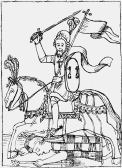 The
cry "Santiago" became a call for the heavenly power to purge the Earth
of all non-Christians infidels, no matter if they were Muslims or Jews in
Europe, Hindus or Natives of the Americas. The
cry "Santiago" became a call for the heavenly power to purge the Earth
of all non-Christians infidels, no matter if they were Muslims or Jews in
Europe, Hindus or Natives of the Americas.
(source: The
Universal Path to Enlightenment - By
Stephen Knapp World
Relief Network September 1992 ISBN 0961741023 volume one Two. p. 122).
(Note:
1492 - Began the process of genocide of Native Americans. "The
only good Indian is a dead Indian".
Today, in spite of 500 years of a genocidal colonization, there is an estimated
40 million Indigenous peoples in the Americas. In Guatemala, the Mayan peoples
make up 60.3 percent of the population, and in Bolivia Indians comprise over 70
percent of the total population. Despite this, these Indigenous peoples lack any
control over their own lands and comprise the most exploited and oppressed
layers of the population; characteristics that are found also in other
Indigenous populations in the settler states of the Americas).
In the seventeenth century,
Spanish missionaries from Yucatan traveled up New River and established churches
in Mayan settlements with the intention of converting and controlling these
people.
(source: Christian
Conquest - about.com).
Refer to Things
They Don't Tell you about Christianity
and
Human sacrifice in the Bible -
By Steven Newcomb and
Cannibalism at Jamestown, Virginia, USA.
***
Cannibalizing
Cultures
- Pests from Europe
Religion,
money and armed might, the unholy trinity of Neo-Imperialism.
Sesha
Samarajiwa
( ? ) from Sri Lanka is interested examining foreign religious agents’ role as
Fifth Columnists of neocolonialism/neoimperialism. He has written:
"Evangelists
belong to a long line of pests from the West who have come and keep coming like
locusts to colonize our souls and cannibalize our cultures.
The
latest incursions are merely a continuation
of the 500-year-old sorry saga
of Asia, Africa and
South
America
, which began with the arrival of the Portuguese and the Spaniards.
Some have never recovered from the machinations of their priests and the
savagery of their conquistadors. The baton of imperialism has passed from the
Europeans to the Americans. That is not to say that the rest of the West has
dropped out. They have not. They are very much in the game. It’s just that the
Americans are in the lead, the new Romans on the rampage.
We know
well how the Europeans won the West. They won it through mass
genocide of the native populations
in North and
South America
. In
South
America
, hundreds and thousands of natives who resisted conversion were garroted.
There
is a poignant painting depicting such conversions. It shows armored Spanish
soldiers garroting native priests, while a Spanish priest holds up a large
cross. More terrified natives await their turn. On the side, another Spanish
priest feeds stacks of ancient gold-leaf books of the Mayans into a fire. On the
face of the Mayan priests, a look of utter sadness mixed with resignation.
In places
like
India
and
Sri Lanka
, they were no better. They too faced abject horrors. In his book, Christianity's
scramble for
India, Navaratna
Rajaram
says that “the
Christian Missionary is neither a Christian nor a missionary. In fact, he is a
racist and a white supremacist in priestly guise.” Their
Buffalo Bills and their Wild Bills, their Custers and their Cortezes, and the
long line of predators
and priests
made sure that the sorry remainder of once-proud nations would remain so, while
they ruled the roost in lands drenched with native blood. Many weaker cultures
succumbed to the relentless onslaught from the West. They either slaughtered
those who resisted or they sowed the seeds of abjection and their eventual
self-destruction. Even today, we see the pathetic dregs of once-noble nations
staggering around native reservations and barrios in North and South America, in
Australia
, in
Canada
, in
New Zealand
. They have lost their spirit. They have lost their will to live. They seem
embarrassed to be alive. They are self-destructing. At best, they are performing
monkeys titillating whites with a thirst for the exotic. These are abject
peoples, vanishing tribes. Now, not satisfied with ruling their large chunk of
raided real estate, they are hell-bent on extending their hegemony over the
whole world. They
howl in protest when the natives resist.
Human misery is happy hunting grounds
for these
spiritual cartels.
They strike when their targets are at their weakest or bomb them to submission
to make sure they are at their weakest. Thus softened up, they are susceptible
to inducements and brainwashing. They are canny. To ‘convert’ people, you
must first make them despise and reject what had sustained their people for
millennia. So they vilify their faith or convince them it is a spent force or
dark superstition. In so doing, they make us spit on our heritage.
(source:
Beware
of wolves in sheep’s clothing
- By Sesha Samarajiwa - Asian Tribune October
9, 2007).
Refer to
Cannibalism at Jamestown, Virginia, USA.
***
The Mayans were the earliest people to have found a civilization
there, they moved from the Mexican plateau into Gauatemala. They were later pushed out, by
the Toltecs, who, in turn, dislodged by the Aztecs.
 This was an era that saw the blossoming of a unified
Central American civilization. The Toltecs were very prosperous. They were accomplished
architects, carpenters and mechanics. The Aztecs also made some striking cultural
advances. They developed a lake civilization based on the island in Lake Texcoco, where
they built their remarkable city. Mexico-Tenochtitlan, which was surrounded by the
colorful Chinampas, or floating gardens. The city was described by Bernal de
Diaz, the
companion of the Spanish commander Cortes, as a dreamland which inspired the Spanish
invaders to lyrical adulation and murderous plunder. Diaz wrote that the Mexicans were like the Romans, and that there was
nothing in Spain to match the royal palace of Montezuma. This was an era that saw the blossoming of a unified
Central American civilization. The Toltecs were very prosperous. They were accomplished
architects, carpenters and mechanics. The Aztecs also made some striking cultural
advances. They developed a lake civilization based on the island in Lake Texcoco, where
they built their remarkable city. Mexico-Tenochtitlan, which was surrounded by the
colorful Chinampas, or floating gardens. The city was described by Bernal de
Diaz, the
companion of the Spanish commander Cortes, as a dreamland which inspired the Spanish
invaders to lyrical adulation and murderous plunder. Diaz wrote that the Mexicans were like the Romans, and that there was
nothing in Spain to match the royal palace of Montezuma.
Hernando Cortes is said to have
slaughtered,
in less than two hours, six thousand people who had gathered
in a temple patio. Destruction of Aztec cities was so complete that almost everything lay
in ruins.
The elite of the Asiomericans were put to death almost to the last man. After
his entry into the conquered capital Tenochtitlan, Cortes
wrote that "you could not put down your foot without stepping on an Indian
corpse." In addition, his soldiery, a few years
later in the Inca Empire, driven by lust for gold, melted down irreplaceable works of art
by the ton to get the precious metal. Thus, the Aztecs civilization came to violent end.
Mystery of Mayan Crystal
skulls - Our
scientists cannot explain how these Mayan crystal skulls could have been carved
in ancient times without instruments and tools of today". The
most amazing thing was that the ancient skull weighing 5.13 kg, 203.4 mm long
and 125.4 wide had been made of a whole crystal. This fact contradicted the laws
of physics. The research by Hewlett-Packard
in 1964 in a special laboratory revealed that the skull had been made long
before the first civilizations appeared in that part of
America
where the skull was found. In addition, rock crystal of such perfect quality
could not be found in that area. The rock crystal has a hardness that is
slightly lower than that of topaz, corundum, and diamond; it can be cut with
diamonds only. It is astonishing, but the ancient Indians managed to cut it
somehow, and even made a lower jaw with the joints. Hewlett-Packard experts say
that the skull had been made regardless of all laws and rules. They surprisingly
said: "The damned thing can't exist at all. Those who had done it had no
idea of crystallography or of fiber optics. The people completely ignored the
axis of symmetry, which was to prevent the crystal from splitting during
processing. To compound the strangeness, HP could find no microscopic scratches
on the crystal which would indicate it had been carved with metal instruments. One
thing it's important to note is that crystal quartz is the same material used in
microchips that can hold billions of bits of information.
Given that, imagine the amount of info a whole skull can hold.
It is said that all the 13 Crystal Skulls are somehow linked to the “Year
Zero” or December 21, 2012, the date at which the Mayan Calendar ends. This
grand cycle of evolution will culminate winter solstice, December 21, 2012 AD.
(source: Mystery
of Mayan Crystal skulls).
Burning of Libraries and records:
 If the history of pre-Columbian America, is obscure, it is
because after the Spanish conquest, the first Bishop
of Mexico, Juan de Zumarraga, burned all the records of the Library of
Texcoco in Tlateloco market square as "the work of the Devil,"
and religious
fanatics destroyed temples and statues. If the history of pre-Columbian America, is obscure, it is
because after the Spanish conquest, the first Bishop
of Mexico, Juan de Zumarraga, burned all the records of the Library of
Texcoco in Tlateloco market square as "the work of the Devil,"
and religious
fanatics destroyed temples and statues.
Zumarraga,
gloating over his success, wrote to his superiors in 1531 that he alone had five hundred
temples razed to the ground and twenty thousand idols destroyed.
Fray Diego de Landa, the second
Bishop of Yucatan, following the pattern, reduced
the Maya Library in Yucatan to ashes in 1562. Post-Columbus history of America for 300
years was the story of ruthless destruction and fanatics like Bishop Diego da Landa burnt
a huge bonfire of valuable documents and nothing but the three codices of 'Chilam Balam' could survive
the holocaust....
He wrote Relación de las cosas de Yucatán, A Narrative of the Things of Yucatan
in 1566, Therein the states,
"We found a large number of their books of
these letters, and because they did not have anything in which there was not
superstition and falsehoods of the devil, we burned them all, which they felt
very sorry for and which caused them grief."
(source: Proof
Vedic Culture's Global Existence
- By Stephen Knapp p.
259).
Refer
to The
Aztec Account of the Spanish Conquest of
Mexico
Refer
to Columbus,
The Indians, and Human Progress -
By Howard Zinn
Landa, in his religious zeal, ordered all their idols
destroyed and all Mayan books to be burned; he was surprised at the distress
this caused the Indians. His orders to destroy all icons and hieroglyphics
obliterated the Mayan language forever, helping to undermine and destroy the
civilization he so vividly described.
 It was Landa that gave the orders for all the Mayans to
bring all manuscripts to the public squares in Mani to be burned. All these
books contained what would now be priceless information on astronomy, medicine,
religion, and philosophy. What
Emperor Theodosious of Constantinople did to the library at Alexandria to save
Christianity from the Greek and Oriental pagan knowledge deposited there, these priests
did in Central America with similar motives but larger success. It was Landa that gave the orders for all the Mayans to
bring all manuscripts to the public squares in Mani to be burned. All these
books contained what would now be priceless information on astronomy, medicine,
religion, and philosophy. What
Emperor Theodosious of Constantinople did to the library at Alexandria to save
Christianity from the Greek and Oriental pagan knowledge deposited there, these priests
did in Central America with similar motives but larger success.
The burning of manuscripts continued for decades. Soldiers were
encouraged to ransack palaces, public buildings, and private houses to find manuscripts.
Pablo Jose de Arriaga, the head of the Jesuit College in Peru,
in almost
unparalleled fanaticism, caused the systematic and wholesale destruction of all state archives,
customs records, royal and imperial archives, codes of laws, temple archives, and
historical records. Less than a score of manuscripts escaped annihilation. These libraries contained records of ancient history, medicine,
astronomy, science, religion, and philosophy.
The Spaniards destroyed whatever they could, but they
could not, for instance, burn the great Pyramid of
the sun and the remains of Teotihuacan, which speak of
the splendid bygone civilization. This is one of the great crimes of world cultural
history.
No matter how much historians stretch their imagination, it will
never be possible to reconstruct a picture of these advanced civilizations which would do
them justice, and yet be held historically acceptable.
Beyond Mexico, the ancient
Andean or Peruvian civilization also suffered an
even worse fate at the hands of the Spainard's than did their neighbors in Central
America. The Spanish assault on the Incas, the
Spanish avarice of gold, and barbarities perpetrated in the wake of victory, including the
inhuman tortures publicly inflicted on the Inca King, Atahuallpa, are illustrations of
savagery seldom surpassed in history.
The Story of Betrayal
The Spaniards were mistaken by Asiomericans for their legendary
white gods, who were to be made welcome and it they inflicted suffering it was to be
accepted as a divine judgment. And by a tragic coincidence, the Spanish conquerors
invaded Mexico at about the time, in 1519, as the Aztec priests and tradition had
predicted the return of the white gods. The Aztecs even offered the Spanish conquistadores
the vestments of Quetzalcoatl and other gods and considered performing human sacrifice to
them in case they were fatigued after such a long journey. Through out the Incas Empire,
the Spainiards were greeted as Viracocha, the Inca name of the great White God
they had been waiting for. It is only when the Asiomericans were completely horrified and
disillusioned by the brutalities and merciless killings, that they recognized their
mistake.
The realization that the Spainard's were not gods, but popolocas
(barbarians), however, came too late.
 The European conquerors of South and Central America not only
destroyed practically all the records and literature of Asiomerica, but created an utterly
distorted images of the American past by taking some of its ugly features out
of context and magnifying them out of proportion. For instance, the human sacrifice
practiced by the Aztecs was repeatedly stressed without explaining its extenuating
features, and without pointing out that human sacrifice had not been unknown to other
peoples, such as in Europe and Rome. Taking their technique a step further they contrasted
this picture with that of their own deeds in Asiomerica in which European
misdemeanor,
caprice, and criminality were soft-pedaled and civilized and human behavior emphasized. The European conquerors of South and Central America not only
destroyed practically all the records and literature of Asiomerica, but created an utterly
distorted images of the American past by taking some of its ugly features out
of context and magnifying them out of proportion. For instance, the human sacrifice
practiced by the Aztecs was repeatedly stressed without explaining its extenuating
features, and without pointing out that human sacrifice had not been unknown to other
peoples, such as in Europe and Rome. Taking their technique a step further they contrasted
this picture with that of their own deeds in Asiomerica in which European
misdemeanor,
caprice, and criminality were soft-pedaled and civilized and human behavior emphasized.
Most people believe that Asiomericans were uncivilized hordes
with an occasional freak of knowledge, who had contributed nothing of permanent value to
civilization by 1492. Despite a good deal of information to the contrary, there is
resistance to accepting a change in this image. Misconceptions multiply fast but die
slowly.
The Mexican Indians and the
Incas of Peru were primarily vegetarians. They were of high moral character and hospitable
and generous as a habit. They practiced astrology, and mental telepathy was common among
them. It was perhaps their peace-loving disposition that, like the Hindus, allowed them to
be ruled by Europeans.
The Europeans, through book burning and bayonet,
successfully, "converted" them, leaving very little trace of their noble
civilization.
Refer
to Mel’s
Merry Messianic Movie Missionaries:An Analysis of Apocalypto and Other Silver
Screen Savagery
- crusadewatch.org and
Guatemalan
official says Mel Gibson's "Apocalypto" derogatory to Mayan people.
Also refer to Apocalypto
trashes Native character.
Temerity to sit on Judgment on Non-Christian
spiritual systems?
Denouncing
cannibals of the New World
***
"I
Yahweh will make them
eat the flesh
of their sons and their daughters,
and they will eat one another's flesh in the siege and in the distress with
which their enemies and those who seek their life will distress them."
– Jeremiah 19.9.
(source:
jesusneverexisted.com).
Refer to
British aristocracy ‘ate human flesh’ -
THE highest members of European aristocracy took part in cannibalism to find
remedies for ailments up until the end of the 18th century, a new book reveals.
European royalty and eminent scholars took pride of place among those who
swallowed parts of the human body as medicine, including flesh, blood and bones.
For more than 200 years, even as they denounced
cannibals of the New World, Europeans applied,
drank, or wore powdered Egyptian mummy, human fat, flesh, bone, blood and
brains.
The British aristocracy consumed human flesh, a new book on medicinal
cannibalism reveals. The well-off in Britain and Europe swallowed parts of the
human body, including its flesh, blood and bones, as medicine until the end of
the 18th century.
Even as they denounced the cannibals of the New World, they applied, drank, or
wore powdered Egyptian mummies, human fat, flesh, bone, blood, brains and skin.
Dr Richard Sugg, a Durham University academic, writes: “James I refused corpse
medicine; Charles II made his own; and Charles I was made into corpse medicine.
Users included Francis I, Elizabeth I’s surgeon, John Banister, William III, and
Queen Mary.
Refer to
Mummies, Cannibals and Vampires - By
Dr Richard Sugg
and
Mel’s
Merry Messianic Movie Missionaries:An Analysis of Apocalypto and Other Silver
Screen Savagery
- crusadewatch.org
Refer
to Crusaders
-The
Cannibals of Ma’arra - Radulph
of Caen, another chronicler, wrote: "In Ma'arra our troops boiled pagan
adults alive in cooking-pots; they impaled children on spits and devoured them
grilled."Thus Amin Maalouf, in his book The Crusades through Arab Eyes, points to
the words of the Crusader chronicler, Albert of Aix, who wrote: "Not only
did our troops not shrink from eating dead Turks and Saracens; they also ate
dogs!
Refer to Things
They Don't Tell you about Christianity. Refer to Cannibalism
and Bloodbath of the Crusades.
***
The Devastation of the Indies – by Bartholome de Las
Casas - excerpts
 "The Devastation of the Indies is an eyewitness account of the
first modern genocide, a story of greed, hypocrisy, and cruelties so grotesque
as to rival the worst of our own century. Las Casas
writes of men, women and children burned alive “thirteen at a time in memory
of Our Redemeer and his twelve apostles.” He describes butcher
shops that sold human flesh for dog food (“Give me a quarter of that rascal
there,” one customer says, “until I can kill some more of my own”). Slave
ship captains navigate “without need of compass or charts,” following
instead the trail of floating corpses tossed overboard by the ship before them.
Native kings are promised peace, then slaughtered. Whole families hang
themselves in despair. Once fertile islands are tuned desert, the wealth of
nations plundered, millions killed outright, whole people annihilated. "The Devastation of the Indies is an eyewitness account of the
first modern genocide, a story of greed, hypocrisy, and cruelties so grotesque
as to rival the worst of our own century. Las Casas
writes of men, women and children burned alive “thirteen at a time in memory
of Our Redemeer and his twelve apostles.” He describes butcher
shops that sold human flesh for dog food (“Give me a quarter of that rascal
there,” one customer says, “until I can kill some more of my own”). Slave
ship captains navigate “without need of compass or charts,” following
instead the trail of floating corpses tossed overboard by the ship before them.
Native kings are promised peace, then slaughtered. Whole families hang
themselves in despair. Once fertile islands are tuned desert, the wealth of
nations plundered, millions killed outright, whole people annihilated.
The papacy empowered the two crowns
(Spanish and Portuguese) to conquer and even enslave pagans “inimical to the
name of Christ.”
The Spaniards killed more Indians here in twelve years by the
sword, by fire, and enslavement than anywhere in the Indies. ......."
(source: The
Devastation of the Indies – by Bartholome de Las Casas).
For more on destruction of Native Cultures refer to Thanksgiving-
a National Day of Mourning
and
Manifest
Destiny).
Refer
to The
Aztec Account of the Spanish Conquest of
Mexico. Refer
to Columbus,
The Indians, and Human Progress -
By Howard Zinn.
Refer
to
Christian
persecution against the Hellenes -
ethnicoi.org.
***
Pope justifies Genocide
"Jesus
Christ" functions as a symbolic cloak for several hidden agendas
.
-
Robert M Price,
author of The God Who Wasn't there.
***
Pope
Benedict XVI in a speech to
Latin American and Caribbean bishops at the end of a visit to
Brazil, the Pope said the Church had not imposed itself on the indigenous peoples of
the Americas.
They had welcomed the arrival of European
priests at the time of the conquest as they were "silently longing"
for Christianity, he said. "Christianity
was not imposed by a foreign culture" drew a sharp reaction from the
native leaders.
"Christ
was the Savior (America
's natives) silently yearned for," the pope said. Benedict also called the
resurgence of pre-Columbian religions "a step backward," offending
native peoples as far away as Mexico.
(Note:
Perhaps the Pope is not aware of the legacy of Western civilization to the world
- Dark
Ages, Crusades, The Inquisition, Witch Hunt, Slavery, Colonization of Africa,
Asia, America and Australia, Imperialism, World Wars, Holocaust, Bombing of
Nagasaki and Hiroshima, Conversion and destruction of Native cultures to
Christianity, Drugs, School shootings in American schools, Gun violence, Racism,
Clergy sex Abuse, Viagra spamming Capitalism, quest
for individualism, Iraq war ….
).
Refer
to Mystery
of Mayan Crystal skulls and
Is a Crisis in White Masculinity Leading to Horrific Gun Crimes Like the Sandy
Hook Shootings?
and
All We Want for Christmas Is...Guns
 Millions
of tribal Indians are believed to have died as a result of European colonization
backed by the Church since
Columbus
landed in the Americas
in 1492, through slaughter, disease or enslavement. They said the Indians had
suffered a "process of genocide" since the first European colonizers
had arrived. Priests blessed conquistadors
as they waged war on the indigenous peoples, although some later defended them
and many today are the most vociferous allies of Indians. Many Indians today
struggle for survival, stripped of their traditional ways of life and excluded
from society. Millions
of tribal Indians are believed to have died as a result of European colonization
backed by the Church since
Columbus
landed in the Americas
in 1492, through slaughter, disease or enslavement. They said the Indians had
suffered a "process of genocide" since the first European colonizers
had arrived. Priests blessed conquistadors
as they waged war on the indigenous peoples, although some later defended them
and many today are the most vociferous allies of Indians. Many Indians today
struggle for survival, stripped of their traditional ways of life and excluded
from society.
"It's
arrogant and disrespectful to consider our cultural heritage secondary to
theirs," said Jecinaldo Satere Mawe, chief coordinator of the
Amazon Indian group Coiab.
(source:
Brazil
's
Indians offended by Pope comments
- newsyahoo.com).
Refer to
Cannibalism at Jamestown, Virginia, USA.
Refer
to The
Great Catholic Cover-Up: The pope's entire career has the stench of evil about
it - By Christopher Hitchens - slate.com.
Refer
to LA
church to pay $600M for clergy abuse
- BBC news and Exposing
Scandal in the Church: Key Players - by Thomas Pierce - npr.org. Watch
Sex
crimes and the Vatican - videogoogle.com.
Refer to
Pedophiles
and Priests: Anatomy of a Contemporary Crisis - By Philip Jenkins.
Pope Benedict Argues
Catholic Church 'Purified' Indigenous Peoples
During his recent trip to
Latin America
, Pope Benedict XVI offended millions when he arrogantly suggested that
Catholicism had purified indigenous populations, and called the resurgence of
indigenous religions a step backward. He also said the native populations were
longing for Christianity, and had welcomed the Catholic priests at the time of
European conquest.
The
Pope seems to have selective amnesia when it comes to the Church and its
horrendous history of human rights disasters against people of color. Not
only is the Pope out of step with the needs and everyday realities of the
Third World
, he is not speaking their language, and not owning up to the sins of the past.
There are three bulls
(edicts, or executive orders, if you will) issued by the Papacy with which we
should concern ourselves. The Dum Diversas,
issued by Pope Nicholas V
in 1452, authorized King Alfonso V of Portugal to reduce any "Saracens
(Muslims) and pagans and any other unbelievers" to perpetual slavery,
thereby ushering in the West African slave trade.
The Romanus Pontifex,
also issued by Pope Nicholas V in 1455,
sanctioned the seizure of non-Christian lands, and encouraged the enslavement of
non-Christian people in Africa and the
Americas
. Specifically, it gave the green light to "invade, search out, capture,
vanquish, and subdue all Saracens and pagans whatsoever, and other enemies of
Christ wheresoever placed," all for profit, and in the name of Jesus
Christ.
The Inter Caetera,
signed by Pope Alexander VI in 1493, states,
"... we (the Papacy) command you (Spain) ... to instruct the aforesaid
inhabitants and residents and dwellers therein in the Catholic faith, and train
them in good morals." This papal law sanctioned and paved the way for
European colonization and Catholic missions in the
New World
.
These
three edicts opened the floodgates for everything that followed, the raping,
pillaging, kidnapping, genocide and enslavement of millions. They established
the groundwork for the global slave trade of the 15th and 16th centuries, and
the Age of Imperialism.
(source:
Pope
Benedict Argues Catholic Church 'Purified' Indigenous Peoples - alternet.org).
Refer
to Mystery
of Mayan Crystal skulls.
Father
of Lies: The Pope's Genocidal Revisionism
Almost no one
in the West seems to have noticed the truly perverse and morally obscene remarks
made by Pope Benedict in
Brazil
. But genocide scholar Adam Jones at CounterPunch noticed, and calls out Herr
Ratzinger for his remarkable historical revisionism, which paints the genocidal
destruction of
America
's pre-Columbus cultures as a "purifying" act which gave the natives
just what they were "longing" for. In this outburst, the conservative
cleric and former Hitler Youth far surpasses revisionists like David Irving in
whitewashing mass murder, slavery and military aggression.
Ask Pope Benedict: When Does Genocide Purify? On the last day of
his visit, in the city of
Aparecida
, the Pope "touch[ed] on a sensitive historical episode," in the
blandly understated language of an Associated Press dispatch (May 13). In other
words, he ripped the bandages off a still-suppurating wound. According to the
official text of Benedict's comments on the Vatican website, the Pope declared
that "the nations of Latin America and the
Caribbean
" were "silently longing" to receive Christ as their savior. He
was "the unknown God whom their ancestors were seeking, without realizing
it ..." Colonization by Spain and Portugal was not a conquest, but rather
an "adoption" of the Indians through baptism, making their cultures
"fruitful" and "purifying" them. Accordingly, "the
proclamation of Jesus and of his Gospel did not at any point involve an
alienation of the pre-Columbian cultures, nor was it the imposition of a foreign
culture."
(Note:
The Uru Chipaya people of Bolivia -
Its members belong to what is thought to be the oldest surviving culture in the
Andes, a tribe that has survived for 4,000 years on the barren plains of the
Bolivian interior. But the
Uru Chipaya,
who outlasted the Inca empire and survived the
Spanish conquest,
are warning that they now face extinction through climate change and conversion.
Refer to
The Uru Chipaya people of Bolivia: Conversion to
Christianity).
So
there we have it. The invasion and conquest of the
Americas
, which caused the deaths of upwards of 90 percent of the indigenous population,
was something the Indians had been pining for all along. They weren't just "asking for it," as sexist cranks
depict women as complicit in their own rapes. They
were actually "longing" for it, since salvation and
"purification" came with it…
Benedict's astounding comments attracted barely a flicker of media attention in
the West -- almost all of it on the wire services, and some of it problematic in
itself. A May 13 Reuters dispatch noted blithely that, contrary to Benedict's
claims, "many Indian groups believe the conquest brought them enslavement
and genocide." This is rather like writing that "many Jewish groups
believe that the Nazi Holocaust brought Jews enslavement and genocide." The
reality exists independently of the belief. As blogger Stentor Danielson points
out: "In the real world, it's a basic historical fact that the Indians were
enslaved. It's a basic historical fact that entire tribes were wiped out. The
reason [that] 'many Indian groups believe' these historical facts is because
people like Reuters' craven reporters won't admit when there's a fact behind the
claims."
(source: Father
of Lies: The Pope's Genocidal Revisionism - crusadewatch.org). Refer
to Mystery
of Mayan Crystal skulls.
Holy Disaster
''Arrogant.''
''Disrespectful.'' ''Poorly advised.'' These harsh words were not aimed at an
unpopular president; not this time. They are the criticisms by Indian leaders in
Latin America of Pope Benedict XVI, who again made headlines for culturally
insensitive and historically inaccurate remarks. In a speech at the Conference
of the Latin American and Caribbean Episcopate, the pope characterized
pre-contact Indians as ''silently longing'' for Christianity and stated that
''the proclamation of Jesus and of his Gospel did not at any point involve an
alienation of the pre-Columbus cultures, nor was it the imposition of a foreign
culture.''
It may be the most blatantly erroneous statement about
the Christian legacy on indigenous cultures ever uttered.
Not only did the pope's comments exhibit an ever-increasing general arrogance
that aims to deny the rights of indigenous peoples around the world but, in this
rare case, they came straight from the source. Millions of tribal people died as
a result of the institution of the 15th century Inter
Caetera papal bulls that provided legal
justification for European colonization of the Native people of the
Americas
(including
Brazil
where Benedict spoke) and
Africa
.
Then, Indians were slaughtered, enslaved or exposed to
deadly diseases. Now, Native survivors of Christian colonization efforts suffer
its traumatic generational effects: a diminished ability to relate to
and practice traditional life ways, social exclusion and learned sexual abuse.
If this does not qualify as an ''imposition'' on the culture of indigenous
peoples, what does? They referred to a ''process of genocide,'' which no doubt
began with the arrival of European Christian crusaders. It is agreed then that
the pope is fully aware of the indigenous position on the lasting legacy of
Christianity as a colonizing force. Ignorance is no excuse.
The comments were more an indication that the Church's knowledge of indigenous
cultures has not evolved much since the days when Natives were thought by
Catholic monarchs to be heathens empty of a guiding spiritual force, in need of
enlightenment. It is now time the
Vatican
, as a religious authority and political nation-state, acknowledges the cost of
Christianity on the indigenous people of the world.
(source:
Holy
Disaster - Pope Alienates Indigenous Peoples - nativeunity.blogspot.com).
Refer
to Mystery
of Mayan Crystal skulls. Refer
to Cannibalism
and Bloodbath of the Crusades.
Are there
times when Pope
Benedict XVI
should just butt out, when he should just keep his holy mouth shut?
 That's what Venezuelan
President Hugo Chávez
and
some of his South American neighbors in
Ecuador
appear to believe after some of the remarks Benedict pronounced publicly during
his visit to
Brazil
last week. The Holy One, looking back
fuzzily at the history of a part of the world he doesn't seem to know very well,
asserted in a speech to Catholic bishops from around Latin America and the
Caribbean who had gathered in São Paulo that the Christian-evangelical movement
that took place during the Spanish-Portuguese colonial era of the 16th and 17th
centuries, in which masses of missionaries set out to convert the locals to
their imported religion, "was
not the imposition of a foreign culture"
on the native peoples of the
conquered region. The pope said that, thanks to the European Catholics'
religious-conversion efforts, the native peoples of what is now known as
Latin America
were given an opportunity to get to know a god who had been "unknown"
to their ancestors. That's what Venezuelan
President Hugo Chávez
and
some of his South American neighbors in
Ecuador
appear to believe after some of the remarks Benedict pronounced publicly during
his visit to
Brazil
last week. The Holy One, looking back
fuzzily at the history of a part of the world he doesn't seem to know very well,
asserted in a speech to Catholic bishops from around Latin America and the
Caribbean who had gathered in São Paulo that the Christian-evangelical movement
that took place during the Spanish-Portuguese colonial era of the 16th and 17th
centuries, in which masses of missionaries set out to convert the locals to
their imported religion, "was
not the imposition of a foreign culture"
on the native peoples of the
conquered region. The pope said that, thanks to the European Catholics'
religious-conversion efforts, the native peoples of what is now known as
Latin America
were given an opportunity to get to know a god who had been "unknown"
to their ancestors.
Venezuelan
President Hugo Chávez said:
"As
the head of state, I ask His Holiness to offer his apologies to the peoples of
our
America. I believe this is the correct thing to do. How can he say they [colonial-era
conquerors and missionaries] came - when they came with crossbows - to
evangelize without any kind of imposition [of their religion in mind]?" Chávez
referred to the European conquest of the Americas as "something much more
serious than the holocaust that took place during the Second World War, and no
one can deny it; not even His Holiness can deny the holocaust of native peoples
[that took place] in this land."
In an ironic-sounding statement, CONAIE Federation
of Indigenous Nationalities of Ecuador
(Spanish acronym: CONAIE) noted: "Certainly the pope doesn't [sic]
know that the representatives of the Catholic Church of those times, with a few
honorable exceptions, were accomplices, concealers and beneficiaries of one
of the most horrific genocides
in [the history of] humanity." The organization was referring to the
massacres of millions of native people that were carried out over time by the
well-armed Europeans who, centuries ago, conquered and claimed the territories
of today's Latin America for their kings "with God" - and the Catholic
Church - "on their side."
(source:
Refer
to Chávez
to the pope: Butt out of our politics and get your historical facts straight!
- crusadewatch.org).

Top of Page
Destruction
of the Inca Empire: The Conquest of
Peru
Lust for
gold made the Spanish conquest of Peru
one of the bloodiest episodes in the history of empire.
 It
was in 1532 that a motley collection of Spanish conquistadors first appeared on
the Fringes of the Inca empire, the largest and most powerful empire in
South America
had ever known. It
was in 1532 that a motley collection of Spanish conquistadors first appeared on
the Fringes of the Inca empire, the largest and most powerful empire in
South America
had ever known.
In the
months to come these 62 horsemen and 106 foot soldiers commanded by a
professional soldier named Francisco
Pizzaro (1471 - 1541) would march to the heart of
Peru
and brutally seize control of the Inca throne. Within a decade, a glittering
Andean world would be firmly in the grip of the Spaniards, its glories stripped
and its people virtually enslaved. Few
historical events have been as dramatic or cruel as the conquest of Peru.
Lack of
principles and greed – By the time the Incas realized the ruthlessness of
their foes, it was too late.
Christians
on the march
The
early 1600s saw a far-flung campaign against idolatry, spurred on by a revival
of native religion in 1565.
The
renewed religious zeal of the Catholic Church led
to a push to stamp out native religion once and for all.
The
crusade also produced volumes of valuable
dictionaries and accounts that are still being studied by historians today. Priests
visited outlying provinces, collecting information on cults and sometimes
torturing villagers to reveal the whereabouts of idols and huacas.
The colonists flourished.
Spain
decreed that all trade from South America should pass through
Lima
, ensuring a massive flow of taxes.
Lima
, the opulent “City of
Kings
,” was crammed with magnificent churches and mansions. The
Diabolical herb?
- Coca was
condemned by the Catholic Church as a “diabolical herb” until it was
realized that the Indians could not survive without it in the brutal mining work
that they were compelled to do.

Meeting
between
Pizzarro and Atahualpa.
Lust for
gold made the Spanish conquest of
Peru
one of the bloodiest episodes in the history of empire.
(image
source: Peru: Insight
Guides).
***
 Atahuallpa
was the last sovereign emperor of the Tahuantinsuyu, or the Inca Empire. He
became emperor upon defeating his older half-brother Huáscar in a civil war
sparked by the death of their father, Inca Huayna Capac, from an infectious
disease thought to be smallpox. During the Spanish Invasion, the Spaniard
Francisco Pizarro crossed his path, captured Atahualpa, and used him to control
the Inca empire. Eventually, the Spanish executed
Atahualpa by garrote, ending the Inca Empire. Atahuallpa
was the last sovereign emperor of the Tahuantinsuyu, or the Inca Empire. He
became emperor upon defeating his older half-brother Huáscar in a civil war
sparked by the death of their father, Inca Huayna Capac, from an infectious
disease thought to be smallpox. During the Spanish Invasion, the Spaniard
Francisco Pizarro crossed his path, captured Atahualpa, and used him to control
the Inca empire. Eventually, the Spanish executed
Atahualpa by garrote, ending the Inca Empire.
Many
decades later.. Tupac
Amaru mounted the scaffold with Bishop Agustín de la
Corunna. The
"multitude of Indians, who completely filled the square, saw that
lamentable spectacle [and knew] that their lord and Inca was to die, they
deafened the skies, making them reverberate with their cries and wailing."
As reported by Baltasar de
Ocampa and Friar Gabriel de Oviedo, Prior of the Dominicans at
Cuzco
, both eyewitnesses, the Sapa Inca raised
his hand to silence the crowds, and his last words were;
"Ccollanan Pachacamac
ricuy auccacunac yahuarniy hichascancuta."
"Mother
Earth, witness how my enemies shed my blood."
Nearly
forty years after the conquest of
Peru
began with the execution of Atahuallpa, the conquest ended with the execution
of his nephew. A roundup of Incan descendants was soon initiated by the Viceroy.
Several dozen, including Tupac Amaru's three-year-old son, were banished to
Mexico, Chilé,
Panama
and elsewhere. King Philip overturned some of the banishments.
 Francisco
de Toledo, Count of Oropesa
(1515 - 1584) ruled Peru
with a harshness never before known. He wrote a large volume of laws, including: Francisco
de Toledo, Count of Oropesa
(1515 - 1584) ruled Peru
with a harshness never before known. He wrote a large volume of laws, including:
"Any Indian who makes friendship with an Indian woman who is an infidel, is
to receive one hundred lashes, for the first offense..." and "Indians
shall no longer use surnames taken from the moon, birds, animals, serpents, or
rivers, which they formerly used."
According
to Spanish records the 'number of souls under their jurisdiction' fell from
about 1.5 million in 1561 to 600,000 in 1796 (including European descendants).
Prior to 1561 it is estimated more than 75% of the native population perished
due to small pox, measles and influenzas introduced by the Europeans. Famines
also took their toll due to the disruptions of economic and social life. In some
provinces fully two-thirds of the population was conscripted to work in silver
mines, where most perished. By 1800, the population was reduced to one-tenth the
aboriginal level, if not far less.
The
Cathedral was built on what once was the
palace
of
Inca
Wiracocha
, and made in part from stones hauled from the fortress of Sacsayhuman
outside the city.
Pope
Benedict XVI said the Church had not imposed itself on the indigenous peoples of
the Americas


The
Cathedral was built on what once was the
palace
of
Inca
Wiracocha
, and made in part from stones hauled from the fortress of Sacsayhuman outside
the city.
***
Spanish
chronicles recall the European astonishment when they saw Coricancha’s patio
filled with life-sized gold and silver statues of llamas, trees, fruits, flowers
and even delicately handicrafted butterflies. Legend has it that Atahualpa’s
ransom included 20 of Coricancha’s life-sized golden statues of
beautiful women.
(source: Peru: Insight
Guides and wikipedia).
Hari Jagannathan Balasubramanian writes
about the intentional assault on local civilizations by Europeans.
While the
predominantly tribal societies of North America had been conquered by European
Protestants, the massive empires of the Central and South had been downed by a
band of daring conquistadors from Catholic Spain. The Caribbean natives faded in
the decades after Columbus’ arrival; Argentina’s natives were exterminated in
the eighteenth century. But in Mexico and the Andean nations (Peru, Ecuador,
Bolivia) the descendants of the Aztecs, the Mayans, the Incas (and many other
indigenous groups) are still there. The conquests were no less devastating, but
a forcibly imposed Catholicism had brought Indians into its fold, even as it
erased earlier beliefs.
The arrival of
the Europeans to America was a Black Swan – an unprecedented event that had a
massive impact. No one could have predicted the consequences. Millions of
American Indians died, either due to disease or conquest, and the Americas
(especially North America) lost their voice and culture. Europe and Asia
benefited immensely from the crops and foods domesticated in the Americas (corn,
tomatoes, potatoes, chilies to name a few). Europeans found a new place to
emigrate to – for them it was a positive Black Swan that unleashed new energies.
In the case of Easter
Island, locals and rats were
blamed for the decline and Western missionaries and invaders were absolved. Now
it turns out that Western missionaries and invaders indeed are to be blamed for
eradicating a culture.
Archaeological
evidence supporting a theory of pre-European internal-collapse is thin on the
ground. “Rather than a story of self-inflicted deprivation, I agree with the
view that substantial blame has to rest with Western contact,” said Dr Croucher.
“Visitors brought disease, pests and slavery, resulting in the tragic demise of
the local population and culture.” [Easter
Island Was Devastated by Western Invaders and Not Internal Conflict]
The
missionaries converted the remaining population to Christianity, encouraging
them to abandon their traditional beliefs. Even then, several hundred
inhabitants were driven off the island to work on sugar plantations in Tahiti.
By 1877, a population of just 110 people was recorded.
(source:
The Criminals
who destroyed Easter Island
-
varman.nationalinterest.in). Refer to
Cannibalism at Jamestown, Virginia, USA.
Destruction
of Spiritual Places
The
Coricancha Temple
The
Coricancha temple (meaning literally, "the corral of gold") was
dedicated primarily to Viracocha, the
creator god, and Inti, the Sun god. The
Coricancha also had subsidiary shrines to the Moon, Venus, the Pleiades, and
various weather deities. The Coricancha
(from the Quechua words Quri Kancha
meaning 'Golden Courtyard'), originally named Inti
Kancha (' Temple of the Sun') was the most important temple in the Inca
Empire, dedicated primarily to Inti, the Sun God.
The walls and floors were once covered in 700 sheets of solid gold, and the
courtyard was filled with golden statues. Spanish reports tell of its opulence
that was 'fabulous beyond belief'. The majority of the gold collected to fill
the ransom room for the Inca Atahualpa was collected from Coricancha.
The
Church
of
Santo Domingo
was built on the site, using the ruined foundations of the temple that was
flattened by the Spanish in the 17th century. Major earthquakes have severely
damaged the church, but the Inca stone walls, built out of huge,
tightly-interlocking blocks of stone, still stand thanks to the sophisticated
stone masonry. The
Coricancha (sometimes spelled Qoricancha) was the centerpiece of a vast
astronomical observatory and calendrical device for precisely calculating
precessional movement.
Colonization
of the Incas
The Brutal
savagery of the Spanish Conquistadores
The Coricancha temple was
dedicated primarily to Viracocha, the creator god, and Inti, the Sun god. The
stone wall in the foreground was part of the temple structure that was
destroyed.
The
stone walls and floors were once covered in sheets of solid gold, and the
courtyard was filled with golden statues. Spanish reports tell of its opulence
that was 'fabulous beyond belief'. On the Summer Solstice sun light from
the opening in one of the rooms illuminates a specific niche in which sits the
Inca chief. The rooms were adorned with elaborate gold ceremonial objects
including a huge gold sun disk which was considered sacred. The
Temple
of the Sun was once the most important temple of the Incas. When the Spanish
conquered the Inca Empire, they used the fine Inca stonework to form the base of
the
Church
of
Santo Domingo
. When the Spaniards conquered
Cuzco
, the Inca capital, they set about stripping the gold from the temples and
melting them down. Legend has it that it took three months to cart all of the
gold from the
Sun
Temple
.
Just
like the Islamic conqueror built mosques on the top of vandalized Hindu temples
in India, the Catholics built the Santo
Domingo
Church on top of Inca temples that they destroyed.
Justifying
Colonization? - Utterly distorted
image of the American past by taking some of its ugly features out of context
and magnifying them out of proportion. Sacrifice
practiced by the Incas was repeatedly stressed without explaining its
extenuating features, and without pointing out that human sacrifice had not been
unknown to other peoples, such as in Egypt,
Rome and
in the Bible.
Taking their technique a step further they contrasted this picture with that of
their own deeds in Asioamerica in which European
misdemeanor, caprice, and criminality were soft-pedaled and civilized
and humane behavior emphasized.
The process
of demonization of Inca culture and faith still continues today......
(image source:
Editor's
own collection of photos taken during a recent visit).
***
Emanating from the temple
were forty lines (some sources say 42) called seques, running arrow-straight for
hundreds of miles to significant celestial points on the horizon. Between 328
and 365 huacas or shrines were situated along these ceques. Four of the ceques
represented the four intercardinal roads to the four quarters of Tawantinsuyu,
others pointed to the equinox and solstice points, and still others to the
heliacal rise positions of different stars and constellations highly important
to the Inca. The Inca also used the Coricancha in conjunction with standing
stones called sucancas positioned on the horizon of nearby mountains for
determining the dates of the solstices and equinoxes, as well as monitoring the
passage of precessional time. The great temple also incorporates a prominent
solar alignment using a nearby peak called Pachatusan as a sightline for the
June solstice. The elliptical exterior wall of the temple may have served as a
model of the celestial ecliptic.
(source: sacredsites.com
and wikipedia).
The
Chinchero
Church
When
the Spanish conquerors arrived first to these lands; they could not explain
themselves how Peruvian "Indians" (ignorant, wild, without any ability
of logical reasoning, one more animal species according to conquerors) could
have built such a greatness. Their religious fanaticism led them to believe that
all that was simply work of demons or malign spirits.
Parallels
to History of India
Destruction
of Ancient pagan way of life

Just
like the Islamic and Portuguese conqueror built mosques and churches on the top of vandalized Hindu temples,
the Spanish built the Chinchero Church on top of Inca ruins.
Given
this bloody history today Catholics continue to piously pray in this church.
(image source:
Editor's
own collection of photos taken during a recent visit).
***
"A band of dacoits may loot
a full busload of passengers at gunpoint but that does not make the dacoits
more intelligent, cultured or superior beings."
(source:
Hindu Culture During and after Muslim Rule - By Ram Gopal
p. 63).
Chinchero was once the home/temple of
one of the last Incan emperors, Yupa Inca, and before Spanish rule, the village
was fondly known as El Pueblo Del Arco Iris, or "birthplace of the
rainbow."
Top of Page
Articles:
Maya Civilization
of Mexico.
Baffling Links with Ancient India
By Anand Sharma
http://www.indiagov.org/perspec/mar99/maya.htm
 The archaeological remains of ancient Maya civilization of Mexico are lying scattered in
the parts of Yucatan, Campeche, Tabasco and eastern half of Chiapas as well as in the
territory of Quintana Roo of the republic of Mexico. Covering an area of about 125,000
square miles, its traces are to be found in the western section of Honduras Republic,
Peten and adjacent highlands of Guatemala and practically in the whole of Honduras.
The archaeological remains of ancient Maya civilization of Mexico are lying scattered in
the parts of Yucatan, Campeche, Tabasco and eastern half of Chiapas as well as in the
territory of Quintana Roo of the republic of Mexico. Covering an area of about 125,000
square miles, its traces are to be found in the western section of Honduras Republic,
Peten and adjacent highlands of Guatemala and practically in the whole of Honduras.
Admiral Christopher Columbus mistakenly called the New World
inhabitants as Indians. Although he corrected himself subsequently, the natives of
Americas continued to be called 'Indians'. During the course of his third journey,
Columbus came into contact with 'Maya' people.
Many theories have been advanced by scholars to
explain the origins of these American Indians and if there were any links between the
ancient civilizations of the Old World and the New World. There are historians who believe
that the American civilizations were purely native in origin and also those who maintain
the theory of Asians crossing over through Bering Strait via Alaska and reaching the
American continent some 12,000 - 15,000 years ago. However, the antiquity of American
Indians remains shrouded in the veil of mystery. In spite of a great deal of
investigations, explorations and deep study by scholars and innumerable historians during
the last many centuries, what we know about pre-Columbus Americas is very little in
comparison to what we do not know.
To quote Glyn Daniel from his book
'The First
Civilizations', "within 15 years, between 1519 to 1533, the Western world discovered
and brutally destroyed three civilizations - the Aztecs of Mexico, Maya of Yuacatan and
Guatemala and Inca of Peru."
The unique elaboration of the Mayan civilization has been a
challenge to the imagination of explorers and students of history. The Mayans had attained
the highest maturity in art, craft, sculpture and hieroglyphs. Innumerable theories exist
about these ancient people. Their magnificent achievements in social, economic, political
and religious fields, their calendar and hieroglyphic writings, reasons of the sudden
collapse of their classic culture everywhere in Mesoamerica, the reality of 'Kulkulkan
Quetzal-Coatl' myth are some of the riddles of Mexican history challenging modern
research. The 'Maya' Indians spent thousands of years in building their magnificent
monuments and Mayapan, Palenque, Copan, Tikal, Kaminalijuyu and Piedras Negras were the
centres where Mayan culture flourished in splendour. How and why these places were
deserted in the past is still a mystery. Although modern scientists have achieved
significant success in deciphering Maya calendar system, none has been able to decipher
their hieroglyphic system of writing.
The possibility of links of
these people with Old World civilizations and particularly with ancient India is not
acceptable to many historians. However, there are those who hold a different view.
Eminent
scholar-writers like Mackenzie, Hewitt, Tod, Pococke and Mrs. Nuttal have collected plenty
of data to show that ancient American civilizations were influenced by Old World
civilizations.
We have to remember that the post-Columbus history of America for 300 years
was the story of ruthless destruction and fanatics like Bishop Diego da Landa burnt a huge
bonfire of valuable documents and nothing but the three codices of 'Chilam Balam' could
survive the holocaust.
There are two specific archaeological discoveries pertaining to
761 AD, about which most Mexican historians are silent, that attract our attention as
possible links of Maya civilization to ancient India. The first one is a wall panel (Panel
No. 3 of Temple 0-13, at Piedras Negras, Guatemala; reproduced as Plate 69, page 343 of
'The Ancient Maya' by S.G. Morley) belonging to the Later Classic Stage of Mexican
history, associated with the peaking of Maya architecture and sculpture. Mexican
historians have not given any interpretation of this panel.
It appears that the scene
depicted in the panel relates to the great Indian epic 'Ramayana'.
It
shows a king sitting on the throne and one maidservant with two children standing on the
right side of the throne. A guard stands behind the three. On the other side of the king,
three important personages are standing whereas the vassal chiefs and important
feudatories are sitting in front of the throne. The king on the throne is believed to be
Suryavanshi Ram with his three illustrious brothers standing by his side. The two little
children are his two sons with a maid and a guard behind them. Amongst the three persons
on the right, two are engaged in a discussion whereas the third one, apparently
Lakshman,
is standing with a bold, brave and confident demeanour which was characteristic of him.
The above panel is a beautiful piece of sculpture and an evidence of great Mayan heritage,
their artistic taste and superior creative ability and, above all, an archaeological
evidence to prove India's link with Mexico in the 8th century at least. The artistic
design and postures of the figures carved can be compared to those found at Ajanta and Ellora caves in
India. This interpretation, however, remains only a plausible one till the hieroglyphics
and frescoes surrounding the wall panel are deciphered.
 Another archaeological discovery at the same place i.e. Piedras
Negras, Guatemala, is a stone stela (No. 12, Plate No. 18, page 61 of 'The Ancient Maya'
by S.G. Morley). A mythological scene has been carved in this stela, depicting the
architectural and artistic maturity of the Maya people of the Classic Stage (594 - 889
AD). There is a beautiful image of a deity with eight hands (ashtabhuja). The art style is
discernibly Indian as in no other religion of the world deities of this type were
worshipped. It may be mentioned that the ruling dynasty of Mexico at the time of the
conquest by Spaniards was 'Aztec' or Ashtak (Eight). The evidence in the form of such
images leaves little doubt about the presence of Indian culture amongst the ancient
Mexicans. The stela pertains to the period of more than eight centuries before Columbus
set foot on the soil of the so-called New World. Another archaeological discovery at the same place i.e. Piedras
Negras, Guatemala, is a stone stela (No. 12, Plate No. 18, page 61 of 'The Ancient Maya'
by S.G. Morley). A mythological scene has been carved in this stela, depicting the
architectural and artistic maturity of the Maya people of the Classic Stage (594 - 889
AD). There is a beautiful image of a deity with eight hands (ashtabhuja). The art style is
discernibly Indian as in no other religion of the world deities of this type were
worshipped. It may be mentioned that the ruling dynasty of Mexico at the time of the
conquest by Spaniards was 'Aztec' or Ashtak (Eight). The evidence in the form of such
images leaves little doubt about the presence of Indian culture amongst the ancient
Mexicans. The stela pertains to the period of more than eight centuries before Columbus
set foot on the soil of the so-called New World.
The place where these pieces
have been discovered - Piedras Negras - appears to be a distorted form of 'Priyadarsh
Nagraj' in Sanskrit, as has been the case with so many words distorted by European
pronunciation. These stone sculptures are adornments of a Mayan temple and depict some
popular mythology prevalent amongst the people of the time. Both human sacrifice and
idolatry were much in practice amongst Maya people. Morley has given a detailed and vivid
account of Maya culture and society in his book 'The Ancient Maya', profusely quoting
Bishop Diego de Landa.
Bishop Landa states that Maya people "…had a very great
number of idols and temples which were magnificent in their own fashion and besides the
community temples, the lords, priests and leading men also had oratories and idols in
their houses where they made their prayers and offerings in private". Not only of
gods but idols of even animals and insects were prepared by Maya people, who believed in
immortality of soul and afterlife. This definitely smacks of an Indian connection.
More serious efforts to connect the ancient American
civilizations with those of ancient India have to be made. The Trans-Pacific contacts of
the people of south-east Asia with the people of ancient America have been established
beyond doubt. It is also a well-proven fact of history that Indians of ancient times were
great sea-farers. In pre-Mahabharata era
as well as in the subsequent period, the kings of southern India possessed large fleets
used for trade with the Arabian and European countries where Indian merchandise was much
in demand. India's links with south-east Asia and other far-off islands of the Pacific
Ocean are an established fact of history. The conquest of Malaya by Rajendra
Chola, the
story of Buddhagupta the Great Sailor (Mahanavik), the religious expeditions of Indians to
preach the gospel of Buddhism in the distant lands of Cambodia, Annam, Bali, Java,
Sumatra, Borneo, Japan, Korea, Mongolia and China are proofs of the impact of Indian
culture.
A remarkable feature of the Indian culture has been that colonial
domination was never identified with economic exploitation. The Buddhist Jatakas (folk
tales) narrate many stories relating to maritime adventures and daring sea journeys which
establish that such activities were an essential part of Indian life at that time.
The author is a historian settled in Vienna.
For
more refer to chapter on Greater
India: Suvarnabhumi and Sacred
Angkor
Top of Page
Master
Builder Uncovers Striking similarities in Indian and Incan/Mayan Sacred Structures
Hinduism Today - June 1995
http://www.hinduismtoday.com/archives/1995/6/1995-6-01.shtml
Ancient Architects Employed Analogous Design Doctrines and
Masonry Methods
"Sri V. Ganapati Sthapati," read Deva Rajan's fax to
our Hawaii editorial office from Machu Picchu high in the rugged Andes Mountains of Peru,
South America, "has just measured with tape, compass and a lay-out story pole, two
ancient Incan structures at Machu Picchu: a temple and a residence. He has confirmed that
the layout of these structures, locations for doors, windows, proportions of width to
length, roof styles, degree of slopes for roofs, column sizes, wall thicknesses, etc., all
conform completely to the principles and guidelines as prescribed in the Vastu Shastras of
India. Residential layouts are identical to those found in Mohenjodaro. The temple layouts
are identical to those that he is building today and that can be found all over
India."
These startling discoveries came during a March, 1995, visit of the master
builder to the ancient Incan and Mayan sites of South and Central America. Ganapati
Sthapati is India's foremost traditional temple architect and perhaps the first true
expert in sculpture and stone construction to personally examine these ancient buildings.
To do so has been his dream since the 1960's.
Sthapati is the architect of the San Marga Iraivan Temple [see
page 28] being built at Kauai Aadheenam, Hawaii, home of Hinduism Today. To fulfill this
life-long ambition to visit the Mayan and Incan sites, our publisher, Satguru Sivaya
Subramuniyaswami, arranged for California builders and architects Deva Rajan and Thamby
Kumaran to accompany Sthapati on a three-week trip through South and Central America.
"Like boys on holiday," they described their exciting trek of discovery which
began 11,000 feet high in central Peru at the famed Incan site of Machu Picchu which
remained hidden until 1911.
It is Sthapati's theory that Mayan, the creator of Indian
architecture, originated from the Mayan people of Central America. In Indian history,
Mayan appears several times, most significantly as the author of Mayamatam, "Concept
of Mayan" which is a Vastu Shastra, a text on art, architecture and town planning.
The traditional date for this work is 8,000bce. Mayan appears in the Ramayana (2000bce)
and again in the Mahabharata (1400bce)-in the latter he designs a magnificent palace for
the Pandava brothers. Mayan is also mentioned in Silappathikaram, an ancient Tamil
scripture, and is author of Surya Siddhanta, one of the most ancient Hindu treatises on
astronomy.
The fundamental principle of Mayan's architecture and town
planning is the "module." Buildings and towns are to be laid out according to
certain multiples of a standard unit. Floor plans, door locations and sizes, wall heights
and roofs, all are determined by the modular plan. More specifically, Mayan advocated the
use of an eight-by-eight square, for a total of 64 units, which is known as the Vastu
Purusha Mandala. The on-site inspection by Sthapati was to determine if the Incan and
Mayan structures did follow a modular plan and reflect the Vastu Purusha Mandala. He also
intended to examine the stone working technology-his particular field of expertise.
Sthapati was
born in 1927 into a family whose ancestors, members of the aboriginal tribe of
Viswakarmas, built the great temple at Tanjore in the 10th century ce at the request of
Raja Raja Chola. He learned the craft from his father, Sri M. Vaiydyanatha Sthapati and
his uncle, Sri M. Sellakkannu Sthapati. He spent 27 years as head of the Government
College of Architecture and Sculpture in Mahabalipuram, Tamil Nadu, and is responsible for
India's significant resurgence in the ancient art of stone carving. After his retirement
in 1988, he continued building temples and founded the Vastu Vedic Research Foundation to
explore the ancient origins of the temple craftsmen. He is responsible for the
construction of dozens of temples in India, plus others in Chicago, Washington D.C.,
Kentucky, Boston, Baltimore, San Francisco, and Hawaii in the USA as well as in the UK,
Singapore, Fiji, Malaysia, Mauritius and the Seychelles.
Machu Picchu
The moment Sthapati approached an ancient Incan residential
building at Machu Picchu on March 15th, he pointed at the wall and said, "That is a
thickness of one kishku hasta"-33 inches, a standard measure in South India first
promulgated by Mayan. He proceeded to measure the buildings in detail and discovered each
was indeed built on a module-based plan [see photos and drawings to right], following the
system of Mayan's eight-by-eight squares. The module method was followed within small
fractions of an inch, according to Thamby Kumaran, who was taking the measurements. The
buildings were oriented toward certain points of the compass, also a principle of Mayan,
rather than randomly placed. Also the lengths of buildings were never more than twice
their width, as Mayan stipulated.
From Machu Picchu the three adventurers traveled to
Saqsayhuman,
an Incan site dated from 400 bce to 1400 ce. Here are the famous stone walls made of rocks
weighing up to 160 tons and fitted together so expertly that a knife blade cannot be put
in any joint. "Nobody knows how these stones were put in place," offered their
guide when they first arrived on the site. Sthapati politely differed, and pointed out the
insets chiseled into the base of many stones, as well as small knobs left on their faces.
"These are for the use of levers, the exact same system we continue to use in India
to move large stones. Thirty to forty men can move these very large rocks with this
method," he explained to the guide's astonishment.
He could see other details of the stone working were identical to what is
practiced in India, such as the method of quarrying stones by splitting off slabs [photo
page 14]. So too was the jointing and fitting of stones, the use of lime mortar, leveling
with a plumb line and triangle, and the corbeling for the roofs. Corbeling is the method
by which stones are drawn in layer by layer until they meet or nearly meet to allow a roof
slab to be placed on top. Sthapati considers the similarity of this technology to that
used in India to be very significant. The use of the horizontal lintel and the absence of
the arch are additional noteworthy points of correspondence between the two traditions.
Land of the Mayans
From the high Andes the threesome flew to Mexico's Yucatan
peninsula. They and forty-five thousand other Mayan aficionados arrived at Chichén Itzá
in time for the summer equinox on March 21st. At the moment of sunset on the equinox, a
shadow is cast by the steps of the Pyramid of the Castle [photo right and on page one,
where the shadow can be seen] upon the side of the staircase to the top. The shadow
creates the image of a serpent's body which joins a stone carving of a serpent's head at
the bottom of the stair case. It is a stunning demonstration of Mayan astronomical and
architectural precision.
Archeologists, tourists and New Agers all gathered for the event,
each with their own agenda. Since the publication of The Mayan Factor-A Path Beyond
Technology by José Arguëlles, the Mayans and their advanced calendar, astronomy,
philosophy and architecture have enjoyed a wide following in the West. Sthapati too has
found much of interest in Arguëlles' book.
Standard academia archeologists consider the New Age interest as
bordering on superstition and refuse to even talk to anyone partial to Mayan mysticism. A
recent book, Copan and Tikal, the Secrets of Two Cities, by Honduran author Ricardo
Agurcia Fasquelle and archaeologist Juan Antonio Valdes of Guatemala, claim that the Mayan
pyramids were actually castles for the wealthy and that what were once thought to be
monuments to the Gods were in fact tributes to the dynasties of various kings. Not likely.
Native Mayan teachers such as Hunbatz Men, whom
Sthapati met while in the Yucatan, are taking advantage of the interest to spark a revival
of the original Mayan religion among the Mayans themselves. Since their brutal conquest
and forced conversion to Catholicism by the Spaniards in the 16th century, Mayans have
lived an oppressed and impoverished existence.
Amidst the crowds, Sthapati, Deva and Thamby again unsheathed
their tape measures and closely examined the Pyramid of the Castle [see diagram right]. It
too conformed to the Vastu Vedic principles of Mayan. The temple structure at the top was
exactly 1/4th of the base. And the stepped pyramid design derived from a three-dimensional
extension of the basic eight-by-eight grid system. The temple room at the top was also
modular in design, with the wall thickness determining the size of doorways, location of
columns, thickness of columns and the width and length of the structure.
Most interesting was the name of this structure-chilambalam,
meaning a sacred space. It is Sthapati's theory that the Mayans worshiped the very concept
of space, specifically a space made according to the modular system. This same idea is
found in Hinduism in the sacred room in the center of the Chidambaram Siva Temple in South
India, where space or akasha is worshiped-there is no idol. Chidambaram, Sthapati finds
suspiciously like chilambalam, means "hall of consciousness." The concept of
sacred space is at the center of the mystical shilpi tradition of India
The richly decorated Mayan buildings provided a feast for a sculptor's eye.
There is a very common feature called a "mask" by the archeologists, but known
to the Mayans as "Big Nose." A nearly identical face is a common feature of
Hindu iconography, seen, for example, at the top of the arch placed behind a deity.
"It is the very same thing in India," chuckled Sthapati, "we call it
`Maha Nyasa'-Big Nose!" Several other details of the sculptures were similar or identical
to India, such as the earrings, ear plugs, teeth, head dresses, even buckles around the
waist. There are bas reliefs of priests sitting in lotus posture meditating.
From Chichén Itzá, they traveled on to Uxmal where they
observed the snake and "bindu" designs on the wall faces [picture right]. They
were astounded by the thousands of pyramids at Tikal and Uxacturn in Guatemala, all laid
out to conform to a grid pattern and oriented in astronomically significant directions.
As in Mayan buildings, Indians have been using lime mortar for
all of their stone and brick buildings. This can been seen in the monumental creations in
Mahabalipuram and also in the stone temples of Tanjor and Gangai Konda Choleasuram in
Tamil Nadu. The outer surfaces were plastered, embellishments worked out in lime mortar,
then painted. This method was strongest among the Mayas at Tikal and Uaxactún, where all
of the structures once had a plaster coating painted with many colors.
What is the Connection?
Sri Ganapati
Sthapati postulates, after deep thought from his journey to the land of the Mayans and a
lifetime study of South Indian architecture, that Mayan, the divine architect of Indian
tradition, came from Central America. Ancient Tamil literature speaks of lands to the
south of India 30,000 years ago, at the time of the first Tamil Sangam. According to
scientists 160 million years ago India did lie physically close to Africa, South and
Central America, but has since moved away as a result of continental drift. At that date,
it would have been dinosaurs and not Mayans who wandered from the Americas to India, but
perhaps the time frame for the continental drift is not correct. Architecture aside, there
are significant similarities between Hinduism and the native religions of both Africa and
the Americas.
There are other explanations. The simplest is boats. In 1970 the
Norwegian Thor Hyerdal sailed a reed boat from Africa to the Americas in 57 days using no
modern equipment. The boat, Ra II, was built for him by the Aymaro Indians of Lake
Titicaca, Peru, neighbors of the ancient Incans. The double-hulled catamarans of India are
also capable of long sea voyages. Historians discount contact between ancient people, but
many cultures, such as the ancient Hawaiians, had remarkable sea-faring skills.
 Perhaps the coincidences of stone working are just that, coincidence -a
favorite "explanation" of archeologists. Stone workers will discover the same
techniques naturally, without need for outside help, they say, and can point to historical
incidents of simultaneous discovery. But this explanation hardly accounts for the
similarities in motifs and modular design. Perhaps the coincidences of stone working are just that, coincidence -a
favorite "explanation" of archeologists. Stone workers will discover the same
techniques naturally, without need for outside help, they say, and can point to historical
incidents of simultaneous discovery. But this explanation hardly accounts for the
similarities in motifs and modular design.
Another explanation is mystical-that Mayan, who is a divine being
in Indian histories, appeared to both peoples. He could have conveyed the knowledge
through visions and dreams.
Sri Ganapati Sthapati is vigorously continuing his research and
is open to suggestions from Hinduism Today readers. Any information you may have on the
similarities of the two cultures may be shared with him by writing to:
Vastu Vedic Research Foundation, Plot A-1, H.I.G. Colony, 1st
Main Road (New Beach Road), Thiruvalluvar Nagar, Thiruvanmiyur, Madras 600 041, India.
Sidebar: The Vastu Vedic Tradition
Text: V. Ganapati Sthapati spoke eloquently during our interviews of the deep mysticism of
his tradition. Here is an excerpt from his paper, "Synthesis of Science and
Spirituality in the Vastu Vedic Tradition of Art and Architecture."
The Vastu Shilpa
tradition of Indian origin has made a scientific approach to the problems of spirit and
spiritual realization. This scientific tradition of Va-stu perceives Shakti [energy] as
all-pervasive and as the casual substance for all the manifestations of visual and aural
phenomena in the universe. They have named their Shakti as Paravastu in Sanskrit and the
universal objects as Vastu. The word Paravastu means the quintessence or the ultimate
substance. This phenomenon of Vastu and Va-stu can be equated to gold turned into gold
ornaments, the shilpi acting as the agent for the transformation. Further, this Vastu is
recognized by the Vastu tradition as one dwelling in the inner space of individual beings
as well as in the outside space, the universal being. The science says that it is space,
because of its self-propelled vibration, that turns into forms-the vibration force acting
as the working agency. To do this is its unquestionable nature. This agency is designated
as Absolute Time, emerging out of space. This is analogous to the vibration of the
instrument of the vina developing into sound space. Here, sound space turns into sound
form, and this when set to rhythmic vibration turns into musical form.
There is also another space responsible for the sound space. It
is called luminous space. This pervades the entire universe (cosmos). This is the ultimate
space wherein lie the Absolute Time and Absolute Energy. This is filled with luminous
substance (Vastu) consisting of Paramanus, the minute particles of space. This luminous
space is supersensitive, capable of becoming conscious of itself and vibrating into
objects that it becomes conscious of. This action is its intrinsic nature and responsible
for the forms that occur in the inner space of individuals as well as in the outer space
of the universe. The experience of this form, in terms of space, is Spiritual Vision. This
phenomenon is nothing but abstract science held by the Vastu tradition.
The Vastu tradition designates the inner being as Shilpi and the inner
manifest subtle form as Shilpa, and as such the whole inner and outer universes are filled
with shilpas. The gross visual forms are projected outside from the inside, by the inner
being. This is the transformation of the subtle inner form into the gross visual, through
the fingers exactly in tune with the subtle in terms of time and space. That "the
sculptor becomes the sculpture and the poet becomes the poem" is therefore a powerful
Vaignanic statement of the Vastu Vedins, and it is of pure advaitic tone. The projected
visual form has the touch of a lyric, depending upon the individual inner culture.
Sidebar: The Linguistic Similarities
Text: Chacla in Mayan refers to force centers of the body similar to the chakras of
Hinduism. K'ultanlilni in Mayan refers to the power of God within man which is controlled
by the breath, similar in meaning to kundalini. Mayan chilambalam refers to a sacred
space, as does Tamil Chidambaram. Yok'hah in Mayan means "on top of truth,"
similar to yoga in Sanskrit.
Top of Page
For
more refer to chapter on Greater
India: Suvarnabhumi and Sacred
Angkor
First
Hindu-Maya cultural dialogue in Guatemala
The
Mayans
of Guatemala - representative of the Maya
civilization that flourished during the first millennium AD in
Central America - believe their ancestors came to this part of the
globe 20,000 years ago from the East.
One
of the most dominant ethnic groups, Kekichi Maya, has always had special
attraction for India in the past as their forefathers have told them that the
"Naga tribes of Nagaland"
were one of the four original branches of the Maya civilization.
It
is for these reasons and the similarities between the Aryan and
Mayan civilizations, the people of Guatemala for long have been
trying to establish contact with Indians and have a cultural
dialogue.
The
first such dialogue formally gets going at Maya Village, Lake
Atitlan in Guatemala on May 29. Lake Atitlan is famous for its
natural beauty and colourful Mayan villages. A 16-member
delegation of intellectuals, academicians and scholars from six
countries - mainly people of Indian origin - left Houston in Texas
for the Guatemala City on May 27 to participate in the two day
conference on "Hindu -Maya Cultural Similarities". The
conference is organized by the Council of Elders of the Sacred
Mayas, Guatemala in collaboration with the International Centre
for Cultural Studies, a non-profit organization based in the US.
The
Council of Elders is an umbrella organization of all the 23
different Maya groups in Guatemala and is responsible for
controlling the tribal life of the people. "The conference
would look at similarities in these cultures and traditions,
besides conducting workshops on ceremonies of these
traditions," Yashwant
Pathak, global coordinator of International
Centre for Cultural Studies.
Giving
details of the conference, Pathak said on May 29 the Hindu
delegation comprising of members from countries like India, the
US, Britain, Trinidad and Guyana would be given a traditional
Mayan welcome followed by lecture on the culture and tradition of
their civilization.
"On
the second day, we would present our papers, besides show them how
a traditional Hindu welcome is with tilak
and aarti. Later in the afternoon, we would also
conduct a Vedic Yagna. We are
taking all the necessary things with us for the conference,"
Pathak said.
Before
the conclusion of the two-day conference, members of the two
delegations would tie "Rakhi" to each other. "This
would represent the permanent brotherhood between the two ancient
civilizations of the world and also that we would protect
tradition and culture of each other," Pathak said.
The Hindu-delegation is also scheduled to meet the Noble peace
prize winner, Rigoberta Menchu, a Mayan Indian. In 1992, she won
the prize in recognition of her work for social justice and
ethno-cultural reconciliation based on respect for rights of
indigenous people.
After
the conference, the Hindu delegation would proceed on a five day
tour of the Guatemala Mayan attractions, he said. Pathak
said the Hindu and the Maya traditions and cultures are one of the
ancient in the world. "There are many similarities in these
two great traditions. While, they date back thousands of years;
they believe in One God with manifestations in different forms.
Both believe in philosophy for human being in totality and total
humanity," he said.
(source:
First
Hindu-Maya cultural dialogue in Guatemala
- By Lalit Jha - hindustantimes.com May 27 2005).
The
repeating
cycles of creation and destruction are like the Hindu
yugas.
Top of Page
 Did You Know? Did You Know?
Chess originated in
India
 Sir William Jones
wrote that chess had been known to Indians in antiquity as Caturanga, meaning the
four wings of the army, which are described in the Amarakosa as elephants,
horses, chariots, and infantry. One of the early Sanskrit texts, the Bhavishya
Purana,
contains a tale of a prince who lost all his possessions in a game of chess played with
dice. Chess must indeed go deep into early Indian history, because it was associated with
astronomical symbolism though out its growth. Sir William Jones
wrote that chess had been known to Indians in antiquity as Caturanga, meaning the
four wings of the army, which are described in the Amarakosa as elephants,
horses, chariots, and infantry. One of the early Sanskrit texts, the Bhavishya
Purana,
contains a tale of a prince who lost all his possessions in a game of chess played with
dice. Chess must indeed go deep into early Indian history, because it was associated with
astronomical symbolism though out its growth.
According to H. J. R. Murray, who published his monumental study
A
History of Chess
(Benjamin Prublisher. December 1985
ASIN 0936317019) in 1913, chess descended from an earlier Indian game called Astapada,
played on a board containing 8 x 8 cells.
Chaturnaga was taken to Persia in the sixth century during the reign of
Anushirvan (531-579) where it came to be known as Chatrang, whcih according to
the Arabic phonetic system became Shatranj.
The earliest reference to chess in Persia is found in the
Karnamak-i-Artakh Shatr-i-Papakan, written about 600. In the tenth century, the poet
Firdusi related a traditional story in his epic poem, Shahnama of how chess came to
Persia through an envoy of the King of Hind (India).
For more on Chess please
refer to chapter on Hindu
Culture and War
in Ancient India). For
more refer to chapter on Greater
India: Suvarnabhumi and Sacred
Angkor
Top of Page
|