|
Western scholars have underestimated India's achievement with regard to commerce,
ship-building and navigation, and sea travel. These scholars believed in the
Doctrine of Christian
Discovery - According to which only Christians could be regarded as discoverers.
Hence,
the claim that Columbus “discovered” America , or that Vasco da Gama
“discovered” India). The people already living on the land did not matter.
This colonist bias against Indian
culture is fully matched by the Indian 'Marxist historian' bias against
Hindu culture.
India, situated at the central point of the ocean
that washes on its coast on three sides, seemed destined very early for a
maritime future. In the Rig Veda, a passage (I. 25.7) represents
Varuna having a full knowledge of the sea routes, and another (L. 56.2) speaks
of merchants going everywhere and frequenting every part of the sea for gain.
The Ramayana refers to the Yavan Dvipa and Suvarna Dvipa (Java and Sumatra) and
to the Lohta Sayara or the Red Sea. The drama Sakuntala, Ratnavali of King
Harsha, Sisupalvadha of Magha, relates stories of sea voyages of merchants and
others, and the fabulous literature of India is replete with stories of sea
voyages by Hindus. Historian R. C. Majumdar states: "The representation of
ship on a seal indicates maritime activity, and there is enough evidence to show
that the peoples of the Sindhu valley carried on trade not only with other parts
of India but also with Sumer and the centers of culture in Western Asia, and
with Egypt and Crete."
There was a time in the past, when Indians were
the masters of the sea borne trade of Europe, Asia and Africa. They built ships,
navigated the sea, and held in their hands all the threads of international
commerce, whether carried on overland or sea. In Sanskrit books we constantly
read of merchants, traders and men engrossed in commercial pursuits. Manu Smriti,
the oldest law book in the world, lays down laws to govern commercial disputes
having references to sea borne traffic as well as inland and overland commerce. India, according to Chamber's
Encyclopedia, "has been celebrated during many ages for its valuable
natural productions, its beautiful manufactures and costly merchandise,"
was, says the Encyclopedia Britannica, "once the seat of commerce."
Sir William Jones was of opinion that the Hindus must have been navigators in
the age of Manu. Lord Elphinstone has written that "The Hindus navigated
the ocean as early as the age of Manu's Code because we read in it of men well
acquainted with sea voyages." Ms. Manning, author of Ancient and Mediaeval
India writes: "The indirect evidence afforded by the presence of
Indian products in other countries coincides with the direct testimony of
Sanskrit literature to establish the fact that the ancient Hindus were a
commercial people."
Indian traders would set sail from the port of Mahabalipuram, carrying with them
cinnamon, pepper and their civilization to the shores of Java, Cambodia and
Bali. Like the Western world, the Indian world stretches far beyond its border,
though India has never used any violence to spread her influence. Noted
historian, R. C. Majumdar observed: "The Indian colonies in the Far East
must ever remain as the high watermark of maritime and colonial enterprise of
the ancient Indians." It has been proved beyond doubt that the Indians of
the past were not, stay-at-home people, but went out of their country for
exploration, trade and conquest. Sir Aurel Stein (1862-1943) a Hungarian, whose valuable researches have
added greatly to our knowledge of Greater India, remarks: "The vast extent
of Indian cultural influences, from Central Asia in the North to tropical
Indonesia in the South, and from the Borderlands of Persia to China and Japan,
has shown that ancient India was a radiating center of a civilization, which by
its religious thought, its art and literature, was destined to leave its deep
mark on the races wholly diverse and scattered over the greater part of
Asia."

Introduction
Allusions
to Maritime Activity in Sanskrit Literature
Sea Trade:
a. The
West
b. The East
Land Trade
The Hindu Period in The Indian
Ocean: A Naval Power
Conclusion

Introduction
"Do Thou, Whose countenance is
turned to
all sides, send off our adversaries as if in a
ship, to the opposite shore: do Thou convey
us in a ship across the sea for our welfare."
- Rig
Veda. 1., 97, 7 and 8.
****
Colonial Bias -
Doctrine of Christian Discovery: according to which only Christians could be
regarded as discoverers.
Professor A.
L. Basham, who reduced India along with her culture to a Wonder land
wrote in his book Wonder
That Was India has observed that: "certain over-enthusiastic Indian
scholars have perhaps made too much of the achievements of ancient Indian
seafarers, which cannot compare with those of the Vikings or of some others
early maritime peoples." A careful examination
indicates that Prof. Basham's assessment is a characteristic example of
colonialist bias in Indian historiography. What was the Viking
achievement? It is clear that the Vikings, during the period A.D. 800 to A.D.
1200, migrated to all the corners of Europe, they did not influence
the people
they came in contact with. On the contrary, they lost their identity under the
influence of the superior cultures of the lands they visited.
In comparison to this, both from the
qualitative and quantitative viewpoints, what was the Indian achievement? With
regard to their contact with Southeast Asia Professor D.
P. Singhal remarks: "Indians came into contact with the
countries of Southeast Asia principally for commercial reasons. But whatever
they settled they introduced their culture and civilization. In turn, they were
influenced by the indigenous culture, laying thus the foundation of a new
culture in the region. Indian cultural contact with Southeast Asia covers a
period of more than thirteen hundred years, and segments of Indian culture even
reached eastwards of this region."
(source: India and World Civilization - By D. P. Singhal
p.25). Watch
Scientific
verification of Vedic knowledge

Goddess Tara: Rescued sailors who were
at risk of Shipwreck. She could change color according to her moods. When she
was calm, she was green or white in color, when angry, she could be blue, red or
yellow.
***
Sir Aurel Stein (1862-1943) a Hungarian and
author of several books including Ra`jatarangini: a
chronicle of the kings of Kashmir and Innermost
Asia : detailed report of explorations in Central Asia, Kan-su, and Eastern Iran
carried out and described under the orders of H.M. Indian Government, whose valuable
researches have added greatly to our knowledge of Greater India, remarks:
"The vast extent of Indian cultural influences, from Central Asia in the
North to tropical Indonesia in the South, and from the Borderlands of Persia to
China and Japan, has shown that ancient India was a radiating center of a
civilization, which by its religious thought, its art and literature, was
destined to leave its deep mark on the races wholly diverse and scattered over
the greater part of Asia."
(source: The
Vision of India - By Sisir Kumar Mitra p. 178 and Main
Currents of Indian Culture - By S. Natarajan p. 50).
Indians of old were keenly alive to
the expansion of dominions, acquisition of wealth, and the development of trade,
industry and commerce. The material prosperity they
gained in these various ways was reflected in the luxury and elegance that
characterized the society. Some find allusion in the Old Testament to
Indian trade with Syrian coast as far back as 1400 B.C. Archaeological evidence
shows that as early as the eighth century B.C., there was a regular trade
relation, both by land and sea, between India on the one hand and Mesopotamia,
Arabia, Phoenica, and Egypt on the other. (For more information refer to chapter
on India and Egypt).
The Chinese literary texts refer to
maritime and trade activity between India and China as far back as the seventh
century B. C. Recent excavations in Philippines, Malay Peninsula, and Indonesia
confirm of early and extensive trade which continued down to the historical
period. It was this naval supremacy that enabled
Indians to colonize the islands in the Indian Archipelago. Shortly,
after, there grew up a regular traffic between India and China, both by land and
sea. India also came in close contact with the Hellenic world. We learn from
ancient authority that in the processions of Ptolemy Philadelphus (285-246 B.C.)
were to be found Indian women, Indian hunting dogs, Indian cows, also Indian
spices carried on camels, and that the yachts of the ruler of Egypt had a saloon
lined with Indian stones. Everything indicates that there was a large volume of
sea-trade between India and the western countries as far as African coast. From
the coast the goods were carried by land to the Nile, and then down the river to
Alexandria which was a great emporium in those days.
There was a mercantile colony of
Indians in an island off the African coast in the first century A.D. The
adventurous spirit of the Indians carried them even as far as the North Sea,
while their caravans traveled from one end of Asia to the other.
(source: Ancient
India - By R. C. Majumdar p. 210-216). For
more refer to chapter on Sacred
Angkor
On journeys by sea there were jalaniryamakas
– guides who could predict the behavior of waters. In the sea coast
town of Shurparak, there was an arrangement to train persons with the help of
Niryamak Sutras. According to these, those person who traveled together in a
ship were called sanyatrika. In the Mahajanaka Jatak, there is a dialogue
between a person swimming in the ocean and Goddess Mani
Mekhala who was the presiding deity of sea-journeys.
“Who is this person, who in an ocean which knows no bound
is trying to swim with his hands? On whose reliance are you doing this exercise?
“O Goddess, I believe that one should do the exercise as long as it is
possible. So I am doing this exercise though I do not see the shore.”
In this way the dialogue continues with the swimmer
continuing to gather courage hoping against hope. Mani Mekhala was the Goddess
whose influence obtained from Kanya Kumari to the island of Katah. There was a
huge temple dedicated to her in Puhara where the Kaveri joined the sea.
(source:
Hinduism: Its Contribution to Science and Civilization
- By Prabhakar Balvant Machwe Vikas Publishing House 1979 ISBN
0 7069 0805 8 p. 129).

The Greater India with Islands
(image source: The Indians And The Amerindians - By Dr. S.
Chakravarti).
Watch
Scientific
verification of Vedic knowledge.
Refer to chapter on Sacred
Angkor
***
Comparing the achievements of the
Indians and the Chinese in Southeast Asia. T. V. Mahalingam observes:
"Though China also exercised a considerable influence over countries of
Southeast Asia, Indian influence was more effective and durable for the Chinese
always remained colonies of foreigners with little inclination to mix with the
local population and in contrast to what the Hindus achieved, there is nowhere
any trace of the taking-over of Chinese culture by the children of the
soil."
His views have been upheld by John
F. Cady who concluded that: "Indian cultural patterns in
particular became widely disseminated during the early centuries A.D., while
Chinese influence, although culturally less contagious, virtually dominated from
Sung times (960 and later) the trade and politics of the eastern
seas."
(source: History
of post-war Southeast Asia - By John F. Cady 1964. p. VI).
Amaury de Riencourt
wrote: "The brightest sun shining over Southeast Asia in the first
centuries A.D. was Indian Civilization. Waves of Indian colonists, traders,
soldiers, Brahmins and Buddhist beat upon one Southeast shore after another.
Great military power based on superior technical knowledge, flourishing trade
fostered by the remarkable increase in maritime exchanges between India and
these areas, the vast cultural superiority of the Indians, everything conspired
to heighten the impact of the Indian Civilization on the Southeast Asian. Passenger
ships plied regularly between the Ganges, Ceylon and Malaya in the middle of the
first millennium A.D. Indian settlers from Gujarat and Kalinga colonized Java,
for instance, while others set out for Burma or Cambodia. Old
Indian books – the Kathasagara, the Jatakas and others – refer to these
wondorous regions that set the imagination of civilized Indians on fire, to
Suvarnabhumi, the fabulous “Land of Gold.” On the whole, the Indianization
of Southeast Asia proceeded peacefully. Local chiefs and petty chieftains were
admitted into the caste structure as Ksatriyas through a ritual known as
vratyastoma, performed by an Indian Brahmin. All
over Southeast Asia tremendous ruins are strewn, testifying to the immense
influence of Indian Civilization."
(source: The
Soul of India - By Amaury de Riencourt p.158-162. For more
on Greater India, refer to chapter on Suvarnabhumi).
Refer to
Marco Polo’s epic journey to China was a big con –
Team Folks
Refer
to India
once ruled the Americas! – By Gene D Matlock
Ancient
Indians knew Atlantic Ocean
Buddhist
Jataka stories wrote about large Indian ships carrying seven hundred
people. In the Artha Sastra, Kautilya
wrote about the Board of Shipping and the Commissioner of Port who supervised
sea traffic. The Harivamsa informs that the
first geographical survey of the world was performed during the period of
Vaivasvata. The towns, villages and demarcation of agricultural land of that
time were charted on maps. Brahmanda Purana
provides the best and most detailed description of world map drawn on a flat
surface using an accurate scale. Padma Purana says that world maps were prepared
and maintained in book form and kept with care and safety in chests.
Surya
Siddhanta speaks about construction of wooden
globe of earth and marking of horizontal circles, equatorial circles
and further divisions. Some Puranas say that the map making had great practical
value for the administrative, navigational and military purposes. Hence the
method of making them would not be explained in general texts accessible to the
public and were ever kept secret. Surya Siddhanta says that the art of
cartography is the secret of gods. This being the general thinking at those
times, yet, there was one group of people who realized that the maps or the
secret texts that contained the geographical surveys will not last a very long
time. Only cryptology using words and names would last longer than any.
(source: Ancient Indians knew Atlantic Ocean - By Dr.
V.Siva Prasad Retired Professor of Engineering. Andhra University,
India).
Top
of Page
Allusions
to Maritime Activity in Sanskrit Literature
All the universe rests within your
nature, in the ocean,
in the heart, in all life. - Rig Veda IV. 58. 11
There are a number of terms in the
Rig Veda that mean ocean or sea. "Samudra"
the main term in classical Sanskrit for the ocean, is very common in
the Rig Veda and this meaning for it makes sense in all passages. The symbolism
of ships is as pervasive in the Vedas as that of the sea, which it tends to
reinforce. The saving action of Agni, the sacred fire, is frequently compared to
a ship that carries us across the river or sea.
As a ship across the river (or sea),
Agni takes us across to safety (I. 97.8). Vedic culture was a maritime culture,
the Vedic people lived by the sea for some time before the hymns of the Rig Veda
were composed.
(source: Gods,
Sages, and Kings - By David Frawley p. 43-64).
The Indians built ships, navigated
the sea and monopolized the international trade both by sea route and land
route. Indian literature furnishes evidence with innumerable references to
sea voyages and sea-borne trade and the constant use of the ocean as the great
highway of international intercourse and commerce.
Rig Veda
The oldest evidence on record is
supplied by the Rig Veda, which contains several references to sea voyages
undertaken for commercial purposes. One passage (I. 25.7)
represents Varuna having a full knowledge of the sea routes, and another (I.
56.2) speaks of merchants, under the influence of greed, going sending
ships to foreign countries. A third passage (I. 56.2)mentions merchants whose
field of activity known no bounds, w ho go everywhere in pursuit of gain, and
frequent every part of the sea. The fourth passage (VII. 88.3 and 4)
alludes to a voyage undertaken by Vasishtha and Varuna in a ship skillfully
fitted out, and their "undulating happily in the prosperous swing."
The fifth, which is the most interesting passage (I. 116. 3), mentions a naval
expedition on which Tugra the Rishi king sent his son Bhujyu against some of his
enemies in the distant islands; Bhujyu, however, is ship wrecked by a storm,
with all his followers, on the ocean, "where there is no support, no rest
for the foot or the hand," from which he is rescued by the twin brethren,
the Asvins, in their hundred-oared galley. The Panis in the Vedas and later
classical literature were the merchant class who were the pioneers and who dared
to set their course from unknown lands and succeeded in throwing bridges between
many and diverse nations. The Phoenicians were no other than the Panis of the
Rig Veda. They were called Phoeni in Latin which is very similar to the Sanskrit
Pani.

Ships of 3rd century B.C.
E.
(image source: Foreign trade and Commerce in Ancient India - By Prakash Charan
Prasad).
***
Among other passages may be
mentioned that which invokes Agni thus: "do thou whose countenance is
turned to all sides send off our adversaries as if in a ship to the opposite
shores; do thou convey us in a ship across the sea for our welfare"; or
that in which Agni is prayed to bestow a boat with oars."
The Ramayana
also contains passages which indicate the intercourse between India and distant
lands by the way of the sea. In the Kishkindha Kandam, Sugriva, the Lord of the
Monkeys, in giving directions to monkey leaders for the quest of Sita, mentions,
all possible places where Ravana could have concealed her. In one passage he
asks them to go to the cities and mountains in the islands of the sea, in
another the land of the Koshakarsa, is mentioned as the likely place of Sita's
concealment, which is generally interpreted to be no other country than China
(or the land where grows the worm which yields the threads of silken clothes); a
third passage refers to the Yava and Dvipa and Suvarna Dvipa, which are usually
identified with the islands of Java and Sumatra of the Malaya Archipelago; while
the fourth passage alludes to the Lohita Sagara or the red sea. In Ayodhya
Kandam there is even a passage which hints at preparation for a naval fight,
thus indirectly indicating thorough knowledge and universal use of waterway. The
Ramayana also mentions merchants who trafficked beyond the sea and were in the
habit of bringing presents to the king.
 In The Mahabharata
the accounts of the Rajasuya sacrifice and the Digvijaya of Arjuna
and Nakula mention various countries outside India with which she had
intercourse. There is a passage in its Sabha Parva which states how
Sahadeva, the youngest brother of the five Pandavas, went to the several islands
in the sea and conquered the Mlechchha inhabitants thereof. the well known story
of the churning of the ocean, in the Mahabharata, in the boldness of its
conception is not without significance. In the Drona Parva there is a passage
alluding to shipwrecked sailors who "are safe if they get to an
island." In the same Parva there is another passage in which there is a
reference to a "tempest-tossed and damaged vessel in a wide ocean." In
the Karna Parva we find the soldiers of the Kauravas bewildered like the
merchants "whose ships have come to grief in the midst of the unfathomable
deep." There is another sholka in the same Parva which describes how the
sons of Draupadi rescued their maternal uncles by supplying them with chariots,
"as the shipwrecked merchants are rescued by means of boats." In the
Santi Parva the salvation attained by means of Karna and true knowledge is
compared to the gain which a merchant derives from sea-borne trade. But the most
interesting passage in the Mahabharata is that which refers to the escape of the
Pandava brothers from the destruction planned for them in a ship that was
secretly and especially constructed for the purpose under the orders of the
kind-hearted Vidura. The ship was a large size, provided with machinery and all
kinds of weapons of war, and able to defy storms and waves. In The Mahabharata
the accounts of the Rajasuya sacrifice and the Digvijaya of Arjuna
and Nakula mention various countries outside India with which she had
intercourse. There is a passage in its Sabha Parva which states how
Sahadeva, the youngest brother of the five Pandavas, went to the several islands
in the sea and conquered the Mlechchha inhabitants thereof. the well known story
of the churning of the ocean, in the Mahabharata, in the boldness of its
conception is not without significance. In the Drona Parva there is a passage
alluding to shipwrecked sailors who "are safe if they get to an
island." In the same Parva there is another passage in which there is a
reference to a "tempest-tossed and damaged vessel in a wide ocean." In
the Karna Parva we find the soldiers of the Kauravas bewildered like the
merchants "whose ships have come to grief in the midst of the unfathomable
deep." There is another sholka in the same Parva which describes how the
sons of Draupadi rescued their maternal uncles by supplying them with chariots,
"as the shipwrecked merchants are rescued by means of boats." In the
Santi Parva the salvation attained by means of Karna and true knowledge is
compared to the gain which a merchant derives from sea-borne trade. But the most
interesting passage in the Mahabharata is that which refers to the escape of the
Pandava brothers from the destruction planned for them in a ship that was
secretly and especially constructed for the purpose under the orders of the
kind-hearted Vidura. The ship was a large size, provided with machinery and all
kinds of weapons of war, and able to defy storms and waves.
But besides the epics, the vast mass
of Sutra literature also is not without evidence pointing to the commercial
connection of India with foreign countries by way of the sea. That these
evidences are sufficiently convincing will probably be apparent from the
following remarks of the well-known German authority, the late Professor
Buhler:
"References to sea voyages are also found in two of the most ancient Dharam
Sutras.
Manu Smriti
In Sanskrit books we constantly
read of merchants, traders and men engrossed in commercial pursuits. Manu Smriti,
the oldest law book in the world, lays down laws to govern commercial disputes
having references to sea borne traffic as well as inland and overland commerce. Manu (iii. 158) declares a Brahmin
who has gone to sea to be unworthy of entertainment at a Shraddha. In chapter
viii again of Manu's Code there is an interesting sloka laying down the law that
the rate of interest on the money lent on bottomry (The lender of money
for marine insurance) is to be fixed by men
well acquainted with sea voyages or journeys by land. In the same chapter
there is another passage which lays down the rule of fixing boat-hire in the
case of a river journey and a sea voyage. But perhaps the most interesting
passages in that important chapter are those which are found to lay down the
rules regarding what may be called marine insurance. One them holds the sailors
collectively responsible for the damage caused by their faults to the goods of
passengers, and other absolves them from all responsibility if the damage is
caused by an accident beyond human control.
Sir William
Jones is of opinion that the Hindus "must
have been navigators in the age of Manu, because bottomry (The lender of money
for marine insurance) is mentioned in it. In the Ramayana, the practice of
bottomry is distinctly noticed. "
(source: The Journal of the Royal Asiatic Society for
1901).
Lord
Mountstuart Elphinstone has written: "The Hindus navigated the
ocean as early as the sage of Manu's Code, because we read in it of men well
acquainted with sea voyages."
(source: History
of India - By Mountstuart Elphinstone London: John Murray Date of
Publication: 1849 p. 166).
In Yajnavalkya
Samhita there is a passage which indicates that the Hindus were in
the habit of making adventurous sea voyages in pursuit of gain. The astronomical
works also are full of passages that hint at the flourishing condition of Indian
shipping and shipbuilding and the development of sea-borne trade.  Thus
the Brihat Samhita has several passages of
this kind having an indirect bearing on shipping and maritime commerce. One of
these indicate the existence of shippers and sailors as a class whose health is
said to be influenced by the moon. Another mentions the stellar influences
affecting the fortunes of traders, physicians, shippers, and the like. The
third, also, mentions a particular conjunction of stars similarly affecting
merchants and sailors. The last one is that which recommends as the place for an
auspicious sea-bath the seaport where there is a great flow of gold due to
multitudes of merchantmen arriving in safety, after disposing of exports abroad,
laden with treasure. Thus
the Brihat Samhita has several passages of
this kind having an indirect bearing on shipping and maritime commerce. One of
these indicate the existence of shippers and sailors as a class whose health is
said to be influenced by the moon. Another mentions the stellar influences
affecting the fortunes of traders, physicians, shippers, and the like. The
third, also, mentions a particular conjunction of stars similarly affecting
merchants and sailors. The last one is that which recommends as the place for an
auspicious sea-bath the seaport where there is a great flow of gold due to
multitudes of merchantmen arriving in safety, after disposing of exports abroad,
laden with treasure.
Puranas
The Puranas also furnish references
to merchants engaged in sea-borne trade. The Varaha
Purana mentions a childless merchant named Gokarna who embarked on a
voyage for trading purposes but was overtaken by a storm on the sea and nearly
shipwrecked. The same Purana contains a passage which relates how a merchant
embarked on a voyage in a sea-going vessel in quest of pearls with people who
knew all about them.
But besides the religious works like
the Vedas, the Epics, and the Sutras and Puranas, the secular works of Sanskrit
poets and writers are also full of references to the use of the sea as the
highway of commerce, to voyages, and naval fights. Thus in Kalidasa
Raghuvamsa (canto 4, sloka 36) we find the defeat by Raghu of a strong naval
force with which the kings of Bengal attacked him, and his planting the pillars
of victory on the isles formed in the midst of the river Ganges. The Shakuntala
also relates the story of a merchant named Dhanavriddhi whose immense wealth
devolved to the king of the former's perishing at sea and leaving no heirs
behind him. In Sakuntala, we learn of the importance attached to commerce, where it is
stated: "that a a merchant named Dhanvriddhi, who had extensive commerce
had been lost at sea and had left a fortune of many millions." In Nala and
Damyanti, too, we meet with similar incidents.
The Sisupalavadha
of the poet Magha contains an interesting passage which mentions how Sri
Krishna, while going from Dvaraka to Hastinapura, beholds merchants coming from
foreign countries in ships laden with merchandise and again exporting abroad
Indian goods.
The expansion of Indian culture and
influence both towards Central Asia and the south-east towards the countries and
islands of the Pacific is one of the momentous factors of the period immediately
preceding the Christian era. From the first century A.D. a systematic policy of
expansion led to the establishment of Hindu kingdoms in Annam, Cochin-China, and
the islands of the Pacific. The Ramayana knew of Java and Sumatra. Communication
by sea between the ports of south India and the islands of the Pacific was well
established many centuries before the Christian era. The discovery and
colonization of Sumatra, Java and Borneo were the results of oceanic navigation.
The allusions in the Ramayana to Java and Ptolemy's
mention of Yava-dwipa in the first century A.D. clearly establish the fact that
Java had come under Indian influence at least by the beginning of the Christian
era.
The reaction of this overseas
activity on India was very considerable. An explanation of the immense wealth of
the merchants who made such munificent endowments as witnessed by the
inscriptions in the temples of the Satvahana period lies in the great overseas
trade. Tamil literature of the first centuries, especially Silappadikaram and
Manimekhalai also testify to this great overseas trade while in Kalidasa we have
the allusion to ships laden with spices from distant lands lying in Kalinga
ports.
(source: India Through
The Ages - By K. M. Panikkar Discovery Publishing House. Delhi 1985.
p.84- 93).
Some passages in
Rig Veda
"May Usha dawn today, the
excitress of chariots which are harnessed at her coming, as those who are
desirous of wealth send ships to sea."
"Do thou, Agni, whose
countenance is turned to all sides, send off our adversaries, as if in a ship to
the opposite shore. Do thou convey us in a ship across the sea for our
welfare." (A remarkable prayer for safe conduct at sea).
The Hitopadesha describes a ship as
a necessary requisite for a man to traverse the ocean, and a story is given of a
certain merchant, "who, after having been twelve years on his voyage, at
last returned home with a cargo of precious stones."
The Institutes of Manu include rules
for the guidance of maritime commerce. Thus, the passage quoted above indicate a
well developed and not a primitive trade.
Significant also is the fact that Lieutenant
Speake, when planning his discovery of the
source of the Nile, secured his best information from a map
reconstructed out of Puranas. (Journal, pp.
27, 77, 216; Wilford, in Asiatic Researches, III). It traced the course of the
river, the "Great Krishna," through Cusha-dvipa, from a great lake in
Chandristhan, "Country of the Moon," which it gave the correct
position in relation to the Zanzibar islands. The name was from the native
Unya-muezi, having the same meaning; and the map correctly mentioned another
native name, Amara, applied to the district bordering Lake Victoria Nyanza.
"All
our previous information," says Speake, "concerning the hydrography of
these regions, originated with the ancient Hindus, who told it to the
priests of the Nile; and all these busy Egyptian geographers, who disseminated
their knowledge with a view to be famous for their long-sightedness, in solving
the mystery which enshrouded the source of their holy river, were so many
hypothetical humbugs. The Hindu traders had a firm basis to stand upon through
their intercourse with the Abyssinians."
(source:
Periplus of the Erythrean Sea - W.H. Schoff p.
229-230. For more information refer to chapter on India
and Egypt)
The Jatakas
Some very definite and convincing
allusions to sea voyages and sea-borne trade are also contained in the vast body
of Buddhist literature known as the Jatakas, which are generally taken to relate
themselves to a period of one thousand years beginning from 500 B.C. E. The Baveru
Jataka without doubt points to the existence of commercial
intercourse between India and Babylon in pre-Ashokan days. The full significance
of this important is thus expressed by the late Professor
Buhler: "The now well-known Baveru-Jataka, to which Professor
Minayef first drew attention, narrates that Hindu merchants exported peacocks to
Baveru. The identification of Baveru with Babiru or Babylon is not
doubtful," and considering the "age of the materials of the Jatakas,
the story indicates that the Vanias of Western India undertook trading voyages
to the shores of the Persian Gulf and its rivers in the 5th, perhaps even in the
6th century B.C. just as in our days. This trade very probably existed already
in much earlier times, for the Jatakas contain several other stories, describing
voyages to distant lands and perilous adventures by sea, in which the names of
the very ancient Western ports of Surparaka-Supara and Bharukachcha-Broach are
occasionally mentioned."
(source: source: Indian
Shipping: A History of the Sea-Borne Trade and Maritime Activity of the Indians
From the Earliest Times - By R. K. Mookerjee p. 437-54).
 Ms. Manning, author of Ancient and Mediaeval
India Volume II, p. 353, writes: "The indirect evidence afforded by the presence of
Indian products in other countries coincides with the direct testimony of
Sanskrit literature to establish the fact that the ancient Hindus were a
commercial people." Ms. Manning, author of Ancient and Mediaeval
India Volume II, p. 353, writes: "The indirect evidence afforded by the presence of
Indian products in other countries coincides with the direct testimony of
Sanskrit literature to establish the fact that the ancient Hindus were a
commercial people."
(source: Ancient
and Medieval India - By Mrs. Manning Volume II p. 353).
Sudas is stated in the Aitteriya
Brahmana to have completely conquered the whole world. This conquest
was not political; it means exploration of the whole earth. Puruvara navigated
the ocean and explored 13 islands.
(source: Historical Researches - Heeran
Volume II p. 266.
Colonel
James Tod (1782-1835) author of Annals
and Antiquities of Rajasthan: or the Central and Western Rajput States of India,
says that one of the ancestors of Rama was Sagara also called the Sea-King whose
sixty thousand sons were so many mariners.
(source: Annals
and Antiquities of Rajasthan: or the Central and Western Rajput States of India
ISBN 8120612892 Vol. II p. 602).
Sir
William Jones wrote: " of this cursory observation on the Hindus
which it would require volumes to expand and illustrate this is the result that
they had an immemorial affinity with old Persians, Ethiopians, and Egyptians,
Phoenicians, Greeks and Tuscans, the Scythians or Goth and Cilts, the Chinese,
Japanese and Peruvians."
(source: Asiatic
Researches Volume I p. 426). For more information refer to chapter on
India and Egypt)
There are references in Buddhist Jataka tales to ships
sailing from Bhrigukachcha to Baveru (Babylon); in the Pali book Questions
of Milinda, a merchant is described as having sailed to Alexandria,
Burma, Malaya and China. Another story of the 6th and 7th
century tells of a merchant having sailed to the
“Island of Black Yavanas” maybe Zanzibar.
(source: Hinduism: Its
Contribution to Science and Civilization - By Prabhakar Balvant Machwe
p. 129 - 130).
Professor Max
Duncker, author of History of Antiquity,
says, that ship-building was known in ancient India about 2000 B.C. It is thus
clear that the Hindus navigated the ocean from the earliest times, and that they
carried on trade on an extensive scale with all the important nations of the
whole world.
A. M. T.
Jackson writes: "The Buddhist Jatakas
and some of the Sanskrit law books tell us that ships from Bhroach and Supara
traded with Babylon (Baveru) from the 8th to the 6th century B.C."
(source: Bombay
City Gazetteer, Vol. II, chapter IV, p.3).
Rev. J.
Foulkes says: "The fact is now scarcely to be doubted that the
rich Oriental merchandise of the days of King Hiram and King Soloman had its
starting place in the seaports of the Deccan, and that with a very high degree
of probability some of the most esteemed of the spices which was carried into
Egypt by the Midianitish merchants of Genesis."
(source: The
Indian Antiquary, Vol. VIII).
Arnold
Hermann Ludwig Heeren (1760-1842) writes: "The Hindus in their most ancient works of poetry are represented
as a commercial people."
Dr.
Caldwell says: "It appears certain from notices contained in the
Vedas that Aryans of the age of Solomon practiced foreign trade in ocean-going
vessels."
In G.
Buhler's opinion,
"prove the early existence of a complete navigation of the Indian Ocean,
and of the trading voyages of Indians."
(source: Origin
of the Indian Brahma Alphabet - By G. Buhler 1898 p. 84).
Thus, Sanskrit literature in all its form - such as the Vedas, the Epics, the
Sutras, the Puranas, poetry epic and dramatic romance etc. is replete with
references to the maritime trade of India, which prove that the ocean was freely
used by the Indians in ancient times as the great highway of international
commerce. Further, the evidence from Sanskrit literature receive their
confirmation again from the evidence furnished by the Buddhistic literature -
the canonical books, and the Jatakas.
Will
Durant (1885-1981) American historian, would like the West
to learn from India, tolerance and gentleness and love for all living things. He
has observed:
"Indian
art had accompanied Indian religion across straits and frontiers into Sri Lanka,
Java, Cambodia, Siam, Burma, Tibet, Khotan, Turkestan, Mongolia, China, Korea
and Japan;
“in
Asia all roads lead from India.”
(source: Story
of Civilization: Our Oriental Heritage - By Will
Durant MJF Books. 1935. p. 605). For
more refer to chapters on Suvarnabhumi,
Pacific and Sacred
Angkor
Top
of Page
Sea Trade
Sir Charles
Eliot (1862-1931), British diplomat and colonial administrator, in
his book, Hinduism and Buddhism
vol. I, p.12. says:
In Eastern Asia the influence of
India has been notable in extent, strength and duration. "Scant
justice is done to India's position in the world by those European histories which
recount the exploits of her invaders and leave the impression that her own
people were a feeble dreamy folk, surrendered from the rest of mankind by their
seas and mountain frontiers. Such a picture
takes no account of the intellectual conquests of the Hindus. Even
their political conquests were not contemptible and were remarkable for the
distance if not for the extent of the territory occupied. For there were Hindu
kingdoms in Java and Camboja and settlements in Sumatra and even in Borneo, an
island about as far from India as is Persia from Rome."
The
West
Gordon
Childe says: "The most startling feature of pre-historic Indian
trade is that manufactured goods made in India were exported to Mesopotamia. At
Eshunna, near Baghdad, typically Indian shell inlays and even pottery probably
of the Indus manufacture have been found along with seals. After c. 1700 B. C.
C. E. the traders of India lost commercial contact with the traders of
Mesopotamia."
 S.
R. Rao
says that the Indian traders first settled in Bahrein and used the circular seal.
Later on the different sections of the Indian merchants colonized the different
cities of Mesopotamia after the name of their race. The Chola colonized the land
where the two rivers, the Tigris and Euphrates, approach most nearly and the
banks touch the so called Median wall. They called their colony Cholades which
later came to be known as Chaldea (i.e. the land of the Cholas) as a result of
corrupt pronunciation. Similarly the Asuras of Vedic India colonized the city
Asura after their name and later they established the Assyrian empire. S.
R. Rao
says that the Indian traders first settled in Bahrein and used the circular seal.
Later on the different sections of the Indian merchants colonized the different
cities of Mesopotamia after the name of their race. The Chola colonized the land
where the two rivers, the Tigris and Euphrates, approach most nearly and the
banks touch the so called Median wall. They called their colony Cholades which
later came to be known as Chaldea (i.e. the land of the Cholas) as a result of
corrupt pronunciation. Similarly the Asuras of Vedic India colonized the city
Asura after their name and later they established the Assyrian empire.
Archaeological
evidence of the use of indigo in the cloths of the Egyptians mummies, Indian
cedar in the palace of Nebuchandnzzar and Indian teak in the temple of the moon
god at Ur shows the continuity of Indian commercial relations with the West. Rassam
found a beam of Indian cedar in the palace of Nebuchadnezzar (604-562 B.C) at
Birs Nimrud. In the second storey of the Temple of the Moon-God at ur rebuilt by
Nebuchadnezzar and Nabonidus (555- 538 B.C.) Taylor found "two rough logs
of wood apparently teak".
The ancient Egyptian traders sailed
there boats not only on the Nile but also ventured into the Mediterranean and
the Red Sea and even into the Indian Ocean, for they are said to have reached
"God's land" or the land of Punt (India).
Similarly the Indian traders sailed their ships not only on the Indian Ocean and
the Persian Gulf, they also ventured into the Red Sea and even into the
Mediterranean and Aegean Sea. From the very beginning Indian traders had a very
fair knowledge of all the ancient oceans and seas of the populated world. the
Egyptians called India as "God's land" because India was in those days
culturally very much developed. The priest of ancient Egypt required vast
quantities of aromatic plants for burning as incense; frankincense, myrrh and
lavender were also used for embalmment purpose. Herodotus has left us a
sickening description of the great number of spices and scented ointments of
which India was the center. Beauty products from India also attracted the
women of Egypt. The cosmetic trade was entirely dependent on imports chiefly
from India. The Pharaohs of the fifth and sixth dynasties made great
efforts to develop trade relations with the land of Punt. Knemphotep made
voyages to Punt eleven times under the captainship of Koui. This expedition was
organized and financed by the celebrated Queen Halshepsut.
(source: Foreign
Trade and Commerce in Ancient India - By Prakash Charan Prasad p.
36-43. For more information refer to chapter on India
and Egypt)
Before trade with the Roman Empire,
India carried on her trade chiefly with Egypt; whose king, Ptolemy Philadelphus
(285-247 B.C.) with whom Ashoka the Great had intercourse, founded the city of
Alexandria, that afterwards became the principal emporium of trade between the
East and West.
M. A.
Murray, the Egyptlogist says in his book, " The splendor that
was Egypt" that the type of men of Punt as depicted by Halshepsut's artists
suggests an Asiatic rather than an African race and the sweet smelling woods
point to India as the land of their origin.
(source: Art
Culture of India and Egypt - By S. M. El Mansouri
p.
14). Refer to
Marco Polo’s epic journey to China was a big con –
Team Folks
This expedition really appears to
have been a great commercial success. The queen proudly recorded on the walls of
the temple of Deir-el-Bahri: "Our ships were filled with all marvelous
things from Punt (India); the scented wood
of God's land, piles of resin, myrrh, green balsan trees, ebony, ivory, gold,
cinnamon, incense, eye-coloring, monkeys, grey dogs and panther-skins."
These objects indicate Indian goods exported to Egypt.
Alexander's
passage of the Indus was effected by means of boats supplied by Indian
craftsmen. A flotilla of boast was used in bridging the difficult river of
Hydaspses. For purpose of the voyage of Nearchus down the rivers and to the
Persian Gulf, all available country boats were impressed for the service, and a
stupendous fleet was formed, numbering around 800 vessels, according to Arrian,
and to the more reliable estimate of Ptolemy nearly 2,000 vessels which
accommodated 8,000 troops, several thousand horses, and vast quantities of
supplies. It was indeed an extraordinary huge fleet, built
entirely of Indian wood and by the hands of Indian craftsmen. All this indicates
that in the age of the Mauryas shipbuilding in India was a regular and
flourishing industry of which the output was quite large.
A book, called the Periplus
of the Erythraean Sea, written by a Graceo-Egyptian sailor in the
first century A.D., gives a very detailed and interesting account of Indian
trade from the author's personal knowledge. He came to India and found the
Indian coast studded with ports and harbors, carrying on brisk trade with
foreign countries. The chief articles of export from India were spices,
perfumes, medicinal herbs, pigments, pearls, precious stones like diamond,
sapphire, turquoise and lapis lazuli, animal skins, cotton cloth, silk yarn,
muslin, indigo, ivory, porcelain and tortoise shell; the chief imports were
cloth, linen, perfume, medicinal herbs, glass vessels, silver, gold, copper,
tin, lead, pigment, precious stones and coral.

Indian figurine buried in the
Mount Vesuvius in Italy - eruption of 79 A.D. Ivory.
(image source: Indian Art - By Vidya Dehejia).
***
The
value of Indian trade may be estimated from the well-known passage of Pliny, in
which he recorded that India drained the Roman empire of fifty million sesterces
every year. The wealth of early India is confirmed by the lament of Pliny the
Elder in Historica Naturalis (Natural History), completed in 77 AD that all of
Rome's coffers were being emptied into India to satisfy Roman demand for
transulent Indian muslins. Pliny's statement is corroborated by the discovery, in India, of
innumerable gold coins of the Roman emperors, which must have come here in
course of trade. Most of the coins have been found. Most of these coins have
been found in South India, and their evidence is corroborated by many passages
in classic Tamil literature. We read of 'Yavanas of
harsh speech' with many wares; of foreign merchants thronging
sea-port towns like Mamallapuram, Puhar, and Korkai; or busy customs officials,
and those engaged in loading and unloading vessels in the harbor. The wealth of
the Roman Empire reached India through the ports of Kalyan, Chaul, Broach, and
Cambay in Western India. Tamralipti was an important port in Bengal. It carried
on trade with China, Lanka, Java and Sumatra. In the Andhra region, the ports
were Kadura and Ghantasala, Kaveripattanam (Puhar) and Tondail were the ports of
the Pandya region. The ports of Kottayam and Muziris were on the Malabar coast.
There was a great maritime trade between India and Southeast Asia and China. The
rulers of India facilitated trade by building and maintaining lighthouses at the
necessary points and by keeping sea routes free and safe from pirates.
According to Surjit
Mansingh: "India's trade with
Europe, both by land and sea, was a constant fact of history from ancient
times"
(source: India:
A Country Study 1985).
The close connection between the
early civilization of Ninevah and Babylon and the West Coast of India is borne
out by indisputable evidence and this was possible only through the navigation
of the Arabian sea. There is ample evidence of a flourishing trade between the
Levant and the West Coast of India, as may be inferred from allusion in the Old
Testament.
As stated by Prof.
K. A. Nilakanta Sastri in Indian Antiquary, 1938 p. 27: "the
evidence of South Indian connections with the West drawn from references in his
(Solomna's) reign to Ophir and Thar Shih to ivory, apes and peacocks is seen to
be only a link in a more or less continuous chain of data suggesting such
connections for long ages before and after. The earliest Indian literature, the
Vedas speak of sea voyage. One well-known mantra (Rig Veda 1, 97, 8) prays:
"Do thou convey us in a ship across the sea for our welfare." Besides
this, there are numerous allusions in the Rig Veda to sea voyages and to ships
with a hundred oars.
(source: India
and the Indian Ocean - K. M. Panikkar The MacMillan Company,
1945 p.23-24).
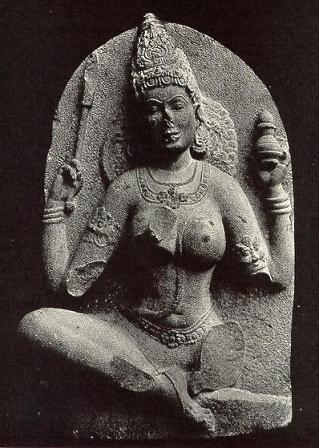 Indian seafarers did not absent
themselves from the Middle East or the European mainland. From the Sanskrit name
of Socotra (Island abode of bliss) and from certain Hindu-like divisions and
customs among the people of East Arabia. C. Lassen
suggested that the first sailors and colonizers on the Indian Ocean came from
India. According to Jeannie Auboyer
"merchant shipping was very active in India and had, even since Roman
times, linked the Mediterranean world to China with great vessels (nava) of
which the Indian king owned a fleet, though most of them belonged to wealthy
individuals." Indian seafarers did not absent
themselves from the Middle East or the European mainland. From the Sanskrit name
of Socotra (Island abode of bliss) and from certain Hindu-like divisions and
customs among the people of East Arabia. C. Lassen
suggested that the first sailors and colonizers on the Indian Ocean came from
India. According to Jeannie Auboyer
"merchant shipping was very active in India and had, even since Roman
times, linked the Mediterranean world to China with great vessels (nava) of
which the Indian king owned a fleet, though most of them belonged to wealthy
individuals."
(source: Daily
Life in Ancient India - By Jeannie Auboyer ISBN 8121506328 p. 75).
The achievements of Indian seafarers
in the Far East and Southeast Asia have been acknowledged by a host of
scholars. The late Professor Buhler
says: "References to voyages are also found in two of the most ancient
Dharma Sutras."
There was also an active trade
between India and Greece. The mention of ivory by Homer and of several other
Indian articles assign the trade a very ancient date. In addition to ivory,
India also supplied indigo to Greece, whence the inhabitants derived their
knowledge of its use. Homer knew tin by its Sanskrit name. Professor Max
Duncker says that the Greeks used to wear silken garments which were
imported from India, and which were called "Sindones, or "Tyrian
robes." "Trade existed between the Indians and Sabaens on the
coast of South Arabia before the 10th century B.C. the time when, according to
the Europeans, Manu lived.
Of the producer of loom, silk was
more largely imported from India into ancient Rome than either in Egypt or in
Greece. "It so allured the Roman ladies, " says a writer, that it sold
its weight in gold."
(source: Encyclopedia Britannica Vol. XI p.
459). For more information refer to chapter on India
and Egypt).
Testimony to the flourishing
condition of the ship-building industry in India is available in the description
of the return journey of Alexander from India via the sea route. According to
estimates of Ptolemy nearly 2000 vessels which between them accommodated 8000
troops, several thousand horses, and vast quantities of supplies. This vivid
description speaks not only of the ready resources and expertise of the Indian
craftsmen but also of the tonnage of the seaworthy ships estimated at about 75
tons (or 3000 amphorea) by Pliny.
The most valuable of the exports of
India was silk, which was under the Persian Empire is said to have exchanged by
weight of gold.
(source: Indian
Shipping - By R.
K. Mookerji p. 83).
It is evident that "there was a
very large consumption of Indian manufactures in Rome. This is confirmed by the
elder Pliny, who complained that there was "no year in which India did not
drain the Roman Empire of a hundred million sesterces (1,000,000 pounds)....so
dearly do we pay for our luxury and our women." The annual drainage of gold
from Rome and its provinces to India was estimated by him at 500 steria, equal
to about Rs. 4,000,000. We are assured on undisputed authority that the Romans
remitted annually to India a sum equivalent to 4,000,000 pounds to pay for their
investments, and that in the reign of Ptolmeies, 125 sails of Indian shipping
were at one time lying in the ports whence Egypt, Syria, and Rome itself were
supplied with the products of India."
(Life in Western India (Guthrie),
from Colonel James Tod - Western India p. 221. Hindu
Raj in the World - By K. L. Jain p. 37).
Roman coins in large quantities are
found in places in Southern India, whence beryl, pepper, pearls and minerals
were exported to Rome. Some of these are described by Mr. Sewell. "These
hoards," he says, "are the product of 55 separate discoveries, mostly
in the Coimbatore and Madura districts."
(source: Journal
of Royal Asiatic Society for 1904, Roman Coins).
There is extant, a Prakrit text on
ship-building named Angavijja written in the Kushana period and edited in the
Gupta period. This text enlists about a dozen names of different types of ships,
such as Nava, Pota, Kotimba, Salika, Sarghad, Plava, Tappaka, Pindika, Kanda,
Katha, Velu, Tumba, Kumba and Dati. Some of these varieties of ships such as
Tappaka (Trappaga), Kotimba and Sarghad have also been mentioned in the Periplus
of the Erythrean Sea. They are considered to be very large ships
capable of sailing along the coast as well as in deep sea.
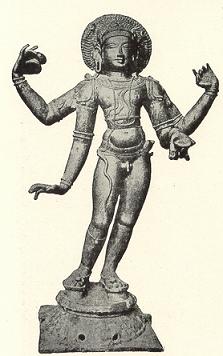 Mr. Momensen in his Provinces
of the Roman Empire (Volume II p. 301), says: "Somewhat further
to the south at Kananor numerous Roman gold coins of the Julio Claudian epochs
have been found, formerly exchanged against the spices destined for the Roman
kitchens." Mr. Momensen in his Provinces
of the Roman Empire (Volume II p. 301), says: "Somewhat further
to the south at Kananor numerous Roman gold coins of the Julio Claudian epochs
have been found, formerly exchanged against the spices destined for the Roman
kitchens."
Arabia being the nearest of the
countries situated to the west of India, was the first to which the Indian
commercial enterprises by sea were directed. The long-continued trade with
Arabia dates from a very remote antiquity. "The labors of Von
Bohlen (Das Alte Indian, Volume I, p. 42), confirming those of Heeran
and in their turn confirmed by those of Lassen (Ind Alt. Vol II. p. 580), have
established the existence of a maritime commerce between India and Arabia from
the very earliest period of humanity. Lassen also says that the Egyptians
wrapped their mummies in Indian Muslin.
Agarthchides
of Cnidus, Ptolemaic Dynasty, President of
the Alexandrain Library, who is mentioned with respect by Strabo, Pliny and
Diodorus, and who lived upwards of 300 years before the time of Periplus,
noticed the active commercial intercourse kept up between Yemen and Pattala - a
seaport in Western India. Pattala in Sanskrit means a "commercial
town" which circumstance if it is true, says Prof. Heeran, "would
prove the extreme antiquity of the navigation carried on by the Indus.
Agatharchides saw large ships coming from the Indus and Pattala.
The importance of trade was
highly appreciated by the people of Kalinga
- a kingdom on the Eastern seaboard of India. Inscriptions "speak
of navigation and ship commerce as forming part of the education of the princes
of Kalinga."
J. Takakusu writes:
"That there was a communication or trade between India and China from 400
A.D. down to 800 A.D. is a proven fact. Not to speak of any doubtful records we
read in the Chinese and Japanese books, Buddhist or otherwise, of Indian
merchant ships appearing in the China Sea; we know definitely that Fahien
(399-415 A.D) returned to China via Java by an Indian boat...at further in the
Tang dynasty an eyewitness tells us that there were in 750 A.D. many Brahmin
ships in the Canton River."
(source: Journal
of Royal Asiatic Society, Great Britain and Ireland. October 1905 p.
872).
Historian Vincent
Smith in his book Early History of India, writes" "Ancient
Tamil literature and the Greek and Roman authors prove that in the first two
centuries of the Christian era the ports on the Coromandel or Cholamandal coast
enjoyed the benefits of active commerce with both East and West. The Chola
fleets.....uncrossed the Indian ocean to the islands of the Malaya
Archipelago."
(source: Early
History of India - By Vincent Smith p. 415).
"The Hindus themselves were in
the habit of constructing the vessels in which they navigated the coast of
Coromandel, and also made voyages to the Ganges and the peninsula beyond it.
These vessels bore different names according to the size." writes Prof.
Heeran. There were commercial towns and ports on the Coromandel coast.
Masulipatam, with its cloth manufactures, as well as the mercantile towns
situated on the mouth of the Ganges, have already been noticed as existing in
the time of Periplus. Even as late as the
17th century, French traveler Tavernier in
1666 A.D. said: "Masulipatam is the only place in the Bay of Bengal from
which vessels sailed eastwards for Bengal, Arrakan, Pegu Siam, Sumatra, Cochin
China and the Manilla and West to Hormuz, Makha and Madagascar."
(source: Hindu
Raj in the World - By K. L. Jain p. 42).
***
The
East
Southeast Asia has always been an
integral part of the Indian consciousness is borne out by the fact that the
countries of Southeast Asia so comprehensively embraced Hinduism and Buddhism in
all its aspects. This spiritual and cultural affinity became an inseparable part
of their ethos and way of life. Successive Indian kings and kingdoms from the
first century AD and even before to the beginning of the 15th century, had
regarded Southeast Asia and the lands lying beyond as vital for their own
strength, security and sustained development. This intricate and abiding web of
relationships in turn contributed significantly to India’s sense of security
in an extended neighborhood in which India is neither seen as an alien power nor
as a country with a colonial past.
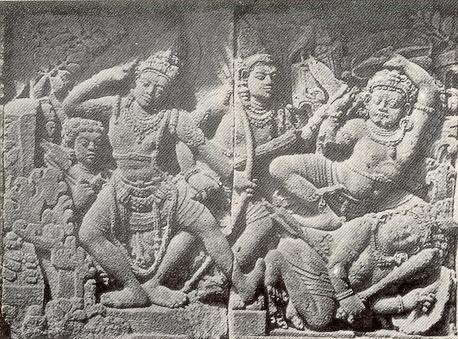
Panel no. 4. Siva temple
bas-relief. Prambanan, Indonesia.
Archaeological Survey of India, New Delhi.
***
The advent of the British in India
and the struggle for influence between European powers that ensued all over
Southeast Asia, suspended the continuous interaction that had existed between
India and the region. Southeast Asia itself was carved up into areas of
influence by the major colonial powers, viz., the British, French, Dutch and
Portuguese. India’s cultural and commercial interaction with this region was
therefore subordinated to the political and strategic considerations of the
great powers. The relationship spanning
nearly 2500 years was founded and nurtured on mutual interest and security in
which both partners constantly enriched and reinforced each other.
In the opinion of Professor Kakasu
Okakura author of The
Ideals of the East, with Special Reference to the Art of Japan:
"Down to the days of the Mohammedan conquest went, by
the ancient highways of the sea, the intrepid mariners of the Bengal coast,
founding their colonies in Ceylon, Java and Sumatra, and binding Cathay (China)
and India fast in mutual intercourse."
 George Coedes,
French historian and author of Indianized
State of South East Asia considered that Indian
colonization, intensive in the 2nd and 3rd centuries A.D. came to full fruition
in 4th and 5th centuries. "I am
convinced that such research will reveal numerous facts which will indicate a
much deeper Indianization of the mass of the population than the sociologists
will at present admit." George Coedes,
French historian and author of Indianized
State of South East Asia considered that Indian
colonization, intensive in the 2nd and 3rd centuries A.D. came to full fruition
in 4th and 5th centuries. "I am
convinced that such research will reveal numerous facts which will indicate a
much deeper Indianization of the mass of the population than the sociologists
will at present admit."
Indianization of Southeast Asia
continued even during the early mediaeval times which is explained by French
scholar, Orientalist who wrote on Eastern religion,
literature, and history Sylvain
Levi (1863-1935) who proposed that:
"India
has produced its true masterpieces in foreign lands under foreign inspiration
and that in architecture it is in distant Cambodia and Java that one must seek
the two marvelous products of Indian genius, Angkor Wat and Borobudar."
T. W. Rhys Davids
author of Pali-English
Dictionary has observed that "Sea going merchants,
availing themselves of the monsoons, were in the habit at beginning of the 7th
century B.C. of trading from ports of the Southwest Coast of India to Babylon,
then a great mercantile emporium."
(source: Buddhist
India - By T. W. Rhys- Davids p. 116).
Reginald S. Le
May (1885 - )
author of The
culture of South-East Asia; the heritage of India
has observed:
"India, indeed,
began to exercise a profound cultural influence on her neighbors to the eastward
- Burma, Siam, Malaya, Cambodia, Java and Sri Lanka all falling beneath her
sway. And this, as far as one can may judge, almost entirely as a result of
trading and peaceful penetration by missionaries, merchants and others, and not
by force of arms." "The beginnings of Indian colonization overseas
eastward go back a very long way in time and it is almost certain that the
results seen today were, in the main, not
achieved by military expedition, but by peaceful trading and religious teaching
- and thereby all the more permanent."
Contrasting the
Indian method with the Chinese
he remarked:
"Indian
religious art and culture seem naturally to have exercised an extraordinary
fascination over the indigenous peoples
of all these territories,
no doubt, owing to the attractions offered by Hinduism and Buddhism, while
Chinese art, not bearing any particular religious message, apparently made
little impression, in spite of the fact that the Chinese, too, sailed to
southern seas..."
(source: India
and The World - By Buddha Prakash
p. 7-8 Institute of Indic Studies Kurukshetra University 1964).
George
Coedes (1886 -1969) author of Ancient
Hinduized states of the Far East, has pointed out the enduring value
of Hindu culture in Outer or Greater India:
"One is struck by the
fundamental difference in the results achieved in the countries of the Far East,
by the civilizing action of China and that of India. The reason of it lies in
the radical difference in the methods of colonization, employed by the Chinese
and by the Hindus. The Chinese proceeded with conquest and by annexation: the
armies occupied the lands and the officials spread the Chinese civilization. The
Hindu penetration and infiltration seem to have almost always been peaceful and
unaccompanied by those destructions, which disgrace the Mongol cavalcade or the
Spanish conquest of America. Far from being destroyed by the
conquerors, the indigenous people have found in the Hindu society, transplanted
and made supple, a frame, in which their own societies have been able to
integrate and develop themselves." "The
exchange of ambassadors between the two shores of the Bay of Bengal was done on
a footing of equality, whereas China always
required of the " barbarians of the south" the recognition of her
suzerainty, which was expressed by the regular payment of tribute."
"The lands, militarily
conquered by China, had to adopt or imitate her institutions, customs,
religions, language and script. On the contrary, those, whom India
peacefully conquered, by the prestige of her culture, have preserved
the essence of their individual characters and have developed them, each
according to its own genius."
(source: Les
états Hindouisés d'Indochine et d'Indonésie - By George Coedes p.
64-66).
The control
of the Indian seas belong predominantly to India till the thirteenth century
A.D. In respect of the Arabian Sea this control meant only the
freedom of navigation. There was no colonizing activity in that area, though
Socotra, or Sukhadhara dwipa (the island of the blest) was discovered long
before the Christian era and was probably under the Indian occupation at that
time. Indian communities existed in Alexandria and other Egyptian towns and
there were also settlements on the coasts of the Persian Gulf. But generally
speaking, the navigation of the Arabian Sea was only for the purpose of trade.
In case of Bay of Bengal, it was different. The supremacy in that sea was naval
and political, based on an extensive colonization of the islands and this
supremacy ceased only with the breakdown of Chola power in the thirteenth
century. The naval activity of the Hindus was controlled by organized
corporations of which the most important were the Manigramam
Chetties and the Nanadesis. Of
the Manigramam Chetties who traded all over the world we have authentic records
in grants and inscriptions. The Bhaskara Ravi Varman plate of the Kerala King
grants certain special privileges to the Manigramam guild. This body was given
charter...including "the sword of sovereign merchantship" and monopoly
rights of trading. Other "merchant adventurers" known from records are
the Nanadesis, the Valangai and the Elangai who are described in the inscription
at Baligami in Mysore as bodies of "brave men born to wander over many
countries since beginning of the Krta Age (the first of the Indian Cycle of
Yugas) penetrating regions of the six continents by land and water routes, and
dealing in various articles, such as horses and elephants, precious stones,
perfumes and drugs either wholesale or in retail."

Indian adventurers sailing out
to Colonize Java.
Large
four-masted ships possessed by the Indians at the time made crossing the Pacific
perfectly feasible.
(image source: India Through the ages - By K. M. Panikkar
and Transoceanic
Contacts Between the Old and New World).
***
The ships built by Hindu navigators
at that time are described thus by J. Hornell stated
to be an authority on Indian boat designs. They were "square rigged, two
masted vessels, with raked stem and stern, both sharp, without bowsprit and
rudder and steered by two quarter paddles." (Quoted in Towards Angkor - By
Q. Wales p. 26). First the Mauryas and then the Andhras were the lords of the
Eastern Seas. The Ambassador of the Prince of Wu
reported that while he was in Khamboja (Cambodia) in about A.D. 250 he saw ships
with seven sails which could stay at sea for four weeks at a time. Other reports
mention ships mention ships which carried over 600 men and more than 1,000 tons
of merchandise. From the Andhras the sovereignty of the eastern Seas passed to
the Pallavas as may be inferred from the great influence which this dynasty
exercised on the colonial kingdoms of Further India.
The Hindus had already in use a magnetic compass
known as Matsya Yantra for determining
direction. The work "Merchants Treasure" written at Cairo by Baylak al
Kiljaki mentions the magnetic needle as being in use in the Indian Ocean. The
route that Fa-hien, the celebrated Chinese
monk, took to return home after his stay in India (412-413) is fully described
by him. Leaving Tramralipti, the Orissa port, he took fourteen days to reach Sri
Lanka. From there he embarked for Java and called at Nicobars (Nakka-varam), the
island of the naked. From Nicobar the ship passed through the Straits of Malacca
into the Pacific. Oceanic travel was therefore well advanced in the fifth
century and Indian mariners not merely crossed the Bay of Bengal at its widest
point, but sailed far out into the Pacific.
Further, the Hindus had developed
great skill in building ocean-going ships of great strength and durability. The
participation of Hindus in the navigational activities of the Red Sea is also
borne out by the Oxyrhynchus Papyri, a second century farce in the Greek
language in which the conversation between certain characters is in a language
which some scholars have identified as being South Indian. Besides, there are
extensive allusions to maritime affairs and to long voyages in early Tamil
literature. Tamil scholars have counted no less than
1,800 nautical words in that language.
The numerous ports of India from
Broach to Quilon became great markets of trade. A first century Tamil classic
describes the port of Muziris. (Cragnore in Cochin) as being filled with ships.
The ruins of a Roman temple have also been discovered in that area.
(source: India
and the Indian Ocean - K. M. Panikkar The MacMillan Company,
copyright 1945 p. 26-27).
 Sir Stamford Raffles
(1781-1826) the British Governor of Java,
in his book, History
of Java, II, p. 87, wrote: Sir Stamford Raffles
(1781-1826) the British Governor of Java,
in his book, History
of Java, II, p. 87, wrote:
“In the year 525 Saka era – 603 A.D., it being foretold
to a king of Gujarat that his country would decay and go to ruin, he resolved to
send his son to Java. He embarked with about 5000 followers in 6 large and about
100 small vessels, and after a voyage of four months reached an island they
supposed to be Java; but finding themselves mistaken, re-embarked, and finally
settled at Matarem, in the center of the island they were seeking….The prince
then found that men alone were wanting to make a great and flourishing state. He
accordingly applied to Gujarat for assistance, when his father, delighted at his
success, sent him reinforcement of 2000 people…From this period Java was known
and celebrated as a kingdom; an extensive commerce was carried on with Gujarat
and other countries, and the bay of Matarem was filled with adventurers from all
parts.”
(source:
Periplus of the Erythrean Sea - W.H. Schoff p.
245).
Yuktikalpataru
gives a detailed classification of ships:
They were two kinds: ordinary (Samanya) ships comprising those used in inland
waters and special (visesa) meant for sea journeys. The largest of these called
Manthara measured 120 cubits in length, 60 in breadth and 60 cubits in height.
During the days of the composition of Yuktikalpataru, it appears that
ship-building was highly advanced. Bhoja has
advised the builders of the sea-faring ships not to join the plants with iron,
as, in the case, the magnetic iron in sea water could expose the ship to danger.
To avoid this risk, he suggests that planks of the bottoms should be held
together with the help of substances other than iron.
According to Marco Polo
an Indian ship could carry crews between 100 to 300. Out of regard for passenger
convenience and comfort, the ships were well furnished and decorated. Gold,
silver, copper and compound of all these substances were generally used for
ornamentation and decoration.
(source: India
Through The Ages: History, Art Culture and Religion - By G. Kuppuram
p. 527-531).
The comparatively large size of
the shipping on the Coromandel coast is indicated also by the Andhra coinage, on
which a frequent symbol is a ship with two masts, apparently of considerable
tonnage.
E. J.
Rapson in his book, Coins of the Andhra
Dynasty “Their maritime traffic, to which the ship type bears
witness, is also attested by the large number of Roman coins which are found on
the Cholamandalum coast.”
The shipping of the Andhra and
Pallava coins doubtless survives in the modern “masula boats” at Madras:
J H
Furneaux wrote in his book, Glimpses of
India, p. 254:
“These masula boats are
flat-bottomed barges constructed of planks sewn together with rope of cocoanut
fiber, caulked with oakum, are able to withstand better than far more solidly
built craft the shock of being landed on the sandy beach from the crest of a
something breaker.”
Similar in a general way to the
Andhra coin-symbol is the Gujarati ship carved in a bas-relief on the frieze on
the Borobodor temple in Java. While dating from about 600 A.D. this vessel was
probably not different from those of the 1st century, while the short
broad sail with double yards is identical with those of the Egyptian Punt
Expedition of the 15th century B.C.
Kalidasa,
in the Raghuvamsa, tells of a tour of conquest of India, made by Raghy, the
great-great-grandfather of Rama; starting from Ayodhya he went eastward to the
ocean, having conquered the Bangalis, who trusted in their ships.”
The textile industry of both
Trichinopoly and Tanjore has been famous from early times. There can be little
doubt that some of the finest fabrics that reached the Roman world came from
this kingdom of Chola. From this part of India, in the middle ages, came those
gold-threaded embroideries which were to such demand in the Saracen markets.
Marco
Polo called Chola “the kingdom of Maalabar called Soli, which is
the best and noblest province in India, and where the best pearls are found.”
(source:
Periplus of the Erythrean Sea - W.H. Schoff p.
242- 250).
Reports Auguste Toussaint in
his book, 'History of the Indian Ocean',
"The Mauryan emperor Chandragupta, who ruled from 321 to 297 B.C had even
at that time, an actual Board of Admiralty, with a Superintendent of Ships at
its head." References to it can be found in Kautilya's
Arthasastra. From
their voyages of conquest and trade, we can infer that although much later, the
Pallavas, Pandyas and Cholas of South India must also have had an efficient
naval organization. The merchants of Surat, who relied upon ships built by the
Wadias of Bombay (who had not taken long to copy prevailing European designs)
were particularly rich - one of them Virji Vora (who died in the beginning of
the 18th century) left a fortune of 22 million gold francs. "According to
certain travelers, Surat was then the most beautiful city of India. One small
detail will give an idea of the unparalleled luxury that prevailed there:
certain streets were paved with porcelain. Francois Martin in his Memoires calls
it 'a real Babylon'.
(source: History of the Indian
Ocean- By Auguste Toussaint).
 The waves of Indian migration before
breaking on the shore of America submerged the islands of the Indian Archipelago
or Suvarnabhumi. The waves of Indian migration before
breaking on the shore of America submerged the islands of the Indian Archipelago
or Suvarnabhumi.
Colonel James Tod wrote: "The isles of the Archipelago were
colonized by the Suryas (Surya-Vamsa Kshatriyas), whole mythological and heroic
history is sculptured in their edifices and maintained in their writings."
(source: Annals
and Antiquities of Rajasthan: or the Central and Western Rajput States of India
ISBN 8120612892 Vol. II p. 218).
Sir
Mountstuart Elphinstone says: "The histories of Java give a
distinct account of a numerous body of Hindus from Kalinga who landed on their
island, civilized the inhabitants and established an era still subsisting, the
first year of which fell in the seventh year before Christ."
"These pilgrims sailed from the
Ganges to Ceylon, from Ceylon to Java and from Java to China in ships manned by
crews professing the Brahmmanical religion."
(source: History
of India - By Mountstuart Elphinstone London: John Murray Date of
Publication: 1849 p.
168-185).
Most of the sculptures show in splendid relief
ships in full sail and scenes recalling the history of the colonization in Java
by Indians in the earlier centuries of the Christian era.
Of one of them E.
B. Havell thus speaks in appreciation:
"The ship, magnificent in design and
movement, is a masterpiece in itself. It tells more plainly than words the
perils which the Prince of Gujarat and his companions encountered on the long
and his companions encountered on the long and difficult voyages from the west
coast of India. But these are over now. The sailors are hastening to furl the
sails and bring the ship to anchor."
Big ships were built. They could
carry anywhere upwards from 500 men on the high seas. The Yuktialpataru
classifies ships according to their sizes and shapes. The Rajavalliya
says that the ship in which King Sinhaba of Bengal sent Prince Vijaya,
accommodated full 700 passengers, and the ship in which Vijaya's Pandyan bride
was brought over to Lanka carried 800 passengers on board. The ship in which
Buddha in the Supparaka Bodhisat incarnation made his voyages from Bharukachha
(Broach) to the "sea of the seven gems," carried 700 merchants besides
himself. The Samuddha Vanija Jataka mentions
a ship which accommodated one thousand carpenters.
(source: Manual
of Buddhism - By Robert Spencer Hardy p. 13 and Hindu
Raj in the World - By K. L. Lal p. 28).
Oldest Hindu
Temple in Siam
One of the most remarkable site in
the center of Siam, is Srideb (Crip-tep), where statues of Hindu deities bearing
Sanskrit inscriptions of the 5th to 6th century have been discovered. The art of
Srideb is of excellent quality and provides a link between Indian art and the
art of Indo-China. Quaritch Wales considered Srideb the oldest temple in
Indo-China.
The author R.
K. Mookerji of Indian
Shipping says:
"For full thirty centuries
India stood out as the very heart of the old world and maintained her position
as one of the foremost maritime countries. She had colonies in Pegu, in
Cambodia, in Java in Sumatra, in Borneo and even in the countries of the Farther
East as far as Japan. She had trading settlements in Southern China, in the
Malayan Peninsula, in Arabia and in all the chief cities of Persia and all over
the East Coast of Africa. She cultivated trade relations not only with the
countries of Asia, but with the whole of the then known world, including the
countries under the dominion of the Roman Empire, and both the East and West
became the theatre of Indian commercial activity and gave scope of her naval
energy and throbbing international life." According to R.
Sewell,
"There was trade both by sea and overland with Western Asia, Greece, Rome
and Egypt as well as China and the East."
(source: Indian
Shipping: A History of the Sea-Borne Trade and Maritime Activity of the Indians
From the Earliest Times - By R. K. Mookerjee p. 4 and Hindu
Raj in the World - By K. L. Jain p. 25). For more information
refer to chapter on India
and Egypt).
 Sir
John Malcolm (1769 - 1833) was a Scottish soldier, statesman, and
historian entered the service of the East India Company wrote about Indian
vessels that they: Sir
John Malcolm (1769 - 1833) was a Scottish soldier, statesman, and
historian entered the service of the East India Company wrote about Indian
vessels that they:
"Indian vessels
"are so admirably adapted to the purpose for which they are required that,
not withstanding their superior science, Europeans were unable, during an
intercourse with India for two centuries, to suggest or at least to bring into
successful practice one improvement. "
(source:
Journal of Royal Asiatic Society, Vol. I and
India
and World Civilization -
By D P Singhal part
II p. 76 - 77).
Anthony
Christie remarks that:
"although attempts have been made from
time to time to minimize the extent of Indian influence upon Southeast Asia, the
evidence for their importance is there for all to see and cannot be controverted."
Alastair Lamb observes that "by
the opening of the Christian era the civilization of India had begun to
spread across the bay of Bengal into both island and mainland Southeast Asia;
and by the fifth century A.D. Indianized states, that is to say, states
organized along the traditional lines of Indian political theory and following
the Hindu religion, had established themselves in many regions of Burma,
Thailand, Indo-China, Malaysia, and Indonesia...The Indianization of Southeast
Asia was a slow and gradual process. With a few exceptions, it was carried out
by peaceful means and in consequence, as it developed, it did not build up a
resistance to its further progress. Indian influence had no difficulty merging
with indigenous cultures to create a series of distinct amalgams in which it is
now virtually impossible to disentangle all the Indian from the non-Indian....it
has now without a doubt guaranteed the Indian heritage a place in Southeast
Asian civilization from which it cannot possibly be dislodged without the total
destruction of the civilization."
(source: Bias
in Indian Historiogarphy - Edited By Devahuti D. K. Publishers'
Distribution. New Delhi. 1980. p. 93).
In
the middle of the 18th century, John Grose
noted that at Surat the Indian ship-building industry was very well established,
indeed, “They built incomparably the best ships in the world for duration”,
and of all sizes with a capacity of over a thousand tons. Their design appeared
to him to be a “a bit clumsy” but their durability soundly impressed him. They
lasted “for a century”.
Lord Grenville mentions, in this connection, a ship built in Surat
which continued to navigate up the Red Sea from 1702 when it was first mentioned
in Dutch letters as “the old ships” up to the year 1700.” Grenville
also noted that ships of war and merchandise “not exceeding 500 tons” were
being built” with facility, convenience and cheapness” at the ports of
Coringa and Narsapore.
Dr.
H. Scott sent samples of dammer
to London, as this vegetable substance was used by the Indians to line the
bottom of their ships; he thought it would be a good substitute “in this
country for the materials which are brought from the northern nations for our
navy…There can be no doubt that you would find dammer in this way an excellent
substitute for pitch and tar and for many purposes much superior to them.”
source:
Decolonizing
History: Technology and Culture in India, China and the West
1492 to the Present Day - By Claude Alvares
p. 68-69).

(image source: India Through the ages
- By K. M. Panikkar).
***
The largest ships carried 10,000 talents or
250 tons. Ajanta painting of a later date depict horses and elephants aboard the
ship which carried Prince Vijaya to Sri Lanka.
Megasthenes
informs us that there was a class of ship-builders among the artisans who were
salaried public servants and not permitted to work for any private persons.
The ships built by them in royal shipyards were, however, let out on hire both
to those who undertook voyages and to professional merchants. The fact that
shipping and sea-trade received adequate attention under the Mauryas is made
clear by the reference to the Superintendent of Ships in the Arthasastras. The Periplus
of the Erythraean Sea, a marine guidebook of 1st century A.D. by an
anonymous Graeco-Egyptian takes note of several ports on the Indian coast.
Beginning from the mouth of the Sindh, notice is taken of Barbaricum. Then
follows Barygaza, ie. modern Broach. In Dachinabades two sea ports are mentioned
namely, Supara and Calliena, both situated near Bombay (Mumbai). Muziris was the
most important port of Kerala. It gained prominence after the discovery of the
monsoons and was always crowded with a large number of Greek and Arab ships.
Nelceynda was another port of Kerala located 500 stadia or 50 miles south of
Muzaris. Near Kanya Kumari also there were two ports named Paralia and Balita.
All these ports were well looked after either by the local or the imperial
rulers of India. The ports served as the chief source of state revenue. (For
more information refer to chapter on India
and Egypt)
Chinese travelers like Fa-hsien,
Hsuang-tsang and I-tsing invariably
speak of Tamralipti, the main outlet for north Indians who wanted to travel to
Southeast Asia via Lanka or by a more direct route. From the volume of exports
and imports and the variety of goods exchanged it appears that considerable
facilities were available at all the ports. Light
houses were provided, remains of some are extant. Late Sinhalese sources speak
of an artificial harbor made during the time of Karikal Chola (1st century A. D).
According to the Divyavadana
the desire to amass wealth without making a sea voyage is like an effort to fill
a pitcher with a few drops.
The work also records that the
captain of a ship reminded the passengers that there were more perils than
pleasure in seafaring. Many went out but few came back and that it was rare to
sail six times successfully across the ocean. This narration points out the
hazards of deep sea sailing but there is no scope for suggesting that the
Indians hated the sea. The Jatakas, the Manimekhalai, Raghuvamsa, Tilakamanjari,
Kathasaritsagara, etc. abound in tales of
the sea as exciting as they are terrifying and point to the Indians
familiarity with, and lure of the sea. The Yuktikalapataru
of Bhoja (11 the century A.D.) affirms that the king who has
boats, wins war, and the king who through ignorance does not keep boats, loses
his prestige, vigor and treasury. This text also supplies details regarding the
construction of ships. (For more please refer to chapter on War
in Ancient India). The Jaina texts like the Gyatadharma
Avasyaka-chou-ko-ta'an (1122 A.D.) mentions large ships from Kalinga
that carried several hundred men and smaller ones which carried hundred or more
men.
 Marco Polo
found Socotra a prey to multitudes of Hindu pirates who encamped there and sold
off their booty. He speaks of Aden as a "port to which many ships of India
come with their cargo." He also gives details regarding the size, form
fittings and mode of repairing of Indian ships. He
remarks about the strength of Indian ships and says that they were built to last
a hundred years. Marco Polo saw ships so large as to require a crew
of 300 men, and other ships that were manned by crews of 200 and 150 men. Friar
Odoric (A.D. 1321) traveled in a ship owned by a Gujarati Rajput that
carried a load of 700 people. Marco Polo
found Socotra a prey to multitudes of Hindu pirates who encamped there and sold
off their booty. He speaks of Aden as a "port to which many ships of India
come with their cargo." He also gives details regarding the size, form
fittings and mode of repairing of Indian ships. He
remarks about the strength of Indian ships and says that they were built to last
a hundred years. Marco Polo saw ships so large as to require a crew
of 300 men, and other ships that were manned by crews of 200 and 150 men. Friar
Odoric (A.D. 1321) traveled in a ship owned by a Gujarati Rajput that
carried a load of 700 people.
Historian Vincent
Smith remarks: "This is a confirmation of the account we have of
those large ships from the time of Agatharcides down to the 16th century, the
ships of Gujarat which traversed the Indian ocean in all ages."
There is an
even earlier mention of Rajput ships sailing between Sumena (Somnath) and China
in Yule's Cathay.
Abd-er-Razzak (A.D. 1442) informs us that
"from Calicut vessels continually sailing for Mecca, which are for the most
part laden with pepper. The inhabitants of Calicut are adventurous sailors, and
pirates do not dare to attack the vessels of Calicut." Nicolo Conti (15th
century) acknowledged that the "natives of India build some ships larger
than ours." In 1510 Albuquerque met Hindu sailors and traders in Java and
Malacca.
Indian land-lubbery was not
synchronous with the coming of Islam, nor with the Middle Ages. The Bay of
Bengal was a Chola lake in the 11th century. A ship built at an Indian dockyard
is said to have been used in the Napoleonic wars. In
fact Indian navigational expertise and enthusiasm seems to have suffered in
direct proportion to the British economic policies reducing India to the
position of a mere supplier of raw materials. People whose ships had
trades with the Mediterranean world in the west, and with the lands of gold in
the east now considered themselves heroic if they made it to England to land at
Lincoln's Inn!
(source: Bias
in Indian Historiogarphy - Edited By Devahuti D. K. Publishers'
Distribution. New Delhi. 1980. p. 90 -100).
***
Untold secrets - India
– the largest gunpowder source in the world
India’s military technology is history’s greatest ‘hidden’
secret. Official (and Western) portrayal
of Indian military systems in the face of Islamic invaders, Mughal sultanate
and the rise of British imperialism makes out India as a sitting duck with
ill-trained and terrified soldiers, armed with bows and arrows, who were
hopelessly outclassed by the enemy.
Facts being
otherwise, it raises questions about motives for this deliberate wrong
portrayal.
Modern history
credits China with the invention of gunpowder.
Firstly, this is largely based on the work of
a self-confessed
Sinophile
– Needham. With a
dismissive one
sentence,
Needham opines, “On Gunpowder history in India, Oppert (1) was duly exploded by
Hopkins(2).” And Indian history as the world’s largest
producer of gunpowder was swept under the carpet. Needham
conveniently ignores
evidence
like how;
"Jean
Baptiste Tavernier recorded a local tradition in the 1660s that
gunpowder and artillery were first invented in Assam from whence they spread to
China and he mentioned that the Mughal general who conquered Assam brought back
numerous old iron guns captured during the campaign."
Secondly,
Mongol territories extended from Mongolia to the gates
of Vienna and Russia – but not India. How is it that a few
deserters-soldiers could establish the world’s largest gunpowder production
system, so rapidly in non-Mongolian India. But, could not do so in conquered
territories of China, Central Asia, Middle East, West Asia, and Europe.
A 100 years
before Needham, India’s pioneering status in saltpetre was common knowledge.
English publications,
for instance in 1852
and another
in 1860 gave weightage
to the opinion of those who believe that gunpowder was invented in India and
brought by the Saracens from Africa to the Europeans; who improved its
manufacture and made it available for warlike purposes.
Unlike China,
with an odd textual reference or a drawing or a singular artefact, was the
entire industry in India – which remained unrivalled in the history of the
world. Compared to China’s paltry production of gunpowder, India’s widespread
and organized gunpowder production system points towards indigenous development.
There are
reports, that in
“664 an Indian visitor to China reportedly demonstrated the peculiar flamability
of saltpeter and provided instructions on how to locate it (Pacey 1990, 16).”
Tall
tales … thin stories
The deserter
Mongol soldier source seems rather far-fetched considering that Mongol armies
studiously avoided attacking India. India,
the richest economy
of the world
at
that time, known and famous for its wealth, was spared by Genghis Khan! Just why
would history’s foremost looter, invader, pillager spare India?
When Genghis
Khan’s Mongol armies were running rampant, Islamic refugees found shelter in
India, during the reign of Iltutmish. In 1221, Khwarezm-Shah and other Persian
refugees, sought refuge in India, across the Indus into the Punjab, India, from
Genghis Khan’s Mongol armies.
India – the largest gunpowder source in the world
Now, combine saltpetre production with the fact that the heart of the Indian
saltpetre production was in Bihar, which was also the home of the Nalanda
seminary /university.
India’s
gunpowder production system
India was the
largest gunpowder production system –
in the history of the world, till the 20th century. Specifically Bengal and
Bihar regions. Operated by a caste of
peoples called the nuniah, saltpetre
beds supplied the most vital element in gunpowder –
saltpetre. And India
produced virtually all of it.
Especially, Bihar, Bengal, Agra and Tamil Nadu, Andhra and Karanataka regions (Anantapur,
Coimbatore, Guntur, Kurnool). The Guntur Sircar
also manufactured saltpetre on a
commercial scale. A mid 17th century
Royal Society
paper documented
how saltpetre was made in India.
(source:
Indian gunpowder -
2ndlook.wordpress.com). For more refer to chapter -
War in Ancient India.
***
Historian
Radha Kumud
Mookerji
"We now know that many ports on both Eastern and
Western Coast had navigational and trade links with almost all Continents of the
world. There are many natural and technological reasons for this. Apart from
Mathematics and Astronomy, India had excellent manufacturing skills in textile,
metal works and paints. India had abundant supply of Timber. Indian - built
ships were superior as they were built of Teak which resists the effect of salt
water and weather for a very long time. Lieut. Col. A Walker's paper
"Considerations of the affairs of India" written in 1811 had excellent
remarks on Bombay-built ships. He notes, "situated as she is between the
forests of Malabar and Gujarat, she receives supplies of timber with every wind
that blows." Further he says, "it is calculated that every ship in the
Navy of Great Britain is renewed every twelve years. It is well known that
teakwood built ships last fifty years and upwards. Many ships Bombay-built after
running fourteen or fifteen years have been brought into the Navy and were
considered as stronger as ever. The Sir Edward Hughes performed, I believe,
eight voyages as an Indiaman before she was purchased for the Navy. No
Europe-built Indiaman is capable of going more than six voyages with
safety." He has also further noted that Bombay-built ships
are at least one-fourth cheaper than those built in the docks of England.
(source: Indian
Shipping - A History of the Sea-Borne Trade and Marine Activity of
The Indians From The Earliest Times 1912).

Sailor dropping anchor -
Angkorwat, Cambodia.
For
more refer to chapters on Suvarnabhumi,
Pacific and Sacred
Angkor
***
Products Traded
Indian Exports
Food: Rice, Wheat, Sugar,
Spices: Turmeric, Pepper, Cinnamon, Nard, Spikenard, Costus, Bdellium, Aloes,
Indigo, Lycioum, Sesame oil, Cotton, Silk
Animals: Lion, Tiger, Parrot, Hides and furs, skins, Horns and tails, wool,
Ivory, Tortoise shells, Pearls, Lac, Log of Ebony, Teakwood, Blackwood,
Sandalwood, Bhurja Leaves, Bamboo
Mineral: Diamond, Agate and Carnelian, Sapphire, Quartz, Crystal, Beryls,
Lapislazuli, Garnet, Asbestos, Turquoise, Copper.
Indian Imports
Sesame, Flax and Linen, Parchment wine, gold, Horse, Peach and apricot, sweet
clover, silver, tin, copper, lead, ruby, topaz, glass, corals, amber,
Teakwood
It is the best building timber as it can resist
the action of water. Theophrastos mentions that ship builders built ships of
this wood of India in the Persian Gulf. Town of Siraf on the Persian Gulf
was entirely built of this wood and in 1811 teak was found in the walls of
a Persian palace near Baghdad (7th century B.C.E.) The Susa inscription of
Darius clearly mentions the import of teakwood in Persia. The Periplus states
that large vessels were regularly sent from Barygaza loaded with timbers of
teakwood to Oman. Realizing the export importance of teakwood Kautilya made
provision for the Superintendent for forest produce.
(source: Foreign
Trade and Commerce in Ancient India - By Prakash Charan Prasad p.203-212).
State patronage with the strength of the
organized guilds greatly increased the prosperity of the country. Megasthenes
records how prices were regulated by state-trading. The idea was that staple
commodities were bought when they were cheap and released when the prices were
high, just to bring the prices down. This was really a measure far ahead of its
time. As historian A. L. Basham points out:
"It is striking that
ancient Indian political theorists anticipated by over 2000 years the plans put
forward by the Food and Agriculture Organization of the United Nations for
maintaining a stable level of prices of staple commodities on a world-wide
scale.
(source:
Ancient Indian History and Culture - By Chidambara
Kulkarni Orient Longman Ltd. 1974. p. 104). For
more refer to chapter on Sacred
Angkor
Top
of Page
Land Trade
The land trade of India extended to
China, Turkistan, Persia, Babylon and sometimes also to Egypt, Greece and Rome.
Historian Vincent Smith writes:
"The country in the north with
which India traded was China." "The name China is of Hindu origin and
comes to us from India."
(source: Early
History of India - By Vincent Smith Vol. II, p. 574-575).
The author of Periplus, after
describing the geographical position of China, says: "Silk was imported
from that country, but the persons engaged in this trade were the Indians
themselves." It may, however, be added, in the words of an English critic:
"It is not improbable that silk was also indigenous in India even at a
remote epoch."
(source: Asiatic
Researches Volume II. p. 286. Also refer to Schlegel, Berlin Calendar
p. 9 1829).
E. B.
Havell (1861-1934)
principal to the Madras College of
Art in the 1890s, says: "From the
sea ports of western and eastern coasts India at this time also sent streams of
colonists, priests and craftsman all over Southern Asia, Ceylon, Siam and far
distant Cambodia. Through China and Korea Indian art entered Japan about the
middle of the sixth century. About 603 A.D. Indian colonists from Gujarat
brought Indian art in Java and at Borobudur in the 8th and 9th centuries. Indian
sculpture achieved its greatest triumphs."
(source: Ancient
Indian Culture At A Glance - By Swami Tattwananda p. 214).

Vishnu Belahan, Java.
(image source: History of Indian
Shipping - By Radha Kumud Mukerjee).
For
more refer to chapters on Suvarnabhumi,
Pacific and Sacred
Angkor
***
As regards the trade with central
and northern Asia, we are told that "the Indians make expeditions for
commercial purposes into the golden desert Ideste, desert of Cobi (Gobi) in
armed companies of a thousand or two thousand men. But according to report, they
do not return home for three or four years. The Takhti, Suleman, or the stone
tower mentioned by Ptolemy and Ctesias was the starting point for Hindu
merchants who went to China.
India traded with Europe by sea as
well as by land. Foreign trade of a nation presupposes development of its
internal trade. Specially is this true of a large country like India, with
varied products, vast population and high civilization.
Professor
Lassen of Paris considers it "remarkable that the Hindus
themselves discovered the rich, luxurious character of India's products; many of
them are produced in other countries, but remained unnoticed until sought for by
foreigners, whereas the most ancient Hindus had a keen enjoyment in articles of
state and luxury. Rajas and other rich people delighted in sagacious elephants,
swift horses, splendid peacocks, golden decorations, exquisite perfumes, Pungent
peppers, ivory, pearls, games etc. and consequently caravans were in continued
requisition to carry down these innumerable other matters between the north and
the south and the west and east of their vast and varied country. These
caravans, it is conjectured, were met at border stations and about ports by
western caravans or ships bound to or from Tyre and Egypt, or to or from the
Persian Gulf and Red Sea."
(source: Ancient
and Mediaeval India - By Vol. II.
p. 348). Ind. Alterthumskunde. For more information refer to chapter on India
and Egypt).
 Professor Heeran remarks,
"The internal trade of India could not have been inconsiderable, as it was
in a certain degree prescribed by nature herself." Royal roads were
constructed all over the country from east to west and from north to south, in
addition to the numerable rivers, along the banks of which considerable commerce
was carried on. Professor Heeran remarks,
"The internal trade of India could not have been inconsiderable, as it was
in a certain degree prescribed by nature herself." Royal roads were
constructed all over the country from east to west and from north to south, in
addition to the numerable rivers, along the banks of which considerable commerce
was carried on.
The Encyclopedia Britannica says:
"It (India) exported its most
valuable produce, its diamonds, its silks, and its costly manufactures. The
country which abounded in those expensive luxuries, was naturally reputed to be
the seat of immense riches, and every romantic tale of its felicity and glory
was readily believed. In the Middle Ages, an extensive commerce with India was
still maintained through the ports of Egypt and the Red Sea; and its precious
produce imported into Europe by the merchants of Venice, confirmed the popular
opinion of its high refinement and its vast wealth."
Foreign commerce on such a gigantic
scale was one of the principle causes of the immense riches of ancient India.
Top
of Page
The Hindu Period in The Indian
Ocean: A Naval Power
The spread of Hindu thought
was an intellectual conquest, not an exchange of ideas. The
Far East counted for nothing in her internal history, doubtless because China
was too distant and the other countries had no special culture of their own. Still
it is remarkable that whereas many Hindu missionaries preached Buddhism in
China, the idea of making Confucianism known to India seems never to have
entered the head of any Chinese. There was never any question of
colonizing or civilizing rude races.
Manu, the great lawgiver, provides in his Code,
for shipping and port dues, while Kautalya's
Arthasastra, an authoritative work
on administration which was written in the fourth century B.C. lays down the
functions of the Port Commissioner and Harbor Master. The Board of Shipping was
one of the six departments of the Mauryan Emperors. At the head of it was a
Minister who dealt with all matters relating to shipping, including the
navigation of the oceans. There under him a staff of commissioners, harbor
masters, etc. whose duty it was to look after ships in distress. As the Mauryan
ports were mainly on the coast of the Bay of Bengal, this is conclusive evidence
of the growth of trade and shipping in that sea as early as the fourth century
B.C.
We have also evidence of regular maritime traffic
by the Hindus in the South China seas before the Christian era. At the beginning
of that period both Chinese records and the Greek geographer Ptolemy record the
existence of Indian colonies in the present territory of South east Asia.
Sir Charles Elliot
(1862-1931), British diplomat and colonial
administrator, a famous scholar and linguist of Oxford, observed on his book
Hinduism and Buddhism
observes:
"This outgrowing of Indian influence, so long continued and so wide in
extent, was naturally not the result of any one impulse. At no time can we see
in India any passion of discovery, any fever of conquest such as possessed
Europe when the New world and the route to the East round the Cape were
discovered. India's expansion was slow, generally peaceful and attracted little
attention at home. The Hindus produced no Tamerlanes or Babers, but a series of
expeditions, spread over long ages, but still not few in number, carried them to
such distant goals as Java and Camboja.
We have also historical evidence of some of the
continental powers using their naval power for purposes of conquest. Pulikesin
II the Chalukya king who reigned in the first half of the seventh century led a
naval expedition of considerable size. The Zamorin of Calicut gloried in the
title of the Lord of the Mountain and the Ocean, and one of the first writs he
issued after coronation was to permit the usual navigation of the sea. The
Pandyas, Cholas and others also maintained powerful navies, while the Rulers of
Malabar exercised naval sway over the seas of the Western coast.

The Hindu Period in The Indian
Ocean
(image source: India and the Indian Ocean - By K. M.
Panikkar).
For
more refer to chapters on Suvarnabhumi,
Pacific and Sacred
Angkor
***
From the fifth century to the tenth the command
of the Malacca Straits was in the hands of a great Indian naval power, based on
Sumatra known to history as the Sri Vijaya Empire. This State included much of
Peninsular Malaya, Sumatra and the Western half of Java besides numerous island
principalities. I'Tsing who resided for some years in that Kingdom says that the
King possessed numerous ships which sailed regularly between India and Sri
Vijaya as also between Sumatra and China.
The Sri Vijaya Kings
maintained a powerful navy which swept the sea of pirates and corsairs.
Their naval power, well attested by their continuous raids on the coasts of
Champa and Annam, is recorded both in local inscriptions and in Chinese annals,
(e.g Po Nagar Stelae inscription of King Satya Varman 784 A.D. and in Yang Tikuh
inscription of Indra Varman I, dated 787). With the Straits of Malacca firmly
under their control and with their authority extending over the far flung group
of islands, the Sri Vijaya Kings were in a position to enforce their rule over
the Indian waves. Further, they were also closely connected with the Indian
Kingdoms of the Eastern side of the Bay of Bengal especially with the Kalinga
monarchs of Orissa.
Till the end of the tenth century, that is, for a
period of nearly 500 years, the Sri Vijaya Kings were the Lords of the Ocean.
But in 1007 the Chola Emperor Rajendra fitted out a powerful navy and challenged
the might of Sri Vijaya. he not only defeated the opposing navy, but captured
Kedah and established the Chola power on the Malaya Peninsula. This hundred year
war was of great importance for it weakened the Sri Vijaya power. Chau
Ju Kua, the Imperial Chinese Inspector of Foreign Trade, in his work
entitled Chu Fau Chi written in 1225 states
that Sri Vijaya was not merely a great emporium of trade, but controlled the
Straits of Malacca and thus was able to dominate the sea trade to China with the
west. All ships passing through the Straits had to call at the capital and the
maritime administration kept a close watch on traffic through the lane.
As regards to Sumatra, the Bombay Gazateer says:
"The Hindu settlements of Sumatra was almost entirely from the east coast
of India, and that Bengal, Orissa and Masulipatam had a large share in
colonizing both Java and Cambodia cannot be doubted."
Charles Coleman
wrote: "Mr. Anderson, in his account of his mission to the coast of that
island (Sumatra) has, however, stated that he discovered at Jambi the remains of
an ancient Hindu temple of considerable dimensions, and near the spot various
mutilated figures, which would appear to clearly indicate the former existence
of the worship of the Vedantic philosophy."
(source: The Mythology of the Hindus - with Notices of Various Mountain and
Island Tribes, Inhabiting the Two Peninsulas of India and the Neighbouring
Islands - By Charles Coleman p. 861). Refer
to India
once ruled the Americas! – By Gene D Matlock
Francois Balazar
Solvyns (1760-1824) a French maritime painter, wrote a book titled "Les
Hindous" (tome troisieme) in 1811. He lived in Calcutta from 1791-1803 and he
remarked:
"In ancient times, the Indians
excelled in the art of constructing vessels, and the present Hindus can in this
respect still offer models to Europe-so much so that the English, attentive to
everything which relates to naval architecture, have borrowed from the Hindus
many improvement which they have adopted with success to their own shipping....
The Indian vessels unite elegance and utility and are models of patience and
fine workmanship."

Indian Shipping: High Vessels -
Pearl, fishers' Grabs and Catamarans
(image source: From "Les Hindous" French early
19th century work).
For
more refer to chapters on Suvarnabhumi,
Pacific and Sacred
Angkor
***
He has described some of the typical Indian
vessels. A Pinnace or Yacht was a strongly masted ship, divided into two
or three apartments, one for company, another for the beds, and a third as a
cabinet, besides a place called varandah forwards for the servants. Balesore,
the principal entrance of the Hugli, is described as being frequented by
different sort of vessels, and particularly by large ships from Bombay, Surat,
and other parts of the western coast. The vessels from the Ganges were called
Schooners, which were very well fitted out and "able to make a voyage to
Europe." their pilots being very skilful. The Grab was a ship with three
masts, a pointed prow, and a bowsprit, its crew consisting of a Nakhoda or
captain and a few khelasses or sailors. The grabs were built at Bombay, their
pointed prow signifying Hindu construction.
The Bangles were the largest Indian boats, some of them carrying four thousand
or five thousand maunds of rice. Brigs were ships that came from the coast of
Coromandel and Malabar, bringing to Calcutta the produce of those countries. To
the coast of Coromandel (Cholamandel) also belonged the Dhoni, with one mast,
resembling a sloop. Its deck consisted of a few planks fastened on each side. It
was badly rigged. Pattooas, lastly, were those ships that differed from other
vessels by their being clincher-built; "the boards are one upon the other,
fastened by little pieces of iron in the form of cramps. The yard is always
without sail, and the sails are hoisted and lowered by blocks."

Some 17th century ships.
(image source: History of Indian
Shipping - By Radha Kumud Mukerjee).
***
Surprisingly, many earlier western traders and
travelers have expressed the same views. Madapollum was a flourishing shipping
center. Thomas Bowrey, an English traveler who visited India during 1669-79,
observes, "many English merchants and others have their ships and vessels
yearly built (at Madapollum). Here is the best and well grown timber in
sufficient plenty, the best iron upon the coast, any sort of ironwork is
ingeniously performed by the natives, as spikes, bolts, anchors, and the like.
Very expert master-builders there are several here, they build very well, and
launch with as much discretion as I have seen in any part of the world. They
have an excellent way of making shrouds, stays, or any other rigging for
ships".
Alain Danielou
(1907- 1994) son of French aristocracy, author of numerous books on philosophy, religion,
history and arts of India has written:
"India's naval dockyards, which belonged to
the state, were famous throughout history. The sailors were paid by the state,
and the admiral of the fleet hired the ships and crew to tradesmen for
transporting goods and passengers. When the British annexed the country much
later on, they utilized the Indian dockyards - which were much better organized
then those in the West - to build most of the ships for the British navy, for as
long as ships were made of wood."
(source:
A
Brief History of India - By Alain Danielou p.
106).
During the same period a great impetus was given
to Indian shipping and maritime enterprise by the great Shivaji,
the great Maratha leader. Shivaji, who liberally patronized the
shipbuilding industry but the beginnings of the Maratha navy were laid a little
earlier. In 1640 Shahji Bhonsle was able to achieve a naval victory over the
Portuguese off Reradanda. Shahji was helped in his expedition by Tukoji,
whose son, the famous Kanhoji Angray,
occupied such an important position in the Maratha navy of the times. Under
Shivaji the growth of the Maratha was accompanied by the formation of a
formidable fleet. Sivaji believed in the doctrine Jalaim jasya, valaim tasya and
so proceeded to organize the Maratha navy on sound lines. In 1698 Kanhoji Angray
succeeded to the command of the Maratha navy with the title of Dariya Saranga.
Angray soon became a menace to the European traders along the west coast and in
1707 his ship attacked the frigate Bombay, which was blown up after a brief
engagement. The career of Angray was one long series of naval exploits and
achievements rare in the annals of Indian maritime activity but unfortunately "dismissed
in a few words by our Indian historians."
(source: Indian
Shipping - A History of the Sea-Borne Trade and Marine Activity of
The Indians From The Earliest Times 1912 p. 183 -184).
The following account of Orme,
describing the features of the Maratha ships and Angrey:
" The piracy which Angray
exercised upon ships of all nations indifferently who did not purchase his
passes, rendered him every day more and more powerful. His fleet consists of grabs
and gallivats, vessels peculiar to the Malabar coast..."
(source: Bombay
Gazetteer, Volume I
part ii p. 89). Refer to
Marco Polo’s epic journey to China was a big con –
Team Folks
In the days of the sailing ships and
oaken vessels, the naval engineering of the Hindus was efficient and advanced
enough to be drawn upon with confidence for European shipping. At Madapollum,
for example, on the Madras coast, many English merchants used to have their
vessels yearly built. The Hindu ship architects could ingeniously perform all
sorts of iron works, e. g., spikes, bolts, anchors, etc. "Very expert
master-builders there are several here," says the English traveler, Thomas
Bowrey in his Geographical
Account of Countries Round the Bay of Bengal (1669-1675);
"they build very well, and launch with as much discretion as I have seen in
any part of the world. They have an excellent way of making shrouds, stays, or
any other riggings for ship."
Writing even as late as 1789, on the
eve of the Industrial Revolution in Europe, Solvyns, the French traveler, could
still recommend, in his Les Hindous (Vol. III, 1811), the Hindu method of
uniting the planks are "not unworthy of the imitation of Europeans."
He says, "In ancient times the Hindus excelled in
the art of constructing vessels, and the present Hindus can in this respect
still offer models to Europe."
In the building of the boat the
Hindus began by choosing a large piece of timber which they bent as they
pleased. To the two ends of this they attached another piece thicker than it,
and covered this simple frame with planks; "but they have a particular
manner of joining these plants to each other, by flat cramps with two points
which enter the boards to be joined, and use common nails only to join the
plants to the knee. For the sides of the boat they have pieces of wood which out
pass the planks. This method is as solid as it is simple."
The Portuguese "imitated"
the pointed prow in their Indian ships. This was a characteristic feature of the
grab, a Hindu ship with three masts. The industrial and material culture of Old
India was thus sufficiently vital to influence contemporary Europe at the
threshold of the 19th century civilization. The tradition is reported also by
old American sea-captains that fishing boats like the sloop, yawl, cutter, etc.
so common in the United States waters were modeled in the '"colonial
period" on Hindu patterns.
(source: Creative
India - By Benoy Kumar Sarkar p. 105).
Francois Balazar
Solvyns (1760-1824) a French maritime painter,
has made the following
observation in his book, "Les Hindous"
Introducing the 40 or so sketches of
boats and river vessels in use in Northern India in the 1790s, he observes,
"the English, attentive to everything which relates to naval architecture,
have borrowed from the Hindoos many improvements which they have adapted with
success to their own shipping."
Commenting on Indian rowing an early
eighteenth century observer remarked: "Their water-men row after a
different manner from ours. They move the oar with their feet, and their hands
serve instead of the hypomochlion, or roller on which it turns."
(source: Indian Science
and Technology in the Eighteenth Century: Some Contemporary European Accounts -
By Dharampal Impex India. p.LVII).


Mahartha Grab and Gallivat
ships attacking an English ship.
(image source: History of Indian
Shipping - By Radha Kumud Mukerjee).
***
Har Bilas Sarda
author of Hindu
Superiority (1906) wrote:
"They built ships, navigated the sea, and
held in their hands all the threads of international commerce, whether carried
on over land or by sea."
Colonel James Tod
author of author of Annals
and Antiquities of Rajasthan: or the Central and Western Rajput States of India
ISBN 8120612892 says:
"The Hindus
of remote ages possessed great naval power."
(source: Hindu Culture
and The Modern Age - By Dewan Bahadur K.S. Ramaswami Shastri -
Annamalai University 1956 p. 74-75).
From
the teak forests, which were numerous along the western coasts, the Indians
built their ships. Bishop Reginald Heber
wrote in 1824, ships built by native artisans are notoriously as good as any
which sail from London or Liverpool.
(source: Journey
Through the Upper Provinces of India - Bishop Reginald Heber Vol.
I and II p. 176). For
more refer to chapter on Sacred
Angkor
***
"...an
Indian naval pilot, named Kanha, was hired
by Vasco da Gama to take him to India. Contrary to European portrayals that
Indians knew only coastal navigation, deep-sea shipping had existed in India.
Indian ships had been sailing to islands such as the Andamans, Lakshdweep and
Maldives, around 2,000 years ago. Kautiliya's shastras describe the times that
are good and bad for seafaring. In the medieval period, Arab sailors purchased
their boats in India. The Portuguese also continued to
get their boats from India, and not from Europe. Shipbuilding and exporting was
a major Indian industry, until the British banned it. There is
extensive archival material on the Indian Ocean trade in Greek, Roman, and
Southeast Asian sources."
(source: History
of Indian Science & Technology).
India became
the first power to defeat a European power in a naval battle - The Battle of
Colachel in 1742 CE.
A
dramatic and virtually unknown past, in an area of bucolic calm surrounded by
spectacular hills: that is Colachel, a name that should be better known to us.
For this is where, in 1741, an extraordinary event took place -- the Battle of
Colachel. For the first, and perhaps the only time in Indian history, an Indian
kingdom defeated a European naval force. The ruler of
Travancore, Marthanda Varma, routed an invading Dutch fleet; the Dutch
commander, Delannoy, joined the Travancore army and served for decades; the
Dutch never recovered from this debacle and were never again a colonial threat
to India.


The
ruler of Travancore, Marthanda Varma, routed an invading Dutch fleet; the Dutch
commander, Delannoy, joined the Travancore army and served for decades; the
Dutch never recovered from this debacle and were never again a colonial threat
to India.
For
more refer to chapters on Suvarnabhumi,
Pacific and Sacred
Angkor
***
The Battle of Colachel in 1742 CE, where
Marthanda Varma of Travancore crushed a Dutch expeditionary fleet near
Kanyakumari. The defeat was so total that the Dutch captain, Delannoy, joined
the Travancore forces and served loyally for 35 years--and his tomb is still in
a coastal fort there. So it wasn't the Japanese in the Yellow Sea in 1905 under
Admiral Tojo who were the first Asian power to defeat a European power in a
naval battle--it was little Travancore. The Portuguese and the Dutch were
trying to gain political power in India at that time. Marthanda Varma defeated
the Dutch in 1741. He was an able ruler. He established peace in his country -
Travancore. It
was a remarkable achievement for a small princely state.
(source:
The
Battle of Colachel: In remembrance of things past - By Rajeev Srinivasan -
rediff.com and
http://www.kerala.com/kera/culture1.htm).
For more refer to chapter on Glimpses
IX and
Sacred
Angkor.
***
Retrospect
Dynasty after dynasty succeeded to
the position of paramount power in the land, but the course of commerce ran
smooth through all these changes. This is shown on the one hand, unmistakably by
the books of Roman writers with their remarkably accurate details regarding
Indian exports and imports, and harbors, and on the other hand, by the
unimpeachable testimony of many finds of Roman coins both in Northern and
Southern India.
A consideration of the kind of
things which India sent abroad in exchange for the things she imported and a
glance at the list of Indian exports and imports such as that given in that most
interesting work on oriental commerce, the Periplus of the Erythraean Sea, will
reveal certain peculiar features regarding the economic system of ancient India,
to which has been traced the proverbial "wealth of
Ind" by many scholars. As remarked by Major J. B. Keith, in an
article in the Asiatic Quarterly Review (July, 1910), "the old prosperity
of India was based on the sound principle which is, that after clothing and
feeding your own people, then of your surplus abundance give to to the
stranger." The result was the development of an external trade to which we
owe, on the one hand, the great cities like Baalbek and Palmyra in the desert,
and, on the other hand, "those great monuments of art, which India was
enabled to erect after clothing and feeding her own people." And of the
many satrapies of Darius, India was the only one, which could afford to pay her
to tribute in gold to him. Finally, we should not miss the point of Pliny's
famous complaint about allowing India to find a market for her superfluous
manufactured luxuries in Rome, and thereby suck out her wealth and drain her of
gold.
It may be noted that it was India's
wonderful achievement in applied chemistry more than her skill in handicraft
that enabled India to command for more than a thousand years (from Pliny to
Tavernier) the markets of the East as well as the West, and secured to her
an easy and universally recognized pre-eminence among the nations of the world
in exports and manufactures. Some of the Indian discoveries in chemical arts and
manufactures are indicated as early as the 6th century A.D. by Varahamihira in
the Brihat-Samhita.
Besides the trade with the West
generally, there was also developed along with it a trade with the East. The
West alone could not absorb the entire maritime activity of India, which found
another vent in a regular traffic in the Eastern waters between Bengal and
Ceylon, Kalinga, and China and Suvarnabhumi, and a complete navigation, in fact,
of the Bay of Bengal and the Indian Ocean and laid the foundation of a Greater
India.
***
"Almost from the dawn of her
history, it has been the privilege of India to carry the torch of her unique
ideals to distant lands and inspire them to noble adventures, both in the inner
and outer fields of human activity. The culture of India has been like a
sky-high tower of light shedding its lustre on the surrounding countries, even
on those at the far ends of the earth, illuminating the mind of man, exalting
his heart, ennobling his life and above all beckoning him on the realization of
the highest spiritual destiny."
(source: The
Vision of India - By Sisir Kumar Mitra ASIN 8124200068 p. 161). For
more refer to chapter on Sacred
Angkor
Top
of Page
Conclusion
Indian shipping has thus had a long
and brilliant history covering a period of about five millennia from the very
dawn of India's civilization in the Indus Valley. Both
Hindu and Buddhistic texts are thus replete with references to the sea-borne
trade of India that directly and indirectly demonstrate the existence of a
national shipping and shipbuilding. It was one of the great national
key industry of India. Indeed, all the evidence available clearly shows that for
full thirty centuries India stood at the very heart of the commercial world,
cultivating trade relations successively with the Phoenicians, Jews, Assyrians,
Greeks, Egyptians, and Romans in ancient times, and Turks, Venetians,
Portuguese, Dutch and English in modern times.
Professor
Basham is not the only scholar to have underplayed India's achievements with
regard to ship-building, navigation, and sea travel. The colonialist bias
against Indian culture is fully matched by the Indian 'Marxist' bias against
culture.
For example, Marxist
historian, B.S. Sharma's oversimplification of
facts for children plays havoc with the subject matter of history. He writes:
"In early times the ancient Indians obtained some knowledge of navigation,
and they contributed to the craft of ship-building. But since political powers
had their seats of power far away from the coast and since there was no danger
from the sea-side, the ancient Indian princes did not pay any particular
attention to navigation." The italics clearly manifest Sharma's
negative treatment of India's accomplishments whereas the obliteration of
Pallavas and Cholas from his memory - important political power which were not
far away from the coast - divulges his northern, perhaps Aryan and Brahmin bias.
There is enough evidence to prove that Indians maintained their maritime
activity through out the ancient and mediaeval periods, naturally with variations
in its extent and excellence, over such a long period of time. Both Basham and
Marxist historians of India have presented untruth, and half truth as
truth.
 Non-Indian scholars, especially
modern writers of secondary works, tend to play down India's importance in the
evolution of South east Asian civilization. The eastward expansion of Hindu
civilization has not yet been fully traced. Non-Indian scholars, especially
modern writers of secondary works, tend to play down India's importance in the
evolution of South east Asian civilization. The eastward expansion of Hindu
civilization has not yet been fully traced.
George Coedes
French historian and author of Indianized
State of South East Asia has said: "I am
convinced that such research will reveal numerous facts which will indicate a
much deeper Indianization of the mass of the population than the sociologists
will at present admit."
Sylvain
Levi French art Historian has shown how references in the Ramayana, Mahabharata,
Mahaniddesa and Brihat-Katha that the products of Burma and Malaya Peninsula
were known to Indian merchants and sailors and also some of its ports such as
Suvarnakudya, Suvarnabhumi, Takkolam, Tamlin and Javam from at least first
century A.D.
(image source:
India Ceylon Bhutan Nepal and the Maldives - By
The Illustrated Library of The World and Its Peoples - volume 2. p.
314).
(source: Ancient
India - By V. D. Mahajan p. 752-753).
That Indian traders and settlers
repeatedly undertook journeys to Southeast Asia, despite the hazards and perils
involved, speaks well for their physical prowess, courage, and determination,
even if allowance for the pull of profit is made.
Historian
K. M. Panikkar, who in his brilliant
exposition, India and the Indian Ocean,
speaks about the ‘influence of the Indian Ocean on the shaping of Indian
history.’ For Panikkar, the geographical ‘imperative’ of the Indian Ocean
– and indeed the Himalaya in the North – has conditioned and shaped the
history and civilization of this subcontinent. ‘The importance of geographical
path on the development of history is only now receiving wide and general
recognition,’ he says.
Nand
Kishore Kumar wonders:
"It
will be hard to find a secondary source from any part of the world which will
endorse Professor Basham's view. Indeed it is difficult to understand, how in
view of incontrovertible primary evidence proving Indian maritime activity,
extensive respect of space and time-span, intensive in terms of variety, tonnage
and value, and altogether of far reaching consequences in material as well as
ideational spheres, Professor Basham could have belittled that is when he found
it worth a mention at all - this aspect of Indian civilization. Is
it because it is hurtful to the pride of a native of the British Isles which
conquered the world through military strength but cannot compare with its
erstwhile colony which for over a millennium dominated the world through
civilized means?"
(source: Bias
in Indian Historiogarphy - Edited By Devahuti D. K. Publishers'
Distribution. New Delhi. 1980. p. 90-100).
Dr. Vincent Smith
has remarked, "India suffers today, in the estimation of the world, more
through the world's ignorance of the achievements of the heroes of Indian
history than through the absence or insignificance of such achievement."
(source: Eminent
Orientalists: Indian European American - Asian Educational
Services. p.314).
***
U.S. adopts Indian Catamaran
technology
Washington May 28 2003: The United States adopted
ancient Indian catamaran-making technology to construct
fast ships which were used with dramatic effect in the Iraq war, says
a media report.
Among the equipment the Americans used to win the
Iraq war were 100-feet catamaran ships to ferry tanks and ammunition from Qatar
to Kuwait.
The ships, built with
technology adapted from ancient Tamil methods to make catamarans, can travel
over 2,500 kms in less than 48 hours, twice the speed of the regular cargo
ships, and carry enough equipment to support about 5,000 soldiers, the Wall
Street Journal reported yesterday.
Having a shallow draft, the boats can unload in
rudimentary ports, allowing troops to land closer to the fight. — PTI
(source: U.S.
adopts Indian Catamaran technology -
hindu.com and tribune.com).
For
more refer to chapter on Sacred
Angkor
***
Sailing
down the seas of history
Charting the coastline from Mumbai to the very
end of Gujarat, where India ends and Pakistan begins, the 1,000 nautical mile
voyage that will end on February 11 is in preparation for another, more
ambitious voyage. The sailors, calling themselves the Maritime Exploration and
Research Group, is getting ready to follow the path of ancient Indian mariners
from south India all the way to Indonesia.
Inspired by the Chola kings of the 11th century, who
discovered the present-day Indonesian islands of Sumatra and Bali, the group is
preparing to replicate the feat using traditional instruments and a boat
resembling the vessels of yore.
Called the Simulation of Chola Navigation Techniques, the forthcoming expedition
will attempt to cover the distance between Nagapatnam in southern India and the
Indonesian islands."The expedition will aim to show that our ancient
seafarers were in no way inferior to their Western counterparts," said B.
Arunachalam, a researcher who is the moving spirit behind the expedition. The
expedition has cost the team members nearly Rs.100,000 but they have received
substantial assistance from the Indian Navy.
(source: Sailing
down the seas of history -
newindpress.com).
For
more refer to chapter on Sacred
Angkor
Books used for this chapter:
1.
Bias
in Indian Historiogarphy - Edited By Devahuti
2. Indian
Shipping: A History of the Sea-Borne Trade and Maritime Activity of the Indians
From the Earliest Times - By R. K. Mookerjee
3. Foreign
Trade and Commerce in Ancient India - By Prakash Charan Prasad
Top
of Page
 Did You Know? Did You Know?
Close resemblance
of Easter Island and Indus Valley
Script
The Hindu and Buddhist cultures in
Indonesia gradually extended to Polynesia through tradesmen and preachers of
Indonesia some of whom might have settled down in Polynesia and were called the
Arii or the Aryans. Dr. E. S. Cragihill Handy describes the story of Polynesian
culture as "a mere index to Indian history."
Author of the 'Ancient Voyagers in
Polynesia' is of opinion that Polynesian ancestors came from the west through
the waters between Buru and Yap to eastern New Guinea and the Melanesian island
and thence to Polynesia by a slow succession of West-East voyage.
The hypothesis of
Indian contact with the Polynesians is strengthened by the discovery of the
Easter Island scripts which closely resemble the scripts of the Indus Valley
civilization.

Easter Island script and Indus
Valley scripts compared.
(image source: The Indians And The Amerindians - By Dr. S.
Chakravarti).
Refer
to India
once ruled the Americas! – By Gene D Matlock
***
William Ellis, the well-known
missionary and author of Polynesian Researches, has commented on the
coincidences in language, mythology, etc. of the Polynesians with those of the
Hindus, the natives of Madagascar, and the Americans. Bishop Heber, an authority
on the Hindus stated "that many things which he saw among the inhabitants
of India reminded him of the plates in Cook's Voyages" Recently, an Indian
scholar, B. C. Chhabra, in his Vestiges of Indian Culture in Hawaii, has noticed
certain resemblances between the symbols found in the petroglyohs from the Hawaiian
Islands and those on the Harappan seals. Some of the symbols in the petroglyphs are
described as akin to early Brahmi script.
The Meitei word 'Atea' of Manipur
which means 'All Powerful Sky God' is found in New Zealand and some other
Polynesian island with out any change in sound or meaning. In Hawaii island, 'Atea'
has become 'Wakea.'
(source: The Indians And The Amerindians - By Dr.
B.
Chakravarti Self-Employment
Bureau Publication Calcutta p. 125-151).
 Edward Tregear, former President of
the Polynesian Society, is cited by William Churchill, "Polynesian
Wandering" (Carnegie Institution, 1911), p. 20 as stating the generally
accepted view of Polynesian scholars to be that the Polynesians came from India,
or from central Asia through India. Edward Tregear, former President of
the Polynesian Society, is cited by William Churchill, "Polynesian
Wandering" (Carnegie Institution, 1911), p. 20 as stating the generally
accepted view of Polynesian scholars to be that the Polynesians came from India,
or from central Asia through India.
(source: The
Ayar-Incas - By Miles Poindexter
published by Horace Liveright New York 1930 Volume
II p. 260).
Characters similar to those on the Indus
seals have also been found on tablets excavated from Easter Island.
This
discovery has presented a difficult problem for the pre-historian. It is not
known if the two belong to a common source, if one provided the model for the
other, or if the similarity is purely accidental due to in accuracies of
drawing. If the Indus models traveled about 13,000 miles eastward, it seems
strange that the characters should have remained unaltered, because figures
generally do not remain identical during prolonged transmission. And, if the
seals were actually made in the Indus Valley and taken to the Easter Island,
what is the explanation for the difference in arrangement between the two groups
of seals?
(source: Indian and World Civilization
- By D. P. Singhal p. 4).
The Easter Island “alphabet” a series of curling lines
and half pictures on wooden tablets, show a surprising resemblance to the Indus
Valley script used in the large cities of Mohenjo Daro and Harappa more than
5,000 years ago. A comparison of the Easter Island and
Indus Valley scripts offer rather convincing visual evidence that they are
related but, since the Indus Valley script has not been deciphered either, the
mystery of their relationship and their meaning is as deep as ever.
..Its similarity to the ancient Indian script constitutes a
remarkable written language link between the Old and New Worlds across the
Pacific…
(source:
The
Mystery of Atlantis - By Charles Berlitz p. 163 - 165). Refer
to India
once ruled the Americas! – By Gene D Matlock
(For more on this topic, please
refer to the chapter India on
Pacific Waves? and
on Sacred
Angkor).
Top
of Page

|