|
Page < 1 2 3 4 5 6 7 8 9 10 11 12 13 14 15 16 17 18 19 20 21 22 23 24 25 >
Show in
alphabetical order
 ome of the famous intellectuals in the West
and the East had the following things to say about Hinduism: ome of the famous intellectuals in the West
and the East had the following things to say about Hinduism:
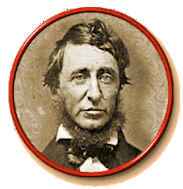 1. Henry David
Thoreau (1817-1862) American Philosopher,
Unitarian,
social critic, transcendentalist and writer. It was Ralph Waldo Emerson who
aroused in him a true enthusiasm for India. 1. Henry David
Thoreau (1817-1862) American Philosopher,
Unitarian,
social critic, transcendentalist and writer. It was Ralph Waldo Emerson who
aroused in him a true enthusiasm for India.
The
force from the Upanishads that Thoreau inherited emerged in Walden and inspired
not only those who pioneered the British labor movement, but all who read it to
this day. Meandering in northeastern Massachusetts, his reverent outer gaze fell
upon Walden Pond.
He alluded often to water---the metaphor is clear---the Gita's
wisdom teachings are the purifier of the mind: "By a conscious effort of
the mind we can stand aloof from actions and their consequences; and all things,
good and bad, go by us like a torrent."
He had found his sacred
Ganga (Ganges).
Living by it and trying to "practice the yoga faithfully" during his
two years at Walden, he wrote:
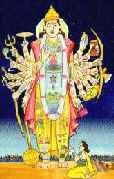 "In
the morning I bathe my intellect in the stupendous and cosmogonal philosophy of
the Bhagavat Geeta, since whose composition years of the gods have elapsed, and
in comparison with which our modern world and its literature seem puny and
trivial; and I doubt if that philosophy is not to be referred to a
previous state of existence, so remote is its sublimity from our conceptions. I
lay down the book and go to my well for water, and lo! there I meet the servant
of the Brahmin, priest of Brahma, and Vishnu and Indra, who still sits in his
temple on the River Ganga reading the Vedas, or dwells at the root of a tree with his
crust and water---jug. I meet his servant come to draw water for his master, and
our buckets as it were grate together in the same well. The pure Walden water is
mingled with the sacred water of the Ganga (Ganges)." "In
the morning I bathe my intellect in the stupendous and cosmogonal philosophy of
the Bhagavat Geeta, since whose composition years of the gods have elapsed, and
in comparison with which our modern world and its literature seem puny and
trivial; and I doubt if that philosophy is not to be referred to a
previous state of existence, so remote is its sublimity from our conceptions. I
lay down the book and go to my well for water, and lo! there I meet the servant
of the Brahmin, priest of Brahma, and Vishnu and Indra, who still sits in his
temple on the River Ganga reading the Vedas, or dwells at the root of a tree with his
crust and water---jug. I meet his servant come to draw water for his master, and
our buckets as it were grate together in the same well. The pure Walden water is
mingled with the sacred water of the Ganga (Ganges)."
At
Walden he put the Bhagavad Gita to the test, while proving to his generation
that "money is not required to buy one necessary for the soul."
(source: The
Writings of Henry D. Thoreau - Walden 1989. Princeton Univ. Press. p
298 and
-
Listen
to The
Bhagavad Gita podcast
- By Michael Scherer - americanphonic.com.
In the 1840s Thoreau's discovered
India, his enthusiasm for Indian philosophy was thus sustained. From 1849-1854,
he borrowed a large number of Indian scriptures from the Harvard University
Library, and the year 1855 when his English friend Thomas Chilmondeley sent him
a gift of 44 Oriental books which contained such titles as the Rig Veda Samhita,
and Mandukya Upanishads, the Vishnu Puranas,
the Institutes of Manu, the
Bhagavad Gita and the Bhagvata Purana etc.
In Indian
contemplation he found a "wonderful power of abstraction" and mental
powers which were able to withdraw from the concerns of the empirical world to
steady the mind and free it from distractions.
"What extracts from the Vedas I have read fall on me
like the light of a higher and purer luminary, which describes a loftier course through
purer stratum. It rises on me like the full moon after the stars have come out, wading
through some far stratum in the sky."
(source: Commentaries on the Vedas, The Upanishads & the
Bhagavad Gita - By Sri Chinmoy Aum Publications. 1996.
p 26).
"Whenever I have read any part of the
Vedas, I have felt that some unearthly and unknown light illuminated me. In the great teaching of the Vedas, there is no
touch of sectarianism. It is of all ages, climes and nationalities and is the royal road
for the attainment of the Great Knowledge. When I am at it, I feel that I am
under the spangled heavens of a summer night."
(source: The
Hindu Mind: Fundamentals of Hindu Religion and Philosophy for All Ages
- By Bansi Pandit B & V Enterprises 1996.
p 307).

Henry David Thoreau - The
Concord sage who derived spiritual inspiration from the Bhagavad Gita.
(image source: Webmaster's
personal collection of art).
Refer to Chitra
Gallery.
***
"I would say to the readers of the Scriptures, if they wish for a
good book, read the Bhagvat-Geeta
.... translated by Charles Wilkins. It deserves to be read with reverence even by
Yankees...."Besides the Bhagvat-Geeta, our Shakespeare seems sometimes youthfully
green... Ex oriente lux
may still be the motto of scholars, for the Western world
has not yet derived from the East all the light it is destined to derive thence."
In his book Walden,
Thoreau
contain explicit references to Indian Scriptures such as:
"How much more admirable the Bhagavad Geeta than all the
ruins of the East.'
(source: The
Writings of Henry D. Thoreau - Walden 1989. Princeton Univ. Press. p 57).
Thoreau described Christianity as
"radical" because of its "pure morality" in contrast to
Hinduism's "pure intellectuality"
(source: A
Week on the Concord and Merrimack Rivers - By Henry David Thoreau
p 109 - 111).
"The Vedas contain a sensible
account of God." "The veneration in which the Vedas are held is itself
a remarkable feat. Their code embraced the whole moral life of the Hindus and in
such a case there is no other truth than sincerity. Truth is such by reference
to the heart of man within, not to any standard without."
Thoreau, like other
Transcendentalist had a breath and catholicity of mind which brought him to the
study of religions of India. From the beginning he was disillusioned with
organized Christianity (he never went to Church) and like Emerson showed great
interest in Hinduism and its philosophy. In comparison to Hebraism, Thoreau
found Hinduism superior in many ways. The following passage demonstrates
Thoreau’s disenchantment with Hebraism and his love for Hinduism: In 1853 he wrote:
“The
Hindoos are most serenely and thoughtfully religious than the Hebrews. They have
perhaps a purer, more independent and impersonal knowledge of God. Their
religious books describes the first inquisitive and contemplative access to God;
the Hebrew bible a conscientious return, a grosser and more personal repentance.
Repentance is not a free and fair highway to God. A wise man will dispense with
repentance. It is shocking and passionate. God prefers that you approach him
thoughtful, not penitent, though you are chief of sinners. It is only by
forgetting yourself that you draw near to him. The
calmness and gentleness with which the Hindoo philosophers approach and
discourse on forbidden themes is admirable.”
The Christian and Hindu concept
of man, Thoreau thinks, are diametrically opposed to each other, the former sees
man as a born sinner whereas the latter takes him to be potentially divine. The
lofty concept of man embodied in Hinduism appealed to Thoreau. Praising such
concept he writes: “In the Hindoo scripture the idea
of man is quite illimitable and sublime. There is nowhere a loftier
conception of his destiny. He is at length lost in Brahma himself ‘the divine
male.’
Thoreau – his grand
philosophic aloofness, his hatred of materialism, his society, his yogic
renunciation and austerity, his lack of ambition, his love of solitude, his
excessive love of nature, resulting his refusal to cooperate with a government
whose policies he did not approve of, were certain extreme traits like to be
misunderstood. Besides, he was a vegetarian, a non-smoker, and a teetotaler. He
remained a bachelor, throughout his life, walked hundreds of miles, avoided
inns, preferred to sleep by the railroad, never voted and never went to a
church, derived spiritual
inspiration from the Hindu scriptures like the Bhagavad Gita, and the
laws of Manu living an extremely frugal and Spartan life.
The
influence of Hinduism made Thoreau a Yogi.
(source: Hindu
Scriptures and American Transcendentalists - By Umesh Patri p 98
-240 and India
And Her People - By Swami Abhedananda
p.235-236).
Henry David Thoreau, was dazzled by Indian spiritual
texts, especially the Bhagavad-Gita. He kept a well-thumbed copy of the
Gita in his cabin at Walden Pond, and claimed wistfully
that “at rare intervals, even I am a yogi.”
(source:
Fear
of Yoga - By Robert Love - Columbia Journalism Review- December
2006).
 "In the Hindoo scriptures the
idea of man is quite illimitable and sublime. There is nowhere a loftier
conception of his destiny. He is at length lost in Brahma himself....there is no
grandeur conception of creation anywhere....The very indistinctness of its
theogeny implies a sublime truth."
"In the Hindoo scriptures the
idea of man is quite illimitable and sublime. There is nowhere a loftier
conception of his destiny. He is at length lost in Brahma himself....there is no
grandeur conception of creation anywhere....The very indistinctness of its
theogeny implies a sublime truth."
Thoreau's use of Indic scriptures in
Walden far outweighs his use of the Bible. He refers to the Bhagawad-Gita, the
Harivamsa, the Vedas, the Vishnu Purana, Pilpay (whose fables form the
Hitopadesa) and Calidasa. Thoreau annexes India for his own purpose. It is, for
example, in the spirit of the Indic myth that Thoreau writes the fantastic
passage connecting Walden with the Ganga and Concord with India, and it is in
the spirit of India that Thoreau wrote or included the story of the artist of
Kuru.
On 6 August 1841 he wrote in his
journal that:
"I cannot read a sentence in
the book of the Hindoos without being elevated as upon the table-land
of the Ghauts. It has such a
rhythm as the winds of the desert, such a tide as the Ganga
(Ganges),
and seems as superior to criticism as the Himmaleh Mounts. Even at this late
hour, unworn by time with a native and inherent dignity it wears the English
dress as indifferently as the Sancrit."
(source: India
in the American Mind - By B. G. Gokhale
p.22-27).
 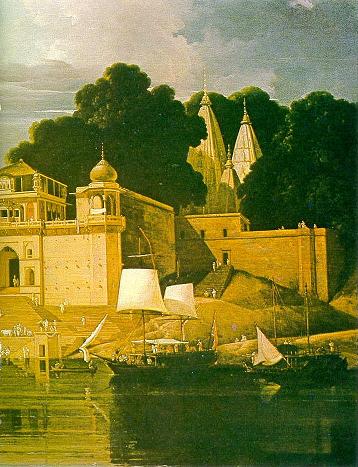
The Ghats on
the River Ganga.
(image source: Picturesque India: sketches of
travels of Thomas and William Daniell – By J. Mahajan).
Watch
Scientific
verification of Vedic knowledge
***
He even followed a
traditional Hindu way of life.
"It was fit that I should live on rice mainly, who
loved so well the philosophy of India."
(source:
Philosophy of Hinduism
- An Introduction - By T. C. Galav
Universal Science-Religion. ISBN: 0964237709 p 18).
In his Transcendental thoughts, the world at large conglomerate into one big
divine family. He finds beside his Walden pond "the servant of the Brahmin,
priest of Brahma and Vishnu and Indra,
who still sits in his temple on the Ganga reading the Vedas…" their buckets "grate together in the same well.
The pure Walden water is mingled with the sacred water of the Ganga".
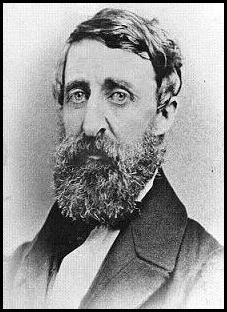 Thoreau, the Concord sage, said, "The
Vedanta teaches how by 'forsaking religious rites' the votary may obtain
purification of mind." And "One sentence of the Gita, is worth
the State of Massachusetts many times over" Thoreau, the Concord sage, said, "The
Vedanta teaches how by 'forsaking religious rites' the votary may obtain
purification of mind." And "One sentence of the Gita, is worth
the State of Massachusetts many times over"
(source: The
Bhagavad Gita: A Scripture for the Future Translation and Commentary - By
Sachindra K. Majumdar Asian Humanities Press. 1991. p 5.)
"The reader is nowhere raised into and sustained in a bigger, purer
or rarer region of thought than in the Bhagavad-Gita. The Gita's sanity and
sublimity have impressed the minds of even soldiers and merchants."
He also admitted that, "The religion and
philosophy of the Hebrews are those of a wilder and ruder tribe, wanting the
civility and intellectual refinements and subtlety of Vedic culture." Thoreau's
reading of literature on India and the Vedas was extensive: he took them
seriously.
(source: The
Secret Teachings of the Vedas. The Eastern Answers to the Mysteries of Life
- By Stephen Knapp volume one.
p 22).
Like Emerson, the Concord sage,
Thoreau, was also deeply imbued with the sublime teachings of Vedanta.
(source: India
And Her People - By Swami Abhedananda
p.235-236).
He was particularly attracted by the
yogic elements in the Manu Smriti. Thoreau embarked on
his Walden experiment in the spirit of Indian asceticism. In a letter written to
H. G. O Blake in
1849, he remarked:
"Free in this
world as the birds in the air, disengaged from every kind of chains, those who
have practiced the Yoga gather in Brahmin the certain fruit of their works. Depend upon
it, rude and careless as I am, I would fain practice the yoga faithfully. This
Yogi, absorbed in contemplation, contributes in his degree to creation; he
breathes a divine perfume, he heard wonderful things. Divine forms traverse him
without tearing him and he goes, he acts as animating original matter. To
some extent, and at rare intervals, even I am a Yogi.
(source: Oriental
Enlightenment: The encounter between Asian and Western thought - By J. J. Clarke
p. 86-87 and Hindu
Scriptures and American Transcendentalists - By Umesh Patri p 98
-240). For more on Thoreau
refer to chapter GlimpsesVI).
Along with Emerson, he published essays on Hindu scriptures in a journal called
The Dial.
Thoreau paid ardent homage to the
Gita and the philosophy of India in A Week on the Concord and Merrimack
Rivers:
"Most books belong to the house and streets only,
. . . .But this . . . . addresses what is deepest and most abiding in man. . . .
Its truth speaks freshly to our experience. [the sentences of Manu] are a piece
with depth and serenity and I am sure they will have a place and significance as
long as there is a sky to test them by."
(source:
-
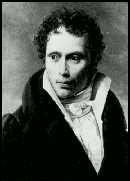 2. Arthur Schopenhauer (1788-1860),
German philosopher and writer. He was one of the greatest philosophers of the 19th
century. He was the first Western philosopher to have access to translations of
philosophical material from India, both Vedic and Buddhist, by which he was
profoundly affected. Counted among his disciples are such thinkers as Nietzsche
and Wittgenstein, as well as Sigmund Freud, who takes a large part of his
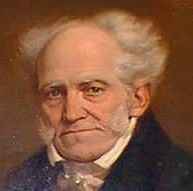
psychological theory from the writings of Schopenhauer. 2. Arthur Schopenhauer (1788-1860),
German philosopher and writer. He was one of the greatest philosophers of the 19th
century. He was the first Western philosopher to have access to translations of
philosophical material from India, both Vedic and Buddhist, by which he was
profoundly affected. Counted among his disciples are such thinkers as Nietzsche
and Wittgenstein, as well as Sigmund Freud, who takes a large part of his
psychological theory from the writings of Schopenhauer.
No other major Western philosopher
so signalizes the turn towards India, combined with a disenchantment with the
European-Christian tradition. He proclaimed the
concordance of his philosophy with the teachings of Vedanta. His
contribution to the propagation and popularization of Indian concepts has been
considerable.
(source: India
and Europe: An Essay in Understanding - By Wilhelm Halbfass p.
436).
"There is
no religion or philosophy so sublime and elevating as Vedanta."
(source: Kumbha
Mela - By Jack Hebner and David Osborn p. preface - By Thomas
Beaudry).
Schopenhauer became acquainted with the thought of the
Upanishads through a Latin translation from Persian by a
Frenchman, Anquetil Duperron. His eulogy is well known.
"The Indian air surrounds us,
the original thoughts of kindred spirits.....And O! how the mind is here washed
clean of all its early ingrafted Jewish superstition! It is the most profitable
and most elevating reading which is possible in the world."
(source: Eastern
Religions and Western Thought - By Dr. S. Radhakrishnan
p
248 and Hinduism
Invades America - By Wendell Thomas p. 240 published by The Beacon Press Inc. New York City 1930).
"How
entirely does the Oupnekhat (Upanishad) breathe throughout the holy spirit of
the Vedas! How is every one, who by a diligent study of its Persian Latin has
become familiar with that incomparable book, stirred by that spirit to the very
depth of his Soul!
(source:
Harvest
Fields).
Schopenhauer was in search of a
"philosophy which should be at once ethics and metaphysics." India did
not disappoint him. He found it in the Upanisadhic "tat
twam asi", "that thou art".
"From every sentence (of the Upanishads) deep, original and sublime
thoughts arise, and the whole is pervaded by a high and holy and earnest
spirit...."In the whole
world there is no study so beneficial and so elevating as that of the Upanishads.
They are destined sooner or later to become the faith of the people." 
Schopenhauer, who was in the habit,
before going to bed, of performing his devotions from the pages of the
Upanishads, regarded them as:
" It has
been the solace of my life -- it will be the solace of my death."
(source: The
Discovery of India - By Jawaharlal Nehru Oxford University Press. 1995. pg
92 and The
Upanishads Translated for the Modern Reader By Eknath
Easwaran
Nilgiri Press. 1987 p. 300 and Outlines
of Hinduism - By T. M. P. Mahadevan - p.30).
He anticipated later speculations
with his claim that Christianity had "Indian blood in its veins" and
that the moral teachings of the New Testament had their historical source in
Asia beyond Israel: "Christianity taught only what the whole of Asia knew
already long before and even better"
(source: Oriental
Enlightenment: The encounter between Asian and Western thought - By J. J.
Clarke p.68-69).
To Schopenhauer
the Upanishads were documents of 'almost superhuman
conception,' whose authors could hardly be thought of as 'mere mortals.'
He also remarked: "How every
line is of such strong, determined, and consistent meaning! And on every page we
encounter deep, original, lofty thoughts, while the whole world is suffused with
a high and holy seriousness."
(source: cited in German in Upanishaden: Altindische Weisheit
(Upanishads: Ancient Indian Wisdom) - By Alfred
Hillebrandt (Dussseldorf-Koln, Germany; Diederichs Verlag, 1964 p. 8).
 He spoke of India as the 'fatherland of mankind' which 'gave the
original religion of our race,' and he expressed the hope that European peoples, 'who
stemmed from Asia,...would re-attain the religion of their home.'
He spoke of India as the 'fatherland of mankind' which 'gave the
original religion of our race,' and he expressed the hope that European peoples, 'who
stemmed from Asia,...would re-attain the religion of their home.'
He believed that the Upanishads, together with the philosophies of Plato and Kant, constituted
the foundation on which to erect a proper philosophy of representation. It was
the Upanishads' analysis of the self which caused Schopenhauer to stamp them as
" the product of the highest human wisdom". He dedicated
himself to this task, producing his magnum opus, The World as Will and Representation,
in 1819. This is what he says in this book:
"We, on the contrary, now send to the Brahmans
English clergymen and evangelical linen-weavers, in order out of sympathy to put them
right, and to point out to them that they are created out of nothing, and that they ought
to be grateful and pleased about it. But it is just the same as if we fired a bullet at a
cliff.
"In India, our religions will never at any time take root; the ancient
wisdom of the human race will not be supplanted by the events in Galilee. On the contrary,
Indian wisdom flows back to Europe, and will produce a fundamental change in our knowledge
and thought."
(source: The
World as Will and Representation - By Arthur Schopenhauer Volume I,
& 63 p. 356-357).
Schopenhauer regarded the Hindus as deeper thinkers
than Europeans because their interpretation
of the world was internal and intuitive, not external and intellectual. For intuition
unites everything, the intellect divides everything. The Hindus saw that the "I"
is a delusion, that the individual is merely phenomenal, and that the only reality is the
Infinite One "That art Thou"
(source: India and World Civilization
- By D. P. Singhal Pan Macmillan Limited. 1993. p 254).
Schopenhauer wrote in the preface of his
The
World as a Will and Representation
 "According to me, the influence of Sanskrit literature on our time
will not be lesser than what was in the 16th century Greece's influence on
Renaissance. One day, India's wisdom will flow
again on Europe and will totally transform our knowledge and thought."
"According to me, the influence of Sanskrit literature on our time
will not be lesser than what was in the 16th century Greece's influence on
Renaissance. One day, India's wisdom will flow
again on Europe and will totally transform our knowledge and thought."
Schopenhauer, had extracted from
Indian philosophy its contempt for the mere intellect. He
admitted extracting his philosophical outlook from the Vedanta and attempting to
weld "empirical realism" with transcendental idealism."
"Schopenhauer went on from
there to vindicate Indian philosophy's rightful place in the world.." He
even went so far as to express pleasure at the continuous failure of
West-Christian proselytism in Asia and added: "Our religions will never at any time take root; the ancient
wisdom of the human race will not be supplanted by the events in Galilee. On the contrary,
Indian wisdom flows back to Europe, and will produce a fundamental change in our knowledge
and thought." His anti-Christianism was largely based on a fierce
anti-Biblism; .....he attributed systematically to subtle influences originating
on the "holy-banks of the Ganga."
(source:
The
Soul of India - By Amaury de
Riencourt p 274-275).
It is well-known that the book 'Oupnekhat'
(Upanishad) always lay open on his table and he invariably studied it before
retiring to rest. He called the opening up of Sanskrit literature 'the
greatest gift of our century', and predicted that the philosophy and
knowledge of the Upanishads would becomes the cherished faith of the West.
(source:
Western
Indologists: A Study in Motives - By P B Dutt http://www.philosophy.ru/library/asiatica/indica/authors/motives.html).
The Upanishads
came to Schopenhauer as a new Gnosis or revelation. "That incomparable book,"
he says, "stirs the spirit of the very depths of the soul."
(source: The
Legacy of India - edited By G. T. Garratt p. 32).
Schopenhauer was fond of saying that
the first intuition of the work he was to do came to him while
reading these texts, of which he was later to say that they had
been “his life’s consolation.”
(source: Yoga and the Hindu Tradition
- By Jean Varenne p. 186 - 187).
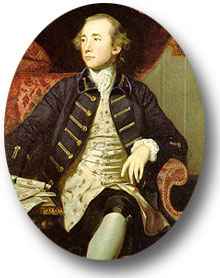 3. Lord
Warren Hastings (1754-1826), was the first
governor general of British India. Hastings
was very much impressed and overwhelmed with Hindu philosophy:
3. Lord
Warren Hastings (1754-1826), was the first
governor general of British India. Hastings
was very much impressed and overwhelmed with Hindu philosophy:
He wrote with a prophetic and resounding
pronouncement on the whole body of Indian writings:
"The writers of the Indian philosophies will
survive, when the British dominion in India shall long have ceased to exist, and when the
sources which it yielded of wealth and power are lost to remembrances."
(source: Philosophy of Hinduism
- An Introduction - By T. C. Galav
Universal Science-Religion. p 19).
" I hesitate not to pronounce the
Gita a performance of great originality, of sublimity of conception, reasoning
and diction almost unequalled; and a single exception, amongst all the known
religions of mankind.."
(source: India
Discovered - By John Keay p 25).
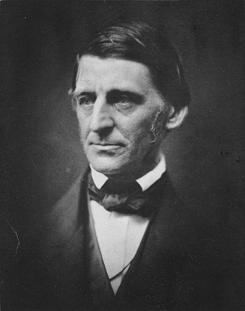
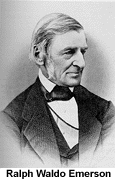
4. Ralph Waldo
Emerson (1803-1882) an author, essayist, lecturer, philosopher, Unitarian minister who lectured on
theology at Harvard University. Emerson was born at Boston in 1803 into a distinguished
family of New England Unitarian ministers. His was the eighth generation to
enter the ministry in a dynasty that reached back to the earliest days of
Puritan America. Despite the death of his father when Emerson was only eleven,
he was able to be educated at Boston Latin School and then Harvard, from which
he graduated in 1821. After several years of reluctant school teaching, he
returned to the Harvard
Divinity School, entering the Unitarian ministry during a period
of robust ecclesiastic debate Following
the death of his first wife, Ellen, his private religious doubts led him to
announce his resignation to his congregation, claiming he was unable to preach a
doctrine he no longer believed.
He
was becoming increasingly disillusioned with
aspects of Christian teaching that just did not make sense to his active and
inquiring intelligence. He was influenced by Indian Scriptures the most. His
initial rebellion against Christianity in its various forms prompted him to find
a ready refuge in the idealism of Hinduism.
Eminent Indian Historian Protap
Chunder Mazumdar has said about Emerson that he was the best of
Brahmin and:
"Amidst this ceaseless, sleepless din and clash of Western
materialism, this heat and restless energy, the character of Emerson
shines upon India serene as the evening star. He seems to some of us
to have been a geographic mistake, he ought to have been born in India. Perhaps
Hindoos were closer kinsmen to him than his own nation because every typical
Hindoo is a child of Nature."
For Emerson, the idealism of the
Hindus propounded in the Upanishads, the Bhagavad Gita and other Indian
scriptures, was based on fundamental concepts. He turned eastward towards India
very early in life, when he was in his teens.
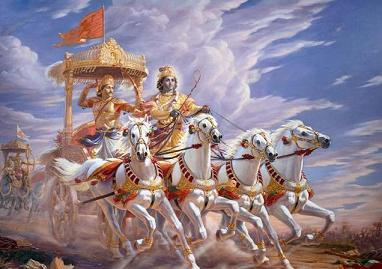 He said this about the
Bhagavad Gita: He said this about the
Bhagavad Gita:
"I owed a magnificent day to the
Bhagavad-Gita. It was as if an empire spoke to us, nothing small or unworthy, but large,
serene, consistent, the voice of an old intelligence which in another age and climate had
pondered and thus disposed of the same questions which exercise us."
(source: Philosophy of Hinduism
- An Introduction - By T. C. Galav
Universal Science-Religion. p 65 and Hinduism
- By Linda Johnsen p 42 and Hindu
Scriptures and American Transcendentalists - By Umesh Patri p
22-23).
(Artwork
courtesy of The Bhaktivedanta Book Trust International, Inc. www.krishna.com).
Listen to The
Bhagavad Gita podcast
- By Michael Scherer - americanphonic.com.
In his Journal, Emerson paid homage
to Vedic thought:
" It is sublime as night and a breathless ocean. It contains every
religious sentiment, all the grand ethics which visit in turn each noble poetic
mind....It is of no use to put away the book; if I trust myself in the woods or
in a boat upon the pond. Nature makes a Brahmin of me
presently: eternal
compensation, unfathomable power, unbroken silence....This is her creed. peace,
she saith to me, and purity and absolute abandonment - these panaceas expiate
all sin and bring you to the beatitude of the Eight Gods."
(source: India's
Priceless Heritage - By Nani A. Palkhivala
1980 p 9 - 24).
Repelled by the increasing materialism of the West, Emerson turned to India
for solace:
"The Indian teaching, through its clouds of legends, has yet a simple and grand
religion, like a queenly countenance seen through a rich veil. It teaches to speak truth,
love others, and to dispose trifles. The East is grand - and makes Europe appear
the land of trifles. ...all is soul and the soul is
Vishnu ...cheerful and noble is the genius of this cosmogony. Hari is
always gentle and serene - he translates to heaven the hunter who has
accidentally shot him in his human form, he pursues his sport with boors and
milkmaids at the cow pens; all his games are benevolent and he enters into flesh
to relieve the burdens of the world."
Emerson refers to the Indian
doctrine of transmigration calling it easy of reception and used the idea in his
essay on History. As early as 1821 he speaks of the intimate relationship
between man and nature and the system of emanations in Indian thought. He wrote
poems such as Brahma and Hamatreya. "Hamatreya" is a free rendering of a passage in the
Vishnu Purana which Emerson copied into his
1845 Journal.
By 1856 Emerson had read the Kathopanisad
and his ideas were increasingly reflecting Indian influence. His poems, such as
Hamatreya showed he had digested his Indian philosophic readings well. Hamatreya
apparently was inspired by a passage from the Vishnu Purana (Book IV). He was
concerned with the subject of illusion-maya. He wrote about it. In his essay Illusions
he said: “ I find men victims of illusions in all parts of life. Children,
youths, adults and old men, all are led by one bauble or another. Yoganidra,
the goddess of illusion, is stronger than the Titans, stronger than Apollo.”
(source: India
in the American Mind - By B. G. Gokhale
p. 120-21 and India and World Civilization
- By D. P. Singhal Pan Macmillan Limited. 1993.
p 254 and East
meets West - gosai.com).
 Emerson's Oversoul is the
paramatman of
the Upanishads. Emerson's Oversoul is the
paramatman of
the Upanishads.
"All science is transcendental
or else passes away. Botany is now acquiring the right theory - the avatars of
Brahman will presently be the text-books of natural history."
(source: India's
Priceless Heritage - By Nani A. Palkhivala
1980 p.9).
Ralph Waldo Emerson
says: "Plato was synthesis of Europe and Asia, and a decidedly Oriental
element pervades his philosophy, giving it a sunrise color."
(source:
India
And Her People - By Swami Abhedananda
p.223).
He
felt that the genius of the Hindus was unsurpassed "in the grandeur of
their ethical statement." Emerson's interest in India which began in 1818
continued well into the 1860s. He admired the "Largeness" or sweep of
the Indian vision which should be a vital part of the Transcendental
wisdom.
In 1848 he says that he owed a "magnificent day to the reading of the
Bhagavat-Gita" and adds that England
could not produce such a book as the Gita. He
found Indian books "excellent gymnastic for the mind as showing treatment -
imagination, volatility etc."
In 1859 he felt: "When
India was explored and the wonderful riches of Indian theological literature
found that dispelled once and for all the dream about Christianity being the
sole revelation."
(source: India
in the American Mind - By B. G. Gokhale
p. 16).
In
1868, he wrote to the nineteenth century American poet, Emma
Lazarus (1849-1887):
"And
of books, there is another which, when you have read, you shall sit for a while
and then write a poem--[it is] the "Bhagvat-Geeta," but read it in
Charles Wilkins' translation." (The Bhagavad-Geeta (1785), xi)
On August 4, 1873 (nine years before his death) Emerson had also written to Max
Müller that,
"all
my interest in the Aryan is . . .Wilkin's [sic] Bhagavat Geeta; Burnouf's
Bhagavat Purana;, and Wilson's Vishnu Purana---yes and a few other
translations."
He credited a work he had read in his youth for the spark of enthusiasm he
received for the Gita: "I remember I owed my first taste for this fruit to
Cousin's sketch (Victor Cousin's Cours des Philosophies), in his first lecture,
of the dialogue between Krishna and Arjoon, and I still prize the first chapters
of Bhagavat as wonderful." (Letters of Emerson, VI:246; I:322-3).
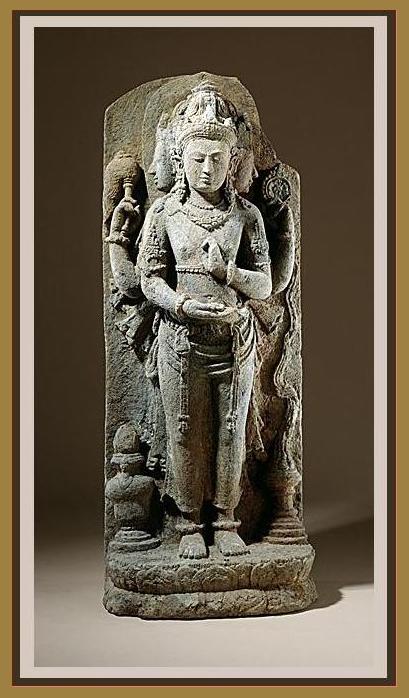
Statue of Lord Brahma from Central Java.
For more
refer to chapter on Greater
India: Suvarnabhumi and Sacred
Angkor
Emerson's profound harmony with the
Indian scriptures is best illustrated in his poem "Brahma," (Brahman)
derived from Kalidasa, and in numerous essays.
Watch
Scientific
verification of Vedic knowledge
***
Emerson's profound harmony with the
Indian scriptures is best illustrated in his poem "Brahma," (Brahman)
derived from Kalidasa, and in numerous essays. According to his Journals, the
theme for "Brahma," composed in 1856, came to him after he read the
Upanishads in the Bibliotheca Indica. He was clearly influenced by the Katha
Upanishad and by the second discourse of the Bhagavad Gita. His poem
"Brahma" reached the highest level of American Vedantism. The higher
truths of non-difference between the illusory opposites, the contrasting
descriptions of the Absolute and their ultimate transcendence in the Unity of
Brahman, are all reflected in Emerson's poem:
If
the red slayer thinks he slays,
Or if the slain thinks he is slain,
They know not well the subtle ways
I keep, and pass, and turn again.
Far or forgot to me is near;
Shadow and sunlight are the same;
The vanished gods to me appear;
And one to me are shame and fame.
They reckon ill who leave me out;
When me they fly, I am the wings;
I am the doubter and the doubt,
And I the hymn the Brahmin sings.
The description of Unity in his
poems "The Celestial Love" and "Wood-Notes"
reflects the description of the immanence of the Supreme Being in
the tenth discourse of the Bhagavad Gita. Emerson's Essays
includes his comments on the role of Warren Hastings, in the
dissemination of the Bhagavad Gita through Wilkins'
translation:
"By
the law of contraries, I look for an irresistible taste for
Orientalism in Britain. For a
self-conceited modish life, made up of trifles, clinging to a
corporeal civilization, hating ideas, there is no remedy like the
Oriental largeness. That astonishes and disconcerts English
decorum. For once, there is thunder it never heard, light it never
saw, and power which trifles with time and space. I am not
surprised to find an Englishman like Warren Hastings, who had been
struck with the grand style of thinking in the Indian writings,
depreciating the prejudices of his countrymen while offering them
a translation of the Bhagavat Gita. " (Essays, V:258-9)
(source:
-
 His famous poem "Brahma" is an example of his Vedantic
ecstasy. If there is one piece that beautifully and succinctly expresses
Emerson's vision of India it is in his poem Brahma.
His famous poem "Brahma" is an example of his Vedantic
ecstasy. If there is one piece that beautifully and succinctly expresses
Emerson's vision of India it is in his poem Brahma.
(source: Story
of Civilization: Our Oriental Heritage - By Will Durant
MJF Books 1935. p 415).
Emerson wrote a third poem with a
Hindu title in addition to "Brahma" and "Hamatreya"; this
little poem, entitled "Maya", begins,
"Illusion works impenetrable,
Weaving webs innumerable."
The poem is called Maya for Hindu
Goddess who keeps mankind under the spell of illusions. For Emerson, life was a
riddle; he loved the Hindus because they had attempted to find a satisfactory
answer to it. In "Poetry and Imagination" the sage of Concord tells us
how ephermeral are man's various conditions in life: youth, age, property - all
like a great dream." ...successive Mayas through which Vishnu mocks and
instructs the soul" But it is not only the Vishnu Purana that
inspired Emerson. Another Hindu work stimulated his mind a great deal: The Katha
Upanishad. In 1856, when he was fifty-three, he wrote in his Journal:
"A grander
legend than Western literature contains, is the story of Nachiketas."
We have noticed how strong had been
the influence of Indian thought in shaping the intellectual and spiritual growth
of the sage of Concord. He felt his own spiritual affinity for the Hindus and
wrote once to a friend, "nature makes a Brahmin of me presently."
(source: Elements
of Brahmanism in the Transcendentalism of Emerson - By Leyla Goren p.
42-45).
Emerson's essays like The Oversoul
and Circles and poems like Brahma are Upanishadic wisdom, pure and simple. At
one stage of his life he writes,
"Nature makes a
Brahmin of me presently."
(source: The
Soul of India - By Satyavrata R Patel p.74).
Emerson's
Transcendentalism earned him the appellation of "the Boston
Brahmin"
(source:
Indian Philosophy and
Modern Culture - By Paul Brunton p. 35 London. Rider
& Co).
(Oliver
Wendell Holmes coined the term ''Boston Brahmins'' to describe
blue-blooded New Englanders. It first appeared in his Autocrat
of the Breakfast Table in 1857. Some of the most
popular antebellam writers came from upper-class New England. These poets and
authors became known as Boston Brahmins, coming from the word Brahmans, the
highest caste of the Hindu religion. The leading Brahmins were Henry
Wadsworth Longfellow, James Russel Lowell,
Theodore
Parker and Quaker
John Greenleaf Whittier).
Emerson
was the father of Transcendentalism and his philosophy influenced people
like Mary Eddy Baker,
founder of the Christian Science Church, poet
and naturalist Henry David
Thoreau, feminist Margaret Fuller,
Elizabeth Palmer Peabody, reformer Dorothea Dix,
Unitarian ministers Theodore Parker, William Henry Channing, William Ellery
Channing, Educator Horace Mann, Alexis
de Tocqueville, Walt
Whitman, Catherine
Beecher, Sarah Grimké, Elizabeth Cady Stanton and
others. The American
transcendentalists seemed to reject the narrow
orthodox Christian concept of God.
 Fredric
Ives Carpenter in his book, Emerson and Asia
(1930) says, that Emerson was the first American thinker to plant Oriental,
especially Indian thought, on the American soil and draw spiritual inspiration
from it. The poem Brahma became a controversial poem from the very beginning
because of its anti-Christian attitude and the direct treatment of the
Upanishadic mysticism. He further says that this poem expresses the fundamental
Hindu concept "more clearly and concisely than any other writing in the
English language perhaps better than any writing in Hindu literature itself.
Emerson got his central idea of the poem from his reading of Katha
Upanishad...If the slayer thinks I slay......does not slay nor is it
slain." Fredric
Ives Carpenter in his book, Emerson and Asia
(1930) says, that Emerson was the first American thinker to plant Oriental,
especially Indian thought, on the American soil and draw spiritual inspiration
from it. The poem Brahma became a controversial poem from the very beginning
because of its anti-Christian attitude and the direct treatment of the
Upanishadic mysticism. He further says that this poem expresses the fundamental
Hindu concept "more clearly and concisely than any other writing in the
English language perhaps better than any writing in Hindu literature itself.
Emerson got his central idea of the poem from his reading of Katha
Upanishad...If the slayer thinks I slay......does not slay nor is it
slain."
The idea of rebirth or reincarnation
is found throughout Emerson's work and journals. "The transmigration of
souls is no fable...."
Faith in transmigration of souls
though antithetical to Christianity, appealed to him because it countered the
notion of finality, inherent in Christianity, and embodied a vision of
correction through successive stages of development until one achieves beatitude
and divine bliss.
(source: Hindu
Scriptures and American Transcendentalists - By Umesh Patri p. 22
-23 and 79).
Emerson, talking of the Upanishads
and the Vedas, said that having read them, he could not put them away. "They
haunt me. In them I have found eternal compensation, unfathomable power,
unbroken peace."
(source: The
Commemorative Sanskrit
Souvenir 2003 of the Bharatiya Vidya Bhavan
p. 28).
"When Confucius and the Indian
Scriptures were made known, no claim to monopoly of ethical wisdom could be
thought of" Emerson joyfully proclaimed. "It is only within this
century (the 1800's) that England and America discovered that their nursery
tales were old German and Scandinavian stories; and now it appears that they
came from India, and are therefore the property of all the nations."
(source: Hinduism
Today - April/May/June 2004 issue p 59).
Unitarian
minister and great American philosopher Ralph Waldo Emerson was moved to write
poetry in imitation of Hinduism’s scripture and to find relief in its
teachings when the faith of his childhood could not serve. For
more refer to Americans
and Hinduism's Great Truth - By Rev. Jack
Donovan - Unitarian Universalist Fellowship, Gainesville, Florida).
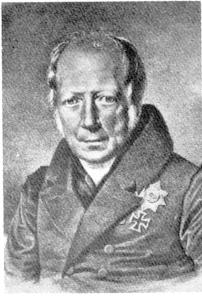 5. Wilhelm von Humboldt (1767-
1835) Prussian minister of education, a brilliant linguist and
the founder of the science of general linguistics. Humboldt
began to learn Sanskrit in 1821 and
was greatly moved by Schlegel's edition of the Bhagavad Gita, on which he published an
extensive study. The Bhagavad Gita made a great impression on Humboldt, who said
that " this episode of the Mahabharata was: 5. Wilhelm von Humboldt (1767-
1835) Prussian minister of education, a brilliant linguist and
the founder of the science of general linguistics. Humboldt
began to learn Sanskrit in 1821 and
was greatly moved by Schlegel's edition of the Bhagavad Gita, on which he published an
extensive study. The Bhagavad Gita made a great impression on Humboldt, who said
that " this episode of the Mahabharata was:
"The most beautiful, perhaps the only true
philosophical song existing in any known tongue ....perhaps the deepest and loftiest thing
the world has to show."
(source: Philosophy of Hinduism
- An Introduction - By T. C. Galav
Universal Science-Religion. p 650).
Listen to The
Bhagavad Gita podcast
- By Michael Scherer - americanphonic.com.
He devoted to it a long treatise in the Proceedings
of the Academy of Berlin (1825-6).
After looking into the Gita, he
wrote to his friend, statesman Frederick von Gentz
(1764 - 1832) in 1827:
“I read the Indian poem for the first time when I was in my country
estate in Silesia and, while doing so, I felt a sense of overwhelming gratitude
to God for having let me live to be acquainted with this work. It must be the
most profound and sublime thing to be found in the world. “
(source: The Bhagavad Gita - The Quest for the
Moral Ideal, Religious Values and the Affirmation of Faith - By P.
Nagaraja Rao Madras 1986 p. 20).
He thanked God for having permitted him to live long enough to become acquainted
with the Gita.
(source: Vedanta:
Heart of Hinduism - By Hans Torwesten An Evergreen Book. Grove Press.
1985. p 6).
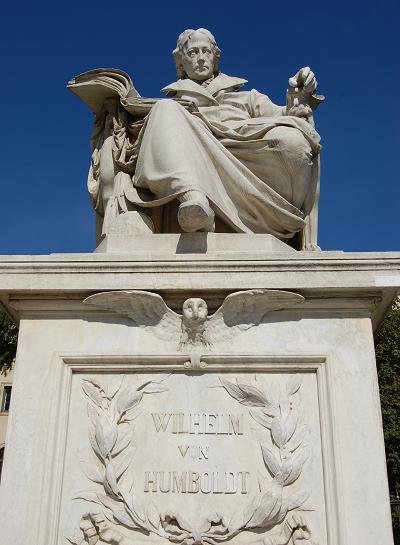
Wilhelm von Humboldt statue
- one of the founders of The Humboldt University
on Unter den Linden in Berlin.
(image source: webmaster's
own collection of photos taken during a recent visit to Germany).
***
On June 30 1825, Humboldt lectured to the
Berlin Academy of Sciences on the Gita, placing it firmly in the mainstream of
the scholarship of the period. He found in the
Bhagavad Gita his own "spiritual ancestors". What appealed to him was
its originality and its simplicity. Krishna's doctrine,
he wrote,
" ...develops in such a peculiarly
individual way, (and) it is, so far as I can judge, so much less burdened with
sophistry and mysticism, that it deserves our special attention, standing as it
does as an independent work of art..."
(source: The
Universal Gita: Western Images of the Bhagavad Gita a Bicentenary Survey
- By Eric J. Sharpe
p. 19).
Humboldt studied Sanskrit with Franz
Bopp in London. For Humboldt, Sanskrit with its wealth
of grammatical forms is the climax of inflecting languages.
(source: German
Indologists: Biographies of Scholars in Indian Studies writing in German
- By Valentine Stache-Rosen. p.5-6).
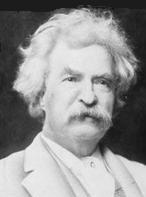
 6. Mark Twain
(1835-1910) also known as Samuel
Clemens, one of the most widely loved and celebrated American writers since his
first books were released in the late 1860s. Many of his writings have reached
the pinnacles of American and world literature, including the timeless Adventures
of Huckleberry Finn, The
Adventures of Tom Sawyer, A
Connecticut Yankee In King Arthur's Court and Following the Equator. Besides these easily recognizable
classics, Twain wrote fascinating Travelogue detailing his experiences in Asia. 6. Mark Twain
(1835-1910) also known as Samuel
Clemens, one of the most widely loved and celebrated American writers since his
first books were released in the late 1860s. Many of his writings have reached
the pinnacles of American and world literature, including the timeless Adventures
of Huckleberry Finn, The
Adventures of Tom Sawyer, A
Connecticut Yankee In King Arthur's Court and Following the Equator. Besides these easily recognizable
classics, Twain wrote fascinating Travelogue detailing his experiences in Asia.
"So far as I am able to judge, nothing has been
left undone, either by man or nature, to make India the most extraordinary country that
the sun visits on his rounds. Nothing seems to have been forgotten, nothing
overlooked."
"Land of religions, cradle
of human race, birthplace of human speech, grandmother of legend, great grandmother of
tradition. The land that all men desire to see and having seen once even by a glimpse,
would not give that glimpse for the shows of the rest of the globe combined."
 "India had the start of the
whole world in the beginning of things. She had the first civilization; she had
the first accumulation of material wealth; she was populous with deep thinkers
and subtle intellects; she had mines, and woods, and a fruitful soul." "India had the start of the
whole world in the beginning of things. She had the first civilization; she had
the first accumulation of material wealth; she was populous with deep thinkers
and subtle intellects; she had mines, and woods, and a fruitful soul."
Varanasi or Banaras has been continuously
populated for more than 3,000 years, and has often been called the oldest city
in the world. It was the contemporary of Thebes and Babylon. Early visitors were
struck by the "spectacle" the "panorama" of the Banaras
riverfront.
In his around-the-world adventures, Following
the Equator, Mark Twain wrote:
"The Ganga (Ganges) front is the
supreme showplace of Benares. Its tall bluffs are solidly caked from water to
summit, along a stretch of three miles, with a splendid jumble of massive and
picturesque masonry, a bewildering and beautiful confusion of stone platforms,
temples, stair flights, rich and stately palaces....soaring stairways,
sculptured temples, majestic palaces, softening away into the distances; and
there is movement, motion, human life everywhere, and brilliantly costumed -
streaming in rainbows up and down the lofty stairways, and massed in
metaphorical gardens on the mile of great platforms at the river's edge."
(source: Banaras:
City of Light - By Diana L Eck p.14).
He had said in his inimitable style: “Varanasi"
or Banaras is older than history, older than tradition, older even than legend, and looks
twice as old as all of them put together.”
(source: Soul
of a Nation - The Hindustan Times).
Mark Twain remarked:
"India has two million gods, and worships them all. In religion all other
countries are paupers; India is the only millionaire." When traveling through India, he had exclaimed that though a week had only seven
days, Indians seemed to celebrate eight festivals every week.
He observed that having had only the
briefest glimpse of India, you would not trade the experience for all the riches
in the world. This is what he wrote about India in 1896:
"India had
the start of the whole world in the beginning of things. She had the first
civilization; she had the first accumulation of material wealth; she was
populous with deep thinkers and subtle intellect; she had mines, and woods, and
a fruitful soul."
(source: Hinduism
Today July/August/September 2002 p. 52).
"Our most valuable and most
instructive materials in the history of man are treasured up in India."
Twain was awed by Hindu
tradition.
He said, "the one land that all men desire to see, and having once seen, by
even a glimpse, would not give that glimpse for all the shows of all the rest of
the globe combined."
(source: Hinduism
- By Linda Johnsen p. 364).
"India
is a country "whose yesterday's bear date with the mouldering antiquities
of the rest of nations."
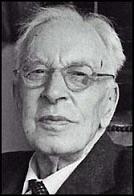 7. Dr. Arnold
Joseph Toynbee (1889-1975) the great British
historian. His massive research was published in 12 volumes between 1934 and
1961 as `A Study of History'. Author of several books, including Christianity:
Among the Religions of the World and One
World and India. Toynbee was a major interpreter of human civilization in the 20th century. 7. Dr. Arnold
Joseph Toynbee (1889-1975) the great British
historian. His massive research was published in 12 volumes between 1934 and
1961 as `A Study of History'. Author of several books, including Christianity:
Among the Religions of the World and One
World and India. Toynbee was a major interpreter of human civilization in the 20th century.
"It is already becoming clear that a chapter which had a Western beginning will have
to have an Indian ending if it is not to end in self-destruction of the human race.
At
this supremely dangerous moment in human history , the only way of salvation is the
ancient Hindu way. Here we have the attitude and spirit that can make it possible for the
human race to grow together in to a single family."
The tolerance of Hinduism was recognized
by Toynbee, who on many occasions contrasted the exclusivity of the Jewish
religion, based on the Jewish belief that the Jews are the chosen people with
the large tolerance of the Hindus and Buddhist. This plague of exclusiveness, he
claims, was inherited by both the Christians and Muslims: hence their lamentable
record.
(source: Concordant Discord - By R. C.
Zaehner p 22-23).
“So
now we turn to India. This spiritual gift, that makes a man human, is still
alive in Indian souls. Go on giving the world Indian examples of it. Nothing
else can do so much to help mankind to save itself from destruction.”
(source: Greater
India - By Arun Bhattacharjee inside cover).
‘‘There
may or may not be only one single absolute truth and only one single ultimate
way of salvation. We do not know. But we do know that there are more approaches
to truth than one, and more means of salvation than one.’’‘‘This is a
hard saying for adherents of the higher religions of the Judaic family (Judaism,
Christianity, and Islam), but it is a truism for
Hindus. The spirit of mutual good-will, esteem, and veritable love ... is the
traditional spirit of the religions of the Indian family. This is one of
India’s gifts to the world.’’
(source: Britannia
Perspectives - Quoted
By T. V.
R. Shenoy in Secularism
is not for Hindus alone).
Toynbee predicted: "At the
close of this century, the world would be dominated by the West, but that in the
21st century "India will conquer her
conquerors."
(source: Spiritual
Heritage of India - By Swami Prabhavananda
Vedanta Press 1997).
 "India is a whole world in
herself; she is a society of the same magnitude as our Western
society." "India is a whole world in
herself; she is a society of the same magnitude as our Western
society."
(source: Civilization on Trail and the World and the
West - By Arnold Toynbee Meridian
Books. p. 257).
In
1952, Toynbee had observed: “In fifty years, the world would be under the
hegemony of the USA, but in the 21st century, as religion captures the place of
technology, it is possible that India, the conquered, will conquer its
conquerors.”
(source:
Power
of the Indian mind: our heritage & asset - by Jagmohan -
tribuneindia.com - editorial - Sunday February 23 2003).
"India
is not only the heir of her own religious traditions; she is also the residuary
legatee of the Ancient Mediterranean World's religious traditions."
"Religion cuts far deeper, and, at the religious level, India has not been
a recipient; she has been a giver. About half the total number of the living
higher religions are of Indian origin."
(source: One
World and India - By Arnold Toynbee Indian Council for
Cultural Relations New Delhi. 1960 p 42 - 59).
Toynbee explains his position in
clear terms: In our spiritual struggle, he says "I guess that both the West
and the world are getting to turn away from man - worshipping ideologies -
Communism and secular individualism alike - and become converted to an Oriental
religion coming neither from Russia nor from the West. I guess that this will be
the Christian religion that came to the Greeks and the Romans from Palestine,
with one or two elements in traditional Christianity discarded and replaced
by a new element from India, I expect and hope that this avatar of
Christianity will include the vision of God as being Love. But I also expect and
hope that it will discard the other traditional Christian vision of God as being
a jealous god, and that it will reject the self-glorification of this jealous
god's "chosen people" as being unique. This
is where India comes in, with her belief that there may be more than one
illuminating and saving approach to the mystery of the universe."
(source: East
and West: Some Reflections - By S. Radhakrishnan
p.128).
What Tonybee,
said of Hindu philosophy of life and its culture is very thought-provoking. He
wrote:
“We witness
such unique mental approach and consciousness among Indians as may help humanity
progress like a family unit. If we do not wish to perish in this atomic age, we
have no other alternative left.”
“Today,
the western scientific progress has physically united the world. It has not only
got rid of the ‘space’ factor, it has also equipped the various countries of
the world with deadly arms. But they have not yet learnt the art of knowing and
loving one another. If we want to save humanity at this most critical juncture,
the only option is the Indian approach.”
“
India
has a perception of life-force and has a vital role to play in the performance
of human conduct, which will be beneficial not only to
India
but to the whole world in the present sorry state of affairs.”
(source: Hindutva
is universal love - By Girish Chandra
Mishra
- organiser.org).

Column of temples at
Chandravati
(image source: Annals
and Antiquities of Rajasthan: or the Central and Western Rajput States of India
- By Colonel James Tod).
Watch
Scientific
verification of Vedic knowledge
***
8.
Annie Wood Besant
(1847-1933) was an active socialist on the executive committee of the Fabian
Society along with George Bernard Shaw. George Bernard Shaw regarded her the "greatest woman public speaker of her time." Was a prominent leader of India's freedom
movement, member of the Indian National Congress, and of the
Theosophical Society. Dr. Annie Besant was a housewife, a propagator of atheism,
a trade unionist, a feminist leader and a Fabian Socialist.
She was also fundamentally
instrumental in freeing the country she lost her heart and sublimed her soul to:
India. Besant is an indivisible part of the composite struggle for independent
India because she declared most passionately,
"I love the Indian people as I love none other. My heart and my
mind... have long been laid on the alter of the Motherland."
(source: Hindustan
Times 01/25/02).
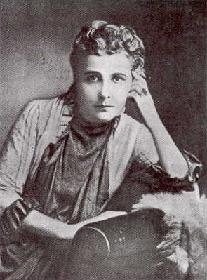 Annie
Besant, proponent of the
philosophy of Theosophy, gave many a lecture in which she aired her views that
India was a victim of the mischief wrought by Christian missionaries. Annie
Besant, proponent of the
philosophy of Theosophy, gave many a lecture in which she aired her views that
India was a victim of the mischief wrought by Christian missionaries.
A friend
of Swami Vivekananda, Mrs. Besant was trying to lead Indians back to their own
gods and arouse their sense of self-respect and pride in the greatness of their
religions.
This is what she said on India and Hinduism :
"After a study of some forty years
and more of the great religions of the world, I find none so perfect , none so scientific,
none so philosophical and none so spiritual that the great religion known by the name of
Hinduism. Make no mistake, without Hinduism, India has no
future. Hinduism is the
soil in to which India's roots are stuck and torn out of that she will inevitably wither
as a tree torn out from its place. And if Hindus do not maintain Hinduism who shall
save it? If India's own children do not cling to her faith who shall guard it. India
alone can save India and India and Hinduism are one. "
Annie
Besant thought that "among the priceless teachings that may be
found in the great Indian epic Mahabharata, there is none so rare and priceless as the Gita."
"This is the India of which I
speak - the India which, as I said, is to me the Holy
Land. For those who, though born for this life in a Western land and
clad in a Western body, can yet look back to earlier incarnations in which they
drank the milk of spiritual wisdom from the breast of their true mother - they
must feel ever the magic of her immemorial past, must dwell ever under the spell
of her deathless fascination; for they are bound to India by all the sacred
memories of their past; and with her, too, are bound up all the radiant hopes of
their future, a future which they know they will share with her who is their
true mother in the soul-life."
(source:
India: Essays and Lectures Vol. IV - By Annie Besant London. The
Theosophical Publishing Co. p. 11.1895).
 Mrs. Besant remarked at Calcutta:
"India is the mother of religion. In her are combined science and religion
in perfect harmony, and that is the Hindu religion, and it is India that shall
be again the spiritual mother of the world." Mrs. Besant remarked at Calcutta:
"India is the mother of religion. In her are combined science and religion
in perfect harmony, and that is the Hindu religion, and it is India that shall
be again the spiritual mother of the world."
(source: Hindu
Superiority - By Har Bilas Sarda - Besant's lecture at the Grand
Theatre, Calcutta on Jan 15th 1906).
“During the early
life of a Nation, religion is an essential for the binding together of the
individuals who make the nation. India was born, as it
were, in the womb of Hinduism, and her body was for long shaped by that
religion. Religion is a binding force, and India has had a longer
binding together by religion than any other Nation in the world, as she is the
oldest of the living Nations.”
(source:
Hindu
Rashtra-What It Means - By Prof.
V. Rangarajan).
Besant
held Hinduism in high esteem and very well advised in her book, In
Defense of Hinduism:
"Based on
knowledge it need not fear any advance in knowledge; profound in spirituality,
the depths of the spirit find in it deeps answering into deep, it has nothing to
dread, everything to hope, from growth in intellect, from increasing sway of
reason."
(source:
India Rediscovered - By Dr. Giriraj Shah p.
31 Abhinav Publications New Delhi 1975).
As Annie Besant
and Bhagavan Das, who jointly authored an Advance Text Book of Hindu Religion
and Ethics entitled 'Sanatana Dharma' in
1898, rightly observed:
"The
religion based on the Vedas, the Sanatana Dharma or Vaidika Dharma, is the
oldest of living religions and stands unrivalled in the depth and splendor of
its philosophy, while it yields to none in the purity of its ethical teachings,
and in the flexibility and varied adaptation of its rites and ceremonies. It is
like a river, which has shallows that a child may play in, and depths which the
strongest diver cannot fathom. It is thus adapted to every human need, and there
is nothing which any religion can add to its rounded perfection. The more it is
studied and practiced, the more does it illuminate the intellect and satisfy the
heart."
(source:
Cry for a Hindu Nation - By V Sundaram - boloji.com).
 9. Victor Cousin
(1792-1867) eminent French philosopher, whose knowledge of the history of
European philosophy was unrivalled, believes
that: 9. Victor Cousin
(1792-1867) eminent French philosopher, whose knowledge of the history of
European philosophy was unrivalled, believes
that:
"When we read with
attention the poetical
and philosophical monuments of the East--above all, those of India, which are beginning to
spread in Europe--we discover there many a truth, and truths so profound, and which make
such a contrast with the meanness of the results at which European genius has sometimes
stopped, that we are constrained to bend the knee before the philosophy of the East, and
to see in this cradle of the human race the native land of the highest philosophy."
(source: Is
India Civilized: Essays on Indian Culture - By Sir John Woodroffe
p. 132).
He has observed:
“The history of Indian
philosophy is the abridge history of the philosophy of the world.”
(source: The
Bible in India: Hindoo origin of Hebrew
and Christian revelation - By Louis Jacolliot p 9).
" India contains the whole
history of philosophy in a nutshell."
(source: India
And Her People - By Swami Abhedananda p 11-12).
10. Jules Michelet
(1798 -1874) French
writer and the greatest
historian of the Romantic school said:
 "At its starting point in India,
the birthplace of races and religions, the womb of the world." "At its starting point in India,
the birthplace of races and religions, the womb of the world."
While seeking for the wisdom of
ages, he cried at the commencement of his work, “The Bible of Humanity”:
“The year 1863 will remain dear and blessed to me.” Why? Because he had read
India’s sacred poem, the Ramayana.
"Divine
poem, ocean of milk!"
cried
Michelet on discovering this
ancient Scripture.
In
what moving terms he then wrote about India. We can but transcribe
his burning words:
“Each year, it is necessary to
respire, to take breath again, to revive ourselves at the great living sources
that forever keep their eternal freshness. Where can we find them if not at the
cradle of our race, on the sacred summits from where descend the Indus and the
Ganga....?
(source: The
Fragrance of India
: landmarks for the world of tomorrow - By Louis Revel p.
16 Kitabistan Allahabad 1946).
Having read Fauche's
translation of the Ramayana in 1863, Michelet said:
"That year
will always remain a dear and cherished memory; it was the first time I had the
opportunity to read the great sacred poem of India, the divine Ramayana. If
anyone has lost the freshness of emotion, let him drink a long draught of life,
and youth from that deep chalice."
(source: India
and World Civilization - By D.
P. Singhal Pan Macmillan Limited. 1993. Part II p. 213).
This is what Michelet
said of the Ramayana:
"Whoever has done or willed too much let him drink from this deep
cup a long draught of life and youth........Everything is narrow in the West - Greece is
small and I stifle; Judea is dry and I pant. Let me look toward lofty Asia, and the
profound East for a little while. There lies my great poem, as vast as the Indian ocean,
blessed, gilded with the sun, the book of divine harmony wherein is no dissonance. A
serene peace reigns there, and in the midst of conflict an infinite sweetness, a boundless
fraternity, which spreads over all living things, an ocean (without bottom or bound) of
love, of pity, of clemency."
Such was the first and enduring
impression made on Michelet by the Ramayana.
(source: Philosophy of Hinduism
- An Introduction - An Introduction By T. C. Galav
Universal Science-Religion. p 149. The Fragrance of India
: landmarks for the world of tomorrow - By Louis Revel p.
16 Kitabistan Allahabad 1946).
" From India comes to us a
torrent of light, a river of Right and Reason" ......
(source: Arise
O' India - By Francois Gautier ISBN
81-241-0518-9 Har-Anand Publications 2000. p. 25).
" Whereas,
in our Occident, the most dry and sterile minds brag in front of Nature, the
Indian genius, the most rich and fecund of all, knows neither small
nor big and has generously embraced universal fraternity, even the identity of
all souls."
(source: La
Bible de l'Humanite in OEuvres - By Louis Michelet
(Paris : Larousse, 1930, vol. 5, p. 119).
 11.
Francois Marie Arouet Voltaire
(1694-1774) France's greatest writers and
philosophers, was a theist, and a bitter critic of the Church, which he looked
upon as the instigator of cruelty, injustice, and inequality. No wonder that
Voltaire, who strongly opposed the Church's totalitarian grip over men's lives,
and may count as one of the ideologues of secularism, mentioned the religions of
India and China as a model of how religion could be a free exploration by the
individual. He said : 11.
Francois Marie Arouet Voltaire
(1694-1774) France's greatest writers and
philosophers, was a theist, and a bitter critic of the Church, which he looked
upon as the instigator of cruelty, injustice, and inequality. No wonder that
Voltaire, who strongly opposed the Church's totalitarian grip over men's lives,
and may count as one of the ideologues of secularism, mentioned the religions of
India and China as a model of how religion could be a free exploration by the
individual. He said :
"We have shown how much we (Europeans) surpass the Indians in courage and
wickedness, and how inferior to them we are in wisdom. Our
European nations have mutually destroyed themselves in this land where we only
go in search of money, while the first Greeks traveled to the same land only to
instruct themselves."
Voltaire
concluded, " I am convinced that
everything has come down to us from the banks of the Ganga (Ganges), - astronomy,
astrology, metempsychosis, etc."
" It is very important to note that some 2,500 years ago at the least
Pythagoras went from Samos to the Ganga (Ganges) to learn geometry...But he would
certainly not have undertaken such a strange journey had the reputation of the
Brahmins' science not been long established in Europe..."
(source: The
Invasion That Never Was - By Michel Danino and
Sujata Nahar p. 12 - 13 and 18 and 90 - 91).
Refer to Voltaire, Lettres
sur l'origine des sciences et sur celle des peuples de l'Asia (first
published Paris, 1777), letter of 15 December 1775. and Voltaire,
Fragments historiques sur l'linde, p. 444 - 445.
Voltaire
(Fragments relating to some
revolutions in India), spoke
of the Hindus as "a peaceful and innocent people, equally incapable of
hurting others or of defending themselves."
(source: Is
India Civilized - Essays on Indian Culture - By Sir John Woodroffe
p. 36).
 He found that India was the home of religion in
its oldest and purest form. He described India as a country "on
which all other countries had to rely, but which did not rely on anyone
else." He also believed that
Christianity derived from Hinduism. He wrote to and assured
Fredrick the Great of Prussia that "our
holy Christian religion is solely based upon the ancient religion of
Brahma." He found that India was the home of religion in
its oldest and purest form. He described India as a country "on
which all other countries had to rely, but which did not rely on anyone
else." He also believed that
Christianity derived from Hinduism. He wrote to and assured
Fredrick the Great of Prussia that "our
holy Christian religion is solely based upon the ancient religion of
Brahma."
(source: On
Hinduism Reviews and Reflections - By Ram Swarup p. 101-102).
It is in such a context, that a man like Voltaire
considered India "famous for its laws and
sciences" and deplored the mounting European preoccupation (both
individual and national) of those in India with the amassing of "immense
fortunes." This quest for riches intensified the struggles, plunder, etc.
during his own time, and made him remark that "If the Indians had remained
unknown to the Tartars and to us, they would have been the happiest people in
the world."
(source: Indian Science
and Technology in the Eighteenth Century: Some Contemporary European Accounts -
By Dharampal Impex India. p. LXIII).
Voltaire among others held up Hinduism as an
example of a natural deistic religion with a pedigree much older than that of
Judeo-Christianity.
(source: Oriental
Enlightenment: The encounter between Asian and Western thought - By J. J. Clarke
p.50).
 12.
Will Durant
(1885-1981) American
historian, would like the West
to learn from India, tolerance and gentleness and love for all living things: 12.
Will Durant
(1885-1981) American
historian, would like the West
to learn from India, tolerance and gentleness and love for all living things:
"It is true that even across the
Himalayan barrier India has sent to us such questionable gifts as grammar and
logic, philosophy and fables, hypnotism and chess, and above all our numerals
and our decimal system. But these are not the essence of her spirit; they are
trifles compared to what we may learn from her in the future."
"Perhaps in return for conquest,
arrogance and spoliation, India will teach us the tolerance and gentleness of the mature
mind, the quiet content of the unacquisitive soul, the calm of the understanding spirit,
and a unifying, a pacifying love for all living things."
(source:
Philosophy of Hinduism
- An Introduction - By T. C. Galav
Universal Science-Religion. p 20).
He has noted in his book, The
Case for India:
"India was the motherland of our race, and Sanskrit the mother of
Europe's languages: she was the mother of our philosophy; mother, through the Arabs, of
much of our mathematics; mother, through the Buddha, of the ideals embodied in
Christianity; mother, through the village community, of self-government and democracy.
Mother India is in many ways the mother of us all."
Nothing should more deeply shame the modern student than the recency and
inadequacy of his acquaintance with India....This is the India that patient scholarship is
now opening up like a new intellectual continent to that Western mind which only yesterday
thought civilization an exclusive Western thing."
"As flowing rivers disappear in the sea, losing
their name and form, thus a wise man, freed from name and form, goes to the divine person
who is beyond all." Such a theory of life and death will not please Western man,
whose religion is as permeated with individualism as are his political and economic
institutions. But it has satisfied the philosophical
Hindu mind with astonishing continuity.
Durant
felt that
"Even in Europe and America,
this wistful theosophy has won millions upon millions of followers, from lonely women and
tired men to Schopenhauer and Emerson. Who would
have thought that the great American philosopher of individualism would give perfect
expression to the Hindu conviction in his poem 'Brahma',
that individuality is a delusion? "
He wrote this about the Upanishads,
and how they had begun to stir Western thought:
"They are the oldest extant
philosophy and psychology of our race; the surprisingly subtle and patient
effort of man to understand the mind and the world, and their relation. The
Upanishads are as old as Homer, and as modern as Kant."
“But hardly
had the British established themselves in
India
before editions and translations of the Upanishads began to stir Western
thought. Fichte conceived an idealism strangely like Shankara’s; Schopenhauer
almost incorporated Buddhism, the Upanishads and the Vedanta into his
philosophy; and Schelling, in his old age, thought the Upanishads the maturest
wisdom of mankind. Nietzsche had dwelt too long with Bismark and the Greeks to
care for
India
, but in the end he valued above all other ideas his haunting notion of eternal
recurrence – a variant of reincarnation.”
(source: Story
of Civilization: Our Oriental Heritage - By Will Durant MJF Books. 1935.
p 410 - 415 and 554).
Durant truly
one of the most recognized historians in the world, has remarked on the
universal applicability of the Vedanta
paradigm.
 13.
Aldous
Huxley (1894-1963) the English novelist and
essayist, born into a family that included some of the most distinguished members of the
English ruling class, says that
the Gita is for the whole world. He is one of those who enriched the West
greatly with the wisdom of the East. 13.
Aldous
Huxley (1894-1963) the English novelist and
essayist, born into a family that included some of the most distinguished members of the
English ruling class, says that
the Gita is for the whole world. He is one of those who enriched the West
greatly with the wisdom of the East.
Author of several books including Brave
New World and The Doors of
Perception and Heaven and Hell and The
Perennial Philosophy, he observed:
"The Bhagavad-Gita is the
most systematic statement of spiritual evolution of endowing value to mankind. The Gita is
one of the clearest and most comprehensive summaries of the spiritual thoughts ever to
have been made."
Hence Huxley
thought its enduring value, not only for Indians, but for all mankind."
(source:
Philosophy of Hinduism
- An Introduction - By T. C. Galav
Universal Science-Religion. p 65).
In his latest books, Eyeless
in Gaza and Ends and Means,
Aldous Huxley invites our attention to the discipline essential for spiritual
insight and argues for the acceptance of the Yoga
method. The influence of Indian thought is not so much a model to be copied as a
dye which permeates.
(source: Eastern
Religions and Western Thought - By Dr. S. Radhakrishnan
p
250).
He observed that while historical
religions have been violent, eternity-philosophies like "Hinduism and
Buddhism have never been persecuting faiths, have preached almost no holy wars
and have refrained from that proselytizing religious imperialism, which have
gone hand in hand with the political and economic oppression of the colored
people."
(source: On
Hinduism Reviews and Reflections - By Ram Swarup p. 149).
"The Gita occupies an
intermediate position between scripture and theology, for it contains the
poetical qualities of the first with the clear-cut methodicalness of the
second."
(source: India's
Empire of Mind - By Sudhansu Bimal Mookherji p. 93).
 Huxley wrote in his book -
The
Perennial
philosophy Huxley wrote in his book -
The
Perennial
philosophy
"The religions whose theology is least preoccupied
with events in time and most concerned with eternity, have been consistently
less violent and more humane in political practice. Unlike early Judaism,
Christianity and Mohammedanism (all obsessed with time) Hinduism and Buddhism
have never been persecuting faiths, have preached almost no holy wars and have
refrained from that proselytizing religious imperialism which has gone hand in
hand with political and economic oppression of colored people."
(source: The
Perennial
philosophy - By Aldous Huxley p.
194 - 204).
In his book, Perennial
philosophy, (an alternate translation of the Hindu name for their
tradition, Sanatana Dharma) Huxley indeed gives due respect to Hinduism,
Buddhism and Taoism stating clearly that History centric religions indeed are
driven by conquest mentality and hence potential for violence exists all the
time because of “ Market share “ and conversion mentality.
"The
Perennial Philosophy is expressed most succinctly in the Sanskrit formula, tat
tvam asi ('That art thou');
the Atman, or immanent eternal Self, is one with Brahman, the Absolute Principle
of all existence; and the last end of every human being, is to discover the fact
for himself, to find out who he really is."
(source:
The
Complete Idiot's Guide to Hinduism - By Linda Johnsen
p. 363).
 14.
Alfred North Whitehead (1861-1947),
British mathematician, logician and philosopher best known for his work in
mathematical logic and who, in collaboration with Bertrand Russell,
authored the landmark three-volume Principia Mathematica
(1910,
1912, 1913). 14.
Alfred North Whitehead (1861-1947),
British mathematician, logician and philosopher best known for his work in
mathematical logic and who, in collaboration with Bertrand Russell,
authored the landmark three-volume Principia Mathematica
(1910,
1912, 1913).
Whitehead is reported to have remarked:
" Vedanta is the most impressive metaphysics the human mind has
conceived."
(source: Huston
Smith: Essays on World Religion edited by M. Darrrol
Bryant Paragon House
1992 p 135).
15. Joseph Campbell (1904-1987) was one of the foremost interpreters of myth in our time.
Campbell was a prolific writer, dedicated editor, beloved teacher, inspiring lecturer, and an avid
scholar of spiritual and cultural development. He is the author of several books
including A
Hero with Thousand faces
"It is ironic that our great western civilization, which has opened to the minds of
all mankind the infinite wonders of a universe of untold billions of galaxies should be
saddled with the tightest little cosmological image known to mankind? The Hindus with
their grandiose Kalpas and their ideas of the divine power which is beyond all human
category (male or female). Not so alien to the imagery
of modern science that it could not have been put to acceptable use."
(source: Myths
to Live By - By Joseph Campbell. A Bantam Book 1988.
p 90).
"The first principle of Indian
thought, therefore, is that the ultimate reality is
beyond description. It is something that can be experienced only by
bringing the mind to a stop; and once experienced, it cannot be described to
anyone in terms of the forms of this world. The truth, the ultimate truth, that
is to say, is transcendent. it goes past, transcends, all speech all images,
anything that can possibly be said. But, as we have just seen, it is not only
transcendent, it is also immanent, within all things, Everything in the world,
therefore, is to be regarded as its manifestation. There is an important
difference her between the Indian and the Western ideas.
 "There is an important difference between the
Hindu and the Western ideas. In the Biblical tradition, God creates man, but man cannot
say that he is divine in the same sense that the Creator is, where as in Hinduism, all
things are incarnations of that power. We are the sparks from a single fire. And we are
all fire. Hinduism believes in the omnipresence of the Supreme God in every individual.
There is no "fall". Man is not cut off from the divine. He requires only to
bring the spontaneous activity of his mind stuff to a state of stillness and he will
experience that divine principle with him." "There is an important difference between the
Hindu and the Western ideas. In the Biblical tradition, God creates man, but man cannot
say that he is divine in the same sense that the Creator is, where as in Hinduism, all
things are incarnations of that power. We are the sparks from a single fire. And we are
all fire. Hinduism believes in the omnipresence of the Supreme God in every individual.
There is no "fall". Man is not cut off from the divine. He requires only to
bring the spontaneous activity of his mind stuff to a state of stillness and he will
experience that divine principle with him."
(source:
Philosophy of Hinduism
- An Introduction - By T C Galav Universal Science-Religion.
p
19 and Joseph
Campbell Foundation).
"There is an illuminating story
told of the deity Krishna, who, in the form of a human child, was raised among a
little company or tribe of herdsmen. One day he said to them, when he saw them
preparing to worship one of the great Gods of the Brahminical pantheon:
"But why do you worship a deity in the sky? The support of your life is
here, in your cattle. Worship these! " Whereupon, they hung garlands around
the necks of their cattle and paid them worship. This
wonderful art of recognizing the divine presence in all things, as a ubiquitous
presence, is one of the most striking features of Oriental life, and is
particularly prominent in Hinduism."
'I have seen very simple people out
in the country, climbing a hill, who, when they became tired and paused to rest
and eat, set up a stone, poured red paint around it, and then reverently placed
flowers before it. The pouring of the red paint set that stone apart. The idea
was simply that those people were now going to regard it, not as a stone, but as
a manifestation of the divine principle that it is immanent in all things. The
pouring of the red paint and placing of the flowers were typical acts of Bhakti,
Devotional Yoga: simple devices, readily available to anyone, to shift the focus
of the mind from the phenomenal aspect of the object as a mere stone to its
mystery of a miracle of being. And this popular form of yoga, no less than the
very much sterner and more difficult discipline of Patanjali's Yoga Sutras, to
which I first alluded, is a technique to link
consciousness to the ultimate truth: the mystery of being. The sense of the
whole universe as a manifestation of the radiance of God and of yourself as
likewise of that radiance, and the assurance that this is so, no matter what
things may look like, round about, is the key to the wisdom
of India..."
(source: Joseph
Campbell Foundation).
Joseph Campbell, traveled widely in
India and was a good friend of Hindu teacher J. Krishnamurti. He also assisted
in the translation of one of the greatest classics of modern times, The Gospel
of Sri Ramakrishna. At one point, he admitted that
discovering the Mandukya Upanishad
affected him more profoundly than the beginning of the
World War II.
(source: Hinduism
- By Linda Johnsen p. 364).
 16. Sir
Monier Monier-Williams (1819-1899) Indologist
and head of the Oxford's Boden Chair said: 16. Sir
Monier Monier-Williams (1819-1899) Indologist
and head of the Oxford's Boden Chair said:
"The strength of Hinduism lies in its infinite adaptability to the infinite diversity
of human character and human tendencies. It has its highly spiritual and abstract side
suited to the philosopher, its practical to the man of the world, its aesthetic and
ceremonial side attuned to the man of the poetic feeling and imagination; and its
quiescent contemplative aspect that has its appeal for the man of peace and the lover of
seclusion."
The Hindus, according to him, were
Spinozists more than 2,000 years before the advent of Spinoza, and Darwinians many
centuries before Darwin and Evolutionists many centuries before the doctrine of Evolution
was accepted by scientists of the present age.
"I
have found no people in Europe more religious, none more patiently persevering
in common duties."
(source: Indian Culture
and the Modern Age - By Dewan Bahadur K. S. Ramaswami Sastri
Annamalai University. 1956 p.22).
"Starting from the Vedas, Hinduism has ended
in embracing something from all religions, and in presenting phases suited to
all minds. It is all tolerant, all-compliant, all-comprehensive,
all-absorbing."
The following passages about the Hindu
Epics (Ramayana and Mahabharata) are noteworthy for their beauty and
for their insight:
"It must be
admitted, however, that, in exhibiting pictures of domestic life and manners,
the Sanskrit epics are even more true and real than the Greek and Roman.
In the delineation of women the Hindu poet thrown aside all exaggerated coloring
and drawn from nature - Kaikeyi, Kausalya, Mandodari (favorite wife of Ravana),
and even the humble-backed Manthara are all drawn to the very life. Sita,
Draupadi, and Damayanti engage our affections and our interest for more than
Helen or even Penelope. Indeed Hindu wives are generally perfect patterns of
conjugal fidelity; can it be doubted that, in these delightful portraits of the
Pativrata or purity and simplicity of Hindu domestic manners in early
times."
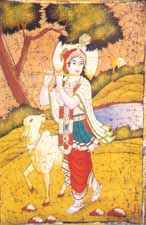 "Indeed, in depicting scenes of domestic
affection, and expressing those universal feelings and emotions which belong to
human nature in all time and in all places, Sanskrit epic poetry is unrivalled
even by Greek Epics.....In the Indian epics, such passages abound, and besides
giving a very high idea of the purity and happiness of domestic life in ancient
India, indicate a capacity in Hindu woman for the discharge of the most sacred
and important social duties." "Indeed, in depicting scenes of domestic
affection, and expressing those universal feelings and emotions which belong to
human nature in all time and in all places, Sanskrit epic poetry is unrivalled
even by Greek Epics.....In the Indian epics, such passages abound, and besides
giving a very high idea of the purity and happiness of domestic life in ancient
India, indicate a capacity in Hindu woman for the discharge of the most sacred
and important social duties."
"Yet there are not
wanting indications in the Indian Epics of a higher degree of civilization than
that represented in the Homeric poems. The battlefields of the Ramayana and
Mahabharata,......are not made barbarously wanton cruelties; and the description
of Ayodhya and Lanka imply far greater luxury and refinement than those of
Sparta and Troy."
"He (Rama) is the type of a perfect husband,
son, and brother. Sita also rises in character far above Helen and even above
Penelope, both in her sublime devotion and loyalty to her husband, and her
indomitable patience and endurance under suffering and temptation.....it may be
affirmed generally that the whole tone of the Ramayana is certainly above that
of the Iliad."
(source: Eminent
Orientalists: Indian European American - Asian Educational
Services. p. 153-157).
In the words of Monier Williams, India is 'in all
respects a complete world in itself'.
(source: India
Through the Ages - By Madan Gopal - under details).
"It may be with truth be asserted that no
description of Hinduism can be exhaustive which does not touch on almost every
religious and philosophical idea that the world has ever known. It is
all-tolerant, all-comprehensive, all-compliant, all-absorbing. It has its
spiritual and its material aspect; it’s esoteric and exoteric; it’s
subjective and objective; it’s rational and irrational. It has one side for
the practical; another for the severely moral; another for the devotional and
the imaginative; another for the philosophical and speculative."
(source: http://www.geocities.com/hindusoc/special/hindintr.htm).
Sir Monier-Williams, in his Brahmanism
and Hinduism : or, Religious thought and life in India, as based on the Veda and
other sacred books of the Hindus , declares:
"Indeed, if I may
be allowed the anachronism, the Hindus were Spinozites more than two thousand
years before the existence of Spinoza; and Darwinians may centuries before
Darwin; and evolutionists many centuries before the doctrine of evolution had
been accepted by the scientists of our time, and before any word like
'evolution' existed in any language of the world."
(source: India
And Her People - By Swami Abhedananda - p.16).
 He said that Pythagoras and Plato both believed
in this doctrine, and that they were indebted for it to Hindu writers. He said that Pythagoras and Plato both believed
in this doctrine, and that they were indebted for it to Hindu writers.
(source: Indian Wisdom -
By Sir M. Monier Williams p. 68).
About the Niti Shastras
he says: " Anyone who studies the best Hindu writings cannot but be struck
by the moral tone which everywhere pervades them...constantly represent the
present condition of human life as the result of actions in the previous
existence. Hence a right course of present conduct becomes an all-important
consideration as bearing on future happiness...."
Sir Monier Williams says that whatever conclusions we form as
to the source of the first astronomical ideas in the world it is probable that
we owe to the Hindus the invention of algebra and its application to astronomy
and geometry. And that from them the Arabs received the numerical symbols and
decimal notation, which now used everywhere in Europe have rendered untold
services to the cause of science.
And again: “The motions of the sun and moon were carefully
observed by the Hindus and with such success that their determination of the
moon’s synodical revolution is a much more correct one than the Greeks ever
achieved. They introduced the period of Jupiter with those of the sun and moon
into the regulation of their calendar in the form of sixty years common to them
and the Chaldeans. They were keenly interested in logic and grammar, and in
medicine and surgery they once kept pace with the most enlightened people of the
world.”
(source:
The
Story of Oriental Philosophy - By L. Adams Beck p. 10 - 13).
He wrote about Sanskrit:
"The Panini grammar reflects the
wondrous capacity of the human brain, which till today no other country has been able to
produce except India."
(source:
Hindu
Superiority - By Har Bilas Sarda
p. 229).
 17.
Friedrich Maximilian Müeller
(1823-1900)
German philologist and Orientalist. He repeatedly drew attention to the
uniqueness of the Vedas and awakened interest in Indology among educated people.
He did more than any other scholar to
popularize philology and mythology, e.g., his lectures Science of Language. 17.
Friedrich Maximilian Müeller
(1823-1900)
German philologist and Orientalist. He repeatedly drew attention to the
uniqueness of the Vedas and awakened interest in Indology among educated people.
He did more than any other scholar to
popularize philology and mythology, e.g., his lectures Science of Language.
Muller is best known for his series
Sacred Books of the East.
He wrote:
"If I were asked under what sky the human mind has most fully developed some of its
choicest gifts, has most deeply pondered over the greatest problems of life, and has found
solutions of some of them which well deserve the attention even of those who have studied
Plato and Kant, I should point to India." And if I were to ask myself from
what literature we who have been nurtured almost exclusively on the thoughts of
Greeks and Romans, and of the Semitic race, the Jewish, may draw the corrective
which is most wanted in order to make our inner life more perfect, more
comprehensive, more universal, in fact more truly human a life...again I should
point to India."
(source: The
World's Religions - By Huston Smith. Harper
San Francisco. 1991 p 12).
"I maintain that for everybody who cares for himself, for his ancestors, for his
history, for his intellectual development, a study of Vedic literature
is indispensable
".
"The
Upanishads are the.....sources of .....the Vedanta philosophy, a system in which
human speculation seems to me to have reached its very acme." "I spend
my happiest hours in reading Vedantic books. They are to me like the light of
the morning, like the pure air of the mountains - so simple, so true, if once
understood."
(source: Philosophy of Hinduism
- An Introduction - By T. C. Galav
Universal Science-Religion. p 19).
Muller said of
Schopenhauer's well known saying - "in the whole world there
is no study so beneficial and so elevating as the Upanishad. It
has been the solace of my death" "If
these words of Schopenhauer required any endorsement I should
willingly give it as the result of my own experience during a long
life devoted to the study of many philosophies and many
religions."
(source: Is
India Civilized? - Essays on Indian Culture - By Sir John
Woodroffe Ganesh & Co. Publishers 1922. p. 133 -
134).
 "The
conception of the world as deduced from the Veda, and chiefly from the
Upanishads, is indeed astounding." "The
conception of the world as deduced from the Veda, and chiefly from the
Upanishads, is indeed astounding."
(source: The
Six Systems of Indian Philosophy - By Max Muller (London:
Longmans, Green & Co., 1916 p. xiv).
"The transcendent temperament
acquired, no doubt, a more complete supremacy in the Indian character than
anywhere else."
In History
of Ancient Sanskrit Literature (p 557), Max
Muller observed, "In the Rig Veda we shall have before us more real
antiquity than in all the inscriptions of Egypt or Ninevah...the Veda is the
oldest book in existence.."
"Historical records (of the Hindus)
extend in some respects so far beyond all records and have been preserved to us
in such perfect and legible documents, that we can learn from them lessons which
we can learn nowhere else and supply missing links."
(source: India
- What It Can Teach Us - By Max Muller p. 21).
"The Vedic literature opens to
us a chamber in the education of human race to which we can find no parallel
anywhere else. Whoever cares for the historical growth of our language and
thought, whoever cares for the first intelligent development of religion and
mythology, whoever cares for the first foundation of Science, Astronomy,
Metronomy, Grammar and Etymology, whoever cares for the first intimation of the
first philosophical thoughts, for the first attempt at regulating family life,
village life and state life as founded on religion, ceremonials, traditions and
contact must in future pay full attention to the study of Vedic
literature."
(source:
Hinduism:
The Eternal Religion - By M. D. Chaturvedi p.12-13).
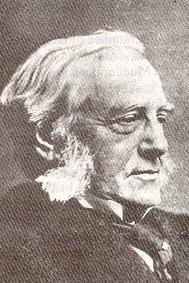 "The
whole of their (Hindu) literature, from one end to the other, is pervaded by
expression of love and reverence for truth.' "The
whole of their (Hindu) literature, from one end to the other, is pervaded by
expression of love and reverence for truth.'
(source:
Popular Hinduism: The Religion of the Masses - By
L S S O'Malley p. 82).
He declared: "None of our
philosophers, not excepting Heraclitus, Plato, Kant, or Hegel, has ventured to
erect such a spire, never frightened by storms or lightnings. Stone follows on
stone, in regular succession after once the first step has been made, after once
it has been clearly seen that in the beginning there can have been but One, as
there will be but One in the end, whether we call it Atman or Brahman."
(source: The
Six Systems of Indian Philosophy - By Max F. Muller p. 239).
Muller says that from Indian
literature the Christian world "may draw that corrective which is most
wanted in order to make our inner life more perfect, more comprehensive, more
universal, in fact more truly humane, a life not for this only, but a
transfigured and eternal life."
(source: India
- What It Can Teach Us - By Max Muller p. 6).
In Three
Lectures on Vedanta Philosophy published in
1896, Muller writes: "What distinguishes
the Vedanta philosophy from all other philosophies is that it is at the
same time a religion and a philosophy." (p
11-12).
About the love of truth experienced by
the sages of the Upanishads, Prof. Max Muller
says, " If it seems strange to you that the old Indian Philosophers should
have known more about the soul than Greek or medieval or modern philosophers,
let us remember that however much the telescopes for observing the stars of
heaven have been improved, the observatories of the soul have remained much the
same."
He
went on to say: "It is surely astounding
that such a system as the Vedanta should have been slowly elaborated by the
indefatigable and intrepid thinkers of India thousands of years ago, a system
that even now makes us feel giddy, as in
mounting last steps of the swaying spire of a Gothic cathedral. None of our
philosophers, not excepting Heraclitus, Plato, Kant or Hegel, has ventured to
erect such a spire, never frightened by storms or lighting. Stone follows on
stone after regular succession after once the first step has been made, after
once it has been clearly seen that in the beginning there can have been One, as
there will be but One in the end, whether we call it Atman or Brahman."
(source: Three Lectures on the Vedanta
Philosophy, London. 1894. p. 7).
 Prof
Max Mueller, an authority on ancient India, says: "I do not deny that the
manly vigor, the public spirit and the private virtues of the citizens of
European states represent one side of the human destiny." But, surely, he
asserts, "there is another side to our nature and possibly another destiny
open to man." Prof
Max Mueller, an authority on ancient India, says: "I do not deny that the
manly vigor, the public spirit and the private virtues of the citizens of
European states represent one side of the human destiny." But, surely, he
asserts, "there is another side to our nature and possibly another destiny
open to man."
And he points to India,
"Where the climate was mild and the soil fertile." He asks: "Was
it not, I say, natural then, that another side of human nature should be
developed — not the active, the combative and acquisitive,
but the passive, the meditative and reflective?"
"If philosophy is meant to be a
preparation for a happy death, or Euthanisia, I know of no better preparation
for it than the Vedanata philosophy."
(source: India
And Her People - By Swami Abhedananda
p.234).
"Whatever
sphere of the human mind you may select for your special study, whether it be
language, or religion, or mythology, or philosophy, whether it be law or
customs, primitive art or primitive science, everywhere you have to go to India,
whether you like it or not, because some of the most valuable and instructive
materials of the history of man are treasured up in India and India only."
(source: Yoga:
A Vision of its Future - By Gopi Krishna p. 119).
"The
Hindus," says Max Muller, "were a people remarkably gifted for
philosophical abstraction."
(source: Hindu
Superiority
- By Har Bilas Sarda
p. 276).
"The
earliest of these Upanishads will always maintain a place in the philosophic
literature of the world among the most astounding products of the human
mind."
(source: Hinduism
Invades America
- by Wendell Thomas
p. 240 published by The Beacon Press Inc. New York City 1930).
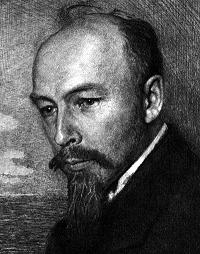 18. Count
Hermann
Keyserling (1880-1946)
philosopher, author, public speaker. He is the first Western thinker to conceive and
promote a planetary culture, beyond nationalism and cultural ethnocentrism, based on
recognition of the equal value and validity of non-western cultures and philosophies.
Keyserling founded the School of Wisdom in Darmstadt, Germany in 1920 based on the original Schools
of Wisdom which prospered over two thousand years ago in Northern India. 18. Count
Hermann
Keyserling (1880-1946)
philosopher, author, public speaker. He is the first Western thinker to conceive and
promote a planetary culture, beyond nationalism and cultural ethnocentrism, based on
recognition of the equal value and validity of non-western cultures and philosophies.
Keyserling founded the School of Wisdom in Darmstadt, Germany in 1920 based on the original Schools
of Wisdom which prospered over two thousand years ago in Northern India.
Keyserling was much impressed with
the metaphysical profundity of India. He used Indian
thought to measure European standards of conduct and morality. The influence
of Keyserling on the European intelligentsia after World War I, especially in
Germany was deep but short-lived. Germany shattered from the disastrous war, had
returned its attention towards India for solace and new inspiration as is
indicated by the publication of innumerable novels and poems with a
predominantly Asian background.
(source: India and World Civilization
- By D. P. Singhal Pan Macmillan Limited. 1993.
p 240).
"I
have not found in Europe or America, poets, thinkers or popular leaders equal, or even
comparable, to those of India today."
(source: The
Discovery of India - By Jawaharlal Nehru Oxford University Press. 1995.
p
89).
"Hinduism at its best has spoken the only relevant
truth about the way to self-realization in the full sense of the word.'
(source: Huston
Smith: Essays on World Religion - edited by M. Darrrol
Bryant Paragon House
1992 p 29-30).
India, says
Keyserling,
“has produced the profoundest metaphysics that we
know of ” and he speaks of
“
the absolute superiority of India over the West
in philosophy; poetry from the Mahabharata, containing the Bhagavad-Gita,
“perhaps the most beautiful work of the literature of the world.”
source:
The
Case for India - By Will Durant Simon and Schuster,
New York. 1930 p.6).
Count
Keyserling, who left Europe shortly before World War I to journey around the
world, wrote an account of the city of Banaras:
"Benares
is holy. Europe, grown superficial, hardly understands such truths anymore.....I
feel nearer here than I have ever done to the heart of the world; here I feel
everyday as if soon, perhaps even today, I would receive the grace of supreme
revelation...The atmosphere of devotion which hangs above the river is
improbable in strength; stronger than in any church that I have ever visited.
Every would be Christian priest would do well to sacrifice a year of his
theological studies in order to spend his time on the
Ganga; here he would discover what piety means."
(source:
Banaras:
City of Light - By Diana L Eck p. 17).
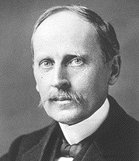 19.
Romain Rolland
(1866-1944) French Nobel laureate, professor of the history of music at
the Sorbonne and thinker. He authored a book on the Life
of Ramakrishna 19.
Romain Rolland
(1866-1944) French Nobel laureate, professor of the history of music at
the Sorbonne and thinker. He authored a book on the Life
of Ramakrishna
This is what he said
about India: "If
there is one place on the face of the earth where all the dreams of living men have found
a home from the very earliest days when man began the dream of existence, it is
India....For more than 30 centuries, the tree of vision, with all its thousand
branches and their millions of twigs, has sprung from this torrid land, the
burning womb of the Gods. It renews itself tirelessly showing no signs of
decay."
"Let
us return to our eagle's nest in the Himalayas. It is waiting for us, for it is
ours, eaglets of Europe, we need not renounce any part of our real nature...whence we
formerly took our flight."
(source:
Philosophy of Hinduism
- An Introduction - By T. C. Galav
Universal Science-Religion. p 20).
"Religious faith in the case of the Hindus has never been allowed to run
counter to scientific laws, moreover the former is never made a condition for
the knowledge they teach, but there are always scrupulously careful to take into
consideration the possibility that by reason both the agnostic and atheist may
attain truth in their own way. Such tolerance may be surprising to religious
believers in the West, but it is an integral part of Vedantic
belief."
Romain
Rolland thought: "The true Vedantic spirit
does not start out with a system of
preconceived ideas. It possesses absolute liberty and unrivalled courage among religions
with regard to the facts to be observed and the diverse hypotheses it has laid down for
their coordination. Never having been hampered by a priestly order, each man has been
entirely free to search wherever he pleased for the spiritual explanation of the spectacle
of the universe."
He points outs out that "a hundred
facts testify to how great an extent the East (India) was mingled with Hellenic
thought during the second century of our era."
(source: Romain
Rolland has given a long Note as an appendix to his book on Vivekananda - 'On
the Hellenic-Christian Mysticism of the First Centuries and its Relationship to
Hindu Mysticism.').
He wrote: "The greatest human
ideal is the great cause of bringing together the thoughts of Europe and Asia; the
great soul of India will topple our world."
(source: The
Genius of India - By Guy Sorman (Le Genie de l'Inde)
Macmillan India Ltd. 2001. ISBN 0333 936000 p. 157-158).
"The
vast and tranquil metaphysics of India is unfolded; her conception of the
universe, her social organization, perfect in its day and still capable of
adaptation to the demands of modern times; the solution which she offers for the
feminist problem, for the problems of the family, of love, of marriage; and
lastly, the magnificent revelation of her art.
The whole vast soul of India proclaims from end to end of its crowded and well
ordered edifice the same domination of a sovereign synthesis." There is no
negation. All is harmonized. All the forces of life are grouped like a forest,
whose thousand waving arms are led by Nataraja,
the master of the Dance. Everything has its
place, every being has its function, and all take part in the divine concert,
their different voices, and their very dissonances, creating, in the phrase of
Heraclitus, a most beautiful harmony. Whereas in the West, cold, hard logic
isolates the unusual, shutting it off from the rest of life into a definite and
distinct compartment of the spirit. India, ever mindful of the natural
differences in souls and in philosophies, endeavors to blend them into each
other, so as to recreate in its fullest perfection the complete unity. The
matching of opposites produces the true rhythm of life.
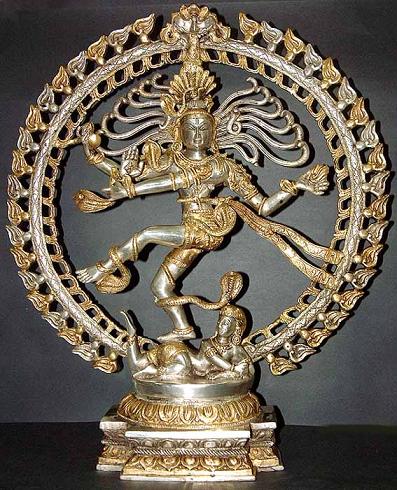
India's magnificent
revelation of her art. There
is no negation. All is harmonized. All the forces of life are grouped like a
forest, whose thousand waving arms are led by Nataraja, the master of the Dance.
And the reason why I love the Brahmin more than the other
schools of Asiatic thought is because it seems to me to contain them all.
Greater than all European philosophies, it is even capable of adjusting itself
to the vast hypotheses of modern science.
Watch
Scientific
verification of Vedic knowledge
***
"Of course, this entire fabric of Indian life stands
solidly on faith, that is to say, on a slender and emotional hypothesis.
But amid all the beliefs of Europe, and of Asia,
that of the Indian Brahmins seems to me infinitely the most alluring. And the
reason why I love the Brahmin more than the other schools of Asiatic thought is
because it seems to me to contain them all. Greater than all European
philosophies, it is even capable of adjusting itself to the vast hypotheses of
modern science. Our Christian religions have tried in vain, when
there were no other choice open to them, to adapt themselves to the progress of
science. But after having allowed myself to be swept away by the powerful rhythm
of Brahmin thought, along the curve or life, with its movement of alternating
ascent and return, I come back to my own century, and while finding therein the
immense projections of a new cosmogony, offspring of the genius of Einstein, or
deriving freely from the discoveries, I yet do not feel that I enter a strange
land. I yet can hear resounding
still the cosmic symphony of all those planets which forever succeed each other,
are extinguished and once more illumined, with their living souls, their
humanities, their gods – according to the laws of the eternal To
Become, the Brahmin Samsara – I hear Siva dancing, dancing in the heart of the
world, in my own heart."
The
Western world, abandoning itself utterly to its search of individual and social
happiness, maims and disfigures life by the very frenzy of its haste, and kills
in the shell the happiness, which it pursues. Like a runaway horse who from
between his blinkers sees only the blinding road before him, the average
European cannot see beyond the boundaries of his individual life, or of the life
of his class, or his country, or his party.
In the great philosophy of Brahma, such violent
turns of the scale are quite unknown. It
embraces vast stretches of time, cycles of human ages, whose successive lives
gravitate in concentric circles, and travel ever slowly towards the
center...."
(source: The
Dance of Shiva - By Dr. Ananda K Coomaraswamy – Foreword -
By Romain Rolland pages xi – xv).
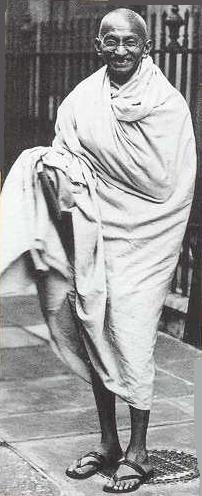 20.
Mahatma
Gandhi (1869-1948) was among India's most fervent
nationalists, fighting for Indian independence from British rule. Gandhi
rose to the eminence of being called “amoral genius” by no less a person
than the celebrated British philosopher C. E. M Joad.
(For more on Joad refer to Quotes301_320). 20.
Mahatma
Gandhi (1869-1948) was among India's most fervent
nationalists, fighting for Indian independence from British rule. Gandhi
rose to the eminence of being called “amoral genius” by no less a person
than the celebrated British philosopher C. E. M Joad.
(For more on Joad refer to Quotes301_320).
He was disillusioned by the hypocrisy of
the Western civilization.
He denounced
England's devilish acts in India, and proclaimed it as a "Satanic Power'.
Then, gave the cry for the 'Quit India' movement.
While in London, Gandhi wrote:
"Looking
at this land, I at any rate have grown disillusioned with Western civilization.
They spend, their days in luxury or in making a bare living and retire at night
thoroughly exhausted. In this state of affairs, I cannot understand when they
can devote themselves to prayers."
It is said that Gandhi was once
asked what he thought of Western civilization, and answered that he felt it
might be a good idea.
(source: OutlookIndia.com).
(Indian Opinion: Mahatma Gandhi quoted
by Judith M. Brown. 1994:5 - Modern India: The Origins of an Asian democracy).
As is clear from
the Mahatma's polemic against the Christian
missionaries, he was first and
foremost a Hindu, who opposed all designs to destroy Hindu culture.
He claimed: "I am a proud staunch Sanatani Hindu."
He took considerable pride in this self-identification. Far from being a dirty
word as it would soon become even for some so-called Hindu leaders, the word
"Hindu" conveyed to him all that was noble and elevating. He did not
feel that he was being "communal" when he called himself a Hindu. For
him Hinduism was a a vast, spiritual vision beckoning man to rise to the highest
heights.
He has further stated:
"Hinduism has made marvelous discoveries in things of religion, of
the spirit, of the soul. We have no eye for these
great and fine discoveries. We are dazzled by the material progress that Western science
has made. Ancient India has survived because Hinduism was not developed along material but
spiritual lines."
"Hinduism is a relentless pursuit of Truth.
"Truth is God"
and if today it has become moribund, inactive, irresponsive to growth, it is
because we are fatigued; and as soon as the fatigue is over, Hinduism will burst
upon the world with a brilliance perhaps unknown before.”
(source:
Young
India, 24/11/1924
p. 390-396 and The
Discovery of India - By Jawaharlal Nehru. Oxford University Press. 1995. pg
75).
"The
tendency of Indian civilization is to elevate the moral being, that of the
western civilization is to propagate immorality. The latter is godless, the
former is based on a belief in God."
(source:
Popular
Hinduism: The Religion of the Masses - By L S S O'Malley p. 46).
"I believe that the civilization
India has evolved is not to be beaten in the world. Nothing can equal the seeds
sown by our ancestry. Rome went; Greece shared the same fate; the might of the Pharaohs
was broken; Japan has become westernized; of China nothing can be said; but
India is still, somehow or other, sound at the foundation."
(source: Hindu
Swaraj or Indian Home Rule Chapter xiii)
This is what Gandhi wrote about the
Bhagavad Gita:
 "The
Geeta is the universal mother. I find a solace in the Bhagavadgeeta that I miss even
in the Sermon on the Mount. When disappointment stares me in the face and all alone I see
not one ray of light, I go back to the Bhagavad Gita. I find a verse here and a verse
there , and I immediately begin to smile in the midst of overwhelming tragedies - and my
life has been full of external tragedies - and if they have left no visible or indelible
scar on me, I owe it all to the teaching of Bhagavadgeeta." "The
Geeta is the universal mother. I find a solace in the Bhagavadgeeta that I miss even
in the Sermon on the Mount. When disappointment stares me in the face and all alone I see
not one ray of light, I go back to the Bhagavad Gita. I find a verse here and a verse
there , and I immediately begin to smile in the midst of overwhelming tragedies - and my
life has been full of external tragedies - and if they have left no visible or indelible
scar on me, I owe it all to the teaching of Bhagavadgeeta."
About the Bhagawad-Gita, Gandhi, says: “Today the Gita is not only my Bible or my Koran, it is
more than that—it is my mother... When I am in difficulty or distress I seek
refuge in her bosom.”
(source: Harijan 24-8-1934).
Listen to The
Bhagavad Gita podcast
- By Michael Scherer - americanphonic.com.
Gandhi, the author
of the Quit
India movement was inspired
by the teachings of Krishna in the Gita.
(source:
On
Secularism in India - By S Gurumurthy).
"Hinduism is a living organism
liable to growth and decay subject to the laws of Nature. One and indivisible at
the root, it has grown into a vast tree with innumerable branches. The changes
in the season affect it. It has its autumn and its summer, its winter and its
spring. It is, and is not, based on scriptures. It does not derive its authority
from one book. "Non violence has found the highest expression and
application in Hinduism.
(source: Hindu
Dharma - By M. K. Gandhi. Chapter on Why I
am a Hindu p.1-8).
 "I
think I have understood Hinduism correctly when I say that it is eternal,
all-embracing and flexible enough to suit all situations.
" "I
think I have understood Hinduism correctly when I say that it is eternal,
all-embracing and flexible enough to suit all situations.
"
(Navjeevan
27-9-1924). Hinduism contains the essence of all religions. What it does not
contain is not worth knowing (Navjeevan
17-9-1925).
Since
Hinduism is based on truth and nonviolence , it can never oppose any other
religion. Hinduism strives for the betterment of all religions, and through them
of the entire world (From a speech made on 25-3-29 while inaugurating Shri
Laxminarayan Temple.).
"I
am a Hindu because it is Hinduism which makes the world worth living."
(source:
Young India
1-12-26). I am a Hindu hence I Love not only human beings, but all living
beings.
He
observed on Hinduism's environmentally
sensitive philosophy by saying:
"I bow my head in reverence to our ancestors for their sense
of the beautiful in nature and for their foresight in investing
beautiful manifestations of Nature with a religious
significance."
(source: Glimpses
of Indian Culture - By Dr. Giriraj Shah
p. 106). For more refer to chapter on Nature
Worship.
He considered the Bhagavad
Gita as a book ' par excellence'
for the knowledge of Truth
(God).
Gandhi called the Gita the 'Gospel of Selfless Action'.
"India
is to me the dearest country in the world, because I have discovered goodness in it. It
has been subject to foreign rule, it is true. But the status of a slave is preferable to
that of a slave holder."
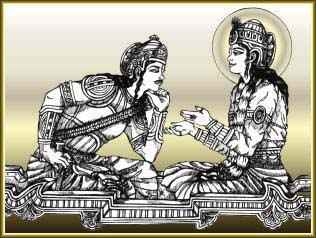 “Hinduism is a living organism. One and indivisible
at the root, it has grown into a vast tree with innumerable branches. Knowledge
is limitless and so also the application of truth. Everyday we add to our
knowledge of the power of Atman (soul) and we shall keep on doing so.” “Hinduism is a living organism. One and indivisible
at the root, it has grown into a vast tree with innumerable branches. Knowledge
is limitless and so also the application of truth. Everyday we add to our
knowledge of the power of Atman (soul) and we shall keep on doing so.”
He was a Hindu to the core. Defining his attitude to a prominent Indian Christian, Kali
Charan Banerjee (1847-1902) he said:
"I am unable to identify with orthodox
Christianity. I must tell you in all humility that Hinduism, as I know it, entirely
satisfies my soul, fills my whole being, and I find solace in the Bhagavad Gita and the
Upanishads that I miss even in the Sermon on the Mount....I must confess to you
that when doubts haunt me, when disappointments stare me in the face, and when I
see not one ray of light on the horizon I turn to the Bhagavad Gita, and find a
verse to comfort me; and I immediately begin to smile in the midst of
overwhelming sorrow. My life has been full of external tragedies and if they
have not left any visible and indelible effect on me, I owe it to the teachings
of the Bhagavad Gita."
(source: The
Collected Works - By M. K. Gandhi Volume 27, New Delhi, 1968 p.
434-435 and India and World Civilization
- By D. P. Singhal Pan Macmillan Limited. 1993.
p 258).
Gandhi wrote in his book Autobiography
or the Story of My Experiments with Truth:
As "philosophically there was
nothing extraordinary in Christian principles" no one, much less a Hindu,
would ever give it a second look.
(source: Christian
Conversions and abuse of Religious Freedom in India - By Brahm Datt Bharti
p. 20).
Mahatma Gandhi told Romain Rolland in
Switzerland on his way back to India from the Round Table Conference (1911) that
Christianity is an echo of the Indian religion and Islam is the re-echo of that
echo."
(source: India
in Primitive Christianity - By Arthur Lillie).
" I have no
other wish in this world but to find light and joy and peace through
Hinduism."
(source: Outlines
of Hinduism - By T. M. P. Mahadevan - p. foreword).
 "If all The Upanishads and all the
other scriptures happened all of a sudden to be reduced to ashes, and if only
the first verse in the Ishopanishad were left in the memory of the Hindus,
Hinduism would live for ever." "If all The Upanishads and all the
other scriptures happened all of a sudden to be reduced to ashes, and if only
the first verse in the Ishopanishad were left in the memory of the Hindus,
Hinduism would live for ever."
(source: The
Upanishads Translated for the Modern Reader By Eknath Easwaran.
Nilgiri Press. 1987. pg 205).
Gandhi has written:
"The Gita "struck me as one of priceless worth."
(source:
The
Collected Works of Mahatma Gandhi Volume
39 New Delhi 1970 p. 32)
Gandhi was a proud and combative Hindu,
his first and foremost loyalty was towards Hindu society and Hinduism, says Koenraad
Elst in his book Negationism
in India: Concealing the Record of Islam p.
84).
'The Bhagavad Gita is my mother,' he
once said; and the name of Sri Rama was his shield.'
(source: Freeindia.org)
He accords
the highest honor to Hindu scriptures - the Vedas, the Upanishads, the Puranas,
the Gita, the Mahabharata, the Ramayan, the Bhagavata. He
defends the "much-maligned Brahman" and entertains " not a shadow
of doubt" that "if Brahmanism does not revive, Hinduism will
perish".
He upholds the "spirit behind
idol-worship" and is prepared "to defend with my life the thousands of
holy temples which sanctify this land." For him cow protection "is the
dearest possession of the Hindu heart" and "no one who does not
believe in cow-protection can possibly be a Hindu." The sacred thread has
"deep meaning for him" as it is "the sign of the second birth,
that is spiritual." He says that varnashrama is
"inherent in human nature, and Hinduism has simply made a science of
it."
(source: Hindu
Dharma - By M. K. Gandhi p. 7-374).
"What the divine author of the
Mahabharata said of his great creation is equally true of Hinduism. Whatever of
substance is contained in any other religion is always to be found in Hinduism,
and what is not contained in it is insubstantial or unnecessary."
(source: Young
India 27-9-1925).
"Hinduism insists on the
brotherhood of not only all mankind but of all that lives."
(source: Harijan
28-3-1936).
"Hinduism is like the Ganga,,
pure and unsullied at its source but taking in its course the impurities in the
way. Even like the Ganga it is beneficent in its total effect. It takes a
provincial form in every province, but the inner substance is retained
everywhere."
(source: Young
India 8-4-1926)
 " On
examination, I have found it to be the most tolerant of all religions known to
me. Its freedom from dogma makes a forcible appeal to me inasmuch as it gives
the votary the largest scope for self-expression." He saw no
reason to for changing his belief or his religion. He found it impossible
"to believe that I could go to heaven or attain salvation only by becoming
a Christian." "Philosophically there was nothing extraordinary in
Christian principles. From the point of view of sacrifice, it seemed that the
Hindus greatly surpassed Christians. It was impossible for me to regard
Christianity as a perfect religion or the greatest of all religions." " On
examination, I have found it to be the most tolerant of all religions known to
me. Its freedom from dogma makes a forcible appeal to me inasmuch as it gives
the votary the largest scope for self-expression." He saw no
reason to for changing his belief or his religion. He found it impossible
"to believe that I could go to heaven or attain salvation only by becoming
a Christian." "Philosophically there was nothing extraordinary in
Christian principles. From the point of view of sacrifice, it seemed that the
Hindus greatly surpassed Christians. It was impossible for me to regard
Christianity as a perfect religion or the greatest of all religions."
(source:
The
Collected Works of Mahatma Gandhi Volume
34 New Delhi 1970 p.112- 261).
London Times editorial said on the
day after his death: "No country but India and no religion but Hinduism
could have given birth to a Gandhi."
(source: India and World Civilization
- By D. P. Singhal Pan Macmillan Limited. 1993. p. 258).
"Hindu
Dharma is like a boundless ocean teeming with priceless gems. The deeper you
dive the more treasures you find."
(source: The
Essence of Hinduism - By M. K. Gandhi p. 205).
"Hinduism is like
Ganga, pure
and unsullied at its source, but taking in its course the impurities in the
way".
(source: Non-Renunciation:
Themes and Interpretations of Hindu Culture - By T. N. Madan)
He
affirmed, again, and again not only the fundamentals of Hindu spirituality but
also the framework of Hindu culture and social life. He valued "the spirit
behind idol-worship" and declared his determination "to defend with my
life the thousands of holy temples which sanctify this
land of ours."
 "Cow-protection is an article
of faith in Hinduism. Apart from its religious sanctity, it is an ennobling
creed. Cow protection is the dearest possession of the Hindu heart. It is the
one concrete belief common to all Hindus. No on who does not believe in
cow-protection can possibly be called a Hindu. It is a noble belief. I endorse
every word of what Prof. Vaswani has said in praise of the cow. For me the cow
is the personification of innocence. Cow protection means that protection of the
weak and helpless." "Cow-protection is an article
of faith in Hinduism. Apart from its religious sanctity, it is an ennobling
creed. Cow protection is the dearest possession of the Hindu heart. It is the
one concrete belief common to all Hindus. No on who does not believe in
cow-protection can possibly be called a Hindu. It is a noble belief. I endorse
every word of what Prof. Vaswani has said in praise of the cow. For me the cow
is the personification of innocence. Cow protection means that protection of the
weak and helpless."
(source: Hindu
Dharma - By M. K. Gandhi p. 108-18). For more on Gandhi refer
to The
Story of my Experiments with Truth).
"I bow my head in reverence to
our ancestors for their sense of the beautiful in nature and for their foresight
in investing beautiful manifestations of Nature with a religious
significance."
(source:
Glimpses
of Indian Culture - By Dr. Giriraj Shah p. 106).
Thoreau and
Gandhi both
believed in non-violence, had religious temperament, were
vegetarians, and admired the teachings of the Bhagavad Gita. The
appreciated poverty and lived the simple life. Webb Miller in his
book I found no peace p. 240, wrote: “Gandhi received
back from America what was fundamentally the philosophy of India
after it had been distilled and crystallized in the mind of
Thoreau.”
The nationalist movement of Congress, and its political vision of a free India,
was as thoroughly suffused with the spirit of Hinduism. Nationalism and religion
were thus allied in Gandhi's teachings. Gandhi found
the substance of India's life in Hinduism. His political vocabulary
of Ram rajya, ahimsa, satyagraha, swaraj,
bharat mata, swadeshi etc. He passionately rejected the British project of
Westernizing India.
(source: Hindu
Scriptures and American Transcendentalists - By Umesh Patri
p 98 -135 and Dharma, India and the World Order - By Chaturved
Badrinath p. 166 -169).
(For more quotes by Gandhi refer
to chapter on Conversion and GlimpseVI).
Top of Page
Show in
alphabetical order
Quotes21_40

Page < 1 2 3 4 5 6 7 8 9 10 11 12 13 14 15 16 17 18 19 20 21 22 23 24 >
|