|
"India is the world's most ancient civilization. Nowhere
on earth can you find such a rich and multi-layered tradition that has remained
unbroken and largely unchanged for at least five thousand years. Bowing low
before the onslaught of armies, and elements, India has survived every invasion,
every natural disaster, every mortal disease and epidemic, the double helix of
her genetic code transmitting its unmistakable imprint down five millennia to no
less than a billion modern bearers. Indians have demonstrated greater cultural
stamina than any other people on earth. The essential basis of Indian
culture is Religion in the widest and most general sense of the world. An
intuitive conviction that the Divine is immanent in everything permeated every
phase of life" says Stanley Wolpert.
Indic civilization has enriched every art and science
known to man. Thanks to India, we reckon from zero to ten with misnamed
"Arabic" numerals (Hindsaa - in Arabic means from India), and use a decimal system without which our modern
computer age would hardly have been possible.
Science and philosophy were
both highly developed disciplines in ancient India. However, because Indian
philosophic thought was considerably more mature and found particular favor
amongst intellectuals, the traditions persists that any early scientific
contribution came solely from the West, Greece in particular. Because of this erroneous belief, which is perpetuated by a wide variety of
scholars, it is necessary to briefly examine the history of Indian scientific
thought. Jawaharlal
Nehru wrote in his book The Discovery of
India: "Till recently many
European thinkers imagined that everything that was worthwhile had its origins
in
Greece
or
Rome
."
From the very earliest times, India had made its contribution to
the texture of Western thought and living. Michael Edwardes author of British
India, writes that throughout the literatures of Europe, tales of Indian origin
can be discovered. European mathematics -
and, through them, the full range of European technical achievement – could
hardly have existed without Indian numerals. But until the beginning of European
colonization in Asia, India’s contribution was usually filtered through other
cultures.
"Many of the advances in the sciences that we
consider today to have been made in Europe were in fact made in India centuries
ago." - Grant Duff British Historian of India. Dr. Vincent Smith has
remarked, "India suffers today, in the estimation of the world, more
through the world's ignorance of the achievements of the heroes of Indian
history than through the absence or insignificance of such achievement."

Medical Science
Astronomy
Earthquakes
and Meteorology
Fables, Music and Games
Martial
Arts
Philosophy
Government
and Constitution
Law
Democracy
Logic
in Ancient India
Religion
Art and Architecture
Art
of Writing in Ancient India
Literature
Agriculture
Textiles


Medical Science
The science of medicine, like other
sciences, was carried to a very high degree of perfection by the
ancient Hindus. Their great power of observation, generalization and
analysis, combined with patient labor in a country of boundless
resources, whose fertility for herbs and plants is most remarkable,
place them in an exceptionally favorable position to prosecute their
study of this great science.
Lord
Ampthill, British Governor, (February 1905) said at
Madras: "Now we are beginning to find out that the Hindu
Sashtras also contain a Sanitary Code no less correct in principle,
and that the great law-giver, Manu, was one of the greatest sanitary
reformers the world has ever seen!"
Sir William Jones
(1746-1794) came to India as a judge of the Supreme Court at Calcutta.
He said with prophetic warning " Infinite advantage may
be derived by Europeans from the various medical books in Sanskrit,
which contain the names and descriptions of Indian plants and
minerals, with their uses, discovered by experience, in curing
disorders."
(source: Eminent
Orientalists: Indian European American - Asian Educational
Services. p.21).
Horace Hyman
Wilson (1786-1860) says: "The Ancients attained a thoroughly a
proficiency in medicine and surgery as any people whose acquaintance
are recorded. This might be expected, because their patient
attention and natural shrewdness would render them excellent
observers, whilst the extent and fertility of their native country
would furnish them with many valuable drugs and medicaments. Their
diagnosis is said, in consequence, to define and distinguish
symptoms with accuracy, and their Materia Medica is most
voluminous."
(source: Wilson's
Works, Volume III, p. 269.)
Albrecht
Weber
(1825-1901) writes: "The number of medicinal works and authors is
extraordinarily large."
(source: Indian
Literature -
Albrecht Weber
p. 269).
Medicine appears to have been the
oldest Indian science, its roots going back to Yoga practices, which
stress a holistic approach to health, based primarily on proper diet
and exercise. Ancient Indian texts on physiology, identified three
body "humours" wind, gall, and mucus - with which are
associated the sattva, (true or good), rajas (strong), and tamas,
(dark or evil) "strands" of behavior, as primary causal
factors in determining good or ill health. Ayurveda focused on
longevity, honey and garlic were often prescribed. A wide variety of
herbs were listed in ancient India's pharmacopoeia. Some of these
medicinal herbs or plant oil have been indeed proved to be cures for
specific diseases. Oil from the bark of chaulmugra trees remains the
most effective treatment for leprosy. India's oldest medical texts
were far superior to most subsequent works in the field.
 Anatomy and physiology, like some aspects of chemistry,
were by-products of medicine. As far back as the sixth century B.C. Indian
physicians described ligaments, sutures, lymphatics, nerve plexus, facia, adipoe
and vascular tissues, mucous and synovial membrances, and many more muscles than
any modern cadaver is able to show. They understood remarkably well the process
of digestion - the different functions of the gastric juices, the conversion of
chyme, into chyle, and of this into blood. Anatomy and physiology, like some aspects of chemistry,
were by-products of medicine. As far back as the sixth century B.C. Indian
physicians described ligaments, sutures, lymphatics, nerve plexus, facia, adipoe
and vascular tissues, mucous and synovial membrances, and many more muscles than
any modern cadaver is able to show. They understood remarkably well the process
of digestion - the different functions of the gastric juices, the conversion of
chyme, into chyle, and of this into blood.
Anticipating Weismann by 2400 years
Atreya (ca 500 B.C.) held that the parental seed is
independent of the parent's body, and contains in itself, in miniature, the
whole parental organism. Examination for virility was recomended as a
prerequisite for marriage in men; and the Code of Manu warned against marrying
mates affected with tuberculosis, epilepsy, leprosy, chronic dysepsia, piles, or
loquacity. Birth control in the latest theological fashion was suggested by the
Indian medical schools of 500 B.C. in the theory that during the twelve days of
the menstrual cycle impregnation is impossible. Foetal development was described
with considerable accuracy; it was noted that the sex of the foetus remains for
a time undetermined, and it was claimed that in some cases the sex of the embryo
could be influenced by food or drugs.
The records of Indian medicine begin with the
Arthava-veda;
here embedded in incantation, is a list of diseases with their symptoms.
Appended to the Atharva-veda is the Ayur-Veda
("The Science of Longevity"). In this oldest system of Indian medicine
illness is attributed to disorder in one of the four humors (air, water phlegm
and blood), and treatment is recommended with herbs. Many of its diagnoses and
cures are still used in India, with a success that is sometimes the envy of
Western physicians. The Rig-Veda names over a thousand such herbs, and advocates
water as the best cure for most diseases. Even in Vedic times, physicians and
surgeons lived in houses surrounded by gardens in which they cultivated
medicinal plants.
The great name in Indian medicine are those of Sushruta
in the fifth century B.C. and Charaka
in the second century A.D. Sushrata professor of medicine at the University of
Benares, wrote down in Sanskrit a system of diagnosis and therapy whose elements
had descended to him from his teacher Dhanwantari.
His book dealt at length with surgery,
obstetrics, diet, bathing, drugs, infant feeding and hygiene, and medical
education. Charaka composed a
Samhita
(or encyclopedia) of medicine,
which is still used in India, and gave to his followers an almost Hippocratic
conception of their calling:
"Not for self,
not for the fulfilment of any earthly desire of gain, but solely for the good of
suffering humanity should you treat your patients, and so excel all." Only less illustrious than these are
Vaghata
(625 A.D.), who prepared a medical compendium in prose and verse, and Bhava
Misra (1550
A.D), whose voluminous work on
anatomy, physiology and medicine mentioned, a hundred years before Harvey, the
circulation of blood, and prescribed mercury for that novel disease, syphilis,
which had recently been brought in by the Portuguese as part of Europe's
heritage to India."

Medical
Instruments of the Hindu Scriptures - Susruta (1000 B.C.E) enumerates 125 sharp
and blunt instruments
Surgical instruments - Courtesy: Institute of History and Medicine - Hydrebad,
India.
Refer
to Indian
Institute of Scientific Heritage
***
Sushruta described many surgical operations - cataract,
hernia, lithoromy, Caesarian section, etc - and 121 surgical instruments,
including lancets, sounds forceps, catheters, and rectal and vaginal speculums.
Despite Brahmanical prohibitions he advocated the dissection of dead bodies as
indispensable in the training of surgeons. He was the first to graft upon a torn
ear portions of skin taken from another part of the body; and from him and his
Indian successors rhinoplasty- the surgical reconstruction of the nose-descended
into modern medicine. "The ancient
Hindus," says F. H.
Garrison, "performed almost every major operation except
ligation of the arteries." Limbs were amputated, abdominal sections were
performed, fractures were set, hemorrhoids and fistulas were removed.
(source: History
of Medicine - By F. H. Garrison
Philadelphia., 1929 and The Story of civilizations:
Our Oriental Heritage - By
Will Durant ISBN:
1567310125 1937
p.531).
Mrs. Charlotte Manning
says: "The
surgical instruments of the Hindus were sufficiently sharp, indeed, as
to be capable of dividing a hair longitudinally."
"Greek physicians have done much to preserve and diffuse the
medicinal science of India. We find, for instance, that the Greek
physician, Actuarius, celebrates the Hindu medicine, called triphala.
He mentions the peculiar products of India, of which it is composed,
by their Sanskrit name, Myrobalans."
(source: Ancient
and Medieval India
Volume II. p. 346).
Refer to
Sciences of the Ancient Hindus:
Unlocking Nature in the Pursuit of Salvation – By Alok
Kumar
Sushruta laid down elaborate rules for preparing an
operation, and his suggestion that the wound be sterilized by fumigation is one
of the earliest known efforts at antiseptic surgery. Both Sushruta and Charaka
mention the use of medicinal liquors to produce insensibility to pain. In 927
A.D. two surgeons trepanned the skull of a king, and made him insensitive to the
operation by administering a drug called Samohini.
For the detection of the 1120 diseases he enumerated, Sushruta recommended
diagnosis by inspection, palpation, and ausculatation. Taking of the pulse was
described in a treatise dating 1300 A.D. Urinalysis was a favorite method of
diagnosis.
In the time of
Yuan Chwang
Indian medical treatment
began with a seven-day fast; in this interval the patient often recovered; if
the illness continued drugs were at last employed. Even then drugs were used
very sparingly; reliance was placed largely upon diet, baths, inhalations,
urethral, and vaginal injections. Indian physicians were especially skilled in
concocting antidotes for poison.
William Ward
(1769-1823) notes:
"Inoculation for the
small pox seems to have been known among the Hindoos from time immemorial."
The method of introducing the virus is
made by incision just above the wrist, in the right arm of the male, and the
left of the female. At the time of inoculation, and during the progress of the
disease, the parents daily employ a brahmin to worship Sheetula, the goddess who
presides over the disease."
(source: A
View of the History, Literature, and Mythology of the Hindoos -
By William Ward volume I I p 339 London
1822).
Vaccination, unknown to Europe before the eighteenth century, was known in India
as early as 550 A.D. if we may judge from a text attributed to Dhanwantari,
one of the earliest Hindu physicians.
"Take
the fluid of the pock on the udder of the cow...upon the point of a lancer, and
lance with it the arms between the shoulders and elbows until the blood appears;
then, mixing the fluid with the blood, the fever of the small-pox will be
produced."
Modern European physicians believe that caste
separateness was prescribed because of the Brahmin belief in invisible agents
transmitting disease; many of the laws of sanitation enjoined by Sushruta and
"Manu" seem to take for granted what we moderns, who love new words
for old things, call the germ theory of disease. Hypnotism as therapy seems to
have originated among Indians, who often took their sick to the temples to be
cured by hypnotic suggestion. The Englishmen who introduced hypnotherapy into
England-Braid Esdaile and Elliotson- "undoubtedly got their ideas, and some
of their experience, from contact with India."
(source: The Story of civilizations:
Our Oriental Heritage - By
Will Durant 1937
p.531)
Susruta calls surgery,
"the first and best of medical sciences."
He insisted that those who intend to practice it must have actual experimental
knowledge of the subject. He says: "No accurate account of any part of the
body, including even its skin, can be rendered without a knowledge of anatomy,
hence anyone who wishes to acquire a thorough knowledge of anatomy must prepare
a dead body, and carefully examine all its parts." For preliminary
training, students were taught how to handle their instruments by operating on
pumpkins or cucumbers, and they were made to practice on pieces of cloth or skin
in order to learn how to sew up wounds. Major operations, as described by
Susruta, included amputations, grafting, setting of fractures, removal of a
foetus and operation on the bladder for removal of gallstones. The operating
room, he declares should be disinfected with cleansing vapors. He describes 127
different instruments used for such purposes as cutting, inoculations,
puncturing, probing and sounding. Cutting
instruments, Susruta maintains, should be of "bright handsome polished
metal, and sharp enough to divide a hair lengthwise."
(source: The
Pageant of India's History - By Gertrude Emerson Sen p. 66 - 68).
"The specific
diseases whose names occur in Panini's grammar indicates that
medical studies had made great progress before his time (350 B.C.).
The chapter on the human body in the earliest Sanskrit dictionary,
the Amara-kosha presupposes a systematic cultivation of the science.
The works of the great traditional Indian physicians, Charaka, and Susruta,
were translated into Arabic not later than the 8th century. The
chief seat of the science was at Benares. The name of Charaka
repeatedly
occurs in the Latin translations of Avicenna (Ibn Sina), Rhazes (Al
Rasi), and Serapion (Ibn Serabi).

Charaka
(image source: Vishwa
Hindu Parishad of America. Inc - 2002 calendar).
***
Indian medicine dealt
with the whole area of the science. It described the structure of
the body, its organs, ligaments, muscles, vessels, and tissues. The
materia medica of the Hindus embraces a vast collection of drugs
belonging to the mineral, vegetable, and animal kingdom, many of
which have been adopted by the European physicians. Their pharmacy
contained ingenious processes of preparation, with elaborate
directions for the administration and classification of medicines.
Much attention was devoted to hygiene, to the regimen of the body,
and to diet.
The surgery of the
ancient Indian physicians appears to have been bold and skilful.
They conducted amputations, arresting the bleeding by pressure, a
cup-shaped bandage, and boiling oil. They practiced lithotomy;
performed operations in the abdomen and uterus; cured hernia,
fistula, piles; set broken bones and dislocations; and were
dexterous in the extraction of foreign substances from the body. A
special branch of surgery was devoted to rhinoplasty, or operations
for improving deformed ears and noses, and forming new ones. They
devoted great care to the making of surgical instruments, and to the
training of students by means of operations performed on wax spread
out on a board, or on the tissues and cells of the vegetable
kingdom, and upon dead animals. Considerable advances were also made
in veterinary science, and mongraphs exist on the diseases of horses
and elephants. "
(source: The
Indian Empire - By
Sir William Wilson Hunter p.148-150).
Ancient India possessed advanced medical knowledge. Her
doctors knew about metabolism, the circulatory system, genetics, and the nervous
system as well as the transmission of specific characteristics by heredity.
Vedic physicians understood medical ways to counteract the effects of poison
gas, performed Caesarean sections and brain operations, and used anesthetics.
Sushruta (5th
century BC) listed the diagnosis of 1,120 diseases. He described 121 surgical
instruments and was the first to experiment in plastic surgery.
(source:
We
Are Not The First – By Andrew Tomas
- A Bantam Book 1971 New York p. 15 -
49).
The most remarkable part of Charaka's
work is his classification of remedies drawn from vegetable, mineral and animal
sources. Over two thousand vegetable preparations, derived from the roots, bark,
flowers, fruits, seeds or sap of plants and trees, are described vy Charaka, who
also gives the correct time of year for gathering these materials and the method
of preparing and administering them. Charaka sounds
surprisingly modern. He devotes a good deal of attention to children's diseases,
and discusses proper feeding and hours of sleep. He stresses the care of the
teeth and the necessity of cleaning them. The universal custom among
Hindus of using a medicinal stick to clean the teeth and of rinsing the mouth
thoroughly after every meal is so firmly established that it must go back to
very ancient times. Diagnosis in Charaka's time was primarily based on careful
study of the pulse, and that Charaka had a good idea of blood circulation is
apparent from this passage in his treatise: "From that great center (the
heart) emanate the vessels carrying blood into all part of the body - the
element which nourishes the life of all animals and without which it would be
extinct."
Charaka's treatise was based on the teaching of Atreya,
whose date has been assigned to the sixth century B.C. Previous to Atreya,
Ayurveda, "the science of life" was one of the recognized Vedic
studies. High ethical standards which should be maintained by medical profession
were also stressed by Charaka. He says: "Not for money nor for any earthly
objects should one treat his patients. In this the physician's work excels all
vocations. Those who sell treatment as a merchandise neglect the true measure of
gold in search of mere dust."
(source: The
Pageant of India's History - By Gertrude Emerson Sen p. 66 - 67).
Horace Hayman
Wilson (1786-1860) Eminent
Orientalist, observed:
"That in medicine, or the
astronomy and metaphysics, the Hindus have kept pace with the most
enlightened nations of the world: and that they attained as thorough
a proficiency in medicine and surgery as any people whose
acquisitions are recorded." He says further: "It would
easily be supposed that their patient attention and national
shrewdness would render the Hindus excellent observers."
(source: Eminent
Orientalists: Indian European American - Asian
Educational Services. p. 77).
 The great picture of Indian medicine is one of rapid
development in the Vedic and Buddhist period, followed by centuries of slow and
cautious improvement. In the time of Alexander, says
Garrison, "Hindu
physicians and surgeons enjoyed a well-deserved reputation for superior
knowledge and skill," and even Aristotle is believed by some students to
have been indebted to them. So too with the Persians and Arabs. The great picture of Indian medicine is one of rapid
development in the Vedic and Buddhist period, followed by centuries of slow and
cautious improvement. In the time of Alexander, says
Garrison, "Hindu
physicians and surgeons enjoyed a well-deserved reputation for superior
knowledge and skill," and even Aristotle is believed by some students to
have been indebted to them. So too with the Persians and Arabs.
We
find Persians and Arabs translating into their languages, in the eighth century
A.D., the thousand-year-old compendia of Sushrata and Charaka. The great Caliph Haroun-al-Rashid accepted the
preeminence of Indian medicine and scholarship, and imported Indian physicians
to organize hospitals and medical schools in Baghdad.
Lord Amphill concludes that medieval and modern Europe owes its system of
medicine directly to the Arabs, and through them to India.
(source:
The Story of civilizations:
Our Oriental Heritage - By
Will Durant ISBN:
1567310125 1937 p.531).
Dorothea Chaplin
mentions in her book,
Matter,
myth and Spirit or Keltic and Hindu Links
(pp 168-9), "Long before the year 460 B.C., in which Hippocrates, the
father of European medicine was born, the Hindus had built an extensive
pharmacopoeia and had elaborate treatises on a variety of medical and surgical
subjects....The Hindus' wonderful knowledge on a variety of medicine has for
some considerable time led them away from surgical methods as working
destruction on the nervous system, which their scientific medical system is able
to obliviate, producing a cure even without preliminary crisis."
(source: Proof
of Vedic Culture's Global Existence - By Stephen Knapp.
World Relief Network ISBN: 0961741066
p 31).
The practice of
medicine, like all other sciences, was regulated by a code of
social ethics. A physician (vaidya) was to be devoted to the
service of the sick. Charaka's advice to his students contained
the gist of the professional ethics:
"If you want
success in your practice, wealth and fame, and heaven after your
death, you must pray every day on rising and going to bed for the
welfare of all beings and you must strive with all your soul for
the health of the sick. You must not betray your patients, even at
the cost of your own life. You must not get drunk, or commit evil,
or have evil companions. You must be pleasant, of speech and
thoughtful, always striving to improve your knowledge."
Free hospitals were
maintained by the kings and merchants. Nursing and attending the
sick was considered to be one of the highest service to
dharma.
(source: Ancient
Indian History and Culture - By Chidambara Kulkarni
p. 273).
Ancient Hospitals
The Hindus were the first nation
to establish hospitals, and for centuries they were the only people in the world
who maintained them. The Chinese traveler, Fa-hien,
speaking of a hospital he visited in Pataliputra says: "Hither come all
poor and helpless patients suffering from all kinds of infirmities. They are
well taken care of, and a doctor attends them; food and medicine being supplied
according to their wants. Thus they are made quite comfortable, and when they
are well, they may go away."
"The earliest hospital in
Europe," says historian Vincent A. Smith, "is said to have been opened
in the tenth century."
(source: Early
History of India - By Vincent Smith
p. 259).
***
Smallpox inoculation started
in India before the West
Smallpox inoculation is an ancient
Indian tradition and was practiced in India before the West.
In ancient times in India smallpox
was prevented through the tikah (inoculation). Kurt
Pollak (1968) writes, "preventive inoculation
against the smallpox, which was practiced in China from the 11th
century, apparently came from India". This inoculation
process was generally practiced in large part of Northern and
Southern India, but around 1803-04 the British government banned
this process. It's banning, undoubtedly, was done in the name of
'humanity', and justified by the Superintendent General of Vaccine
(manufactured by Dr. E. Jenner from the cow for use in the
inoculation against smallpox).
Dharmapal
has quoted British sources to prove that inoculation in
India was practiced before the British did. In the seventeenth
century, smallpox inoculation (tikah) was practiced in
India. A particular sect of Brahmins employed a sharp iron needle
to carry out these practices. In 1731, Coult was in Bengal and he
observed it and wrote (Operation of inoculation of the smallpox
as performed in Bengall from Re. Coult to Dr.
Oliver Coult in 'An account of the diseases of Bengall'
Calcutta, dated February 10, 1731):
"The operation of inoculation
called by the natives tikah
has been known in the kingdom of Bengall as near as I can learn,
about 150 years and according to the Bhamanian records was first
performed by one Dununtary, a physician of Champanagar, a small
town by the side of the Ganges about half way to Cossimbazar whose
memory in now holden in great esteem as being through the another
of this operation, which secret, say they, he had immediately of
God in a dream.'
English physician Jenner is
credited with discovering vaccination on a scientific basis with
his studies on small pox in 1796. A group
of Fellows of the Royal Society had earlier studied the method of
inoculating people in India and submitted its report in the 1760s.
Dr J. Z. Holwell, one of the members who was in the Bengal Province
for more than ten years to study the Indian vaccination method,
lectured at the London Royal College of Physicians in 1767
"that nearly the same salutary method, now so happily pursued
in England,... has the sanction of
remotest antiquity (in India), illustrating the
propriety of present practice".
 Dr. J. Z.
Holwell writes the most detailed account for the
college of Physicians in London in 1767 (An account of the
manner of inoculating for the smallpox in the East Indies, by
J. Z. Holwell, F.R.S. addressed to the President and Members of
the College of Physicians in London). He wrote: Dr. J. Z.
Holwell writes the most detailed account for the
college of Physicians in London in 1767 (An account of the
manner of inoculating for the smallpox in the East Indies, by
J. Z. Holwell, F.R.S. addressed to the President and Members of
the College of Physicians in London). He wrote:
"Inoculation is
performed in Indostan by a particular tribe of Bramins, who are
delegated annually for this service from the different Colleges of
Bindoobund, Eleabas, Benares, & c. over all the distant
provinces: dividing themselves into small parties, of three or
four each, they plan their traveling circuits in such wise as to
arrive at the places of the operation consists only in abstaining
for a month from fish, milk, and ghee (a kind of butter made
generally of buffalo's milk). When the Bramins begin to inoculate,
they pass from house to house and operate at the door, refusing to
inoculate any who have not, on a strict scrutiny, duly observed
the preparatory course enjoined them. It is no uncommon thing for
them to ask the parents how many pocks they choose their children
should have."
(source: An
account of the manner of inoculating for the smallpox in the East
Indies
- by J. Z. Holwell M.D., F.R.S.).
On the efficacy of this practice
Holwell has the following to say:
"When the before recited
treatment of the inoculated is strictly followed, it is next to a
miracle to hear, that one in a million fails of receiving the
infection, or of one that miscarries under it.. Since, therefore,
this practice of the East has been followed without variation, and
with uniform success from the remotest unknown times, it is but
justice to conclude, it must have been originally founded on the
basis of rational principle and experiment."
Holwell's detailed account, not
only describes inoculation, but also shows that the Indians knew
that microbes caused such diseases.
(source: Indian
Science And Technology in the Eighteenth Century; some
contemporary European accounts - By
Dharampal 1971. An Account of the manner of
inoculating for the Smallpox in the East Indies. Mapusa, Goa:
Other India Press. Chapter VIII p. 142 -164. The
Healers, the Doctor, then and now - By Pollack,
Kurt 1968.English Edition. p. 37-8.).
Also refer to Indian
Institute of Science - Prevention
of Small Pox in ancient India).
The Sactya Grantham
- ancient Brahman medical text ~ 3,500 years old describing brain surgery and
anaesthetics, contains the following passages giving instructions on small
pox vaccination:
“Take on the tip of a knife the contents of the
inflammation, inject it into the arm of the man, mixing it with his blood. A
fever will follow but the malady will pass very easily and will create no
complications.” Edward Jenner (1749-1823) is credited with the discovery
of vaccination but it appears that ancient India has prior claim!"
(source:
We
Are Not The First – By Andrew Tomas
- A Bantam Book 1971 New York p. 15 -
49).
and
http://www.habtheory.com/1/habrefs.php).
The Brahmins had a theory of their
operations. They believed the atmosphere abounded with
imperceptible animalculae (refined to bacteria within a larger
context today). They distinguished tow types of these: those that
are harmful and those not so. The Brahmins therefore
believed that their treatment in inoculating the person expelled
the immediate cause of the disease. How effective was the
inoculation? According to Dr. J. Z.
Holwell, FRS, who had addressed the College of
Physicians in London:
“When the before recited treatment of the inoculation is
strictly followed, it is next to a miracle to hear, that one in a
million fails to receiving the infection, or of one that
miscarries under it.”
A later estimate by the Superintendent General of Vaccine in
1804 noted that fatalities among the inoculated counted one in 200
among the Indian population and one in 60 to 70 among the
Europeans. There is an explanation for this divergence. Most
of the Europeans objected to the inoculation on theological
grounds.
 Small pox has a long
history in India; it is discussed in the Hindu scriptures and even
has a goddess (Sitala, literally “the cool
one")
devoted exclusively to
its cause. It seems therefore almost natural to expect an Indian
medical response to the disease. The inoculation treatment against
it was carried out by a particular caste of Brahmins from the
different medical colleges in the area. These Brahmins circulated
in the villages in groups of three or four to perform their task. Small pox has a long
history in India; it is discussed in the Hindu scriptures and even
has a goddess (Sitala, literally “the cool
one")
devoted exclusively to
its cause. It seems therefore almost natural to expect an Indian
medical response to the disease. The inoculation treatment against
it was carried out by a particular caste of Brahmins from the
different medical colleges in the area. These Brahmins circulated
in the villages in groups of three or four to perform their task.
The person to be inoculated was obliged to follow a certain
dietary regime; he had particularly to abstain from fish, milk, and ghee, which,
it was held, aggravated the fever that resulted after the treatment. The method
the Brahmins followed is similar to the one followed in our own time in certain
aspects. They punctured the space between the elbow and the wrist with a sharp
instrument and then proceeded to introduce into the abrasion “various
matter” prepared from inoculated pistules from the preceding year. The purpose
was to induce the disease itself, albeit in a mild form; after it left the body,
the person was rendered immune to small-pox for life.
The Brahmins had a theory of their operations. They believed
the atmosphere abounded with imperceptible animalculae. They distinguished two
types of these: those harmful and those not so. The universality of this
practices ceased to obtain with the arrival of the British. Like many
specialists in India, including teachers, the Brahmin doctors had been
maintained through public revenues. With British rule, this fiscal system was
disrupted and the inoculators left to fend for themselves.
Two
of the more important medical arts of India – plastic surgery
and inoculations against small pox. Both were indigenously
evolved and the accounts we have, come from Westerners
sent out to study them. One
of these curious facts was the inoculation against small pox
disease, practiced in both north and south India till it
was banned or disrupted by the English authorities in 1802-3.
The ban was pronounced on “humanitarian” grounds by the
Superintendent General of Vaccine.
(source: Homo
Faber: Technology and Culture in India, China and the West 1500-1972 - By
Claude Alvares p. 65-67 and
Decolonizing
History: Technology and Culture in India, China and the West
1492 to the Present Day - By Claude Alvares
p.66-67).
European colonists from the
sixteenth century onwards, gained knowledge of plants, diseases
and surgical techniques that were unknown in the West. One such
example is rauwolfia serpentia, a plant used in traditional Indian
medicine. The active ingredient is today used to treat
hypertension and anxiety in the West.
Sir Mountstuart
Elphinstone has written:
"Their use of these medicines seems to have been very bold. They
were the first nation who employed minerals internally, and they not
only gave mercury in that manner but arsenic and arsenious acid, which
were remedies in intermittents. They have long used cinnabar for
fumigations, by which they produced a speedy and safe salivation. They
have long practiced inoculation."
"They cut for the stone, couched
for the cataract, and extracted the fetus from the womb, and in their
early works enumerate not less than 127 sorts of surgical
instruments!" "Their acquaintance with medicines seems to
have been very extensive. We are not surprised at their knowledge of
simples, in which they gave early lessons to Europe, and more recently
taught us the benefit of smoking dhatura in asthma and the use of
cowitch against worms."
(source: History
of India - Mountstuart Elphinstone London: John Murray Date of
Publication: 1849 p. 145).
The Englishman
(a Calcutta Daily), in a lead story in 1880, said: "No one can
read the rules contained in great Sanskrit medical works without
coming the conclusion that in point of knowledge, the ancient Hindus
were in this respect very far in advance not only to the Greek and
Romans but also to Medieval Europe."
(source: Sanskrit
Civilization - By G. R. Josyer p. 28).
***
Ayurveda or the Veda of Longevity
Ayurveda is a
3,000- to 5,000-year-old holistic healthcare system, which looks
at the individual, addresses diet, lifestyle and spirit, and strives
for balance in each person. It
focuses on prevention,
and sees, many illnesses not as a collection of symptoms but as
imbalances within the body, mind or spirit that, once balance is
restored, eats disease at its root.
"The science
of Medicine was cultivated early in India and modern researches have
disclosed the fact that the Materia Medica of the Greeks, even of
Hippocrates the "Father of Medicine," is based on the
older Materia Medica of the Hindus....
Charaka's work is divided into eight books, describing various
diseases and their treatment; and Susruta's work has six parts, and
specially treats of surgery and operations which are considered
difficult even in modern times. Various chemical processes were
known to the Hindus. Oxides, sulphates, and suphurets of various
metals were prepared, and metallic substances were administered
internally in India long before the Arabs borrowed the practice from
them, and introduced it in Europe in the Middle Ages."
(source: The
Civilization of India - By Romesh C. Dutt
p. 64).
A
tree resin used in Indian medicine for
2,000 years as a folk remedy for a variety of ailments
works to lower cholesterol in lab animals, and in a new way that
might lead to the development of improved drugs for people, U.S.
researchers report.
The
tree is known in India as guggul,
or the myrrh shrub. It’s been used there since at least 600 BC to
battle obesity and arthritis, among other ailments.
(source:
Ancient
remedy could lead to alternative to today’s drugs
- msnbc.com).
"Indian
medicine's influence on Portugal was fairly wide. You had echoes of Indian or
Ayurvedic practices that come into Portuguese usage. Tamarind,
for example, is a plant widely used in Ayurveda. It is applied in Portuguese
hospitals. It is used as a cooling agent, in combination with other medicinal
plants to help the absorption of those plants and it is used in a poultice,
placed on the skin.
(source:
West
has always benefited from Indian medicine).
"Hindu literature on anatomy and
physiology as well as eugenics and embryology has been voluminous.
The Hindus knew the exact osteology of the human body 2,000 years
before Vesalius (c. 1545) and had some rough ideas of the
circulation of blood long before Harvey (1628). the internal
administration of mercury, iron and other powerful metallic drugs
were practized by the Hindu physicians at least 1,000 years before
Paracelsus (1540). And they have written extensive treatises on
these subjects."
(source: Creative
India - By Benoy Kumar Sarkar published Motilal Banarsi
Dass, Lahore 1937. p. 5).
Ayurveda is a traditional
healing system of India, with origins firmly rooted in the culture of the Indian
subcontinent. Some 5000 years ago, the great rishis, or
seers of ancient India, observed the fundamentals of life and organized them
into a system. Ayurveda was their gift to us, an oral tradition
passed down from generation to generation. Ayurvedic
teachings were recorded as sutras, succinct poetical verses in Sanskrit,
containing the essence of a topic and acting as aides-memoire for the students.
Sanskrit, the ancient language of India, reflects the philosophy behind Ayurveda
and the depth within it. Sanskrit has a wealth of words for aspects within and
beyond consciousness.
A
few treatises on Ayurveda date from around 1000 B.C. The best known is Charaka
Samhita, which concentrates on internal medicine. Many of today’s Ayurvedic
physicians use Astanga Hrdayam, a more concise compilation written over 1000
years ago from the earlier texts.
(source: The
Book of Ayurveda: A Holistic Approach to Health and Longevity - By Judith H.
Morrison p. 15 -20).
US
medical schools to teach Ayurveda
American
medical schools will teach students the goodness of Ayurveda with visiting
Indian specialists offering a 12-hour crash course programme on the medical
system based on herbs.
Schools in the
United States
are offering the course taught by Dr Palep under the aegis of Complementary
Alternative Medicine and include topics like Ayurveda philosophy, anatomy,
physiology, pathology, pharmacology, clinical exam and treatments. It also
teaches Yoga, meditation and panchkarma therapy
(process of detoxification and rejuvenation).
(source:
US
medical schools to teach Ayurveda
- sify.com).
Veterinary science in Ancient India
 Since animals were regarded as a part of
the same cosmos as humans, it is not surprising that animal life was keenly
protected and veterinary medicine was a distinct branch of science with its own
hospitals and scholars. Numerous texts, especially of the postclassical period, Visnudharmottara
Mahapurana for example, mention veterinary
medicine. Megasthenes refers to the kind of treatment which was later to be
incorporated in Palakapyamuni's Hastya yur Veda
and similar treatises. Salihotra
was the most eminent authority on horse breeding and hippiatry. Juadudatta
gives a detailed account of the medical
treatment of cows in his Asva-Vaidyaka. Since animals were regarded as a part of
the same cosmos as humans, it is not surprising that animal life was keenly
protected and veterinary medicine was a distinct branch of science with its own
hospitals and scholars. Numerous texts, especially of the postclassical period, Visnudharmottara
Mahapurana for example, mention veterinary
medicine. Megasthenes refers to the kind of treatment which was later to be
incorporated in Palakapyamuni's Hastya yur Veda
and similar treatises. Salihotra
was the most eminent authority on horse breeding and hippiatry. Juadudatta
gives a detailed account of the medical
treatment of cows in his Asva-Vaidyaka.
(source: India and World Civilization
- By D. P. Singhal Pan Macmillan Limited. 1993.
p.187-188).
According to Stanley
Wolpert, " Veterinary science had
developed into an Indian medical specialty by that early era, and India's
monarchs seem to have supported special hospitals for their horses as well as
their elephants. Hindu faith in the sacrosanctity of animals as well as human
souls, and belief in the partial divinity of cows and elephants helps explain
perhaps what seems to be far better care lavished on such animals... A uniquely
specialized branch of Indian medicine was called Hastyaurveda
("The Science of Prolonging Elephant Life").
(source: An
Introduction to India - By Stanley Wolpert
p. 193-194).
Top
of Page
Astronomy
The science of astronomy flourishes only amongst
a civilized people. Hence, considerable advancement in it is itself proof of the
high civilization of a nation. Hindu astronomy has received the homage of
numerous European scholars.
Sir William Hunter (1840-1900)
says
"The Astronomy of the Hindus has formed the subject of excessive
admiration."
"Proof of very extraordinary
proficiency," says
Lord Elphinstone, "in
their astronomical writings are found."
(source: Hindu Superiority
- By Har Bilas
Sarda p. 332 - 348).
William
Robertson wrote: "It is
highly probable that the knowledge of the twelve signs of zodiacs
was derived from India."
(source: An
Historical Disquisition Concerning the Knowledge which the Ancients
had of India - By
William
Robertson p. 280).
India has left a universal legacy
determining for instance the dates of solstices, as noted by 18th century French
astronomer Jean-Claude Bailly
(1736–93) 18th century French astronomer and politician. His works on
astronomy and on the history of science (notably the Essai sur la théorie
des satellites de Jupiter and History
of Astronomy) were distinguished both for scientific interest
and literary elegance and earned him membership in the French Academy, the
Academy of Sciences, and the Academy of Inscriptions. Bailly, who was
guillotined during the French Revolution, maintained that the Brahmins of India
had been tutors of the Greeks and, through them, of Europe.
 Jean-Claude
Bailly
said: Jean-Claude
Bailly
said:
" The motion of the
stars calculated by the Hindus before some 4500 years vary not even
a single minute from the tables of Cassine and Meyer (used in the
19-th century). The Indian tables give the same annual variation of
the moon as the discovered by Tycho Brahe - a variation unknown to
the school of Alexandria and also to the Arabs who followed the
calculations of the school... "The Hindu systems
of astronomy are by far the oldest and that from which the Egyptians, Greek,
Romans and - even the Jews
derived from the Hindus their knowledge."
(source: The Politics of
History - By N. S. Rajaram Voice of India ISBN 81-85990-28-X. 1995 p.
47).
The paper of John
Playfair (1748-1819) (FRS and Professor of Mathematics at the
University of Edinburgh) is a detailed review (published in 1790)
of the book 'Traite de ';astronomie Indienne et Orientale,' by J.
S. Bailly (Paris 1787), the famous French historian of astronomy.
Taken as if by surprise by Bailly's rather positive evaluation of
the origin, antiquity and achievements of Indian astronomy,
Playfair states that: "I entered on the study of that work,
not without a portion of skepticism....The result was, an entire
conviction of the accuracy of the one, and of the solidity of the
other.' Both Bailly's book and Playfair's article examine in
detail some of the astronomical tables (based on Indian astronomy)
that the French had procured from Siam (Thailand), Playfair's main
conclusions are the following:
1. The observations on which the
astronomy of India is founded, were made more than three thousand
years before the Christian era; and in particular, the places of
the sun and the moon, at the beginning of the Kali-yoga/Calyougham
(i.e., 17/18 February 3102 B.C.), were determined by actual
observation.
2. Though the astronomy which is
now in the hands of the Brahmins, is so ancient in its origin, yet
it contains many rules and tables that are of later
construction.
3. The basis of the four systems of
astronomical tables which we have examined, is evidently the same.
4. The construction of these tables
implies a great knowledge of geometry, arithmetic, and even of the
theoretical part of astronomy.
Playfair argues that 'communication
is more likely to have gone from India to Greece, than in the
opposite direction."
(source: India
Through The Ages: History, Art Culture and Religion - By G. Kuppuram
p.671-672).
Hindu astronomy received considerable
homage from European scholars. Sir William
Hunter (1840-1900) says: "The astronomy of the Hindus has formed
the subject of excessive admiration." "In some points the
Brahmins made advances beyond Greek astronomy. Their fame spread
throughout the West, and found entrance into the Chronicon Paschale
(commenced about 330 A.D. and revised under Heraclius 610-641).
"The Sanskrit term for the apex of a planet's orbit seems to
have passed into the Latin translations of the Arabic astronomers.
The Sanskrit uccha became the aux (genaugis) of the later
translators." "The Arabs became their (Hindus) discipline
in the 8th century, and translated Sanskrit treatises, Siddhanats,
under the name Sindhends."
 Albrecht Weber
(1825-1901) says: Albrecht Weber
(1825-1901) says:
"The fame of Hindu astronomers spread to the
West, and the Andubarius (or probably, Ardubarius), whom the Chronicon Paschale
places in primeval times as the earliest Indian astronomer, is doubtless none
other than Aryabhatta, the rival of Pulisa, and who is likewise extolled by the
Arabs under the name of Arjabahar."
(source: Indian
Literature - By Albrecht Weber ISBN: 1410203344 p. 255).
Research scholars like Sylvain
Bailley (1736-1793) and Charles Francois
Dupuis (1742-1809) aver that the Hindu
Zodiac is the earliest known to man and that the first calendar was made in
India in about B.C. 12,000.
(Refer to Bailley's Histoire
de Astonomie Ancienne p. 483 as well as the Proceedings of the
Society of Biblical Archaeology - December 1901 part I).
The Hon. Emmeline M.
Plunket (1835- ) in the great work Ancient
Calendars and Constellations p. 192 - says that there were very
advanced Hindu Astronomers in B.C. 6,000.
(source: Hinduism: That
Is Sanatana Dharma - By R. S. Nathan p. 38 published by Central
Chinmaya Mission Trust. Bombay).
Horace Hyman
Wilson (1786-1860) wrote: "The science of astronomy at present
exhibits many proofs of accurate observation and deduction, highly
creditable to the science of the Hindu astronomers. The division of
the ecleptic into lunar mansions, the solar zodiac, the mean motions of the
planets, the procession of the equinox, the earth's self-support in space, the
diurnal revolution of the earth on its axis, the revolution of the moon on her
axis, her distance from the earth, the dimensions of the orbits of the planet,
the calculations of eclipses are parts of a system which could not have been
found amongst an unenlightened people."
But the originality of the Hindus is not less
striking than their proficiency. Wilson says: "The originality of Hindu
astronomy is at once established, but it is also proved by intrinsic evidence,
and although there are some remarkable coincidences between the Hindu and other
systems, their methods are their own."
(source: History
of British India
- by James Mill Volume II p,
106-107).
Mountstuart
Elphinstone wrote: "Proofs of very extraordinary
proficiency in their astronomical writings are found."
The Hindu astronomy not only
establishes the high proficiency of our ancestors in this department
of knowledge and exacts admiration and applause: it does something
more. It proves the great antiquity of the Sanskrit literature and
the high literary culture of the Hindus. "Monsieur
Bailly, the celebrated author of the History of
Astronomy, inferred from certain astronomical tables of the Hindus,
not only advanced progress of the science, but a date so ancient as
to be entirely inconsistent with the chronology of the Hebrew
scriptures. His argument was labored with the utmost diligence and
was received with unbounded applause. All concurred at the time with
the wonderful learning, wonderful civilization and wonderful
institutions of the Hindus!"
(source: History
of British India
- By James Mill Volume II. p. 97-98).
Albrecht Weber
(1825-1901) says: "Astronomy was practiced in India as early as 2780
B.C." "The fame of Hindu astronomers spread to the
West, and the Andubarius (or probably, Ardubarius), whom the
Chronicon Paschale places in primeval times as the earliest Indian
astronomer, is doubtless none other than Aryabhatta, the rival of
Pulisa, and who is likewise extolled, by the Arabs under the name of
Arjabahar."
(source: Indian
Literature - By Albrecht Weber p. 30-255).
 But
some of the greatest modern astronomers have decided in favor of a
much greater antiquity. Cassini, Bailly, Gentil and Playfair
maintain "that there are Hindu observations extant which must
have been made more than three thousand years before Christ, and
which evince even then a very high degree of astronomical
science." But
some of the greatest modern astronomers have decided in favor of a
much greater antiquity. Cassini, Bailly, Gentil and Playfair
maintain "that there are Hindu observations extant which must
have been made more than three thousand years before Christ, and
which evince even then a very high degree of astronomical
science."
Count
Magnus Fredrik Ferdinand Bjornstjerna (1779-1847)
proves conclusively that Hindu astronomy was very far advanced even at the
beginning of the Kaliyug, or the iron age of the Hindus (about 5,000 years ago).
He says: "According to the astronomical calculations of the Hindus, the
present period of the world, Kaliyug, commenced 3,102 years before the birth of
Christ, on the 20th of February, at 2 hours 27 minutes and 30 seconds, the time
being thus calculated of the planets that took place, and their tables show this
conjunction. Bailly states that Jupiter and Mercury were then in the same degree
of the ecliptic, Mars at a distance of only eight, and Saturn of seven degrees;
whence it follows, that at the point of time given by the Brahmins as the
commencement of Kaliyug, the four planets above-mentioned must have been
successively concealed by the rays of the sun (first Saturn, then Mars,
afterwards Jupiter and lastly Mercury)....The calculation of the Brahmins is so
exactly confirmed by or own astronomical tables, that nothing but an actual
observation could have given so correspondent a result."
The learned Count
continues: "He (Bailly) further informs
us that Laubere, who was sent by Louis XIV as
ambassador to the King of Siam, brought home, in the year 1687, astronomical
tables of solar eclipses and that other similar tables were sent to Euorpe by
Patouillet (a missionary in the Carnatic - India), and by Gentil, which later
were obtained from the Brahmins in Tirvalore, and that they all perfectly agree
in their calcuations although received from different persons, at different
times, and from places in India remote from each other. On these tables Bailly,
makes the following observation. The motion calculated by the Brahmins during
the long space of 4,385 years (the period eclipsed between these calculations
and Bailly's), varies not a single minute from the tables of Cassini and Meyer;
and as the tables brought to Europe by Laubere in 1687, under Louis XIV, are
older than those of Cassini and Meyer, the accordance between them must be the
result of mutual and exact astronomical observations." Then again,
"Indian tables give the same annual variation of the moon as that
discovered by Tycho Brahe, a variation unknown to the school of Alexandria, and
also to the Arabs, who followed the calculation of this school."
"These facts," says the erudite Count,
"sufficiently show the great antiquity and distinguished station of
astronomical science among the Hindus of past ages." The Count then asks
"if it be true that the Hindus more than 3,000 BC., according to Bailly's
calculation, had attained so high a degree of astronomical and geometrical
learning, how many centuries earlier must the commencement of their culture have
been, since the human mind advances only step by step on the path of
science."
The length of the Hindu tropical year as deduced
from the Hindu tables is 365 days, 5 hours, 50 minutes, 35 seconds, while La
Callie's observation given 365-5-48-49. This makes the year at the time of the
Hindu observation longer than at present by 1'46". It is however, an
established fact that the year has been decreasing in duration from time
immemorial and shall continue to decrease.
(source: The
Theogony of the Hindoos with their systems of Philosophy and
Cosmogony
- By Count Bjornstjerna p. 32).
W Brennand
had said in his book Hindu
Astronomy:
"It
is certain that the ancient Hindu astronomers, many centuries before
the Christian Era, were in possession of knowledge, derived from
observations made by them of the motions of the heavenly bodies,
which they were able to use, and did actually use, in very accurate
computations of time. "
"Upon
the first point (the antiquity of that system), it may be remarked, that no one
can carefully study the information collected by various investigators and
translators of Hindu works relating to Astronomy, without coming to the
conclusion that, long before the period when Grecian learning founded the basis
of knowledge and civilization in the West, India had its own store of erudition.
Master minds, in those primitive ages, thought out the problems presented by the
ever recurring phenomena of the heavens, and gave birth to the ideas which were
afterwards formed into a settled system for the use and benefit of succeeding.
Astronomers, Mathematicians, and Scholiasts, as well as for the guidance of
votaries of religion."
It is in
the light of such consideration as these, that the investigator of the facts
relating to Hindu Astronomy, is compelled to admit the extreme antiquity of the
science. An impartial investigation of the circumstances relating to the
question whether the Grecian Astronomy was original in its nature, and was
copied by the Hindus, places it beyond doubt that the Hindu system was
essentially different from and independent of the Greek.
“No
nation in existence can afford to compare to latter [India] in many tenets of
science, with its earliest theories and cosmography, without a smile at the
expense of ancestors, but the Hindus, in this view, may, with not a little
justifiable pride, point to their science of astronomy, arithmetic, algebra,
geometry and even of trignometry, as containing within them evidence of a
traditional civilisation compared formally with that of any other nation in the
world.”
(source: Hindu
Astronomy
- By W Brennand p.
34 and 320 - 323).
 Paul
G Johnson has observed in his book, God and World
Religions: Paul
G Johnson has observed in his book, God and World
Religions:
"In 600 B.C.E.
the writer of Genesis perceived Earth to be the motionless
centerpiece of creation, and above its flat surface were two great
lights – the Sun and the Moon. Fourteen
centuries before, the Hindu scripture – The
Rig Veda – had a more accurate
picture. Not only did the Sun, Moon, and Earth revolve in orbits,
but “the Earth in its orbit revolves around the Sun.” (8:2).
(source: God
and World Religions - By Paul
G Johnson p. 3).
"In India,
we see the beginning of theoretical speculation of the size and
nature of the earth. Some one thousand years before Aristotle,
the Vedic Aryans asserted
that the earth was round and circled the sun. A translation of
the Rig Veda goes: " In
the prescribed daily prayers to the Sun we find..the Sun is at
the center of the solar system. ..The student ask, "What is
the nature of the entity that holds the Earth? The teacher
answers, "Rishi Vatsa holds
the view that the Earth is held in space by the Sun."
"Two
thousand years before Pythagoras, philosophers
in northern India had understood that gravitation held the solar
system together, and that therefore the sun, the most massive
object, had to be at its center."
"Twenty-four
centuries before Isaac Newton, the Hindu Rig-Veda
asserted that gravitation held the universe together. The
Sanskrit speaking Aryans subscribed to the idea of a spherical
earth in an era when the Greeks believed in a flat one. The
Indians of the fifth century A.D. calculated the age of the
earth as 4.3 billion years; scientists in 19th century England
were convinced it was 100 million years."
(source: Lost
Discoveries: The Ancient Roots of Modern Science - By Dick
Teresi p. 1 - 8 and 159 and 174 -239).
For more on Dick Teresi refer to chapters Quotes301_320,
GlimpsesVI and GlimpsesVII
).
 Historian A.
L. (Arthur Llewellyn) Basham wrote: Historian A.
L. (Arthur Llewellyn) Basham wrote:
"The procession of the equinoxes
was known, and calculated with some accuracy by medieval
astronomers, as were the lengths of the year, the lunar month, and
other astronomical constants. These calculations were reliable for
most practical purposes, and in many cases more accurate than those
of the Greco-Roman world. Eclipses were forecast with accuracy and
their true cause understood."
These were achieved without the help
of a telescope. Accurate measurement was made possible by the
decimal system of numerals, invented by the Indians.
It is certain that the Vedic Indians knew something of
astronomy and that it had a high utilitarian value for them as it did for all
peoples of antiquity. The Vedic priests had to make careful calculations of
times for their rituals and sacrifices, and also had to determine the time of
sowing and harvest. Moreover, astronomical periods played an important role in
Vedic thought for they were considered to be successive parts of the ever
returning cosmic cycle.
The Rig Veda lists a number of stars and mentions twelve divisions of the sun's
yearly path (rashis) and also 360 divisions of the circle. Thus, the year of 360
days is divided into twelve months. The sun's annual course was described as a
wheel with twelve spokes, which correspond to the twelve signs of the
zodiac.
The theory of the great cycles of the universe and the
ages of the world is of older origin than either Greek or Babylonian
speculations about the "great year," the period within which all the
stars make a round number of complete revolutions. But there is remarkably close
numerical concordance in these theories. The Indian concept of the great year (mahayuga)
developed from the idea of a lunisolar period of five years, combined with the
four ages of the world (yugas) which were thought to be of unequal perfection
and duration, succeeding one another and lasting in the ration of 4:3:2:1.
The
last, the Kaliyuga,
was one-tenth of the mahayga or 432,000 years. This figure was calculated not
only from rough estimates of planetary and stellar cycles, but also from the
10,800 stanzas of the Rig Veda, consisting of 432,000 syllables. The classical
astronomers calculated the great period as one of 4,320,000 years, the basic
element of which was a number of sidereal solar years, 1,080,000 a multiple of
10,800. According to Berossus, the Babylonian great year was a period of 432,000
years, comprising 120 "saroi" of 3,600 years apiece.
The Rig Veda talks
about the annual motion of the earth. The diurnal motion is
described in the Yajur Veda. The Aiteriya Brahmana explains that
"the sun neither sets nor rises, that when the earth, owing to
the rotation on its axis is lighted up, it is called day" and
so on.
(source: Haug's Aitreya Brahmana Volume II. p. 242).
The Indian astronomer, Aryabhata
lived in during the period in which the
Surya
Siddhanta
was composed. He was born in 476 and reputedly completed his famous
work, Aryabhatiya,
at the age of twenty-three. A concise and brilliant work of astronomy and
mathematics.
The Aryabhatiya introduced certain new concepts, like Aryabhata's
new epicyclic theory,
the sphericity of the
earth, its rotation on its axis and revolution around the sun,
the
true explanation of eclipses and methods of forecasting them with accuracy, and
the correct length of the year were his outstanding contributions. The Arabs
preserved the theory of sphericity of earth, and Pierre d'Ailly employed it in
1410 in his map, which was used by Columbus.
As regards the stars
being stationary, Aryabhatta
says:
"The starry
vault is fixed. It is the earth which, moving round its axis, again
and again causes the rising and setting of planets and stars."
He starts the question: "Why do the stars seem to move? and
himself replies: "As a person in a vessel, while moving
forwards sses an immovable object moving backwards, in the same
manner do the stars, however immovable, seem to move
daily."
The Polar days and
nights of six months are also described by him. T.
E. Colebrooke says:
"Aryabhatta affirmed the diurnal revolutions of the earth on
its axis. He possessed the true theory of the causes of solar and
lunar eclipses and disregarded the imaginary dark planets of
mythologists, affirming the moon and primary planets to be
essentially dark and only illuminated by the sun."
(source: T.
E. Colebrooke's Essays, Appendix G. p. 467).
For more refer to Surya
Siddhanta.
Centuries ago
Aryabhatta told Pluto is not a planet
"Indian astrology did not include Pluto as a
planet and the latest announcement by leading global astronomers
after a marathon week-long meeting at Prague on Thursday only
endorsed the Indian mathematical astrology of Aryabhatta and
Varahamihira in the sixth century," eminent mathematical
astrologer Mangal Prasad told PTI. "Western astrology uses
Pluto as a planet while Pluto was always out of Indian astrology and
we do not use it in our calculations. This is the practice from the
days of Aryabhatta and Varahamihira," Prasad said.
"Indian astrology is mathematically concerned
with the nine planets, two of which are Rahu and Ketu that are
nothing but derivatives from the diameter of the Earth, which is a
circle having a value Pi (22/7) imbedded in the equator of
earth," he said.
"This was discovered and mathematically shown
by Aryabhatta and Varahamihira in the sixth century during the
golden period of the Guptas," said Prasad, the author of books
based on the work of the two great sixth century scientists.Indian
astrology is concerned more with astronomy and the derivations are
from the equator of the Earth, diameter of the moon, the solar year
and how the planets are viewed in the northern lattitudinal region
during January and February, soon after the sun has crossed the
Tropic of Capricon and moved towards the northern part of the
hemisphere.
(source: Pluto
demotion vindicates Aryabhatta
- ibnlive.com).
As regards to the
size of the earth, it is said: "The circumference of the earth
is 4,967 yojanas and its diameter is 1,581 1/24 yojanas. A yojanas
is equal to five English miles, the circumference of the earth would
therefore be 24, 835 miles, and its diameter 7, 905 5/24 miles.
 The
Yajur Veda
says that the earth is kept in space owing to the superior
attraction of the sun. The theory of gravity is thus described in
the Siddhanta
Shiromani centuries
before Newton was born: The
Yajur Veda
says that the earth is kept in space owing to the superior
attraction of the sun. The theory of gravity is thus described in
the Siddhanta
Shiromani centuries
before Newton was born:
"The earth,
owing to its force of gravity, draws all things towards itself, and
so they seem to fall towards the earth." etc..
As regards to the
solar and lunar eclipses it is said: "When the earth in its
rotation come between the sun and the moon, and the shadow of the
earth falls on the moon, the phenomenon is called lunar eclipse, and
when the moon comes between the sun and earth the sun seems as if it
was being cut off - this is solar eclipse.
The following is
taken from Varahamihira's
observations on the moon:
"One half of the
moon, whose orbit lies between the sun and the earth, is always
bright by the sun's rays; the other half is dark by its own shadows,
like the two sides of a pot standing in the sunshine."
About the eclipses,
he says: "The true explanation of the phenomenon is this: in an
eclipse of the moon, he enters into the earth's shadow; in a solar
eclipse the same thing happens to the sun. Hence the commencement of
a lunar eclipse does not take place from the west side, nor that of
the solar eclipse from the east."
(source: Brihat
Samhita
Chapter V v. 8).
Brahmagupta who was born in 598 and worked in Ujjain,
foreshadowed Newton by declaring that " all things fall to the earth by a
law of nature, for it is the nature of the earth to attract and keep
things".
But the law of gravitational
itself was not anticipated.
Recognition of the superiority of the Vedic mathematics
was also recorded as long as 662 A.D. by Severus
Sebokht, the Bishop of Qinnesrin in North Syria.
As
reported in Indian Studies in Honor of Charles
Rockwell (Harvard University Press. Cambridge,
MA. Edited by W. E. Clark, 1929), Sebokht
wrote that the Indian discoveries in astronomy
were more ingenious than those of the Greeks or Babylonians, and their numerical
(decimal) system surpasses description.
"I
will omit all discussion of the science of the Hindus [Indians], a people not
the same as Syrians, their subtle discoveries in the science of astronomy,
discoveries more ingenious than those of the Greeks and the Babylonians; their
valuable method of calculation [the decimal system]; their computing that
surpasses description. I wish only to say that this computation is done by means
of nine signs. If those who believe because they speak Greek, that they have
reached the limits of science should know these things, they would be convinced
that there are also others who know something."
(source: Proof
of Vedic Culture's Global Existence - By Stephen Knapp.
World Relief Network ISBN: 0961741066
p 22)
The celebrated European
astronomer, John
Playfair
(1748-1819) says: "The Brahmin obtains his result with wonderful certainty
and expedition in astronomy."
(source: Playfair on the
astronomy of the Hindus. Transactions of the Royal Asiatic Society of Great
Britain and Ireland. Volume II. p. 138-139).
Professor Sir
M. Williams wrote:
"It is their science of astronomy by which the (Hindus) heap billions upon
millions, trillions upon billions of years, and reckoning up ages upon ages,
eons upon eons, with even more audacity than modern geologists and astronomers.
In short, an astronomical Hindu ventures on arithmetical conceptions quite
beyond the mental dimensions of anyone who feels himself incompetent to attempt
a task of measuring infinity."
Mrs. Charlotte Manning exclaimed: "The
Hindus had the widest range of mind of which man is capable."
***
Bramin's
Observatory At Benares - By Sir Robert Barker
Benares in the East Indies,
one of the principal seminiaries of the Bramins or priests of the original
Gentoos of Hindostan, continues still to be the place of resort of that sect of
people; and there are many publick charities, hospitals, and pagodas, where some
thousands of them now reside. Having frequently heard
that the ancient Brahmins had a knowledge of astronomy, and being
confirmed in this by their information of an approaching eclipse both of the Sun
and Moon, I made inquiry, when at that place in the year 1772, among the
principal Bramins, to endeavor to get some information relative to the manner in
which they were acquainted of an approaching eclipse.
(source: Indian Science and
Technology in the 18th Century - By Dharampal).
***
Sun the
center of the Solar System
Dick
Teresi has observed that:
"The Vedas recognized the
sun as the source of light and warmth, the source of life, and center of
creation, and the center of the spheres. This perception may have planted a
seed, leading Indian thinkers to entertain the idea of heliocentricity long
before some Greeks thought of it. An ancient Sanskrit couplet
also contemplates the idea of multiple suns:
"Sarva
Dishanaam, Suryaham Suryaha, Surya."
Roughly translated this means,
"There are suns in all directions, the night sky being full of them,"
suggesting that early sky watchers may have realized that the visible stars are
similar in kind to the sun. A hymn of the Rig Veda,
the Taittriya Brahmana, extols,
nakshatravidya (nakshatra means stars; vidya, knowledge)."
"Two
thousand years before Pythagoras, philosophers in northern India had understood
that gravitation held the solar system together, and that therefore the sun, the
most massive object, had to be at its center. "
(source: Lost
Discoveries: The Ancient Roots of Modern Science - By Dick Teresi
p. 1 and 130). For more refer to Surya
Siddhanta.
Ancient
Indians knew Atlantic Ocean
Buddhist Jataka stories
wrote about large Indian ships carrying seven hundred people. In the Artha
Sastra, Kautilya wrote about the Board of Shipping and the Commissioner of Port
who supervised sea traffic. The Harivamsa informs that the first geographical
survey of the world was performed during the period of Vaivasvata. The towns,
villages and demarcation of agricultural land of that time were charted on maps.
Brahmanda Purana provides the best and most
detailed description of world map drawn on a flat surface using an accurate
scale. Padma Purana says that world maps were prepared and maintained in book
form and kept with care and safety in
chests.
Surya
Siddhanta speaks about construction of wooden
globe of earth and marking of horizontal circles, equatorial circles
and further divisions. Some Puranas say that the map making had great practical
value for the administrative, navigational and military purposes. Hence the
method of making them would not be explained in general texts accessible to the
public and were ever kept secret. Surya Siddhanta says that the art of
cartography is the secret of gods. This being the general thinking at those
times, yet, there was one group of people who realized that the maps or the
secret texts that contained the geographical surveys will not last a very long
time. Only cryptology using words and names would last longer than any.
(source: Ancient Indians knew Atlantic Ocean - By Dr.
V.Siva Prasad Retired Professor of Engineering. Andhra University,
India).
Top
of Page
Earthquakes
and Meteorology
The concept of
"earthquake clouds", has been dealt with in detail in the 32nd chapter
of Varahamihira's Brihat
Samhita.
The greatness of philosopher, mathematician and
astronomer Varahamihira (505-587 AD) is widely acknowledged. The Ujjain-born
scholar was one of the Navaratnas in the court of King Vikramaditya Chandragupta
II. His works, Pancha-Siddhantika (The Five
Astronomical Canons) and Brihat Samhita (The Great Compilation), are considered
seminal texts on ancient Indian astronomy and astrology.
Varahamihira was a
celebrated astronomer-astrologer-mathematician sought to study earthquakes on
the Indian subcontinent. He drew correlations between terrestrial earth, the
atmosphere and planetary influences. He described earth as a mass floating on
water and spoke of unusual cloud formations and abnormal animal behavior as
precursors to earthquakes."
What has astonished scientists and Vedic scholars
here and has renewed interest in the Brihat Samhita,
are references to unusual "earthquake clouds" as precursor to
earthquakes. The 32nd chapter of the manuscript is devoted to signs of
earthquakes and correlates earthquakes with cosmic and planetary influences,
underground water and undersea activities, unusual cloud formations, and the
abnormal behavior of animals. "I find it rather odd that the description of
earthquake clouds in Brihat Samhita matches the observations made by Zhonghao
Shaou at the Earthquake Prediction Centre in Pasadena, California," said B
D Kulkarni, head of the National Chemical Laboratory's Chemical Engineering
Division.
Varahamihira categorises earthquakes into
different kinds and says that the indications of one particular kind will appear
in the form of unusual cloud formations a week before its occurrence: "Its
indications appearing a week before are the following: Huge clouds resembling
blue lily, bees and collyrium in colour, rumbling pleasantly, and shining with
flashes of lightning, will pour down slender lines of water resembling sharp
clouds. An earthquake of this circle will kill those that are dependent on the
seas and rivers; and it will lead to excessive rains."
(source: A
temblor from ancient Indian treasure trove?).
Angirasa’s
Tract on Meteorology
 Maharishi
Angirasa, whose name occurs in the Puranas frequently, is the Author of the
interesting work on Cloud formation named “Meghotpatti-Prakarna.”
This book contains detailed descriptions regarding formation of water by
electric discharges during thunder and lightning; thunder bolts and their
description; also different varieties of lightning, some of which are beneficial
as they are water forming while others are ‘destructive’(as they contain
electric charge which is killing, causing thunder-bolts). There is
another similar book by the same author Maharishi Angirasa called
“Karaka Prakarana.” The title signifies “Thunders and thunderbolts.” But
in fact, the book deals with different forms of electric discharges and
energy-emissions from the Sun as well as from the atmosphere; also described in
the book are the different properties of sun’s rays and how different kinds of
cloud-formations are caused by the different rays of the sun. Maharishi
Angirasa, whose name occurs in the Puranas frequently, is the Author of the
interesting work on Cloud formation named “Meghotpatti-Prakarna.”
This book contains detailed descriptions regarding formation of water by
electric discharges during thunder and lightning; thunder bolts and their
description; also different varieties of lightning, some of which are beneficial
as they are water forming while others are ‘destructive’(as they contain
electric charge which is killing, causing thunder-bolts). There is
another similar book by the same author Maharishi Angirasa called
“Karaka Prakarana.” The title signifies “Thunders and thunderbolts.” But
in fact, the book deals with different forms of electric discharges and
energy-emissions from the Sun as well as from the atmosphere; also described in
the book are the different properties of sun’s rays and how different kinds of
cloud-formations are caused by the different rays of the sun.
This second book is strikingly original in its theories about
the origin of various precious stones and crystals in the earth which result
from different kinds of Solar flares or Sun’s radiations. It has a very
interesting theory regarding the origin of insects, different animals and plants
which occur as sudden outbursts at certain times and again as suddenly disappear
with the change in atmosphere at other times (like locust swarms, for instance).
These sudden waves of seasonal or periodic changes in plant and animal life,
according to Angirasa Rishi, are caused by different kinds of weather which in
turn, is a result of difference of Sun’s rays. All such atmospheric changes,
cloud-formations, thunder and lightning, outbursts of plant and vegetable life,
electric discharges in the atmosphere, are all dealt with in this marvelous book
“Karakaprakarana” which is a masterly analysis of the Sun’s rays.
(source:
Hinduism
in the Space Age
- by E. Vedavyas Published for Vedavyasa Bharathi, University of
Vedic Sciences, Yoga Brotherhood of America (Inc) USA; ASIN: 8174600000 p. 143-144).
Top
of Page
Fables, Music and Games
Fables
Lin Yutang
(1895-1976) Chinese scholar and author of the book, The Wisdom of China and India,
writes:
"India is the home of
fables...one must say that the Hindu mind is fabulous. The genius for creating
fables seems inexhaustible in Indian literature...."
Ernest Rhys (1859-1946)
in his Introduction
to Fable, Aesop and Others
justly remarks, "We have to admit that the beast-fable did not begin with
him (Aesop), or in Greece at all. We have, in fact, to go East and to look to
India and burrow in the 'tale of tales' of Hitopadesa
to get an idea how old the antiquity of the fable actually is. When one
remembers also that many of the stories in the Arabian Nights, including that of
the famous Sindbad the Sailor, are of Hindu origin, it is not easy to accept the
view that such tales are not of native Indian growth."
(source: The
Wisdom of China and India - By Lin Yutang p.
265-7).
The Hindu achievements in this branch of
literature establish once for all their intellectual superiority. It is this
part of their literature that has made its way to the remotest corners of Europe
and America. Its sway over the mind of the civilized world is almost complete.
Professor Horace
Hyman Wilson
(1786-1860) observed:
"Fables constitutes with the Hindus practical ethics - the
science of Niti or Polity - the system of rules necessary for the
good government of society in all maters not of a religious nature - the
reciprocal duties of the members of an organized body either in their private or
public relations. Hence it is specially intended for the education of princes,
and proposes to instruct them in those obligations which are common to them and
their subjects, and those which are appropriate to their princely office; not
only in regard to those over whom they rule, but in respect to other princes,
under the contingencies of peace and war."
Sir William Wilson
Hunter (1840-1900) says: "The fables of animals, familiar to
the Western world from the time of Aesop downwards, had their original home in
India. The relation between the fox and the lion in the Greek versions had no
reality in nature, but it was based upon the actual relation between the lion
and his followers, the jackal, in the Sanskrit stories. Panchatantra was
translated into the ancient Persian in the 6th century A.D. from that rendering
all the subsequent versions in Asia Minor and Europe have been derived. The most
ancient animal fables of India are at the present day the nursery stories of
England and America. This graceful Hindu imagination delighted also in fairy
tales, and the Sanskrit compositions of this class are the original source of
many of the fairy stories of Persia, Arabia and Christendom."
Friedrich
Max
Muller
(1823-1900) says:
"The King of
Persia, Khusro Nausherawan (531-579 A. D) sent his physician, Barzoi, to India
in order to translate the fables of the Panchatantra from Sanskrit into Pahlavi."
  Hitopdesa
(hita = good and updesa = advice) as Mrs. Manning
says, is the form in which the old Sanskrit fables became introduced into the
literature of nearly every known language. She remarks on the Panchtantra:
"Each fable will be found to illustrate and exemplify some reflection on
worldly vicissitude or some precept for human conduct; and instead of being
aggregated promiscuously or without method, the stories are all strung together
upon a connected thread and arranged in a framework of continuous narrative, out
of which they successively spring."
Hitopdesa
(hita = good and updesa = advice) as Mrs. Manning
says, is the form in which the old Sanskrit fables became introduced into the
literature of nearly every known language. She remarks on the Panchtantra:
"Each fable will be found to illustrate and exemplify some reflection on
worldly vicissitude or some precept for human conduct; and instead of being
aggregated promiscuously or without method, the stories are all strung together
upon a connected thread and arranged in a framework of continuous narrative, out
of which they successively spring."
Fabel
maintains the Indian origin of the fables common to India and Greece, which
proves the antiquity of the Hindu fables.
Professor Albrecht
Weber
(1825-1901) says: " Allied
to the fables are the fairy tales and romances, in which the luxuriant fancy of
the Hindus has, in the most wonderful degree, put forth all its peculiar grace
and charm."
Professor Horace
Hyman Wilson
(1786-1860)
writes: "The Fables of the
Hindus are a sort of machinery to which there is no parallel in the fabling
literature of Greece and Rome." He also says that the Hindu literature
contained collections of domestic narrative to an extent surpassing those of any
other people. "In a manuscript of the Parable of Sendebar (Sindbad), which
existed in the British Museum, it is repeatedly asserted in anonymous Latin
notes that the work was translated out of the Indian language into Persian and
Arabic, and from one of them into Hebrew. Sendebar is also described as a chief
of the Indian Brahmins, and Beibar, the King, as a King of India."
(source: Metrical Romances - By George Ellis
Vol. III.).
A careful study of the subject will show that
event the books which appear to have a distinctive Persian character and are
generally regarded to be of Persian origin are in reality Hindu to the core. Count
Bjornstejerna remarks: "The thousand and one Nights, so
universally known in Europe, is a Hindu original translated into Persian and
thence into other languages. In Sanskrit the name is Vrihat Katha. Professor
Lassen of Paris asserts that "the Arabian Nights Entertainments
are of Hindu origin."
Jean-Louis-Auguste
Loiseleur-Deslongchamps (1774-1849) says: "The book of Sindabad
is of Indian origin"
 A
decisive proof of Sindbad being an Indian is the direct evidence on the subject,
of the eminent Arabic writer, Masudi. In his
Golden Meadows (Mirajul Zeheb), in a chapter on the ancient Kings of India, he
speaks of an Indian philosopher named Sindebad, who was contemporary with Kurush,
and was the author of the work entitled, "The Story of Seven Vaziers, the
tutor, the young man and the wife of the king." "This is the
work," he adds, "which is called the book of Sendebad." A
decisive proof of Sindbad being an Indian is the direct evidence on the subject,
of the eminent Arabic writer, Masudi. In his
Golden Meadows (Mirajul Zeheb), in a chapter on the ancient Kings of India, he
speaks of an Indian philosopher named Sindebad, who was contemporary with Kurush,
and was the author of the work entitled, "The Story of Seven Vaziers, the
tutor, the young man and the wife of the king." "This is the
work," he adds, "which is called the book of Sendebad."
(source: Hindu Superiority
- By Har Bilas Sarda p. 262-268).
Franklin Edgerton
wrote: "No other work of Hindu literature has played so important a part in the
literature of the world as the Sanskrit story-collection called the Pancatantra.
Indeed, the statement has been made that no book except the Bible has enjoyed
such an extensive circulation in the world as a whole. This may be---I think it
probably is---an exaggeration. Yet perhaps it is easier to underestimate than to
overestimate the spread of the Pancatantra."
It has been claimed that India is the original home of
literary fiction and intellectual games. There
is no doubt that stories of Indian origin have long been told in distant lands
of Asia and Europe in a variety of forms, giving delight to countless people,
often without reference to or awareness of their sources. Centuries before Kalidasa's
Sakuntala captured the fascination of Western
intellectuals at the end of the eighteenth century, Indian myths and tales were
widely known, and the influence of Visnusarma, the legendary author of the
Pancatantra,
the most famous collection of Indian fables was widely felt. Once again it was
mainly the Arabs, and the Iranians, before them, who transmitted Indian fables
and folklore to Europe, either through Turkey and Spain. From Constantinople
Indian stories were transmitted to Venice and Naples through trade contacts and
thence
they found their way into the works of
Boccaccio, Chaucer, Cervantes, Shakespeare, Le Sage, La Fontaine, Voltaire, and
other famous Western writers.
With each
story-teller the story assumed a new look, eventually reaching a stage at which
it often bore only a feeble resemblance to the original. It was not until
Western scholars discovered Sanskrit language and literature in the latter part
of the eighteenth century that the Indian contribution to the world's fiction
came to be appreciated, although its full extent is yet to be systematically
assessed.
Throughout mediaeval Christendom,
Barlaam
and Josaphat, was accepted as an exposition of
the ideals of Christian monasticism and asceticism. The churches celebrated the
festival days associated with the Indian hermit Barlaam and his royal pupil
Prince Josaphat (Buddha) with appropriate solemnity, and "their relics were invested
with exceptional healing power." In the literary world too, the influence
of the Barlaam story was deep and lasting. It inspired outstanding writers such
as Guy de Cambrai, and Lope de Vega, Leo Tolstoy, and Shakespeare, who borrowed
from it the story of the Caskets.
 The worldliness and sensuality of the Indian fables
must have helped to bring European literature back to its natural course. Hence,
almost immediately after their arrival in Europe, Indian fables appeared in
Giovanni Boccaccio's (1313-1375) Decameron and Don Juan Manuel's Conde Lucanor,
unrivalled example of mediaeval prose. The worldliness and sensuality of the Indian fables
must have helped to bring European literature back to its natural course. Hence,
almost immediately after their arrival in Europe, Indian fables appeared in
Giovanni Boccaccio's (1313-1375) Decameron and Don Juan Manuel's Conde Lucanor,
unrivalled example of mediaeval prose.
Other popular European storybooks such as the
fourteenth century Chaucer's Canterbury Tales; La Fontaine's Fables; and Grimm's
Tales include fables of Indian origin. The
Indian fables became known in Europe as the Fables of Bidpai (Pilpay) because in
the translation one of the wicked kings is reclaimed to virtue by a Brahman
sage, Bidpai.
Jean de La Fontaine
(1621-1695) French poet,
in his second edition of Fables, published in 1678,
expressly confessed his indebtedness to Indian tradition.
In the Preface he says: " It is not necessary that I shall say whence I
have taken the subjects of these new fables. I shall only say, from a sense of
gratitude that I owe the largest portion of them to Pilpay the Indian
sage."
The story of the ebony horse in Geoffrey Chaucer's "Squires' Tale" came
from India via Persia, Egypt, and Spain to France. (Le Cheval de Fust) and
thence to Chaucer's ears.
The theme of the three caskets and of the pound of
flesh in the Merchant of Venice are of Buddhist origin, and stories derived from
the Pancatantra - the " Gullible Husband" and the "Butler and the
Blinded Brahman" - were adapted by Boccaccio (1313-1375). Many of the immensely popular
tales found in Hans Christian Andersen's fairy tales, such as the "Magic
Mirror" "Jack and the Beanstalk" and the "Purse of
Fortunatus," have been traced to Indian sources. Many of these tales are
also traced to the Jatakas, Kathasaritsagara, So are the Arabian Nights which
have been traced to Indian sources. The world
famous story of Sindabad is a tale of Indian origin. The Arab historian Al
Masudi expressly said that the Kitab el Sindbad was derived from India.
***
Music - Sangita
Charles Coleman
writes in his book Mythology of the Hindus
preface p. ix:
"An account of the state of musical science amongst the Hindus of
early ages and a comparison between it and that of Europe is yet a desideratum
in Oriental literature. From what we already know of the science, it appears to
have attained a theoretical precision yet unknown to Europe, and that too in a
period when even Greece was little removed from barbarism."
Anne
C. Wilson adds: "It must, therefore, be a secret source of pride
to them to know that their system of music, as a written science, is the oldest
in the world. Its principles were accepted by the Mahommedan portion of the
population in the days of their pre-eminence, and are still in use in their
original construction at the present day."
Dr. Ananda
Coomaraswamy (1877-1947) the
late curator of Indian art at the Boston Museum of Fine Arts, and author of The
Dance of Shiva: Essays on Indian Art and Culture, has written:
"Music has been a cultivated
art in India for at least three thousand years. The chant is an
essential element of Vedic ritual; and the references in later
Vedic literature, the epics, the scriptures of Buddhism, show that
it was already highly developed as a secular art in centuries
before the beginning of the Christian era. Its zenith may perhaps
be assigned to the Imperial age of the Guptas - from the 4th to
the 6th century A.D. This was the classic period of Sanskrit
literature, culminating in the drama of Kalidasa; and to the same
time is assigned the monumental treatise on the theory of music
and drama."
(source: The
Wisdom of Ananda Coomaraswamy - presented by S. Durai Raja Singam
1979 p. 84).
 Music
in India has a history of at least three thousand years. The Vedic hymns, like
all Hindu poetry, were written to be snug; poetry and song, music and dance,
were made one art in the ancient ritual. Sangita, the Indian tradition of music,
is as old as Indian contacts with the Western world, and it has graduated
through various strata of evolution: primitive, prehistoric, Vedic, classical,
mediaeval, and modern. It has traveled from temples and courts to modern
festivals and retaining a clearly recognizable continuity of tradition. Music
in India has a history of at least three thousand years. The Vedic hymns, like
all Hindu poetry, were written to be snug; poetry and song, music and dance,
were made one art in the ancient ritual. Sangita, the Indian tradition of music,
is as old as Indian contacts with the Western world, and it has graduated
through various strata of evolution: primitive, prehistoric, Vedic, classical,
mediaeval, and modern. It has traveled from temples and courts to modern
festivals and retaining a clearly recognizable continuity of tradition.
Sangita which originally meant drama, music and dance,
was closely associated with religion and philosophy.
According to Indian philosophy the ultimate goal of
human existence is moksha, liberation of the atman from the life-cycle,
or spiritual enlightenment; and nadopasana (literally, the worship of
sound) is taught as an important means for reaching this goal. The highest
musical experience is ananda, the "divine bliss." This devotional
approach to music is significant feature of Indian culture.
The Indian music tradition can be traced to the Indus (Saraswati) Valley
civilization. The goddess of music, Saraswati, who is also the goddess of
learning, is portrayed as seated on a white lotus playing the vina.
Indian
music is based upon a system of ragas and is improvised or composed at
the moment of performance. The notes which are to convey certain definite
emotions or ideas are selected with extreme care from the twenty-five intervals
of the sruti scale and then grouped to form a raga, a mode or a melodic
structure of a time. It is upon this basic structure that a musician or singer
improvises according to his feeling at the time. Structural melody is the most
fundamental characteristic of Indian music. The term raga is derived from
Sanskrit root, ranj or raj, literally meaning to color but figuratively meaning
to tinge with emotion.
 German author Albert
Weber writes in his book,
Indian
Literature - By Albrecht Weber ISBN: 1410203344 (p.
27): German author Albert
Weber writes in his book,
Indian
Literature - By Albrecht Weber ISBN: 1410203344 (p.
27):
"The Hindus scale -
Sa, Re, Ga, Ma, Pa, Dha, Nee has been borrowed by the Persians, where we find it
in the form of do, re, ma, fa, so, le, ci. It came to the West and was
introduced by Guido d' Arezzo
in Europe in the form of do, re, mi, fa, sol, la, ti....even the 'gamma'
of of Guido (French gramma, English gamut) goes back to the Sanskrit gramma and
Prakrit gamma and is thus a direct testimony of the Indian origin of our
European scale of seven notes."
He observes: "According to Von
Bohlen and Benfrey, this notation
passed from the Hindus to the Persians," and from these again to the Arabs,
and was introduced into European music by Guido D'Arezzo at the beginning of the
11th century."
More information on how the Indian system
of music traveled to Europe is provided by Ethel
Rosenthal's research in her book, The
Story of Indian Music (South Asia Books; ; 1 edition (August 1, 1990)
ISBN 8186142908) and its Instruments, on page 3, in which she observes, "In The
Indian Empire, Sir William Wilson Hunter
remarked that:
"A regular system of notation had
been worked out before the age of Panini and the seven notes were designated by
their initial letters. This notation passed from the Brahmins through the
Persians to Arabia, and was then introduced into European music by Guido d'
Arezzo at the beginning of the 11th century....Hindu music after a period of
excessive elaboration, sand under the Muhammadans into a state of arrested
developments......."
Sir William Wilson Hunter
(1840-1900) further observes, "Not content with the tones and semi-tones, the Indian
musicians employed a more minute sub-division, together with a number of sonal
modifications which the Western ear neither recognizes or enjoys. Thus, they
divide the octave into 22 sub-tones instead of 12 semi-tones of the European
scales. The Indian musician declines altogether to be judged by the new simple
Hindu airs which the English ear can appreciate."
The two phenomena,
which have already been stated as the foundation of musical modes,
could not long have escaped the attention of the Hindus, and their
flexible language readily supplied them with names for the seven
Swaras, or sounds, which they dispose in the following order:
Shadja, pronounced Sharja, Rishabha, Gandhara, Madhyama, Pachama,
Dhaivata, Nishada, but the first of them is emphatically named
Swara, or the sound, from the important office, which it bears in
the scale; and hence, by taking the seven initial letters or
syllables of those words, they contrived a notation for their airs
and at the same time exhibited a gamut, at least as convenient as
that of Guido: they call it Swaragrama or Septaca, and express it
in this form:
Sa,
ri, ga, ma, pa, dha, ni,
three of which syllables are, by a singular
concurrence exactly the same, though not all in the same places, with three of
those invented by David Mostare, as a substitute for the troublesome gamut used
in his time, which he arranges thus: Bo, ce, di, ga, lo, ma, ni.
(source: The
Story of Indian Music - By
Ethel Rosenthal p. 3 and
177-178).
 The ancient Western world was aware of the existence
of a highly developed system of Indian music. According to Curt Sachs, it was
the South Indian drum tambattam that was known in Babylonia under the name of
timbutu, and the South Indian kinnari shared its name with King David's kinnor.
Strabo referred to it, pointing out that the Greeks believed that their music,
from the triple point of view of melody, rhythmn, and instruments, came to them
originally from Asia. Arrian, the biographer of Alexander, also mentions that
the Indians were great lovers of music and dance from earliest times. The Greek
writers, who made the whole of Asia, including India, the sacred territory o
fdionysos, claimed that the greater part of music was derived from India. The ancient Western world was aware of the existence
of a highly developed system of Indian music. According to Curt Sachs, it was
the South Indian drum tambattam that was known in Babylonia under the name of
timbutu, and the South Indian kinnari shared its name with King David's kinnor.
Strabo referred to it, pointing out that the Greeks believed that their music,
from the triple point of view of melody, rhythmn, and instruments, came to them
originally from Asia. Arrian, the biographer of Alexander, also mentions that
the Indians were great lovers of music and dance from earliest times. The Greek
writers, who made the whole of Asia, including India, the sacred territory o
fdionysos, claimed that the greater part of music was derived from India.
Sir Yehudi Menuhin (1916-1999), American-born
violinist, one of the foremost virtuosos of his generation, was convinced that:
" We
would find all, or most, strands beginning in India; for only in India have all
possible modes been investigated, tabulated, and each assigned a particular
place and purpose. Of these many hundreds, some found their way to Greece;
others were adopted by nomadic tribes such as the Gypsies; others became the
mainstay of Arabic music."
(For additional information on Indian Music, Visit - Music
of India http://trumpet.sdsu.edu/M345/Music_of_India1.html).
Regarding the
growth and development of music in India, Yehudi Menuhin, the well
known violonist who visited India (1952) writes in an American
literary magazine The Saturday Review of Literature that he found
"there was so much new and satisfying to him that in India
the equilibrium of life is better balanced than elsewhere, a
greater unity of thought and feeling prevail than in the
West." In his view Indian music, culture and philosophy
"are quite sufficient, soundly conceived and adequate for the
needs not only of Indian but capable of being beneficial if
adopted in a wider sphere of humanity. Indian music is a
traditional crystalized form of expression in which the performers
and auditors partake of the resignation of environment and fact.
It invites to attain a sense of meditation, of oneness with
God."
(source: Ancient
Indian Culture At A Glance - By Swami
Tattwananda p. 147-148).
The Sakuntala furor has lasted till
almost today. One of the noblest "overtures" in European
music is the Sakuntala
overture of the Hungarian composer Carl
Goldmark (1830-1915).
(source: Creative
India - By Benoy Kumar Shenoy p. 110).
The Hindus first developed the
science of music from the chanting of the Vedic hymns. The Sama
Veda was especially meant for music. And the scale with seven
notes and three octaves was known in India centuries before the
Greeks had it. Probably the Greeks learnt it fromt he Hindus. It
is interesting to know that German composer, Richard
Wagner was indebted to the Hindu science of music,
especially for his principal idea of the "leading
motive"; and this is perhaps the reason why it is so
difficult for many Western people to understand Wagner's music. He
became familiar with Eastern music through Latin translations, and
his conversation on this subject with Arthur
Schopenhauer. (refer to Quotes1-20
page for Schopenhauer).
(source: India
And Her People - By Swami Abhedananda - p.221).
As M.
Bourgault Ducodray (1840 - 1910) writes: "The Hindu music will
provide Western musicians with fresh resources of expression and
with colors hitherto unknown to the palate of the musicians."
It seems Wagner got the idea
of leading motive from India through Latin translations. The
Gregorain mode in Western music introduced by Pope Gregory, the
Great, are of Indian inspiration, which he got when he was
ambassador at Constantinople. Indian music has ardent admirers in
the West. Romain Rolland told Dilip Kumar Roy that by his capacity
for continuous improvisation, the executant in Indian music was
always a creator, while in European music he was only an
interpreter. George Duhamel,
the eminent French author and critic, told Roy that Indian music
was "indeed a novel but delightful experience with me. The
music of India is without doubt one of the greatest proofs of the
superiority of her civilization."
Leopold Stotowski,
Yehudi Meuhudin and others have spoken in glowing words of the
subtle intricacies of Indian rhythm from which the West has much
to learn. Ravi Shanker has held spell-bound many a Western
audience, by playing on his Sitar.
(source: The
Soul of India - By S. Patel p. 45-48).
Ancient Indians made 'rock music'
Archaeologists
have rediscovered a huge rock art site in southern India where ancient people
used boulders to make musical sounds in rituals.
The Kupgal Hill site
includes rocks with unusual depressions that were designed to be struck with the
purpose of making loud, musical ringing tones. It was lost after its discovery
in 1892, so this is the first fresh effort to describe the site in over a
century. Granite
percussion The
boulders which have small, groove-like impressions are called "musical
stones" by locals. When struck with small granite rocks, these impressions
emit deep, "gong-like notes".
(source:
Ancient
Indians made 'rock music' - BBC.com).
In
Shiva’s temple, stone pillars make music - an architectural rarity
Shiva
is the Destroyer and Lord of Rhythm in the Hindu trinity. But here he is Lord
Nellaiyappar, the Protector of Paddy, as the name of the town itself testifies
— nel meaning paddy and veli meaning fence in Tamil.
Prefixed
to nelveli is tiru, which signifies something special — like the exceptional
role of the Lord of Rhythm or the unique
musical stone pillars in the temple.In the Nellaiyappar
temple, gentle taps on the cluster of columns hewn out of a single piece of rock
can produce the keynotes of Indian classical music.
“Hardly
anybody knows the intricacies of how these were constructed to resonate a
certain frequency. The more aesthetically inclined with some musical knowledge
can bring out the rudiments of some rare ragas from these pillars.”
The
Nelliyappar temple chronicle, Thirukovil Varalaaru, says the nadaththai ezhuppum
kal thoongal — stone pillars that produce
music — were set in place in the 7th century during the reign of Pandyan king
Nindraseer Nedumaran. Archaeologists
date the temple before 7th century and say it was built by successive rulers of
the Pandyan dynasty that ruled over the southern parts of Tamil Nadu from
Madurai. Tirunelveli, about 150 km south of Madurai, served as their subsidiary
capital.
Each
huge musical pillar carved from one piece of rock comprises a cluster of smaller
columns and stands testimony to a unique understanding of the “physics and
mathematics of sound." Well-known
music researcher and scholar Prof. Sambamurthy Shastry, the “marvellous
musical stone pillars” are “without a parallel” in any other part of the
country.
“What
is unique about the musical stone pillars in the Tiruelveli Nellaiyappar temple
is the fact you have a cluster as large as 48 musical pillars carved from one
piece of stone, a delight to both the ears and the eyes,” The
pillars at the Nellaiyappar temple are a combination of the Shruti and Laya
types.
This
is an architectural rarity and a sublime beauty to be cherished and preserved.
(source: In
Shiva’s temple, pillars make music - telegraphindia.com).
***
There
are many pillar in the Vithalla temple in Hampi which sound like various musical
instruments when struck. There is one at the Ajanta caves too. In
fact these are 56 pillars of Vithala Temple Complex in Hampi ruins dating back
to 13th century of Vijayanagara Empire. These type of pillars emanating
the sa..re..ga..ma.. notes are also found in Belur and Halebid in Karnataka.
(For
more refer to
"If
dreams were made out of stone, it would be Hampi" - karnataka.com).
For more on Music, please refer to
chapter on Hindu Music).
***
Games
Chess
Chess,
the game of mind and intellect,
was a gift of India to the world in the late 6th
or early 7th century.
Sissa's request and Chess
Among the fascinating legends
told about the origin of chess is the story of Sissa,
a Brahmin and the inventor of the game. In western India, Raja Balhait had asked
his advisers to create a game that demonstrated the values of prudence,
diligence, foresight, and knowledge. Sissa brought a chessboard to the raja and
explained that he had chosen war as a model for the game because war was the
most effective school in which to learn the values of decision, vigor,
endurance, circumspection, and courage. The raja was delighted with the game and
ordered its preservation in temples. He considered its principles the foundation
of all justice and held it to be the best training in the art of war.
The raja said to his subject Sissa, "Ask any reward. It will be
yours." Being a scientist, Sissa felt rewarded by the pleasure his
invention was giving others; but the kind insisted, and finally Sissa said,
"Give me a reward in grains of corn on the chessboard (ashtapada). On the
first square one grain, on the second two, on the third four, on the fourth
double of that, and so on until the 64th and last square."
The raja would not hear of it. He
insisted that Sissa ask for something of more worth than grains of corn. But
Sissa insisted he had no need of much and that the grains of corn would suffice.
Thereupon the raja ordered the corn to be brought; but before they had reached
the 30th square, all the corn of India was exhausted. Perturbed, he looked at
Sissa, who laughed and told his raja that he knew perfectly well he could never
receive the reward he had asked because the amount of corn involved would cover
the whole surface of the earth to a depth of nine inches.
The raja did not know which to admire more: the
invention of chess or the ingenuity of Sissa's request. The number
involved is 18,446,744,073,709,551,615 grains. This number had been previously
calculated by the early Indian mathematicians, who incidentally, had invented
the decimal system long before it reached the Arabs and Europe.
(source: Feast
of India: A Legacy of Recipes and Fables -
By Rani p. 84).
For more on Chess refer to Indian
Chess: From Origin To Fame -
By K R Banerjee
 Chess,
one of the world's oldest war games, which was invented in northern India.
The original pieces were based on the infantry, cavalry, elephants, and chariots
of the ancient Indian army. These troops were led onto the chessboard by the king
and his chief minister, the vizier. Chess,
one of the world's oldest war games, which was invented in northern India.
The original pieces were based on the infantry, cavalry, elephants, and chariots
of the ancient Indian army. These troops were led onto the chessboard by the king
and his chief minister, the vizier.
For a long time the invention of chess was ascribed to various peoples ranging
from the Egyptians to the Welsh, and ever since the Arabs transmitted it to
Europe more than a thousand years ago, it has been held in great esteem there.
It commands an authority which no other board game has ever attained, and has
been described as " a philosophy, a contest of mental athletics." It
was after the discovery of Sanskrit by European scholars that the Indian
ancestry of chess was realized and acknowledged.
Said
al-Andalusi
(1029-1070) Arabic
scholar, focused on India as a major center for science, mathematics and
culture.
“That
which has reached us from the discoveries of their clear thinking and the
marvels of their inventions is the (game) of chess. The Indians have,
in the construction of its cells, its double numbers, its symbols and secrets,
reached the forefront of knowledge. They have extracted its mysteries from
supernatural forces. While the game is being played and its pieces are being
maneuvered, there appear the beauty of structure and the greatness of harmony.
It demonstrates the manifestation of high intentions and noble deeds, as it
provides various forms of warnings from enemies and points out ruses as well as
ways to avoid dangers. And in this, there is considerable gain and useful
profit.”
(source:
In
the eleventh-century, an important manuscript titled The
Categories of Nations was authored in Arabic by Said
al-Andalusi, who was a prolific author and in the powerful position
of a judge for the king in Muslim Spain. A translation and annotation of this
was done S.
I.Salem and Alok Kumar and published by University of Texas Press: “Science in
the Medieval World”. This is the first English translation of this
eleventh-century manuscript. Quotes are from Chapter V: “Science in India”).
Sir
William Jones
(1746-1794) wrote that chess had been known
to Indians in antiquity as
Caturanga,
meaning the four wings of the army, which are described in the Amarakosa
as elephants, horses, chariots, and infantry. One of the early Sanskrit texts,
the Bhavishya Purana, contains a tale of a prince who lost all his possessions
in a game of chess played with dice. Chess must indeed go deep into early Indian
history, because it was associated with astronomical symbolism throughout its
growth.
 According
to
H. J. R. Murray,
who published his monumental study A
History of Chess According
to
H. J. R. Murray,
who published his monumental study A
History of Chess
(Benjamin Prublisher. December 1985
ASIN 0936317019) in 1913,
chess descended from an earlier Indian game called
astapada,
played on a board containing 8 x 8 cells. Chaturanga
was taken to Persia
in the
sixth century during the reign of Anushirvan (531-579) where it came to be known
as Chatrang, which according to the Arabic phonetic system it became Shatranj.
The earliest reference to chess in Persia, is found in the Karnamak-i-Artakh
Shatr-i Papakan, written about 600. In the tenth century, the poet Firdusi
related a traditional story in his epic poem Shahnama of how chess came to
Persia through an envoy of the Kind of Hind (India). Subsequently, it became
known to the Arabs and also to the Byzantine court. For example, Al Masudi,
writing about 950, mentions that chess had existed possibly as long as a
thousand years before his generation.
From India, Chaturanga traveled to China and then to
Japan. The earliest reference to chess in China is found in Niu Seng-Ju's Yu
Kuai Lu (Book for Marvels) written at the end of the eighth century. The
countries of Southeast Asia learned chess both directly from India, and as in
the case of Siam, indirectly from China. Indian games seems to have reached as
far as Mexico. Writing in 1881, Edward Tylor, the first important exponent of
parallelism in cultural development, pointed out that the ancient and popular
Mexican game of patolli was very similar to the Indian pachisi,
and and concluded that it must have come from India.
In
China the first indisputable sources appeared only around 800 AD. "The
King of Kanauj had sent the game of chess to the court of Sasanian King Kusrau I
Anshirvan (531-579).
Several games
now familiar across the world owe their origins in India, particularly, the
games of chess, ludo
(including ladders and snake), and playing
cards.
The famous epic Mahabharata
narrates an incidence where a game called Chaturang was played between two
groups of warring cousins. In some form or the other, the game
continued till it evolved into chess. H. J. R. Murray, in his work titled “A
History of Chess”, has concluded that “chess is a descendant of an Indian
game played in the 7th century AD”. The Encyclopedia
Britannica states that “we find the best authorities agreeing that
chess existed in India before it is known to have been played anywhere else.”
The game of cards also developed in ancient
India. Abul Fazal was a scholar in the court of Mughal emperor Akbar. In his
book, “Ain-e-Akbari”, which is a mirror of life of that time, records game
of cards is of Indian origins.
Martial
arts by the name of Kalaripayattu were a native of Kerala,
a state of India.
Kalaripayattu consists of a series of intricate movements that train the
body and mind. These are believed to have traveled, through Buddhist
monks, to eastern China,
where they got merged with local martial traditions.
(source:
Science
and technology in ancient India - Wikipedia). Refer
to chapter on War
in Ancient India.
For
more refer to chapter on Greater
India: Suvarnabhumi and Sacred
Angkor
Snakes
& Ladders /
Mokshapat
The earliest
version of Snakes and Ladders is credited to 13th century saint-poet
of Maharashtra Gyandev, who called his creation Mokshapat
(Moksha=Salvation, pat=cloth). The
‘game’, however, was not about entertainment; it was created to
explain the basic tenets of Hinduism to the common man.
The game was
drawn out on a cloth divided into blocks called houses, each
representing emotions like daya, karuna and darr. The ladders
represented virtues and the snakes, vices. The snake at hinsa would
take one down to mahanarak while Vidyabhyas would take one to the
Shastras. The game was played with dices and cowrie-shells.
The
game travelled to Thanjavur in the 17-18th century. It
was magnified in size and called Parama
Pada Sopana Pata and went through other alterations as
well. The morality of the game must have appealed to the Victorians,
who took to the game when it was published in 1892 in England.
Ganjipha
 The
playing cards, too, had a religious sanction. They were circular in
shape and varied from 20 mm to 120 mm in size. They were covered
with various kinds of material or with lac and paintings, depending
on the owner’s economic background. While the poor would use paper
or starched cloth for their cards, the wealthy would go in for cards
in ivory, tortoise-shell or mother-of-pearl. The
playing cards, too, had a religious sanction. They were circular in
shape and varied from 20 mm to 120 mm in size. They were covered
with various kinds of material or with lac and paintings, depending
on the owner’s economic background. While the poor would use paper
or starched cloth for their cards, the wealthy would go in for cards
in ivory, tortoise-shell or mother-of-pearl.
There was a
basic set of 12 cards featuring various aspects of Indian mythology,
but the Dashavtari (referring to the 10 incarnations of Vishnu)
Ganjipha was played with 120 cards and three players. The Navagraha
Ganjipha was a game with 108 cards divided into nine suites,
representing the nine planets. Ganjipha was popular right up to the
19th century among royal families.
(source: Ancient
Wisdom Deals A New Hand - Indian Express).
Parchisi
an Indian race game, that
dates back at least 2,200 years. Pachisi (also spelt Parcheesi,
Pachisi, Parchisi, Parchesi; also known as Twenty-Five) is the
National Game of India. The name comes from the Indian word "pacis"
which means twenty five, the highest score that could be thrown with
the cowry shells. Pachisi is, in fact, the younger sister of Chaupar
(or Chausar or Chaupad), a more venerable, complex and
skilful game that is still played in India.
Polo
Of the earliest forms of the equestrian game is said to have been played around
34 AD (some even date it to 2,000 BC) in the northeastern Indian state of
Manipur where it was locally called Sagol Kangjei (lit. sagol = horse, kang
= ball, jei = stick). Muslim settlers in India later introduced the
Persian (Chaugan) and the Afghani (Buzkashi) version in the
country. The first king of Delhi Sultanate, Qutub-ud-din Aibak, died in 1210 AD
of injuries sustained after he fell off his horse during a game of Chaugan.
The modern version was codified in the 19th century by British planters in
northeast India. It consists of four horse-riders from two teams attempting to
score goals, using long Polo sticks to move the ball while they remain on
horseback. India also became home to the world's first Polo Club when the
Calcutta Club was founded in 1865 by British Indian Army officers.
This game was also played at Angkor
Vat. Polo
players played under the eye of King Jayavarman VII, seated beneath a parasol on
the royal Elephant Terrace at Angkor Thom. (please refer to the chapter on
Suvarnabhumi).
Badminton
Though the modern version of the racket sport developed in England, badminton
derives its origins from the 2,000-year-old game of battledore and shuttlecock
played in ancient India. The first modern rules of the game were evolved in 1876
at Pune in the western Indian state of Maharashtra. It is one of the Olympics
newest sports, named after its place of origin at Badminton Hall in
Gloucestershire, England, the seat of the Dukes of Beaufort.
(source: About.com)
Kabaddi
Kabaddi is a game of speed, strength,
strategy and, most importantly, lungpower. Kabaddi
was developed about 4000 years ago to help Indian soldiers develop
their self-defense skills (not to mention their
pronunciation of the word Kabaddi skills).
It was known by various names in various places. For
example Chedugdu, or Hu-tu-tu in Southern parts of India, Hadudu
(Men),Chu kit-kit (Women) in Eastern India and Kabadi in
Northern India.
(source: Kabadi http://www.geocities.com/kennykabb/).
Top
of Page
Martial
Arts
 
"Fighting
without weapons was a specialty of the Ksatreya (caste of Ancient India) and foot
soldier alike.
Danger and Divinity:
Originating at least 1,300 years ago, India's Kalaripayit is the oldest martial
art taught today. It is also one of the most potentially violent. Weaponless but
nimble, a karaipayit master displays for his students how to meet the attack of
an armed opponent.
For
more refer to chapter on Greater
India: Suvarnabhumi and Sacred
Angkor
Watch
Kalari
Martial Arts and
Silambam
Martial Arts video
***
According to author
Terence Dukes:
 "Fighting
without weapons was a specialty of the Ksatreya (caste of Ancient India) and foot
soldier alike. "Fighting
without weapons was a specialty of the Ksatreya (caste of Ancient India) and foot
soldier alike.
For the Ksatreya it was simply part and parcel of their all
around training, but for the lowly peasant it was essential. We read in the
Vedas of men unable to afford armor who bound their heads with turbans called Usnisa
to protect themselves from sword and axe blows.
This indigenous martial arts, under the name of Kalari
or Kalaripayit exists only in South India today. Kalarippayat
is said to be the world's original martial art. Originating at least 1,300 years ago, India's
Kalaripayit is the oldest martial art taught today. It is also the most
potentially violent, because students advance from unarmed combat to the use of
swords, sharpened flexible metal lashes, and peculiar three-bladed daggers.
The
“Urimi” is the most extraordinary weapon of Kalari, unique in the world.
This double-edged flexible sword which the old-time masters used to wrap around
the waist to keep coiled in one hand, to suddenly whip at the opponent and
inflict mortal blows, is hardly used today in trainings, for it is
much too dangerous. More
than 2,000 years old, it was developed by warriors of the Cheras kingdom in
Kerala.
Training followed strict rituals and guidelines. The entrance to the 14
m-by-7 m arena, or kalari, faced east and had a bare earth floor. Fighters took
Shiva and Shakti, the god and goddess of power, as their deities. From unarmed
kicks and punches, kalarippayat warriors would graduate to sticks, swords,
spears and daggers and study the marmas—the 107 vital spots on the human body
where a blow can kill. Training was conducted in secret, the lethal warriors
unleashed as a surprise weapon against the enemies of Cheras.
Kalari
payatt was banned by the British in 1793.
(Refer
to chapter on European
Imperialism).
 Fighting on foot for a Ksatreya was necessary in case he was unseated from his
chariot or horse and found himself without weapons. Although the high ethical
code of the Ksatreya forbid anyone but another Ksatreya from attacking him,
doubtless such morals were not always observed, and when faced with an
unscrupulous opponent, the Ksatreya needed to be able to defend himself, and
developed, therefore, a very effective form of hand-to-hand combat that combined
techniques of wrestling, throws, and hand strikes. Tactics and evasion were
formulated that were later passed on to successive generations. Fighting on foot for a Ksatreya was necessary in case he was unseated from his
chariot or horse and found himself without weapons. Although the high ethical
code of the Ksatreya forbid anyone but another Ksatreya from attacking him,
doubtless such morals were not always observed, and when faced with an
unscrupulous opponent, the Ksatreya needed to be able to defend himself, and
developed, therefore, a very effective form of hand-to-hand combat that combined
techniques of wrestling, throws, and hand strikes. Tactics and evasion were
formulated that were later passed on to successive generations.
This skill was
called Vajramukhti, a name meaning "thunderbolt closed - or clasped -
hands." The tile Vajramukti referred to the usage of the hands in a manner
as powerful as the Vajra maces of traditional warfare. Vajramukti was practiced
in peacetime by means of regular physical training sessions and these utilized
sequences of attack and defense technically termed in Sanskrit
nata."
"Prior to and during the life of the Buddha various principles were
embodied within the warrior caste known as the Ksatreya
(Japanese: Setsuri). This title - stemming from Sanskrit root Ksetr meaning
"power," described an elite force of usually royal or noble-born
warriors who were trained from infancy in a wide variety of military and martial
arts, both armed and unarmed.
In China, the Ksatreya were considered to have
descended from the deity Ping Wang (Japanese: Byo O), the "Lord of those
who keep things calm." Ksatreyas were like the Peace force - to keep kings and
people in order. Military commanders were called Senani - a name reminiscent of
the Japanese term Sensei which describes a similar status. The Japanese samurai
also had similar traits to the Ksatreya. Their battle practices and techniques
are often so close to that of the Ksatreya that we must assume the former came
from India perhaps via China. The traditions of sacred Swords, of honorable
self-sacrifice, and service to one's Lord are all found first in
India.
 "In
ancient Hinduism, nata was acknowledged as a
spiritual study and conferred as a ruling deity, Nataraja,
representing the awakening of wisdom through physical and mental concentration. "In
ancient Hinduism, nata was acknowledged as a
spiritual study and conferred as a ruling deity, Nataraja,
representing the awakening of wisdom through physical and mental concentration.
However,
after the Muslim invasion of India and its brutal destruction of Buddhist and
Hindu culture and religion, the Ksatreya art of nata was dispersed and many of
its teachers slain. This indigenous martial arts, under the name of Kalari
or Kalaripayit exists only in South India today.
Originating at least 1,300 years ago,
India's
Kalaripayit is the oldest martial art taught today. It is also the most
potentially violent, because students advance from unarmed combat to the use of
swords, sharpened flexible metal lashes, and peculiar three-bladed daggers.
Watch Kalari
Martial Arts and
Silambam
Martial Arts video
When Buddhism came to influence India (circa 500
B.c), the Deity Nataraja was converted to
become one of the four protectors of Buddhism, and was renamed Nar (y)ayana Deva
(Chinese: Na Lo Yen Tien). He is said to be a protector of the Eastern
Hemisphere of the mandala."
 Father
and founder of Zen Buddhism (called C’han in China), Boddidharma, a Brahmin
born in Kacheepuram in Tamil Nadu, in 522 A.D. arrived at the courts of the
Chinese Emperor Liang Nuti, of the 6th dynasty. He taught the Chinese monks
Kalaripayattu, a very ancient Indian martial art, so that they could defend
themselves against the frequent attacks of bandits. In time, the monks became
famous all over China as experts in bare-handed fighting, later known as the
Shaolin boxing art. The Shaolin
temple which has been handed back a few years ago by the communist
Government to the C’han Buddhist monks, inheritors of Boddhidharma’s
spiritual and martial teachings, by the present Chinese Government, is now open
to visitors. On one of the walls, a fresco can be seen, showing Indian
dark-skinned monks, teaching their lighter-skinned Chinese brothers the art of
bare-handed fighting. On this painting are inscribed: “Tenjiku Naranokaku”
which means: “the fighting techniques to train the
body (which come) from India…” Father
and founder of Zen Buddhism (called C’han in China), Boddidharma, a Brahmin
born in Kacheepuram in Tamil Nadu, in 522 A.D. arrived at the courts of the
Chinese Emperor Liang Nuti, of the 6th dynasty. He taught the Chinese monks
Kalaripayattu, a very ancient Indian martial art, so that they could defend
themselves against the frequent attacks of bandits. In time, the monks became
famous all over China as experts in bare-handed fighting, later known as the
Shaolin boxing art. The Shaolin
temple which has been handed back a few years ago by the communist
Government to the C’han Buddhist monks, inheritors of Boddhidharma’s
spiritual and martial teachings, by the present Chinese Government, is now open
to visitors. On one of the walls, a fresco can be seen, showing Indian
dark-skinned monks, teaching their lighter-skinned Chinese brothers the art of
bare-handed fighting. On this painting are inscribed: “Tenjiku Naranokaku”
which means: “the fighting techniques to train the
body (which come) from India…”
INDIA

Ksatreya Vajramukti
Simhanta
Bodhisattva Vajramukti
Trisatyabhumi
Trican Nata
Dharmapala
Mahabhuta Pratima
CHINA
Seng Cha
Pu Sa Chin Kang Chuan
(Bodhisattva Vajramukti
(Po Fu) (Huo Ming) (Pa She) (Pai Chin)
Seng Ping
Chuan Fa or Kung Fu
(Karate) (Tae Kwon
Do) (Thai Boxing) (Ju Jitsu) (Judo) (Aikido)
(source: The
Boddhisattva Warriors: The Origin, Inner Philosophy, History and Symbolism of
the Buddhist Martial Art Within India and China p.3
- 158-174 and 242).
The famous Shao-lin style of boxing is also
attributed to Indian influence. Bodhidharma,
(8th century AD) who believed in a sound mind in a
sound body, taught the monks in the Shao-lin temple this style of boxing for
self-defense for rejuvenating the body after exacting meditation and mental
concentration.
According to the History channel martial arts were introduced in China by an
Indian named Bodhidharma, who taught it to
the monks so that they could defend their monasteries. He was also said to have
introduced the concept of vital energy or chi ("prana"
probably corresponds to this). This concept
is the basis acupuncture.
Chuan Fa, the Buddhist martial
arts, preserved many Ksatreya techniques in their original forms. The
monks to practiced Chuan Fa were often the sole preservers of the Ksatreya art
of Avasavidya,
called in Chinese Huo Ming or Hua Fa.
(For more information
please refer to the chapters on India
and China
and War
in Ancient India).
Yoga
 Carl
G. Jung the eminent Swiss psychologist, described yoga as
'one of the greatest things the human mind has ever created.'
Yoga is an integral part of the Hindu religion. There is a saying:
“There is no Yoga without Hinduism and no Hinduism without
Yoga." The country of origin of Yoga is undoubtedly India, where
for many hundreds of years it has been a part of man's activities
directed towards higher spiritual achievements. Carl
G. Jung the eminent Swiss psychologist, described yoga as
'one of the greatest things the human mind has ever created.'
Yoga is an integral part of the Hindu religion. There is a saying:
“There is no Yoga without Hinduism and no Hinduism without
Yoga." The country of origin of Yoga is undoubtedly India, where
for many hundreds of years it has been a part of man's activities
directed towards higher spiritual achievements.
Yoga
sutra consists of two words only: yogash chitta-critti-nirodah, which
may be translated: “Yoga is the cessation of agitation of the
consciousness.”
Yoga,
which means “to yoke,” is an ancient eight-pronged approach to
achieving union with God, is a 5,000-year-old Indian tradition. While
the Upanishads are the original source of yoga philosophy, yoga is
expounded in many sections of the Hindu epic Mahabharata.
The Bhagavad Gita gives universal
expression to the yogic teachings.
Yoga is not a religion. It is a method
or a technique of training the mind and developing its subtle powers
of perception to discover spiritual truths that provide the basis for
religious beliefs and practices. The Sanskirt
word yoga is derived from the root word yuj, meaning union with the
divine. A man who seeks after this union is called yogin or yogi.
There are four divisions of yoga: Karma, Yoga, Bhakti Yoga, Jnana Yoga
and Raja Yoga. The science of Raja Yoga was systemized and codified by
Sage Patanjali (250-350 BCE). His
work, known as "Yoga Sutras of Patanjali"
or "The Aphorisms of Yoga by Patanjali" consists
of 196 sholkas (verses).
The purpose of Raja Yoga is to purify the body and mind for developing
perfect concentration. It is also called Ashtanga Yoga, "The Yoga
of eight limbs or steps" Ashta means eight and anga means limb or
part.
(source: The Hindu Mind - Fundamentals of Hindu Religion
and Philosophy for All Ages - By Bansi Pandit p. 61-75).
The
Sanskrit dhyana becomes Ch’an in Chinese which becomes Thom in
Vietnamese, Son in Korean, Zen in Japanese.
(source:
Yoga
and The Teaching of Krishna - By Ravi Ravindra
p. 48). For more on yoga refer to chapter on Yoga
and Hindu Philosophy).
Silambam – Indian Stick Fighting
 The
art Nillaikalakki Silambam,
which exists for more than five thousand years,
is an authentic art which starts with the stick called Silambamboo (1.68 meters
long). It originates from the Krunji
mountains of south India, and is as old as the Indian sub-continent itself. The
art Nillaikalakki Silambam,
which exists for more than five thousand years,
is an authentic art which starts with the stick called Silambamboo (1.68 meters
long). It originates from the Krunji
mountains of south India, and is as old as the Indian sub-continent itself.
The natives called
Narikuravar were using a staff called Silambamboo as a weapon to defend
themselves against wild animals, and also to display their skill during their
religious festivals. The Hindu scholars and yogis who went to the Krunji
mountains to meditate got attracted by the display of this highly skilled
spinning Silambamboo. The
art Nillaikalakki Silambam therefore became a part of the Hindu scholars and
yogis training, as they were taught by the Narikuravar.
They brought the art to
the royal court during the reign of the Cheran, Cholan and Pandian emperors,
once powerful rulers of India.
(source: Silamban
– Indian Stick Fighting).
Watch
Kalari
Martial Arts and
Silambam
Martial Arts video
Top
of Page
Philosophy
 "On action alone be thy interest, "On action alone be thy interest,
Never on its fruits
Abiding in discipline perform actions,
Abandoning attachment
Being indifferent to success or failure."
-
Bhagavad Gita I:25
As a religion, Hinduism has set side by side in peaceful
coexistence every shade of belief ranging from the most primitive sort of
animism to a highly sophisticated monism, with this has come a corresponding
range of worship of practice extending from the simplest disease spirits to the
most concentrated mediation designed to produce knowledge of abstract impersonal
deity.
Swami Vivekananda
describes it thus, " From the high spiritual flights of the Vedanta
philosophy, of which the latest discoveries of science seem like echoes, to the
low ideas of idolatry with its multifarious mythology, the agnosticism of the
Buddhists, and the atheism of the Jains, each and all have a place in the Hindu
religion."
Unlike other religions, Hinduism has no founder. It
does not depend for its authority on the personality of any man - a messiah, a
savior, a prophet or guru. Its authority is eternal Truth which has revealed
itself through the minds of great rishis who perfected themselves by long
penances and are said to have heard in their hearts eternal truths as Sruti.
Thus it has become a cumulative record of metaphysical experimentation.
Rig Veda is the Veda par excellence, the real Veda that
traces the earliest growth of religious ideas in India. It is in poetical form,
has one thousand twenty eight hymns called Samhita. It is much full of thought
that at this early period in history no poet of any nation could have conceived
them. The sublimity, the nobility, the natural justice, the equality, the love
and welfare of all humanity as a whole is the theme of the Rig Veda. The Vedic
God has no partisan attitude of the jealous and vindictive God.
Philosophically, Hindus accept no dogma, no laws, no
rules, no rites or rituals and no requirements of temple or place of worship.
According to Romain Rolland (1866-1944)
author of Inde
Journal, French Nobel laureate, professor of the history of music at
the Sorbonne and thinker:
"Religious faith in the case of the Hindus has never been allowed to run
counter to scientific laws, moreover the former is never made a condition for
the knowledge they teach, but there are always scrupulously careful to take into
consideration the possibility that by reason both the agnostic and atheist may
attain truth in their own way. Such tolerance may be surprising to religious
believers in the West, but it is an integral part of Vedantic
belief."
The goal is not to find God, a god, the heaven, a kingdom of God on earth,
permanent youthfulness, or eternal life, but it is the abolishment of individual
identity for merger into the Ultimate.
"As flowing rivers disappear in the sea, losing
their name and form, thus a wise man, freed from name and form, goes to the
divine person who is beyond all." This philosophy has satisfied the
philosophical Hindu mind with astonishing continuity.
 Albrecht
Weber (1825-1901) in his book The
history of Indian literature p. 126, says: “It is in this field and that of grammar
that the Indian mind attained the highest pitch of its marvelous
fertility.” Albrecht
Weber (1825-1901) in his book The
history of Indian literature p. 126, says: “It is in this field and that of grammar
that the Indian mind attained the highest pitch of its marvelous
fertility.”
“The Hindu,
says
Friedrich Maximilian
Muller (1823-1900)
“were a
people remarkably gifted for philosophical abstraction.”
Frederich
von Schlegel (1772-1829)
in his book, History of Literature p.
109, says: “India is preeminently distinguished for the many traits
of original grandeur of thought and of the wonderful remains of
immediate knowledge.”
Like all other
things in India, the Hindu philosophy, too, is on a gigantic
scale. Every shade of opinion, every mode of thought, every school
of philosophy has found its expression in the philosophical
writings of the Hindus and received it full development.
(source: Hindu Superiority
- By Har Bilas Sarda p.276 -277).
William
Enfield (1741-1797) wrote: “We find that it (India)
was visited for the purpose of acquiring knowledge by Pythagoras,
Anaxarchus, Pyrrho, and others who afterwards became eminent
philosophers in Greece.” “Some of the doctrines of the Greeks
concerning nature are said to have been derived from the Indians.
(source:
The
History of Philosophy from the earliest times to the beginnngs of
the present century; drawn upon Brucker's Historia Critica
Philosophiae -
By William
Enfield p
70).
Hopkins
says "Plato is
full of Samkhyan
thought worked out by
him but taken from Pythagoras. Discussing the historical genesis
of Greek antiquity, J.
P. Mayer observes:
" Egyptian, Persian and Indian cultural influences were
absorbed into the Greek world from very early times."
(source: Political
Thought, The European Tradition, p.7).
John Bowle
categorically declares that Plato was influenced by
Indian ideas.
(source: A
New Outline of World History - By John Bowle p. 91).
Top
of Page
Government
and Constitution
The saying of the
greatest English exponent of Political Philosophy, Edmund Burke,
that no country in which population flourishes can be under a bad
government, introduces us to the subject of the political
constitution of Ancient India.
Megasthenes
says that “there are 120 nations in India.” Arrian admits that
the Indians were the most numerous people and that it was impossible
to know and enumerate the cities in Aryavarta. Prof. Max Dunker says
“the Indians were the largest of the nations.” Ctesias states
that “they (Hindus) were as numerous as all the other nations put
together.”
Arrian
mentions with admiration that every Indian is free. Lt.
Colonel Mark Wilks, while discussing the political system
in its provincial working, says, “ Each Hindu township is, and
indeed always was, a particular community or petty republic by
itself.” “The whole of Inida,” he says again, “is nothing
more than one vast congeries of such republics.”
 Sir
Charles Metcalf (1785 -1846) says: “The village communities are
little republics having nearly everything they can want within
themselves and almost independent of any foreign nation. They seem
to last where nothing lasts. Dynasty after dynasty tumbles down,
revolution succeeds revolution, and Pathan, Moghuls, English are all
masters in turn, but the village communities remain the same. This
union of village communities, each one forming a separate little
state in itself, is in a high degree conducive to their (Hindu)
happiness, and to the enjoyment of a great portion of freedom and
independence.” Sir
Charles Metcalf (1785 -1846) says: “The village communities are
little republics having nearly everything they can want within
themselves and almost independent of any foreign nation. They seem
to last where nothing lasts. Dynasty after dynasty tumbles down,
revolution succeeds revolution, and Pathan, Moghuls, English are all
masters in turn, but the village communities remain the same. This
union of village communities, each one forming a separate little
state in itself, is in a high degree conducive to their (Hindu)
happiness, and to the enjoyment of a great portion of freedom and
independence.”
The benevolent
nature of the Hindu civilization is proved by the fact that the
Hindu civilization is proved by the fact that the Hindu colonies and
dependencies enjoyed the same Constitution as the mother country. Sir
Stamford Raffles (1781-1826) says about Bali, an island east of
Java: “Here together with the Brahminical religion, is still
preserved, the ancient form of Hindu municipal polity. “
Abu Sabhbad had the
Rajniti translated into Persian in 1150 A.D. Buzarchameber, the
renowned minister of Nausherwan the Just, received his political
education and training in India.
Sir William Jones
(1746-1794) wrote:
"The laws of Manu very probably were considerably older than those
of Solon or even of Lycurgus, although the promulgation of them, before
they were reduced to writing, might have been covered with the first
monarchies established in Egypt and India."
(source: Land
Tax of India - By Colonel Briggs p. 24).
Sir William Jones also points out:
"Although perhaps Manu was never in Crete, yet some of his
institutions may well have been adopted in that island, whence Lycurgus
a century or two after may have imported them into Sparta."
(source: Preface to Haughton's Institutes of
Hindu Law p xii).
Louis
Jacolliot (1837-1890) writes in The
Bible in India: "The Manu Smriti was the foundation
upon which the Egyptian, the Persian, the Grecian and the Roman codes of law
were built, and that the influence of Manu were still felt everyday in
Europe."
Horace
Hyman
Wilson (1786-1860) says that the Hindus had " a code of laws adapted
to a great variety of relations which could not have existed except in
an advanced condition of social organization."
(source: History
of British
India -
By James Mill Volume II p. 282).
A writer in the Asiatic
Journal (p. 14) says: "All the requisite shades of care
and diligence, the corresponding shades of negligence and default are
carefully observed in the Hindu law of bailment, and neither in
jurisprudence nor in the legal treatises of the most civilized States of
Europe are they to be found more logically expressed or more accurately
defined. In the spirit of Pyrrhus, observation on the Roman legions, one
cannot refrain from exclaiming: "I see nothing barbarous in the
jurisprudence of the Hindus."
Of the Commentary
of Calluca on Manu, Sir William Jones says: "It is the
shortest yet the most luminous; the least ostentatious yet the most
learned; the deepest yet the most agreeable commentary ever composed on
any author ancient or modern, European or Asiatic."
(source: Preface
to Haughton's Institutes of Hindu Law p. 18 and Hindu
Raj in the World - By K. L. Lal p.1-22).
Before the Greeks,
before Buddhism, India had developed a style of local government
which endured up to modern times, just as it had developed an
amazingly modern system of town and village planning and almost fool
proof economic and social structure. That’s what kept the country
so stable through all disturbances and invasions, and gives a
definite continuity to its culture.
(source : The
Power of India – Michael Pym p.
218-219).
Top
of Page
Law
Law is a test of good government. The
great Hindu work on law is a marvel of simplicity and wisdom.
Without being complex, it satisfied all the diverse wants of the
people. Sir William Jones says: “The laws of Manu very probably
were considerably the promulgation of them, before they were reduced
to writing, might have been coeval with the first monarchies
established in Egypt and India.”
The Bible in India says that the Manu Smriti was the foundation upon
which the Egyptian, the Persian, the Grecian and the Roman Codes of
Law were built, and that the influence of Manu was still every day
felt in Europe.
Horace Hyman Wilson (1786-1860) says, the Hindus had a code of
Laws adapted to a great variety of relations which could not have
existed except in an advanced condition of social organization.”
H. T. Coleman in his book, Mythology of the
Hindus, p. 8, says: The style of it (Manu) has a certain austere
majesty that sounds like the language of legislation and extorts a respectful
awe. The sentiments of independence on all beings but
God, and the harsh administrations even to kings are truly noble,
and the many panegyrics on the Gayatri prove the author to have
adored the divine and incomparably greater light which illumines
all, delights all, from which all proceed, to which all must return,
and which can alone irradiate our intellect.”
William Robertson in his book, An
Historical Disquisition Concerning the Knowledge which the Ancients
had of India p. 217 says:
“ With respect to the number and variety of points that
Hindu code considers it will bear a comparison with the celebrated
Digest of Justinian, or with the systems of jurisprudence in nations
most highly civilized. The articles of which the Hindu code
is composed are arranged in natural and luminous order. They
are numerous and comprehensive, and investigated with that minute
attention and discernment which are natural to a people
distinguished for acuteness and subtlety of understanding, who have
been long accustomed to the accuracy of judicial proceedings, and
acquainted with all the refinements of legal practices. Whoever
examines the whole work cannot entertain a doubt of its containing
the jurisprudence of an enlightened and commercial people. Whoever
look into any particular title will be surprised with a
minuteness of detail and nicety of distinction which, in many
instances, seem to go beyond the attention of European legislation;
and it is remarkable that some of the regulations which indicate the
greatest degree of refinement were established in periods of the
most remote antiquity.”
An eminent authority, the late Chief Justice of Madras, Sir
Thomas Strange (1756-1841) says of the Hindu
Law of Evidence:
“It will be read by every
English lawyer with a mixture of admiration and delight, as it may
be studied by him to advantage.”
(source India -
By James Mill Volume II. p. 512 and Hindu Superiority
- By Har Bilas Sarda p. 13- 26).
Louis Francois Jacolliot
(1837-1890), who worked in French India as a government official
and was at one time President of the Court in Chandranagar,
translated numerous Vedic hymns, the Manusmriti,
and the Tamil work, Kural.
His masterpiece, La
Bible dans l'Inde, stirred a storm of controversy.
Manu
– Hindoo Law
 The
Hindoo law were codified by Manu more than 3,000 years before the
Christian era, copied by entire antiquity and notably by Rome,
which alone has left us a written law – the code of Justanian,
which has been adopted as the base of all modern legislations. The
Hindoo law were codified by Manu more than 3,000 years before the
Christian era, copied by entire antiquity and notably by Rome,
which alone has left us a written law – the code of Justanian,
which has been adopted as the base of all modern legislations.
Besides, what
antiquity wholly overlooked, but what we cannot too much admire in
India, is its respect for women, almost amounting to worship. This
extract from Manu (shloka 55) will not be read without surprise:
“Women should
be nurtured with every, tenderness and attention by their fathers,
their brothers, their husband, and their brother-in-law, if they
desire great prosperity.” “Where women live in
affliction, the family soon becomes extinct, but when they are
loved and respected, and cherished with tenderness, the family
grows and prospers in all circumstances.” This
veneration of women produced in India an epoch of adventurous
chivalry during which we find the heroes of Hindoo poems
accomplishing high deeds, which reduce all the exploits of Amadis,
knights of the Round Table, and the Paladins of the Middle Ages,
to mere child’s play.”
Jurisprudence
“Observe,
enpassant, this striking coincidence with French law, that the
Hindoo wife, in default of her husband’s authority may release
from her incapacity, by authority of justice. “
“The contract
made by a man who is drunk, foolish, imbecile or grievously
disordered in his mental condition….” Manu further adds –
“What is held under comprehension – held by force is declared
null.”
Would
not this be thought a mere commentary on the Code of Napoleon?
Of 4-5,000 years after “How far is all this from those barbarous
customs of first ages, when every question was solved by violence
and force, and what admiration should we feel for a people who, at
the epoch at which Biblical fall would date the world’s
creation, had already reached the extraordinary degree of
civilization indicated by laws so simple and so practical.”
(source: La
Bible dans l'Inde - By Louis
Jacolliot p.
40 - 45).
Top
of Page
Democracy
Arrian mentions
with admiration that every Indian is free. (refer to Indica,
ch. X and Ephinstone's India p.
239).
Will Durant,
American Historian says: " India is the mother of
democracy" He points out that the Greek Assembly, the Roman
Agora or the German Moot, the antecedents of modern democracy, were
derived from the Indian institution known as Samiti or Sabha
recorded in the Vedas. In fact, there was a democratic deity called
Samajnana to whom the last hymn of the Rig Veda makes
salutation."
(source: The
Soul of India - By Satyavrata R Patel p.137).
Luigi
Miraglia (1846-1903) author of Comprehensive
Legal Philosophy, wrote: "Among the Aryans there was
never arisen that all-controlling despotism which blots out man, as
in Egypt, Babylon, China, among the Mussalman and Tartar tribes; or
if it has appeared, it has not been of long duration."
(source: Comprehensive
Legal Philosophy - By Luigi Miraglia p. 120).
Lt. Colonel Mark
Wilks, (1760?-1831) while discussing the political system in its
provincial working says:
"Each Hindu township is, and indeed
always was, a particular community of petty Republics by itself. The
whole of India is nothing more than one vast congeries of such
Republics."
(source: Historical
Sketches of the South of India, Volume I. p. 119).
Even historian James
Mill (1773-1836) was force to admit that "in examining of the spirit
of these ancient constitutions and laws, we discover evident traces of a
germ of republicanism. "The village communities are little
Republics having nearly everything they could want within themselves and
almost independent of any foreign nation. They seemed to last where
nothing else lasted."
(source: Hindu
Raj in the World - By K. L. Lal Akshat Publications ASIN:
8185069085 p.1-22).
Old inscriptions recently discovered also
furnish incontestable proof of the representative form of government
prevailing in India in ancient times.
Indeed, in ancient India, monarchical thinking was constantly battling with
another vision, of self-rule by members of a guild, a village, or an extended
kin-group, in other words, any group of equals with a common set of interests. Though evidence
for non-monarchical government goes back to the Vedas, republican polities were most common and vigorous in the Buddhist period, 600
B.C.-A.D. 200. But the literature, Pali and Sanskrit, Buddhist and Brahmanical, shows
that non-monarchical forms of government were omnipresent. There was a complex
vocabulary to describe the different types of groups that ran their own affairs.
 Such an organization, of whatever type, could be designated, almost
indifferently, as a gana or a
sangha; and similar though less important bodies
were labeled with the terms sreni, puga, or vrata. Gana and sangha, the most
important of these terms, originally meant "multitude." By the sixth
century B.C., these words meant both a self-governing multitude, in which
decisions were made by the members working in common, and the style of
government characteristic of such groups. In the case of the strongest of such
groups, which acted as sovereign governments, the words are best translated as
"republic."
Such an organization, of whatever type, could be designated, almost
indifferently, as a gana or a
sangha; and similar though less important bodies
were labeled with the terms sreni, puga, or vrata. Gana and sangha, the most
important of these terms, originally meant "multitude." By the sixth
century B.C., these words meant both a self-governing multitude, in which
decisions were made by the members working in common, and the style of
government characteristic of such groups. In the case of the strongest of such
groups, which acted as sovereign governments, the words are best translated as
"republic."
That there were
many sovereign republics in India is easily demonstrated from a number of
sources. Perhaps it is best to begin with the Greek evidence, even though it is
not the earliest, simply because the Greek writers spoke in a political language
that is familiar.
Perhaps the
most useful Greek account of India is Arrian's Anabasis of Alexander , which
describes the Macedonian conqueror's campaigns in great detail. The Anabasis,
which is derived from the eyewitness accounts of Alexander's companions, portrays him as meeting
"free and independent" Indian communities at
every turn.
What "free and independent" meant is illustrated from the
case of Nysa, a city on the border of modern Afghanistan and Pakistan that was
ruled by a
president named Aculphis and a council of
300.
Such a
development is hinted at in
Kautilya:
according to him, there were two kinds of janapadas, ayudhiya-praya, those made up mostly of soldiers, and sreni-praya,
those comprising guilds of craftsmen, traders, and agriculturalists. As
Panini's
most thorough modern student has put it,
there was "a craze for constituting new republics" which "had
reached its climax in the Vahika country and north-west India where clans
constituting of as many as one hundred families only organized themselves as
Ganas." Furthermore, power in some republics was vested in a large number of
individuals. In a well-known
Jataka
tale we are told that in the
Licchavi
capital of Vesali, there were 7707 kings (rajas), 7707 viceroys, 7707 generals,
and 7707 treasurers.
(source: Democracy
in Ancient India - By by Steve
Muhlberger).
Then came the British, who, like a
heavy steamroller, confounded and dejected the soul of India. But
yet at the village level democracy flourished in the form of the Gram-Panchayats.
Sir Charles Napier Metcalfe in
an official report to the British Parliament writes, "The
village communities are little republics having nearly everything
they want within themselves. They seem to last when nothing else
lasts. Dynasty after dynasty tumbles, revolution succeeds
revolution, but the village community remains the same."
(source: The
Soul of India - By Satyavrata R Patel p.144).
C. E. M. Joad (1891-1953)
British
philosopher and author. He became head of the department of
philosophy at Birbeck College, Univ. of London, in 1930 wrote: The
Sabha, Vidathaand Sena: A feature of the social organization of
the Vedic age was the Sabha, a word which means literally, "a
body of men shining together", and conveys the suggestion
that those who were entitled to a seat in the Sabha were thereby
invested with luster. The Sabha seems to have been a sort of
standing committee of selected persons of the kind whom the
English call "elder statesmen", appointed by the Samiti
and acting under its supervision as the judicature of the
community. The religious life of the community was organized
through the assembly known as the Vidatha, which also performed
certain civil and military functions. The Sena, or army, which was
in those early times more or less identical with the whole
community in arms, ranked as a separate constitutional unit. The
characteristic form of government of post-Vedic times is
Republicanism. Megasthenes, writing about 300 B.C. records that sovereignty
(kingship) was dissolved and that democratic governments were set
up in a number of places. The historians of Alexander's campaign
also mention a number of States as
"free, autonomous and independent." During
his retreat Alexander actually came across a number of Indian
republics. Indeed, all the states with which he made contact on
his way back appear to have been under republicanism form of
government. The most powerful of these were the Khudrakas
and the Malavas. From the
description in the writings of Greek historians, we gather that
the populations of the republics were large, their territories
wide; that they contained a number of cities and that some of them
were very rich. In a word they were independent, wealthy,
prosperous and highly organized. The
Buddha himself was born in a republican country, and it
is not without significance that he should have called the
monastic order he founded the Republic of the Bhikkus (Monks), the
name "Republic" suggesting that he transferred the constitution
of a political to a religious order. Thus, independent democratic
and aristocratic republics seem to have flourished widely
throughout the continent of India for a period of nearly a
thousand years, a period which ended with the establishment of the
Gupta Empire in A.D. 300. The outstanding feature of the
republican system during this period is known as the "gana
rajya", or rule of numbers, that is to say, the
rule of many persons. (source:
The
Story of Indian Civilization
- By C. E. M. Joad p. 108-111).
American
Rev. Jabez T. Sunderland (1842-1936)
has
written:
"The
fact is, not Europe but Asia seems to have been the cradle of
political liberty, the cradle of democratic and republican
government, in the world...research makes it clear that the
democratic and republican institutions of Europe and America
actually send their roots back to Asia, and especially to India.
Republics actually existed in India at least as early as the days of
the Buddha (6th century before Christ). The republican form of
government in ancient India had a duration of at least a thousand
years. We have records of no other country, ancient or modern, where
republics have existed and continued for so long a period. Even more
important than her republics has been the spirit of freedom and
democracy which has manifested itself in many forms among the Indian
people from the earliest ages. The Vedas
show that the principle of representative government were held by
the ancient Aryans 12-13 centuries before the Christian era."
(source:
India
in Bondage: Her Right to Freedom - By Rev. Jabez T. Sunderland
p 196 -197).
The
Marquess of Zetland former
Viceroy of India, has written: "And
it may come as a surprise to many to learn that in the Assemblies
of the Buddhists in India, 2,000 years and more
ago, are to be found the rudiments of our Parliamentary practice
of the present day. The dignity of the Assembly was
preserved by the appointment of a special officer - the embryo of
'Mr. Speaker' in our House of Commons. A second officer was
appointed whose duty it was to see that when necessary a quorum
was secured - the prototype of the Parliamentary 'Chief Whip' in
our own system. A member initiating business did so in the form of
a 'motion' which was then open for discussion. In some cases this
was done once only, in others three times, thus anticipating the
practice of Parliament in requiring that a Bill be read a third
time before it becomes a law. If discussion disclosed a difference
of opinion, the matter was decided by a vote of the majority, the
voting being a ballot." (source:
The
Legacy of India - edited By G. T. Garrett p. x-xii). The
state of Nysa was an oligarchy, governed by a Council of 300
aristocrats, while another was democratic, with an Assembly 0f
5,000 members. The Yaudheyas, the Malavas, and the Arjuneyas had
democratic constitutions. It is interesting to study the working
of the village-republics of which we have definite and widespread
evidence. It was about the survivals of these, in the early 19th
century, that Sir Charles Metcalfe
in the Report of the Select Committee of
the House of Commons, London, 1832, wrote in
admiration: "They seem to last where nothing else lasts.
Dynasty after dynasty tumbles down; revolution succeeds
revolution; but the village-communities remain the same. This
union of the village-communities, each one forming a separate
little State in itself, has, I conceive, contributed, more than
any other cause, to the preservation of the peoples of India,
through all the revolutions and changes which they have suffered,
and is, in a high degree, conducive to their happiness and to the
enjoyment of a great portion of freedom and independence.
Sir George
Birdwood, author of Industrial
Arts of India, remarked that, though India has
undergone more religious and political revolutions than any other
country in the world, these village communities have stood like a
rock in the midst of the rising and the falling tide, 'in full
municipal vigor all over the peninsula.'
(source: Our
Heritage and Its Significance - By Shripad Rama Sharma p.
90-103).
Top
of Page
Logic
in Ancient India
Rabindra Chandra Dutt (1912-
) says:
“Comapring dates, we are disposed to say of this as of many other
sciences, the Hindus invented logic, the
Greeks perfected it.” We must not forget the historical
fact that there was a close intercourse between the Greeks and the
Hindus from the time of Pythagoras, who, it is said, went to India
to gather the wisdom of the Hindus. Alexander himself was so deeply
impressed, when he heard about the Hindu philosophers,
that he desired to make their acquaintances. It is also said
that he brought back many Hindu philosophers back to Greece with
him. These two schools of philosophy, the Vaisheshika and the Nyaya,
supplement each other, and have at present many followers in some
parts of India, especially in Bengal and among the Jains.
 Then comes the Sankya system of Kapila. Kapila lived about
700 B.C. He is called the father of the evolution theory in India.
His system is more like the philosophy of Herbert Spencer. He
rejected the atomic theory by tracing the origin of atoms to one
eternal cosmic energy, which he called Prakriti (latin, procreatrix,
the creative energy). He maintained that the whole phenomenal
universe has evolved out of one cosmic energy which is eternal.
Kapila defined atoms as force centers, which correspond to the Ions
and Electrons of modern science. It was Kapila who for the first
time explained creation as the result of attraction and repulsion,
which literally means love and hatred of atoms, as Empedocles puts
it. Then comes the Sankya system of Kapila. Kapila lived about
700 B.C. He is called the father of the evolution theory in India.
His system is more like the philosophy of Herbert Spencer. He
rejected the atomic theory by tracing the origin of atoms to one
eternal cosmic energy, which he called Prakriti (latin, procreatrix,
the creative energy). He maintained that the whole phenomenal
universe has evolved out of one cosmic energy which is eternal.
Kapila defined atoms as force centers, which correspond to the Ions
and Electrons of modern science. It was Kapila who for the first
time explained creation as the result of attraction and repulsion,
which literally means love and hatred of atoms, as Empedocles puts
it.
The Sankhya philosophy of Kapila, in short, is devoted
entirely to the systematic, logical, and scientific explanation of
the process of cosmic evolution from that primordial Prakriti, or
eternal Energy. There is no ancient philosophy in the world which
was not indebted to the Sankhya system of Kapila. The idea of
evolution which the ancient Greeks and neo-Platonists had can be
traced back to the influence of this Sankhya school of thought.
E. W. Hopkins says: “Plato is
full of Sankhyan thought, worked out by him, but taken from
Pythagoras. Before the sixth century B.C. all the religious
philosophical ideas of Pythagoras are current in India. (L.
Schroeder, Pythagoras). If there were but one or two of these cases,
they might be set
aside as accidental coincidences, but such coincidences are too
numerous to be the result of change. "
And again he
writes: "Neo-Platonism and Christian Gnosticism owe much to
India. The Gnostic ideas in regard to a plurality of heavens and
spiritual worlds go back directly to Hindu sources. Soul and light
are one in the Sankhyan system, before they became so in Greece, and
when they appear united in Greece it is by means of the thought
which is borrowed from India. The famous three qualities of the
Sankhyan reappear as the Gnostic 'three classes.'
 In his Hindu
Philosophy John
Davies, speaks of Kapila’s system as the first recorded
system of philosophy in the world, and calls it “the earliest
attempt on record to give an answer, from reason alone, to the
mysterious questions which arise in every thoughtful mind about the
origin of the world, the nature and relations of man and his future
destiny.” In his Hindu
Philosophy John
Davies, speaks of Kapila’s system as the first recorded
system of philosophy in the world, and calls it “the earliest
attempt on record to give an answer, from reason alone, to the
mysterious questions which arise in every thoughtful mind about the
origin of the world, the nature and relations of man and his future
destiny.”
Furthermore, Mr. Davies says, in reference to the German
philosophy of Schopenhauer and of Hartmann,
that it is “a reproduction of the philosophic system of Kapila in
its materialistic part, presented in a more elaborate form, but on
the same fundamental lines. In this respect the human intellect has
gone over the same ground that it occupied more than two thousand
years ago; but on a more important question it has taken a step in
retreat. Kapila recognized fully the existence of a soul in man,
forming indeed his proper nature,
- the absolute of Fichte, - distinct from matter and
immortal; but our latest philosophy, both here and in Germany, can
see in man only a highly developed organization.”
It is most startling to find that the ultimate conclusions of
this Sankhya system harmonize and coincide with those of modern
science. It says:
- Something
cannot come out of nothing
- The
effect lies in the cause, that is, the effect is the cause
reproduced
- Destruction
means the reversion of an effect to its caused state
- The
laws of nature are uniform and regular throughout
- The
building up of the cosmos is the result of the evolution of the
cosmic energy. These are some of the conclusions which Kapila
arrived at through observation and experiment, and by following
strictly the rules of inductive logic.
(source:
Hindu Philosophy:
The Sânkhya Kârikâ of Îúwara Krishna. An Exposition of the
System of Kapila - By John
Davies Elibron Classics reprint. Paperback. New.
Based on 1881 edition by Trьbner & Co., London).
Top
of Page
Religion
Religion, the balm for afflicted minds, is, as Bacon
observed: “the chief bond of human society.”
The Vedic religion is the knowledge, the recognition of the
eternal principles of being, of God, of spirit and matter, and their
relation to one another as revealed to them in the Vedas.
Frederich
von Schlegel
says: “It cannot be denied that the early Indians
possessed a knowledge of the true God. All their writings are
replete with sentiments and expressions, noble, clear, severely
grand, as deeply conceived as in any human language in which men
have spoken of their God.”
 Charles Coleman
in his book, Wisdom of Ancient Indians,
wrote: “The Almighty, Infinite, Eternal,
Incomprehensible, Self-existent Being; He who sees everything though
never seen; He who is not to be compassed by description, and who is
beyond the limits of human conception is Brahman, the one unknown
true Being, the Creator, the Preserver and Destroyer of the
universe. Under such and innumerable other definitions is the Deity
acknowledged in the Vedas, or the sacred writings of the Hindus.” Charles Coleman
in his book, Wisdom of Ancient Indians,
wrote: “The Almighty, Infinite, Eternal,
Incomprehensible, Self-existent Being; He who sees everything though
never seen; He who is not to be compassed by description, and who is
beyond the limits of human conception is Brahman, the one unknown
true Being, the Creator, the Preserver and Destroyer of the
universe. Under such and innumerable other definitions is the Deity
acknowledged in the Vedas, or the sacred writings of the Hindus.”
An eminent Frenchman says that the Hindu Revelation is “of
all Revelations the only one whose ideas are in complete harmony
with modern science.”
Count Bjornstjerna author of
The
Theogony of the Hindoos with their systems of Philosophy and
Cosmogony, after
giving a quotation from the Vedas, says:
“These truly sublime
ideas cannot fail to convince us that the Vedas recognize only one
God, who is Almighty, Infinite, Eternal, Self-existent, the Light
and the Lord of the Universe.”
“The Vedic dharma, however, never feared scientific
advancement, nor was it ever guilty of the terrors of the
Inquisition. It never shed the blood of a Galileo, a Copernicus or a
Bruno.”
The Countess of Jersey says in the Nineteenth Century: “Bu
to the higher caste Hindu, Christianity offers no solution to his
doubts and to his fears. The doctrines of the Upanishads (the
philosophical speculations of the Vedas) satisfy the utmost longings
of the mind. The acute logic of the ancient Rishis has raised a bulwark
of arguments to support the huge fabric of Hindu thought.
The doctrine of Karma offers the simplest and most reasonable answer
to the obvious inequalities and striking contrasts in this visible
world, of happiness and suffering. The ferment and unrest of the
soul in the search of knowledge is soothed and laid at rest when the
object of contemplation is reduced to a figure head and finally a
point in space. This contemplation of point in space results in a
self absorbing delight which knows no end, and which places the
soul high above all carnal wants and aspirations. This is the
goal of the Hindu philosophy."
(source:
Hindu Superiority
- Har Bilas Sarda p.431 - 454 - For more
quotes on Hinduism, refer to chapter on Quotes).
Houston
Steward Chamberlain (1855 - 1927) an important thinker,
admits India's uniqueness. He says: "Indian thought is
unsurpassed in depth and many sided comprehensiveness."
(source: The
Soul of India - By Satyavrata R Patel p.73).
Top
of Page
Art and Architecture
 American
historian Will
Durant has said, " Before Indian art, as
before every phase of Indian civilization, we stand in humble wonder at its age
and its continuity. Probably no other nation known to us has ever had so
exuberant a variety of arts." "Textiles were woven with an artistry
never since excelled; from the days of Caesar's to our own the fabrics of India
have bee prized by all the world. Every garment woven in India has a beauty that
comes only of a very ancient, and now almost instinctive, art." American
historian Will
Durant has said, " Before Indian art, as
before every phase of Indian civilization, we stand in humble wonder at its age
and its continuity. Probably no other nation known to us has ever had so
exuberant a variety of arts." "Textiles were woven with an artistry
never since excelled; from the days of Caesar's to our own the fabrics of India
have bee prized by all the world. Every garment woven in India has a beauty that
comes only of a very ancient, and now almost instinctive, art."
Sir John Marshall, one
of the acknowledged authority of the Indus Valley, has said,
" To know
Indian art in India alone, is to know but half its story. To apprehend it to the
full, we must follow it in the wake of Buddhism, to central Asia, China, and
Japan; we much watch its assuming new forms and breaking new forms and breaking
into new beauties as it spread over Tibet and Burma, and Siam; we must gaze in
awe at the unexampled grandeur of its creations in Cambodia and Java. In each of
these countries, Indian art encounters a different racial genius, a different
local environment, and under their modifying influence it takes on a different
garb. "
 Indian architecture can be traced to the Indus Valley
civilization. The great Bath at Mohenjodaro
is finely built brick structure with a layer of bitumen as waterproofing, and
adjoining well that supplied water and an outlet that led to a large drain.
Surrounding the bath are porticoes and set of rooms, while as stairway led to an
upper level. The well planned residential areas were laid out on a grid pattern
,with main thoroughfares aligned north-south. The people lived in multi-roomed
houses, with a bathing room which were connected to a street drain. An estimated
700 wells supplied Mohenjodaro residents with water and even the smallest house
was connected to a drainage system. The impressive infrastructure of the Indus
cities suggests an effective central authority. The Indus people adorned
themselves with beads and ornaments of shell and terracotta, as well as silver
and gold necklaces. Indian architecture can be traced to the Indus Valley
civilization. The great Bath at Mohenjodaro
is finely built brick structure with a layer of bitumen as waterproofing, and
adjoining well that supplied water and an outlet that led to a large drain.
Surrounding the bath are porticoes and set of rooms, while as stairway led to an
upper level. The well planned residential areas were laid out on a grid pattern
,with main thoroughfares aligned north-south. The people lived in multi-roomed
houses, with a bathing room which were connected to a street drain. An estimated
700 wells supplied Mohenjodaro residents with water and even the smallest house
was connected to a drainage system. The impressive infrastructure of the Indus
cities suggests an effective central authority. The Indus people adorned
themselves with beads and ornaments of shell and terracotta, as well as silver
and gold necklaces.
 During the
Gupta
period, the Golden Age of India,
the caves of
Ellora and Ajanta
Ellora and Ajanta
Ellora and Ajanta
were dug out and frescoes
painted. The Mighty caves of Ellora were carve out of solid rock with the
stupendous Kailasa temple in the center; it is difficult to imagine how human
beings conceived this or having conceived it, gave body and shape to their
conception. The caves of Elephanta,
with the powerful and subtle Trimurti,
date also to this period. During the
Gupta
period, the Golden Age of India,
the caves of
Ellora and Ajanta
Ellora and Ajanta
Ellora and Ajanta
were dug out and frescoes
painted. The Mighty caves of Ellora were carve out of solid rock with the
stupendous Kailasa temple in the center; it is difficult to imagine how human
beings conceived this or having conceived it, gave body and shape to their
conception. The caves of Elephanta,
with the powerful and subtle Trimurti,
date also to this period.
K M Pannikkar
(1896-1963) has observed: "the two hundred years of the Gupta rule may be said to mark
the climax of Hindu imperial tradition."
(source: Indian Heritage
and Culture - By P. R. Rao Publisher: Sterling ISBN:
81-207-0930-6 p. 21)
"Stupendous
work," wrote British
artist James Wales
in 1792 of his first view of the Buddhist rock cave temple at Karli.
Carved in the face of the Western Ghats, the steep hills separating the
coastal plain and the central plateau southeast of Bombay, the temple
dated from the first century A.D. Unlike anything Wales had ever seen
before, Karli, along with other cave complex in the area, had been
hollowed out of the rock by Hindus, Buddhists and Jains as places of
worship and monastic residence through the ages.
 Wales arrived in Bombay,
intrigued by sketches he had seen of a
rock temple on the island of Elephanta.
The images inspired Wales to visit the great cave there with its high,
pillared hall, housing a towering three-headed bust of Brahma, Vishnu, and
Shiva. Wales took meticulous measurements, copied inscriptions, and
sketched the ornate interior of the caves. Following Wales's lead, artist
Henry Salt visited Karli in 1804. A companion wrote of their awe at coming
upon the temple: "The
entrance to the temple was through a very lofty gateway, I should suppose
about one hundred feet high, covered with carved work to the summit."
So much earth and rock had been gouged by hand, then carved with great
delicacy, all with rudimentary tools, that the explorers were overwhelmed
by the devotion of the followers of the ancient faith. Wales arrived in Bombay,
intrigued by sketches he had seen of a
rock temple on the island of Elephanta.
The images inspired Wales to visit the great cave there with its high,
pillared hall, housing a towering three-headed bust of Brahma, Vishnu, and
Shiva. Wales took meticulous measurements, copied inscriptions, and
sketched the ornate interior of the caves. Following Wales's lead, artist
Henry Salt visited Karli in 1804. A companion wrote of their awe at coming
upon the temple: "The
entrance to the temple was through a very lofty gateway, I should suppose
about one hundred feet high, covered with carved work to the summit."
So much earth and rock had been gouged by hand, then carved with great
delicacy, all with rudimentary tools, that the explorers were overwhelmed
by the devotion of the followers of the ancient faith.
(source: What
Life Was Like in the Jewel of the Crown: British India AD 1600-1905
- By The Editors of
Time-Life Books.
p. 106).
Shiva Nataraja:
According to Epstein, "Shiva dances, creating the world and destroying it,
his large rhythms conjure up a vast eons of time, and his movements have a
relentless magical power of incantation. Our European allegories are banal and
pointless by comparison with these profound works, devoid of the trappings of
symbolism, concentrating on the essential, the essentially plastic."
(source:
The
Discovery of India - By Jawaharlal Nehru
Oxford University Press. 1995 p. 214).
For
more refer to chapter on Greater
India: Suvarnabhumi and Sacred
Angkor
Lost Temples of India
If you switch on The History
Channel, you are overwhelmed with documentaties on Egypt. Every pyramid, every
pharoah and every single grain of sand has a documentary. “Ancient Secrets of
Egypt”, “Really Ancient Secrets of Egypt”, “The secret of the pyramids”, “The
Pharoah’s slave’s wife’s second cousin’s story”, so goes the list.
But if you ask which Indian emperor has moved more
stone than the pyramid in Giza to construct a temple, everyone would blink.
It was refreshing to see the
documentary called The
Lost Temples of India on
the Big Temple at Tanjore, constructed by Raja Raja
Chola. The documentary talks about how Raja Raja selected elephants
for battle, how he moved 40 tonne granite stones to build the temple and the
techniques used for cutting granite. They even find the remains of the ramp
which could have been used for sliding up the stones.
(source:
Lost Temples of India).
Also the group of monuments at Mamallapuram in South India. The Ajanta frescoes
are very beautiful. They take one back to some distant dream-like and yet very
real world.
Hindu Art in the Old Indian Colonies:
It is the magnificent art and architecture of the old
Indian colonies that the Indian influence is most marked.
 At
Ankor Wat,
bas-reliefs of the legends of Lord Rama and Krishna are reproduced. Of Angkor, Mr.
Osbert Stilwell has written:
" Let it be
said immediately that Angkor, as it stands, ranks as chief wonder of the world
today, one of the summits to which human genius has aspired in stone, infinitely
more impressive, lovely and, as well, romantic....The material remains of a
civilization that flashed its wings, of the utmost brilliance, for six
centuries, and then perished so utterly that even his name has died from the
lips of man." At
Ankor Wat,
bas-reliefs of the legends of Lord Rama and Krishna are reproduced. Of Angkor, Mr.
Osbert Stilwell has written:
" Let it be
said immediately that Angkor, as it stands, ranks as chief wonder of the world
today, one of the summits to which human genius has aspired in stone, infinitely
more impressive, lovely and, as well, romantic....The material remains of a
civilization that flashed its wings, of the utmost brilliance, for six
centuries, and then perished so utterly that even his name has died from the
lips of man."
"From Persia to the Chinese Sea," writes
Sylvain
Levi,
"from the icy regions of Siberia to
the islands of Java and Borneo, from Oceania to Socotra, India has propagated
her beliefs, her tales and her civilization. She has left indelible imprints on
one-fourth of the human race in the course of a long succession of centuries.
She has the right to reclaim in universal history the rank that ignorance has
refused her for a long time and to hold her place amongst the great nations
summarizing and symbolizing the spirit of Humanity."
(source: The
Discovery of India - By Jawaharlal Nehru
Oxford University Press. 1995 p .208- 210).
For more information please refer to chapter on Suvarnabhumi).
In
Shiva’s temple, stone pillars make music - an architectural
rarity
Shiva
is the Destroyer and Lord of Rhythm in the Hindu trinity. But here
he is Lord Nellaiyappar, the Protector of Paddy, as the name of
the town itself testifies — nel meaning paddy and veli meaning
fence in Tamil.
Prefixed
to nelveli is tiru, which signifies something special — like the
exceptional role of the Lord of Rhythm
or the unique musical stone pillars in the temple.In the Nellaiyappar
temple, gentle taps on the cluster of columns hewn out of a single
piece of rock can produce the keynotes of Indian classical music.
“Hardly
anybody knows the intricacies of how these were constructed to
resonate a certain frequency. The more aesthetically inclined with
some musical knowledge can bring out the rudiments of some rare
ragas from these pillars.”
The
Nelliyappar temple chronicle, Thirukovil Varalaaru, says the
nadaththai ezhuppum kal thoongal — stone
pillars that produce music — were set in place in the 7th
century during the reign of Pandyan king Nindraseer Nedumaran.
Archaeologists
date the temple before 7th century and say it was built by
successive rulers of the Pandyan dynasty that ruled over the
southern parts of Tamil Nadu from Madurai. Tirunelveli, about 150
km south of Madurai, served as their subsidiary capital.
Each
huge musical pillar carved from one piece of rock comprises a
cluster of smaller columns and stands testimony to a unique
understanding of the “physics and mathematics of sound." Well-known
music researcher and scholar Prof. Sambamurthy Shastry, the “marvellous
musical stone pillars” are “without a parallel” in any other
part of the country.
“What
is unique about the musical stone pillars in the Tiruelveli
Nellaiyappar temple is the fact you have a cluster as large as 48
musical pillars carved from one piece of stone, a delight to both
the ears and the eyes,” The
pillars at the Nellaiyappar temple are a combination of the Shruti
and Laya types.
This
is an architectural rarity and a sublime beauty to be cherished
and preserved.
(source: In
Shiva’s temple, pillars make music - telegraphindia.com).
 Hindu Architecture and the Taj
Mahal
Hindu Architecture and the Taj
Mahal
Percy
Brown
has remarked, "Konark
(Temple) should be the wonder, not the Taj Mahal".
Lord
Curzon,
Viceroy of India (1890-1905) was the first British ruler to admire Indian
civilization and to acknowledge that India’s architectural heritage
constituted ‘the greatest galaxy monuments in the world’ As well as his
contemporary, the first man to attempt an exposition of Indian art, was Dr.
Ernest Binfield Havell.
Havell’s
is not a name writ large in the annals of the British Raj. He came to India as
principal to the Madras College of Art in the 1890s and left as principal of the
Calcutta College of Art some 20 years later. But during this period his work and
writings exercised considerable influence both in India and in the West.
 Havell
(1861-1934) insisted that the Islamic architecture in India was influenced by the Hindus.
He supplied the following quotes from the opening quotes of his book,
Indian
Architecture - Its Psychology, Structure and History from the First
Mohammedan Invasion to the Present Day. These
give evidence at the admiration the Muslims had for Indian architecture:
" Albiruni, the Arab historian,
expressed his astonishment at and admiration for the work of Hindu
builders. "Our people, he said,
"when they see them, wonder at them and are unable to describe
them, much less to construct anything like them." Havell
(1861-1934) insisted that the Islamic architecture in India was influenced by the Hindus.
He supplied the following quotes from the opening quotes of his book,
Indian
Architecture - Its Psychology, Structure and History from the First
Mohammedan Invasion to the Present Day. These
give evidence at the admiration the Muslims had for Indian architecture:
" Albiruni, the Arab historian,
expressed his astonishment at and admiration for the work of Hindu
builders. "Our people, he said,
"when they see them, wonder at them and are unable to describe
them, much less to construct anything like them."
Abdul
Fazal (wrote), "It passes our
conception of things, few indeed in the whole world can compare with
them."
On
page 321, Historian Vincent
Smith in his book
Akbar
the Great Moghul,
says:
" It is surprising to find unmistakable Hindu features in the
architecture of the tomb of a most zealous Musalman saint, but the whole
structure suggests Hindu feeling and nobody can mistake the Hindu origin
of the column and struts of the porch."
(source: Proof
of Vedic Culture's Global Existence -
By Stephen Knapp
p. 280-9).
Islamic
architecture was one of rapid
capitulation to the superior indigenous art of India. Akbar was not the
exception but the classic example. His wholesale adoption of Hindu styles and
his patronage of Indian craftsmen marked the end of a brief experiment with
non-Indian forms (Tughlak’s tomb for example), and the beginning of one of the
greatest periods of purely Indian building.
Taking
the bull firmly by the horn Havell turned to the classic age of Moghul
architecture, the reign of Shah Jehan (1628-58), and in particular to none other
than the Taj Mahal. The great dome of subtle contour, the soaring minarets, the
formal Persian garden, the chaste inlay work and tracery, the clustered cupolas
– nothing, surely, could be more typically Mohammedan. But Havell was a
determined polemicist and uniquely qualified scholar. His first point was that
whatever the inspiration, ‘there is one thing which has struck every writer
about the Taj Mahal and that is its dissimilarity to any other monument in any
other part of the world..’
Outside
India, its supposed precursor, Humayun’s tomb in Delhi, or the other two white
marble tombs, those of Itimad-ud-Daula in Agra and Salim Chishti at Fatehpur
Sikri, were so inferior as to be unworthy of comparison.
There was no precedent in the strictly non-representational art of Islam. If the
inspiration for the building was to be sought in sculpture rather than the
architecture, then it must be sought in Indian sculpture. The purity of line and
subtlety of contour which characterized it were precisely the qualities that
distinguished the Mathura Buddhas or the Khajuraho apsaras.
There
is also evidence that the building known as Humayun's Tomb is none other
than a captured Lakshmi Temple. Abul Fazal says Humayun is buried in
Sirhind. French
writer G.
Le Bon has
published in his book The
World of Ancient India
(Publisher: Editions Minerva - Spain Date of Publication: 1974) a photo of marble footprints found in the building. He describes them as
the footprints of Lord Vishnu. This is typical of a Vedic temple, to
have the footprints of the main Divinity of the shrine. In this case, it
is the husband of Lakshmi, Lord Vishnu.
And
only an Hindu artist with his purely conceptual approach could have created a
building that was so blatantly seductive.
 It
was a measure of the Taj’s uniqueness that some Englishmen suggested that its
designer might have been one of the Europeans employed by Shah Jehan. It was
just another example of foreigners trying to find a non-Indian inspiration for
anything in Indian culture that took their fancy.
James
Todd
had mentioned a Jain temple of the
fifteenth century with something similar. Besides, the records showed that the
inlay artists employed on the Taj were all Hindus. It
was a measure of the Taj’s uniqueness that some Englishmen suggested that its
designer might have been one of the Europeans employed by Shah Jehan. It was
just another example of foreigners trying to find a non-Indian inspiration for
anything in Indian culture that took their fancy.
James
Todd
had mentioned a Jain temple of the
fifteenth century with something similar. Besides, the records showed that the
inlay artists employed on the Taj were all Hindus.
The
gardens, too, which add so much to the staging of the Taj, were the work of a
Hindu, from Kashmir. Havell had studied the
Silpa-sastras -
the traditional manuals of the Hindu builder –
and believed that even the bulbous dome conformed more closely to Indian ideals
than those of Samarkhand. There was even a sculptural representation of such a
dome in one of the Ajanta cave temples.
Moreover, the internal roofing arrangement of four domes grouped round the
fifth, central, dome conformed exactly to the panch-ratna, the ‘five jewel’
system so common to Indian buildings of all sorts.
 All
this was not enough to shake the traditional views, but Havell was not finished.
In the 19th century, as now, people were inclined to concentrate too
much on the buildings of Delhi and nearby Agra. For most, the style were the sum
total of Islamic architecture, because they were inclined to concentrate too
much on the buildings of Delhi and nearby Agra. Havell, was convinced that away
from the political turmoil of north-west India, the architectural continuity
before and after the Mohammedan conquest was unbroken; and that it was from
these provincial centers that the ideals and craftsmen used by Shah Jehan had
been drawn. In Gujarat, some of the mosques of the first Mohammedan dynasty are
indistinguishable from temples; also in Gujarat, white marble had been used
extensively by both Hindu and Jain. All
this was not enough to shake the traditional views, but Havell was not finished.
In the 19th century, as now, people were inclined to concentrate too
much on the buildings of Delhi and nearby Agra. For most, the style were the sum
total of Islamic architecture, because they were inclined to concentrate too
much on the buildings of Delhi and nearby Agra. Havell, was convinced that away
from the political turmoil of north-west India, the architectural continuity
before and after the Mohammedan conquest was unbroken; and that it was from
these provincial centers that the ideals and craftsmen used by Shah Jehan had
been drawn. In Gujarat, some of the mosques of the first Mohammedan dynasty are
indistinguishable from temples; also in Gujarat, white marble had been used
extensively by both Hindu and Jain.
At Bijapur
the Mohammedans also inherited a local building tradition, for nearby lay the
great Hindu capital of Vijayanagar. European accounts of Vijayanagar before its
destruction only hint at its architectural wonders, but certainly the dome and
the pointed arch were in general use.
It was no
coincidence that the great building period in Mohammedan Bijapur began
immediately after the fall of Vijayanagar. Encouraged to concentrate on the
dome, the erstwhile Hindu architects produced first the Bijapur Jama Masjid and
then the giant Gol Gumbaz with one of the largest domes in the world.
According
to Havell, it was on the skills of these master dome builders that Shah Jehan
drew for the Taj Mahal.
The
Rajput palaces, are arguably the most impressive and certainly the most romantic
group of buildings in India. For,
as Havell rightly observed, there could be no argument that in secular
architecture the styles of Hindu and Mohammedan, of Rajput and Moghul, were one
and the same. Moreover, the origins
of this style were wholly Indian.
 Witness
the great fifteenth-century Man Singh palace in the Gwalior fort. Witness
the great fifteenth-century Man Singh palace in the Gwalior fort.
‘One of the finest specimen of Hindu architecture that I have seen…the
noblest specimen of Hindu domestic architecture in northern India.”
Noted
General Sir Alexander Cunningham.
Babur, the first of the
Moghuls, evidently
agreed. His official diary shows that he admired and coveted this building above
all others in India. In due course it became the inspiration for all the palaces
of the sixteenth and seventeenth centuries, for the Moghul forts of Delhi and
Agra as well as for the Rajput forts of Orchha, Amber and Jodhpur.
“ If our poets had sung them (wrote Havell of the Rajput palaces), our
painters pictured them, our heroes and famous men had lived in them, their
romantic beauty would be on every man’s lips in Europe. Libraries of
architectural treatises would have been written on them.”
Bishop
Heber
had been equally impressed when he toured
the palace of Amber a century earlier.
“
I have seen many royal palaces containing larger and more stately rooms – many
the architecture of which was in purer taste, and some which have covered a
greater extent of ground – but for varied and picturesque effect, for richness
of carving, for wild beauty of situation, for the number and romantic
singularity of the apartments, and the strangeness of finding such a building in
such a place, I am unable to compare anything with Amber….The idea of an
enchanted castle occurred, I believe, to all of us, and I could not help
thinking what magnificent use Ariosto or Sir Walter Scott would have made such a
building. “
James
Ferguson,
historian of India’s architecture, was not blind to the romantic
appeal of the Rajput palaces. He praised their settings and lack of affectation.
 Havell
noted the way these buildings seemed to grow organically out of the rocks on
which they stood ‘ without self-conscious striving after effect.’ Thus,
above all, their romantic appeal; but there is also a grandeur and an elegance
of detail beside which the Moghul palaces pale into mere prettiness. Here was
Hindu architecture both more virile and more noble than its Islamic equivalent. Havell
noted the way these buildings seemed to grow organically out of the rocks on
which they stood ‘ without self-conscious striving after effect.’ Thus,
above all, their romantic appeal; but there is also a grandeur and an elegance
of detail beside which the Moghul palaces pale into mere prettiness. Here was
Hindu architecture both more virile and more noble than its Islamic equivalent.
Sir
Edwin Lutyens, the architect of New Delhi, thought the palaces of
Datia one of
the most architecturally interesting buildings in India. It is also one of the
most impressive. Conceived as a single unit, unlike the Moghul palaces, it
towers above the little town of Datia like the work of an extinct race of
giants. Each side is about 100 yards long rises from the bare rock so subtly
that it is hard to tell where nature’s work ends and man’s begins. The
impression is of immense strength, and only the skyline of flattened domes and
cupolas gives any hint of the treasures within. Datia was built by Rajah Bir
Singh Deo in the seventeenth century. The palaces of Orchha were also his work,
and here there are more painted halls and dappled pavilions as well as some of
the finest carved brackets. Today hardly anyone visits these masterpieces. It is
a setting one of ruination – miles of crumbling stables, overgrown gardens and
forgotten temples. Forlorn masterpieces indeed.....
(source:
India
Discovered - By John Keay
1981. chapter 9. pg- 111-130)
For
more refer to chapter on Greater
India: Suvarnabhumi and Sacred
Angkor
***
Taj Mahal, a Hindu Temple?
E.
B. Havell,(1861-1934)
the
English architect, principal to the
Madras College of Art in the 1890s and left as principal of the Calcutta College
of Art some 20 years later), has all along
stressed that the Taj is entirely a Hindu
structure in design and execution. Within its three floors -
basement, ground and first floors - the marble structure has a nearly 25
room palace suite. The four towers used to sport multi-colored lights.
The Taj precincts are a huge building complex encompassing over three
hundred rooms.
Many
believe that the Taj Mahal was a 12th century temple-palace seized from Raja
Jaisingh of Jaipur and converted to accommodate Mumtaz's tomb. Mullah
Abdul Hamid Lahori, Shah Jehan's own official chronicler, has written, that
Mumtaz's body was laid to rest in a "lofty sky-high palace with a majestic
dome" procured from Raja Jaisingh.
The journals of Tamerlane (1336-1405) and Babur (1483-1530)
show that this palace pre-dates Shah Jehan and also points to the notable
absence of any claim by Shah Jehan himself for its construction.
A passage from Shahjahan’s court chronicle, the Badshahnama,
which despairingly admits that the Taj Mahal is a commandeered Hindu palace.
Mansingh’s mansion (manzil) was then in the possession of his grandson
Jaisingh – says the Badshahnama.
 "In
a paper that Professor Mills read in Chicago on November 4, 1983 at the 17th
Annual Meeting of Middle East Studies Association of North America,
based on his preliminary research endeavors involving an archaeometric analysis
of the so-called Muslim buildings in ancient Spain, Mr. Mills observed, 'Two
specific potentially fertile monuments for the application of archaeometry are
the Taj Mahal and the (so-called) Mosque of Cordoba. Neither face Mecca. "In
a paper that Professor Mills read in Chicago on November 4, 1983 at the 17th
Annual Meeting of Middle East Studies Association of North America,
based on his preliminary research endeavors involving an archaeometric analysis
of the so-called Muslim buildings in ancient Spain, Mr. Mills observed, 'Two
specific potentially fertile monuments for the application of archaeometry are
the Taj Mahal and the (so-called) Mosque of Cordoba. Neither face Mecca.
The (so-called) mosque that is part of the Taj complex faces due west whereas
Mecca from Agra is 14 degrees 55 minutes south of west. It is oriented to the
cardinal directions as would be typical of a Hindu temple in India."
Prof.
Mills then describes how a wood sample he took from the rear, river-level
doorway of the Taj and had it tested for carbon-14 dating by Dr. Evan Williams,
Director of the Brooklyn College Radiocarbon Laboratory, provided that even the
door was pre-Shah Jahan. Similar samples taken from the Fatehpur Sikri also
proved that the township, usually attribute to the third generation Moghul
emporer Akbar, is also much more ancient."
(source: Proof
Vedic Culture's Global Existence - By Stephen Knapp
p.
273-274)
Tejo
Mahalaya?
In the course of his research,
P.
N. Oak
discovered the Shiva temple palace was
usurped by Shah Jahan from then
Maharaja of
Jaipur, Jai Singh. Shah Jahan then remodeled
the palace into his wife's memorial. In his own court chronicle, Badshahnama,
Shah Jahan admits that an exceptionally beautiful grand mansion in Agra was
taken from Jai Singh for Mumtaz's burial. The ex-Maharaja of Jaipur still
retains in his secret collection two orders from Shah Jahan for surrendering the
Taj building.
Using captured temples and mansions, as a burial place for dead
courtiers and royalty was a common practice among Muslim rulers.
For example,
Humayun, Akbar, Etmud-ud-Daula and Safdarjung are all buried in such mansions.
Oak's inquiries begin with the name Taj Mahal.
He
says this term does not occur in any Moghul court papers or chronicles, even
after Shah Jahan's time.
 The
term "Mahal" has never been used for a building in any of the Muslim
countries, from Afghanistan to Algeria. "The unusual explanation that the
term Taj Mahal derives from Mumtaz Mahal is illogical in at least two respects.
Firstly,
her name was never Mumtaz Mahal but Mumtaz-ul-Zamani,"
he writes. "Secondly, one cannot omit the first three letters 'Mum' from a
woman's name to derive the remainder as the name for the building." Taj
Mahal, he claims, is a corrupt version of Tejo-Mahalaya, or the Shiva's Palace. The
term "Mahal" has never been used for a building in any of the Muslim
countries, from Afghanistan to Algeria. "The unusual explanation that the
term Taj Mahal derives from Mumtaz Mahal is illogical in at least two respects.
Firstly,
her name was never Mumtaz Mahal but Mumtaz-ul-Zamani,"
he writes. "Secondly, one cannot omit the first three letters 'Mum' from a
woman's name to derive the remainder as the name for the building." Taj
Mahal, he claims, is a corrupt version of Tejo-Mahalaya, or the Shiva's Palace.
Oak also says the love story of Mumtaz and Shah Jahan
is a fairy tale created by court sycophants, blundering historians and sloppy
archaeologists. Not a single royal chronicle of Shah Jahan's time corroborates
the love story.
But she as not Shah Jahan’s
first wife. Shah Jahan’s first wife, the queen, was a great
grand-daughter of the ruler of Persia – Shah Ismail Safwi. Shah Jahan had
numerous other wives and many consorts. He not only was married before taking
Mumtaz as his wife but also married again after her
death. In between these weddings he also used to take consorts by the hundreds into
his harem. It is, therefore, futile to argue, as is traditionally done, that
Shah Jahan was so devoted to Mumtaz as to lose all interest in life after her
death and that he, therefore, perpetuated her memory in a magnificent monument.
During the 18 years of her married life she bore 14 children
of whom 7 survived her. That meant in no single year was she free from
pregnancy, which shows Shah Jahan’s utter disregard
to his wife’s health, so much so that Mumtaz died soon after her
last delivery. She was only 37 years of age.
Furthermore, Oak cites several documents suggesting the Taj
Mahal predates Shah Jahan's era, and was a temple palace dedicated to Shiva
worshipped by the Rajputs of Agra city. For example, Professor Marvin Miller of
New York took a few samples from the riverside doorway of the Taj. Carbon dating
tests revealed that the door was 300 years older than Shah Jahan.
Shah Jahan is often misrepresented in Indian histories as a
fabulously rich Mughal. The image o his derives from the belief that he built a
number of costly buildings while he actually did not build even a single one.
Far from being a monarch possessing fabulous wealth Shah Jahan could hardly
command any resources worth his name because his near – 30 –years reign was
marred by 48 military campaigns. Shah Jahan’s relative poverty is fully
borne out by Tavernier’s remark that
from “want of wood” the scaffolding, including the support of arches, had
all to be made of bricks. The reader may well consider whether a monarch who
cannot muster even the timber necessary for a scaffolding, in a country like
India which had vast stretches under dense forest, can ever hope or dream of
ordering a building as magnificent and majestic as the Taj Mahal???
European traveler Johan Albert
Mandelslo,
who visited Agra in 1638(only seven years after Mumtaz's death), describes the
life of the city in his memoirs.
But he makes no
reference to the Taj Mahal being built.
The
writings of
Peter Mundy,
an English visitor
to Agra within a year of Mumtaz's death, also suggest the Taj was a noteworthy
building long well before Shah Jahan's time. Oak points out a number of design
and architectural inconsistencies that support the belief of the Taj Mahal being
a typical Hindu temple rather than a mausoleum. Many rooms in the Taj Mahal have
remained sealed since Shah Jahan's time, and are still inaccessible to the
public. Oak asserts they contain a headless statue of Shiva and other objects
commonly used for worship rituals in Hindu temples. Fearing political backlash,
Indira Gandhi's government tried to have Oak's book withdrawn from the
bookstores, and threatened the Indian publisher of the first edition with dire
consequences.
(source: The
Taj Mahal: The True Story -
By P. N. Oak).
Nicolo Conti
described the banks of the Ganges (ca 1420) as lined with one prosperous
city after another, each well designed, rich in gardens and orchards,
silver and gold, commerce and industry.
****
 The
City of Jaipur The
City of Jaipur
The building of Jaipur began in
1727. The city turned out to be an astonishing well-planned one, based on the
ancient Hindu treatise on architecture, the Shilpa
Shastra. The
town planner was a talented, young scholar and engineer, Vidyadhar Bhattacharya,
whose family had been invited to settle in Jaipur from the distant state of
Bengal by Raja Man Singh I.
 Jaipur
was built on a grid system. Its main streets, 119 feet wide were
intersected at right angles by secondary streets, 60 feet wide, which
were further criss-crossed by lanes and bylanes, 30 feet and 15 feet
wide respectively. The streets were lined with fine buildings of
uniform design and shaded by trees. In the middle of the main road run
an aqueduct, and there were wells for drinking water at regular
intervals, many of which are still used today. The city was divided
into nine rectangular sectors (representing the nine divisions of the
universe). Different streets were allotted for different professions
such as potters, weavers, dyers, jewelers, and bakers. Jaipur
was built on a grid system. Its main streets, 119 feet wide were
intersected at right angles by secondary streets, 60 feet wide, which
were further criss-crossed by lanes and bylanes, 30 feet and 15 feet
wide respectively. The streets were lined with fine buildings of
uniform design and shaded by trees. In the middle of the main road run
an aqueduct, and there were wells for drinking water at regular
intervals, many of which are still used today. The city was divided
into nine rectangular sectors (representing the nine divisions of the
universe). Different streets were allotted for different professions
such as potters, weavers, dyers, jewelers, and bakers.
Louis Rousselet,
the well-known
19th century French traveler, wrote,
"The town is built
in a style of unusual magnificence....I doubt whether at the time it
was built there were many cities in Europe which could compare with
it."
The 19th century
English bishop, Heber,
wrote that it was comparable to the Kremlin in Moscow. Raja Sawai Jai
Sing II named the new city after himself (fortuitously Jaipur also
means "City of Victory").
"...
THE GOOD PEOPLE OF AMERICA BUILDED THEIR TOWNS AFTER THIS PATTERN, BUT
KNOWING NOTHING OF JEY SINGH, THEY TOOK ALL THE CREDIT
THEMSELVES."
Wrote Rudyard
Kipling,
Letters of Marquee, 1899
 Raja
Sawai Jai Singh II’s observatory prompted the Portuguese
Viceroy in Goa to send an emissary to Jaipur in 1729 to study it.
Later, as its fame spread, French and German scholars, astronomers,
and priests also came here. Through his Portuguese friend, Padre
Manuel de Figueredo, Raja Sawai Jai Singh II procured the latest
astronomical texts and instruments from Europe. Raja
Sawai Jai Singh II’s observatory prompted the Portuguese
Viceroy in Goa to send an emissary to Jaipur in 1729 to study it.
Later, as its fame spread, French and German scholars, astronomers,
and priests also came here. Through his Portuguese friend, Padre
Manuel de Figueredo, Raja Sawai Jai Singh II procured the latest
astronomical texts and instruments from Europe.
Using his huge
masonry instruments, he was able to detect errors in the well-known
astronomical tables of Pere de la Hire, who like other European
astronomers, used only standard-sized brass instruments.
Raja Sawai Jai Singh II’s eclectic collection of astronomical
instruments and manuscripts from all over the then known world are
displayed at Jantar Mantar and the City Palace Museum. The astrolabe,
is a kind of celestial map engraved on a 7 foot wide metal disc. He
called it the Raj Yantra, and wrote two volumes on the principles and
utility of the device, which became one of his proudest possessions.
 Samrat
Yantra -
His
great Samrat Yantra, for example, is basically a sundial, except that
it is a massive 89 feet high and 148 feet wide. As a result, when the
sun moves across the sky it casts a shadow on the finely calibrated
quadrants on either side, which moves at a precise and measurable 0.08
inch every second. It was designed to measure local time as well as
such things as zenith distances, meridian pass time as well as such
declination of the stards with remarkable precision. Interestingly,
the Samrat Yantra at each of his five observatories varies slightly in
shape in order to ensure that the hypotenuse of its great triangle is
aligned perfectly with the axis of the earth and the flanking
quadrants are perfectly parallel to the Equator. Samrat
Yantra -
His
great Samrat Yantra, for example, is basically a sundial, except that
it is a massive 89 feet high and 148 feet wide. As a result, when the
sun moves across the sky it casts a shadow on the finely calibrated
quadrants on either side, which moves at a precise and measurable 0.08
inch every second. It was designed to measure local time as well as
such things as zenith distances, meridian pass time as well as such
declination of the stards with remarkable precision. Interestingly,
the Samrat Yantra at each of his five observatories varies slightly in
shape in order to ensure that the hypotenuse of its great triangle is
aligned perfectly with the axis of the earth and the flanking
quadrants are perfectly parallel to the Equator.
Other
Instruments
In
all, Raja Sawai Jai Singh II invented fifteen different instruments,
all of them based on his principle of accuracy through gigantic size.
They ranged from Ram Yantra, which determines the azimuths and
altitudes of various heavenly bodies, to Misra Yantra, which, among
other things, tells the time at four different foreign observatories.
The instruments are in such a good condition that, surprisingly, they
are still used today. Samrat Yantra, for instance, is consulted every
year on the full moon night of
Guru
Purnima, along
with the ancient Sanskrit texts, to predict the onset of the monsoon.
One of the instruments on display at Jantar Mantar and the City Palace
Museum is a telescope, indicating just how aware the Raja was of the
latest technology of his time.
(source:
Knopf
Guide India : Rajasthan : Jaipur, Bikaner, Jaisalmer, Jodhpur, Udaipur
and Mount Abu Kota, Bharaatpur (Knopf Guides) pg
132-141).
For
more information on art, please refer to chapter on Hindu
Art). For
more refer to chapter on Greater
India: Suvarnabhumi and Sacred
Angkor
Top
of Page
Art
of Writing in Ancient India
Shyamji Krishnavarma,
Oriental Lecturer of Balliol College, Oxford, in the paper he read
before the International Congress of Orientalists at Leyden in
1883, which he attended as the delegate of the Government of
India, has dealt with the subject in a masterly way, and shown
that the art of writing has been in use in India since the Vedic
times.
He says: “I feel no hesitation in saying that there are words
and phrases occurring in the Samhitas of the Vedas, in the
Brahmanas and in the Sutra works, which leave no doubt as to the
use of the written characters in ancient India. It may be
confidently asserted that the systematic treatises in prose which
abounded at and long before Panini could never have been composed
without the help of writing. We know for certain that with the
exception of the hymns of the Rig Veda, most of the Vedic works
are in prose, and it is difficult to understand how they could
possibly have been composed without having recourse to some
artificial means.”
 Katyayana says: “When
the writer and the witnesses are dead.” Yagyavalka mentions
written documents; and Narada and others also bear testimony to
their existence. Katyayana says: “When
the writer and the witnesses are dead.” Yagyavalka mentions
written documents; and Narada and others also bear testimony to
their existence.
Even Max Muller himself
is compelled to admit that “writing was
known to the authors of the Sutras.”
The supposition that writing was unknown in India before 350
B.C. is only one of the many instances calculated to show the
strange waywardness of human intellect.
Har Bilas Sarda a member
of the Royal Asiatic Society and author of Hindu Superiority has
written: “The extraordinary vocal powers of the Hindus, combined
with their wonderful inventive genius, produced a language which,
when fully developed, was commensurate with their marvelous
intellectual faculties, and which contributed materially in the
creation of a literature unparalleled for richness, sublimity and
range. The peculiar beauties inherent in the offspring of such
high intellectual powers are greatly enhanced by its scientific
up-bringing and by constant and assiduous exercise it has
developed into what is now such a model of perfection as to
well-deserve the name of deo-bani, or “the language of the
gods.” The very excellence of the language
and the scientific character of its structure have led some
good people to doubt if this polished and learned language could
ever have been the vernacular of any people.
(source:
Hindu Superiority
- By Har
Bilas Sarda p. 215-217).
Top
of Page
Literature
Literature is only a reflection of
the national mind of a people.
Indians have always worshipped "sacred
utterances" (Brih) as divinities incarnates. Story telling has, moreover,
been a fine Indian art since the creation of epics Mahabharata
and Ramayana,
more than 3,000 years old. Thanks to the prodigious powers of
memory Brahmins have captivated countless attentive ears with tales of gods and
demons, heroes and villains enrapturing village audiences of every age and stage
of life to this day. Valmiki,
author of the Ramayana,
was a wandering bard inspired to recite his great Epic when he saw a hunter
shoot down a dove, and watched its heartbroken mate fly in anguished circles
over that corpse. Valmiki was so moved by what he saw that he sat pondering the
cruelty and poignant beauty of life until his body was covered with an
anthill.
``Indian literature alone has been able to blend
successfully the best features of tradition with modern concepts. Although
deeply bound to tradition, it offers answers to contemporary issues and
problems' says
Dr. Martin Kampchen,
the German writer.
 Kalidasa,
who lived in the reign of Chandragupta II, who named his greatest work for its
heroine,
Shakuntala. The
best Sanskrit work of dramatic art, has been translated into every major
language and is almost as as well known outside India as the Mahabharata is. As
the great Johann Wolfgang
von Goethe,
German Poet, Dramatist, Novelist himself put it after first reading Shakuntala Kalidasa,
who lived in the reign of Chandragupta II, who named his greatest work for its
heroine,
Shakuntala. The
best Sanskrit work of dramatic art, has been translated into every major
language and is almost as as well known outside India as the Mahabharata is. As
the great Johann Wolfgang
von Goethe,
German Poet, Dramatist, Novelist himself put it after first reading Shakuntala
"Wills du den Himmel, die
Erfe, mit einem Namen begreifen; Nenn'ich, Shakuntala, Dich, und so is Alles
gesagt."
("Would you capture heaven and earth with a single name? I say to you then,
Shakuntala, and all is said!") The idea of giving a prologue to Faust
is said to have originated from Kalidasa's
prologue, which was in accordance with the usual tradition of the Sanskrit
drama.
In Russia part of
Kalidasa's play Shakuntala was translated by Nikolai
Karamzin in
1792-1793. In the preface of this publication Karamzin wrote that the
play contained poetry of outstanding beauty and was an example of the
highest art.
(source: A
History of India - By K. Antonova, G.
Bongard-Levin, and G. Kotovsky
Moscow, Volume I and II 1973 p. 169).
The Sakuntala furor has lasted till
almost today. One of the noblest "overtures" in European
music is the Sakuntala
overture of the Hungarian composer Carl
Goldmark (1830-1915).
(source: Creative
India - By Benoy Kumar Shenoy p. 110).
H. H. Wilson who used to
be professor of Sanskrit at Oxford University, has said:
"It is impossible to conceive
language so beautifully musical or so magnificently grand, as that of the verses of
Kalidasa.'"
(source: The
Discovery of India - By Jawaharlal Nehru
Oxford University Press ISBN: 0195623592
p 160 ).
Soviet historians, K.
Antonova, G. Bongard-Levin, and G. Kotovsky, authors of A
History of India, Moscow, Volume I and II 1973, refer to work of
Kalidasa:
"one of the
pearls of ancient Indian literature." and
as "an illustrious page of history of world's culture."
(source: A
History of India - By K. Antonova, G.
Bongard-Levin, and G. Kotovsky
Moscow, Volume I and II 1973 p. 169).
Of
all these Muslim scholars, Alberuni (AD
973 - 1048), a Muslim scholar, mathematician and master of Greek and
Hindu system astrology, wrote twenty books. He left
the most detailed accounts of India's civilization. In the introduction
to his translation of Alberuni's famous book, Indica,
the Arabic scholar Edward Sachau
summarizes how India was the source of considerable Arabic culture:
“The foundations of Arabic literature was laid
between AD 750 and 850. It is only the tradition relating to their
religion and prophet and poetry that is peculiar to the Arabs;
everything else is of foreign descent… Greece, Persia, and India were
taxed to help the sterility of the Arab mind… What
India has contributed reached Baghdad by two different roads.
Part has come directly in translations from the Sanskrit, part has
traveled through Eran, having originally been translated from Sanskrit (Pali?
Prakrit?) into Persian, and farther from Persian into Arabic. In this
way, e.g. the fables of Kalila and Dimna have been communicated to the
Arabs, and book on medicine, probably the famous Caraka.”
(source:
Alberuni (AD 973 - 1048), a Muslim scholar, mathematician and master of
Greek and Hindu system astrology, wrote twenty books. In his seminal
work, "Indica" (c. 1030 AD). he wrote Alberuni's
India - by Edward Sachau. Low Price Publications, New
Delhi, 1993. (Reprint). First published 1910 -- translated in 1880s.)
Long before Kalidasa, another famous play was produced - Shudraka's
"Mrichhkatika" or Clay Cart, a tender rather
artificial play, and yet with a reality which moves us and gives us
a glimpse into the mind and civilization of the day. The Little Clay Cart offers interesting insight into Guptan society and ancient
Indian legal procedures, and its poor hero, Charudatta, is human enough to fall
hopelessly in love with a courtesan.
An English translation of Shudraka’s
“Mrichhkatika” was staged in New York in
1924.
 Mr. Joseph Wood Krutch, (1893-1970) the dramatic critic
for The Nation,
and author of The
Measure of Man
on Freedom Human Values, Survival and the
Modern Temper. He wrote of the play as follows:
Mr. Joseph Wood Krutch, (1893-1970) the dramatic critic
for The Nation,
and author of The
Measure of Man
on Freedom Human Values, Survival and the
Modern Temper. He wrote of the play as follows:
“Here, if anywhere, the spectator will be able to see a
genuine example of that pure art theatre of which theorists talk,
and here, too, he will be led to meditate upon that real
wisdom of the East which lied not in esoteric doctrine but in a
tenderness far deeper and truer than that of the traditional
Christianity which has been so thoroughly corrupted by the hard
righteousness of Hebraism …..A play wholly artificial
yet profoundly moving because it is not realistic but
real….Whoever the author may have been, and whether he lived in
the fourth century or the eighth, he was a good man and wise with
the goodness and wisdom which comes not from the lips or the
smoothly flowing pen of the moralist but from the heart. An
exquisite sympathy with the fresh beauty of youth and love tempered
his serenity, and he was old enough to understand that a
light-hearted story of ingenious complication could be made the
vehicle of tender humanity and confident goodness….Such a play can
be produced only by a civilization which has reached stability; when
a civilization has thought its way through all the problems it
faces, it must come to rest upon something calm and naïve like
this. Macbeth and Othello, however great and stirring they might be,
are barbarous heroes because the passionate tumult of Shakespeare is
the tumult produced by the conflict between a newly awakened
sensibility and a series of ethical concepts inherited from the
savage age. The realistic drama of our own time is a product of a
like confusion; but when problems are settled, and when passions are
reconciled with the decisions of an intellect, then form alone
remains….Nowhere in our European past do
we find, this side the classics, a work more completely
civilized.”
(source: The
Discovery of India - By Jawaharlal Nehru
Oxford University Press ISBN: 0195623592 p. 164).
For more information on Indian
literature, please refer to the chapter on Sanskrit.
Top
of Page
Agriculture
Agriculture has flourished in India under all changes of
dominion, and was practiced even in the early period of Rig Veda,
where fields are frequently mentioned and the produce carried home
in carts.
Models of ancient ploughs
were exhibited at the Great Exhibition in
1851, and a species of
drill-plough is attributed to Dr. Royle to the ante-Christian
centuries of which we are treating. And not only of seed were
these ancient farmers economical, but also of the soil, sowing
“plants which require transplantation in the same field with
rice-plants, which mature in sixty days; and swing mudga and masha
beneath a tall cereal, called in the Code barley, but which is in
fact a millet.
 Rotation of crops
is also practiced by the native farmers, who alternate the pulses,
which improve the land, with the cereal grasses, which exhaust it;
and to India Dr. Roxburgh believes the western world to be
indebted for this system. In a country so luxuriant in coco-nuts
and other fruits, edible roots, and water-plants, it bespeaks
considerable civilization to make laws in favor of agriculture;
and we therefore read with interest that Rotation of crops
is also practiced by the native farmers, who alternate the pulses,
which improve the land, with the cereal grasses, which exhaust it;
and to India Dr. Roxburgh believes the western world to be
indebted for this system. In a country so luxuriant in coco-nuts
and other fruits, edible roots, and water-plants, it bespeaks
considerable civilization to make laws in favor of agriculture;
and we therefore read with interest that
“If the land be injured by the fault of the farmer himself,
as if he fail to sow it in due time, he shall be fined ten times
as much as the King’s share of the crop that might otherwise
have been raised.”
Indigo refers itself to
India by the name which it has certainly borne in Europe since the
time of Pliny; in its own country it is called Nili
or blue. It is supposed to have been early exported to
Arabia, Tyre, and Egypt, and to have been adulterated or imitated;
for Pliny writes, “Cast the right indigo upon live coals, it
yieldeth a flame of most excellent purple.”
Indigo is a common looking little plant, with a
bluish-green juice, and is only converted into a handsome color
and a permanent dye by a process of oxygenation; and Bancroft
thinks it wonderful that so many thousand years ago, the natives
of India should have discovered means by which the colorable
matter of the plant “might be extracted, oxygenated, and
precipitated from all the other matter combined with it.”
(source: Phases of Indian
Civilization – by Mrs. C. Speir p. 15-153).
Dr. Voelcker, a
Consulting Chemist with the Royal Agricultural Society of England
wrote in 1889:
“On one point there can be no question, that the ideas
generally entertained in England, and often given expression to
even in India, that Indian agriculture is, as a whole, primitive
and backward, and that little has been done to try and remedy it,
are altogether erroneous…At his best, the Indian Ryot, or
cultivator is quite as good as, and in some respects the superior
of, the average British farmer….”
Nor need our British farmers be surprised at what I say, for
it must be remembered that the natives of India were cultivators
of wheat centuries before those in England.
 Abul Fazl, found
agriculture flourishing “in high degree” in Bihar, where rice,
“which for its quality and quantity was rarely to be equaled.”
Abul Fazl, found
agriculture flourishing “in high degree” in Bihar, where rice,
“which for its quality and quantity was rarely to be equaled.”
The variety of agricultural produce is well documented too.
Writing about the indigenous plantations of south India, Buchanan
noted the practice of having a separate piece of ground allotted
for each kind of plant. “Thus one plot is entirely filled with
rose-trees, another with pomegranates, and so forth.” The
coconut tree supplied a great deal of necessities; pith, liquor,
fruit, “cloths,” roofs, sails, and ropes. In Bengal, notes
another traveler, “the plantations have no end.” He mentions
mangoes, oranges, citrons, lemons, pineapples, coconuts,
palm-fruits, and jack-fruits. Stavorinus
adds bananas, and guavas. Other fruits, grown in large scale
plantations, included melons, apples, peaches, figs, and grapes.
Ives refers to “the endless variety of vegetables” used by
Indians in their curries and soups.
Bengal itself produced a surplus that was traded all over the
country: grains, spices, and pulses. “To mention all the
particular species of goods that this rich country produces is far
beyond my skill.” Rice was grown in such plenty that, writes Orme,
“it is often sold at the rate of two pounds for a farthing.”
In general, the valleys of all rivers consisted of “one sheet of
the richest cultivation.” Berar, with its black soil, produced
cotton, wheat, barley, and flax. Nagpur wheat matured in three
months. The Northern Circars are described as “the granary of
the Carnatic.” The spices of Malabar, including pepper, ginger,
cardamom, and cinnamon found their way into Europe.”
Irrigation
Technology
India, have been under continuous
irrigation from ancient times. The earliest reservoir and dam for
irrigation was built in Saurashtra. According
to Saka King Rudradaman I of 150 BC a beautiful lake aptly called
'Sudarshana' was constructed on the hills of Raivataka during
Chandragupta Maurya's time.
In the Rgveda there are copious mentions of flood-irrigation.
Indra dug channels for flood waters to flow through them. Kareze,
a sloping horizontal bore to bring underground water to the ground
level was developed by Indra so as to use this water for
irrigation purpose. The famous Dasarajna battle between king
Sudasa and other tribal kings is described in the Rgveda. It
reveals that changing of a river course was a technique well known
to Indians even at that ancient time.
The Kautiliya
Arthasastra gives
information on irrigation laws and irrigation cess. An interesting
building called 'Himagriha' is described in the Kadambari of
Banabhatta. It is an air-cooled house, the summer temperature
being brought down by a flowing water channel and innumerable
water-sprays.
 The Grand
Anicut built by the Chola king
across the river Kaveri is the best example of the great
achievements of southern engineers in irrigation engineering. They
have perfected flood irrigation method and took utmost advantage
of the flat land slope in the Krishna, Kaveri delta systems. They
have also created irrigation system in which there were
innumerable interconnected small reseviors with their network of
irrigation channels. This system not only ensured assured supply
of water even in the summer season but also it was the best
solution to avoid devastation by the river in spate. The Grand
Anicut built by the Chola king
across the river Kaveri is the best example of the great
achievements of southern engineers in irrigation engineering. They
have perfected flood irrigation method and took utmost advantage
of the flat land slope in the Krishna, Kaveri delta systems. They
have also created irrigation system in which there were
innumerable interconnected small reseviors with their network of
irrigation channels. This system not only ensured assured supply
of water even in the summer season but also it was the best
solution to avoid devastation by the river in spate.
(source:
Irrigation
In Ancient And Medieval India - Dr. R.P. Kulkarni).
The opinion, however, that India’s
irrigation works, were of little or no consequence has been so
influential that even Indian historians have glibly accepted. Alexander
Walker comments:
“the practice of watering and irrigation is not peculiar to
the husbandary of India, but it has probably been carried there to
a greater extent and more laborious ingenuity displayed in it than
in any other country.”
In Bengal, dykes were the usual response to floods, and tanks
and reservoirs stored water if rains proved scarce. Wells were a
common feature; even today, every village continues to have its
own well. Where there were no rivers, deep extensive tanks,
measuring from three hundred to four hundred feet at their sides,
were constructed, with a short temple alongside for adornment.
 Lord Elphinstone reports
that extensive embankments had been constructed on the rivers of
Khandesh for irrigation purposes, and in Rohilkhand the local
chiefs had built aqueducts “traversing corn-fields in all
directions.” In the
hilly regions, dams blocked streams. Bishop
Heber, in the early part of the 19th century
described Bharatpur State as “one of the best cultivated and
watered tracts which I have seen in India.” Lord Elphinstone reports
that extensive embankments had been constructed on the rivers of
Khandesh for irrigation purposes, and in Rohilkhand the local
chiefs had built aqueducts “traversing corn-fields in all
directions.” In the
hilly regions, dams blocked streams. Bishop
Heber, in the early part of the 19th century
described Bharatpur State as “one of the best cultivated and
watered tracts which I have seen in India.”
Alexander
Walker
observed:
“The vast and enormous tanks, reservoirs, and artificial
lakes as well as dams of solid masonry in rivers which they
constructed for the purpose of fertilizing their fields, show the
extreme solicitude which they had to secure this object. Besides
the great reservoirs for water, the country is covered with
numerous wells which are employed for watering the fields. The
water is raised by a wheel either by men or by bullocks, and it is
afterwards conveyed by little canals which diverged on all sides,
so as to convey a sufficient quantity of moisture to the roots of
the most distant plants.”
(source: Homo
Faber: Technology and Culture in India, China and the West
1500-1972 - by Claude Alphonso Alvares p. 48-54).
India invented sugar
It
would be interesting to many to learn that “it was in India that the
Greeks first became acquainted with sugar.” It
was known to Pliny as a medicine. Sugar bears a name derived
from Sanskrit. With the article the name traveled into Arabia and
Persia, and thence became established in the languages of Europe.
Sugar from sugar-cane was pre-eminently
an Indian commodity and there is reason to believe that the rest of the
world derived their equivalent of sugar from the Indian 'Sakara' (and
Shakar) (Compare Arabic 'Shakar' Latin 'Sacharum', French 'Sucere'
German 'Zucker' and English 'sugar.'
Top
of Page
Textiles
American historian
Will
Durant
(1885-1981) has remarked: "Textiles were woven
with an artistry never since excelled; from the days of Caesar to our
own the fabrics of India have been prized by all the world. From
homespun khaddar to complex brocades flaming with gold, from picturesque
pyjamas to the invisibly-seamed shawls of Kashmir, every garment woven
in India has a beauty that comes only of a very ancient, and now almost
instinctive art."
(source: Story
of Civilization: Our Oriental Heritage - By Will Durant
MJF Books.1935 p. 585).
From
the scrap of indigo dyed `ikat woven cloth found in a
Pharaoh's tomb pointing to 5,000-year-old trade connections with
India, to an England-bound East India Company Shipman's meticulous
record of "bales of muslin stuffs and Masulipatnam Palampores"
is testimony to the widespread popularity of the textiles of
India. In fact, by the 18th Century, Indian mulls and
"cashmeres" were much sought after fashion wear in the
courts of Europe.
India's textile tradition is an
elegant legacy perfectly preserved over millennia. The
extraordinary range of Indian textiles reflects the cutural
richness and adaptability from the royal courts of the Mauryas.

Ceremonial
cloth and sacred heirloom, Coromandel coast, India,
The
textiles of Indonesia have, across time, also incorporated and
integrated Hindu's symbols such as the Garuda, the naga, the
lotus, the elephant, the "mandala diagrams"
For
more refer to chapter on Greater
India: Suvarnabhumi and Sacred
Angkor
***
The
royalty and artistocracy of South East Asian ruling kingdom too
favoured the flamboyant gold shot woven cottons and silks of
India, the gossammar thin muslin, the intricate weaves and motifs
which embellished textiles. The genesis
of the lasting impact on South East Asia of Indian culture perhaps
lies in the "Greater India" Hindu kingdoms of Khamboja,
Champa, Annam Srivijaya and Madajahit, which flourished in (modern
day) Malaysia, Vietnam, Indonesia and the Philippines and lasted
from Second Century A.D. to the 15th Century. Founded
by merchant princes from South India and perhaps even Orissa and
Bengal, these kingdoms had well organised cities with temples
(Angkor Vat being the most famous of all), priests, rituals,
artisans and brisk trade with the mother country. Along with trade
came the religious myths and beliefs of India. Although Islam and
Buddhism were eventually to emerge as dominant religions in the
region, the deep impress of Hindu civilisation can be felt every
where. In the place names of many cities and the inclusion of
Sanksrit words in the local languages, in the
pervasive influence of the Ramayana and the Mahabharata in both
classical and folk expressions of art, particularly in Indonesia.
The textiles of Indonesia have, across time, also incorporated and
integrated Hindu's symbols such as the Garuda, the naga,
the lotus, the elephant, the "mandala diagrams"
and so on. In fact, the country's textiles — from apparel to
ritualistic hanging, ship cloth and sacred religious cloth —
demonstrate the remarkable exchane of ideas, materials, designs
and images resulting from Indonesia's Indian trade links.
(source:
Textiles
as History - By Pushpa Chari - hindu.com). for more
refer to chapter on Suvarnabhumi:
Greater India).
Indians, even of the present day,
are remarkable for their delicacy of sense, especially their
nicety of touch.
 Indians were the first
to perfect the art of weaving. Enchanting and very fascinating in
appeal, the traditional Indian textiles have a romantic story that dates
back several centuries. No other land enjoys such a profusion of
creative energies for the production of textiles as the subcontinent of
India. The interaction of
peoples-invaders, indigenous tribes, traders and explorers- has built a
complex structure legendary for its vitality and color. Indians were the first
to perfect the art of weaving. Enchanting and very fascinating in
appeal, the traditional Indian textiles have a romantic story that dates
back several centuries. No other land enjoys such a profusion of
creative energies for the production of textiles as the subcontinent of
India. The interaction of
peoples-invaders, indigenous tribes, traders and explorers- has built a
complex structure legendary for its vitality and color.
William Ward
has observed in his books:
“muslins are made which sell at a
hundred roopees a piece. The ingenuity of the
Hindoos in this branch of manufacture is wonderful. Persons
with whom I have conversed on this subject say, that at two places in
Bengal, Sonar-ga and Vikrum-pooru, muslins are made by a few families so
exceedingly fine, that four months are required to weave one piece,
which sells at four or five hundred roopees. When this muslin is laid on
the grass, and the dew has fallen upon it, it is no longer
discernible.”
"...the making of chintz
appears to be an original art in India, long since invented, and
brought to so great a pitch of excellency, that the ingenuity of
artists in Europe has hitherto added little improvements...."
(source: A
View of the History, Literature, and Mythology of the Hindoos - By
William Ward volume I p
127 and 130 London 1822).
Albrecht Weber
(1825-1901) says: “The skill of the Indians in the production of
delicate woven fabrics, in the mixing of colors, the working of metals
and precious stones, the preparation of essences and in all manner of
technical arts, has from early times enjoyed a world-wide celebrity.”
James A. B.
Scherer, author of Cotton
as World Power, "India is the original home of
cotton. Cotton cloth was first seen in Europe when the soldiers of
Alexander brought some of it back, as a curiosity, in the 4th century
before Christ. All India was clothed with it then, as today; some of the
ancient textiles being so delicate and beautiful as to give rise to the
poetic description, "webs of the woven wind."
(source: Cotton
as World Power - By James A. B. Scherer).
Cotton was indigenous to India and from
her soil its knowledge and cultivation spread to the rest of the world.
The name of this plant has been borrowed by all the nations of antiquity
from India. thus Sanskrit 'Karpasa' (Kapas in Hindi) became 'Kapas' in
Hebrew and 'Carposos' in Greek and Latin. Handspun, hand-made Indian
muslins are still the pride of India. Egyptian mummies were wrapped in
Indian muslins 2000 years ago.
 Next
to agriculture, cotton and cotton goods constituted the principal
industry in the Indian sub-continent, as did the woolen industry in
England. Up to 1800, no country produced a greater abundance or
variety of textiles in the world. In 1700
itself, India was the largest exporter of textiles in the world.
Wrote Andre Dubois: Next
to agriculture, cotton and cotton goods constituted the principal
industry in the Indian sub-continent, as did the woolen industry in
England. Up to 1800, no country produced a greater abundance or
variety of textiles in the world. In 1700
itself, India was the largest exporter of textiles in the world.
Wrote Andre Dubois:
“With such simple tools the patient Hindus, thanks to his
industry, can produce specimens of work which are often not to be
distinguished from those imported at great expense from foreign
countries.”
From the Roman times till their decline in the 19th
century, the main textile areas on the subcontinent had been the
same:
“They are described in the Periplus of the 1st
century A.D. in much the same terms as they were described by
travelers of the 17th and 18th centuries.
These main areas were three: South India, comprising the Coromandel
(Cholamandal) Coast as it used
to be known, stretching from the Krishna Delta to Point Calimere;
and North-east India including Bengal, Orissa and the Gangetic
Valley.”
From Abbe de Guyon, in
the middle of the 18th century, we have the following
account of Ahmedabad in western India:
“People of all nations, and all kinds of mercantile goods
throughout Asia are to be found at Ahmedabad. Brocades of gold and
silver, carpets with flowers of gold, though not so good as the
Persian velvet, satins, and taffeta of all colors, stuffs of silk,
linen and cotton and calicoes, are all manufactured here.”
Surat “an emporium of foreign commerce”,
manufactured the “finest Indian brocades, the richest silk
stuffs of all kinds, calicoes and muslins”.
“Painted and printed calicoes constituted the most
important class of Indian fabric exported from Surat in the 17th
century. They covered a wide range of quality, the best and the more
expensive being painted rather than printed…In the former case,
dyes and mordants were applied to the cloth, not with a wood-block,
but free-hand with brush. Thus, each painted design had the
character of individual drawing with the human and sensuous touch,
instead of being limited to the repeat pattern imposed by the
print-block. Sometimes painting and printing techniques were
combined, but the finest decorative calicoes from both western India
and the Coromandel Coast were of the painted kind.”
Within another fifty years, this entire picture would be of a
great deal reversed. In England and the Continent, the textile
industries were being revolutionized through the study and close
imitation of the work of Asian craftsmen. And later, these
improvements, harnessed to the machine, would turn the tide of
events.
Muslins of the finest sort
These are the muslins of the Dacca
district, the most delicate of all the fabric of India, an ancient
test of which was for the piece to be drawn through a finger-ring.
Ventus textiles, or nebula, were names under which the Romans knew
of them. They are mentioned in the Institutes of Manu, in a way to
show the organization of the industry: “let a weaver who has
received 10 palas of cotton thread give them back increased to
eleven, by the rice-water and the like used in weaving; he who
does otherwise shall pay a fine of 10 panas.”
17th century, French traveler, Tavernier
tells of a Persian ambassador who took his sovereign, on returning
home from India, “a coconut of the size of an ostrich’s egg,
enriched with precious stones; and when it was opened a turban was
drawn from it 60 cubits in length, and of a muslin so fine that
you would scarcely know that you had it in your hand.”
The history of cotton spinning in India goes back to remote
antiquity, being associated with Vedic gods and goddesses who are
described and pictured as wearing woven garments. The patterns of
such garments, showing great skill in both woven and tinted design
are abundantly reproduced from early temples.
(source:
Periplus of the Erythrean Sea - W.H. Schoff p.
256).
Country after country tells the same tale in Europe. P.
R. Schwartz and R. de Micheauieux, in their book, A
century of French fabrics: 1850-1950, state that in
France:
“the term indiennes (chintz) is
found in Marseilles inventories since at least 1580, and
on 22 June, 1648, a card-maker and engraver of this too was
associated with the dyeing of cloth to make indiennes”. The
imitation printing of these chintz was banned in due course, but the
indiennes continued to grow in popularity, “despite the heavier
fines imposed, the ripping off by the police of the offending print
dresses from the backs of women walking in the streets and the
destroying of stocks of garments”.
Once the ban was lifted (1759), the designers began to
introduce designs at first based solely upon Indian patterns. The
same may be observed in Germany,
where in order to protect the home industry, Fredrick William I
banned the wearing, importing or selling of any kind of printed or
painted calicoes. Again these laws were flouted and in 1743, print
works were established in various parts of the country, imitation
printing being officially permitted in 1752. Textile workers in
Italy, from the late 17th century to about 1855 had their
earlier patterns based on indiennes. More obvious is the case of the
Netherlands:
“The Dutch merchants and explorers were some of the first
to bring back the painted and printed Coromondel clothes from the
East during the early 17th century…and Dutch textile
printers attempted to imitate the brilliantly colored Indian cotton
which were not only fast to water but became more beautiful and
brilliant when washed. Their first attempts with the oil or water
colors long used in Europe, that either smelt badly or would not
wash, bore no comparison with the Eastern cloths printed or painted
with mordant dyes and indigo.
The first European print works was founded in Amersfoot in
Holland in 1678 and attempted to use Indian methods.”
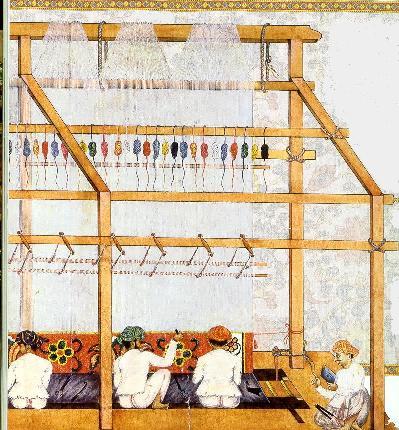 Success came after nearly 70 years, when Dutch printers
succeeded in copying the sheer Indian cottons by using copper
plates. The first Spanish
calico print works started by the Esteban Canals in Barcelona in
1738, copied indiennes and used the imported Eastern textiles as a
source of pattern. Switzerland
repeats the story, and in the United States
too, the earliest evidence of textile printing shows Eastern
influences in the patterns. It has not been any different with
the circulation of ideas in Europe. Literature-wise, three large
documents found in European libraries are representative, having
been written with the express purpose of informing Europeans about
Indian processes and techniques. The letters of Jesuit,
Coeurdoux, for example, were sent out in 1742 and 1747.
The earlier letter begins typically: Success came after nearly 70 years, when Dutch printers
succeeded in copying the sheer Indian cottons by using copper
plates. The first Spanish
calico print works started by the Esteban Canals in Barcelona in
1738, copied indiennes and used the imported Eastern textiles as a
source of pattern. Switzerland
repeats the story, and in the United States
too, the earliest evidence of textile printing shows Eastern
influences in the patterns. It has not been any different with
the circulation of ideas in Europe. Literature-wise, three large
documents found in European libraries are representative, having
been written with the express purpose of informing Europeans about
Indian processes and techniques. The letters of Jesuit,
Coeurdoux, for example, were sent out in 1742 and 1747.
The earlier letter begins typically:
“I have not forgotten that in several of your letters you
have urged me to acquaint you with the discoveries I might make in
this part of India,…..Recently, with a little leisure, I have used
it to find out the way in which Indians make these beautiful cloths,
which form part of the trade of whose Companies established to
extend commerce, and which, crossing the widest seas, come from the
ends of Europe into these distant climes to search for such
things.”
(source:
Decolonizing
History: Technology and Culture in India, China and the West
1492 to the Present Day - By Claude Alvares
p.55-67).
Though the British had initially been
drawn to India by the spice trade, textiles soon became the major
export. Using handlooms and spindles and building on more than 5,000
year history of weaving, Indian artisans created such fine fabrics that
one 19th century Briton characterized them as
"the work of fairies or insects rather than of men."
From yarn described as the
"web of the woven wind." Bengali weavers produced delicate
cotton muslins so sheer that they were named "running water"
and "evening dew." Silk
brocades from the city of Benares in northern India glittered with
threads of gold or silver. In Kashmir, enormous shawls - so
finely woven that they could be drawn through a ring - were made from the
inner fleece of a rare mountain goat, which left its hairs behind when it
rubbed against shrubs on Himalayan peaks. Indian chintz - calico that was
hand painted or printed by artisans-was renowned for brilliant colors that
seemed to improve with repeated washings.
A rage for Indian fabric swept across
Britain, causing a serious drain of gold and silver from the West.
"From the greatest gallants to the meanest Cook Maids, nothing was
thought to fit to adorn their persons as the Fabric from India,"
grumped an English politician in 1681. Despite stiff import duties, Indian
textiles threatened England's own manufacturers. "Europe bleedth to
enrich Asia," complained another 17th century Englishman. An act of
Parliament in 1700 made it illegal to wear or use Indian fabrics in Great
Britain, but clandestine trade flourished nonetheless.
A little century later, however, the tide
turned. Britain's restrictive economic policies, combined with the
Industrial Revolution, spelled doom for India's textile industry. England
produced and flooded the market with - inexpensive machine made textiles.
The result was tragic. - "The bones of weavers," said one 19th
century observer, were left "bleaching on the plains of
Hindustan."
(source: What
Life Was Like in the Jewel of the Crown: British India AD 1600-1905
- By The Editors
of Time-Life Books.
p. 91-93).
The quality of the
textile goods were fine and delicate. Marco
Polo remarked
of the elegant and light buckrams manufactured in several parts of the
Deccan: "These are the most delicate buckrams and of the highest
price; in sooth they look like the tissue of spider's web. there can
be no king or queen in the world but might be glad to wear them."
(source:
India
Through The Ages: History, Art Culture and Religion - By G. Kuppuram
p. 574).
Toile - India's
design inspired the style
 In
medieval and early modern France, people [of rank and wealth] wore
fabrics such as silk and velvet that were rarely printed. During
the sixteenth century, Portuguese navigators opened the trade
routes to India and introduced Europe to Indian painted cottons.
By the end of the seventeenth century, the
Indiennes - brightly printed Indian cotton fabrics that were
lighter than velvet, and washable - were famous and widely used
for clothing. In
medieval and early modern France, people [of rank and wealth] wore
fabrics such as silk and velvet that were rarely printed. During
the sixteenth century, Portuguese navigators opened the trade
routes to India and introduced Europe to Indian painted cottons.
By the end of the seventeenth century, the
Indiennes - brightly printed Indian cotton fabrics that were
lighter than velvet, and washable - were famous and widely used
for clothing.
In 1686 Colbert's
mercantilist and protectionist policies forbade the import of
foreign fabrics, with highly prejudicial results for the French
fabric industry. This embargo lasted for 73 years, but
it was unable to stop the success of the Indiennes.
Although
we think of it as French, toile's founding father was Francis
Nixon of Ireland, who, inspired by printed fabrics from India,
created the first toile fabric in 1752. His techniques quickly
spread to England and then France -- the country that gave the
style its name and assured its place in design history.
The
mother of all toiles is Toile de Jouy
-- the brain-child of
Christophe Philippe Oberkampf who established a manufactory for
printed cottons in Jouy-en-Josas (a town near Versailles) in 1760.
The
idea was to emulate the printed cottons of India while keeping the
process (and profits) at home in France.
And it was an unbridled success. In
1806, the Emperor and Empress, Napoleon and Josephine, one day
surprised Oberkampf with a visit to the factory, nor did Napoleon
fail to ask a thousand questions after his usual manner. So
pleased was the Emperor that he made of Oberkampf a member of the
Legion of Honor, supplying him with the decoration which he
detached from his own coat. Napoleon came again—this time with
the new Empress, Marie Louise.
Chintz
Chintz
- printed
cotton fabric from India: a
printed or stained calico fabric made in India. Early
17th century. Earlier chints ,
from chint “calico
cloth,” from Hindi chīṭ
“stain,” from Sanskrit citra
“variegated.”]
The
painted cloths from India were rich in color, and full of
ancient tradition in design. The manner of making them was
intricate, requiring not only talent but infinite patience and
the employment of several arts. And these charming exotics that
were spread before those lovely ladies of Europe in the
Seventeenth and Eighteenth Century, are the ancestors of the
mountains of chintz that fill our shops today.
 Palampores, or bed covers, they
called the oblongs from India, and at this time the most favored
design for these was the Tree of Life, a straying meander of
slender branches all aflower with blooms of many kinds, the
tree-trunk small and planted in a pyramid of rocks. But its
exquisite tones and shades were impossible to describe, also the
symbolism of the border which reaches back to far antiquity. In
France as in England the first imported cottons from India
arrived in the second half of the Seventeenth Century and
awakened at once the desire for possession in the breast of
every person of wealth or social consequence. The more they
bought, the more the returning ships brought to them. And the
greater the consumption of this artistic novelty, the less was
the demand for French silks and woolens. Palampores, or bed covers, they
called the oblongs from India, and at this time the most favored
design for these was the Tree of Life, a straying meander of
slender branches all aflower with blooms of many kinds, the
tree-trunk small and planted in a pyramid of rocks. But its
exquisite tones and shades were impossible to describe, also the
symbolism of the border which reaches back to far antiquity. In
France as in England the first imported cottons from India
arrived in the second half of the Seventeenth Century and
awakened at once the desire for possession in the breast of
every person of wealth or social consequence. The more they
bought, the more the returning ships brought to them. And the
greater the consumption of this artistic novelty, the less was
the demand for French silks and woolens.
It became therefore the pleasure
and duty of domes-tic print weavers to protest, and of the State
to pass laws of prohibition. Between 1686 and 175o no less than
thirty decrees were issued in France in restraint of the use of
printed cottons. But prohibition fails to exclude. There is a
naughtiness in human nature, a half-humorous rebellion that
makes us snatch at things denied. All the well planned
restrictions of France failed to abolish the use of printed
cottons.
Indian
prints were ever very high in price. All who appreciated could
not afford them. Thus it came that French textile workers set
about making an imitation to sell at low cost. The
origin of chintz is a Hindu word which signified colored or
flowered—chint. In the time of Samuel Pepys it was
so spelled ("bought a chint for my wife"), and only
later was an s added which time changed to z.
(source: http://seattlepi.nwsource.com/lifestyle/190289_toileside11.html
and
http://www.oldandsold.com/articles06/draperies-19.shtml
and http://www.domestications.com/emails/043003.htm
and http://www.w-w-d.com/toile.html
and http://www.cnn.com/STYLE/9905/20/toile.de.jouy/
and http://rico21.chez.tiscali.fr/cadre_musee.htm
).
***
Lord
Elphinstone, speaking of Indian cotton cloth, says,
"the beauty and delicacy of which was so long admired, and
which, in fineness of texture, has never yet been approached in any
country."
John Murray
wrote in The History of India,
p. 27: "Its fabrics, the most beautiful that human art has
anywhere produced, were sought by merchants at the expense of the
greatest toils and dangers."
Indian textile technology had a
profound influence in Britain during the industrial revolution,
stimulating inventors there to devise methods to attain similar
results – the brightness and permanence of the colors, the
delicacy of the cotton yarn – with machines. The British had
little success in attaining the quality of hand-made Indian
textiles. British spinners showed little interest in how their
Indian counterparts achieved the high quality of their textiles and
would have been disappointed had they known. The secret was
painstaking and laborious hand spinning.
(source:
Lost
Discoveries - Dick Teresi p.
354).
As regards to dyeing of fabrics, Lord
Mountstuart Elphinstone
says: “”The brilliancy and permanence of many of the dyes
have not yet been equaled in Europe.” He adds: “the brilliancy
of their dyes is remarked on as well as their skill in manufactures
and imitations of foreign objects.”
The Hindus were
the earliest nation who discovered the art of extracting colors
from plants. The names by which several plants are known in
foreign countries bear testimony to this fact. Indigo is called
after India. Pliny used the
word indico.
Bancroft
gives much praise to the “natives of India for having so many
thousand years ago discovered means by which the colorable matter
of the plants might be extracted, exygenated and precipitated from
all other matters combined with it.” Even James
Mill is constrained to say: “Among the arts of the
Hindus, that of printing and dyeing their clothes has been
celebrated; and the beauty and brilliancy, as well as durability
of the colors they produce, are worthy of particular praise.”
John
Forbes
Watson, in his work on the Textile
Manufactures and Costumes of People of India gives an
interesting account of a series of experiments made on both the
European and the Indian muslins, to determine their claims to
superiority. The results were altogether in favor of the Indian
fabrics. He concluded: "However viewed therefore, our
manufacturers have something still to do. With all our machinery
and wondrous appliances we have hitherto been unable to produce a
fabric which, for fineness or utility, can equal the woven air of
Dacca, the product of arrangements, which appear rude and
primitive, but which in reality are admirably adapted for the
purpose."
Arnold
Hermann Ludwig Heeren
(1760-1842) an Egyptologist
says: "The variety of cotton fabrics mentioned even by the author of
Periplus as articles of commerce is so great that we can hardly suppose the
number to have increased afterwards."
(source:
Hindu Superiority - By Har Bilas Sarda
p.397 – 404).
According
to NY Times:
"Considering that it is the country historically credited
with giving the world paisley, seersucker, calico, chintz,
cashmere, crewel and the entire technique of printing on cloth,
it is anybody's guess why India barely registers on the global map
of fashion."
(source:
Fashion
From India, Beyond the Bangles - NY Times May 13 ' 2003).
***
The
Sari
A charming folktale explains the origin
of the Sari as follows:
"The Sari, it is
said, was born on the loom of a fanciful weaver. He dreamt of Woman. The
shimmer of her tears. The drape of her tumbling hair. The colors of her
many moods. The softness of her touch. All these he wove together. He
couldn't stop. He wove for many yards. And when he was done, the story
goes, he sat back and smiled and smiled and smiled".
Noted psychologist Carl
Jung has waxed lyrical about the elegance of the sari
thus:
"It would be a
loss to the whole world if the Indian woman should cease to wear her
native costume. India is practically the only civilized country where
one can see on living models how woman can and should dress".
Couturier
Valentino Garavani (
? ) Italy’s most famous designer says:
‘‘I consider the
sari deeply elegant—it is one of the most grounding elements of what
haute couture is all about,’’ he adds. ‘‘In India, modernity and
tradition can find a fine balance without erasing a unique heritage.
Homogeneity is never a good thing.’’
‘‘India’s
heritage is one of the most fascinating and inspirational of all,’’
he says. ‘‘My 2002 haute couture collection was entirely inspired by
India. But there have always been Indian themes running through all my
collections. It’s definitely a reference for my idea of beauty and
grace.’’
 The
discovery of several spindles, and a piece of cotton stuck to a silver
vase, revealed that the spinning and weaving of cotton was known to the
Harrappans, nearly five million years ago. References to weaving are
found in the Vedic literature on the method of spinning, the various
materials used. The
discovery of several spindles, and a piece of cotton stuck to a silver
vase, revealed that the spinning and weaving of cotton was known to the
Harrappans, nearly five million years ago. References to weaving are
found in the Vedic literature on the method of spinning, the various
materials used.
The foundations of the Indian textile trade with other countries began
as early as the second century BC. A hoard of
block printed and resist-dyed fabrics, mainly of Gujarati origin, found
in the tombs of Fostat, Egypt, are the proof of large scale Indian
export of cotton textiles to the Egypt in medieval times.
In the 13th century, Indian silk
was used as barter for spices from the western countries. Towards the
end of the 17th century, the British East India Company had begun
exports of Indian silks and various other cotton fabrics to other
countries. These included the famous fine Muslin cloth of Bengal, Bihar
and Orissa. Painted and printed cottons or chintz was extensively
practiced between India, China, Java and the Philippines, long before
the arrival of the Europeans.
" India, undoubtedly the greatest exporter of textiles from 1600 to
1899, not only revolutionized European taste and fashion with its chintz
but struck at the very roots of economic stability. Chintz, which
captured the fabric market with ease in the 18th century, caused
hardship among weavers, provoked riots, and finally inspired satirical
poems about noble ladies who preferred exotic finery to honest, English
home-spun products. "
(source: Much
Maligned Monsters: A History of European Reactions to Indian Art
- By Partha Mitter p. 221 and I
am inspired by India’s heritage).
Sir
Charles Trevelyan, Finance
Minister of India in the 1860s, was anxious
to see the disappearance of the Indian weaver as a class,
a development he thought best for both Britain and India: India
would benefit because the weaver, faced with competition from
machine-made goods, would be forced to give up his craft and turn to
agriculture; the increased labor supply would then raise output and
England would benefit since makers of cloth would be converted into
consumers of Lancashire goods."
(source:
Decolonizing
History: Technology and Culture in India, China and the West 1492 to
the Present Day - By Claude Alvares p. 152).
Paisley pattern stretches across
millennia
 The lacy teardrop pattern known as paisley is
Indian
in origin, but its name derives from a town
in southern Scotland. Paisley, which today is a suburb west of Glasgow, was a
major site for the manufacture of printed cotton and wool in the 19th Century,
according to the Paisley Museum in Scotland.
The lacy teardrop pattern known as paisley is
Indian
in origin, but its name derives from a town
in southern Scotland. Paisley, which today is a suburb west of Glasgow, was a
major site for the manufacture of printed cotton and wool in the 19th Century,
according to the Paisley Museum in Scotland.
Resembling
a large comma, paisley is one of the most recognized patterns in the world.
The pattern can be traced back more than 2,000 years. The
design was copied from the costly silk and cotton Kashmir shawls brought back
by Scottish soldiers serving in India and later shipped by members of the East
India Company.
The explorer Marco Polo
has said: " Embroidery is here produced with more delicacy than anywhere in
the world."
(source: India:
Living Wisdom -
By Richard Waterstone p. 116).
 Printed “Paisley” in
the 19th century
Printed “Paisley” in
the 19th century
The
word Cashmere, or Kashmir, has various connotations, all evoking
luxury. The cloth, known as cashmere, is woven from the winter
coat of a mountain goat found in the Kashmir region of India. When
woven, the woollen cloth is of an incomparable softness and
refinement. The design motif, known as Cashmere, or Paisley, was
created by Indian weavers and is easily definable by it's shape in
the form of a teardrop.
(source: http://www.musee-impression.com/gb/collection/indiennes.html).
Note:
Just as Delftware
(named for the town of Delft in The Netherlands) blue and white
pottery was inspired by Chinese
porcelain, the lacey teardrop pattern was inspired by India
but was later named Paisley
after a town in Scotland.
Pashmina Shawls
 The
exquisite pashmina, whose history dates
back to the days of Mohenjadaro, the soft fine fabric
draped around the statue of a woman found at Mohenjadaro was
probably pashmina from the valley. It
was popular
amongst the Indian aristocracy The famous pashmina shawls of
Kashmir are made of the finest wool and have a luxuriant silky
texture. The Chandra goat from which the pashmina wool is
extracted is found at a height of 14,000 feet in Ladakh. The
exquisite pashmina, whose history dates
back to the days of Mohenjadaro, the soft fine fabric
draped around the statue of a woman found at Mohenjadaro was
probably pashmina from the valley. It
was popular
amongst the Indian aristocracy The famous pashmina shawls of
Kashmir are made of the finest wool and have a luxuriant silky
texture. The Chandra goat from which the pashmina wool is
extracted is found at a height of 14,000 feet in Ladakh.
***
Benares - Fabled
bazaars
From the earliest times traders passed
this way on their way to Pataliputra, to the time of the Muslim
invaders, the British invaders, and now the tourist invaders, the
bazaars of Benares have dazzled the imagination. In his famous
description of Benares in the late 18th century, Lord
Thomas Babbington Macaulay
(1800-59)
is best known for introducing English education in India. Macaulay was the first
Law Member of the Governor-General's Legislature, and was also known for his notorious
1835
Minute, wrote:
"Commerce had as many pilgrims as
religion. All along the shores of the venerable stream lay fleets of
vessels laden with rich merchandise. From the
looms of Benares went forth the most delicate silk adorned the balls of
St. James's and of Versailles; and in the bazaars, the
muslins of Bengal and the sabres of Oude were mingled with the jewels of
Golconda and the shawls of Cashmere."
(source: The
Sacred City of the Hindus: in Ancient and Modern Times
- By M. A. Sherring p. 10).
Sir Edwin Arnold,
(1832-1904) poet and scholar, principal of the British government
college at Pune, India. Although his interest in India was primarily
spiritual, he was nonetheless captured by the wares of Benares. In his
book, India Revisted, he describes
the "dazzling flood of gold and silk kincobs, embroidered cloths
and scarves, cashmere shawls of marvellous make, texture, and tints,
slippers for princesses, turbans for kings, and cholis glittering with
gems and gold laces."
(source: India
Revisted - By Edwin Arnold
p. 220).
Blue Jeans originated
in India
One of India's lasting contributions to
Western life was the export of a thick cotton cloth known as "Dungaree"
which, in the sixteenth century was sold near the Dongarii Fort
in Bombay. Portuguese and Genoan sailors used this durable blue broad
cloth, dyed with indigo, for their bellbottom sailing pants. Thus, blue
jeans, originating in India, were widely adopted by farmers,
cowboys, working-class men, teen-agers, suburban moms; almost everyone
in the West has at least one pair of blue jeans. They are the hallmark
of American fashion and in vogue across the world.
According to Webster Dictionary:
dungaree n. hindi dungri - 1. a coarse cotton cloth; specif, blue
denim. 2. work trousers or overalls made of this cloth.
(source: Infinity
Foundation).
History of Indigo
The
word Indigo is derived from the Greek Indikon and the Latin Indicum,
meaning a substance from India. Evidence for the use of Indigo in India
before the medieval age is based on the writings of a trader in Egypt in
the first century A D. India was then the pivot of trade both Westwards
and Eastwards. Indians were highly accomplished
in textile arts. As with other subjects such as mathematics, much
earlier on, knowledge from India was dispersed through the trade route. Indigo,
the last natural dye, was a highly priced commodity on the "Silk
route". From 1600 onwards, the documents of the East India Company
mention the production of indigo in India and its export. Gujarat and
Sind were the major sources then. From mid 17th century, Europeans
arriving on India's East Coast
picked up finished textiles, cotton and silk, rather than the raw
material indigo. Indigo was a major dye used in these fabrics. In
the 19th century, Bengal was the world's biggest producer of indigo in
the world! An Englishman in the Bengal Civil Service is said to have
commented, "Not a chest of indigo reached England without being
stained with human blood". Indigo was part of the national
movement. Champaran in Bihar witnessed indigo riots in 1868.
(source:
The
Colorful history of Indigo - chennaionline.com).

Distillation of
Perfumes
The distillation of scents, perfumes and fragrant
liquids and ointments was one area where the knowledge of chemistry was
applied in India since ancient times. In fact the very word 'scent'
which is of unexplained origin according to the Oxford Dictionary, is
possibly derived from the Sanskrit term
Sugandha which literally means 'good or aromatic paste'. This
word could have been transmitted to European languages through the Greek
langua which has borrowed (and lent) many words from Sanskrit. Other
instances of such transmission are the English words like 'cotton' which
is derived from the Sanskrit Karpasa
or the word 'sugar' derived from the Sanskrit Sharkara,
etc. Many present day perfumes had existed in India since ancient times
and perhaps had originated here. In ancient times perfumes and fragrant
ointments were of two typ viz., Teertha (liquids) and Gandha (slurries
or ointments). During the coronation Kings or during any auspicious
occasion person was sprinkled with aromatic oils. Fragrant ointments
based on sandalwood were applied during ceremonial bathing. Even today
during some festivals like Diwali aromatic slurries and pastes are
prepared out of a powder called Sugandhi. Utne and are used during the
ceremonial bath which is taken during that festival. Even in other
religious rites, Sandalwood, Ochre and Camphor are traditionally used by
Hindus.
 Sandalwood:
Since very early times Sandalwood and Sandalwood oil were items of
export. The
Greek text of the 1st century A.D., Periplus mentions sandalwood
as one of the items being imported from India. The word
Sandal (wood) is derived from the Latin terms Santalum Album or
Santalacae. These terms used by the Romans to describe sandalwood
were, according to the Oxford Dictionary, derived from the Sanskrit
term Chandana, for sandalwood. Sandalwood:
Since very early times Sandalwood and Sandalwood oil were items of
export. The
Greek text of the 1st century A.D., Periplus mentions sandalwood
as one of the items being imported from India. The word
Sandal (wood) is derived from the Latin terms Santalum Album or
Santalacae. These terms used by the Romans to describe sandalwood
were, according to the Oxford Dictionary, derived from the Sanskrit
term Chandana, for sandalwood.
The Sandalwood tree is native to India and is found mainly in
South-western India in t he state of Karnataka. Sandalwood has
been a known item of export from India since ancient times.
Authors of Sanskrit texts on botany which in Sanskrit is called
Vanaspati-Shastra had classified Sandalwood into three types viz.
white sandalwood Shrikanda (which perhaps is an abbreviation of
the term Shewta-Chandana ), the second is yellow sandalwood or
Pitta-Chandana and the last is red sandalwood or RaktaChandana
The reference to Sandalwood in the
Periplus is perhaps the earliest available western reference to
Sandalwood. It has been mentioned in later times by
Comas Indiwpleustes in the 6th century A.D. as Tzandana and
thereafter it is frequently referred to by Arab traders. Oil was
also extracted from Sandalwood. This oil which was a thick but
refined liquid was extracted in specially constructed oil mills
called Teyl-Peshani and Teylena-Lip. The oil extracted from these
mills was a thick, dark yellow liquid. Along with Sandalwood, the
Sandalwood oil was also an item of export from India during
ancient times. Sandalwood oil was mainly bought by the Romans
between the 1st and 3rd centuries A.D.
Musk: Musk is also a fragrant
substance which is secreted in the gland by a male musk-deer. Musk
is redish-brown in colour and is used as a base for perfumes and
also as an ingredient for soaps to give it a musky smell. In
Sanskrit, Musk is known as Muska which means the scortum i.e. the
pouch of skin containing the testicles of the deer. The
English term Musk originates from the Sanskrit term Muska
according to the Oxford Dictionary.
The Sanskrit word Muska is perhaps derived from the words Maunsa
or Masa which means 'flesh'. In Sanskrit, other words used for
musk are Kasturi, Kastutrika and Mruga-Nabhi. The
last term literally means 'a deer's navel'.
Spikenard: Spikenard was a
costly aromatic ointment extracted since ancient times from an
Indian plant known in Sanskrit as Nardostachys Jatamansi which
perhaps means 'the braid of hair (Jataa) of (Narada). The English
word Spikenard is derived from the Greek term Nardostakhus and the
Latin term Spica Nardi; both the terms are derived from the
Sanskrit term Nardostachys Jatamansi. This plant has
purplish-yellow flower heads and is very rarely found. Its smell
is quite pleasing and hence it had been in great demand since
ancient times.
In Sanskrit, other terms used to refer to this plant are, Jatila
which means 'difficult', Tapasvini which literally means
'concentration and devotion'. These words used to describe
Spikenard indicate that it was very difficult to obtain and
cultivate this plant. In India this herb was available only in the
Himalayas. Spikenard, which is aromatic and bitter, yields on
distillation a pleasant smelling oil.
In India, it had been used since ancient times as an aromatic
adjunct in the preparation of medicinal oils and was popularly
believed to increase the growth and blackness of hair. The Roman
historian Pliny observes the Spikenard was considered very
precious in Rome and
it was stored in alabaster boxes by persons of eminence.
(source: Contribution
of Ancient Hindu Society - http://www.angelfire.com/super/pride/mech.html).
Top
of Page
Conclusion:
Jawaharlal Nehru has said: " It is not some secret doctrine or esoteric
knowledge that has kept India vital and going through these long ages, but a
tender humanity, a varied and tolerant culture, and a deep understanding of life
and its mysterious ways. Her abundant vitality flows out from age to age in her
magnificent literature and art, though we have only a small part of this with us
and much lies hidden still or has been destroyed by nature or man's vandalism.
The Trimurti, in the Elephanta (Gharapuri ) caves, might well be
the many faced statue of India herself, powerful, with compelling eyes, full of
deep knowledge and understanding, looking down upon us. The Ajanta frescoes are
full of tenderness and love of beauty and life, and yet always with a suspicion
of something deeper, something beyond."
***
Sources for this chapter :
1. A Discovery of
India - By Jawaharlal Nehru
2. India and World Civilization - By D. P. Singhal
3. Our Oriental Heritage - By Will Durant
4. India - By Staley Wolpert
5. A Philosophy of Hinduism - By Galav
6. Hindu Superiority - Har Bilas Sarda
Top
of Page
 Did You Know Did You Know
 Vasishtha Head - Vedic Aryan
Head Vasishtha Head - Vedic Aryan
Head
In 1990, the Journal of Indo-European Studies carried an article entitled
"Analysis of an Indo-European Vedic head- Fourth Millennium B.C."
The life size head has a hairstyle that the Vedas describe ad being unique
to the family of Vasistha, one of the great seers who composed parts of the
Rig-Veda. The hair is oiled and coiled with a tuft on the right, and their ears are riveted...Carbon -14 tests.. indicate that it was cast around 3,700
B.C.
This questions the Aryan Invasion Theory.
For more information about the Aryan Invasion, please refer to the chapters on
Aryan
Invasion Theory First Indologists
and History
of Hinduism.
(source: The Empire of the Soul:
Some Journeys into India - By Paul William Roberts pg 306.
Top
of Page
For
more refer to chapter on Greater
India: Suvarnabhumi and Sacred
Angkor
Continue
to Hindu Culture Part I

|