Sound (nada) is believed to be the heart of the process of
creation. In Hinduism, the sacred syllable Om embodies the
essence of the universe - it is the "hum" of the
atoms and the music of the spheres - and sound in general
represents the primal energy that holds the material world
together. Nada Brahma is a primal word in Indian spirituality, a
primal word that also refers to India's great classical music. Since the most ancient times, music in India has been practiced
as a spiritual science and art, a means to enlightenment.
Sangita, which originally meant drama, music and dance, was
closely associated with religion and philosophy. At first it was
inextricably interwoven with the ritualistic and devotional side
of religious life. The recital and chant of mantras has been an
essential element of vedic ritual throughout the centuries.
According to Indian philosophy, the ultimate goal of human
existence is moksha, liberation of the atman from the
life-cycle, or spiritual enlightenment; and nadopasana
(literally, the worship of sound) is taught as an important
means for teaching this goal. The highest musical experience is
ananda, the “divine bliss.” This devotional approach to
music is a significant feature of Indian culture.
The origin of Indian
music is enshrined in beautiful tales and legends. It is common
Hindu practice to attribute the beginning of a branch of
learning to a divine origin through the agency of a rishi.
Shiva, also called Nataraja, is supposed to be the creator of
Sangita, and his mystic dance symbolizes the rhythmic motion of
the universe.
Curt Sachs (1881-1959) who
played the leading role among early modern scholars in the field
organology -- the study of musical instruments and their musical
and cultural contexts, has said, that the South Indian drum
tambattam that was known in Babylonia under the name of timbutu,
and the South Indian kinnari shared its name with King David's
kinnor. Arrian, the biographer of Alexander, also mentions that
the Indian were great lovers of music and dance from earliest
times.Sir Yehudi Menuhin (1916-1999), American-born
violinist, one of the foremost virtuosos of his generation, has written:
"We would find all, or most, strands
beginning in India; for only in India have all possible modes
been investigated, tabulated, and each assigned a particular
place and purpose. Of these many hundreds, some found their way
to Greece; others were adopted by nomadic tribes such as the
Gypsies; others became the mainstay of Arabic music. Indian
classical music, compared with our Western music, is like a pure
crystal. It forms a complete perfected world of its own, which
any admixture could only debase. It has, quite logically and
rightly, rejected those innovations which have led the
development of Western music into the multiple channels which
have enabled our art to absorb every influence under the sun.
Freedom of development in Indian music is accorded the
performer, the individual, who, within fixed limits, is free to
improvise without any restraint imposed externally by other
voices, whether concordance or discordant - but not to the basic
style, which exclude polyphony and modulation."
Author Claude Alvares has said, that the Indian system of talas, the rhythmical time-scale of Indian
classical music, has been shown (by contemporary analytical
methods) to possess an extreme mathematical complexity. The
basis of the system is not conventional arithmetic, however, but
more akin to what is known today as pattern recognition.
Indian
music is art nearest to life. That is why Irish poet William Butler Yeats
(1856-1939) a 1923 Nobel Laureate in Literature, has aptly described
Indian music "not an art but life itself."
Introduction
History of Music
The
Origins of Hindu Music
The
Antiquity of Indian Music
The Development of Scale
The Nature of Sound
Raga - The Basis of Melody
Tala
or Time Measure
Musical Instruments
and Sanskrit
Writers on Music
Some
Ancient
Musical Authorities
Raga and Jazz
Colonialist
thinking of Indian music
Views about Hindu music
Mantras
Conclusion


Introduction
"Even if
he be an expert in the Revealed and the traditional scriptures,
in literature and all sacred books, the man ignorant of music is
but an animal on two feet."
"He who
knows the inner meaning of the sound of the lute, who is expert
in intervals and in modal scales and knows the rhythms, travels
without effort upon the way of liberation.
- (Yajnavalkya Smriti III, 115).

Sound (nada) is believed to be the
heart of the process of creation. In Hinduism, the
sacred syllable Om embodies
the essence of the universe - it is the "hum" of
the atoms and the music of the spheres - and sound in general
represents the primal energy that holds the material world
together. Sangita, the Indian tradition of music, is an old as Indian
contacts with the Western world, and it has graduated through
various strata of evolution: primitive, prehistoric, Vedic,
classical, mediaeval, and modern. It has traveled from temples
and courts to modern festivals and concert halls, imbibing the
spirit of Indian culture, and retaining a clearly recognizable
continuity of tradition. Whilst the words of songs have varied
and altered from time to time, many of the musical themes are
essentially ancient.
The music of India is one of the oldest unbroken musical
traditions in the world. It is said that the origins of
this system go back to the Vedas (ancient scripts of the
Hindus). Sangita, which originally meant drama, music and dance, was
closely associated with religion and philosophy. At first it was
inextricably interwoven with the ritualistic and devotional side
of religious life. The recital and chant of mantras has been an
essential element of Vedic ritual throughout the centuries.
According to Indian philosophy, the ultimate goal of human
existence is moksha, liberation of the atman from the
life-cycle, or spiritual enlightenment; and nadopasana
(literally, the worship of sound) is taught as an important
means for teaching this goal. The highest musical experience is
ananda, the “divine bliss.” This devotional approach to
music is a significant feature of Indian culture.
The Indian
music tradition can be traced to the Indus (Saraswati) Valley
civilization. The goddess of music, Saraswati, who is also the
goddess of learning, is portrayed as seated on a white lotus
playing the vina.

Bow-harps
and Flutes - Amaravati A.D. 200. - Vina in the
hands of Goddess Saraswati
(image source: The Legacy of India - edited by G. T.
Garrett).
***
Alain
Daneliou a.k.a
Shiv Sharan (1907-1994), son of
French aristocracy, author of numerous books on philosophy,
religion, history and arts of India, including Virtue,
Success, Pleasure, & Liberation : The Four Aims of Life in
the Tradition of Ancient India. He
was perhaps the first European to boldly proclaim his Hinduness.
He settled in India for fifteen years in the study of Sanskrit. In Benaras Daniélou
came in close contact with Karpatriji Maharaj, who inducted him
into the Shaivite school of Hinduism and he was renamed Shiv
Sharan. After leaving Benaras, he was also the director of
Sanskrit manuscripts at the Adyar Library in Chennai for some
time. He returned to Europe in 1960s and was associated with
UNESCO for some years
.While
in Europe, Daniélou was credited with bringing Indian music to
the Western world. This was the era when sitar maestro Ravi
Shankar and several other Indian artists performed in Europe and
America. During his years in India, Daniélou studied Indian
music tradition, both classical and folk traditional, and
collected a lot of information from rare books, field
experience, temples as well as from artists. He also collected
various types of instruments.
Alain Daniélou was
credited with bringing Indian music to the Western world.
Watch
Raga
Unveiled:
India
’s Voice – A film
The history and essence of North Indian classical Music
***
He
has written:
"Under the name of
Gandharva
Vedas, a
general theory of sound with its metaphysics and physics appears
to have been known to the ancient Hindus. From such
summaries: The
ancient Hindus were familiar with the theory of sound (Gandharva
Veda), and its metaphysics and physics. The
hymns of the Rig Veda contain the earliest examples of words set
to music, and by the time of the Sama Veda a complicated system
of chanting had been developed. By the time of the Yajur
Veda, a
variety of professional musicians had appeared, such as lute
players, drummers, flute players, and conch blowers."
The origin of Indian music is enshrined in beautiful tales
and legends. It is common Hindu practice to attribute the
beginning of a branch of learning to a divine origin through the
agency of a rishi. Shiva, also called Nataraja, is supposed to
be the creator of Sangita, and his mystic dance symbolizes the
rhythmic motion of the universe. He transmitted the knowledge of
cosmic dance to the rishi Bharata, through one of his ganas.
Tandu. The dance is called tandava and Bharata thus became the
first teacher of music to men, and even to apsaras, the heavenly
dancers. Similarly, the rishi Narada, who is depicted as
endlessly moving about the universe playing on his vina (lute)
and singing, is believed to be another primeval teacher of
music.
Buddhist
texts also testify to the prevalence of Sangita, both religious
and secular, in early India. Music in India, however, reached
its zenith during the Gupta
period,
the classical age of the Indian art and literature.

Music
in India, however, reached its zenith during the Gupta Empire,
the classical age of the Indian art and literature.
(image
source: Early
Civilization: Universal History of the World – By John
Bowman volume
I Golden Press.
New York
. Published in 1966. p. 75).
***
Indian
music is based upon a system of ragas and is improvised or composed at
the moment of performance. The notes which are to convey certain definite
emotions or ideas are selected with extreme care from the twenty-five intervals
of the sruti scale and then grouped to form a raga, a mode or a melodic
structure of a time. It is upon this basic structure that a musician or singer
improvises according to his feeling at the time. Structural melody is the most
fundamental characteristic of Indian music. The term raga is derived from
Sanskrit root, ranj or raj, literally meaning to color but figuratively meaning
to tinge with emotion. The essential of a raga is its power to evolve
emotion. The
term has no equivalent in Western music, although the Arabic
maqam iqa corresponds to it.
Oversimplified, the concept of raga is to connect musical ideas
in such a way as to form a continuous whole based on emotional
impact. There are, however, mixed ragas combined in a continuous
whole of contrasting moods. Technically, raga is defined as
"essentially a scale with a tonic and two axial
notes," although it has additional characters.
Musical notes
and intervals were carefully and mathematically calculated and
the Pythagorean Law was known many centuries before Pythagoras
propounded it. They were aware of the mathematical law of music.
(source: India:
A synthesis of cultures – by Kewal Motwani p.
78-95).
The word raga
appears in Bharata's
Natyasastra, and a similar concept did
exist at the time, but it was Matanga (5th century) who first
defined raga in a technical sense as "that kind of sound
composition, consisting of melodic movements, which has the
effect of coloring the hearts of men." This definition
remains valid today. Before the evolution of the raga concept in
Bharata's time, jati tunes with their fixed, narrow musical
outlines constituted the mainstay of Indian music. These were
only simple melodic patterns without any scope for further
elaboration. It was out of these jati tunes that a more
comprehensive and imaginative form was evolved by separating
their musical contents and freeing them from words and metres.

Music lessons.
(image
source: The Splendor that was India -
By K T Shah p. 116).
***
Indeed a raga is
basically a feeling, the expression of which has come to be
associated with certain notes and twists of melody. A musician
may compose in the same raga an indefinite number of times, and
the music can be recognized in the first few notes, because the
feelings produced by the musician's execution of these notes are
intensely strong. The effect of Indian music is cumulative
rather than dramatic. As the musician develops his discourse in
his raga, it eventually colors all the thoughts and feelings of
the listeners. Clearly, the longer a musician can dwell on and
extend the theme with artistic intensity the greater the impact
on the audience.
Alain
Danielou (1907-1994)
head of the
UNESCO Institute for Comparative Musicology wrote:
""Unlike
Western music, which constantly changes and contrasts its moods,
Indian music, like Arabic and Persian, always centers in one
particular emotion which it develops, explain and cultivates,
upon which it insists, and which it exalts until it creates in
the hearer a suggestion almost impossible to resist. The musician, if he is sufficiently skilled, can "lead his
audiences through the magic of sound to a depth and intensity of
feeling undreamt of in other musical systems."
(source: Northern
Indian Music -
By Alain Danielou Praeger, 1969
p. 115).
 Dr.
Ananda Coomaraswamy
has written: "Indian music is essentially impersonal,
reflecting "an emotion and an experience which are deeper
and wider and older than the emotion or wisdom of any single
individual. Its sorrow is without tears, its joy without
exultation and it is passionate without any loss of serenity. It
is in the deepest sense of the word all human." Dr.
Ananda Coomaraswamy
has written: "Indian music is essentially impersonal,
reflecting "an emotion and an experience which are deeper
and wider and older than the emotion or wisdom of any single
individual. Its sorrow is without tears, its joy without
exultation and it is passionate without any loss of serenity. It
is in the deepest sense of the word all human."
(source: The
Dance of Shiva - By Ananda Coomaraswamy
p. 94).
It is an art nearest to life; in fact, W.
B. Yeats
called
Indian music,
"not an art, but life itself,"
although its theory is elaborate and technique difficult.
The possible
number of ragas is very large, but the majority of musical
systems recognize 72 (thirty-six janaka or fundamental, thirty
six janya or secondary). New ragas, however, are being invented
constantly, as they have always been, and a few of them will
live to join the classical series. Many of the established ragas
change slowly, since they embody the modes of feeling meaningful
at a particular time. It is for this reason that it is
impossible to say in advance what an Indian musician will play,
because the selection of raga is contingent upon his feelings at
the precise moment of performance.
Indian music
recognizes seven main and two secondary notes or svaras.
Representing definite intervals, they form the basic or suddha
scale. They can be raised or lowered to form the basic of suddha
scale. They can be raised or lowered to form other scales, known
in their altered forms as vikrita. The chanting of the Sama Veda
employed three to four musical intervals, the earliest example
of the Indian tetrachord, which eventually developed into a full
musical scale. From vaguely defined musical intervals to a
definite tetrachord and then to a full octave of seven suddha
and five vikrita was a long, continuous, and scientific process.
For instance, Bharata's
Natyasastra, the earliest surviving work
on Indian aesthetics variously dated between the second century
B.C. and the fourth century A.D., in its detailed exposition of
Indian musical theory, refers to only two vikrita notes, antara
and kakali. But in the Sangita
Ratnakara,
an encyclopedia of Indian music attributed to Sarngadeva
(1210-1247), the number of vikritas is no less than nineteen;
shadja and panchama also have acquired vikritas. It was during
the medieval period that Ramamatya
in the south, and Lochana-kavi
in the north in his Ragatarangini
refered to shadja and panchama as constant notes. Indian music
thus came to acquire a full fledged gamut of mandra, madhya, and
tar saptak.
The scale as it
exists today has great possibilities for musical formations, and
it has a very extensive range included in the microtonal
variations. The microtones, the twenty-two srutis, are
useful for determining the correct intonation of the notes,
their bases, and therefore their scales (gramas). The Indian
scale allows the musician to embellish his notes, which he
always endeavors to do, because grace plays the part in Indian
music that harmony does in European music.
Whilst Indian
music represents the most highly evolved and the most complete
form of modal music, the musical system adopted by ore than
one-third of mankind is Western music based on a highly
developed system of harmony, implying a combination of
simultaneously produced tones. Western music is music without
microtones and Indian music is music without harmony. The
strongly developed harmonic system of Western music is
diametrically opposed in conception and pattern to the melodic
Indian system. Harmony is so indispensable a part of Western
music today that Europeans find it difficult to conceive of a
music based on melody alone. Indians, on the other hand, have
been for centuries so steeped in purely melodic traditions that
whilst listening to Western music they cannot help looking for a
melodic thread underlying the harmonic structures.

Flying Gandharvas and Apsaras.
Indian musical
instruments are remarkable for the beauty and variety of their
forms, which the ancient sculptures and paintings in caves of
India have remained unchanged for the last two thousand years.
(image
source: The Splendor that was India -
By K T Shah p. 115).
***
The fundamental
and most important difference between the European and Indian
systems of rhythm is respectively one of multiplication and
addition of the numbers two and three. The highly developed tala,
or rhythmic system with its avoidance of strict metre and its
development by the use of an accumulating combination of beat
subdivisions, has no parallel in Western music. On the other
hand, the Indian system has no exact counterpart to the tone of
the tempered system, except for the keynote, of Western music.
Consequently, just and tempered intonations are variously
conceived which eliminate the possibility of combining the
melodic interval theory of the sruti system with the Western
modulating, harmonic, arbitrarily tempered theory of intervals.
With its tempered basis, larger intervals, and metred rhythms,
Western music, is more easily comprehended than Indian music,
which seems to require a certain musical aptitude and ability to
understand its use of microtones, the diversification of the
unmetred tala, and the subtle and minutely graded inflection.
Western music, as
it appears today, is a relatively modern development. The
ancient Western world was aware of the existence of a highly
developed system of Indian music. According
to Curt
Sachs (1881-1959)
author of The
History of Musical Instruments
(W W Norton & Co ASIN 0393020681) it was the South Indian drum tambattam that was known in
Babylonia under the name of timbutu, and the South Indian
kinnari shared its name with King David's kinnor, Strabo
referred to it, pointing out that the Greeks believed that their
music, from the triple point of view of melody, rhythm, and
instruments, came to them originally from Thrace and Asia.
Arrian, the biographer of Alexander,
also mentions that the
Indians were great lovers of music and dance from earliest
times. The Greek writers, who made the whole of Asia, including
India, the sacred territory of Dionysos, claimed, that the
greater part of music was derived from Asia. Thus, one of them,
speaking of the lyre, would say that he caused the strings of
the Asian cithara to vibrate. Aristotle describes a type of lyre
in which strings were fastened to the top and bottom, which is
reminiscent of the Indian type of single-stringed ektantri vina.
Curt Sachs considers India the possible source of eastern rhythms, having the oldest history and one of the most sophisticated rhythmic development.
It is probably no accident that Sanskrit, the language of India, is one in which there is no pre-determined accent upon the long and short syllables; the accents are determined by the way in which it falls in the sentence. Sanskrit developed in the first thousand years B.C. Each section of the ancient holy book, the
Rigveda, has a distinct rhythm associated with each section so that the two aspects are learned as one.

The ancient
Vina: This
one instrument alone is sufficient evidence of the development
to which the art had attained even in those early days.
***
The vina is really neither a lute
nor a harp, although it is commonly translated in English as
lute. Generally known in its construction as bow-harp, the vina
must have originally been developed from the hunting bow, a type
of musical bow, pinaka, on which a tightly drawn string was
twanged by the finger or struck with a short stick. To increase
the resonance a boat-shaped sound box was attached, consisting
of a small half-gourd of coconut with a skin table or cover,
through which a bamboo stick was passed longitudinally, bearing
a string of twisted hair resting on a little wooden bridge
placed on the skin table. This was the ekatari, or one-stringed
lute of India, which soon produced its close relative, the
dvitari or two-stringed lute. Later, additional strings were
inevitably added. Whilst it is possible to trace the passage of
the slender form of the fingerboard instrument, pandoura, from
Egypt to Greece, it was not until they came into contact with
the Persians that the Greeks became acquainted with the bow, a
fact which may reinforce the view of the Indian origin of the
Greek lute.
Although many varieties of the
vina have been evolved, it existed in its original form, now
extinct, in the vedic and pre-vedic times. This is known from
the excavations at Mohenjodaro and Harappa. There is sufficient
evidence that some of these musical instruments were constructed
according to the heptatonic, sampurna, scale with seven notes.
However, in the other contemporary civilizations of Egypt and
Mesopotamia, similar instruments have been found. The vina is
often shown in the hands of the musicians on the early Buddhist
sculptures at Bhaja, Bharhut, and Sanchi and is still in use in
Burma and Assam. In Africa, it is used by many Nilotic tribes. A
bow-barp, known as an angle-harp, closely resembling the Indian
vina can be seen in the mural paintings at Pompeii.

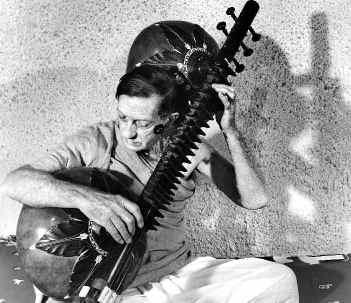
A
professional sitar player.
(image source: The
Splendor that was India - By K T Shah p. 116).
***
The two earliest Greek scales,
the Mixolydic and the Doric, have an affinity to early Indian
scales. Some recent British writers, for example the editors of
The New Oxford History of Music, have attempted to exclude
Indian influence by making the somewhat strange suggestion that
the term "India" meant countries much nearer. Whilst
the evidence pointing to the direct influence of India on Greek
interest in Indian art. In addition, there are parallels between
the two systems, which may or may not be connected. It
is certainly true that the seven note scale with three octaves
was known in India long before the Greeks were familiar with it.
Pythagoras scheme of cycle of the fifth and cycle of the fourth
in his system of music is exactly the same as the sadjapancama
and saja-madhyama bhavas of Bharata. Since
Bharata lived several centuries after Pythagoras, it has been
suggested that he borrowed the scheme from Pythagoras. At the
same time it has been pointed out that Indian music, dating as
it does from the early Vedic period, is much anterior to Greek
music, and that it is not unlikely that Pythagoras may have been
indebted to Indian ideas. In almost all other fields of
scholarship in which he was interested, a close identity between
his and the older Indian theories has already been noted.
Whilst no title of any Sanskrit
work on music translated at Baghdad is available, there
is not doubt that Indian music influenced Arab music.
The well-known Arab writer Jahiz,
recording the popularity of Indian music at the Abbasid Court,
mentions an Indian instrument known as kankalah, which was
played with a string stretched on a pumpkin. This instrument
would appear to be the kingar, which is made with two gourds.
Knowledge of Indian music in the Arab world is evidenced by an
Arab author from Spain, who refers to a book on Indian tunes and
melodies. Many technical terms for Arab music were borrowed from
Persia and India. Indian music, too, was influenced in return,
incorporating Persio-Arab airs, such as Yeman and Hiji from
Hijaz. At the beginning of their rise to power, the Arabs
themselves had hardly any musical system worth noting and mainly
practiced the existing system in the light of Greek theory.
Since Indian contact with western Asia had been close and
constant, it would appear likely that the Arabic maqam iqa is
the Persian version of the Indian melodic rhythmic system, traga
tala, which had existed for more than a thousand years before
maqam iqa was known.
 Yehudi
Menuhin (1916-1999) had one of the longest and most
distinguished careers of any violinist of the twentieth century.
He was convinced that: Yehudi
Menuhin (1916-1999) had one of the longest and most
distinguished careers of any violinist of the twentieth century.
He was convinced that:
""We would find all, or most, strands
beginning in India; for only in India have all possible modes
been investigated, tabulated, and each assigned a particular
place and purpose. Of these many hundreds, some found their way
to Greece; others were adopted by nomadic tribes such as the
Gypsies; others became the mainstay of Arabic music. However,
none of these styles has developed counterpoint and harmony,
except the Western-most offshoot (and this is truly our title to
greatness and originality), with its incredible emotional impact
corresponding so perfectly with the infinite and unpredictable
nuances, from the fleeting shadow to the limits of exaltation or
despair, or subjective experience. Again, its ability to paint
the phenomena of existence, from terror to jubilation, from the
waves of the sea to the steel and concrete canyons of modern
metropolis, has never been equalled."
(source:
Indian and Western Music - Yehudi
Menuhin / Hemisphere, April 1962, p. 6.).
"Indian
music has continued unperturbed through thirty centuries or more,
with the even pulse of a river and with the unbroken evolution of
a sequoitry."
(source:
The
Music of India - By Peggy Holroyde
p. 119).
Peter
Yates (1909 -1976) music critic, author,
teacher, and poet, was born in Toronto, had reason when he said
that “Indian music, though its theory
is elaborate and its technique so difficult, is not an art, but
life itself.”
(source: The
Dance of Shiva – by A K Coomaraswamy p. 79-60).
"Despite
predisposition in India's favor, I have to acknowledge that Indian
music took me by surprise. I knew neither its nature nor its
richness, but here, if anywhere, I found
vindication of my conviction that India was the original
source."
"Its
purpose is to unite one's soul and discipline one's body, to make
one sensitive to the infinite within one, to unite one's breath of
space, one's vibrations with the vibrations of the cosmos."
(source:
Unfinished
Journey - By
Yehudi Menuhin
p. 250 - 268).
Top
of Page
History
of Music
The beginnings
of Indian music are lost in the beautiful legends of gods and
goddesses who are supposed to be its authors and patrons. The
goddess Saraswati is always
represented as the goddess of art and learning, and she is
usually pictured as seated on a white lotus with a vina, lute,
in one hand, playing it with another, a book in the third hand
and a necklace of pearls in the fourth.
 The technical
word for music throughout India is the word sangita, which
originally included dancing and the drama as well as vocal and
instrumental music. Lord Shiva is supposed to have been the
creator of this three fold art and his mystic dance symbolizes
the rhythmic motion of the universe. The technical
word for music throughout India is the word sangita, which
originally included dancing and the drama as well as vocal and
instrumental music. Lord Shiva is supposed to have been the
creator of this three fold art and his mystic dance symbolizes
the rhythmic motion of the universe.
In Hindu
mythology the various departments of life and learning are
usually associated with different rishis and so to one of these
is traced the first instruction that men received the art of
music. Bharata rishi is said
to have taught the art to the heavenly dancers - the Apsaras -
who afterwards performed before Lord Shiva. The Rishi Narada,
who wanders about in earth and heaven, singing and playing on
his vina, taught music to men. Among the inhabitants of Indra's
heaven we find bands of musicians. The Gandharvas are the
singers, the Apsaras, the dancers, and the Kinnaras performers
on musical instruments. From the name Gandharva has come the
title Gandharva Veda for the art of music.
Among the early
legends of India there are many concerning music. The
following is an interesting one from the Adbuta Ramayana about
Narada rishi which combines criticism with appreciation.
"Once upon
a time the great rishi Narada thought himself that he had
mastered the whole art and science of music. To curb his pride
the all-knowing Vishnu took him to visit the abode of the gods.
They entered a spacious building, in which were numerous men and
women weeping over their broken limbs. Vishnu stopped and
enquired of them the reason for their lamentation. They answered
that they were the ragas and the raginis, created by Mahadeva;
but that as a rishi of the name of Narada, ignorant of the true
knowledge of music and unskilled in performance, had sung them
recklessly, their features were distorted and their limbs
broken; and that, unless Mahadeva or some other skillful person
would sing them properly, there was no hope of their ever being
restored to their former state of body. Narada, ashamed ,
kneeled down before Vishnu and asked to be forgiven."
Vedic
Music
It is a matter
of common knowledge to all music lovers that Indian classical
music has its origin in the Sama Veda. Yet the singing of the
Sama Veda has practically disappeared from India. What is heard
nowadays is sasvara-patha and not sasvara-gana, that is to say,
only musical recitation of the Sama Veda, not its actual
singing.
Top
of Page
“animals tamed or wild, even children, are charmed by
sound. Who can describe its marvels?” (Sang. Darp. I-31).
Under the name of Gandharava Veda,
a general theory of sound with its metaphysics and physics
appears to have been known to the ancient Hindus. From such
summaries as have survived till modern times, it seems that the
properties of sound, not only in different
musical forms and systems but also in physics, medicine,
and magic. The rise of Buddhism with its hostility towards
tradition brought about a sharp deviation in the ancient
approach to the arts and sciences, and their theory had often to
go underground in order to avoid destruction. It was at this
time that the Gandharva Veda, with all the other sacred
sciences, disappeared; though the full tradition is said to
survive among the mysterious sages (rishis) who dwell in
Himalayan caves.
When the representatives of the old order, who had been able
to maintain their tradition under ground through the centuries
of persecution, arose again, their intellectual and cultural
superiority was in many fields so great that Buddhism was
defeated. In hardly more than a few decades, Buddhism, by the
mere strength of intellectual argument, was wiped out from the
whole Indian continent over which it had ruled for a thousand
years. It was then (during 6th and 7th
century) that an attempt was made, under the leadership of
Shankaracharya, to restore Hindu culture to its ancient basis.

Megh
raga.
Watch
Raga
Unveiled:
India
’s Voice – A film
The history and essence of North Indian classical Music
***
A number of eminent Brahmins were entrusted with the task of
recovering or re-writing the fundamental treatises on the
traditional sciences. For this they followed the ancient system
which starts from a metaphysical theory whose principles are
common to all aspects of the universe, and works out their
application in a particular domain. In this way the theory of
music was reconstructed. In this way the theory of music was
reconstructed.
Musical theory and theory of language had been considered
from the earliest times as two parallel branches of one general
science of sound. Both had often been codified by the same
writers. The names of Vashishtha,
Yajnavalkya, Narada, Kashyapa, Panini are mentioned
among these early musicologist-grammarians. Nandikeshvara
was celebrated at the same time as the author of a work on the
philosophy of language and of a parallel work on music. His work
on language is believed to be far anterior to the Mahabhashya of
Patanjali (attributed to the 2nd century B.C.) into
which it is usually incorporated, though it is thought to be
probably posterior to Panini, who lived no later than 6th
century B.C. The chronology of works on music would seem,
however, to place both Panini and Nandikeshvara at a much
earlier date. The work of Nandikeshvara on the philosophy of
music is now believed to be lost but fragments of it are
undoubtedly incorporated in later works. At the time of the
Buddhist ascendancy, when so much of the ancient lore had to be
abandoned, grammatical works were considered more important than
musical ones.
A part of Nandikeshvara’s work on dancing, the Abhinaya
Darpana, has been printed (Calcutta 1934) with
English translation by M. Ghosh). An earlier translation by
Ananda Coomaraswamy appeared under the title The Mirror of
Gesture (Harvard Univ. Press. 1917).
Top
of Page
The period extending from the Mahabharata war to the
beginnings of Buddhism may well have been one of the greatest
the culture of India has known, and its influence extended then
(as indeed it still did much later) from the Mediterranean to
China. Traces of its Mediterranean aspect have been found in the
Cretan and Mycenean remains as well as in Egypt and the Middle
East.
The Vedas, which until the beginning of this period had been
transmitted orally, were then written down, and later on, the
Epics and Puranas. Most of the treatises on the ancient sciences
also belong to the age, though many may have been to a certain
extent re-shaped later on. Ananada K. Coomaraswamy, in his book,
Arts and Crafts of India and Ceylon, speaks of this “early
Asiatic culture and as far south as Ceylon….in the second
millennium B.C..”
The ancient Kinnari Vina
or Kin, for example, became known in China as the Khin, a
stringed instrument said to have been played by the first
Emperor, Fu-Hi (circa 3000 BC), The Kin is further mentioned in
ancient Chinese chronicles such as the Chi Ki (2nd
century B.C) in reference to events of the 6th or 7th
century. According to the Li Ki, Confucius (551-478) always had
his Khin with him at home, and carried it when he went for a
walk or on a journey.
In Genesis, (iv, 21 and xxxi, 27) a stringed instrument of
the same kind is called Kinnor. David used to play the Kinnor as
well as the nebel (flute).
 
Shiva,
Yoga-Dakshinamurti with Rishis, Snake dancers, and Musicians
- The Art Institute of Chicago.
***
The antiquity of Indian theatrical art and musical theory was
well known to the ancient world. According to Strabo
(Geography X, II 17) the Greeks considered that music,
“from the triple point of view of melody, rhythm and
instruments” came to them originally from Thrace and Asia.
“Besides, the poets, who make of the whole of Asia, including
India, the land or sacred territory of Dionysos, claim that the
origin of music is almost entirely Asiatic. Thus, one of them,
speaking of the lyre, will say, that he causes the strings of
the Asiatic cithara to vibrate.” Many ancient historians spoke
of Dionysos (or Bacchos) as having lived in India.
The many stories that tell how the various styles of North
Indian music were invented by musicians of the Muhammadan period
have probably no basis in reality.
Under Muslim rule, age-old stories were retold as if they had
happened at the court of Akbar, simply to make them more vivid,
and in conformity with the fashion of the day. Such
transferences of legend are frequent everywhere. In Western
countries, many a pagan god in this way became a Christian saint
and many ancient legends were rearranged to fit into Christian
world. Some episodes in the life of the Buddha, for example,
found their way into the Lives of the Saints where the Buddha
appears under the name of St. Josaphat.
The impartial ear of sound-measuring instruments makes one
marvel at the wonderful accuracy of the scales used by the great
“Ustads” of Northern India – scales
which in everyway confirm with the requirements of ancient Hindu
theory.
To say that they pertain to, or have been influenced by, the
Arab or the Persian system shows a very superficial knowledge of
the subject. These systems, originally mostly derived from
Indian music, have become so reduced and impoverished in
comparison with it that no one can seriously speak of their
having had any influence on its development. In fact the whole
of the theory and most of the practice of Arab as well as
Persian music is the direct descendant of the ancient Turkish
music. At the beginning of the Muslim era, the Arabs themselves
had hardly any musical system worth the mentioning, and all the
Arabic theoreticians – Avicenna, (born about 980 A. D)
Al Farabi, Safi ud’din, and others – are claimed by
the Turks as Turkish in culture if not always in race. In fact,
they merely expounded in Arabic the old Turkish system was well
known to medieval Hindu scholars who often mention it (under the
name of Turushka) as a system closely allied to Hindu music. The
seventeen intervals of the octave, as used by the Arabs, are
identical with seventeen of the twenty-two Indian shrutis, and
there is no modal form in Arabic music which is not known to the
Hindus.
(source: Northern
Indian Music -
By Alain Danielou Praeger, 1969 volume I p. 1-35).
Top
of Page
The
Development of Scale
All music is
based upon relations between sounds. These relations can,
however, be worked out in different ways, giving rise to
different groups of musical systems. The modal group of musical
systems, to which practically the whole of Indian muisc belongs,
is based on the establishment of relations between diverse
successive sounds or notes on the one hand and, on the other,
upon a permanent sound fixed and invariable, the
"tonic".
 Indian music like all modal
music, thus exists only by the relations of each note with the
tonic. Contrary to common belief, modal music is not merely
melody without accompaniment, nor has a song or melody, in itself,
anything to do with mode. The modes used in the music of the
Christian Church are modes only in name, though they may have been
real modes originally. But much of Scottish and Irish music, for
example, is truly modal; it belongs to the same musical family as
Indian music and is independent of the Western harmonic
system. Indian music like all modal
music, thus exists only by the relations of each note with the
tonic. Contrary to common belief, modal music is not merely
melody without accompaniment, nor has a song or melody, in itself,
anything to do with mode. The modes used in the music of the
Christian Church are modes only in name, though they may have been
real modes originally. But much of Scottish and Irish music, for
example, is truly modal; it belongs to the same musical family as
Indian music and is independent of the Western harmonic
system.
Music must have
been cultivated in very early ages by the Hindus; as the
abridged names of the seven notes, via, sa,
ri, ga, ma, pa, dha, ni, are said to occur in the
Sama Veda; and in their present order. Their names at length are
as follows:
Shadja,
Rishabha, Gandhara, Madhyama, Panchama, Dhaivata, Nishada.
The seven notes
are placed under the protection of seven Ah'hisht'hatri Devatas,
or superintenting divinities as follows:
Shadja, under
the protection of Agni
Rishabha, of Brahma
Gandhara, of Saraswati
Madhyama, of Mahadeva
Panchama, of Sri or Lakshmi
Dhaivata, of Ganesa
Nishada, of Surya
"The note
Sa is said to be the soul, Ri is called the head, Ga is the
arms, Ma the chest, Pa the throat, Dha the hips, Ni the feet.
Such are the seven limbs of the modal scale." (Narada
Samhita 2, 53-54).
"Shadja is
the first of all the notes and so it is the main or chief
note." Datilla explains that the Shadja (the tonic)
may be established at will at any pitch (on any shruti) and that,
by relation with it, the other notes should be established at the
proper intervals.
The Hindus
divide the octave into twenty two intervals, which are called
Sruti, by allocating four Sruti to represent the interval. The
sruti or microtonal interval is a division of the semitone, but
not necessarily an equal division. This division of the semitone
is found also in ancient Greek music. It is an interesting fact
that we find in Greek music the counterpart of many things in
Indian music. Ancient India divided the octave into twenty two and
the Greek into twenty-four. The two earliest Greek scales, the
Mixolydic and the Doric show affinity with early Indian scales.
The Indian scale divides the octave into twenty-two srutis.
Gramas
Indian
music is traditionally based on the three gramas. First reference
to Grammas or ancient scales is found in the Mahabharata and teh
Harivamsa. The former speaks of the 'sweet note Gandhara',
probably referring to the scale of that name. The Harivamsa speaks
enthusiastically of music 'in the gramaraga which goes down to
Gandhara', and ot 'the women of Bhima's race who performed, in the
Gandhara gramaraga, the descent of the Ganges, so as to delight
mind and ear.'
Top
of Page
The
Nature of Sound
"Sound
(Nada) is the treasure of happiness for the happy, the
distraction of those who suffer, the winner of the hearts of
hearers, distraction of those who suffer, the winner of the
hearts of hearers, the first messenger of the God of Love. It is
the clever and easily obtained beloved of passionate women. May
it ever, ever, be honored. It is the fifth approach to Eternal
Wisdom, the Veda."
- Sangita Bhashya.
Sound is said
to be of two kinds, one a vibration of ether, the other a
vibration of air. The vibration of ether, which remains
unperceived by the physical sense, is considered the principle
of all manifestation, the basis of all substance. It corresponds
with what Pythagoras called the "music of the spheres"
and forms permanent numerical patterns which lie at the very
root of the world's existence. This kind of vibration is not due
to any physical shock, as are all audible sounds. It is
therefore called anahata, "unstruck".
The other kind of sound is an impermanent vibration of the air,
an image of the ether vibration of the same frequency. It is
audible, and is always produced by a shock. It is therefore
called ahata or "struck".

Watch
Raga
Unveiled:
India
’s Voice – A film
The history and essence of North Indian classical Music
***
Thus, the Sangita
Makaranda (I 4-6) says: "Sound is considered to
be of two kinds, unstruck and and struck; of these two, the
unstruck will be first described. "Sound produced from
ether is known as 'unstruck'. In this unstruck sound the Gods
delight. The Yogis, the Great Spirits, projecting their minds by
an effort of the mind into this unstruck sound, depart,
attaining Liberation."
"Struck
sound is said to give pleasure, 'unstruck' sound gives
Liberation." (Narada Purana).
But "this
(unstruck sound) having no relation with human enjoyment does
not interest ordinary men." (Sang. Ratn 6.7.12).
Top
of Page
Raga
- The Basis of Melody
"I
don not dwell in heaven, nor in the heart of yogis. there only I
abide, O Narada, where my lovers sing."
(Narada Samhita I.7).
"That
which charms is a raga." (Sang.
Darpan 2-1).
Each
raga or mode of Indian music is a set of given sounds called notes
(svara-s) forming with a permanent tonic certain ratios. To each
of these ratios is said to correspond a definite idea or emotion.
The complex mood created by the mixture and contrast of these
different ideas or emotions is the mood or expression of the raga.
The harmonious relations which exist between the notes and which
can be represented by numerical ratios do not exclusively belong
to music. The very same relations can be found in the harmony
which binds together all the aspects of manifestation. These
ratios can express the change of the seasons and that of the
hours, the symphony of colors as well as that of forms. Hence the
mood of a raga can be accurately represented by a picture or a
poem which only creates an equivalent harmony through another
medium. The expression of a raga is thus determined by its scale.
It results from the expressions of each of the intervals (shrutis)
which the different notes form with the tonic.
The
Raga poems: Poems describing the mood of the raga are found in a
number of Sanskrit works of music. References
to them in other works seem to show that many of them were
originally part of a treatise (now believed lost) by Kohala, one
of the earliest writers on music.
Raga is the
basis of melody in Indian music and a substitute for the western
scale. "It is the attempt of an
artistic nation to reduce the law and order the melodies that
come and go on the lips of the people." In Raga
Vibodha, it is defined as 'an arrangement of sounds which
possesses varna, (color) funishes gratification to the
senses and is constituted by musical notes." says Matanga.
Indian ragas
are also supposed to be able to reproduce the conditions and
emotions associated with them. The Dipak
raga is supposed to produce flames in actuality; and
a story is told of the famous musician named Gopal
Naik (Baiju Bawara) who, when ordered to sing this by
the Emperor Akbar went and stood in the Jamuna up to his neck
and then started the song. The water became gradually hotter
until flames burst out of his body and he was consumed to ashes.
The Megh mallar raga is
supposed to be able to produce rain. It is said that a dancing
girl in Bengal, in a time of drought, once drew from the clouds
with this raga a timely refreshing shower which saved the rice
crop. Sir W. Ousley, who
relates many of these anecdotes, says that he was told by Bengal
people that this power of reproducing the actual conditions of
the raga is now only possessed by some musicians in western
India.
In connection
with the sciences of raga, Indian music has developed the art of
raga pictures. Mr. Percy Brown,
formerly of the School of Art, Calcutta, defines a raga as "a
work of art in which the tune, the song, the picture, the
colors, the season, the hour and the virtues are so blended
together as to produce a composite production to which the West
can furnish no parallel."

Vina
player from Mysore.
***
It may be
described as a musical movement, which is not only represented
by sound, but also by a picture. Rajah
S M Tagore, thus describes the pictorial
representations of his six principal ragas. Sriraga
is represented as a divine being wandering through a beautiful
grove with his love, gathering fragrant flowers as they pass
along. Near by doves sport on the grassy sward. Vasanta
raga, or the raga of spring, is represented as a
young man of golden hue, and having his ears ornamented with
mango blossoms, some of which he also holds in his hands. His
lotus-like eyes are rolling round and are of the color of the
rising sun. He is loved by the females. Bhairava
is shown as the great Mahadeva (Shiva) seated as a sage on a
mountain top. River Ganga falls upon his matted locks. His head
is adorned with the crescent moon. In the center of his forehead
is the third eye from which issued the flames which reduced Kama,
the Indian Cupid, to ashes. Serpents twine around his neck. He
holds a trident in one hand and a drum in the other. Before him
stands his sacred bull - Nandi. Panchama
raga is pictured as a very young couple in love in a
forest. Megh raga is the
raga of the clouds, and the rainy season. It is the raga of hope
and new life. The clouds hang overhead, and already some drops
of rain have fallen. The animals in the fields rejoice. This
raga is said to be helpful for patients suffering from
tuberculosis. Nattanarayana
is the raga of battle. A warrior king rides on a galloping steed
over the field of battle, with lance and bow and shield. Lakshmana
Pillay has said: "Thus, each raga comes and goes
with its store of smiles or tears, of passion or pathos, its
noble and lofty impulses, and leaves its mark on the mind of the
hearer."
Sir Percy Brown read a paper
on the raga which he called Visualized
Music. He described it as a combination of two arts,
music and painting. He mentioned a miniature painting which was
called 'the fifth delineation of the melody Megh
Mallar Saranga, played in four-time at the time of
the spring rains. He wrote: "Todi ragini is one of the
brides of Vasanta raga. The melody of this raga is so
fascinating that every living creature within hearing is
attracted to it. as the raga has to be performed at
midday."
This
art seems to have come originally from northwest India. The
Indian tendency is to visualize abstract things.
The
six principal ragas are the following:
1.
Hindaul - It is played to
produce on the mind of the bearer all the sweetness and freshness
of spring; sweet as the honey of the bee and fragrant as the
perfume of a thousand blossoms.
2. Sri
Raga - The quality of this rag is to affect the mind
with the calmness and silence of declining day, to tinge the
thoughts with a roseate hue, as clouds are glided by the setting
sun before the approach of darkness and night.
3. Megh
Mallar - This is descriptive of the effects of an
approaching thunder-storm and rain, having the power of
influencing clouds in time of drought.
4. Deepak
- This raga is extinct. No one could sing it and live; it has
consequently fallen into disuse. Its effect is to light the lamps
and to cause the body of the singer to produce flames by which he
dies.
5. Bhairava
- The effect of this rag is to inspire the mind with a feeling of
approaching dawn, the caroling of birds, the sweetness of the
perfume and the air, the sparkling freshness of dew-dropping morn.
6. Malkos
- The effect of this rag are to produce on the mind a feeling of
gentle stimulation.
(source:
Hindu
Superiority - By Har Bilas Sarda
p. 371).
Top
of Page
Tala
or Time Measure
Claude
Alvares has written: "The Indian system of talas, the rhythmical time-scale of Indian
classical music, has been shown (by contemporary analytical
methods) to possess an extreme
mathematical complexity. The basis of the system is
not conventional arithmetic, however, but more akin to what is
known today as pattern recognition."
To
quote Richard Lannoy author
of The
Speaking Tree:
A Study of Indian Culture and Society:
"In
the hands of a virtuoso the talas are played at a speed so fast
that the audience cannot possibly have time to count the
intervals; due to the speed at which they are played, the talas
are registered in the brain as a cluster configuration, a
complex Gestalt involving all the senses at once. While the
structure of the talas can be laboriously reduced to a
mathematical sequence, the effect is subjective and
emotional.....The audience at a recital of Indian classical
music becomes physically engrossed by the agile patterns and
counter-patterns, responding with unfailing and instinctive kinesthetic
accuracy to the terminal beat in each tala."
 Their
ability with instruments is repeated with the voice. The
extraordinary degree of control of the human voice has been
described by the musicologist, Alain Danielou, who has stated
that Indian musicians can produce and differentiate between
minute intervals (exact to a hundreth of a comma, according to
identical measurements recorded by Danielou at monthly recording
sessions). This sensitivity to microtones is, from the purely
musicological point of view, of little importance, like the
mathematical complexity of the talas. Nevertheless, as Lannoy
puts it: Their
ability with instruments is repeated with the voice. The
extraordinary degree of control of the human voice has been
described by the musicologist, Alain Danielou, who has stated
that Indian musicians can produce and differentiate between
minute intervals (exact to a hundreth of a comma, according to
identical measurements recorded by Danielou at monthly recording
sessions). This sensitivity to microtones is, from the purely
musicological point of view, of little importance, like the
mathematical complexity of the talas. Nevertheless, as Lannoy
puts it:
"It
is an indication of the care with which the "culture of
sound" is developed, for Hindus still believe that such
precision in the repetition of exact intervals, over and over
again, permits sounds to act upon the internal personality,
transform sensibility, way of thinking, state of soul, and even
moral character."
(source:
Decolonizing
History: Technology and Culture in India, China and the West
1492 to the Present Day - By Claude Alvares p.
73-74).
"In
other words, the Hindu has never divorced
the physical from the spiritual; these 'ancient
physiologists' ascribed an ethical significance to physiological
sensitivity. The aristocratic cult of kalokagathia, 'beautiful
goodness', has never been abandoned in India, even if its
metaphysic bears little resemblance to the kalokagathia of the
ancient Greeks.
(source: The
Speaking Tree:
A Study of Indian Culture and Society
- By Richard Lannoy p. 275).
Musical time in
India, more obviously then elsewhere, is a development from the
prosody and metres of poetry. The insistent demands of language
and the idiosyncrasies of highly characteristic verse haunt the
music, like a 'presence which is not to be put by.' 'The
time-relations of music are affected both by the structure of
the language and by the method of versification which ultimately
derives from it.' says one student of Indian music from the west.
Until late, there was practically no prose in India and
everything had to be learnt through the medium of verse chanted
to regular rules. Both in Sanskrit and in the vernacular all
syllables are classified according to their time-lengths, the
unit of time being a matra. Very short syllables of less than a
matra also occur.
Great stress
has always been laid by Indian grammarians upon giving 'the
exact value' to syllables inverse; and as there is no accent at
all in Indian verse the time-length is all important. This
may account for the great development of time-measures in Indian
music. Rajah S M Tagore says that the word tala
refers to the beating of time by the clapping of hands.
Sometimes it is also done by means of small hand-cymbals, which
are called tala or kaitala or kartal (hand-cymbals).
Top
of Page
Musical Instruments
and Sanskrit
Writers on Music
The Vedic
Index shows a very wide variety of musical
instruments in use in Vedic times. Instruments of percussion are
represented by the dundubhi,
an ordinary drum; the adambara,
another kind of drum, bhumidundubhi,
an earthdrum made by digging a hole in the ground covering it
with hide; vanaspati, a
wooden drum; aghati, a
cymbal used to accompany dancing. Stringed instruments are
represented by the kanda-vina,
akind of lute; karkari,
another lute; vana, a lute
of 100 strings; and the vina,
the present instrument of that name in India. This
one instrument alone is sufficient evidence of the development
to which the art had attained even in those early days. There
are also a number of wind instruments of the flute variety, such
as the tunava, a wooden flute; the nadi, a reed flute, bakura,
whose exact shape is unknown. 'By the time of the Yajur Veda
several kinds of professional musicians appear to have arisen;
for lute-players, drummers, flute-players, and conch-blowers are
mentioned in the list of callings.'


Kalyayana-vina
Sarinda
Katyayana-vina
Chikara
That vocal
music had already got beyond the primitive stage may be
concluded from the somewhat complicated method of chanting the Sama
Veda, which goes back to the Aryan age. These hymns
of the Rig Veda and Sama Veda are the earliest examples we have
of words set to music. The Sama Veda, was sung according to very
strict rules, and present day Samagah - temple singers of the
Saman - claim that the oral tradition which they have received
goes back to those ancient times. The Chandogya and the
Brihadaranyaka Upanishads both mention the singing of the Sama
Veda and the latter also refers to a number of musical
instruments.

Sarangi
(Bengal)
Sarangi
Mahati Vina
Kinnari

Mayuri Esraj
Vina (Southern)
Ektar


Group
of stringed instruments: Dilruba, Bin Sarangi and Peacock
sitar Some ancient instruments:
Svaramandala. Brahma cina, Kural and Bastram.
Watch
Raga
Unveiled:
India
’s Voice – A film
The history and essence of North Indian classical Music
***
Drumming
The
drum is one of the most important of Indian musical instruments.
It provides the tonic to which all the other instruments must be
tuned. It is a royal instrument having the right of royal honors.
The drums used in India are innumerable. Mrs.
Mann says: "The Indian drummer is a great artist.
He will play a rhythm concerto all alone and play us into an ecstasy
with it." "The drummer will play it in bars of 10, 13,
16, or 20 beats, with divisions within each bar flung out with a
marvelous hypnotizing swing. Suggestions of such rhythm beaten out
by a ragged urchin on the end of an empty kerosene oil-can first
aroused me to the beauty and power of Indian music."
The
Indian drummer can obtain the most fascinating rhythm from a mud
pot, and some of them are great experts at this pot-drumming. The mridanga
and tabla are both played in
the same way, the only difference being that, in the case of the
table, the two heads are on two small drums, and not on the same
drum. The Mridanga or Mardala
is the most common and probably the most ancient of Indian drums.
It is said to be invented by Brahma to serve as an accompaniment
to the dance of Shiva, in the honor of his victory over
Tripurasura; and Ganesha, his son, is said to have been the first
one play upon it. The word Mridanga or Mardala means 'made of
clay' and probably therefore its body was originally of mud. Other
drums include Pakhawaj, Nagara or Bheri or Nakkara, Dundubhi
Mahanagar or Nahabet, Karadsamila, Dhol, Dhoki, Dholak and Dak.
Damaru, Nidukku, or Budhudaka, Udukku, Edaka and many others.
***
In the Ramayana
mention is frequently made of the singing
of ballads, which argues very considerable
development of the art of music. The poem composed by the sage
Valmiki is said to have been sung before King Dasratha. The
Ramayana often makes use of musical similes. The humming of the
bees reminded him of the music of stringed instruments, and the
thunder of the clouds of the beating of the mridanga. He talks
of the music of the battlefield, in which the twanging and
creaking of the bows takes the place of stringed instruments and
vocal music is supplied by the low moaning of the
elephants. Ravana is made to say that "he will play
upon the lute of his terrific bow with the sticks of his
arrows." Ravana was a great master of music and was said to
have appeased Shiva by his sublime chanting of Vedic hymns.
The Mahabharata
speaks of seven Svaras and also of the Gandhara Grama, the
ancient third mode. The theory of consonance is also alluded
to.
The Mahajanaka
Jataka (c. 200 B. C) mentions the four great sound (parama maha
sabda) which are conferred as an honor by the Hindu kings on
great personages. In these drums is associated with various
kinds of horn, gong and cymbals. These were sounded in front of
a chariot which was occupied, but behind one which was empty.
The car used to go slowly round the palace and up what was
called 'the kettle-drum road'. At such a time they sounded
hundreds of instruments so that 'it was like the noise of the
sea.' The Jataka also records how Brahmadatta presented a
mountain hermit with a drum, telling him that if he beat on one
side his enemies would run away and if upon the other they would
become his firm friends.
 In the Tamil
books Purananuru and Pattupattu
(c. A.D 100-200) the drum is referred to as occupying a position
of very great honor. It had a special seat called murasukattil,
and a special elephant, and was treated almost as a deity. It is
described as 'adorned with a garland like the rainbow.' One of
the poets tells us, marveling at the mercy of the king, 'how he
sat unwittingly upon the drum couch and yet was not
punished.' Three kinds of drums are mentioned in these
books: the battle drum, the judgment drum and the sacrificial
drum. The battle drum was regarded with same the veneration that
regiments used to bestow upon the regimental flag. One poem
likens the beating of the drum to the sound of a mountain
torrent. Another thus celebrates the virtues of the drummer. In the Tamil
books Purananuru and Pattupattu
(c. A.D 100-200) the drum is referred to as occupying a position
of very great honor. It had a special seat called murasukattil,
and a special elephant, and was treated almost as a deity. It is
described as 'adorned with a garland like the rainbow.' One of
the poets tells us, marveling at the mercy of the king, 'how he
sat unwittingly upon the drum couch and yet was not
punished.' Three kinds of drums are mentioned in these
books: the battle drum, the judgment drum and the sacrificial
drum. The battle drum was regarded with same the veneration that
regiments used to bestow upon the regimental flag. One poem
likens the beating of the drum to the sound of a mountain
torrent. Another thus celebrates the virtues of the drummer.
"For my
grandsire's grandsire, his grandsire's grandsire.
Beat the drum. For my father, his father did the same.
So he for me. From duties of his clan be has not swerved.
Pour forth for him one other cup of palm tree's purest
wine.."
The early Tamil
literature makes much mention of music. The Paripadal
(c. A.D 100-200) gives the names of some of the svaras and
mentions the fact of there being seven Palai (ancient modes).
The yal is the peculiar instrument of the ancient Tamil land. No
specimen of it still exists today. It was evidently something
like the vina but not the same instrument, as the poet Manikkavachakar
(c. A. D 500-700) mentions both in such a way as to indicate two
different instruments. Some of its varieties are said to have
had over 1,000 strings. The The Silappadigaram
(A. D. 300), a Buddhist drama, mentions the drummer, the flute
player, and the vina as well as the yal, and also has specimens
of early Tamil songs. This book contains some of the
earliest expositions of the Indian musical scale, giving the
seven notes of the gamut and also a number of the modes and
ragas in use at that time. The latter centuries of the Buddhist
period were more fertile in architecture, sculpture and painting
than in music. The dramas of Kalidasa
make frequent references to music and evidently the rajahs of
the time had regular musicians attached to their courts. In the Malavikagnimitra
a song in four-time is mentioned as a great feat performed at a
contest between two musicians. The development of the drama
after Kalidasa meant the development of music as well, as all
Indian drama is operatic. 'The temple and the stage were the
great schools of Indian music.'
The oldest
detailed exposition of Indian musical theory which has survived
the ravages of ants and the fury of men is found in a treatise
called Natya Sastra or the
science of dancing, said to have been composed by the sage
Bharata. There are nine chapters of the Natya Sashtra
that deal with music proper. These contain a detailed exposition
of the svaras, srutis, gramas, murohhansas, jatis. A translation
of a portion of this chapter appeared in Mr. Clement's
Introduction to Indian Music, and there is a complete French
translation by Jean Grosset.
The seventh and
eighth centuries of our era in South India witnessed a religious
revival associated with the bhakti
movement and connected with the theistic and popular
sects of Vishnu and Shiva. This revival was spread far and wide
by means of songs composed by the leaders of the movement and so
resulted in a great development of musical activity among the
people generally and in the spread of musical education. Sangita
Makaranda, said to be by Narada, but not Narada Rishi as his
name is mentioned in the book, was probably composed between the
eighth and eleventh centuries. He gives a similar account of the
Gandhara Grama to that of Sangita Ratnakara. Musical sounds are
divided into five classes according to the agency of
productions, as nails, wind etc. The 18 Jatis of Bharata are
given and he enumerates 93 ragas.
***
In
Shiva’s temple, stone pillars make music - an architectural
rarity
Shiva
is the Destroyer and Lord of Rhythm in the Hindu trinity. But here
he is Lord Nellaiyappar, the Protector of Paddy, as the name of
the town itself testifies — nel meaning paddy and veli meaning
fence in Tamil.
Prefixed
to nelveli is tiru, which signifies something special — like the
exceptional role of the Lord of Rhythm
or the unique musical stone pillars in the temple.In the Nellaiyappar
temple, gentle taps on the cluster of columns hewn out of a single
piece of rock can produce the keynotes of Indian classical music.
“Hardly
anybody knows the intricacies of how these were constructed to
resonate a certain frequency. The more aesthetically inclined with
some musical knowledge can bring out the rudiments of some rare
ragas from these pillars.”
The
Nelliyappar temple chronicle, Thirukovil Varalaaru, says the
nadaththai ezhuppum kal thoongal — stone
pillars that produce music — were set in place in the 7th
century during the reign of Pandyan king Nindraseer Nedumaran.
Archaeologists
date the temple before 7th century and say it was built by
successive rulers of the Pandyan dynasty that ruled over the
southern parts of Tamil Nadu from Madurai. Tirunelveli, about 150
km south of Madurai, served as their subsidiary capital.
Each
huge musical pillar carved from one piece of rock comprises a
cluster of smaller columns and stands testimony to a unique
understanding of the “physics and mathematics of sound." Well-known
music researcher and scholar Prof. Sambamurthy Shastry, the “marvellous
musical stone pillars” are “without a parallel” in any other
part of the country.
“What
is unique about the musical stone pillars in the Tiruelveli
Nellaiyappar temple is the fact you have a cluster as large as 48
musical pillars carved from one piece of stone, a delight to both
the ears and the eyes,” The
pillars at the Nellaiyappar temple are a combination of the Shruti
and Laya types. This
is an architectural rarity and a sublime beauty to be cherished
and preserved.
(source: In
Shiva’s temple, pillars make music - telegraphindia.com).
Top
of Page
Some
Ancient
Musical Authorities
Among important
landmarks of the literature on music must also be counted
portions of certain Puranas, particularly the Vishnu Dharmottara,
Markandeya Purana and Vayu
Purana. The Hindus claim a great antiquity for these
Puranas and this seems to be corroborated by the technical terms
used in reference to music. The Sanskrit authors on music can be
divided into four main periods. The first period is those whose
names are mentioned in the Puranans and in the Epics (Mahabharata
and Ramayana), the second that of the authors mentioned in the
early medieval works (Buddhistic period), the third period is
that of the authors who wrote between the early medieval Hindu
revival and the Muslim invasion, and the last or modern period
that of Sanskrit writers under Muslim and European rule.
(Note: The
Different Narada -s: There were probably three authors known by
the name of Narada. One, the author of the Naradiya Shiksha. The
Panchama Samhita and Narada Samhita are probably the work of the
later Narada (Narada II), the author of the Sangita Makarnada.

Sanskrit
authors on music can be divided into four main periods, according
to Alain Danielou.
***
First
Period - ((The Vedic/Puranic/Epic Period)
Narada, Bharata,
Nandikeshvara, Arjuna, Matanga, Kohala, Dattila, Matrigupta, and Rudrata and
others.
Second
Period
Abhinava
Gupta, Sharadatanaya, Nanya Bhupala, Parshvadeva and
Sharngadeva, and others.
Third
Period
Udbhata,
Lollata, Shankuka, Utpala Deva, Nrisimha Gupta, Bhoja King,
Simhana, Abhaya Deva, Mammata, Rudrasena, Someshvara
II, Lochana Kavi (Raga Tarangini), Sharngadeva (Sangita
Ratnakara), Jayasimha, Ganapati, Jayasena, Hammira, Gopala Nayak
and others.
Fourth
Period
Harinayaka,
Meshakarna, Madanapala Deva, Ramamatya (Svara-mela Kalanidhi), Somanatha (Raga Vibodha), Damodhara Mishra (Sangita
Darpana), Pundarika Vitthala (Shadraga Chandrodya, Raga Mala,
Raga Manjari), Somanatha, Govinda Dikshita, Basava Raja,
and others.
***
The first North
Indian musician whom we can definitely locate both in time and
place is Jayadeva, who lived
at the end of the 12th century. He was born at Kendula near
Bolpur, where lived Rabindranath Tagore, the poet, laureate of
Bengal and modern India. Jayadeve wrote and sang the Gita
Govinda, a series of songs descriptive of the love of
Krishna, and the bhakti movement. The Gita Govinda was
translated by Sir Edwin Arnold under the name of The Indian Song
of Songs. In these songs Radha pours forth her yearning, her
sorrow and her joy and Krishna assures her of his love.
Sarangadeva
- (1210- 1247 A D) one of the greatest of ancient Indian musical
authorities and one who still inspires reverence in the minds of
India's musicians. He lived at the court of the Yadava dynasty
of Devagiri in the Deccan. at that time the Maratha Empire
extended to the river Kaveri in the south, and it is probable
that Sarngadeva had come into contact with the music of the
south as well as the north. His work, the Sangita Ratnakara
shows many signs of this contact. It is possible that he was
endeavoring to give the common theory which underlies both
systems.
 Gopala
Nayaka or
Bijubawara (1295-1315) a musician from the court of
Vijayanagar. Gopala
Nayaka or
Bijubawara (1295-1315) a musician from the court of
Vijayanagar.
The
14th and 15th centuries are the most important in the development
of the northern school. It was the time of the Muhammed conquest.
Many of the emperors did a great deal to extend the practice of
music of the earlier Hindu rajahs, and most of them had musicians
attached their courts. Amir Khusru was
a famous singer at the court of Sultan Alla-ud-din (A D
1295-1316). He was not only a poet and musician, but also a
soldier and statesman. There is a story told of a contest between
Amir Khusru and Gopal Naik, a musician from the court of
Vijayanagar. While Gopal was singing a beautiful composition,
Khusru hid under the throne of the king and afterwards imitated
all the beauties of Gopal's melodies. Muhammadan historians relate
that, when the Moghuls, completed the conquest of the Deccan, they
took back with them to the north many of the most famous southern
musicians, in the same way that they took toll of the Indian
architects and sculptors for their new buildings.
Bharata,
Iswara, Parana and Narada were among the great Hindu musicians of
ancient India. In more recent times, however, Naik Gopal and
Tansen have been the most celebrated ones. About Naik Gopal, Arthur
Whitten says:
"Of the magical effect produced by the singing of Gopal Naik
and of the romantic termination to the career of the sage, it is
said that he was commanded by Akbar to sing the raga deepak, and
he, obliged to obey, repaired to the river Jumna, in which he
plunged up to his neck. As he warbled the wild and magincal notes,
flames burst from his body and consumed him to ashes." He
adds: "It is recorded of Tansen that he was also commanded by
the Emperor Akbar to sing the sri, or night raga, at midday, and
the power of the music was such that it instantly became night,
and the darkness extended in a circle around the palace as far as
his voice could be heard." India, it seems, produced
Orpheuses even so late as the 17th century A.D.
(source:
Hindu
Superiority - By Har Bilas Sarda
p.
373-374).
Dr.
Tennet says: "If we are to judge merely from the
number of instruments and the frequency with which they apply
them, the Hindus might be regarded as considerable proficients in
music."
(source:
Music of the Ancients -
By Arthur Whitten p. 21).
Lochana
Kavi - The Ragatarangini,
was composed by Lochana Kavi and probably belongs to this period.
The major portion of this work is devoted to the discussion of a
number of songs by a poet named Vidyapati, who flourished in the
15th century at the court of the Raja Siva Singh of Tirhut. The
author also describes the current musical theories of the day, and
groups the ragas under twelve thats or fundamental modes.
Chaitanya
(A.D. 1485-1533)
- The development of the
bhakti revival in Northern India and Bengal under Chaitanya was
accompanied by a great deal of musical activity, and it was at
this time that the popular musical performances, known as
Sankirtan and Nagarkirtan were first started.
 Swami
Haridas - was a great Hindu saint and musician who
lived on the banks of Brindaban, the center of the Lord Krishna
on the banks of the Jamuna in the reign of Akbar. He was
considered the greatest musician of his time. Tan
Sen, a Gaudhiya brahmin and the celebrated singer of Akbar's court, was one
of his pupils. Many tales are told about Tan Sen and Haridas.
One of these tells how the Emperor after one of his performances
asked him if there was anyone in the world who could sing like
him. Tan Sen replied that there was one who far surpassed him.
At once the Emperor was all anxious to hear this other singer
and when told that he would not even obey the command of the
Emperor to come to court, he asked to be taken to him. It was
necessary for the Emperor to go in disguise as the humble
instrument carrier to his singer. They came to the hermitage of
Haridas Swami on the banks of the Jamuna, and Tan Sen asked him
to sing but he refused. Then Tan Sen practized a little trick
and himself sang a piece before his old master, making a slight
mistake in doing so. The master at once called his attention to
it and showed him how to sing it properly, and then went on in a
wonderful burst of song, while the Emperor listened enraptured.
Afterwards, as they were going back to the palace, the Emperor
said to Tan Sen, "Why cannot you sing like that?"
"I have to sing whenever my Emperor commands." said
Tan Sen, "but he only sings in obedience to the inner
voice." Swami
Haridas - was a great Hindu saint and musician who
lived on the banks of Brindaban, the center of the Lord Krishna
on the banks of the Jamuna in the reign of Akbar. He was
considered the greatest musician of his time. Tan
Sen, a Gaudhiya brahmin and the celebrated singer of Akbar's court, was one
of his pupils. Many tales are told about Tan Sen and Haridas.
One of these tells how the Emperor after one of his performances
asked him if there was anyone in the world who could sing like
him. Tan Sen replied that there was one who far surpassed him.
At once the Emperor was all anxious to hear this other singer
and when told that he would not even obey the command of the
Emperor to come to court, he asked to be taken to him. It was
necessary for the Emperor to go in disguise as the humble
instrument carrier to his singer. They came to the hermitage of
Haridas Swami on the banks of the Jamuna, and Tan Sen asked him
to sing but he refused. Then Tan Sen practized a little trick
and himself sang a piece before his old master, making a slight
mistake in doing so. The master at once called his attention to
it and showed him how to sing it properly, and then went on in a
wonderful burst of song, while the Emperor listened enraptured.
Afterwards, as they were going back to the palace, the Emperor
said to Tan Sen, "Why cannot you sing like that?"
"I have to sing whenever my Emperor commands." said
Tan Sen, "but he only sings in obedience to the inner
voice."

Akbar
and Tansen visiting Swami Haridas, Kishangarh, second half of
the 18th century.
(image source: National Museum, New
Delhi).
Watch
Raga
Unveiled:
India
’s Voice – A film
The history and essence of North Indian classical Music
***
Raja
Man Singh of Gwalior, one of the greatest of Akbar's
ministers, was also a great patron of music and is have said to
have introduced the Dhrupad style of singing. The Gwalior court
has maintained its high musical traditions to the present day.
Mirabai
- The heroic Mirabai (c.
1500) wife of a prince of the Udaipur clan and famous poetess and
musician, and Tulsi Das
(1584), the singer and composer of the Hindi Ramayana, are
representatives of musical culture in North India.
Pundarika
Vitthal - another
musician during Akbar's reign. He lived at Burhanpur in Khandhesh
and may have been asked to go to Delhi when Akbar took over
Khandhesh in 1599. Pundarika wrote four works: Shadragachandrodaya,
Ragamala, Ragamanjari, and Nartananirnaya: these have been
recently discovered in the State Library of Bikanir.
During
the reign of Aurangzeb music went out of favor in the royal court.
A story is told of how the court musicians, desiring to draw the
Emperor's attention to their distressful condition, came past his
balcony carrying a gaily dressed corpse upon a bier and chanting
mournful funeral songs. Upon the Emperor enquiring what the matter
was, they told him that music had died
from neglect and that they were taking its corpse to
the burial ground. He replied at once, "Very well, make the
grave deep, so that neither voice nor echo may issue from
it."
Top
of Page
Raga
and Jazz
The raga is the
core of the Indian classical music system. The Raga Guide begins
by attempting to explain what has always been elusive. As to the
question, "What is a raga?," it says, "Virtually
every writer on Indian music has struggled with this fundamental
question." The guide ventures, "A raga can be regarded
as a tonal framework for composition and improvisation; a
dynamic musical entity with a unique form, embodying a unique
musical idea." A raga is not merely a scale (as in Western
music), or a tune or song. A raga is built upon a scale and
contains a tune, but it encompasses and implies much more.
Indian music
has always placed emphasis on vocal expression over
instrumental. The best instrumental is thought to be that which
renders most faithfully the subtleties of the human voice. Jazz
is often also conceived of vocally, even purely instrumental
jazz. Indian classical music is melodical, whereas Western music
is harmonical. Music of the world began as a melodic stream,
which later branched out into harmonics. Although Indian
musicians knew the principles of harmony, they chose to develop
their systems along the lines of melody: one-line, or one
dimensional, "horizontal" music, which lends itself to
meditative individual expression. Here we find a similarity to
jazz which gives a license for long solo improvisation.
Because Indian
music is modal, it knows no change of keys but sticks to one
steady ground note. Very important to Indian music are
embellishments, tone colors, and intervals that do not exist in
well-tempered Western music which allows expression only through
improvisation. Jazz is also modal and it does not limit itself
to the tones of Western tuning. In theory Indian octaves consist
of 66 microtones, but in practice there are 22 tones per octave,
which is nearly twice the number found in the Western octave. In
many freestyle jazz improvisations, one can also find the use of
this many tones.
The
French ethnomusicologist Alain Danielou,
one of the West's top experts in the field of Indian music, once
said: "Two basic traits are characteristic of music in India.
For one thing, in all its various forms its basic concept is
vocal; for another thing, Indian music is modal music in the true
sense; it knows no change of keys, that is, it sticks to one
steady, unvarying ground tone...A crucial role is played by
embellishments, tone colors, and above all, by intervals that do
not exist in Western well-tempered music. A music created from
this vantage point...can find its musical expression only in
improvisation."
Danielou's
statements show immediately how many similarities
exist between jazz and Indian music. Jazz, too is
vocally conceived, even in its instrumental forms. Nor does jazz
limit itself to the tone reservoir of Western tempered tuning.
Jazz musicians - singers and instrumentalists alike have never
limited themselves to the well-tempered scales. Theoretically, the
Indian octave consists of 66 shrutis (microtones); in musical
praxis there are 22 tones per octave, almost twice the number in
the Western octave! Jazz and fusion guitarist Larry Coryell was
completely right when he said, "I hear a lot of blues in
Indian music."
 The
rhythmic possibilities of India's music have been attractive to
jazz musicians. Trumpeter Don Ellis (1934-1978)
was one of the first to emphasize the similarities between jazz
and Indian music. In Jazz he wrote," Jazz musicians like to
think of themselves as masters of rhythm (and in comparison to
European music they are in the forefront) but.....how crude and
primitive the conventional jazz musician's grasp of rhythm is in
comparison with Indian music...And jazz musicians who desires to
really acquire a grasp of rhythm should, if at all possible,
study Indian music." The
rhythmic possibilities of India's music have been attractive to
jazz musicians. Trumpeter Don Ellis (1934-1978)
was one of the first to emphasize the similarities between jazz
and Indian music. In Jazz he wrote," Jazz musicians like to
think of themselves as masters of rhythm (and in comparison to
European music they are in the forefront) but.....how crude and
primitive the conventional jazz musician's grasp of rhythm is in
comparison with Indian music...And jazz musicians who desires to
really acquire a grasp of rhythm should, if at all possible,
study Indian music."
It
was also Don Ellis who pointed out that Indian music is played
with a different - non-Western - concept of time. The
mysteries of Indian music - its talas, its rhythmic sequences -
incomprehensible for Western listeners - can be as long as 108
beats. Tala: the word combines the two syllables ta (from tandava,
Shiva's cosmic dance) and la (from Lasya, the name of Shiva's
dance partner), implying cosmic musical union. Ragas are not keys
in the Western sense, although ragas combine all those things that
in Western music break down into theme, key, tuning, phrasing,
form, and even composition. The
ancient Sanskrit sages gave the following definition: Ranjayati
iti ragah ("that which colors the spirit is a raga"). According
to Ravi Shankar, a raga is "discovered as a zoologist may
discover a new animal species or as a geographer may discover a
new island. " In other words, a raga - each raga exists from
the beginning; it is a musical archetype. In theory the number of
raga is unlimited. In South India alone, there are 5,831 ragas
known by their individual titles. Even an average musician is
expected to have mastered at least seventy to eighty ragas.
A composition
or melody in classical Indian music is called a raga or in the
feminine, ragini. Raga means that which gives pleasure. Ragas
and ragini are formed by the combination of the seven basic
notes on the scale: SA, RE, GA, MA, PA, Dha, and NI. Each raga
and ragini is considered to be a person. The
rishis perceived that behind everything is personality;
consciousness has personality. The ragas are also
associated with a particular time of day and often to a
particular season. Within the guidelines of the raga system,
musicians uniquely express themselves. In India over the
centuries, there evolved almost 6,000 different ragas. The
system is an extremely flexible one, as is jazz among the rest
of Western music.
Ragas combine
everything that Western music breaks down into them, key tuning,
phrasing, form, and even composition. But they are not thought
of as compositions by their would-be musical composers.
According to Pandit Ravi Shankar,
a raga is "discovered as a zoologist may discover a new
animal species, or a geographer may discover a new island. They
are better understood as musical archetypes. Raga is accompanied
by rhythmic time cycles. These time cycles are known as matra
and can be as long as 108 beats. Although the Western ear is
lost, the trained ear is following with a subtle excitement the
longer consequences, waiting for the rhythmist to complete the
cycle and meet with the other
Indian music is
played with a much different conception of time than Western
music. Sometimes one piece an last an entire night.
 Joachim-Ernst
Berendt (1922-2000) author of Nada
Brahma: The World is Sound (Inner
Traditions Intl Ltd ISBN 0892813180)
and
The Jazz Book. In the later
book, he has demonstrated that "a non-Western concept of
time plays a decisive role in jazz." According to Berendt,
"Jazz is played with two different concepts of time, one
Western and one non-Western." Joachim-Ernst
Berendt (1922-2000) author of Nada
Brahma: The World is Sound (Inner
Traditions Intl Ltd ISBN 0892813180)
and
The Jazz Book. In the later
book, he has demonstrated that "a non-Western concept of
time plays a decisive role in jazz." According to Berendt,
"Jazz is played with two different concepts of time, one
Western and one non-Western."
There were many
musicians who became caught up in the mystery of Indian music,
and of course the beat '50s poets as well, but of all of them,
John Coltrane played the highest note. Coltrane is perhaps the
best example of how India's spiritual vibration affected jazz
musicians spirituality. Coltrane's life was deeply moved by
Indian spiritual thought, as were those with whom he played. His
albums, beginning as early as 1961 with India, followed by
Meditation: A Love Supreme, and Om, are examples of his
influence on his music.
John Coltrane (1926-1967) Pioneering American jazz
artist.
Non-European religion especially Hinduism long
recognized in music a potential for the ecstatic spiritual
experience. During
the seven year period from 1957 to 1964, Coltrane began to
become interested in nonwestern music and philosophy. He
explored West African music as well as the music of India and began to read books about Hinduism. "Resolution"
begins with Coltrane's introduction of the theme, followed by a
series of variations that develop in a manner that has more in
common with the Indian raga than with the traditional jazz solo
development.
 As he explored world religions, Coltrane so also
explored world music. In 1961 he began listening closely to
Indian music, especially the sitarist Ravi Shankar. Coltrane’s
interest in scales and modes from India and elsewhere was part
of his broader mission to discover the universalities in music.
Coltrane recorded a track titled "India".
"India" is characterized by a musical chant that never
moves from the G pedal point, much like the North Indian music
he was listening to at the time. Jazz scholars have found that
the probable source of the tune is a recorded Vedic chant that
seems to have been issued around that time. The melody of the
singer on the recording is nearly identical to that of Coltrane.
As he explored world religions, Coltrane so also
explored world music. In 1961 he began listening closely to
Indian music, especially the sitarist Ravi Shankar. Coltrane’s
interest in scales and modes from India and elsewhere was part
of his broader mission to discover the universalities in music.
Coltrane recorded a track titled "India".
"India" is characterized by a musical chant that never
moves from the G pedal point, much like the North Indian music
he was listening to at the time. Jazz scholars have found that
the probable source of the tune is a recorded Vedic chant that
seems to have been issued around that time. The melody of the
singer on the recording is nearly identical to that of Coltrane.
Well-known
practitioners and dabblers in aspects of Hinduism have included Alice Coltrane,
Mahavishnu John McLaughlin, Narada Michel Walden, Carlos "Devadip"
Santana, Charles Mingus, The Beatles, Boy George, Madonna and
Sting.
The popular
Hare Krishna mantra was heard for months over the radio within
ex-Beatle George
Harrison's number one single, "My
Sweet Lord."
(source:
Ancient Wisdom For Modern Ignorance -
By Swami B. V. Tripurari).
Refer
to jalebimusic.com
In
reference to music, spirituality is Nada Brahma. Tenor saxophonist
Nathan Davis said: "What we really mean by saying
spirituality is religiousness." James
Baldwin wrote that anyone who really wants to become a
moral humane being must first of all "free himself from the
taboos, the misdeeds and the hypocrisy of the Christian
Church..The concept of God is valid and useful only if it can make
us greater, freer and more capable of love."
John
Coltrane's musical development was driven forward, motivated,
supplemented, enlarged, and enriched by its interaction with his
spirituality. He said: "My goal in meditating through music
remains the same."
John
McLaughlin, when asked for the beginning of his musical
interest in India, first speaks of spiritual things and then of
musical matters: "I opened myself to
Indian music, because I felt a tie with Indian culture."
For
many jazz musicians and for the new species of "world
musician" in general, Indian music is a memory of what music
should actually be and what it was in the beginning.
(source:
Nada
Brahma: The World is Sound -
By Joachim-Ernst
Berendt Inner
Traditions Intl Ltd ISBN 0892813180
p 201-226).
 Warren
Senders - The leader
of the indo-jazz ensemble Anti-Gravity, and a member of the New
England Conservatory faculty. He who lives
in Boston and has learnt Hindustani classical music for the last
27 years. His gurus include the legendary Bhimsen
Joshi. Warren
Senders - The leader
of the indo-jazz ensemble Anti-Gravity, and a member of the New
England Conservatory faculty. He who lives
in Boston and has learnt Hindustani classical music for the last
27 years. His gurus include the legendary Bhimsen
Joshi.
Recently Warren performed at the Nehru Centre. Wearing
a grey embroidered pyjama kurta, with a Himachali cap on
his head, and rimless glasses perched on his nose, he sat cross
legged on the stage, and launched
into a masterful rendering of Madhuvanti raag, followed by Gaud
Malhar and a folk dhun in Pahari. It
was strange to see a foreigner so immersed in the delineation of a
raag, displaying the same facial movements and body
contortions typical of Indian classical singers. His tayyari
was great, and it was undoubtedly the result of long and
painstaking
saadhana.
(source:
We
must know our roots - By Pavan K Varma -
hindustantimes.com). Refer to
jalebimusic.com
Top
of Page
Colonialist
thinking of Indian music
A brief look at the position of the
musical cultures of Asia in the history of music - primarily the
cultures of India. Indian music is classical, and it is a sign of
"colonialist" thinking when they are referred to as
"folklore." One often hears such nonsense when Indian
music is performed; someone will say that Hariprasad Chaurasia,
for instance, the master of the "divine flute," plays
"Indian folklore," In a way, that is the same as calling
a Mozart divertimento "Salzburg folklore," or a Verdi
opera "Milanese folklore," or a Gershwin song
"American folklore."
To call
classical Indian music "folklore" is a sign of
arrogance, making it sound as if classical music existed only in
the European tradition, while all other traditions have folk
music.
Many of the great musical cultures
outside of Europe and North America not only are of equal rank
with Western music, but surpass it in certain fields. In terms of
rhythm, for example, the music of Africa and that of India are far
richer than almost anything brought forth in the West. Consider
the talas, the rhythmic series of Indian music. Even long talas of
fifteen or nineteen beats, structured in the most complex way, can
be followed beat for beat not only by the musicians but also by
many listeners in India. Western audiences, however, become unsure
as soon as they are faced with rhythms more complex than simple
three-quarter or four-four time, and Western musicians become
uncertain about meters of more than five or seven beats.
The music of India is richer in
tonality than the music of the West, because it uses microtones.
Its tone repertoire is almost twice as large as that of our music.
The ears of music lovers in India have not yet been spoiled by our
"well-tempered" scale.
(source: Nada
Brahma: The World is Sound -
By Joachim-Ernst
Berendt Inner Traditions
Intl Ltd ISBN 0892813180 p157-158).
Top
of Page
Views
about Hindu Music
Music has been
a cultivated art in India for at least three thousand years. The
chant is an essential element of Vedic ritual; and the
references in later Vedic literature, the scriptures of
Buddhism, and the Hindu epics show that it was already highly
developed as a secular art in centuries preceding the beginning
of the Christian era. Its zenith may perhaps be assigned to the
Imperial Age of the Guptas - from the fourth to the sixth
century A.D. This was the classical period of Sanskrit
literature culminating in the drama of Kalidasa; and to the same
time is assigned the monumental treatise of Bharata on the
theory of music and drama. The cosmological aspect in Indian music, unlike
that in Western counterpart, is of great importance. Indian
ragas are to be played at specified times, such as in the
morning or evening, or during spring or autumn etc.
There
is much that is common to both the Hindu and European systems.
Arthur Witten writes: "Their (Hindus) scale undoubtedly
resembles our diatonic mode, and consists of seven sounds, which
are extended to three octaves, that being the compass of the human
voice. Their voices and music, like ours, are divided into three
distinct classes. The bass, called odarah, or lowest notes; the
tenor, called madurrah, or middle notes; the soprano, called the
tarrah, or upper notes. The similarity of the formation of the
ancient Hindu scale to our modern system is noteworthy. We name
the sounds of our scales: Doh, Ray, Me, Fah, Sol, La, Te. That
common in India is: Sa, Ray, Ga, Ma, Pa, Dha, Ne. The reason of
this similarity is evident.
Amir
Khusrow
(1234-1325) poet, historian, and musician, who called himself a
"Hindu Turk" was passionately involved with Indian
music. He wrote:
"Indian
music, the fire that burns heart and soul, is superior to the
music of any other country."
(source:
Hinduism and
Secularism: After Ayodhya - edited by Arvind Sharma
p. 185).
Sir
William Wilson Hunter
(1840 -1900) says:
"A
regular system of notation was worked out before the age of Panini,
and seven notes were designated by their initial letters. This
notation passed from the Brahmins through the Persians to Arabia,
and was thence introduced into European music by Guido d'Arezzo at
the beginning of the eleventh century."
According
to Albrecht
Weber
(1825 -1901) "According to Von
Bohlen and Benfrey, this notation
passed from the Hindus to the Persians," and from these again to the Arabs,
and was introduced into European music by Guido D'Arezzo at the beginning of the
11th century."
Strabo,
the Greek historian wrote: "Some of the Greeks attribute to
that country (India) the invention of nearly all the science of
music. We perceive them sometimes describing the cittiara of the
Asiatics and sometime applying to flutes the epithet Phrygian. the
names of certain instruments, such as nabla and others, likewise
are taken from barbarous tongues."
Colonel
James Tod says: "This nabla of Starbo is possible
the tabla, the small tabor of India. If Strabo took his
orthography from the Persian or Arabic, a single point would
constitute the difference between the N (nun) and the T (te).
(source:
Hindu
Superiority - By Har Bilas Sarda
p. 371- 373).
Sir
William Jones
foremost Oriental scholar, who went to India in 1794, wrote
On the Musical Modes of the Hindus,
say:
"The Hindu system of music has, I believe, been
formed on truer principles than our own; and all the skill of
the native composers is directed to the great object of their
art, the natural expression of strong passions, to which melody,
indeed, is often sacrificed, though some of their tunes are
pleasing even to an European ear."
"As
to the notation, since every Indian consonant includes, by its
nature, the short vowel a, five of the sounds are denoted by
single consonants, and the two others have different short
vowels, taken from their full names; by substituting long
vowels, the time of each note is doubled, and other marks are
used for a further elongation of them. The octaves above and
below the mean scale, the connexion and accerration of notes,
the graces of execution, or manner of finger in the instrument,
expressed very clearly by small circles and eclipses, by little
chains, by curves.

Ragini
Todi, Malwa, late 17th century A.D. Legend has it that wild deer
would come from the forest enchanted by the sound of the vina.
Watch
Raga
Unveiled:
India
’s Voice – A film
The history and essence of North Indian classical Music
***
H T Coleman
writes, "An account of the state of musical science amongst the Hindus of
early ages and a comparison between it and that of Europe is yet a desideratum
in Oriental literature. From what we already know of the science, it appears to
have attained a theoretical precision yet unknown to Europe, and that too in a
period when even Greece was little removed from barbarism."
Coleman has written in his book,
Hindu Mythology: "Of the Hindu system of music the excellent writer whom I
have before mentioned (Sir William Jones), has expressed his belief that it has
been formed on better principles than our own."
(source: Hindu
Mythology - By H. T. Coleman preface. p. ix).
Lady Anne Campbell Wilson author of After
five years in India, or, Life and work in a Punjaub district, says: "An eminently poetical people," as
the ancient Hindus were, could not but have been eminently musical also.
"The people of India are essentially a musical race.....To such an extent
is music an accompaniment of existence in India, that every hour of the day and
season of the year has its own melody."
(source:
Hindu
Superiority - By Har Bilas Sarda
p. 366).
Dr. Ananda
Coomaraswamy (1877-1947) the
late curator of Indian art at the Boston Museum of Fine Arts, and author of The
Dance of Shiva: Essays on Indian Art and Culture, has written:
"Music has been a cultivated
art in India for at least three thousand years. The chant is an
essential element of Vedic ritual; and the references in later
Vedic literature, the epics, the scriptures of Buddhism, show that
it was already highly developed as a secular art in centuries
before the beginning of the Christian era. Its zenith may perhaps
be assigned to the Imperial age of the Guptas - from the 4th to
the 6th century A.D. This was the classic period of Sanskrit
literature, culminating in the drama of Kalidasa; and to the same
time is assigned the monumental treatise on the theory of music
and drama."
"..it
reflects emotions and experiences which are deeper, wider and
older than the emotion or wisdom of any single individual. Its
sorrow is without tears, its joy without exultation and it is
passionate without any loss of serenity. It is in the deepest
sense of the words all-human."
(source: The
Wisdom of Ananda Coomaraswamy - presented by S. Durai Raja Singam
1979 p. 84 and The Dance of Shiva - By Ananda
Coomaraswamy p. 94).
J.
T. Coker
"Music has been a cultivated art in
India for at least three thousand years. It flows from the
essential element of chant in ancient Vedic religious expression. More
than any other musical form, the Indian raga tradition
structurally and acoustically corresponds to and embodies the
spiritual/religious experience. It offers a direct experience of
the consciousness of the ancient world, with a range of expression
rarely accessible today. All Indian instruments are played as
extensions of the ultimate, because most natural, instrument --
the human voice -- that chants the sacred poems, mantras, and
invocations of the gods. "
"The
European musical scale has been reduced to twelve fixed notes by
merging close intervals such as D sharp and E flat -- a compromise
of necessity in the development of the mathematical harmony that
made possible the triumphs of Western orchestration, causing the
Western keyboard, unlike instruments from other musical cultures,
to be inherently "out of tune. "We
can hear in Indian music the richest correlation of sound with the
origins and manifestations of spiritual consciousness. The
idea of nonmanifest sound -- the essence in the interval between
notes -- is akin to the New Testament conception of the Word, and
underlies and pervades the music. It lies beneath all that is
manifest in nature, cosmic and microcosmic, and realizes itself as
the multiplicities and differentiations of existence."
(source:
A
Handful of Beauty: Music as a Vehicle of Spirit - by J.
T. Coker Sunrise magazine, February/March 1991 Theosophical
University Press).
Music
in India has a history of at least three thousand years. The Vedic hymns, like
all Hindu poetry, were written to be snug; poetry and song, music and dance,
were made one art in the ancient ritual. Sangita, the Indian tradition of music,
is as old as Indian contacts with the Western world, and it has graduated
through various strata of evolution: primitive, prehistoric, Vedic, classical,
mediaeval, and modern. It has traveled from temples and courts to modern
festivals and retaining a clearly recognizable continuity of tradition.
German author
Albrecht
Weber writes in his
book The
history of Indian literature (p.
27):
"The Hindus scale -
Sa, Re, Ga, Ma, Pa, Dha, Nee has been borrowed by the Persians, where we find it
in the form of do, re, ma, fa, so, le, ci. It came to the West and was
introduced by Guido d' Arezzo
in Europe in the form of do, re, mi, fa, sol, la, ti....even the 'gamma'
of of Guido (French gramma, English gamut) goes back to the Sanskrit grammar and
Prakrit gamma and is thus a direct testimony of the Indian origin of our
European scale of seven notes."
More information on how the Indian system
of music traveled to Europe is provided by Ethel
Rosenthal's research in her book, The
Story of Indian Music and its Instruments, on page 3, in which she observes, "In The
Indian Empire, Sir William Wilson Hunter
(1840-1900) remarked that:
"A regular system of notation had
been worked out before the age of Panini and the seven notes were designated by
their initial letters. This notation passed from the Brahmins through the
Persians to Arabia, and was then introduced into European music by Guido d'
Arezzo at the beginning of the 11th century....Hindu music after a period of
excessive elaboration, sank under the Muhammadans into a state of arrested
developments......."


Relief from
Sharahat (2nd century B. C) arched harps and
drums. Relief
from Gandhara (c.100 A.D. with lute).
***
Sir William
Wilson Hunter
(1840-1900) further observes, "Not content with the tones and semi-tones, the Indian
musicians employed a more minute sub-division, together with a number of sonal
modifications which the Western ear neither recognizes or enjoys. Thus, they
divide the octave into 22 sub-tones instead of 12 semi-tones of the European
scales. The Indian musician declines altogether to be judged by the new simple
Hindu airs which the English ear can appreciate."
The two phenomena,
which have already been stated as the foundation of musical modes,
could not long have escaped the attention of the Hindus, and their
flexible language readily supplied them with names for the seven
Swaras, or sounds, which they dispose in the following order:
Shadja, pronounced Sharja, Rishabha, Gandhara, Madhyama, Pachama,
Dhaivata, Nishada, but the first of them is emphatically named
Swara, or the sound, from the important office, which it bears in
the scale; and hence, by taking the seven initial letters or
syllables of those words, they contrived a notation for their airs
and at the same time exhibited a gamut, at least as convenient as
that of Guido: they call it Swaragrama or Septaca, and express it
in this form:
Sa,
ri, ga, ma, pa, dha, ni,
three of which syllables are, by a singular
concurrence exactly the same, though not all in the same places, with three of
those invented by David Mostare, as a substitute for the troublesome gamut used
in his time, which he arranges thus: Bo, ce, di, ga, lo, ma, ni.
(source: The
Story of Indian Music - By
Ethel Rosenthal p. 3 and
177-178).
Regarding the
growth and development of music in India, Yehudi
Menuhin (1916
-1999) the well
known violinist who visited India (1952) writes in an American
literary magazine The Saturday Review of Literature that he found:
"there was so much new and satisfying to him that in India
the equilibrium of life is better balanced than elsewhere, a
greater unity of thought and feeling prevail than in the
West." In his view Indian music, culture and philosophy
"are quite sufficient, soundly conceived and adequate for the
needs not only of Indian but capable of being beneficial if
adopted in a wider sphere of humanity. Indian music is a
traditional crystallized form of expression in which the performers
and auditors partake of the resignation of environment and fact.
It invites to attain a sense of meditation, of oneness with
God."
(source: Ancient
Indian Culture At A Glance - By Swami
Tattwananda p. 147-148).
The Sakuntala furor has lasted till
almost today. One of the noblest "overtures" in European
music is the Sakuntala
overture of the Hungarian composer Carl
Goldmark (1830-1915).
(source: Creative
India - By Benoy Kumar Shenoy p. 110).
The Hindus first developed the
science of music from the chanting of the Vedic hymns. The Sama
Veda was especially meant for music. And the scale with seven
notes and three octaves was known in India centuries before the
Greeks had it. Probably the Greeks learnt it from the Hindus. It
is interesting to know that German composer, Richard
Wagner was indebted to the Hindu science of music,
especially for his principal idea of the "leading
motive"; and this is perhaps the reason why it is so
difficult for many Western people to understand Wagner's music. He
became familiar with Eastern music through Latin translations, and
his conversation on this subject with Arthur
Schopenhauer. (please refer to Quotes1-20
page for more on Schopenhauer).
(source: India
And Her People - By Swami Abhedananda - p.221).
William
Smythe Babcock
Mathews
(1837-1912)
author
of Popular
History of the Art of Music
"Hindoos
carried the theory of music to an extremely fine point,
having many curious scales,
some of them with 24 divisions in an octave. However 22 was the
usual number. The pitch of each note in
every mode was accurately calculated mathematically and
the frets of the VeeNaa located thereby, according to very old
theoretical work by one with name Soma, written in Sanskrit as
early as 1500 BC."
(source:
Popular
History of the Art of Music - By W.
S .B. Mathews
Publisher: Clayton F. Summy Date of Publication: 1906).
 As M.
Bourgault Ducondray (1840-1910) writes: "The Hindu music will
provide Western musicians with fresh resources of expression and
with colors hitherto unknown to the palate of the musicians."
It seems Richard Wagner got the idea
of leading motive from India through Latin translations. The
Gregorain mode in Western music introduced by Pope Gregory, the
Great, are of Indian inspiration, which he got when he was
ambassador at Constantinople. Indian music has ardent admirers in
the West. Romain Rolland told Dilip Kumar Roy that by his capacity
for continuous improvisation, the executants in Indian music was
always a creator, while in European music he was only an
interpreter. George Duhamel,
(1844-1966) the eminent French author and critic, told Roy that Indian music
was "indeed a novel but delightful experience with me. The
music of India is without doubt one of the greatest proofs of the
superiority of her civilization." As M.
Bourgault Ducondray (1840-1910) writes: "The Hindu music will
provide Western musicians with fresh resources of expression and
with colors hitherto unknown to the palate of the musicians."
It seems Richard Wagner got the idea
of leading motive from India through Latin translations. The
Gregorain mode in Western music introduced by Pope Gregory, the
Great, are of Indian inspiration, which he got when he was
ambassador at Constantinople. Indian music has ardent admirers in
the West. Romain Rolland told Dilip Kumar Roy that by his capacity
for continuous improvisation, the executants in Indian music was
always a creator, while in European music he was only an
interpreter. George Duhamel,
(1844-1966) the eminent French author and critic, told Roy that Indian music
was "indeed a novel but delightful experience with me. The
music of India is without doubt one of the greatest proofs of the
superiority of her civilization."
Leopold Stotowski,
Yehudi Meuhudin and others have spoken in glowing words of the
subtle intricacies of Indian rhythm from which the West has much
to learn. Ravi Shanker has held spell-bound many a Western
audience, by playing on his Sitar.
(source: The Soul
of India - By Satyavarta R. Patel p. 45-48).
Count
Hermann Keyserling (1880-1946)
philosopher, author, public speaker, pointed
out about Indian music that: "Indian music encompasses
an immensely wide world. when listening to it, one experiences
nothing in particular, nothing one can put one's hand on, and yet
one feels alive in a most intense way. By following its different
tones, one actually listens to oneself."
(source:
Nada
Brahma: The World is Sound -
By Joachim-Ernst
Berendt Inner Traditions
Intl Ltd ISBN 0892813180
p. 153).
Anne
C. Wilson adds: "It must, therefore, be a secret source of pride
to them to know that their system of music, as a written science, is the oldest
in the world. Its principles were accepted by the Mahommedan portion of the
population in the days of their pre-eminence, and are still in use in their
original construction at the present day."
(source:
A Short Account of the Hindu System of
Music - By Anne C. Wilson p. 9).
"While
Western music speaks of the wonders of God's creation, Eastern
music hints at the inner beauty of the Divine in man and in the
world. Indian music requires of its hearers something of that
mood of divine discontent, of yearning for the infinite and
impossible." Mrs. Mann,
(source:
The Music of
India - By H.
A. Popley South Asia Books ASIN 8185418063
p. 136).
Arthur
Whitten observes: "Their (Hindus) scale
undoubtedly resembles our diatonic mode, and consists of seven
sounds, which are extended to three octaves, that being the
compass of the human voice. Their voices and music, like
ours, are divided into three distinct classes: the bass, called
odarah, or lowest notes: the tenor, called madurrah, or middle
notes; the soprano, called the tarrah, or upper notes. The
similarity of the formation of the ancient Hindu scale to our
modern system is noteworthy. We name the sounds of our scales:
Doh, Ray, Me, Fah, Sol, La Te. Those common in India are: Sa,
Ray, Gam, Ma, Pa, Dha, Ni,"
(source: The
Music of the Ancients - By Arthur Whitten).
Dr.
Arnold Adrian Bake (Editions of Damodara's Sangita-darpana)
has said:
"It is impossible to divorce Indian
music from the whole structure of Indian culture and
philosophy." "A show of instrumental agility in which
words have no importance or hardly any, but which for perfection
of speed, neatness and precision of intonation, has perhaps no
equal anywhere in the world."
(source:
The
Music of India - By Peggy Holroyde
p. 218).
Gustav
Holst (1874 - 1934)
composer of S¯avitri ; The dream-city,
Choral
hymns from the Rig Veda and S¯avitri;
an episode from the Mah¯abharata, Op. 25
He was Vaughan Williams’ greatest friends. Despite his German name, Holst was born in Cheltenham in
1874. This
English composer composed operas about Sita
and Savitri and other works
based on Hindu themes. It was in 1895
that Holst first became interested in Hindu philosophy and
Sanskrit literature. His immediate impulse was to set
some hymns from the Rig Veda,
the most important of the Hindu scriptures, to music.
The
most notable of many works springing from Holst's preoccupation
with Hinduism was the chamber opera Savitri
dating from 1908, based on an episode from the epic poem Mahabharata:
its economy and intensity are exemplified in the arresting and
dramatic opening, where Death sings, offstage and unaccompanied. From 1908 to 1912, he wrote four sets of
hymns from the Rig Veda, the Vedic Hymns for voice and piano,
and the large scale choral work called The Cloud Messenger.
(source: http://hem.passagen.se/alkerstj/worldofclassicalmusic/early20th/gustav_holst.html
and http://wso.williams.edu/~ktaylor/gholst/).
For more refer to chapter on Quotes271_300).
Joachim-Ernst
Berendt (1922-2000) author of Nada
Brahma: The World is Sound has
written: " Nada Brahma is a primal word in Indian spirituality, a
primal word that also refers to India's great classical music.
Nada is a Sanskrit word meaning "sound." The term nadi
is also used to mean "stream of consciousness," a
meaning that goes back 4,000 years to the oldest of India's four
sacred Vedic scriptures, the Rig Veda. Thus the relationship
between sound and consciousness has long been documented in
language.
(source:
Nada
Brahma: The World is Sound -
By Joachim-Ernst
Berendt Inner Traditions
Intl Ltd ISBN 0892813180
p. 1-20).
Top
of Page
Many people mediate on a mantra. A mantra is a sacred sound
that may be an entire phrase, a single world, or even a syllable.
What does the word mantra mean? The syllable mantra means
“intelligence,” also “thinking” or “feeling” –
everything that distinguishes a human being.
Mantras emerge from the mantric sound, in Sanskrit bija, or
“seed.” Mantras are germinating seeds that sprout oneness.
They are tools of becoming one.
The greatest of all mantras is “OM” Indra’s pearl,
although no larger than all other pearls contain all pearls of the
world – and just as, according to recent ideas in particular
physics, the events in a single electron “contain” all the
nuclear events in the world. In the Upanishads: “Whoever speaks
this mantra thirty-five million times, the mantra of the sacred
word, shall be released from his karma and from all his sins. He
shall be freed of all his bonds and shall reach absolute
liberty.”
Nada Brahma, the world is sound. The sages of India and Tibet
as well as the monks of Sri Lanka fee that if there is a sound
audible to us mortals that comes close to the primal sound that is
the world, then it is the sound of the sacred word OM.
A quote from the Upanishads:
The essence of all beings is earth,
the essence of earth is water,
the essence of water are plants,
the essence of plants is man,
the essence of man is speech,
the essence of speech is sacred knowledge,
the essence of sacred knowledge is word and sound,
The essence of word and sound is Om.
(source: Nada
Brahma: The World is Sound -
By Joachim-Ernst
Berendt Inner Traditions
Intl Ltd ISBN 0892813180
p. 26-29).
Chant
and music were conceived of as mediums for expressing the inward
yearning of a man's very breadth and therefore his soul. This was
symbolized in the Sanskrit word 'prana.'
Michael
Pym has observed: "Sound - shabda - is the
manifestation of what might be called the principle of pure
intelligence working upon and through matter. In another sense it
is the creator of form and the animating principle of form. The
idea resembles that of the Greek Logos - the word of creation.
Sound is also the quality of inherent property - in Sanskrit the
guna - of akasha or ethereal space. There are two forms of sound,
unlettered and lettered, the latter proceeding from the former.
Sound
is mantra, force or energy; name is form the grosser aspect of the
principle. Indian music of the classical type represents something
near the essence of existence at a particular moment. The
immediate effect of Indian music is not as striking as Western
music, but it is in the end, far more insidiously intoxicating.
Between the two types of music, the difference is almost like that
which exists between getting drunk on spirits and being drugged.
The parallel even continues to this point, that once you have
really become attuned to Indian music, Western music, beautiful as
it may be, becomes too obvious and too tiring for you...And then
you begin to understand how the subtle,
pattern weaving music of India conveys India; how the philosophic,
imagist music of the raga, with its one theme varied in
a thousand ways, never beginning, and never finishing, but just
becoming audible and going again into inaudibility, is the real
expression of India's sense of eternity - beginning in the unknown
and going beyond our ken."
(source:
The Power of India
- By Michael Pym p. 170 - 182).
An
integral aspect of this Vedic 'culture of sound' is the so called
science of mantrashastra. The Word is Brahman; the Word is
Revelation, an icon of the Absolute, murti - a 'momentary deity'.
Words, magical formulae, sacred verses - mantra - exist in
relation to the divine as the yantra to the god; words are
machines. Words are the Vedic yoga: they unite mind and matter.
The Word is God, Number is God - both concepts result in a kind of
intoxication. Only the Pythagorean Master can hear the music of
the spheres: only the perfected Hindu sage can hear the primordial
sound - Nada."
(source: The
Speaking Tree:
A Study of Indian Culture and Society
- By Richard Lannoy p. 275-276).
Top
of Page
Conclusion
'Self-realization'
mans God-realization. In ancient times, Yajnavalkya,
the famous law-giver, wrote:
"One
who knows the principles of playing the veena; one who is in
expert in jati, and has the mastery of sruti and tala attains to
moksha without any effort.'
Thyagaraja,
the famous 18th century saint/musician of South India, declared in
his Sripapriya that music is yoga: "Music which is composed
of the seven svaras is a treasure for the great tapasvins
(ascetics) who have cooled the tapatraya (the world of nvolvment).
Moksha is impossible for one who has no music in him."
"Those who
sing here," says Sankaracharya, "sing God"; and
the Vishnu Purana adds, "All songs are a part of Him, who
wears a form of sound."
Many
historians, both in the East and the West consider the Gupta
Empire between the 4th and 6th centuries A.D. to have been the
"renaissance of Indian music." At that time Sanskrit
as a classical literature took form, and music, stimulated by
the lively ideas of the period, achieved new proportions.
Explaining it
for the Westerner the great poet and Indian Nobel prize winner, Rabindranath
Tagore wrote: "For us Hindus, music always
always has a transcendent meaning,
even when its intentions are by no means mystical or religious,
but epic and amorous. Above all, music tries to touch the great
hidden reasons for happiness in this world."
"It is
precisely because of this that Indian musicians aspire above all
things, to realize the complete identification between the
imperfect soul of man and the perfect soul of the divine nature.
Hindu music aims at creating
a point where the beautiful and ugly, good and bad can meet, not
on the dangerous level of compromise, but on a level of the
absolute. For this reason, our music is paradoxically a
combination of chords and discords, equals and opposites. It
willingly runs the risk of seeming to be, in fact being,
fragmentary and inconclusive."

Ragmala
- Rajput school, 18th century A.D.
Watch
Raga
Unveiled:
India
’s Voice – A film
The history and essence of North Indian classical Music
***
"Our
everyday life often, our music always, appears contradictory to
the sophisticated eyes of the West. We do not hesitate to
recognize in the sublime paradox, the ultimate, perhaps the
eternal meaning of the serene, ordered, and happy world of
sounds generated by gods and governed by men."
Thus, music is
considered to be of divine origins; legend has it that the three
divinities who preside over the Hindu pantheon, Brahma, Vishnu
and Shiva, are themselves accomplished musicians, and that it
was they who taught the great laws of musical expression to the
first codifiers of Indian music. Ravi
Shankar's description of his life as a disciple of
spiritual music underscores this point. His practice would begin
at 4:00 am. After two hours he would bathe and do his morning
spiritual practice. Shankar stated that "total humility and
surrender to the guru" were expected; "a complete
shedding of the ego" was the goal. About the musical
culture of India's ancients, Shankar says:
"There is
no dearth of beautiful stories relating how great musicians and
saint-musicians such as Baiju Bavare, Swami Haridas
or Tan Sen
performed miracles by singing certain ragas. It is said that
some could light fires or the oil lamps by singing one raga, or
bring rain, melt stones, causing flowers to blossom, and attract
ferocious wild animals - even snakes and tigers - to a peaceful,
quiet circle in a forest around a singing musician. To us in
this modern, mechanical, materialistic age, all this seems like
a collection of fables, but I sincerely believe that these
stories are all true and that they were all feasible, especially
when one considers that these great musicians were not just
singers or performers, but also great yogis whose minds had
complete control of their bodies. They knew all the secrets of
tantra, hatha yoga, and different forms of occult power, and
they were pure, ascetic, and saintly persons. That has been the
wonderful tradition of our music."
Legends abound
in the annals of India's music, attesting to the extraordinary
prowess of India's devotional musicians. Indian music has
always placed emphasis on vocal expression over instrumental.
The best instrumental is thought to be that which renders most
faithfully the subtleties of the human voice.
Ravi
Shankar has written in his autobiography:
"Our
tradition teaches us that sound is God - Nada Brahma.
That is, music of sound and the musical experience are steps to
the realization of the self. We view music as a kind of spiritual
discipline that raises one's inner being to divine peacefulness
and bliss. We are taught that one of the fundamental goals a Hindu
works toward in his lifetime is a knowledge of the true meaning of
the universe - its unchanging, eternal essence - and this is
realized first by a complete knowledge of one's self and one's own
nature. The highest aim of our music is to reveal the essence of
the universe it reflects, and the ragas are among the means by
which this essence can be apprehended. Thus, through music, one
can reach God."
The
sparkling energy of India lies in Hinduism. Without the framework
of Hindu belief India would fall apart even today. Without
Hinduism India is not herself. "It is impossible," Dr
Arnold Bake (1899-1963) the late Dutch scholar of
Indian music, has written in The New Oxford History of Music,
"to divorce Indian music from the whole structure of Indian
culture and philosophy with which it is interwoven in a number of
ways from the earliest times of which we have records."
(source:
The
Music of India - By Peggy Holroyde p. 37-39).
 
***
Books
used for this Chapter:
1.
The Music of India - By Herbert A Popley
2.
India and World Civilization - By D. P. Singhal
3. Ancient Wisdom for Modern Ignorance - Swami B. V. Tripurari
4. The Musical Heritage of India - By M R Gautam
5. North Indian Music - By Alain Danielou v
1- 2
6. Hindu Music - By S.
M. Tagore
7. Nada
Brahma: The World is Sound -
By Joachim-Ernst
Berendt Inner Traditions
Intl Ltd ISBN 0892813180
8.
The
Music of India - By Peggy Holroyde
***
Watch
Raga
Unveiled:
India
’s Voice – A film
The history and essence of North Indian classical Music
India, unlike any
other country in the world, boasts of cradling an art music that
has been sifted and refined over 4000 years. With the even flow of
evolution and an unshakeable support of theory, raga music is at
once vibrant, mesmeric and sublime to this day. At its core is an
ambition to profoundly change the performer and the listener at
the deepest level. Nothing more nothing less! Raga Unveiled is a
most inspiring and sweeping look at the entire “ architectural
brilliance” of a musical system that gave birth to this most
wonderful and profound musical art form. For the first time on
film, eloquent commentaries by musicians, Vedic scholars, and
musicologists join hands with spectacular cinematography,
intoxicating spectrums of sound, and rare archival footage
resulting in a grand synthesis to honor this music in its
entirety. Raga Unveiled inspires, moves and transports one to a
place that you never imagined existed. It is a spiritual
engagement second to none!
***
Music
Site to visit: Indian
Classical Music
and Sanatana
Dharma - Music. Refer to jalebimusic.com
Top
of Page
 Did
You Know? Did
You Know?
Gypsies -
Lords of the Open Country
Romanies or Gypsies as they are
popularly known, had their origin in India. They are the
descendents of tribes who left the banks of the Indus, traversed
a number of intervening countries over a period of centuries,
and arrived in Europe more than five hundred years ago, where
they have been severely persecuted. Gypsies,
the long-lost children of India, number about 12
million worldwide. In Europe, the 8 million Gypsies constitute
its largest minority. During World War II, the Nazis
exterminated 1.5 million Gypsies.
 Despite their significant
contributions to European cultural life over a period of centuries,
Europe on the whole has not accepted them with kindness. They have
been frequently persecuted throughout the period of their known
history. European countries have a sordid record of
Gypsy-persecution. Half a million Romany gypsies from across
occupied Europe were killed in the Holocaust - yet that fact is now
largely forgotten. Soon after their arrival in Europe they were
characterized as a people who spoke a strange language and practiced
sorcery. In 1427 the Bishop of Paris excommunicated them and they
were driven out of the city. Even today, gypsy women are often
seen begging with infants in Paris. Despite their significant
contributions to European cultural life over a period of centuries,
Europe on the whole has not accepted them with kindness. They have
been frequently persecuted throughout the period of their known
history. European countries have a sordid record of
Gypsy-persecution. Half a million Romany gypsies from across
occupied Europe were killed in the Holocaust - yet that fact is now
largely forgotten. Soon after their arrival in Europe they were
characterized as a people who spoke a strange language and practiced
sorcery. In 1427 the Bishop of Paris excommunicated them and they
were driven out of the city. Even today, gypsy women are often
seen begging with infants in Paris.
A gypsy on the road knows the
taste of real liberty and he regards modern man as little more
than a mere cog in a gigantic machine tied to money, convention,
and a timetable. Throughout the centuries Gypsies have fought
and suffered numerous humiliation and penalties to retain their
own individuality, freedom, language and cultural
identity.
Considering that there are many
Greek words in the Gypsy language, and that all Gypsies still
count in Greek, Verovici is of the opinion that the first exodus
of the Gypsies from India happened at the time of Alexander's
invasion. On the other hand, Grellmann believed that the Gypsies
had been driven out of India by Timur and his savage hordes at
the end of the 14th century. Charles Leland, who identifies the
Gypsies with Northern India, suggests that they were taken away
in large numbers as slaves by Mahmud of Ghazni during his Indian
invasion.
The Gypsies speak a language called
Romany which has many common words with Indian languages. The
religion of the Gypsies is a modified form of early Hinduism.
Romani is related to Sanskrit in the same way as the Romance
language are to Latin. The following list of cardinal numbers
illustrates the point. The sentence is generally constructed in
the same way in Romani and Hindi. For example:
Romani:
Ja, kik kon chalavelo o vurdo.
Hindi: Ja, dekh kaun
chalaaya dvar ko.
English: Go and see who has come to the door.
Romani: Mero sero dukkers.
Hindi: Mero sir dukhe.
English: My head hurts.
Gypsy heritage of laws and
customs can be identified with ancient Indian practices. The
wise and learned men are called rashey,
reminiscent of the Indian rishi, occupy
in India, a highly esteemed place in Gypsy society.
Amongst the authentic signs on the sceptre of a Gypsy tribal
chief is the trishul (trident), the insignia of Shiva. Gypsy
chiefs are still called Thakur.
The elders of the tribe are addressed respectfully as kako,
meaning uncle, a Hindi word of the same meaning. The feminine
version of the tribal chief is called phuri
dai, which in Hindi is burhi
dai, the old lady. The Gypsy council of elders is
clearly a replica of the Indian panchayat, and the Gypsy chief
corresponds to the head of the panchayat. The Gypsy family
system is a joint one, as is the Hindu embracing parents,
children, aunts, uncles, and all kinds of cousins. Likewise,
property belongs to the family and not to the individual.
In Indian and Spanish Gypsy music
there is, unlike in Western music a luxuriance of cross rhythms,
elaborate ornamentation, and quarter tones, unknown to Western
music, are common to both Hungarian Gypsy and Indian music. The
Gypsies mentioned by Firdusi
and the Arab historian, Hamza, were expert lute players, and it
has been suggested that it was probably they who introduced the
lute to Europe.
Gypsy dance has influenced western dance styles like the Waltz
and the foxtrot. Even the American Break dance and other dances
associated with jazz music have borrowed elements from the gypsy
folk dance. The Gypsy folk dance, is itself a free flowing and care
free dance, a modified version of which is found in the folk dances
of many Adivasi and nomadic tribal communities in India. Gypsies
have displayed an adaptability towards the religious beliefs of
the countries in their path. Many practice their faith with deep
devotion. They call the Bible the
Sastra, the Sanskrit name for scriptures. Gypsies
believe in Karma and some
kind of continuation of life after death.
(source: India
and World Civilization - By D. P. Singhal
Michigan State Univ Pr ASIN 0870131435 p.234
- 266).
Saip
Jusuf is the author of one of the first Romani grammars and a
principal leader in Skopje, Macedonia, which has the largest Gypsy
settlement anywhere. Jusuf helped organize the first world Romany
Congress in 1971 in London. The conference was financed in part by
the Government of India, and at its urging the U.N. agreed first
to recognize the Rom as a distinct ethnic group and several years
later accorded voting rights to the International Romani Union.
In
an interview with the author, Jusuf, having converted from Islam
to Hinduism, joyously displayed his new
icon collection of Ganesha, Parvati, and Durga . Ramche
Mustupha, a poet, showed his passport. Under
"citizenship" it recorded Yugoslav; under
"nationality," Hindu. The lost
children of India, having found their ancestral land, are very
proud of its ancient civilization -- the oldest continuous
civilization in the world -- "Amaro Baro Thanh" (Romani
for "our big land").
Isable
Fonseca author of Bury Me
Standing: The Gypsies and their Journey has observed:
"Many of the young women, fed up with the baggy-bottomed
Turkish trousers they were supposed to wear, have begun to wear
saris."
(source: India
Star.com).
Top
of Page

|