|
Page < 1 2 3 4 5 6 7 8 9 10 11 12 13 14 15 >
"In the days when historian supposed
that history had begun with Greece, Europe gladly believed that India has been a hotbed of
barbarism. In 1924 the world of scholarship was again roused by news from India. Sir John
Marshall announced that he had discovered at Mohenjo-daro, on the western bank of the
lower Indus, remains of what seemed to be an older civilization than any yet know to
historians. The indications are that Mohenjo-daro was at its height when Cheops built the
first great pyramid; that it had commercial, religious, and artistic connections with
Sumeria, and Babylonia. It survived over 3000 years, until the third century before
Christ." (source: "The Story of Civilization:
Our Oriental Heritage - By Will Durant ISBN 1567310125 p
394-396).
Since the nineteenth century, India's ancient history from Vedic
times and the true content of the Veda have both been distorted by a blinkered and
unsympathetic scholarship. British rulers, European scholars and missionaries combined in
a campaign to disparage the roots of Indian civilization, and used the wholly groundless
Aryan Invasion theory to sow seeds of division in the Indian society - "divide and
rule," but also "divide and convert." The same fallacies continue to be
promoted today. Unfortunately, many of the wounds the Aryan invasion theory inflicted on
Indian society are still painfully open today, nurtured as they have been by missionaries,
Marxist historians and politicians, who together have made sure that divisions between
castes have been sharpening rather than subsiding - for the simple reason that without
such divisions they would all be out of business. Today, it is necessary to examines the
birth of the Aryan myth, and the misuses it has bred; it then gives a fresh look at the
invasion theory in the light of recent scientific evidence, and shows how it now stands
overwhelmingly disproved. (source: The Invasion That Never Was
- By Michel Danino and Sujata
Nahar p. 26).
Sardar
Kavalam Madhava Panikkar (1896-1963) Indian scholar, journalist,
historian from Kerala, administrator, diplomat, Minister in Patiala Bikaner and
Ambassador to China, Egypt and France. He was the author of Asia
and Western Dominance and has written in his book, 'A
Survey of Indian History’ (1954):
‘One thing, however, is
certain and can no longer be contested—civilization did not come to India with
the Aryans. This doctrine of the Aryan origin of Indian civilization which finds
no support in Indian Literature which does not consider the Dasyus (Dravidians)
as uncivilized, is the result of the theories of Indo-Germanic scholars who held
that everything valuable in the world originated from the Aryans. Not only is
Indian civilization pre-Vedic, but the essential features of Hindu religion as
we know it today were perhaps present in Mohenjo-Daro."
It is gratifying to note that people like Swami
Vivekananda, Aurobindo Ghosh and Dadabhai
Naoroji did not have appetite for racial theories, because, as
Naoroji put it, they were unrealistic and often used to prove the inferiority of
Asians. Only one among our great political leaders saw through the
hollowness of the Aryan theory. B R Ambedkar
who observed: “That
the theory of the Aryan race set up by Western writers fails to the ground at
every point goes without saying….Anyone who comes to scrutinize the theory
will find that it suffers from a ‘double infection.’ He could clearly see the implications of such ill-founded
hypotheses which colonial Indology imposed on India and which Indian scholars
went on repeating ad nauseam.

Introduction
Oriental Renaissance
Motives of the British East India Company
Implication
of Aryan Invasion Theory
Voices of dissent
Indian protests
Challenging the infallible façade of Western
scholarship
Indological MacCarthyism
Race, Religion and
Philology in the 19th Century
Colonial
Indology - Acceptance of A Racist Theory
California
Textbook Controversy
CAPEEM
Fights Discrimination Against Hindu Children with a Lawsuit
Disparaging/Sarcastic
text of Ramayana in American Textbooks?
Background
on Aryan Invasion Theory
Scientific Racism
India's
Cultural Unity
Harmful
Theory
Evidence from Indian tradition
Evidence
from Archaeology
Conclusion
***
For more information, please
read the articles at the link listed below:
Articles on Aryan invasion theory
Introduction
"History
is the propaganda of the victors" -
Ernest
Toller (1893 - 1937) playwright.
***
"Archaeology has been used as a
tool for intellectually dominating the subjugated nations and minorities. During
the colonial period the history of the colonized nations was perceived in such a
way as to relegate them in various ways to the static backwaters of human
development. In this sense the interpretation of the archaeological data from
these nations or colonized areas was the direct handmaiden of the political
reality of the period. This plank was laid down at the height of Western
political hegemony over India, and the fact that this still has been left in its
place speaks a volume for the post-1947 pattern of the retention of Western
dominance in various forms."
- Dilip K Chakrabarti - archaeologist,
historian and author of Colonial Indology:
Sociopolitics of the Ancient Indian Past
"As
Eurocentrism is
becoming identified with ignorance and oppression,
Asia
’s emergence as the true center of culture and civilization seems
inevitable."
-
Thomas
Beaudry in
the book, Kumbha Mela
 Oswald
Arnold Gottfried Spengler (1880 – 1936) was a German historian and
philosopher whose interests also included mathematics, science, and art. He is
best known for his book
The Decline of the West
on p. 13
in which he puts forth a cyclical theory of the rise and decline of
civilizations. Oswald
Arnold Gottfried Spengler (1880 – 1936) was a German historian and
philosopher whose interests also included mathematics, science, and art. He is
best known for his book
The Decline of the West
on p. 13
in which he puts forth a cyclical theory of the rise and decline of
civilizations.
Spengler
observed this about Eurocentrism:
“The Western European area is
regarded as a fixed pole, a unique patch chosen on the surface of the sphere for
no better reason, it seems, than because we live on it – and great histories
of millennial duration and mighty faraway Cultures are made to revolve around
this pole in all modesty. It is a quaintly conceived system of sun and planets.
We select a single bit of ground as the natural center of the historical system,
and make it the central sun. From it all the events of history receive their
real light; from it their importance is judged in perspective.”
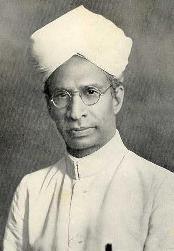
Sir
(Dr) Sarvepalli Radhakrishnan
(1888-1975) was one of the most profound
philosophers of this century, author and
educationalist. In 1926, he
was deputed by Calcutta University as the university delegate to the Congress of
the Universities of the British Empire. He was elected Fellow of the British
Academy in 1940, first Indian to be thus honored.
He succinctly said:
“The West tried its best to
persuade India that its philosophy is absurd, its art puerile, its poetry
uninspired, its religion grotesque and its ethics barbarous”.
(source:
The
Decline of the West - By Oswald Spengler p. 13 and Contending
paradigms of Indian history: Did India lack historical agency? - By Shivaji
Singh).
Refer
to
The Myth of Saint Thomas and the Mylapore Shiva Temple
- By Ishwar Sharan and Invading
the Sacred: An Analysis of Hinduism Studies in America
- By Krishnan Ramaswamy, Antonio de Nicolas and Aditi
Banerjee
Refer
to
Gypsies arrived in Europe 1,500 years ago, genetic study
says
- Aryan invasion was a fairytale?
The colonial era of Indian history
was an era of historical myth-making.
Innumerable myths were created and propagated to falsify history with a view to
change Indian psyche and denationalize Indian identity.
 "In the days when historian supposed
that history had begun with Greece, Europe gladly believed that India has been a hotbed of
barbarism.
"In the days when historian supposed
that history had begun with Greece, Europe gladly believed that India has been a hotbed of
barbarism.
In 1924 the world of scholarship was again roused by news from India.
Sir John
Marshall announced that he had discovered at Mohenjo-daro, on the western bank of the
lower Indus, remains of what seemed to be an older civilization than any yet know to
historians. The indications are that Mohenjo-daro was at its height when Cheops built the
first great pyramid; that it had commercial, religious, and artistic connections with
Sumeria, and Babylonia. It survived over 3000 years, until the third century before
Christ."
(source: "The Story of Civilization:
Our Oriental Heritage - By Will Durant ISBN 1567310125 p
394-396).
The first point to note is that the
idea of the Aryans as foreigners who invaded India and destroyed the existing
Harappan Civilization is a modern European invention; it
receives no support whatsoever from Indian records - literary or archaeological.
The same is true of the notion of the Aryans as a race; it
finds no support in Indian literature or tradition. (And genetics demolishes
it.) The word 'Arya' in Sanskrit means noble and
never a race. In fact, the authoritative Sanskrit lexicon (c. 450
AD), the famous Amarakosha gives the
following definition:
mahakula kulinarya sabhya sajjana sadhavah
.

Statue
of a Serene Lord Vishnu.
An Arya is
one who hails from a noble family, of gentle behavior and demeanor, good-natured
and of righteous conduct.
Aryan
Invasion theory has no support whatsoever from Indian records - literary or archaeological.
In this Imperial history, India is portrayed as the land
“conquered” first by the ‘Dravidians’, then by the ‘Aryans’, later
by Muslims, and finally by the British. Otherwise, everything else is mythical.
Our history books today exhibit this obsession with foreign rule.
Watch
Scientific
verification of Vedic knowledge
and
refer to Romila
Thapar’s Kluge Prize – By Dr. Gautam Sen - vigilonline.com
and
watch
New
Discoveries on
India
's History
Now:
A Kerala model Aryan Invasion is to Set Sail
- By
Prof. C. I. Issac
***
An Arya is one who hails
from a noble family, of gentle behavior and demeanor, good-natured and of
righteous conduct. And the great epic Ramayana
has a singularly eloquent expression describing Rama as:
arya sarva samascaiva sadaiva priyadarsanah
- Arya, who worked for the equality
of all and was dear to everyone. The Rig Veda also uses the word Arya
something like thirty six times, but never to mean a race. The nearest to a
definition that one can find in the Rigveda is probably:
praja arya jyotiragrah ...
Children of Arya are led by
light - Rig Veda VII.
33.7.
“Krunvanto Vishwam
Aryam” - Rig Veda IX.63.5
“Anaryajushtam aswargyam akeertikaram arjuna
- Lord Krishna in Shrimad Bhagavad Gita -II.2.
Thus, the modern notion of an Aryan-Dravidian racial divide is contradicted by
ancient records. We have it on the authority of Manu that the Dravidians were
also part of the Aryan fold. Interestingly, so were the Chinese. Race never had
anything to do with it until the Europeans adopted the ancient word to give
expression to their nationalistic and other aspirations.
Please refer to Naimisha
Journal
for interesting articles on Aryan Invasion Theory).
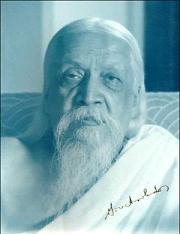 Sir Aurobindo
(1872-1950) most original philosopher of modern India. He
has said: "It distresses us to see Indian inquirers with their great
opportunities simply following in the path of certain European scholars,
accepting and adding to their unstable fantasies, their huge superstructures
founded on weak and scattered evidence and their imaginative "history of
our prehistoric ages." Sir Aurobindo
(1872-1950) most original philosopher of modern India. He
has said: "It distresses us to see Indian inquirers with their great
opportunities simply following in the path of certain European scholars,
accepting and adding to their unstable fantasies, their huge superstructures
founded on weak and scattered evidence and their imaginative "history of
our prehistoric ages."
(source: India's Rebirth
- Sri Aurobindo p. 110-111).
The term 'aryan' has never been used
in a racial sense anywhere in the vast compendium of Hindu literature. In the
whole of the Rig Veda the word arya occurs no more than four times. It stands
for whatever is regarded as eminent and ennobling. The term was used in a racial
sense for the first time by Western historians who cooked up the theory of an
Aryan invasion of India around 1500 B.C. They also popularized in a racial
sense, the term Dravidian which had earlier had only a linguistic connotation.
(source: Story
of Islamic Imperialism in India - By Sita Ram Goel Voice of
India ISBN : 81-85990-23-9 p. 8).
It is not a wise or correct view that the Hindus
had no historical sense. When they excelled in many difficult sciences and arts,
it cannot be that they were deficient in the comparatively crude and primitive
art of keeping chronicles, in which much lesser peoples have excelled.
 Colonel Jame Tod
(1782-1835) author of Annals
and Antiquities of Rajasthan: or the Central and Western Rajput States of India
ISBN 8120612892 says well: Colonel Jame Tod
(1782-1835) author of Annals
and Antiquities of Rajasthan: or the Central and Western Rajput States of India
ISBN 8120612892 says well:
"If we consider the political changes and
convulsions which have happened in Hinduism since Mahmud's invasion and the
intolerant bigotry of many of his successors, we shall be able to account for
the paucity of its national works on history, without being driven to the
conclusion, that the Hindus were ignorant of an art which was cultivated in
other countries from almost the earliest ages. Is it to
be imagined that a nation so highly civilized as the Hindus, amongst whom the
exact sciences flourished in perfection, by whom the fine arts, architecture,
sculpture, poetry and music were not only cultivated but taught and defined by
the nicest and most elaborate rules, were totally unacquainted with the simple
art of recording the events of their history, the chapters of their princes and
the acts of their reigns?"
Though it is often said glibly that India has
never had any historical instinct and that she has never kept any record of her
achievements, such a view is incorrect.
The fact seems to be that the so-called
Dravidians and the so-called Aryans were indigenous people in India and that the
theory of their immigration and incursion into India is a figment of occidental
scholarship.
In Tamil words Dravida is said to be the name of
the Southern portion of India from Tiruvenkatam (Tirupati) to Kumari (Cape
Comorin). The ancient Tamil works speak of a flood which destroyed the land
south of the Kumari. The term Pancha Dravidas include the Tamils, the Telegus,
the Karnatahas, the Maharastrians, and the Gurjaras, just as the term Pancha
Gowdas include the people of the north of the Vindhyas. Thus
the term Dravidas relates to a tract of land and not to a race.
The theory of the Aryan
immigration into India from somewhere has been so often repeated by the western
savants that it has become an article of faith even with the Indian scholars!
But the Vedas refer to the Himalayas as the Uttara Giri i.e. the northern border
and and contain no hints of an Aryan immigration into India from abroad.
(source: Indian Culture
and the Modern Age - By Dewan Bahadur K. S. Ramaswami Sastri
Annamalai University. 1956 p. 46-51).
Several eminent
personalities including Swami Vivekanand, Gurudev Rabindranath Tagore
and Shri Aurobindo firmly
believed that Aryans were homegrown, born and brought up in India.
Many chose to dismiss those views simply as irrational, inspirational or
ultra-nationalistic. Yet, the archeological finds being
uncovered presently, year after year, supported by continuing historical &
scholarly research seem to prove that Swami Vivekanand, Rabindranath Tagore and
Shri Aurobindo, and many learned
personalities were correct to raise pointed questions against the Aryan Invasion
Theory.

The theory of the Aryan
immigration into India from somewhere has been so often repeated by the Western
savants that it has become an article of faith even with the Indian scholars!
If there
were similarities in certain features of Indian people and people from Central
Europe, then automatic inference drawn was that the Aryans coming from Europe
invaded
India
and settled here. No one dared of thinking in any other way. Therefore, there
is urgency for the historians and all other intellectuals to stop reducing
Indian history to myth. There is need to gather, dig out, search, unearth and
analyze all the evidences, which would throw more light on ancient Indian
civilization and culture.
Watch
Scientific
verification of Vedic knowledge
Watch The
Saraswati River
- youtube.com
and
Watch
New
Discoveries on
India
's History
Refer
to Invading
the Sacred: An Analysis of Hinduism Studies in America
- By Krishnan Ramaswamy, Antonio de Nicolas and Aditi
Banerjee.
Refer
to Romila
Thapar’s Kluge Prize – By Dr. Gautam Sen - vigilonline.com.
Refer
to Ram
was for real – By Saroj Bala
The Pioneer
October 12, 2003. Refer to
The Lost River: On the trail of the Sarasvati - By Michel Danino - Penguin.
***
The British, in presenting the
Aryan Invasion Theory offered no proof. They
did not need to. Hundreds of Indian historians rushed forward to earn their
doctorates, promotions, patronage and government-aided jobs and positions for
supporting the British theory of Aryan Invasion of India.
Their Proof? Largely quoting
those very hundreds of articles and books –and asking - how could so many
learned books and serious articles by countless British and Indian historians be
wrong!
Some
did murmur that the British-created Myth was aimed at proving to the Indians
that they have always been ruled by foreigners, being incapable of ruling
themselves and that it was always the foreign invader, like the Aryans (and in
later times, other foreigners and finally, the British), who brought progress
and enlightenment – and therefore never must Indians aspire for self-rule
unless the intention is to bring back darkness, decadence and ruin on
themselves.
(source: Return
of the Aryans - By Bhagwan S Gidwani - Book reviewed by Prof. Jagjit
Mirchand).Refer to chapters on First
Indologists and European
Imperialism.
Top of Page
Oriental
Renaissance
In the 18th century, India was
regarded as the origin of civilization, by thinkers like Voltaire and Schlegel.
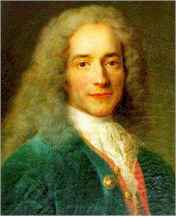 Voltaire
Francois Marie Arouet (1694-1774)
France's greatest writer and philosopher wrote:
Voltaire
Francois Marie Arouet (1694-1774)
France's greatest writer and philosopher wrote:
" I am
convinced that everything has come down to us from the banks of the Ganges, -
astronomy, astrology, metempsychosis, etc." " It is very
important to note that some 2,500 years ago at the least Pythagoras went from
Samos to the Ganges to learn geometry...But he would certainly not have
undertaken such a strange journey had the reputation of the Brahmins' science
not been long established in Europe..."
Friedrich
von Schlegel (1772-1829) German philosopher, critic, and writer, declared in 1803:
"Everything
without exception is of Indian origin.." "whether directly or
indirectly, all nations are originally nothing but Indian colonies."
(source: The Invasion That Never Was -
By Michel Danino and Sujata
Nahar p. 12 - 13 and 90 - 91).
Refer to Voltaire, Lettres
sur l'origine des sciences et sur celle des peuples de l'Asia (first
published Paris, 1777), letter of 15 December 1775. and Voltaire,
Fragments historiques sur l'linde, p. 444 - 445.
Refer to Out
of India Theory - wikipedia.org and refer to chapter on Survarnabhumi
and Sacred Angkor
Count Magnus
Fredrik Ferdinand Bjornstjerna (1779-1847)
author of Die
Theogonie, Philosophie und Kosmogonie der Hindus says:
"It is there in (Aryavarta) we
must seek not only for the cradle of the Brahmin religion but for the cradle of
the high civilization of the Hindus, which gradually extended itself in the west
to Ethiopia, to Egypt, to Phoenicia; in the East to Siam, to China and Japan; in
the South to Ceylon, to Java and to Sumatra; in the North to Persia, to Chaldea,
and to Colchis, whence it came to Greece and to Rome and at length to the
distant abode of the Hyperboreons."
 Five years later, Alexander Hamilton
(1757-1804) aide-de-camp to George Washington and first secretary of the
Treasury, epitomized this attitude in these words: Five years later, Alexander Hamilton
(1757-1804) aide-de-camp to George Washington and first secretary of the
Treasury, epitomized this attitude in these words:
"When we read in the valuable
production of those great Oriental scholars...those of a Jones, a Wilkings, a
Colebrooke, or a Halhed - we uniformly discover in the Hindus a nation, whose
polished manners are the result of a mild disposition and an extensive
benevolence."
Frederick
Eden Pargiter (1852-1927) in his well-known work Ancient
Indian Historical Tradition says that the Aryan civilization is the
civilization of the Aila or Lunar race which lived in Ilavrita in mid-Himalayas:
that the Vedic culture reflects a blend of both Aryan and Dravidian and that the
Aryan civilization did not come from beyond; and that
it spread to Afghanistan and Persia and further west from India.
(source: Indian Culture
and the Modern Age - By Dewan Bahadur K. S. Ramaswami Sastri
Annamalai University. 1956 p.39).
 Theodor Benfey
(1809-1881), a German linguist, was of the opinion that India is the origin of
ancient civilization that spread to Europe along with its language and the
religious stories. Theodor Benfey
(1809-1881), a German linguist, was of the opinion that India is the origin of
ancient civilization that spread to Europe along with its language and the
religious stories.
Benfey's fame rests on his Pantschantantra,
Fuenf Buecher indischer Fabeln, Maerchen und Erzaehlungen. ("Pancatantra,
five books of Indian fables, fairy tales and stories), 1859. In the Introduction
he showed that many Oriental and Occidental fairy tales are of Indian origin. He
traced their route to the West: they were firs translated into Pahlevi, then
into Arabic to be later rendered into Greek, Persian, Hebrew, Latin and German.
According to Benfey, the Pancatantra is a nitishastra, a book on statesmanship
for kings and ministers. He concludes the introduction by saying "my
research in the field of fables, fairy stories and tales of Orient and Occident
have convinced me that not few fables, but a large number of fairy tales and
stories, was spread from India all over the world."
(source: German
Indologists: Biographies of Scholars in Indian Studies writing in German
- By Valentine Stache-Rosen p.32 - 33).
Refer to Out
of India Theory - wikipedia.org.
Historian Thomas
R. Trautmann explains, its proponents hoped that "the study of
Sanskrit and Indian antiquities would bring a second renaissance to the West, as
the study of Greek learning had been the foundation of the first
Renaissance."
The French scholar Maurice
Olender agrees: "Hebrew, whose centrality had been challenged
for some time, finally gave way to Sanskrit," and, for a time, Sanskrit
texts "with an air of eternity about them came to supplant the Bible."
Well, almost.
***
Doctrine
of Christian Discovery
 C
K Raju (1954
- ) holds a Ph.D. from the Indian Statistical Institute. He taught mathematics
for several years before playing a lead role in the C-DAC team which built Param:
India
’s first parallel supercomputer. His earlier book ‘Time: Towards a
Consistent Theory’ set out a new physics with a tilt in the arrow of time. He
has been a Fellow of the Indian Institute of Advanced Study and is a Professor
of Computer Applications. C
K Raju (1954
- ) holds a Ph.D. from the Indian Statistical Institute. He taught mathematics
for several years before playing a lead role in the C-DAC team which built Param:
India
’s first parallel supercomputer. His earlier book ‘Time: Towards a
Consistent Theory’ set out a new physics with a tilt in the arrow of time. He
has been a Fellow of the Indian Institute of Advanced Study and is a Professor
of Computer Applications.
He has observed that:
"According
to which only Christians could be regarded as discoverers.
The
church decreed that ownership of a piece of land must go to the first Christian
to spot it. (Hence, the claim that
Columbus
“discovered”
America
, or that Vasco da Gama “discovered”
India). The people already living on the land did not matter, and the church
encouraged their killing on a mass scale, where possible, as actually happened
on three continents.
This
doctrine was made into a law by the
US
supreme court, and that is where the current US law on land-ownership vis-a-vis
the “Red Indians” stands".
(source:
Newton
as Theologian
- By C K Raju).
Refer to Five
Hundred Years of Injustice and
Evangelical Intrusions - By Sandhya Jain Rupa Publications.
Note:
The Doctrine of Discovery provided that
by law and divine intention European Christian countries gained power and legal
rights over indigenous non-Christian peoples immediately upon their
“discovery” by Europeans. Various European monarchs and their legal systems
developed this principle to benefit their own countries. Refer to Native
America, Discovered and Conquered: Thomas Jefferson, Lewis & Clark, and
Manifest Destiny - By Robert Miller
***
However, this generous estimate of
Indian civilization and its possible contribution to the West started changing
as Britain's hold over India grew more firm and widespread. While most 18th
century European travelers to India described her as "flourishing,"
less than a century later she had sunk into depths of dismal misery. The Mahabharata
has this pregnant image: "If spent ceaselessly even the Himalayas would be
exhausted." The British were anxious to clothe their greed in lofty
ideals" the "white man's burden"
of civilizing (and, naturally,
Christianizing) less enlightened races, the "divinely ordained
mission" of bringing to India the glory of Europe's commercial and
industrial civilization, and so forth.
 As Thomas R.
Trautmann American historian, puts it: As Thomas R.
Trautmann American historian, puts it:
"Evangelical influence drove British policy down a path that tended to minimize
and denigrate the accomplishments of Indian civilization and to position itself
as the negation of the (earlier) British Indomania" that was nourished by
belief in Indian wisdom."
(Refer
to
What
Every "Ugly American" Must Know about the "Civilized British
- www.larouchepac.com)
The Rich Ironies of the Aryan Invasion Theory
This is not to say that the British
did not succeed in taking control of the overall Indian narrative by
conceptualizing its history in communal terms and by outright fabrications such
as the “Aryan invasion theory” postulating an imaginary proto-European parent of
Indian civilization. But that was as much self-deception as it was manipulation.
In fact, the invention of the “Aryan Race” proved disastrous for Britain: it
became the basis for the racist ideology of Nazi
Germany and, in one of history’s rich ironies, mobilized under the
Swastika the armies that demolished its capacity to hold onto India.
(source:
Why Britain Failed to Subvert the Hindu Narrative – By Bhaskar Menon).
That is how the short-lived "Indomania"
gave way to what the French scholar Raymond Schwab
called "British Indophobia." Sadly,
but mistakenly, most of Europe's Sanskrit scholars were now certain that these
translations would "carry their own condemnation." The British could
even less accept that they owed their language and civilization to a benighted
India - that would have been dealing a blow to the very foundation of Europe's
mission in India, and particularly to the British Empire now at the height of
its glory. Thus, the Rig-Veda was seen as "rather Indo-European than Hindu,
and representing the condition of the Aryans before their final settlement in
India."
Never mind that all this was mere
conjecture, that the Rig-Veda itself made it clear that the wars between Aryans
and Dasyus, were battles between powers of light and darkness, that the word
"Arya" was plainly used in the Veda to describe not a racial group,
but a quality of being and a culture, a dedication to the truth and readiness to
fight for it - all this was simply brushed aside, and whole edifice was promptly
erected on these non-existent foundations.
 This theory was used to cut down the
Indian's pride in his past and nation - since India was no longer the source of
Indian civilization - and make him all the more willing to accept the white
man's rule: now that the Hindus were shown to be descendants of former invaders
who belonged to the same "Aryan race" as the Europeans' ancestors, it
was easier to legitimize Britain's conquest of India as merely as one more
"Aryan wave" which, this time would bring true light to the
subcontinent. John Wilson, a leading
Christian missionary of the time, declared in all seriousness in 1858, and
naturally this happy family reunion had now brought India into contact
"with the most enlightened and philanthropic nation in the
world." This theory was used to cut down the
Indian's pride in his past and nation - since India was no longer the source of
Indian civilization - and make him all the more willing to accept the white
man's rule: now that the Hindus were shown to be descendants of former invaders
who belonged to the same "Aryan race" as the Europeans' ancestors, it
was easier to legitimize Britain's conquest of India as merely as one more
"Aryan wave" which, this time would bring true light to the
subcontinent. John Wilson, a leading
Christian missionary of the time, declared in all seriousness in 1858, and
naturally this happy family reunion had now brought India into contact
"with the most enlightened and philanthropic nation in the
world."
Lord Derby,
then Secretary of State for India, declared that the scholars who had discovered
and proved the close relationship between Sanskrit and English, had rendered
more valuable service to the (colonial) Government of India than many a
regiment."
Sir
William Wilson Hunter
1840-1900) He was educated at Glasgow University (B.A. s86o), Paris and
Bonn, acquiring a knowledge of Sanscrit, and passing first in the final
examination for the Indian Civil Service in 1862. Author of A
Brief History of the Indian Peoples and editor of Imperial
Gazetteer of India.wrote in 1868:
"The
aboriginals would be a good target group for conversion
to Christianity. They have yet to start on the path of progress. It remains for
us to decide whether the path is to lead them to Hinduism, or the purer faith
and civilization which we represent."
(source: The Invasion That Never Was
-
By Michel Danino and Sujata
Nahar).
Thomas
R Trautmann author of Aryans and British
India (1997) and The Aryan Debate in India,
points out that the racial theory of Indian civilization is the product of the
late 19th century, when the relations between whites and other ethnic
groups in the Anglo-Saxon world were being reconfigured with ideological support
from a spate of racial essentialism.
Trautmann
concludes: “That the racial theory of Indian
civilization still lingers is a miracle of faith. Is it not time we did away
with it.” (215).
(source: The Quest for the Origin of Vedic
Culture
- By Edwin F Bryant p. 51 – 62).
History as a
Colonial Tool
Foisting Western Myths
on Rest of the world -
Columbus discovered America,
St. Thomas in India,
Churchill, the Lionheart?,
Saintly Mother Teresa and Aryan Invasion Theory.
“For
Western historians anything that is pre-Christian has to have been heathen,
barbaric, godless or pagan, and traced back to Greek or Rome. Thus, their religious loyalties stunt their intellectual horizons."
- Stephen
Knapp, author of Proof of Vedic Culture's
Global Existence p. 272.
***
Eurocentrism
is becoming identified with ignorance and oppression

(source: The Invasion That
Never Was - By Michel Danino/Sujata Nahar p. 44).
Refer to Out
of India Theory - wikipedia.org. Watch
Scientific
verification of Vedic knowledge
and
Watch
New
Discoveries on
India
's History
Refer
to Defaming
of Hinduism-I – By V Sundaram – newstodaynet.com and Defaming
of Hinduism-II – By V Sundaram – newstodaynet.com. Refer
to Communist
Historians: The Enemy Within – By Yvette
Rosser and
Romila
Thapar’s Kluge Prize – By Dr. Gautam Sen - vigilonline.com
Refer to
What
Every "Ugly American" Must Know about the "Civilized British
- www.larouchepac.com
For
more on Christian Intolerance refer to
chapters on The Goa
Inquisition, European
Imperialism, Conversion,
and First Indologists.
Refer
to Invading
the Sacred: An Analysis of Hinduism Studies in America
- By Krishnan Ramaswamy, Antonio de Nicolas and Aditi
Banerjee.
***
 Henri Cordier (1849 -
1925) French scholar quoted in The
Adventures of Ibn Battuta
Henri Cordier (1849 -
1925) French scholar quoted in The
Adventures of Ibn Battuta
“Westerners
have singularly narrowed the history of the world in
grouping the little that they know about the expansion of the human race around
the peoples of Israel, Greece and Rome. Thus have they ignored all
those travelers and explorers who in their ships ploughed the China Sea and the
Indian Ocean, or rode the immensities of Central Asia to the Persian Gulf.
In
truth the larger part of the globe, containing cultures different from those of
the ancient Greeks and Romans but no less civilized, has remained unknown to
those who wrote the history of their little world under the impression that they
were writing world history."
The
Alleged Massacre at Mohenjo-daro
This
was the second major distortion
 One
of the major props for this theory has been the ”massacre at
Mohenjo-daro.” According to this “theory,” the Aryans supposedly came
riding on their horses swinging their iron swords and masssacred the hapless
“Dravidian” inhabitants of Mohenjo-daro (the ancient city of Indus Valley
Civilisation). One
of the major props for this theory has been the ”massacre at
Mohenjo-daro.” According to this “theory,” the Aryans supposedly came
riding on their horses swinging their iron swords and masssacred the hapless
“Dravidian” inhabitants of Mohenjo-daro (the ancient city of Indus Valley
Civilisation).
How
do we know there was a massacre?
Because,
we are told, many skeletons have been found at this ancient site which
conclusively prove the Aryan invasion. B .B. Lal (ex-Director
General, Archaeological Survey of India) in his paper presented at
the International Conference on Indian History, Civilisation and Geopolitics
2009, has this to say about the alleged massacre at Mohenjo-daro which is the
“proof” given to us for the Aryan invasion:
"Adding
fuel to the fire was the famous declaration of my revered guru, Sir
Mortimer Wheeler (1890 - 1976). In 1946, after having discovered a
fortification-wall around one of the mounds at Harappa and on learning that in
the Vedas Indra has been described as puraÅdara
(i.e. destroyer of forts), he lost no time and announced:
 “On
circumstantial evidence Indra [symbolic of the Vedic Aryans] stands accused [of
destroying the Harappan Civilization].” “On
circumstantial evidence Indra [symbolic of the Vedic Aryans] stands accused [of
destroying the Harappan Civilization].”
The
hands of the Vedic “invaders” were sullied with the blood of the so-called
‘Dravidian-speaking Harappans’ who were said to have been massacred by the
former, and whose territories were usurped by them driving
the latter all the way down to south India. In support of the
(supposed) massacre, Wheeler cited some skeletons met with at Mohenjo-daro.
However,
an in-depth analysis of the provenance of these skeletons shows that they
occurred in different stratigraphic levels – some in the middle, some in the
late and yet some others in deposits which had accumulated at the site after its
abandonment. Had an invasion been the cause of these deaths, one expects that
the skeletons would have been found in one level which also would have been the
uppermost, after which the inhabitants are taken to have deserted the site and
migrated to south India. Further, all the skeletal remains came from the Lower
Town which was occupied by the commoners, but none from the Citadel area which
was the seat of the government. Are we expected to believe that the
‘invaders’ killed the commoners and carefully spared the high-ups? The doubt
about the deaths having been the result of an ‘invasion’ is also supported
by that fact some of the skeletons bore cut-marks which had been healed – a
process which must have taken quite some time. There would have been no healing
had the deaths been due to a ‘massacre’.
I
am in full agreement with George F. Dales
who captioned his paper (1964): ‘The Mythical
Massacre at Mohenjo-daro’. In this context, it also needs to be
added that no site of the Harappan Civilization has yielded any evidence of
‘invasion’, much less of ‘massacre’. Nor is there any evidence of an
alien culture overtaking any of these sites. On the other hand, the data show a
continuity of occupation and only gradual cultural transition – such as into
what has been labeled as the Jhukar Culture at Chanhu-daro or Cemetery H Culture
at Harappa or the Rangpur Culture in Gujarat."

Christian imperialists and modern evangelists have, and still are
re-interpreting Hindu Scriptures by using their sinister imagination to paint a
false picture of Aryan-Dravidian divide. There was never such thing as Aryan
race and Dravidian race in the past.
Refer
to
The Myth of Saint Thomas and the Mylapore Shiva Temple
- By Ishwar Sharan
The Myths imposed on Indians by the White Man's
willful arrogance - include the
Aryan Invasion,
The Myth of Saint Thomas
and
British gave India democracy
and
The Hoax of Mother Teresa
and
Now:
A Kerala model Aryan Invasion is to Set Sail
- By
Prof. C. I. Issac
and
Aryan Idols: Indo-European Mythology as Ideology and Science by Stefan Arvidsson
– Book Review by N S Rajaram
and
Exposing the relayed myth of “Aryan Invasion” and Proselytizing Evangelicals -
Book Review
- By D R Sardesai and
Gypsies arrived in Europe 1,500 years ago, genetic study
says
- Aryan invasion was a fairytale?
***
Sometimes
I wonder if these Raj-era historians and the modern
communist historians of India have been inhabiting a cuckoo-land
all along. What is the reason for these people to be so determined to
teach our children this history of India and simply refuse to change it despite
the laughable arguments and day-dreaming on which most of its conclusions rest? And
to think that an entire “Dravidian” movement was created in Tamil Nadu based
on this fantastic proof of Aryan invasion of India! Those old
Dravidian war-horses are still grazing contentedly in the south, I have heard,
and have managed to rule the state for many years in the bargain. The
Aryan invasion theory is a political theory created with a certain political
objective in mind (detaching south India from rest of India and turning it into
a Christian land).
This
is why the lack of a historical proof for this theory is treated as a minor
irritant and brushed aside with contempt by Anglo-Americans
and Indian communist professors. It
is the now the turn of Indians to brush these people aside with the same
contempt.
(source:
The
Alleged Massacre at Mohenjo-daro - indianrealist.com). Refer
to Communist
Historians: The Enemy Within – By Yvette
Rosser.
A
Hoax of a theory
No
mention of
Europe
There is no mention of any
location outside the mainland of
India
in any of the Vedic texts! If Aryans came from
Europe
, then why haven't the so called Aryans mentioned any of the European locations
in any of the Vedic or related texts? The farthest location away from
India
towards the west mentioned in the Vedas is Kadhahar of present day
Afghanistan
, which was called Gandhar in the Vedic texts and was said to be the
kingdom
of
Shakuni
. Why haven’t any of the texts mentioned about their European locations? Why
is there no Vedic text which talks about migration from
Europe
?
No
European Rivers
None of the Vedic texts
talk about rivers outside
India
! Everybody knows that rivers were the major sources of water for all ancient
civilizations and so all ancient civilizations were centered around the
world’s major rivers. Why is there no mention of any European river or a river
outside
India
anywhere in the Vedic texts? Wouldn’t a race mention something or the other
about its native place in at least one of its texts?
Dravidians
was not a separate race
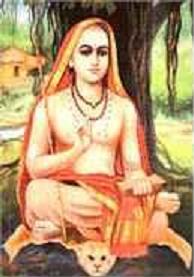 The
word ‘Dravida’ was first coined by Adi Sankara,
a Brahmin monk from Kerala: in his shasthrath with Mandana Mishra at
Varanasi
, he had called himself a ‘Dravida shishu’
that is a child of an area where three oceans meet ie.
South India
. The
word ‘Dravida’ was first coined by Adi Sankara,
a Brahmin monk from Kerala: in his shasthrath with Mandana Mishra at
Varanasi
, he had called himself a ‘Dravida shishu’
that is a child of an area where three oceans meet ie.
South India
.
Refer to
The Myth of Saint Thomas and the Mylapore Shiva Temple
- By Ishwar Sharan
Why don't any Dravidian
folk lore or ancient texts or sayings or stories or epics exist which talk about
the so called Aryan invasion? Also why do the Vedic texts talk about locations
in
South India
? The Ramayana, Mahabharatha all talk about South Indian locations even below
and beyond the main
land
of
India
into the
Indian ocean
like Srilanka! If Aryans were from Europe and if they invaded North India and
pushed local people down to
South India
, where did these locations come from? This proves beyond doubt that there do
not exist any separate Aryan and Dravidian races. Instead natives of both North
India and
South India
belong to one single race called the Vedic Indian race!
(source: Hoax
of Aryan invasion theory).
Passport
to Europe?
The
Aryan-Dravidian divide in history taught in schools and universities is purely a
concept of foreign historians like Max Muller;
it has no basis in Indian historical records. This fraudulent
history has been lapped up by upper caste Indians,
as their racial passport to
Europe
. Such has been the demoralization of the Hindu mind, which we have to shake off
through a new factual account of our past.
(source:
Hindus
Under Siege - By Dr.
Subramanium Swamy
p. 1 - 20).
AAA's (American
Anthropological Association) Statement
on Race
From its
inception, this modern concept of "race" was modeled after an ancient
theorem of the Great Chain of Being, which posited natural categories on a
hierarchy established by God or nature. Thus "race" was a mode of
classification linked specifically to peoples in the colonial
situation. It subsumed a growing ideology of inequality devised to
rationalize European attitudes and treatment of the conquered and enslaved
peoples. Proponents of slavery in particular during the 19th century
used "race" to justify the retention of slavery. The ideology
magnified the differences among Europeans, Africans, and Indians, established a
rigid hierarchy of socially exclusive categories underscored and bolstered
unequal rank and status differences, and provided the rationalization that the
inequality was natural or God-given. The different physical traits of
African-Americans and Indians became markers or symbols of their status
differences.
As they
were constructing
US
society, leaders among European-Americans fabricated the cultural/behavioral
characteristics associated with each "race," linking superior traits
with Europeans and negative and inferior ones to blacks and Indians. Numerous
arbitrary and fictitious beliefs about the different peoples were
institutionalized and deeply embedded in American thought.
(source: AAA's
Statement on Race).
Watch
New
Discoveries on
India
's History
Page < 1 2 3 4 5 6 7 8 9 10 11 12 13 14 15 >
|