|
A Glorious Hindu Legacy: Indic influence in Southeast
Asia.
Kalinga Dvipa
- The Philippines
Kalinga
Srisailam established the Sri
Vijaya empire
in Palambangu (Sumatra island). The first large empire to make Sumatra its home
was Sri Vijaya in the 7th century, also the first Hindu kingdom
of Indonesia. They controlled not only this empire but also most
part of the Indonesia and Malay Peninsula. The
empire of Sri Vijaya of Malacca (or Melaka) Malaysian
archipelago was the largest kingdom in the Pacific.

The
Hindu Empire of Sri Vijaya of Malacca Malaysian
archipelago was the largest kingdom in the Pacific.
(For
more refer to chapters on Greater
India: Suvarnabhumi and
Sacred
Angkor).
***
Philippines
was for a time part of the Sri Vijaya Empire, which has been
described by Filippino historians, as Hinduistic in culture.
Indianization
of Asia was entirely peaceful, never resorting to physical force
or coercion to subvert local cultures or identities, or to
engage in economic or political exploitation of the host
cultures and societies. Its worldviews were based on compassion
and mutual exchange, and not on the principle of conquest and
domination.
The Philippines consists of a group of 7,000 small islands.
We have found some literary evidence to show that there was
Hindu Sanskriti in this area of about 11,500 square miles.In the
central part of Sebu a bronze idol of Lokeshwar and a golden
idol of a Garuda have been found. In south Luzan, an idol of
Padmapni Avalokiteshwar has been found. It is inferred that the
Funan, Shalendra, and Mahapahit kingdoms had relations with the
Philippines.
At present Manila is the capital of
the Philippines. In the National Assembly Hall, behind the
president’s seat, is a picture of Manu. Manu taught law to the
Philippines, hence this picture. This shows the relation of the
ancient Hindu culture to the Philippines.
When the Philippines drafted its
Constitution, it placed the statue of Manu
(the progenitor and lawgiver of the human race) in the
National
Assembly Hall
with this inscription on its base: "The
first, the greatest and the wisest law-giver of mankind." Researches
into the racial and cultural origins of the Philippines
increasingly prove that it was colonized by some people in South
India. In fact, the script of the Filipinos has some obvious
similarities with that of South India. "Our dialects belong
to the Dravidian family." says Justice Romualdez. "The
names of some places on the shores of Manila Bay and the coast
of Luzon show their Sanskrit origin."
Indian influence is most patent in handicrafts and the old names
of coins used there. Many social customs current there show a
likeness to the Indian ones. Saleeby says, "The head-gods
of the Indian Triad and the earliest Vedic gods had the foremost
place in the minds and devotion of the hill-tribes of Luzon and
Mindanao. A Ganesha statue too was found there. Indeed as Beyer
says, "India has most profoundly affected the Philippine
civilization." Even the national
flower of Philippines is the Indian champaka. The
Indian influence on Philippines is explicable by the fact that
it was that it was for 150 years a colony of a Java-based Hindu
Empire of Sri Vijaya.
(source: The
Soul of India - By Satyavrata R Patel p. 30).
According
to Arun
Bhattacharjee:
"The unique
feature of India's contacts and relationship with other
countries and peoples of the world is that the cultural
expansion was never confused with colonial domination and
commercial dynamism far less economic exploitation. That culture
can advance without political motives, that trade can proceed
without imperialist designs, settlements can take place without
colonial excesses and that literature, religion and language can
be transported without xenophobia, jingoism and race complexes
are amply evidenced from the history of India's contact with her
neighbors...Thus although a considerable part of central and
south-eastern Asia became flourishing centers of Indian culture,
they were seldom subjects to the regime of any Indian king or
conquerors and hardly witnessed the horrors and havocs of any
Indian military campaign. They were perfectly free, politically
and economically and their people representing an integration of
Indian and indigenous elements had no links with any Indian
state and looked upon India as a holy land rather than a
motherland – a land of pilgrimage and not an area of
jurisdiction."
(source:
Greater
India - By Arun Bhattacharjee -
Munshiram
Manoharlal Publishers Private Limited, 1981, New Delhi
p. 2 - 3 and Indian Culture over the World - By S V Shevade p.
91 and The Soul
of India - By Satyavrata R Patel p. 30 and Geopolitics
and Sanskrit phobia
- By Rajiv Malhotra -
sulekha.com).
Philippines
was for a time part of the Sri Vijaya Empire, which has been
described by Filippino historians, as Hinduistic in culture.
Dr
Pardo de Tavera (1857 - 1925) has observed:
“It is
impossible to believe that the Hindus, if they came only as
merchants, however great their number, would have impressed
themselves in such a way as to give to these islanders, the
Philippines, the number and the kind of words, which they did
give. These names of dignitaries, of caciques, of high
functionaries of the court, of noble ladies, indicate that these
high positions, with names of Sanskrit origin, were occupied at
one time by men, who spoke that language. The words of similar
origin, for objects of war, fortresses and battle songs, for
designating objects of religious beliefs, for superstitions,
emotions, feelings, industrial and farming activities, show us
clearly that the warfare, religion, literature, industry and
agriculture were at once time in the hands of the Hindus and
that this race was effectively dominant in the Philippines.”

One
of the most ancient and most extensively studied Sanskrit
inscriptions from the Indochina peninsula is the so called 'Vo
canh' text, found near to Nha Trang. It came from the reign of
King Bhadravarman I. of Champa (Vietnam).
The
Spanish tried to stamp out all examples of native scripts and
literature for fear that Filipinos were using exotic symbols to
foment rebellion.
***

Royal
archives of Panduranga, Vietnam. Seal with Sanskrit
characters.
(image
source: Hindu-Buddhist Art of Vietnam:
Treasures from Champa - By Emmanuel Guillon)
***
(source: El
Sanscrito en la langua Tagalag - By T H Pardo de Tavera
Paris 1887; The Philippines and India -
By Dhirendra Nath Roy Manila 1929 and India
and The World - By Buddha Prakash p. 119-120).
Philippine
literature, stories, and folklore are traceable to India. The
Maranawa epic - An adaptation of "The
Ramayana," the 4th century Indian epic, as preserved by the
Maranao people of the South Philippines. A story of the battle
between good and evil, with love, deceit, heroism and triumph.
The
Ramayana in the Philippines
Contacts
between India and the Philippines could be traced back to Malay
culture, which has a clear imprint of Indian influence. Archaeological evidence suggests that the two
countries had trade relations as early as the beginning of the
Christian era. Coinage of Indian origin going back to 1800
years, have been found in the Philippines.
Sanskrit
words are
found in abundance in the local languages, indicating deep
cultural and linguistic ties. Ramayana is still a popular play
in some parts of the country.
The
Ramayana is an ancient Indian epic, but throughout
the ages it has swept through Southeast Asia from Myanmar,
Thailand, Cambodia, and Laos right through to Malaysia,
Indonesia and the Philippines, where the people have adopted it
and made it part of their own culture, adapting parts of the
story and changing the names of the characters, though Rama,
Sita and Dasaghiri remain the
principal characters. It is a popular legend even today.
(source: India
and World Civilization - By D. P. Singhal Part
II p. 155 - 157 and filipinolinks.com).

Devi - A Goddess
with Vajra in her right hand, while the left hand is in a mudra,
a gesture in Hindu iconography often symbolizes the imparting of
wisdom. The sculpture is a good example of the originality of so
many of the images carved by the neighboring Champa sculptors.
(image
source: Hindu-Buddhist Art of Vietnam:
Treasures from Champa - By Emmanuel Guillon)
Spanish clergy were very destructive of
local religious practices in the Philippines. They systematically destroyed
indigenous holy places and 'idols', or statues and
representations of indigenous spirits, gods or goddesses.
***
According to Alfred
Louis Kroeber (1876-1960), American anthropologist, and
a major figure in the founding of modern anthropology, as well
as author of Peoples of the Philippines
(1919):
"Most
of the folklore of the Philippines is of Hindu origin."
"There is no tribe in the Philippines no matter how
primitive and remote, in whose culture today elements of Indian
origin cannot be traced." Pre-Spanish Philippine
society with its nobility, code of laws, and political
procedure, was largely of Indian cast. Some years ago when a
legislative building was put in Manila, the capital, four
figures were carved on its facade illustrating the source of the
Philippine culture, one of which is Manu, the ancient Indian
lawgiver. Beyer, the first
to conduct systematic archaeological investigation in the
Philippines, finds formidable evidence to strengthen the view
that there was pre-Christian contact between India and Southeast
Asia.

Seated Deva -
The pedestal of this monolithic statue is carved on three sides
with a kala head, and was situated in the inner Dong Dong
enclosure of Champa/Vietnam.
Some years ago when a
legislative building was put in Manila, the capital, four
figures were carved on its facade illustrating the source of the
Philippine culture, one of which is Manu, the ancient Indian
lawgiver.
(image
source: Hindu-Buddhist Art of Vietnam:
Treasures from Champa - By Emmanuel Guillon).
***
The
Hindu element in the ancient Philippine religious beliefs, and
in the names of old Philippine gods, and of legendary heroes is
quite apparent. Several religious objects have
been unearthed in the island of Mactan, including two images of
Hindu deities.
Two
Filipino scholars, Tavera and Paterno, have concluded that about
25 % of the Philippine vocabularies can be traced to Indian
influence.
For instance: bahagi
(part, portion), in Tagalog is bhag in Hindi,
katha (story, fiction) - katha;
diwata (god or goddess) is devata
dukha (poor, destitute) is duhkha
guru (teacher) is guru
mukha (face) is mukha
yaya (nurse) is aya and so on.
(source: Philippine
Political and Cultural History - By G. F. Zaide p.
45).
***
Destruction of
Native Culture by the Spanish Conquest
Conversion of Indigenous people of Philippines
 In 1521 a Spanish expedition
led by explorer and navigator Ferdinand Magellan made the first
recorded European contact with the Philippine Islands. Magellan
was on a mission for Spanish king Charles I (also Holy Roman
emperor as Charles V) to establish a westward route to the
Moluccas, also known as the Spice Islands. It was ruled as a
gobernación, a territory administered by a governor, and was
officially subordinate to the Spanish viceroy of New Spain. Spain's
objective in colonizing the islands: to provide a base from
which to Convert Asians to
Christianity, and to convert the
people of the Philippine Islands. The term
"Filipino" is a result of Spanish colonization.
The word "Philippines"
was named in honor of
King Philip
II of Spain
(1527
- 1598) it has no meaning for the inhabitants.
King Philip was also responsible for the formation of an Inquisition
in South America in
1569. In 1521 a Spanish expedition
led by explorer and navigator Ferdinand Magellan made the first
recorded European contact with the Philippine Islands. Magellan
was on a mission for Spanish king Charles I (also Holy Roman
emperor as Charles V) to establish a westward route to the
Moluccas, also known as the Spice Islands. It was ruled as a
gobernación, a territory administered by a governor, and was
officially subordinate to the Spanish viceroy of New Spain. Spain's
objective in colonizing the islands: to provide a base from
which to Convert Asians to
Christianity, and to convert the
people of the Philippine Islands. The term
"Filipino" is a result of Spanish colonization.
The word "Philippines"
was named in honor of
King Philip
II of Spain
(1527
- 1598) it has no meaning for the inhabitants.
King Philip was also responsible for the formation of an Inquisition
in South America in
1569.
The
Spanish-American War -
In April 1898 war broke out between Spain and the United States over
their competing imperialist
interests.
In May U.S. Commodore (later Admiral) George Dewey commanded the
Asiatic Squadron into Manila Bay, where it easily destroyed the
antiquated Spanish fleet at anchor there.
Spain
and Portugal spread Roman Catholicism to their colonies by
converting the indigenous peoples.
The legacy of Spanish Conquest and colonial rule in the
Philippines, was a colonial attempts to 'master' or manage
indigenous populations. Spanish clergy were very destructive of
local religious practices. They systematically destroyed
indigenous holy places and 'idols', or statues and
representations of indigenous spirits, gods or goddesses. They
also tried to stamp out all examples of native scripts and
literature for fear that Filipinos were using exotic symbols to
foment rebellion.
Spanish
colonization used Christianity as an instrument for conquest.
Philippine
literature dates from the era before the Spanish conquest. The
early Tagalog and a few other groups had a script that they used
in writing on strips of bamboo or palm. Most
of these early writings were destroyed by the Spanish
missionaries. Of what remained, few pieces survive
because of the highly perishable materials on which they were
written. The
Philippines supplied some wealth (including gold) to Spain, and
the richly laden galleons plying between the islands and New
Spain were often attacked by English freebooters. There was also
trouble from other quarters, and the period from 1600 to 1663
was marked by continual wars with the Dutch, who were laying the
foundations of their rich empire in the East Indies, and with
Moro pirates. One of the most difficult problems the Spanish
faced was the subjugation of the Moros. Intermittent campaigns
were conducted against them but without conclusive results until
the middle of the 19th cent. As the power of the Spanish Empire
waned, the Jesuit orders became more influential in the
Philippines and acquired great amounts of property. It was the
opposition to the power of the clergy that in large measure
brought about the rising sentiment for independence. Spanish
injustices, bigotry, and economic oppressions fed the
movement, which was greatly inspired by the brilliant writings
of José
Rizal.
In 1896 revolution began in the province of Cavite, and after
the execution of Rizal that December, it spread throughout the
major islands.

"Most
of the folklore of the Philippines is of Hindu origin."
Sanskrit words are
found in abundance in the local languages, indicating deep
cultural and linguistic ties. Ramayana is still a popular play
in some parts of the country.
(image
source: Hindu-Buddhist Art of Vietnam:
Treasures from Champa - By Emmanuel Guillon)
***
American
Imperialism: Manifest
Destiny and The Philippines
“The
moneyed elite in the United States have long coveted their
neighbors' land, resources, and cheap labor forces. Eager to
invade, annex, and exploit, the plutocracy began to disseminate
the warped notion of Manifest Destiny
in the Nineteenth Century. Purporting
to have the unwavering support of the Almighty, the
"superior" Anglo-Saxons rationalized slavery, the
Native American Genocide, the conquest of half of Mexico, the
annexation of Hawaii, and their eradication of over 300,000
"savages" in conquering the Philippines.”
(source:
Hell
Awaits, America - rense.com).
Manifest Destiny was a popular
concept in the 1840s as both an encouragement to and a
rationalization for the spread of the United States across the
entire continent. Americans came to accept the ethnocentric idea
that it was the divine mission of America to bring the benefits
of Christianity and civilization and progress to all areas of
North America. In addition an ideology combining
Social
Darwinism, Christianity, racism, and pseudoscientific
theories were sweeping across Europe and America. These
nineteenth century factor laid the basis for America's quest for
empire.
Anglo-Saxonism, the' Great Race':
a corollary in the Social Darwinist imaginary is the ideology of
Anglo-Saxonism: Teutons, Aryans are constructed at the apex of
the pyramid of civilized peoples, the 'sliding scale' of races,
with biologically inherited 'racial traits.' Teddy
Roosevelt's history The
Winning of the West (1907) is predicated on this
notion, westward movement as "the
civilizing conquest of the savage by the Anglo-Saxon
democrat". Roosevelt openly admired various
aspects of Gobineau's theories on
racial inequality and H. S.
Chamberlain's Die Grundlagen des 19. Jahrhunderts (1899),
which later became the 'bible' for theorists of the German
master race. Many
US citizens wanted to "Christianize" the world
according to their version of Christianity.
In addition to helping
the American economy and trade, American imperialism will allow
America to carry out its noble god-given destiny of
"regenerating the world."
The Spanish-American
War began in April 1898 and this war gave independence to Cuba
in May 1902. America then turned her
attention to the Philippines Islands. America viewed these
islands as an ideal base from where American interests in China
could be defended. In February 1899, the United States
launched a campaign against the so-called insurgents in
Philippines Islands. The war lasted three and a half years.
According to American General Bell, who led the campaign, 100000
Philippines men were wiped out. 4000 American lives were lost.
Then began the American occupation of Philippines which lasted
till her independence after the II World War.
"The Bible is a mass of fables and traditions,
mere mythology." -wrote Mark Twain in Mark
Twain and the Bible
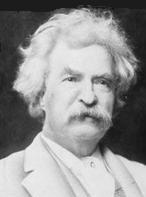 American
writer and journalist Mark Twain,
(1835-1910) also known as Samuel Clemens, one of the most widely
loved and celebrated American writers since his first books were
released in the late 1860s. American
writer and journalist Mark Twain,
(1835-1910) also known as Samuel Clemens, one of the most widely
loved and celebrated American writers since his first books were
released in the late 1860s.
Twain
was morally outraged by the United States' brutal
subjugation of the Philippines. His commentaries – a
condemnation of United States' mission to "civilize"
the Philippines. He
felt strongly compelled to comment on the massacre
Moro
Massacre.
The
Anti-Imperialist League quickly
published two leaflets about the massacre. General Leonard
Wood slaughtered all 600 unarmed Moros, counting women
and children, in the bowl of an extinct crater, near Jolo in
South Philippines.
In 1521, Ferdinand Magellan, the
Portuguese explorer in the service of the Spanish King,
celebrated the first Easter Mass on Limasawa island. From this
beginning, the archipelago, later named Las Islas Filipinas
after Prince Felipe of Asturias, became
the only Christian country in Asia.
Senator Albert
J
Beveridge
and other
supporters of an American empire believed that America had a
"divine mission" to bring our modern civilization,
Christianity, our democratic institutions, and our culture to
backward peoples.

Philippines rebel
leader being executed in Manila in 1899.
(source:
American
brutality recaptured - By V. Sundaram -
newstodaynet.com).
***
"God
has made us the master organizers of the world to establish
system where chaos reigns. He has given us the spirit of
progress to overwhelm the forces of reaction throughout the
earth. He has made us adept at government that we may administer
government among savage and senile peoples. Were it not for such
a force as this the world would relapse into barbarism and
night. And of all our race He has marked the American people as
his chosen nation to finally lead in the regeneration of the
world. This is the divine mission of
America, and it holds for us all the profit, all the glory, all
the happiness possible to man..."
(For
more refer to Empire
Beyond the Seas - By Richard A Silocka and to Mark
Twain - On
the Philippine-American War and
The
Founding Fathers were Not Christians
- By Steven
Morris, in Free Inquiry, Fall, 1995).
Refer to Pantheism
in the Philippines and American
Imperialism in the Philippines and Filipinos
in the Debate About Imperialism).
 President
McKinley (1843 -1901)
said on the Philippines:
"When
next I realized that the Philippines had dropped into our laps I
confess I did not know what to do with them......That
there was nothing left for us to do but to take them all, and to
educate the Filipinos, and uplift and civilize and Christianize
them as our fellow men for whom Christ also died." But
instead of creating a Philippine democracy, President William
McKinley annexed the country and installed
a colonial administrator. The United States then
fought a brutal war against the same Philippine independence
movement it had encouraged to fight Spain. The war dragged on
for fourteen years. Before it was over, about 120,000 American
troops were deployed and more than 4,000 died; more than 200,000
Filipino civilians and soldiers were killed. Thus
began the official American nationalist story of
"benevolent assimilation" and fraternal tutelage in
its half century of colonial occupation of the Philippines. President
McKinley (1843 -1901)
said on the Philippines:
"When
next I realized that the Philippines had dropped into our laps I
confess I did not know what to do with them......That
there was nothing left for us to do but to take them all, and to
educate the Filipinos, and uplift and civilize and Christianize
them as our fellow men for whom Christ also died." But
instead of creating a Philippine democracy, President William
McKinley annexed the country and installed
a colonial administrator. The United States then
fought a brutal war against the same Philippine independence
movement it had encouraged to fight Spain. The war dragged on
for fourteen years. Before it was over, about 120,000 American
troops were deployed and more than 4,000 died; more than 200,000
Filipino civilians and soldiers were killed. Thus
began the official American nationalist story of
"benevolent assimilation" and fraternal tutelage in
its half century of colonial occupation of the Philippines.
There
is one predominantly Christian
country in all of Asia. The
Philippines is approximately 85 percent Christian (mostly Roman
Catholic) and yet one of poorest in the world. (The
Philippines is one of the world’s poorest countries. This
country has no national health service and people who fall ill
are condemned. Because of poverty which affects most of the
people, every year thousands of people die from quite ordinary
diseases for which they cannot afford treatment or medicine. It
is one of the places where the majority dies of hunger and
healthcare is a privilege of a few, most people face problems
every day connected with poverty, precarious living conditions,
almost non existence of homes with sanitation, malnutrition,
which promote diseases linked with the tropical climate. For
most of them death is very often the direct consequence of not
receiving proper care).
"From
George Washington
to John Quincy Adams, the American way has been to avoid
imperial adventures."
John
Quincy
Adams' famous admonition that
America "goes not abroad in search of monsters to destroy.
She is the well-wisher to the freedom and independence of all.
She is the champion and vindicator only of her own."
Imperial Amnesia - The
United States invaded a distant country to share the blessings
of democracy. But after being welcomed as liberators, U.S.
troops encountered a bloody insurrection. Sound familiar? Don't
think Iraq-think the Philippines and Mexico decades ago. But, of
course, the United States and Britain had always claimed the
highest motives in seeking to dominate other peoples. McKinley
had promised to civilize and Christianize the Filipinos.
(source: Imperial
Amnesia - By John B Judis). Also refer to
George
Bush: 'God told me to end the tyranny in Iraq' - guardian.co.uk
and
How
the Dominionists Are Succeeding in Their Quest for National
Control and World Power - yuricareport.com
and
Christian
Supremacy: Pushing the Dhimmitude of Non-Christians in America
.
 Forrest G
Wood the author of Black
Scare: The Racist Response to Emancipation and Reconstruction
and
Arrogance
of Faith, is Professor of History at
California State University, writes: Forrest G
Wood the author of Black
Scare: The Racist Response to Emancipation and Reconstruction
and
Arrogance
of Faith, is Professor of History at
California State University, writes:
“Manifest
destiny was a religious concept that was exalted by Americans of
all social levels and had been an essential element in the
adventures of every European colonial power.”
Among the justification for seizing
the Philippines during the war with Spain in 1898 was the
contention that the United States had a manifest right to
civilize and Christianize “our little brown brothers,” who
had suffered so long at the hands of the corrupt Spanish
papists. The fact that the Filipinos were
overwhelmingly Roman Catholic meant little to white
Americans…The tunnel of piety was long and narrow. Religion is
man’s search for God, Christians like to say, but Christianity
is God’s search for man, a minder that the arrogance of faith
is not easily set aside.
(source: Arrogance
of Faith - By Forrrest
G Wood
p.
22 - 23 and 216).
For more refer to chapter on European
Imperialism and How
various parts of the world was converted to Christianity.
Top
of Page
Indian
Cultural Influence in Southeast Asia
Prof. Reginald Le May author
of The
culture of South-East Asia;: The heritage of India,
wrote:
“The beginnings of Indian
colonization overseas eastward go back a very long way in time
and it is almost certain that the results seen today were, in
the main, not achieved by military expeditions, but by peaceful
trading and religious teaching – and thereby all the more
permanent.”
***
 The Indonesian nationalist leader Suharto
Sukarno
(1901- 1970) was the first President of Indonesia. He helped the
country win its independence from the Netherlands. The Indonesian nationalist leader Suharto
Sukarno
(1901- 1970) was the first President of Indonesia. He helped the
country win its independence from the Netherlands.
He echoed the
same sentiments. In a special article in The Hindu on 4 January
1946, Sukarno wrote:
"In the veins of every one of my
people flows the blood of Indian ancestors and the culture that
we possess is steeped through and through with Indian
influences. Two thousand years ago people from your country came
to Jawadvipa and
Suvarnadvipa in the spirit of brotherly love.
They gave the initiative to found powerful kingdoms such as
those of Sri Vijaya, Mataram and
Majapahit. We then learnt to
worship the very Gods that you now worship still and we
fashioned a culture that even today is largely identical with
your own. Later, we turned to Islam: but that religion too was
brought by people coming from both sides of India."
(source:
Prospects
for a Bay of Bengal community - By V. Suryanarayan).
The long- sustained process of
Indianisation, for more than a millennium beginning from the
early centuries of Christian era, was accomplished by Brahman
priests, Buddhist monks, scholars and artisans who were
introduced into the Southeast Asian native societies by Indian
merchants time and again. This facet of history exemplifying the
long-sustained trade and cultural contacts between India and
Southeast Asia owes much to climatic changes characterized by
reversals of the monsoon winds that facilitated navigation
across the Bay of Bengal. The Arakan Yoma mountain ranges
deterred any possibility of developing overland routes between
the geographically proximate regions of Assam (northeastern
India) and Myanmar. Re-invigorated by the Guptas in northern
India, the Pallavas and the Cholas in Tamil country in southern
India, Indian cultural expansion all along the maritime trade
routes led likewise to the emergence of Indianized kingdoms in
Southeast Asia during the first millennium of the Christian era.

In fact, it was about 2000 years ago
that the first navigators, Indian merchants and Brahmins brought
to our ancestors their gods, their techniques, their
organization.
(For
more refer to chapter on Greater
India: Suvarnabhumi and
Sacred
Angkor).
***
Obviously, all these early kingdoms were all based
on the Hindu conception of royalty; but never had they become
Indian colonies. Among Indianized states of this nature were the
Funan, Champa, Langasuka (1-2 centuries AD), Mons of Thaton,
Pegu and Pyu (until 6C), Chenla (7-8C), Angkor (9-15C),
Sailendras in Java (8C), Sri Vijaya in Sumatra (8-13C) and
Majapahit (14C). Many of these kingdoms had their cultural and
diplomatic contacts maintained with Indian kingdoms on the
sub-continent. For instance, Funan (3C), Champa (5C) and
Sailendras (late 9C) had their cultural emissaries sent to the
northern Indian kingdoms. The visits of Pagan rulers of Burma to
India in the 12th century facilitated the renovation
of the Mahabodhi temple at Bodh Gaya in Bihar. This had served
as a cue for building similar monuments at Pagan and Xieng Mai
(in Thailand). A Sri Vijayan ruler built a Buddhist monastery at
Nagapattinam in South India (11C) which had enjoyed the
patronage of Chola kings.

Personal names, too, such as,
Rama, Norodom
Sihanouk, Sukarno, Suharto, Megawati, Mahathir, and
Ranaridh testify to the Southeast Asian peoples’ ardent
fascination for Indian culture.
***
The rulers of early Indianized kingdoms,
who enjoyed pre-eminence and prestige, had never been deprived
of the benefit of enjoying good neighbourly relations with
India, notwithstanding its multitude of kingdoms. Such relations
between India and the states of “South East Asia” cannot
however be construed as a freakish historical phenomenon since
the native rulers had displayed their penchant for having their
names styled on those in
vogue in India as, for instance, Narawara, Narapati, Naradipati,
Bhuvana, Nagara, and Rajadhiraja. ‘Varman’, the title of
Pallava kings, had become an ornament to such rulers as
Jayavarman, and so was ‘Candra’ adopted by the rulers of
Arakan like Rajacandra. These
titles “entailed” the first part of the names which too
recalled the nomenclature inherently based on Indian culture.
The intelligible similarity in the names was
something like ‘borrowing words,’ which Wignesan prefers to
term as “the primal proof of unidirectional influence” of
the donor’s culture or language on the recipient’s.
Even the Muslim rulers had their names suffixed with
Bhuvana or prefixed with Raja. Likewise, Indian cultural efflorescence is vividly found in
place names like
Srikshetra, Vyadhapura, Tambralinga,
Dvaravati, Haripunjaya, Singapura, Bhavapura and Ayuthia.
In the same way as contemporary place names, such as,
Malaya, Sumatra, Java, Bali and Cambodia, personal names, too, such as,
Rama, Norodom
Sihanouk, Sukarno, Suharto, Megawati, Mahathir, and
Ranaridh testify to the Southeast Asian peoples’ ardent
fascination for Indian culture.
The Southeast Asian peoples jealously
claim the Ramayana
and the Mahabharata
as their
own, as they consider their own territories as
the venue for all the
episodes of
the epics. Dedicated to Siva, Vishnu, Buddha, and the pantheon
of gods and goddesses of Indian mythology, are the world famous
Hindu-Buddhist temples —
Borobudur and Prambanan (Java),
Angkor Wat and Bayon (Cambodia), Ananda and Mahabodhi (Myanmar)
Mi-son and Po-nagar (Vietnam), Watphu (Laos), and Vat Chet Yat
and Maha Tat (Thailand) — which stand as an animate
though mute testimony of filial affiliation to a culture of
great antiquity.

Dedicated to Siva, Vishnu, Buddha, and the pantheon
of gods and goddesses of Indian mythology, are the world famous
Hindu-Buddhist temples —
Borobudur and Prambanan (Java),
Angkor Wat and Bayon (Cambodia), Ananda and Mahabodhi (Myanmar)
Mi-son and Po-nagar (Vietnam), Watphu (Laos), and Vat Chet Yat
and Maha Tat (Thailand) — which stand as an animate
though mute testimony of filial affiliation to a culture of
great antiquity.
***
The common populace had naturally toed
the religious path of the king who was looked upon as the
manifestation of God on the earth.
In consequence, the wealth of Indian culture percolated
down to the lowest rung of native societies with diversified
cultural bases. The strong foundations laid by these Indianized
states helped Indian culture to survive even after their decline
and downfall following the arrival of Europeans into Southeast
Asia, starting with the Portuguese in the early 16th
century. Equally fascinating it is to find that avenues,
edifices, national monuments are named after the great
personalities and events of Indian mythology.


Garuda
and Five headed Garuda from Vietnam.
(image
source: Hindu-Buddhist Art of Vietnam:
Treasures from Champa - By Emmanuel Guillon)


Standing
Ganesha from Vietnam.
Recently
an Ancient
statue of Lord Vishnu
has been found in Russian
town of the Volga region.
***
A few other cases worthy of mention are the
Garuda
Airlines and Lord Ganesha-depicted currency notes exemplifying
the fascination of the state for the culture of Indian origin.
Many scholarly works have also testified to the legacy of
Indian culture explicitly to be found in place and personal
names.This
glorious chapter of Indian influences in the Southeast Asian
region was eclipsed with the penetration of Europeans into
Southeast Asia from the beginning of 16th century.

Graceful
apasara (divine angels) carved in low relief on the pillars on
the gallery in front of the Angkor Wat temple of (Kambhoja/Cambodia).
***
Thanks to European diplomacy, geared to
accruing – so to speak - the benefits
of three Gs: Gold, Gospel, and
Glory, Southeast
Asia was dismembered into British colonies: Myanmar and
Malaysia; French: the Indochinese states of Cambodia, Laos and
Vietnam; Dutch: Indonesia; and Spanish: the Philippines (which
was later to become a US colony).
In this process, the pre-modern polities were totally
obscured by these newly emerged colonial dominions which
transgressed the facts of history and logic of geography.
As Sukarno had once again, in July 1950, described the
friendship and co-operation existing between the two countries
as being of 'ancient origin', Malaysia,
too, appreciably traced its
ancient cultural
connection with India to the beginnings of the Christian era.
 In
a similar vein of appreciation, Norodom
Sihanouk, Head of
the State of the Royal Government of Cambodia (1954-1970 and,
again, since 1993) had on the occasion of the inauguration of
the Jawaharlal Nehru Boulevard
in Phnom Penh, on 10 May 1955, traced the cultural
evolution in Southeast Asia to the pervasive Indian cultural
influence: In
a similar vein of appreciation, Norodom
Sihanouk, Head of
the State of the Royal Government of Cambodia (1954-1970 and,
again, since 1993) had on the occasion of the inauguration of
the Jawaharlal Nehru Boulevard
in Phnom Penh, on 10 May 1955, traced the cultural
evolution in Southeast Asia to the pervasive Indian cultural
influence:
“When we
refer to thousand year old ties which unite us with India, it is
not at all a hyperbole. In fact, it was about 2000 years ago
that the first navigators, Indian merchants and Brahmins brought
to our ancestors their gods, their techniques, their
organization. Briefly
India was for us what Greece was to Latin Orient. “
(source: The
Fossilized Indian Culture of Southeast Asia - By Y Yagama
Reddy
Top
of Page
The
Impress of India on Philippines
The empire of Sri Vijaya of Malacca (or Melaka) Malaysian
archipelago was the largest kingdom in the pacific. Some say the
Visayas region of the Philippines were once part of this empire
hence the name Visaya derived from Vijaya?
By
the 12th century ad the powerful Sumatra-based Malay kingdom of Sri
Vijaya had extended its considerable influence to the
Philippines.

Filipino
literature and folklore show the impress of India. The
tale of the Ifugao legendary hero, Balituk, who obtained water
from the rock with his arrow, is similar to Arjuna's adventure
in Mahabharata, another Hindu epic.
***
Filipino
literature and folklore show the impress of India. The Maranao
epic Darangan is Indian in plot and characterization. The Agusan
legend of a man named Manubo Ango, who was turned into stone,
resembles the story of
Ahalya in the Hindu epic
Ramayana. The
tale of the Ifugao legendary hero, Balituk, who obtained water
from the rock with his arrow, is similar to
Arjuna's adventure
in
Mahabharata, another Hindu epic.
Many Filipino customs are of Indian origin.
A
placing a sampaguita flower garland around the neck of a visitor
upon his arrival and departure as a symbol of hospitality and
friendship. Another Indian influence is seen in the
decorative art and metal work of the early Filipinos, and in
their use of brass, bronze, copper, and tin. The boat-lute, a
musical instrument in southern Philippines, is of Indian origin.
Finally, about 5% of the blood in Filipino veins in Indian.
Rajah
Mangandiri is the Ramayana of the Philippines
Rajah
Mangandiri is
the Philippine version of the great Indian story The
Ramayana,
as passed down through the centuries-old oral tradition of the
Maranao people of the southern Philippines. From the 4th to the
10th centuries, the Philippines along with other southeast Asian
countries was part of the Indian Shri Vidyayah empire. As a
dance, musical, and martial arts drama, RAJAH MANGANDIRI blends
traditional forms of Maranao court and secular dances, with live
kulintang (gamelan) orchestral music, silat and kali martial
arts, and a touch of the contemporary in a rich visual, aural,
and performance tapestry....Like no other RAMAYANA, the Princess
Sita can finally wield a sword.
(source:
The
Impress of India on Philippines
Top
of Page
Greater
India - Global
Expansion of Indian Culture
The voluminous output of evidence – Buddha image in
Scandinavia, summary of the Upanishads in Rome, ivory statuette of
Lakshmi at Pompeii, silver dish depicting Mother India at
Lampascus, sheets of manuscripts of Aryaprajnaparamita in Romania,
South Indian finds in Sudan, bronze image of an Indian danseuse in
south Arabia, burial of south Indian people at Kalaly-gry-l in
Khorezm, Sanskrit manuscript in three parts in a decorated vase at
the site of old Merv in Turkmenia, remains of a silk bale bearing
price in Brahmi script and the fragments of the Bower Manuscript
and the dramas of Asvaghosha on the silk route in the Tarim basin,
caves of thousand Buddhas on the frontier of China, Angkor Thom
and Angkor Vat in Indo-china, Prambanam and Borobudur
in Indonesia, the temples and sculptures of Korea and Japan are
sure proofs of global expansion of Indian culture.
"The unique
feature of India's contacts and relationship with other
countries and peoples of the world is that the cultural
expansion was never confused with colonial domination and
commercial dynamism far less economic exploitation. That culture
can advance without political motives, that trade can proceed
without imperialist designs, settlements can take place without
colonial excesses and that literature, religion and language can
be transported without xenophobia, jingoism and race complexes
are amply evidenced from the history of India's contact with her
neighbors...Thus although a considerable part of central and
south-eastern Asia became flourishing centers of Indian culture,
they were seldom subjects to the regime of any Indian king or
conquerors and hardly witnessed the horrors and havocs of any
Indian military campaign. They were perfectly free, politically
and economically and their people representing an integration of
Indian and indigenous elements had no links with any Indian
state and looked upon India as a holy land rather than a
motherland – a land of pilgrimage and not an area of
jurisdiction."
Reasons for the success of India and
failure of China in establishing colonies in South east Asia:
It
may be interesting to note that although China had commercial
and diplomatic relations with the countries of South east Asia
since the early centuries of the Christian era, her cultural
influence over those lands was very little and negligible
vis-a-vis the Indian influence over that area.
This difference
is well pointed out by George Coedes author
of The
Indianized States of Southeast Asia:
"The
reason of it lies in the radical difference in the methods of
colonization, employed by the Chinese and the Hindus. The
Chinese proceeded with conquests and annexations: the armies
occupied the lands and the officials spread the Chinese
civilization. The Hindu penetrations and infiltrations seem to
have almost always been peaceful and unaccompanied by those
destructions, which disgrace the Mongol cavalcade or the Spanish
conquest of America."

Devi (Goddess)
from Hong Que: sandstone, 10th century. Champa - (Vietnam).
"The unique
feature of India's contacts and relationship with other
countries and peoples of the world is that the cultural
expansion was never confused with colonial domination and
commercial dynamism far less economic exploitation."
***
The Hindus did not
at all undertake military conquest and annexation in the name of
the state or a metropolis, and the Hindu kingdoms that were
formed out in Greater India in the early centuries had only the
bonds of traditions with the reigning dynasties of India proper
without any political dependence. The exchange of ambassadors
between the two shores of the Bay of Bengal was done in a
footing of equality whereas China always required of the
"barbarians of the south" the recognition of her
suzerainty which was expressed by the regular payment of
tribute."
Prof.
Reginald Le May author
of The
culture of South-East Asia: The heritage of India,
wrote:
“The beginnings of
Indian colonization overseas eastward go back a very long way in
time and it is almost certain that the results seen today were,
in the main, not achieved by military expeditions, but by
peaceful trading and religious teaching – and thereby all the
more permanent.”
Arnold
J Toynbee
(1889
-1975) British historian
said:
“India is the
central link in a chain of regional civilizations that extend
from Japan in the far north-east to Ireland in the far
north-west. Between these two extremities the chain sags down
southwards in a festoon that dips below the Equator in
Indonesia. It is not of course only in a geographical sense that
India is in a key position. At the present moment, for instance,
it is widely recognized that India holds the balance in the
world-wide competition between rival ideologies."
(source:
Greater
India - By Arun Bhattacharjee -
Munshiram
Manoharlal Publishers Private Limited, 1981, New Delhi
p. 7).
Top
of Page
Afghanistan's
Historic Hindu Temples Busy For Navaratri
Kabul, Afghanistan.
October 5, 2005: With the onset of the
nine-day festival period of Navaratri, Kabul's ancient Hindu
temples are buzzing with a record number of devotees of all
faiths. The focal attraction is Asamai
temple.
Hundreds of
Afghanistan's Hindus and Sikhs as well as Indians employed in
reconstruction projects pay their obeisance there every day. The
hill is named Asamai after Asha, the Goddess of hope said to be
residing on the hilltop since time immemorial. Legend
goes that the Akhand Jyoti or continuous fire there has been
burning uninterrupted for over 4,000 years.
Amazingly, both the temple and the jyoti have survived numerous
bloody wars for supremacy over Kabul, says this article. Two
large halls with a capacity of about 1,000 persons form part of
the Asamai complex, commonly used for religious congregations on
festivals like Navaratri and Diwali.


The
Asamai temple in Afghanistan - named after Asha - The Goddess of
Hope. Legend
goes that the Akhand Jyoti or continuous fire there has been
burning uninterrupted for over 4,000 years.
***
Kabul
boasts another ancient temple complex--Harshri Nath--with
temples devoted to Hindu deities Siva, Saraswati and Ganesha.
The Harshri Nath temple attracts several Hindu families who
returned to Kabul over the past four years. Several Sikh
families also visit the temple every week to pray alongside
Hindus. Kabul's third temple is located in the Shor
Bazaar area once the hub of the trade in clothes, currency and
dry fruits that is dominated by Hindus and Sikhs. Dedicated
to God Siva, the small temple miraculously survived severe
shelling during the Civil War, even as the entire Shor Bazaar
was reduced to rubble. Though the local Hindu and Sikh
population has dropped to about 5,000 from close to 20,000, the
temple is a favorite with scores of Indians currently engaged in
reconstruction work.
For more about refer to Afghan
Hindus - visit www.afghanhindu.info/
and www.afghanhindu.com/
. For Hindu
Temple in Azerbaijan
- refer to chapter on Glimpses
VIII.
(source: Afghanistan's
Historic Hindu Temples Busy For Navaratri -
hinduismtoday.com). For more refer to chapter on Islamic
Onslaught and Glimpses II
Top
of Page
A historical survey of India -
By John Woodroffe
India has produced all varieties of human character. India
which is religious also produced the Charvakas and Lokayatas;
materialists and sensualist who denied the existence of God,
reviled the Vedas and the priests as frauds and cheats; sought
enjoyment only in life leaving at death ”as many debts as
possible.” India which produced ascetic fugitives from women
also worked out a scientific Scripture of Erocticism – the
Kama Shastra, wrote sensuously conceived literature, carved
recondite obscenities on its temples, and painted similar scenes
for the incitement of its passions, which it satisfied in many
forms of sensual enjoyment both on this, and the superphysical
plane. The same India which in the person of the sannyasi fled
from the world to the forest, also glorified that world in
sumptuous art. India was meditative and yet gave birth to men of
action celebrated as warriors and statesmen, and a people who
governed themselves practically and with success. Those who say
that this country has never known Self-government do not
themselves know their subject.
 As
Jules
M Barthelemy Saint Hilaire
(1805 – 1895) French philosopher, journalist and statesman
said (“L’Inde Anglaisse”)
in 1887: As
Jules
M Barthelemy Saint Hilaire
(1805 – 1895) French philosopher, journalist and statesman
said (“L’Inde Anglaisse”)
in 1887:
“In no country in the whole world
has communal autonomy been so developed as in India."
“Dans aucun pays du
monde, l’autonomie communale n’a ete pousee plus loin.”
It was, as Professor Monier Williams
said, Self government in all its purity.
This was the communal organization of the village with its
headman, Panchayat or Council and its local officers and
servants. Well developed also were the relations and functions
of the people (Prajadharma) towards the King with his
Councillors and of the King towards his people (Rajdharma). Some
seem to think that because India had not the ballot-box and
hustings and other paraphernalia of political Western life, it
did nit know what Self-government is. The Hindu Kings were not
autocrats. Their will was as much subject to the general Dharma
as were the people. Ancient India possessed a notable
substantive law and procedure, which, in particulars, have been
found even superior to that which we possess today.
Thus Sir William Markby
(1829 -1914) colonial jurist and author of Elements
of Law: Principles of General Jurisprudence, was of opinion that the English Law, of
Prescription should be remodeled on the lines of the Hindu
Law, and the distinguished, and happily still living,
lawyer Sir Rashbehary Ghose
characterized the Hindu Law of securities “as a model of good
sense and logical consistency.”
(source: Is
India Civilized? - Essays on Indian Culture - By Sir John
Woodroffe p. 175 - 180).
Top
of Page
Secularism:
A fraud on the Hindus
Infinite
tolerance is the hallmark of Hinduism. Cyril
Edwin Mitchinson Joad (1891-1953) English
philosopher and author, has said: "Such
toleration is a very rare thing in the history of mankind, as
rare as it is invaluable."
The
first statement of tolerance in Hinduism comes from the
Rig
Veda: "The
truth is one but the wise call it by many names"
 Lord
Krishna says
in the Bhagavad Gita: "Whoever
invokes a deity by whatever name, it is Me he invokes" Lord
Krishna says
in the Bhagavad Gita: "Whoever
invokes a deity by whatever name, it is Me he invokes"
And the
Bhagavad
Gita:
" Ye
yathaa maam prapadyante Taamstathaiva bhajaamyaham." (In
whatever way men approach me, even so do I reward them; my path
do men tread in all ways, Arjuna!).
***
HINDU
India was tolerant to every faith. Buddhist India was not
different. Is this the tradition of the Semitic faiths? No. Hindu
India kept politics and religion separate. Was this the tradition
of the Semitic faiths? No.
 It
was the tradition of Rajadharma
(Politics) to protect all people irrespective of their faiths. And
be impartial in whatever the ruler did. Thus, Ashoka, the great
Buddhist emperor, gave protection to all his subjects: to the Brahmanas,
Sramanas and even the atheists. It was this
impartiality which gave the Indian state its moral competence. It
was from this that its authority flowed. Are these the traditions
of the Semitic faiths? No. Then what is it that Hinduism has in
common with Semitic faiths? Very little. It
was the tradition of Rajadharma
(Politics) to protect all people irrespective of their faiths. And
be impartial in whatever the ruler did. Thus, Ashoka, the great
Buddhist emperor, gave protection to all his subjects: to the Brahmanas,
Sramanas and even the atheists. It was this
impartiality which gave the Indian state its moral competence. It
was from this that its authority flowed. Are these the traditions
of the Semitic faiths? No. Then what is it that Hinduism has in
common with Semitic faiths? Very little.
In Rock Edict XII, Ashoka says
(2300 years ago): “A person should not make an exhibition of
reverence of his own sect (religious group) and condemn another
without good reason.” On the contrary, he says, “the other
sect should be shown reverence. By so doing, a person exalts his
own sect and does service to another's sect. By doing otherwise,
he does harm to both.” This policy came to be known as sarva
dharma samabhava (Equal respect to all religions).
Does
the Pope of Rome
look upon other religions with ‘equal respect’? Do the American
Methodists respect Hinduism? Does
Islam respect other religions? The answer is: No, No, No!
(Note:
Extra
ecclesia nulla salus
(Outside
the Church there is no salvation - says the Vatican).
Refer to Religions
aren't equal, Vatican says.
Then why was this doctrine of Samabhava imposed on the Hindus,
when they needed no Jawaharlal Nehru
to tell them of their ancient tradition?
 India
will remain secular, not because of Nehru, but because freedom is
at the bottom to tell them of their ancient tradition to tell them
to tell them of their ancient tradition? India
will remain secular, not because of Nehru, but because freedom is
at the bottom to tell them of their ancient tradition to tell them
to tell them of their ancient tradition?
Both
Christianity
and Islam
are proselytising religions. To denounce Hinduism is a daily
routine with their missionaries. That is the traditional way to
win converts. The Christians say that Hinduism represents
‘demonic forces’, while Muslims say it (Hinduism) is a
‘false religion’.
So, was it not a
deliberate fraud on the part of Nehru to impose this doctrine of
‘equal respect for all religions’ on the Hindus alone?
Didn't he know that Christianity and Islam, both foreign
religions, are committed to convert India. Even a man of
ordinary intelligence (and he certainly was not so
‘ordinary’) would have called for a ban on conversion to
make his doctrine of samabhava meaningful. But he did nothing.
He was as cussed to the Hindus as he was when he passed the
Hindu Code Bill.
Shyam
Prasad Mukherjee declared: "Government did not dare to touch the
Muslim community."
When the American colonies founded the United States, they
declared themselves in favour of secularism. So, when the Mormons
(an obscurantist Christian sect) insisted on retaining their
Personal Laws including polygamy (as the Indian Muslims have
been insisting on) they were told that admission to the Union
would depend on their giving up their Personal Laws.
Was Nehru aware of
this episode? Did he have the courage to follow the American
example? Perhaps he was more comfortable with the adulation of
the Muslims.
So, the appeasement went on. The Congress party continued to
make concessions to the minorities for their votes. Nehru had
little to say against minority fundamentalism, but much against
Hindu fundamentalism. This suited the Muslims. But this does not
suit the Hindus. They want this pseudo-secularism of Nehru to be
scrapped.

Lord
Vishnu
Secularism was, therefore, designed to hold the Hindus in
duress. In the event, it kept the fault lines open. To close
these fault lines, the Indian people must go back to
nationalism.
***
The case against religion is that it is divisive. But
by introducing the Parliamentary system, with unchecked growth
of political parties, the Congress brought in the worst divisive
form of government that one could think of. Race, religion,
ethnicity, caste, language, region-all these became fault lines
in the divisive process. The Indian polity is already highly
fragmented. The damage has been done. Thanks to the Congress
Party.
But what is one to make of Nehru, the
‘visionary’, the ‘builder of modern India’ when he went
for the ‘first-past-the-post’ system of elections? Was this
not done in the full knowledge of its consequences? Of course it
was, but it helped the Congress to stay in power.
Secularism was, therefore, designed to hold the Hindus in
duress. In the event, it kept the fault lines open. To close
these fault lines, the Indian people must go back to
nationalism. One simple way is to insist that the winner in an
election must secure 51 per cent of the votes cast.
In a country of India's diversity, further fragmentation poses
great danger. The time is, therefore, ripe for the reverse
process. Only nationalism, modified to suit our times, can unite
our people. Only nationalism can close the fault lines.
(source: Secularism:
A fraud on the Hindus - By M S N Menon - organiser.org).
Refer
to Who
Killed Our Culture? We Did
- By Youki
Kudoh
- time.com
May 3 1999.
Top
of Page
Sanskrit Wisdom – By G R Josyer
Galileo’s telescope is a fine invention. It would have got
him a Nobel prize now. But it can probe only a limited horizon
in the vast expanse of the Universe. But
there is no telescope with which we could visualize the vast
expanse of antiquity. Christ’s semi-historicity is
as far as we can reach, and perhaps if we stand on tiptoe, and
stretch our hands, we touch the cornice of the window-sill of
Greece and Rome, with the aid of Plutarch!
Prior to that, civilization may have risen and passed,
nations may have progressed and become extinct, but to us they
are simply “Dark Ages”. Occasionally one sees a vague and
far away reference to Egyptians, Phoenician, Mayan, Aztec and
Inca civilizations. All of them are dubbed in one sweep, “Dark
Ages”! We mean that they were ages of
ignorance. The ignorance, in truth, is ours!
In the eyes of the English and
Europeans, civilization started with Greece and Rome.
They evolved from those civilizations. They
come to India and conclude that what civilization they see here
is also derived from Greece and Rome! They would even speak of
Chinese civilization. But every one, Indians included, would
seek to wriggle out rather than admit the antiquity of Indian
civilization!

In the eyes of the English and Europeans, civilization
started with Greece and Rome.
Indian
thought acknowledges many earlier civilizations, and the
intellectual treasures that have come down today are to be
derived from earlier ones by psychic comprehension.
***
Every people endowed with human qualities soon evolve some
measure of civilization, and if they are receptive borrow from
those higher advanced. On this planet Earth, India seems to be
most endowed with conditions productive of civilization.
Civilization is not permanent or eternal. It is epochal, and
has a life span, with a beginning, culmination, and decadence.
And then, like a gaunt tree which puts out new shoots and
foliage, there is a new growth, reflecting the old, or out of
the remnants of the old.
Indian thought acknowledges many
earlier civilizations, and the intellectual treasures that have
come down today are to be derived from earlier ones by psychic
comprehension.
Not only has it had resurgence in
India itself from aeon to aeon, but its fragrance and luster
have been wafted to other lands and people, Asian, African,
European, American, to Aztecs and Incas of the Far West, and to
the Thais, Malays, and Polynesians of the Far East.
Hence was India the cynosure of all
minds, those who coveted glory, coveted wealth, or coveted
knowledge. Alexander invaded India, not in order to confer Greek
civilization on backward India, but drawn by the fame of its
wisdom and grandeur. Megasthenes and Houen-tsang came here as
pilgrims in quest of knowledge, and not in order to bestow their
Chinese civilization on India. Christ came here to slake his
thirst for spirituality. Columbus started out to seek a fortune
in India, but went astray. Vasco da Gama came to India and found
it.
This is proof enough of the glamour and antiquity of Indian
civilization. If present day scholarship babbles about other
civilizations and seeks to put the cart before the horse, it
shows how superficial, how self-willed, how self-deceptive that
scholarship is. The Greek philosophers were debtors to India.
Much of modern European knowledge germinated from Indian seeds.
Much of the present civilization of the Far East reflects
Indian.

Ten
Nobel Prize poets together cannot equal Valmiki and Vyasa.
Kapila and Gautama, Patanjali and Panini, Kanada and Jaimini
were intellectual giants whose equals no nation has ever
produced.
***
Ten Nobel Prize poets together
cannot equal Valmiki
and Vyasa.
Kapila and Gautama,
Patanjali and Panini, Kanada
and Jaimini
were intellectual giants whose equals no nation has ever
produced.
These statements are made, not as a claim for pride, but as a
cold record of facts. Those, who seek to burke them might
examine themselves, or have themselves examined. Indian
civilization is not alien in origin. It is Indian in origin.
Many other civilizations also are of Indian origin.
One of the main features of Indian civilization was Wisdom. Shakespeare
or Emerson, Voltaire or Goethe, Homer or Virgil, Confuscius or
Tolstoy, have not said anything nobler, more refined, more
comforting, more delectable, or more inspiring than India’s
rishis.
(source: Sanskrit Wisdom – By G R
Josyer International Academy of Sanskrit
Research. printed at Coronation Press 1953 Mysore. p 1 - 5).
Top
of Page
Black
Diwali - Terrorism's deadly blast hit Delhi
 Two
near-simultaneous blasts took place in markets in central and
south Delhi, crowded with people shopping ahead of religious
festivals of Diwali and Id next week. A
day after the deadly blasts in Delhi, people are still trying to
come to terms with what are being described as the worst attacks
in the Indian capital. This is one of the busiest times of
the year, when Indians of all faiths are out shopping and
celebrating ahead of two major religious festivals - Diwali, the
Hindu festival of lights, and Eid, marking the end of the Muslim
holy month of Ramadan. Most of the residents of this bustling
city of 14 million pored over newspapers and reports, trying to
make sense of the violence. Two
near-simultaneous blasts took place in markets in central and
south Delhi, crowded with people shopping ahead of religious
festivals of Diwali and Id next week. A
day after the deadly blasts in Delhi, people are still trying to
come to terms with what are being described as the worst attacks
in the Indian capital. This is one of the busiest times of
the year, when Indians of all faiths are out shopping and
celebrating ahead of two major religious festivals - Diwali, the
Hindu festival of lights, and Eid, marking the end of the Muslim
holy month of Ramadan. Most of the residents of this bustling
city of 14 million pored over newspapers and reports, trying to
make sense of the violence.

 
Black Diwali:
There is no political will in India to fight terror - says Chief
Justice Lahoti
***
Enough
is enough - say Indian newspapers
We can either dismiss
what happened in Delhi on Saturday as just another in a long
line of terror attacks on Indian soil, and pray that there’s
at least a decent interval before we are hit again. Or, we can
send out a hard-hitting, unambiguous message: that we are not
willing to accept such outrages as part of our fate, and are
determined to do whatever it takes to protect our citizens. This
is no occasion to be genteel and ‘civilised’ in our
response. It’s time we got angry. This is an act of war,
doesn’t matter that it’s not been officially declared as
one. It calls for a scale and intensity of response comparable
to London’s, where the number of deaths was actually fewer
than Delhi’s and far, far fewer than Mumbai’s in 1993. - Times
of India.
Echoing
the theme, The
Pioneer
argues the government should have done more in the aftermath of
the bombs. "Mere words of sympathy could be no substitute
for accepting responsibility and owning up to failure. "By
calling for restraint and asking people not to get carried away,
the prime minister and his men mock at the memory of those who
perished on Saturday or have been maimed for the rest of their
lives. "This battle against terror must be won, we cannot
afford to lose it."
The
Indian Express
endorses this view: "How much more evidence does this
country need that it is in the line of fire? "The resolve
of terrorists can only be defeated if we display an even greater
resolve to defeat them."
***
What
cross-border terrorism? Let's celebrate survival
" Muslims
are bullies and Hindus cowards," Mahatma
Gandhi
once said.
 "Terrorism
is a menace that we all have to face and fight together. This is
not only a phenomenon here in our country. This is something
that the whole world has to face. It is important that we all
together fight it together," "Terrorism
is a menace that we all have to face and fight together. This is
not only a phenomenon here in our country. This is something
that the whole world has to face. It is important that we all
together fight it together,"
- said
Sonia
Gandhi.
***
The custodians of national conscience
have coupled their generous overuse of hoary adjectives like
"heinous" and "dastardly" to appeal for
calm, to praise our collective restraint and to assure us that
India will not buckle under terrorism. There is no need, the UPA
Chairperson has gratuitously informed us, to be either unduly
perturbed or point an accusing finger at anyone. Terrorism,
after all, is a "global phenomenon".
The mood of forgiveness resonates
throughout Lutyens' Delhi.
Even as the Police speak of the terrorists' links across the
Radcliffe Line, a decision is taken to declare Pakistan a
non-issue. Nothing, absolutely nothing, must be done to derail
the "peace process".
The Government is in denial. It
doesn't want to accept that what happened in Delhi on Saturday
was no freak show. The terrorists wilfully targeted the crowded
pre-Diwali bazaars as a gesture of defiance, to show that they
are still in business.
It is certainly time to be phlegmatic
but it is also a time to be angry. For the narrowest of
political compulsions, the Government has conveyed the
impression that terrorism is a trivial act of deviancy and that
the killers must be indulged and treated with kid gloves. The "soft state" is not merely a helpless Prime
Minister, an inept Home Minister and a compromised External
Affairs Minister. It is a mindset of squeamish appeasement
guaranteed to ensure the victims of last Saturday's massacre
won't be the last.
Diwali commemorates Lord Ram's triumphant return to Ayodhya.
This year we will be observing a collective delusion that evil
is just an abstraction, maya. We are celebrating survival by
pretending there is no war.
(source:
What
cross-border terrorism? Let's celebrate survival - By Swapan
Dasgupta). Refer
to She
became loyal to
India
a trifle late, by 16 years!
- By S Gurumurthy
Refer
to chapter on Islamic
Onsalught and Refer
to My
People, Uprooted: "A
Saga of the Hindus of Eastern Bengal"
- By Tathagata Roy
***
Without
political will to fight terror, we are finished.
There is no political will here to fight terror - says
Chief
Justice Lahoti
"Terrorism
is a menace that we all have to face and fight together. This is
not only a phenomenon here in our country. This is something
that the whole world has to face. It is important that we all
together fight it together,"
said Sonia Gandhi.
 Sending a
wake-up call to the Government, outgoing Chief
Justice of India - Justice R C Lahoti said today that
there was no “political will” in
the country to fight terrorism, a crime that needed an
“altogether new type of investigation.” Sending a
wake-up call to the Government, outgoing Chief
Justice of India - Justice R C Lahoti said today that
there was no “political will” in
the country to fight terrorism, a crime that needed an
“altogether new type of investigation.”
Speaking to
the press on his last day in office, Justice Lahoti’s remarks
assume significance coming as they do two days after the worst
terrorist strike in Delhi. And when the
UPA government repealed the terror law citing its misuse and its
commitment in the Common Minimum Programme. Has anyone thought
why there has not been a single instance of terror in USA
post-9/11 unlike India where such attacks occur almost every
day? The difference lies in the desire to study the problem
scientifically and take remedial measures,” Justice Lahoti
said.
Subdued
Diwali in bomb-hit Delhi - Hindus in India have been
marking their main festival of the year, Diwali, amid fear and
tight security in Delhi, three days after bombs killed 62 people. People
are feeling very low. They don't want to celebrate Diwali they way
they normally do."
For more refer to Worst Diwali since
1947, say agencies - http://www.indiareacts.com/nati2.asp?recno=3537
(source: Deadly
blasts hit Delhi - BBC and
Black
Diwali). Refer
to chapter on Islamic
Onsalught.
Why
are Hindus so submissive?
After
9/11, Americans resolved to smash the spectre of Islamic
fundamentalism. From London to Bali via Beslan, the rage of the
civilised world is mounting against terrorists and their
ideology.
Chief
Justice RC Lahoti rightly diagnosed the government psyche as
lacking in political will. The
US took the 9/11 attack seriously enough to go to war in
Afghanistan, the base of Osama bin Laden. Israel has a
five-decade-old record of dealing with Arab terrorism. Thailand
is sparing no mercy to prevent the Muslims of Pattani, the
country's southern province, from getting away with secession.
 Contrast the Thai policy with New Delhi's handling of
Jammu and Kashmir. In spite of Parliament passing a unanimous
resolution that the entire J&K, including POK, was an
integral part of India, the Prime Ministers of India, whether of
the BJP or the Congress, merrily sit to negotiate what else to
give up beyond insisting on the LOC. How China handled the
secession by Xinjiang was interesting. Between 1911 and 1948,
the writ of the central government did not run in this Turko
Uygur province. Meanwhile,
the Gandhians, the Leftists and their fellow travellers reflect
a perversion in response to a long, collective oppression. The result is that Hindu elites run down their own community.
It is difficult to think of another society whose intelligentsia
indulges in so much self-condemnation. Contrast the Thai policy with New Delhi's handling of
Jammu and Kashmir. In spite of Parliament passing a unanimous
resolution that the entire J&K, including POK, was an
integral part of India, the Prime Ministers of India, whether of
the BJP or the Congress, merrily sit to negotiate what else to
give up beyond insisting on the LOC. How China handled the
secession by Xinjiang was interesting. Between 1911 and 1948,
the writ of the central government did not run in this Turko
Uygur province. Meanwhile,
the Gandhians, the Leftists and their fellow travellers reflect
a perversion in response to a long, collective oppression. The result is that Hindu elites run down their own community.
It is difficult to think of another society whose intelligentsia
indulges in so much self-condemnation.
(source: Why
are Hindus so submissive? - By Prafull
Goradia -
November 5 2005 Op-ed daily pioneer.com).
Too much tolerance is cowardice!
The
blasts in Delhi on Deepavali eve should have been the last
straw, but even ten days after that blatant and brutal assault
on India, the tendency of our rulers is to wish it away, or
rather wash it away, as just one of those usual accidents. In
fact on that fatal day, the PM's first reaction could be had
only four to five hours after the blast, which is ridiculous in
these days of omnipresent and penetrative media. He probably was
awaiting Sonia's nod because he spoke only after the lady did.
And, when he did speak, it was the usual uninspiring stuff,
offering neither comfort nor confidence. Pussy-footing on terrorism is nothing new to Indian
leadership which in turn is probably reflecting a national
malaise.
America
crossed two oceans and two continents to secure itself against
'perceived' threats. To this day, not a shred of
evidence has been produced to justify its war on Iraq nor has it
got within even smelling distance of Osama whose captivity was
the purpose of the attack on Afghanistan. Britain sent its troops
to the tip of South America to retake the Falklands from
Argentina as the world watched the 'exploits' of the Royal Navy
against a tiny nation. But no one bothered to ask what the UK
was doing in such distant places.
Let
alone crossing oceans and continents, India is not even supposed
to cross the imaginary and largely invisible Line of Control, to
secure itself against an open, blatant and real threat, a threat
which has manifested itself every day for the last over fifty
years. Four formal wars, including the Kargil one, have been
fought. On every occasion Pakistan has been the aggressor. Each
time the Indian army not only repulsed the enemy but was in a
position to take back PoK, which we officially still claim as
our own. And each time, like a rolling trophy being handed back
to the organisers after a win, we frittered away the
triumphs!
Terrorism,
particularly religious terror, is not new to India. We have
faced it for over thousand years ever since the times of Khiljis,
Gajjinis, Ghoris and Babars. And probably we have got numbed by
it to the point of not only complete acceptance of the methods
of the aggressors but also their rationale!
(source: Too
much tolerance is cowardice!
- By T W Jawahar - newstodaynet.com). Refer
to chapter on Islamic
Onsalught
Refer
to My
People, Uprooted: "A
Saga of the Hindus of Eastern Bengal"
- By Tathagata Roy
Top
of Page
Sanatana
Dharma and Persecutory
ideology Cults ?
 "Millions
of innocent men, women and children, since the introduction of Christianity, have been burnt, tortured, fined,
imprisoned; yet we
have not advanced an inch towards uniformity. What has been
the effect of coercion? To make one half the world
fools, and the other half hypocrites. To support
roguery and error all over the earth." "Millions
of innocent men, women and children, since the introduction of Christianity, have been burnt, tortured, fined,
imprisoned; yet we
have not advanced an inch towards uniformity. What has been
the effect of coercion? To make one half the world
fools, and the other half hypocrites. To support
roguery and error all over the earth."
-
Thomas
Jefferson
(1743 - 1826) Third
President of US -
"Notes
on Virginia"
***
No Muslim will declare that all
religions are equal and no Christian will ever concede that all
religions are similar. Their prophets and books have indoctrinated
that their god is the only god and other Gods are false and the
followers of the false Gods are to be killed or converted.
So, for them a question of equality in religions never arises. A
thought that all religions are equal is itself a heresy or Kufr
for Christians and Muslims.
Ram Swarup’s
statement that hatred for others is a theological requirement for
them is very much true.
But a Hindu, without having good knowledge on Hinduism, and no
knowledge on Islam and Christianity, will declare from the roof
top that all religions are equal and they teach the same thing.
 Today
the best propagandists of Christianity and Islam are the Hindus of
all kinds – politicians, academics, media persons, swamis,
swaminis and most of the general Hindu population. By declaring
all religions to be equal, these Hindus want to give equal respect
to Islam and Christianity. That means one has to give equal
respect also to an inferior teaching which the desert cults give.
When Hindus look at these West Asian ideologies in an image of
Hinduism, it is an act of promotion of a hostile and intolerant
ideology. Today
the best propagandists of Christianity and Islam are the Hindus of
all kinds – politicians, academics, media persons, swamis,
swaminis and most of the general Hindu population. By declaring
all religions to be equal, these Hindus want to give equal respect
to Islam and Christianity. That means one has to give equal
respect also to an inferior teaching which the desert cults give.
When Hindus look at these West Asian ideologies in an image of
Hinduism, it is an act of promotion of a hostile and intolerant
ideology.
The Hindus have fast
forgotten that both Christianity and Islam have a very long, black
and blood-soaked history of slaughtering millions of innocent
Pagans and Hindus around the world.
Despite
the repeated Islamic
invasions into India, the Hindus
never tried to study the purpose of the invasions and the
religious and ideological motives of the Islamic invaders.
They
thought that it is also one kind of a religion. However, as an
exception, few persons like Bankim
Chandra, Swami Dayanand Saraswati, Vivekanand and
Shri Aurobindo understood the nature of the prophetic
cults, both Islam and Christianity.
But it was Shri Ram Swarup, who had the necessary scholarship and
courage, examined these cults critically and found them simply to
be an imperialist
ideology meant to use in the
conquest of the world under the cover of the name of god.
He finds nothing comparable between Hinduism and these persecutory
cults, intellectually or spiritually. Hinduism and persecutory
cults of Christianity and Islam differ radically in their approach
and ethos on most important questions relating to man, divinity,
nature, ethics and moksha. There is no truth in prophetism’s
claim that god can be known indirectly through a ‘pet
go-between’, a ‘sole begotten son’ or a ‘last prophet’.
 When
Shri Sita Ram Goel was asked
in an interview to compare Hinduism with Christianity he
strongly refused to compare Hinduism with Christianity, as there
was nothing to compare with. He said that Christianity could be
compared only with Nazism and Communism. The
central piece of the two creeds is ‘one true god’ of masculine
gender who makes himself known to his believers through an equally
single, favored individual, as Shri Ram Swarup states it. He
further states that these creeds are the products of a fitful mind
and can make only a temporary impression and their life could not
be but brief. When
Shri Sita Ram Goel was asked
in an interview to compare Hinduism with Christianity he
strongly refused to compare Hinduism with Christianity, as there
was nothing to compare with. He said that Christianity could be
compared only with Nazism and Communism. The
central piece of the two creeds is ‘one true god’ of masculine
gender who makes himself known to his believers through an equally
single, favored individual, as Shri Ram Swarup states it. He
further states that these creeds are the products of a fitful mind
and can make only a temporary impression and their life could not
be but brief.
|
Santana
Dharma |
Persecuting
cults |
|
multiple Gods |
A
single god |
|
no prohets |
A
single prophet |
|
many books |
A
single book (A depository of all `truths’) |
|
many paths |
A
single church or ummah |
|
many lives |
A
single life |
|
pluralistic and highly
diverse |
Monotheism
and monolith |
|
peaceful in temperament |
Violent
by nature |
|
tolerant by nature |
Not
tolerant and hegemonic |
|
No conflict with science |
They
are in conflict with scientific and cosmic discoveries. |
|
No threats of punishment |
Eternal
damnation threats |
|
Both
female and male deities |
only
male God |
|
No conversion of people |
Conversion of other people by force or allurement.
Conversions are political and military acts, or acts of aggressive hard
sale. |
|
Hinduism
speaks of truths which can be experienced and these truths are
verifiable by an individual. Verifiable truths, truths open to all. |
The
claims of the prophets can not be tested or verified by anybody as no
methods are known. |
|
Humans
and all creation are divine |
Humans
are sinners |
(source: Sanatana
Dharma and Persecutory
Cults
- hinduunity.com).
Refer
to Can
Hinduism face the onslaught of Project Thessalonica?
-
By Alex Pomero
Why
this war on Hinduism?-
These
two (Christianity and Islam) hostile ideologies, flawed because
they are not based on human experience but on spurious and
fantastic literature, are based on a priori illusion that human
beings are genetically flawed and can be redeemed only by
symbolic conversion and the acceptance of their bookish deity. For
instance, if the Christian and Islamic clergy do not propagate
and force their sterile ideologies down the throats of
unsuspecting or helpless people through dubious means, or do not
force them to stay on with censure and punishment, their
religions would be wiped out in decades. Europe is a primary
example.
(source:
Why
this war on Hinduism? - By
George Thundiparambil
- christianaggression.org). Refer
to Truth
can kill the West - By
M.S.N. Menon - Truth can kill the West—the truth
about Christianity. It is all in the Dead
Sea scrolls. Refer to Quotes
from The American Taliban
and
Christian
Supremacy: Pushing the Dhimmitude of Non-Christians in America.
Refer
to The
Swami Devananda Saraswati Interview with Rajeev Srinivasan -
christianaggression.org. Refer
to Christian
Muslim bloodbath in Nigeria - time.com -
February 24 2006 and Clash
of Two Aggressive Religious Philosophies in the Middle East -
By Hari Sud - saag.org.
Refer
to
Former
Catholic Sister Says Even Mother Teresa Is a Fraud
- By By Greg Szymanski
June
6, 2007).
Top
of Page
Recall the Goa Inquisition to stop
the Church from crying foul
His
Majesty the king has ordered that there shall be no Brahmins in
his land and that they should be banished.'
'In
the name of his Majesty I order that no Hindu can or shall
perform marriages…'
'The
marriages of the supplicants are superstitious acts or functions
which include Hindu rites and ceremonies as well as cult,
adoration and prayers of Hindu temples…'
'I
order that no Hindu temples be erected in any of the territories
of my king… and that Hindu temples which already have been
erected be not repaired…'
Anybody
familiar with the brutalisation of
Hindu customs and practices, indeed Hindu faith and
belief, could mistakenly believe these extracts have been taken
from royal decrees issued during Muslim rule. The harshness with
which suppression is prescribed in these decrees, the callous
disregard that is advocated for the other's sentiment, the
cruelty that is so palpable in both thought and action, suggest
that these firmans could have been issued by one of the
"shadows of god" who stalked this land, laying to
waste Hindu lives and property.
But
these are not extracts taken from firmans issued from
the court of say, Aurangzeb. They have been taken from firmans
issued by the Portuguese who ruled Goa and recognised no
religion other than Christianity as the legitimate means of
communion with god. It was no secular rule that they imposed,
but a ruthless system of pillage disguised as trade and a cruel
administration for whom the heathens, especially Brahmins,
unless they embraced Christianity, were nothing more than
"supplicants" to be crushed into submission or exiled
into oblivion.
 The
horrors inflicted on Galileo Galilei
by the Inquisition
-- the Vatican has only recently admitted that the Church was
wrong and Galileo was right -- are well known. Not
that well-known, and tragically so, are the horrors inflicted by
the Goa Inquisition. Every child reads about
Galileo's trial and how it is symbolic of the triumph of science
over blind faith. But there is no
reference -- indeed, all reference is scrupulously avoided -- to
the brutal attempts of the Church to triumph over Hinduism by
seeking to destroy all that was Hindu in territories conquered
by the Portuguese in India. The
horrors inflicted on Galileo Galilei
by the Inquisition
-- the Vatican has only recently admitted that the Church was
wrong and Galileo was right -- are well known. Not
that well-known, and tragically so, are the horrors inflicted by
the Goa Inquisition. Every child reads about
Galileo's trial and how it is symbolic of the triumph of science
over blind faith. But there is no
reference -- indeed, all reference is scrupulously avoided -- to
the brutal attempts of the Church to triumph over Hinduism by
seeking to destroy all that was Hindu in territories conquered
by the Portuguese in India.
And
this silence is not because there exists no evidence: There
exist, in full text, orders issued by the Portuguese viceroy and
the governor. There exist, in written records and travelogues,
penned not by the persecuted but by the persecutors, full
details of the horrors perpetrated in the name of Christ. Yet
this silence has been maintained -- a
silence willed by secular historians and politicians; an
illegitimate silence legitimised by the popular belief that
missionaries and their patrons were, and remain, a benign lot
who could never hurt a fly.

The Holy Inquisition.
Yet this silence has been maintained -- a silence willed by
secular historians and politicians; an illegitimate silence
legitimised by the popular belief that missionaries and their
patrons were, and remain, a benign lot who could never hurt a
fly.
***
It
is apparent from the resolution that the Brahmins stood as an
obstacle between the Church and the masses, preventing the
former from converting the latter by exhorting the people not to
discard their ancient faith to embrace an alien god.
However, to the great dismay of the Church, threats of
banishment, loss of estates and forced slave labour on galleys
did not quite break the spirit of the Hindus. So, the bishops,
the viceroy, the governor and the prelates had to come up with
something more draconian, something which would reduce the
religion of the heathens into one that could neither be
practiced nor preached. For this, they decided to ban all Hindu
rites and rituals.
The
Vatican has apologised for the agony inflicted on Galileo
Galilei. But the terrible agony inflicted on the Hindus of India
during the Goa Inquisition remain buried in the carefully
crafted history of the Church as a benign institution. It is
time India demanded and secured an apology from the Vatican for
the Goa Inquisition. In fact, we should go a step further and
demand reparation from Portugal.
(source: Recall
the Goa Inquisition to stop the Church from crying foul - By
Kanchan Gupta - rediff.com). For more on the Inquisition refer to The Pit and the Pendulum
- By Edgar
Allen Poe. 1843). Refer
to Quotes
from The American Taliban
Top
of Page
St.
Francis Xavier - Whitewashing A Bloody Legacy in India ?
"Although
the Bible says that "God is love," Christianity has
shed more blood and perpetrated more cruelty than any other
religion in the world."
- G W Foote and J M
Wheeler,
authors of Crimes
of Christianity. Progressive Publishing Co.
London. 1887.
***
"Scholars
are generally agreed that the Inquisition of Goa had earned “a
sinister renown as the most pitiless in Christendom.”
"The
story of the Inquisition in Goa
is a dismal record of callousness and cruelty, tyranny and
injustice, espionage and blackmail, avarice and corruption,
repression of thought and culture and promotion of obscurantism."
(source:
The
Goa Inquisition - By Anant Kakba Priolkar p. ix -
57).
Refer to Goa
Inquisition was most merciless and cruel
- says Novelist Richard Zimler
The
Followers of the Prince of Peace and Love,
as they called Jesus Christ, got busy with conversion of the
Hindus, because they had been commanded by Jesus: Go ye,
therefore, and teach all nations, baptizing them in the name of
the Father, and of the Son, and of the Holy Ghost"
(Mt.xxvii:19). Therefore, they set up in Goa (A.D. 1560) the
Inquisition to teach the Hindus the tenets of their religion
which, they claimed, like the Muslims, was the only true religion
in the world!. They called it the Holy Office; the Hindus who
suffered at its hands called it the Bloody Inquisition. The
followers of Jesus Christ made free and forcible use of the
faggot, the thumbscrew, the whip, the stake and the scaffold to
teach the Hindus what the true religion.
(source:
The
Hindu - By Krishna Vallabh Paliwal and Brahm Datt Bharti
p.10). For more refer to Details
of the Goa Inquisition


St.
Francis Xavier - Whitewashing A Bloody Legacy?
***
Recently
a leading US
magazine
(secular in the uniquely White American way) tried to whitewash
Francis Xavier's bloody legacy and convince us that because
hundreds of Christians (native and tourists) flock to his once-intact-but-since-disintegrated body, he was a great saint
(figure that out, if you can). The Inquisition may have been
excessive, but its noble objective was saving the heathens.
The
trouble with conversions is that, like a dog that runs after a
moving car and wouldn't know what to do if he caught it, the
missionaries appear clueless about what to do with the saved (sic)
souls.
In the West, Christians continued to mistreat their slaves
after converting them to Christianity, which is why the liberated
slaves are striking back through the Black Muslim movement.
India's contemporary Dalit movement is in crisis because it is
largely financed and indoctrinated by American and British
proselytizers. It is heartening that
a few intrepid souls are venturing to challenge these instruments
of neo-colonial geo-politics and find their own voice. Though
ignored by the secular media, they nonetheless have a case.
Refer to Missionary,
Explorer, Hero - St.
Francis Xavier was a failure, so why do millions of believers
flock to see his remains in Goa? - By Alex Perry - Time
and Chapter on European
Imperialism and The Goa
Inquisition and The
Christianising of Europe and Heresy
and the Inquisition VI The Spanish Inquisition.
Also refer to Christian
Atrocities - A River of Blood and Victims
of Christian Faith). From
those wonderful folks who brought you the Inquisition and
The
Destruction of The Tasmanian Aborginies.
For more refer to chapter on European
Imperialism and How
various parts of the world was converted to Christianity.and
Christian
Supremacy: Pushing the Dhimmitude of Non-Christians in America.
Refer
to The
Swami Devananda Saraswati Interview with Rajeev Srinivasan -
christianaggression.org.
Top
of Page
Church
flays film on Goa Liberation
Why is the Indian Church defending actions of Foreign rulers past
and present? It is this positioning of loyalty which disturbs
Hindus.


"Measured by our Christianity
of to-day, bad as it is, hypocritical as it is, empty and hollow
as it is, neither the Deity nor His Son is a Christian, nor
qualified for that moderately high place. Ours is a terrible
religion. The fleets of the world could swim in spacious comfort
in the innocent blood it has spilt."
-- Mark
Twain (1835-1910)
most
widely loved and celebrated American writers
- Reflections
on Religion.
"The clergy converted the simple teachings of Jesus into an
engine for enslaving mankind
and adulterated by artificial constructions into a contrivance to
filch wealth and power themselves...these clergy, in fact,
constitute the real Anti-Christ."
- Thomas Jefferson (1743
- 1826) Third President of US - Deism
and America
***
The Catholic
Church in Goa has come out in protest against a
government-sponsored documentary on the liberation of the state
from Portuguese rule. The Archdiocese of Goa and Daman, which
viewed the documentary, said the film, Goa
Ka Swadhinata Sangram, produced by Ramesh Deo, was
‘‘highly communal’’. The Diocesan Service Centre for
Social Action (DSCSA) and the Diocesan Society of Education (DSE),
in a joint statement, also criticised the state government’s
decision to screen the documentary in schools across the state.
‘‘The
aim seems to fan communal hatred and draw a wedge among Goan
communities living peacefully and in total communal harmony since
hundreds of years,’’ they added. Fr
Vaz further said the way things have been presented is wrong.
‘‘In the beginning, it is shown that Christianity was against
the local culture. A rape is shown. Some atrocities might have
occurred, but this is not the way to present them. It will only
create hatred.’’
However,
when contacted, a history lecturer, Prajal Sakhardande, in a local
college, said there is no harm in showing anything which is a part
of history. ‘‘It is shown that Catholic priests were behind
The
Inquisition, and it is a fact. Why
should the church object to it,’’ he asked.
Ashok N.P.
Dessai, Director Education, when contacted, extended support to
the film, and said that the documentary was based on facts. Goa
Electronics Limited has been awarded the contract of producing the
CDs, and they would shortly distribute them among all the schools
in Goa, Desai added.
(source: Church
flays film on Goa liberation and
Hindu
Unity.com). Refer
to Can
Hinduism face the onslaught of Project Thessalonica?
-
By Alex Pomero. Refer
to Bible
thumpers: Americans
are being increasingly stereotyped as stupid - By Arvind Kumar
- indiareacts.com).
Refer
to Missionary,
Explorer, Hero - St.
Francis Xavier was a failure, so why do millions of believers
flock to see his remains in Goa? - By Alex Perry - Time Magazine
and Chapter on European
Imperialism, The Goa
Inquisition and The
Christianising of Europe and Heresy
and the Inquisition VI The Spanish Inquisition.
Also refer to Christian
Atrocities - A River of Blood and Victims
of Christian Faith). From
those wonderful folks who brought you the Inquisition
Refer
to Truth
can kill the West - By
M.S.N. Menon - Truth can kill the West—the truth
about Christianity. It is all in the Dead
Sea scrolls.
For more refer to chapter on European
Imperialism and How
various parts of the world was converted to Christianity.
Top
of Page
The Inquisition - Controlling the Human Spirit
 “In
West Africa, where the population was especially dense and from
which the great bulk of slaves was secured, Christianity was
practically unknown until the Portuguese began to plant missions
in the area in the sixteenth century. It
was a strange religion, this Christianity, which taught equality
and brotherhood and at the same time introduced on a large scale
the practice of tearing people from their homes and transporting
them to a distant land to become slaves." “In
West Africa, where the population was especially dense and from
which the great bulk of slaves was secured, Christianity was
practically unknown until the Portuguese began to plant missions
in the area in the sixteenth century. It
was a strange religion, this Christianity, which taught equality
and brotherhood and at the same time introduced on a large scale
the practice of tearing people from their homes and transporting
them to a distant land to become slaves."
- John
Hope Franklin (1915 - ) African American
historian and author of From
Slavery to Freedom
(Note: Loss of Identity:
Africans were stripped of their
humanity through a systematic obliteration of their ancestral
heritage, culture, language, and traditions. Only
the black person was perceived in stark color terms. Southern
slaves lost most of the
vestiges of their African heritage because the oppressive
institutional forces of Protestant Anglo-American society easily
smothered them
).
(source:
Arrogance
of Faith - By Forrrest
G Wood
p. xxi).
***
There has been no more organized effort by a religion to
control people and contain their spirituality than the Christian
Inquisition. Developed within the Church’s own legal
framework, the Inquisition attempted to terrify people into
obedience.
As the Inquisitior Francisco
Pena stated in 1578, “We must remember that the
main purpose of the trial and execution is not to save soul of
the accused but to achieve the public good. The Inquisition took
countless human lives in Europe and around the world as it
followed in the wake of missionaries. And along with the tyranny
of the Inquisition, churchmen also brought religious
justification for the practice of slavery.

Medieval
Spanish for "act of faith", the auto de fe was the
ritual of public penance or humiliation of condemned heretics
and apostates that took place when the Spanish
Inquisition had decided their punishment.
***
Pope Innocent III (1116 -
1216) declared, “that anyone who attempted
to construe a personal view of God which conflicted with Church
dogma must be burned without pity.” Inquisitors
believed the printed word to be a channel of heresy and so
hampered the communication produced by the 15th
century invention of the printing press. With license granted by
the Pope himself, inquisitors were free to explore the depths of
horror and cruelty. Dressed as black-robed fiends with black
cowls over their heads, Inquisition invented every conceivable
device to inflict pain. Many of these devices were inscribed
with the motto “Glory be only to God.” The rack, the hoist
and water tortures were the most common. Victims were rubbed
with lard or grease and slowly roasted alive. Ovens built to
kill people, made infamous in 20th century Nazi
Germany, were first used by the Christian Inquisition in Eastern
Europe. Victims were thrown into a pit full of snakes and buried
alive or in mass burning called auto-da-fe.
By 1492 the Inquisition in Spain had become so virulent in
its persecution of Jews that it demanded either their conversion
to Christianity or their expulsion. Muslims experienced little
better. Not surprisingly, Islamic countries offered far safe
sanctuaries to escaping Jews than Christian lands.

Genocide
and enslaving of Native Americans. Columbus mistook the native
inhabitants as "Indians".
The tyranny inherent in the belief in Singular Supremacy
accompanied explorers and missionaries throughout the world.
Columbus vowed aim to “convert
the heathen Indian to our Holy Faith” that
warranted the enslaving and exporting of thousands of Native
Americans.
(image
and text source: The
Dark Side of Christian History - By Helen Ellerbe p.
88 - 89).
***
The tyranny inherent in the belief in singular supremacy
accompanied explorers and missionaries throughout the world.
When Christopher Columbus
(1451-1506) landed in America in 1492, he mistook it for India and called
the native inhabitants “Indians.” It was his avowed aim to “convert
the heathen Indian to our Holy Faith” that
warranted the enslaving and exporting of thousands of Native
Americans. That such treatment resulted in complete genocide did
not matter as much as that these natives had been given the
opportunity of everlasting life through their exposure to
Christianity. The same sort of thinking also gave Westerners
license to rape women. In his own words, Columbus described how
he himself “took (his) pleasure” with a native woman after
whipping her “soundly” with a piece of rope. (For more refer to Columbus
'sparked a genocide' - BBC and
The genocide and atrocious acts committed by the
Spanish against the natives (the Tainos in particular) are well
documented in terrifying detail by Bartolomé
de Las Casas in his letters and book A
Short Account of the Destruction of the Indies.
The Inquisition quickly followed in their wake. By 1570 the
Inquisition had established an independent tribunal in Peru and
the city of Mexico for the purpose of “freeing
the land, which has become contaminated by Jews and heretics.
Natives who did not convert to Christianity were burned like any
other heretic. The Inquisition spread as far as
Goa,
India, where the late 16th
and early 17th centuries it took no less than 3, 800
lives.
(source:
The
Dark Side of Christian History - By Helen Ellerbe
p.
76 - 88).
Refer
to Can
Hinduism face the onslaught of Project Thessalonica?
-
By Alex Pomero. Refer
to Bible
thumpers: Americans
are being increasingly stereotyped as stupid - By Arvind
Kumar - indiareacts.com). Refer
to The
Swami Devananda Saraswati Interview with Rajeev Srinivasan -
christianaggression.org.
Top
of Page
The
Goa Inquisition - Suppressing
History for Political and Religious Agenda?
 "The
West won the World not by the superiority of its ideas or values
or religion but rather by its superiority in applying organized
Violence. Westerners often forget this fact, non-Westerners never
do." "The
West won the World not by the superiority of its ideas or values
or religion but rather by its superiority in applying organized
Violence. Westerners often forget this fact, non-Westerners never
do."
- Samuel P. Huntington (1927
- ) political scientist and author of Clash
of Civilizations and the Remaking of World Order.
***
Banning and censorship are
increasingly becoming a pernicious part of civil and political
governance. History now seems to be under serious threat due to
attempts to suppress it for political and religious
considerations. A deliberate attempt is being made to make the
future generation of students blind followers of the policies the
political parties and religious powers wish to impose.
No rational thinking person would deny
that the Portuguese rule in Goa was a rule of fanaticism and
endless persecutions, that it was nothing short of a butchery
lasting several hundreds of years and characterized by orgies of
blood, the inquisitions, the heretical tribunals and the cruelest
pieces of legislations against inhabitants who were not even
looked upon as humans.

Shri
Mangesh Temple, Goa
Schooling is not meant to 'instill
conformism' but to open up the minds of children and inculcate in
them the questioning temper. Why then must one fear history,
delete facts and suppress reason?
***
The implications of deliberate attempts to "suppress"
history with a politically and religiously motivated agenda are
dangerous in many ways. Schooling is not meant to 'instill
conformism' but to open up the minds of children and inculcate in
them the questioning temper. Why then must one fear history,
delete facts and suppress reason? Isn't the very premise of our
education, which is based on an egalitarian precept, being
questioned in the process?
Infringement of freedom of speech and discussion makes nonsense of
education. Discussion and exploration of ideas are the primary
functions of schooling. Children need be told objectively how
their ancestors lived, how their social structure evolved and how
it changed over a period of time. It is only through such a
thorough understanding of how the present state of affairs came
into existence can the direction of our future be changed.
Suppression of history due to 'religious considerations' will only
harm our Nation. Religion has a very less role to play in
Nation-building. We will always be a
developing nation if we don't inculcate critical thinking. The
mind needs to be cultivated to think critically, understand
complexity, and value truth.
Do we wish to create an open, democratic,
secular and progressive state or do we wish to create an insecure
Nation like Afghanistan where true history is censored and
religious fairy tales are being depicted as truths? Do we wish to
create rational-thinking intellects or do we wish to create
religious zealots?
(source: Opposition
to Film on Goa Freedom Struggle
- yahoogroup - IndianCivilization).
For more refer to chapter on European
Imperialism and How
various parts of the world was converted to Christianity. Refer
to The
Swami Devananda Saraswati Interview with Rajeev Srinivasan -
christianaggression.org.
Top
of Page
Ford project to bring NASA scientists,
Vedic scholars together
Scientists
from the National Aeronautics and Space Administration will
join hands with Vedic scholars to explore mysteries of ancient
Indian cosmology at a Vedic Planetarium about 100 km from
Kolkata, once the initiative of Alfred Brush Ford, scion of the
United States automobile giant Ford, bears fruit.
Planned at
Mayapur, an ancient seat of Vaishnavism and global headquarters
of the International Society for Krishna Consciousness, the
plantarium forms part of a Rs 283-crore economic initiative by
Ford, an ISKCON devotee. Ford's company, ABF International, will
promote the project along with a village industries park and a
tourism hospitality complex at Mayapur visited by lakhs of
tourists each year from India and abroad.
"This
will be unique project showcasing the scientific evidence on
ancient consmological descriptions of space. We have conducted a
series of research and found that the distance between planets,
as mentioned in Vedic cosmology, are profoundly accurate with
the findings of modern studies,'' said ABF International senior
vice-president Alister Taylor.
Recalling
that Mayapur was a famous seat of scientific and cultural
learning in medieval Bengal, he said, "through our
reasearch, we realised that something very interesting
(cosmological studies) was happening here." "At the
planetarium's research centre, we will have NASA scientists
explaining the contributions of Vedic
cosmology to the study of today's space science.
There will be regular symposia on the subject by astro-physicists,"
Taylor added.
(source: Ford
project to bring NASA scientists, Vedic scholars together -
rediff.com).
Top
of Page
Neem
tree and the patent war
Recently
India has won a 15-year-old patent battle with the USA.
The article highlights the importance of Neem.
According
to the Shalivahan Shaka, the Hindu calendar shows the beginning
of New Year from the first day of the first month of Chaitra,
which is celebrated with great joy as the Gudi Padwa
Day. The
year begins in March-April and is determined by the date on
which the sun enters the sign of Capricorn. The third new moon
after this day is marked as the beginning of the New Year.

Statues of Lord
Ram and Sita from Indonesia.
***
According
to legend, it was also a ‘Day of Return Home’ of the great
King Rama of Ayodhya along with his wife Sita
and brother Laxman
after spending 14 years in exile. The people of Ayodhya were so
happy that they celebrated the day by displaying gudi at the
entrance of their houses. It was a very simple gesture to
express their feelings—yet of a great significance! At
the top end, a colored silk cloth is pleated and fixed with a
silver or brass pot. It is then decorated with a small garland
of flowers and twig of the Neem tree—the plant that purifies (Azadirachta
indica or margosa). Well, the Neem has thirty-three different
names!
 A
gudi is a long pole. At the top end, a coloured silk cloth is
pleated and fixed with a silver or brass pot. It is then
decorated with a small garland of flowers and twigs of the Neem
tree—the plant that purifies (Azadirachta indica or margosa).
Well, the Neem has thirty-three different names!
The
Neem tree also occurs on various amulets of early Indus
civilisation found in Mohenjo-daro excavation. In the Jataka
Tales of Buddhism, there is a mention of the Neem tree as
nature’s bitter boon—highlighting humankind’s
interdependence on natural environment and restoration of the
ecological balance on Mother Earth. A
gudi is a long pole. At the top end, a coloured silk cloth is
pleated and fixed with a silver or brass pot. It is then
decorated with a small garland of flowers and twigs of the Neem
tree—the plant that purifies (Azadirachta indica or margosa).
Well, the Neem has thirty-three different names!
The
Neem tree also occurs on various amulets of early Indus
civilisation found in Mohenjo-daro excavation. In the Jataka
Tales of Buddhism, there is a mention of the Neem tree as
nature’s bitter boon—highlighting humankind’s
interdependence on natural environment and restoration of the
ecological balance on Mother Earth.
The
Neem tree also occurs on various amulets of early Indus
civilisation found in Mohenjo-daro excavation. In the Jataka
Tales of Buddhism, there is a mention of the Neem tree as
nature’s bitter boon—highlighting humankind’s
interdependence on natural environment and restoration of the
ecological balance on Mother Earth. In India, it is a common belief that chewing a
fresh leaf of Neem daily purifies the blood and strengthens the
defence mechanism of the human body. In olden days travellers
used to sleep under the Neem tree in the belief that it would
keep them healthy during the journey.
In
Ayurveda—an ancient science of life—Neem has been mentioned
in the Charak Samhita as nimba and its mode of use as a ‘pest
of decoction of all parts of the tree used in prescription for
internal or external use as medicine for skin diseases, urinary
diseases, fever and a large number of other ailments’.


In
Ayurveda—an ancient science of life—Neem has been mentioned
in the Charak Samhita as nimba and its mode of use as a ‘pest
of decoction of all parts of the tree used in prescription for
internal or external use as medicine for skin diseases, urinary
diseases, fever and a large number of other ailments’.
***
The
pharmacological properties of the Neem tree are so popular in
India that virtually it is playing the role of a village
dispensary! Almost every part of the tree is used in one way or
other: the twigs are used as toothbrush called datoon, to clean
teeth. The juice of the twig is rather bitter in taste, but has
germicidal and antiseptic properties. The decoction of leaves
and bark is used as febrifuge to relieve fever. The bark and dry
flowers are used as a tonic after fever. The leaves and bark are
used to heal wounds, ulcer, jaundice and skin diseases. The
fruits are used as a purgative, emollient (softens the skin) and
anthelminthic agent. The oil of the seeds is used as medicinal
hair oil and also for curing rheumatism and leprosy.
Two
tragedies attracted the world attention towards Neem. In 1958,
there was a devastating locust attack in Nigeria that wiped out
every tree in the area, leaving only the Neem untouched! And the
second was the Bhopal gas disaster in 1984 that killed thousands
of people. Apart from this, the regular use of
chemically-prepared pesticides such as DDT, BHC, malathion,
carbofuran, carburyl, aldrin and dieldrin had created havoc by
causing serious health hazards in human beings and severe
environment pollution, accounting for about 3 million cases of
poisoning. These pesticides are one of the most dangerous
pollutants, resulting in 220,000 deaths each year according to a
recent estimate by the World Health Organisation (WHO). Maneka
Gandhi in her interview to BBC on February 17, 1992 had said
that every year in India, 30,000 people die due to pesticides
that farmers spray on their crops.
Thus
began the intensive research all over the world for evolving a
safer pest control agent and the Neem tree kindled a ray of hope
in solving the problem. The medicinal properties of Neem have
been known to traditional healers in India for thousands of
years. Inspired by the importance of Neem tree, C.M. Ketkar, a
posgraduate in agriculture and based in Pune, dedicated his life
to the ‘Neem mission’ and since the last four decades has
spread the message of Neem, ‘the plant that purifies’, the
world over. According to a rough estimate, about 14 million Neem
trees are under cultivation or growing wild in India. They yield
about 83,000 tons of Neem oil and 330,000 of oil cake. Neem tree
is considered to be a village dispensary in India. The Gujjar
tribe of Rajastan worship Neem tree and calls it neem narayan (Neem
God). Some of the places in Madhya Pradesh are named after Neem—like
Neemach, Neemkheda, etc.
Prayer meetings by Gandhi at Sabarmati and
Sevagram ashrams were conducted under the Neem tree. In south
India many of the temple-compounds dedicated to a goodess have a
Neem tree. Cutting of these trees is a taboo as it is considered
akin to killing a young girl! (Bharatiya Sanskriti Kosh, Part 2,
26/27). Elizabeth Hoddy, head of the Asia Desk of Deutsche
Welle’s in English Service on German Radio says,
“The
earliest mention of plants or those with pest control properties
is found in the Indian Rig Veda, the classic book of
Hinduism.”
(source:
Neem
tree and the patent war - By Prem Vaidya
- oraganiser.org).
For more refer to chapter on Nature
Worship.
Top
of Page
Saffron used
to treat mild depression
In test tube and
animal studies, saffron has demonstrated cancer-preventing
properties; in animal studies, the spice has shown the ability
to improve learning and memory. In a recent preliminary clinical
trial, a small daily dose of saffron showed promise in treating
depression that is not severe.
The color of Buddhist monks' robes and the artist Christo's
"The Gates," saffron is also the name for the spice
derived from the dried stigmas of the crocus flower (Crocus
sativus). Native to India and the near and Middle East, pure
saffron is highly precious: A thousand flowers yield just a few
grams. The higher the altitude in which it is grown, the more
precious the carotenoid-rich spice is considered. For
millenniums, the spice has been used to color and flavor foods
and treat a variety of ailments.
(source:
LA Times - June 21 2005). For more refer to http://www.itmonline.org/arts/saffron.htm
Top
of Page
Stereotypes
in Schooling: Hinduism - By Yvette C. Rosser (some
excerpts)
Negative Pressures in the American Educational System on Hindu
Identity Formation
"The
war against Hindus is a media war, beginning in textbooks, but
global in its scale." - says George
Thundiparambil
***
“Too
many Western students still leave high school clutching their
Bibles believing that Judeo-Christian Mythology is the one true
faith and all others are a religious mockery.”
(source: Hyper
Multiculturalism - Encouraging Comparative Religion in Education
- By Mark Liberator).
 Tavleen Singh columnist with Indian
Express has recently commented in her article A
Dark and Distorted Hinduism:
Tavleen Singh columnist with Indian
Express has recently commented in her article A
Dark and Distorted Hinduism:
"..American
professors who have written scholarly tomes on Hinduism make
Hinduism sound like a mix of voodoo and pornography. Hindu gods
and religious symbols have been put through Freudian analysis to
establish such bizarre conclusions as Ganesha’s trunk
representing a “flaccid phallus” and his love of sweets as a
desire for oral sex. He also has Oedipal problems! This Freudian
analysis goes beyond the gods to actual Hindu religious
practices, and it is then that these scholars show not just
their abysmal ignorance but their
deliberate distortion of reality. They
teach students in American universities that Brahmins drink
menstrual blood and other human fluids and that this is Tantra.
They teach that Shiva temples are dens of vice where priests
routinely murder and rape unsuspecting pilgrims."
Refer
to A
Dark and Distorted Hinduism and
Invading
the Sacred: An Analysis of Hinduism Studies in America
- By Krishnan Ramaswamy, Antonio de
Nicolas and Aditi Banerjee.
***
Stereotypes
about India and Hinduism when taught as fact in American
classrooms may negatively impact students of South Asian origin
who are struggling to work out their identity in a
multicultural, predominately Anglo-Christian environment.
In American
textbooks, Hinduism is referred to as
one of the world's "five great religions" and yet
paradoxically, Hindu beliefs and traditions are often
represented as a superstitious localized collection of archaic
cults. Hinduism is too complex, too dense, too
unbelievable, on the level of Greek mythology but with too many
gods who are even more bizarre than Zeus and the pantheon of
Mount Olympus, who were at least the precursors of "Western
traditions." During the
impressionable teenage years, these negative portrayals can
cause shame and embarrassment among Indian-American students
regarding their ancestry and can engender a dislike for India. Students
may also respond to these negative stereotypes by adopting a
defensive posture vis-à-vis the teacher's presentation, as they
feel compelled to correct misperceptions.

The Magnificent
Angkor Wat: Temple dedicated to Lord Vishnu.
"At the sight of this temple, one feels one's spirit
crushed, one's imagination surpassed. One looks, one admires,
and, seized with respect, one is silent. For where are the words
to praise a work of art that may not have its equal anywhere on
the globe? ... What genius this Michalangelo of the East had,
that he was capable of concaving such a work.'' wrote
French explorer - Henri Mouhot
In American
classrooms, Hinduism is
taught as poverty stricken, superstitious, polytheistic,
"caste ridden" Hindu "way of life". . . and
then somehow magically culminates with a eulogy of Mahatma
Gandhi.
"With
all their orientation towards “culture” the Western
Indologists positively dislike Hinduism when it stands up to
defend itself. They prefer museum Hinduism, or an innocent
Gandhian kind of Hinduism, and they readily buy the secularist
story that an assertive Hinduism is not the “real Hinduism”.
(source:
Ayodhya
and After: Issues Before Hindu Society -
By Koenraad Elst p 83).
(For
more refer to chapter on Greater
India: Suvarnabhumi and
Sacred
Angkor).
***
This
essentialist presentation of Indic Civilization can be
summarized as the standard pedagogic approach which runs quickly
from the "Cradle of Civilization"—contrasting the
Indus Valley with Egypt and Mesopotamia—on past the Aryans,
who were somehow our linguistic (and/or racial) ancestors—to
the poverty stricken, superstitious, polytheistic, "caste
ridden" Hindu "way of life". . . and then somehow
magically culminates with a eulogy of Mahatma Gandhi.
Negativities
may persist in classes at the University level, in which
Hinduism is represented as myth, rather than a living tradition
embodying universal truths—as Hindus would naturally perceive
it. Wars, disease, population, Gandhi, Mother Theresa, female
infanticide, flooding, and starvation." "India,"
stated another student was "only thought of as a third
world country—considered inferior and totally ignorant of
world events."
The
majority of the informants' comments agreed with this list of
essentialisms. Though most stated that "Hinduism, the caste
system, poverty, third world country inferiority" were the
aspects of India that were stressed, one student did state that
her teacher "dealt only with the independence
movement." One articulate informant complained that, in her
classes, India was not depicted accurately and "only
negativities were enforced, [India was not presented through] a
wide picture." She continued by summarizing the gist of the
treatment of India: "We all
starve. We eat monkey brains. We worship rats. We worship
cows." Ultimately she observed that "Only
Gandhi and ancient India were covered with any respect."
Another informant reinforced this assessment with his list of
topics, which can be said to form the structure of most high
school classroom presentations. He cited, "Indus
Valley, British occupation, Gandhi," and then added,
"That's it!"
One
informant complained that "Hinduism" was described as
"some
sort of bizarre mystic religion in which people do dances and
worship strange things. India is full of poor uneducated
starving people, a country on the verge of collapse."
Critical of the stereotype-as-fact orientation, another young
man stated "The poverty of India was blown out of
proportion and no Asian countries were credited with the
artistic and literary contributions they made to the world.
Islamic nations were presented as fanatical, China was the
'communist enemy', Japan was an economic and educational threat
and India was overpopulated." The majority of the
informants agreed that when India was studied, "Religion
and the caste system were emphasized." Several noted that
when studying Gandhi, in the context of Partition,
"animosity between Hindus and Muslims" was discussed.
The
textbook gives both the Mahabharata and
the Ramayana
paragraph-length descriptions which, considering space
limitations, is at least adequate. The book explains that in the
Bhagavad-Gita "doing
one's moral duty according to one's responsibilities marks the
highest fulfillment in life." It mentions Rama and Sita who
"symbolize the ideals of Indian manhood and
womanhood." The next statement is strange. It claims that
from these epics and the
” Upanishads and the Vedas
themselves, scholars have pieced together the origins of the two
most important influences in Indian history—the caste system
and Hinduism.”
This
textbook, published in 1990, can not be expected to be free of
Euro-centric jargon, but it should not perpetuate the
patronizing perspective that scholars have "pieced
together" the essence of India and through their
reconstructions have discovered the origins of Hinduism, based
primarily on the caste system. Though this may be a subtle
complaint, it represents the overall tone found in this type of
presentation of Indian civilization—the burden of preservation
by occidental scholars. Though this makes reference to the work
of scholars, this phrasing in no way offers insight into the
processes of historiography.
Once
again, in concluding, the authors state that: “the caste
system and Hinduism ranked as the most important developments of
Indian history. These two ideas become interwoven in the fabric
of Indian society.”
The
caste system has received far more space than anything else
about ancient India. A total of nine paragraphs have been
devoted to the topic of caste, to the exclusion of any mention
of the famous poet Kalidasa,
or ragas and rasas—systems of aesthetics, or statecraft. This
book implies that nothing in India is more important than the
caste system. The next heading, "Buddhism," begins
after the four pages devoted to Hinduism stating that
"Buddha did not accept the Hindu gods," and
"Although he did not attack the Hindu caste system openly,
he did not accept it."

Ganesha Buddha
- He is also
known as Shoden
in Japan.
Biased
and Shoddy Western scholarship -"Buddha did not accept the
Hindu gods?"
Ganesha
holds an exalted position not only in Hinduism but also in
Jainism and Buddhism. There are a number of gods and goddesses from the Hindu
tradition who appear in the Buddhist context. The four high
gods: Brahma, Indra, Shiva and Vishnu and their respective
Shaktis are integrated into Buddhism.
***
Indians
should "hire a high-powered lawyer
and sue textbook publishers for character assassination. How
else could you get their attention so they would reconsider
their treatment of South Asia except through a method that they
all understand. Sue them for libel!"
On
page 213 the authors state that "Mathematicians of India
developed the system of Arabic numerals, but the Arabs
transmitted the system to the West. The Arabs also contributed
the concept of zero to mathematics." This implies that zero
was an Arab concept, though the authors previously mentioned
that the Arabs had transmitted zero from India. Which
is it? The text does say that Arab views of a
spherical earth with hemispheres is attributed to a Hindu idea.
(source:
Stereotypes
in Schooling: Hinduism - By Yvette C. Rosser - has
an M.A. in Asian Studies from the University of Texas at Austin,
and is currently completing her doctoral dissertation in
Curriculum and Instruction at that university).
Bigotry
and Prejudice: the Depiction of Hinduism in the West
- By Rajeev Srinivasan - rediff.com. For
the past few months, an obscure debate has been raging on about
California school textbooks, which actually boils down to a
vexed and important issue: Do Hindus
have the right to be treated as equals with followers of other
religions, or are Hindus and Hinduism to be deemed, ipso facto,
inferior and objects of scorn?
Endemic
discrimination against Hindus - By Rajeev Srinivasan. I was once looking through the 'Great Books' series
from Harvard University: this is widely used as reading material
in college. In the introduction to the Bhagavad
Gita, the compiler of the volumes says something -- I
paraphrase -- to the effect that 'to
western ears, this sounds primitive.' I
was startled at the prejudice, for, to my eastern ears, the
Christian Bible sounds like much blood and violence and God
casually smiting people dead and full of implausible
contradictions, but I would never say so lest it hurt people's
sentiments. No such consideration, obviously, for Hindu
sentiments from the 'Great Books' editor.
Sanu, in a forceful analysis
of Microsoft's Encarta encyclopedia, which is widely used by
schoolchildren, showed how the treatment of Christianity and
Islam on the one hand, and Hinduism on the other, were like
night and day. The former had reverential articles written by
believers in those traditions, who went to great lengths to
present even illogical beliefs in the most positive light. On
the other hand, the article on Hinduism was written by a
non-Hindu whose personal penchant for wild sexual fantasies and
proclivity to see erotica everywhere had long been remarked
upon.
For
more on textbook changes refer to chapter on Aryan
Invasion theory and Indian
Identity in American Schools - By C. Alex Alexander. Refer
to Bible
thumpers: Americans
are being increasingly stereotyped as stupid - By Arvind
Kumar - indiareacts.com).
Refer to Quotes
from The American Taliban.
Refer
to As
America declines, the Bible thumpers take hold
- By Ramesh Rao - indiareacts.com.
Refer
to
Why
this war on Hinduism?
- By
George
Thundiparambil
and
American
conspiracy against Hinduism!
- By V Sundaram - newstodaynet.com
and
Whose
religion is it anyway? - By Ramesh Rao - indiareacts.com
and
The
California Textbook Trial - By
Kalavai Venkat
- sulekha.com.
Refer
to Who
Killed Our Culture? We Did
- By Youki
Kudoh
- time.com
May 3 1999.
Refer
to Hindus
and Sikhs Protest Curriculum Changes in Calif. Textbooks -
"Hinduism
is not treated with the same respect as Christianity or
Judaism," Dr. Mihir Meghani, president of the Hindu
American Foundation, told the board. Unlike in those faiths,
"the sacred scriptures of Hinduism are referred to as
legends or myths."
For
more refer to chapter on Aryan
Invasion Theory. For
more refer to chapter on Quotes,
Hindu Scriptures, Symbolism in
Hinduism, Hindu Culture, Sanskrit,
Yoga
and Hindu Philosophy, Hindu Cosmology
and Advanced Concepts of
Hinduism. Refer
to
Stop
this anti-Hindu tirade! - hindustantimes.com. Sign
- End Harvard Association of Hate Groups!
- http://www.petitiononline.com/stopIER/petition.html
Top
of Page
For
the love of India
A dhoti clad Englishman named B G Horniman
The air was reverberating with the chant of Vande Mataram.
Protesters were marching despite police warning not to go any
further. The police charged at the protesters. Among those who
braved the lathi blows of the colonial police, while protesting
against the partition of Bengal, was a
dhoti-clad, bare-footed Englishman named B G Horniman.
Horniman was later invited by Pherozeshah
Mehta to take charge of his nationalist newspaper, The
Bombay Chronicle. As a formidable editor of The
Bombay Chronicle, he criticised the
British authorities for their anti-India polices. He could see
how the colonial authorities ignored India's interests to
promote and protect the interests of their parent nation.
The corrupt and insensitive
administration was adding to the misery of the poor Indian
masses. He spared none. To expose exploitation and corruption in
the British administration, he wrote against several Government
officials that included governors, police commissioners. Even
viceroys were not spared.
Then came the draconian Rowlatt
Act of 1919 - (authorised
the government to imprison any person living in the Raj without
trial on suspicion of being a terrorist).
Horniman offered satyagraha against it. He
even condemned the Jalianwala Bagh massacre in strongest words
in his columns. No wonder, the British Government viewed his
writings incendiary and seditious in nature.
Seeing a barrage of anti-British articles in The Bombay
Chronicle, the Viceroy sought the permission of the Secretary of
State for Horniman's deportation to England. No sooner the
orders came, ill and fever-ridden Horniman was dragged out of
his bed and deported to England in 1919.
But Horniman's soul was in India.
So strong was his yearning to come back to this country that one
day he booked a berth on a ship sailing for Colombo against the
advice of the booking clerk, who was under obligation to inform
the authorities in India about his departure to Colombo. On
reaching Sri Lanka, he took a boat-train to India and then a
mail train to Victoria terminus.
As Horniman stepped on the platform and had barely gone a
couple of yards, he was arrested despite his protest. Next day,
he was produced before the judge. He looked fresh and agile, and
greeted the judge in a voice that exuded confidence. The judge
and his subordinate staff and all present took note of his
unusual confidence. The court proceedings started with the
judge asking Horniman about the reason of his visit to India, as
it was a violation of the deportation orders. Horniman answered,
maintaining his composure, that he had committed no offence by
coming to the country he loved. It was the police who had
committed offence by arresting him. The judge looked at him
in bewilderment and asked: "Haven't you read the
order?" "I have, sir. The concerned portion of the
order reads that I am not suppose to land in India; and in
Queen's English, one can land from a ship or a plane. I have
come to India by boat-train, and to Bombay by mail train. One
cannot land by train. One can only alight from train,"
Horniman said.
The judge was clueless. And Horniman won back his stay in
India to pursue his honest efforts to serve the cause of freedom.
(source:
For
the love of India - By Vikram Kumar -
dailypioneer.com August 14 2005).
Top
of Page
Minority
Religious Groups Call for Removal of Commandments
Arguing the
Ten Commandments are a Judeo-Christian rather than
universal code of morality, an alliance representing millions of
Hindus, Buddhists and Jains is urging the U.S. Supreme Court to
remove a controversial monument from government property.
The
Hindu American Foundation (HAF) made its position
official this month (December) by filing a brief in a case in
which the plaintiff aims to purge the Texas State Capitol
grounds of a 6-foot-tall Ten Commandments monument. The Supreme
Court in October agreed to review a federal appeals court ruling
in favor of keeping the monument. The court will also hear a
similar case from Kentucky. Decisions in both cases are expected
sometime in 2005.
In submitting its brief with signatories from such groups as the
Federation of Jain Associations in North America, the HAF said
it was weighing in on behalf of millions of religious
minorities.
"The brief makes it clear that the co-signatories regard
the Ten Commandments with utmost respect," said Suhag
Shukla, legal counsel for the HAF. "But
the overtly religious monument is a blow to pluralism, and its
prominent presence on Texas Capitol grounds implies political
and social exclusion of Hindus, Jains and Buddhists alike. The
district and appellate courts failed to consider the effect of
the monument on those adhering to non-Judeo-Christian
faiths."
The place of the Ten Commandments on government property has for
years generated heated debate. The issue came to a head last
year when the top justice of Alabama, Roy Moore, lost his job in
a bid to keep a Ten Commandments monument in the courthouse
rotunda.Now as the issue moves into the hands of nation's
highest court, those outside the Judeo-Christian tradition are
taking a higher-profile role. The American Humanist Association,
representing some 7,000 non-theists, has also filed a brief
urging that the Texas monument be removed.
The HAF brief argues that the
Commandments are irreconcilable with beliefs of Jains and
Buddhists, who recognize no "creator/controller God."
What's more, the second commandment bans the worship of idols or
graven images, a notion anathema to Hindus, who consecrate
images in worship.
"The courts below (Federal Court of Appeals) completely
ignored the effect of the Ten Commandments monument on
non-Judeo-Christians," the brief said, "whose beliefs
regarding the nature of God and the relationship between man and
God differ greatly from those enshrined in the monument and for
whom the monument is clearly and unavoidably `sectarian."'
(source: Minority
Religious Groups Call for Removal of Commandments - Hindu
American Foundation).
Refer
to Bible
thumpers: Americans
are being increasingly stereotyped as stupid - By Arvind
Kumar - indiareacts.com).
Top
of Page
US SC rules against Hindu body's
plea
The US
Supreme Court has ruled that a 6x3 foot granite monument
of the
Ten Commandments could remain near a Texas court though a
dissenting opinion said it violated the rights of other
religions such as Hinduism.
 Ruling
on two separate cases Monday, one in Kentucky where the court
held the Ten
Commandments could not be displayed inside the
courthouse, the Supreme Court supported a Kentucky court
decision that disallowed the display. Ruling
on two separate cases Monday, one in Kentucky where the court
held the Ten
Commandments could not be displayed inside the
courthouse, the Supreme Court supported a Kentucky court
decision that disallowed the display.
But
in the Texas case, it upheld the ruling of the Texas Fifth
Circuit that the granite monument could be displayed on
government property. The monument was placed roughly 40 years
ago unlike the Kentucky display, which was apparently just three
years old.
"I
think that the legal community was probably anticipating or
hoping for some kind of standard that could be applied, some
type of test, but again the Supreme Court has demonstrated that
these types of cases would be looked at on a fact by fact
basis," Suhag Shukla, legal counsel for Hindu
American Foundation (HAF)
that initiated the amicus brief in the Texas case, told IANS.
"But
as a member of the Hindu American community, we are very happy
to participate in this national dialogue and the HAF brief has
been mentioned in the Texas case," she said.
In
his dissenting opinion in the five-four decision, Justice
Stevens says,
"Even if, however, the message of the
monument, despite the inscribed text, fairly could be said to
represent the belief system of all Judeo Christians, it would
still run afoul of the establishment clause by prescribing a
compelled code of conduct from one god, namely a Judeo Christian
god, that is rejected by prominent (religions).... Hinduism,
Buddhism."
Last
December HAF spearheaded the filing of an amicus curiae (friend
of the court) brief with the US Supreme Court in the Texas case
in what became one of the most widely anticipated cases being
heard in the Supreme Court this year.
(source: US
SC rules against Hindu body's plea. For more
refer to High
Court Rejects Religious Right Demands To Scuttle Church-State
Safeguards - au.org and Hindu
American Foundation. Refer
to Quotes
from The American Taliban. Refer
to Bible
thumpers: Americans
are being increasingly stereotyped as stupid - By Arvind
Kumar - indiareacts.com). Refer
to As
America declines, the Bible thumpers take hold
- By Ramesh Rao - indiareacts.com.
Top
of Page
The
Elephanta Caves - Gharapuri
Introduction:
According to French
art historian, Rene Grousset
(1885-1952) who speaks of the Trimurti statue at Elephanta
Caves:
"Universal
art has succeeded in few materialization of the Divine as
powerful and also as balanced. He believed that it is
"the greatest representation of the pantheistic god created
by the hands of man." He concludes with poetic enthusiasm:
"Never have the overflowing sap of life, the pride of force
superior to everything, the secret intoxication of the inner god
of things been so serenely expressed."
(source: The
India I Love - By Marie-Simone Renou p.
88-93).
Located
on an island off Mumbai's eastern shore, the 6th century AD
Elephanta cave temples, chiselled into a rocky cliff and
dedicated to Shiva, contain some great masterpieces of Indian
sculpture. Originally called Gharapuri or
"Fort-city", the island was renamed by the Portuguese
after a huge stone elephant that once stood there. This is now
in the garden of the Bhau Daji Lad Museum in Mumbai's Byculla
area. A UNESCO
World Heritage Site,
the Elephanta cave temples can be visited on a day trip from
Mumbai.

One
of the most profoundly moving images of Shiva ever created. The
5.5 m (18 ft) colossal image of Maheshmurti dominates the cave
temple.
This
is the glory of Elephanta, and few visitors can fail to be moved
by this powerful, compelling image hailed by art historian Percy
Brown as "the creation of a genius". The three faces
represent Shiva in his different manifestations. Here, Indian
art has found one of its most perfect expressions, particularly
the huge high reliefs in the main cave.
(iimage
source: Ways to Shiva - Joseph Dye).
***
Frijof
Capra (1939-
) the famous theoretical high-energy physicist has
observed:
" A superb
sculpture of Shiva in the Hindu temple of Elephanta shows three
faces of the god.....in the center the sublime union, of the two
aspects in the magnificent head of Shiva Maheshvara, the Great
Lord, radiating serene tranquility and transcendental aloofness.
In the same temple, Shiva is also represented in androgynous
form – half male, half female – the flowing movement of the
god’s body and the serene detachment of his/her face
symbolizing, again, the dynamic unification of the male and
female."
(source: The
Tao of Physics: An Exploration of the Parallels Between Modern
Physics and Eastern Mysticism - By Fritjof Capra p.
148-149). For more refer to chapter on Hindu
Art
Maheshmurti
This
is the glory of Elephanta, and few visitors can fail to be moved
by this powerful, compelling image hailed by art historian Percy
Brown as "the creation of a
genius". The three faces represent Shiva in his different
manifestations. The central face with its towering,
elaborate crown depicts Shiva the Preserver, sublimely serene
and introspective. The one facing west represents Shiva the
Creator, gentle, solicitous and graceful. The head facing east,
with its cruel mouth, fiercely hooked nose and serpents adorning
the hair, shows Shiva the Destroyer. On either side of the
statue are other superb sculptures.


Plan
of Elephanta Caves and cave entrance.
The
one on the east shows Shiva as Ardhanarishvara
- the Lord who is Both Male and Female, and thus symbolizes the
Divine Unity in which all opposites are resolved. The image on
the west is of Shiva as Gangahara,
helping the river goddess Ganga descend to earth while his
consort Parvati and other deities look on. Contrasting
images of peace and violence, joy and fury, can be seen in
exquisite sculptures throughout the temple. Thus one
sculpture near the Western Entrance lyrically depicts the
marriage of Shiva and Parvati, while opposite it is a powerful
panel showing Shiva brutally imapling the demon Andhaka. The
Eastern Entrance has Shiva and Parvati contentedly playing dice
in their mountain abode, as the demon-king Ravana tries to shake
their mountain home in Kailash.
(source: India - DK Eyewitness Travel
Guides London p. 461).


Thus
one sculpture near the Western Entrance lyrically depicts the
marriage of Shiva and Parvati, while opposite it is a powerful
panel showing Shiva brutally imapling the demon Andhaka.
***

At
Elephanta when the Portuguese discovered the caves they
certified their piety by smashing statuary and bas-reliefs in
unrestrained barbarity.
When
the Portuguese discovered the caves, these temples suffered in
the hands of religious zealots as attempts were made to convert
them into Christian churches. From G P Maffei (1588), the
official historian of Jesuit missions, we learn that after
purging one of the temples at Elephanta of all previous
profanations Father Antoine had dedicated it to God. Presumably
the building was aesthetically pleasing enough to be consecrated
to God so long as it could be cleansed of its pagan
associations. In midst of Jesuit hostility there are occasional
grudging tributes to Elephanta.
***
 Joao
do Castro, a remarkable man and Renaissance
personality with wide ranging interests and
accomplishments. Joao
do Castro, a remarkable man and Renaissance
personality with wide ranging interests and
accomplishments.
Castro's
navigational diary Roteiro de Goa ate
Dio reflects a deep feeling
of wonder on his part at the sight of the huge and magnificent
temple at Elephanta, for he was thoroughly overwhelmed by the
great 'boldness' of manner in which the whole edifice was hewn
out of the hard, solid rock.
A
work of such magnitude and artifice, he declared could not have
been produced by mortals and it must be regarded as one of the
wonders of the world. Castro was so impressed by the sculptures
that he stated that 'Indeed the proportions and symmetry with
which each figure and everything else is made it would be worth
the while of any painter to study it even if he were Apelles.'
Diego
do Couto, the Portuguese historian noted:
"It
is constucted at the foot of a great Hill of Stone of light grey
color; there is a beautiful Hall at its entrance, and in the
yard that leads to the front back door, there are two human
figures engraved on the same stone, twice as big as the Giants
exhibited on the Procession of the Corpus Christi feast in
Lisbon, so beautiful, elegant, and so well executed, that even
in Silver they could not be better wrought and made with such
perfection."
The
conclusion he reached 'may certainly be reckoned one of the
wonders - and perhaps the greatest in the world." He took
elaborate measurements of the 'remarkable' and 'stupendous'
temple, remarking that it was laid on a north-to-south axis.
About the sculptures he made the general remark that 'not only
the figures looked very beautiful, but the features and
workmanship could be very distinctly perceived, so that neither
in silver or wax could such figures be engraved with greater
nicety, fineness or perfection."
The
elaborate plastic treatment of Siva's matted hair with beautiful
jewels set in it especially fascinated Couto who mentioned it
admiringly on several occasions. His most important contribution
was to leave an account of the great Maheshmurti group,
generally regarded as the highest achievement of the Kalacuri
period:
"From
the pavement of this chapel issued a body from the waist upwards
of so enormous size, that it fills the whole vacuum in length
and breath of the chapel: it has three large faces, the middle
one looks to the north, the second to the west, and other to the
east. Each of these faces has two hands, and on the neck two
large necklaces, wrought with considerable perfection. The
figures have on their heads there very beautiful crowns."
Finally,
from Couto we learn that the Elephanta interior was covered with
a fine coat of lime and bitumen composition which 'made the
Pagoda (temple) so bright, that it looked very beautiful and was
worth seeing'. The colors have faded since in Elephanta, and
only Couto's testimony remains to tell us how splendid it looked
in the 16th century.
The
Englishman John Ovington
(1696) author of “A Voyage to Surat
in the Year 1689, ”was specially fascinated by the
animal sculpture in Elephanta: "Here likewise are the just
dimensions of a Horse Carved in Stone, so lively with such a
Colour and Carriage and the shape finisht with that Exactness,
that many have Fancyed it, at a distance, a living Animal, than
only a bare Representation.'
According
to the Cambride man, Dr. Fryer,
Elephanta too was a 'miraculous Piece hewd out of solid stone;
it is supported with Forty two Corinthian Pillars, being a
Square, open on all sides but towards the East; where stands a
statue with three Heads, crowned with strange Hieroglyphics.' He
noted with regret that the Portuguese 'strive to erase the
reminders of this Herculean Work, that it may sink into oblivion
of its Founders.'
Gemelli-Careri,
the Italian (1700) took it to be the work of Alexander.
"The Pagod or Temple....is one of the greatest wonders of
Asia..."
(source:
Much
Maligned Monsters: A History of European Reactions to Indian Art
- By Partha Mitter
p. 31 - 41).
***
Elephanta Caves - A Sixth Century
Saivite Site Needing Better Care
Mumbai, India. June 13, 2005: Ancient sixth century Saivite
caves about seven miles from Mumbai on a quiet island have
become a focus in India's political arena.
The
Elephanta Caves originally called (Gharapuri
or Fort-city) boast a main cave that the news release
says has a three-headed Sadashiva,
a dozen highly detailed sculpture panels, and a Siva Lingam
shrine, all patterned in a complex Hindu mandala geometry.
Presently the caves have a meagre 320,000 visitors a year.
Transportation to the island is via diesel powered boats that
provide a rough ride and the subsequent train ride to the caves
is less than comfortable. The article explains, "The caves
remain only almost a world class tourist complex, while an
exhaustive plan for the sustainable development of the entire
1.98-sq km island, prepared in 2003 by the Indian National Trust
for Art and Cultural Heritage (INTACH), languishes on official
tables. INTACH plans include drawing up a plan to fight seepage
in the main cave hall and developing more aesthetic modes of
transportation for tourists as well as providing shaded
walkways, street furniture, memento shops and a better-kept
museum."
The news release explains other challenges affecting the
progress, "Waste from the JNPT's ships, ship-breaking
activities, and oil and chemical industries along the Thane
creek have almost killed the mangroves on one side of the caves.
The longterm impact on the fragile caves and rock sculptures is
anybody's guess. Also, for anybody working on Elephanta's
development, logistics is a huge quandary. During the 1998-99
cleaning and restoration of the caves, if anybody forgot a roll
of tape or a pack of nails, it meant a day's work lost, until
the items could be fetched from Mumbai."
(source:
Elephanta
cave-in - indianexpress.com). For
more refer to chapter on Hindu
Art
Top
of Page
The
predominance of Western culture in India
The tragedy of India in modern times
India is now a
divided society. If you go into the family homes in the lesser
cities, such as Bangalore or Madras and smaller towns such as
Allahabhad, Benares, Lucknow or Jaipur you will see educated
Indians working in the offices, factories, businesses and so on
in a more or less western, modern industrialised style; but when
they go home they will put on their dhoti and have puja at their
home shrine. In their homes, particularly among the women, their
Hindu culture is still intact. It can also be found
in the temples, of which there are still hundreds and thousands,
and new ones being built all the time. They
don't want to leave it because emotionally they are attached to
it - in their heart of hearts they know this is the secure womb,
the place where they can feel happy and safe. But they suffer
from an inferiority complex, because all the newspapers and
modern books and all the industrialised world are telling them
this is backward! They feel shy to admit that they have Indian
culture and that they have their own tradition. So they will
come out to the office in their suit and tie, even in the
boiling heat of the summer. They will wear woollen three-piece
suits - inside they are sweating - because unless they have
these suits they will not be respected. This is the tragedy of
India in the modern times.
This
predominance of western culture, however, will probably be
short-lived. The culture of the industrial world has no soul. It
has no substance. It is a paper tiger, a balloon - one prick and
it will burst. What that one prick
is going to be we cannot know, but the industrial way of life
and materialistic mode of education is not sustainable. Nor are
there the natural resources, or more significantly the social
and spiritual resources, to sustain it. It is all external. Modern
industrial culture is very glamorous with its cinemas,
televisions, supermarkets and airports and its tremendous
military power. But inside it is hollow. On the other hand, the
Hindu way of life and Hindu philosophy may look very modest from
the outside, but inside it is very rich and solid and has
thousands of years of maturity. It is not going to disappear
very easily.

Temple town in
South India.
Indians suffer
from an inferiority complex of, because all the newspapers and
modern books and all the industrialised world are telling them
this is backward!
They feel shy to admit that they have Indian
culture and that they have their own tradition. So they will
come out to the office in their suit and tie, even in the
boiling heat of the summer. They will wear woollen three-piece
suits - inside they are sweating - because unless they have
these suits they will not be respected. This is the tragedy of
India in the modern times.
(For
more refer to chapter on Greater
India: Suvarnabhumi and
Sacred
Angkor).
***
It is a very sad thing that as a
result of western influence the government of India is bent on
achieving economic growth and high living standards at the
expense of the quality of life and traditional values. Indian
industrialists are building big dams, big industries, big roads
and big airports; there is a tremendous amount of pollution and
resources are being depleted; population and demands are
growing; greed is growing; poverty is increasing; there are more
poor now in India than there were at the time of independence.
In the name of reducing poverty and hunger we are increasing
them. Progress and development are actually causing hunger. If
India could again practice yajna, dhana and tapas
poverty could be cured.
Hinduism is a holistic religion.
It is a way of life rather than a religion or a set of beliefs.
It includes economic life, sexual life, political life -
everything is part of Hindu religion. 'Religion' is a Western
word, and so is 'Hindu'. A correct description is 'sanatan
dharma'. Sanatan means eternal, and dharma means
the true state. The dharma of fire is to burn; the dharma
of water is to quench thirst. So 'sanatan dharma' means to find
the true, everlasting state of being, the eternal path. Hindus
(we call them Hindus, but we mean the Indian people) are
searching for the dharma of the soul, the meaning of
life. That is the quest.
The Isa
Upanishad says it all. Nature is sacred, all life is
sacred, the whole earth is sacred. That is the Hindu
contribution. Western industrial life has become desacrilised.
The only sanctity left is human life. We have to push the
frontier beyond human and include the whole earth. Earth is our
mother, earth is goddess, earth is Kali, earth is Parvati, earth
is Sita, Earth mother - and she is the home of God.
(source: Hinduism
and Ecology - By Ranchor Prime - Chapter Nine -
Life of Sacrifice). For more refer to chapter on Nature
Worship
Top
of Page
India
out to reclaim Yoga power
Indian
Government's
building database of 1500 postures to prevent patenting by US
India's
more than 4,000-year-old Yoga tradition may witness some
high-octane trade disputes sometime from now. The Union
government is building its muscles to bust the market monopolies
on yoga that Western practitioners have been securing through
copyrights, trademarks and patents. Yoga is a flourishing
$27bn-a-year business in the US.
To
start with, the government is making a digital database of 1,500
yoga postures and their therapeutic properties that can be used
to overthrow the 134 patents on yoga accessories, 150
yoga-related copyrights and 2,315 yoga trademarks the US Patent
Office has granted so far, sources said.
This
database, comprising body cleansing practices, breathing
exercises, yoga symbols called mudras, postures and special
practices such as floating in water, will be digitally
documented in five major international languages so that it can
be shared with prominent patent offices around the world.

The Union
government is building its muscles to bust the market monopolies
on yoga that Western practitioners have been securing through
copyrights, trademarks and patents. Yoga is a flourishing
$27bn-a-year business in the US.
***
This
is to prevent the grant of trademarks, copyrights and patents on
yoga in the future. The database would also help avoid costly
litigation to reverse the rights already granted. To reverse
them, India has to move the World Intellectual Property
Organisation (WIPO).
The
National Institute of Science Communication and Information
Resources (NISCIR), under the science and technology ministry is
developing this nearly one-crore page digital database for the
Department of Ayurveda, Yoga, Naturopathy, Unani, Sidha and
Homoeopathy (Ayush) under the health ministry. The database will
also cover ayurveda, sidha and unani medicines.
Many
of these rights have been secured by non-resident Indians like
Bikram Chowdhury, who used a copyright on his book in which he
described his sequence of yoga postures to prevent others from
teaching them, although the postures themselves were not under
any form of protection.
He
got protection for a sequence of 26 postures called 'asanas' to
be performed at a particular atmospheric temperature. While the
postures are straight out of India's tradition, the temperature
requirement, the ambience and accessories such as the mat spread
on the floor are his own, as justifications for the protection,
an official source said.
The
government now fears that someone may get market monopoly for
the Buddhist way of meditation called 'vipassana' and
transcendental meditation taught by UP-based Maharshi Vedic
University. There is another problem the government is facing
now, with no easy solution in sight. "There are instances
where people have been registering yoga-related domain names
only for selling them later at a huge profit," the official
said.
(source:
India
out to reclaim Yoga power
- By Gireesh Chandra Prasad
- The Economic Times
Date:
June 8, 2005).
India
in a twist as West 'steals' yoga positions
Foreigners
claim patents on ancient techniques. It is meant to engender
feelings of peace and well-being, but yoga has become a
battleground as India tries to stop its ancient heritage from
being exploited by the West. The Indian government is furious
that yoga practices dating back thousands of years are being
''stolen'' by gurus and fitness instructors in Europe and the
United States. Foreign practitioners are already said to have
claimed hundreds of patents and copyrights on poses and
techniques lifted straight from classical Indian yoga treatises.
''Yoga
piracy is becoming very common and we are moving to do something
about it,'' says Vinod Gupta, the head of a recently established
Indian government task force on traditional knowledge and
intellectual property theft. ''We
know of at least 150 asanas [yoga positions] that have been
pirated in the U.S., the U.K., Germany and Japan. These were
developed in India long ago and no one can claim them as their
own.'' In an effort to protect India's heritage, the task force
has begun documenting 1,500 yoga postures drawn from classical
yoga texts -- including the writings of the Indian sage
Patanjali, the first man to codify the art of yoga. The data are
being stored in a digital library whose computerized contents
will soon be made available to patents offices worldwide.
According
to one report, attempts have even been made in the United States
to patent the syllable ''Om,'' the sacred sound with which
Hindus begin their chants.
''No
one should be able to claim ownership of these traditional
postures,'' Dr. Gupta said. ''The information has been in the
public domain in India for thousands of years. But, until now,
it has only been available in languages which people in the
outside world cannot understand.''
The
government move is part of a larger project to document all
sources of traditional Indian knowledge. The database contains
details of thousands of herbal treatments drawn from age-old
health systems. So far, 10 million of an estimated 30 million
pages of texts in Sanskrit, Arabic and Persian have been
translated and entered into the digital library. India was
alerted to commercial exploitation of its national heritage in
1995, when a U.S. company was granted a patent on the
wound-healing properties of turmeric. Two years later, another
company was granted a patent on basmati rice. India successfully
challenged both patents.
(source:
India
in a twist as West 'steals' yoga positions - By David
Orr, The Sunday Telegraph -
canada.com).
For
more refer to chapter on Yoga and Hindu
Philosophy and Nature
Worship.
Top
of Page
The
my 'God is better than your God' Madness -
By
Mel Seesholtz, Ph.D
Fritz Ridenour Strange assessment of Hinduism
 "The
study of theology, as it stands in the Christian
churches, is
the study of nothing; it is founded on nothing; it rests on no
principles; it proceeds by no authority; it has no data; it can
demonstrate nothing; and it admits of no conclusion" "The
study of theology, as it stands in the Christian
churches, is
the study of nothing; it is founded on nothing; it rests on no
principles; it proceeds by no authority; it has no data; it can
demonstrate nothing; and it admits of no conclusion"
-
Thomas Paine (1737- 1809) -
The
Age of Reason.
***
"I
knew that my God was bigger than his [a Muslim's]. I knew that
my God was a real God, and his was an idol.
- Lt. Gen. William Boykin.
That evangelical Christians claim they alone know
"God," "His Will," and "The Truth"
is not new. Nor is the attempt by evangelicals and their
missionaries to "convert" those of other religious
beliefs to Christianity, which is itself a form of bigotry and
intolerance.
The Christian way or no way.
It
was none other than St. Augustine who first advocated forcible
conversions. Since then pious Christians throughout history have
damned and waged holy war against infidel Jews and Muslims, and
slaughtered the New World natives who didn't convert. Sometimes
they murdered them even if they did, ad majorem gloriam Dei.
Interesting how those political facts are omitted from Christian
writers' historical descriptions of their benign religion, such
as those offered by Fritz Ridenour.
 On
May 28, 2005, James Dobson's Focus
on the Family's (FOF) website featured the
following item in the "Teen" section:
What
Goes Around Comes Around: What's Up With Hinduism? - By
Fritz Ridenour. Reincarnation.
Karma. Yoga. Familiar terms. But did you know they all relate to
Hinduism? And how does this faith compare to Christianity? On
May 28, 2005, James Dobson's Focus
on the Family's (FOF) website featured the
following item in the "Teen" section:
What
Goes Around Comes Around: What's Up With Hinduism? - By
Fritz Ridenour. Reincarnation.
Karma. Yoga. Familiar terms. But did you know they all relate to
Hinduism? And how does this faith compare to Christianity?
Beginning
with the pseudo-hip "what's up with" title, the article is a
snide, sarcastic, pejorative, simplistic, and extremely biased
rendering of one of the world oldest belief systems. It's
difficult to see it as anything other than an attempt to foster
religious bigotry and intolerance.
The FOF
excerpt from Mr. Ridenour's "assessment" of Hinduism
began with
All
approaches to God are good and equal. In fact, you can be god,
or at least part of god, if you search deep enough within
yourself. Sound
familiar? You might have heard these misguided thoughts from a
friend, a popular band or even a teacher.
"All
approaches to God are good and equal." That would seem a
no-brainer, but only if everyone had exactly the
same understanding of the word "God." Eastern beliefs
have kept "God" as a concept capable of embracing
differences. Western religions turned the Concept into a Being,
and there can be only one Supreme Being. No differences allowed.
Wars over whose "God" was God were inevitable.
 The renowned
Protestant theologian Paul Tillich
(1886 - 1965) He studied theology at the universities of Berlin,
Tubingen and Halle before being ordained as a minister of the
Evangelical Lutheran Church in 1912. After the war he taught
theology in several universities until being dismissed in 1933
because of his opposition to Adolph Hitler. He emigrated to the
United States and began teaching at the Union Theological
Seminary in New York City. This was followed by periods at
Harvard University and the University of Chicago. The renowned
Protestant theologian Paul Tillich
(1886 - 1965) He studied theology at the universities of Berlin,
Tubingen and Halle before being ordained as a minister of the
Evangelical Lutheran Church in 1912. After the war he taught
theology in several universities until being dismissed in 1933
because of his opposition to Adolph Hitler. He emigrated to the
United States and began teaching at the Union Theological
Seminary in New York City. This was followed by periods at
Harvard University and the University of Chicago.
He argued frequently and convincingly that:
"One
of the worst mistakes made by Western religions was
transmogrifying the Concept of "God" into a Being,
which necessitated endless wars to determine whose Supreme Being
was really "God."
Left as a concept,
"God" could embrace all representations, even those
"made like to birds, and four-footed beasts, and creeping
things," which are common in Native American and Hindu
representations as well as in Christian art where the "Holy
Spirit" is most often depicted as a bird. As for
blasphemous images "made like to corruptible man,"
virtually all Christian art does just that, whether it be the
muscle-bound, perpetually stern-looking "God the
Father" appearing in clouds or the meek and mild
European-looking Jesus surrounded by children and animals, the
representations are "made like to corruptible man"
which, along with animal representations, are explicitly
condemned in Romans 1.
Mr.
Ridenour's remark about becoming "at least part of
god" would seem at odds with evangelicals' claim to be
united with the Holy Spirit and their becoming part of
"the body of Christ." Metaphors may differ, but their
message is the same.
Ridenour
unctuously mocked the concept of Karma. Sadly, he failed to
recognize Karma is but another expression of the biblical
"reap what you sow" and "do unto others as you
would have them do unto you." So what's the difference?
The
Hindu version lacks the "all Loving God" who damns
some of his human creations to Eternal hell for being . .
."human." Not a very loving thing for a Father-Creator
to do to His children, is it?
(Note:
Eternal
Hell and Damnation seems profoundly unfair idea.
Unceasing torment and eternal punishment in hell is cruel
concept. This problem is magnified for
religions which claim to be the only path to
salvation, since it
is clear that which religion a person subscribes to is largely a
result of the culture they are born in. Suppose, for example,
that one has to be Christian to avoid Hell. Many
of the greatest and most moral human beings in history would be
burning in hell because they weren't "Christians."
Those condemned to hell would include Einstein, Socrates,
Buddha, Gandhi, Homer, Confucius, Virgil, Marcus Aurelius,
Geronimo, etc. Meanwhile "wonderful" people such as
Oliver Cromwell, Cortes, Pizzaro, Caesar Borgia, Al Capone, the
Inquisitors, virtually all of Hitler's generals, and most of
Stalin's henchmen would be enjoying eternal bliss in heaven
because they were "Christians.").
Ridenour
also criticized anything that argued against the concept of
"sin" as defined by Christianity. That's
to be expected. After all, "sin" and its
"forgiveness" are the most profitable parts of the
Business of Christianity. Whether it be the medieval Church
authorizing the selling of pardons and salvation, or today's
evangelical leaders clamoring to exchange prayers for the
flock's financial contributions, it's ultimately motivated by
self-interest and political power. And in the case of
Dobson and Focus on the Family, that political power is
obsessively used to encourage intolerance, discrimination and
legislation against gay and lesbian Americans, regardless of
their religious beliefs.
To
call Hindu beliefs "misguided" is the epitome of
arrogance and bigotry, especially given the blood-soaked history
of Christianity and the centuries of crimes against humanity
committed in its name.
(source: The
my 'God is better than your God' madness - By Mel Seesholtz, Ph.D).
For a biased scholarship refer to by
Alden Bass -apologeticspress.org/). http://www.biblicalnonsense.com/.
Christianity
Dying In The West?
- By M S N Menon - organiser.org.
Refer
to Can
Hinduism face the onslaught of Project Thessalonica?
-
By Alex Pomero and
Christian
Supremacy: Pushing the Dhimmitude of Non-Christians in America.
Refer
to America's
Moral Decline and the Rise of False Christianity - by Karen Horst Cobb - Evangelical
Christians are organizing and conspiring to manipulate
governments to use weapons if necessary to kill some of God’s
children so that prime real estate goes to people whom they
believe God likes best.
Refer
to Bible
thumpers: Americans
are being increasingly stereotyped as stupid - By Arvind
Kumar - indiareacts.com). Refer to Quotes
from The American Taliban.
Refer
to Truth
can kill the West - By
M.S.N. Menon - Truth can kill the West—the truth
about Christianity. It is all in the Dead
Sea scrolls.
Evangelism is the “steel hand of
truth encased in the velvet glove of love.” (James
S Dennis)
 The Reverend Jerry Falwell
founder of the Moral Majority & Liberty University, and a
prominent Conservative activist. He teaches that Jesus is “the way” and that people who do not
accept Jesus as their Lord are in danger of failure and eternal
damnation: The Reverend Jerry Falwell
founder of the Moral Majority & Liberty University, and a
prominent Conservative activist. He teaches that Jesus is “the way” and that people who do not
accept Jesus as their Lord are in danger of failure and eternal
damnation:
“If you are not a Christian, it is truly a sad thing. It is
sad because one day you will meet God, unprepared, and spend
eternity in hell.”
A cult frequently attempts to
instill fear into their followers. The followers are taught
constantly that salvation comes only through the cult. “If you
leave us, you will lose your salvation” they say.
(source:
Fundamentalism: Hazards and
Heartbreaks – By Rod L Evans and Irwin M Berent
p. 17 – 18). Refer to Quotes
from The American Taliban
Why
this war on Hinduism?-
These
two (Christianity and Islam) hostile ideologies, flawed because
they are not based on human experience but on spurious and
fantastic literature, are based on a priori illusion that human
beings are genetically flawed and can be redeemed only by
symbolic conversion and the acceptance of their bookish deity. For
instance, if the Christian and Islamic clergy do not propagate
and force their sterile ideologies down the throats of
unsuspecting or helpless people through dubious means, or do not
force them to stay on with censure and punishment, their
religions would be wiped out in decades. Europe is a primary
example.
(source:
Why
this war on Hinduism? - By
George Thundiparambil
- christianaggression.org). Refer
to The
Swami Devananda Saraswati Interview with Rajeev Srinivasan -
christianaggression.org.
***
Russian
Archbishop calls Lord Krishna 'Satan'
Lack of tolerance in Russia?
Hindus are shocked and
outraged to read the views of the Russian Orthodox Church on Lord
Krishna, who is revered by over one billion Hindus
worldwide as the Supreme Lord, said an ISCKON press
statement.
According to it, in a letter to the Mayor of Moscow, Yuri
Luzhkov, dated November 29, 2005, the Archbishop
Nikon of Ufa and Sterlitamak
from the Russian Orthodox Church called Lord Krishna "an
evil demon, the personified power of hell opposing God",
and "a livid lascivious youth".


Religious
intolerance in Russia? Russian Orthodox Church called Lord Krishna "an
evil demon, the personified power of hell opposing God",
and "a livid lascivious youth".
***
The Archbishop further requested
the Mayor to ban construction of the proposed Krishna temple in
Moscow saying it would otherwise become "an idolatrous
disgrace erected for the glory of wicked and malicious 'god'
Krishna".
"Construction of
the temple (a satanic obscenity destined to be built right in
the heart of the Orthodox Christian country of Russia) to
Krishna offends our religious feelings and insults the
thousand-year religious culture of Russia where the overwhelming
majority of people, Christians and Muslims including, consider
Krishna an evil demon, the personified power of hell opposing
God", said the Archbishops letter. Aside from displaying
stunning ignorance of the world's oldest religion, it is also
evident from the statement that the Russian Orthodox Church is
still embedded in the dark ages of religious exclusivity, which
has no place in today's increasingly pluralistic society. To
call Lord Krishna 'satanic' is not only sacrilegious in the eyes
of Hindus; it is also patently ridiculous as any student of
Hinduism knows; for Krishna is famous as the slayer of demons, Bhagavad-Gita
(4.7-8).
(source: Russian
Archbishop calls Lord Krishna 'Satan' -
christianaggression.org). Refer
to Christian
Supremacy: Pushing the Dhimmitude of Non-Christians in America.
Protest
Russian Taliban, Support Krishna temple -
http://www.indiacause.com/cause/iv001_russia_temple.aspx
Top
of Page
Stretching
for Jesus - Christian
yoga is an oxymoron ?
Separating Yoga from its Hindu roots
The seeds of
the yoga system may be discovered in the Vedic
Samhita
because the Vedas are the foundation of Indian culture
philosophy and religion. In the Upanishads
the term Yoga signifies the union of the personal soul with the
soul of the universe.
Rishi
Patanjali's Yoga
sutra defines:
"Yoga
is controlling the ripples of the mind."
 Carl G.
Jung (1875-1961) the eminent Swiss psychologist in
1935, described Yoga as Carl G.
Jung (1875-1961) the eminent Swiss psychologist in
1935, described Yoga as
'one of the
greatest things the human mind has ever created.'
Hostility to
Yoga in Catholic Church - A
few years ago the Pope issued a proclamation telling Catholics,
particularly monks and priests, to
avoid yogic practices and mixing Catholicism with
Eastern traditions like the Hindu and Buddhist.
In the book Pope
John-Paul II on Eastern
Religions and Yoga: a Hindu-Buddhist Rejoinder (1995)
was occasioned precisely by one of the Pope's statements (Crossing
the Threshold of Hope, 1994) condemning
the incorporation of yogic practices in the spiritual discipline
of Christian clerics and laymen.
Refer to Pope
in 1989 - Eastern Religions are "Moral Deviations"
- Chanting Om may cause moral
deviation and refer to Vatican
and Yoga - Hinduismtoday May 1990.
Christian
yoga is gaining a devout following--upsetting purists, Hindus
and some Christians.
 The yoga teacher
sits in a lotus position atop a polished wooden platform. Behind
her, verdant woods are visible through panoramic windows. Gentle
music tinkles from overhead speakers. Two dozen students in
spandex outfits, most of them women, settle onto purple and blue
mats to begin the class with ujjayi, a breathing exercise. Their
instructor, Cindy Senarighi, recommends today's mantra.
"'Yahweh' is a great breath prayer," she says.
"The Jesus Prayer also works. Now lift your arms in praise
to the Lord." The yoga teacher
sits in a lotus position atop a polished wooden platform. Behind
her, verdant woods are visible through panoramic windows. Gentle
music tinkles from overhead speakers. Two dozen students in
spandex outfits, most of them women, settle onto purple and blue
mats to begin the class with ujjayi, a breathing exercise. Their
instructor, Cindy Senarighi, recommends today's mantra.
"'Yahweh' is a great breath prayer," she says.
"The Jesus Prayer also works. Now lift your arms in praise
to the Lord."
The
platform is an altar, the tinkly tune is praise music, and the
practice is Christian yoga. Senarighi's class, called
Yogadevotion and taught in the main chapel of St. Andrew's
Lutheran Church in Mahtomedi, Minn., is part of a fast-growing
movement that seeks to retool the 5,000-year-old practice of
yoga to fit Christ's teachings. From Phoenix, Ariz.,
to Pittsburgh, Pa., from Grand Rapids, Mich., to New York City,
hundreds of Christian yoga classes are in session. A national
association of Christian yoga teachers was started in July, and
a slew of books and videos are about to hit the market. But
the very phrase stiffens yoga purists and some
Christians--including a rather influential Catholic--who insist
yoga cannot be separated from its Hindu roots.
Yoga
purists, while encouraging people of all faiths to practice
yoga, recoil at the Christian co-opting of its ancient
traditions--especially when used as a tool for evangelizing.
"We shouldn't use yoga to sell our students anything,"
says Patricia Walden, a renowned disciple of Hatha
yoga guru B. K .S. Iyengar. Moreover, others argue,
Hinduism is not like a recipe ingredient that can be extracted
from yoga.
Says
Subhas Tiwari, professor of yoga philosophy and meditation at
the Hindu University of America
in Orlando, Fla:
"Yoga
is Hinduism."
 "Christian
yoga is an oxymoron,"
agrees Laurette Willis of Tahlequah, Okla. She says yoga led her
to dabble in a rootless New Age lifestyle until she became a
Christian in 1987. Willis now speaks to Christian groups against
yoga, offering instead a series of poses called PraiseMoves. "Christian
yoga is an oxymoron,"
agrees Laurette Willis of Tahlequah, Okla. She says yoga led her
to dabble in a rootless New Age lifestyle until she became a
Christian in 1987. Willis now speaks to Christian groups against
yoga, offering instead a series of poses called PraiseMoves.
Catholics
face a more formidable skeptic. In 1989 the Vatican issued a
document saying the practice of Eastern traditions like yoga
"can degenerate into a cult of the body," warning
Catholics against mistaking yoga's "pleasing
sensations" for "spiritual well-being." It was
signed by then Joseph Cardinal
Ratzinger--now Pope
Benedict XVI. In a 2003 document
the Vatican further distances itself from New Age practices,
including yoga.
(source:
Stretching
for Jesus - time.com).
Refer to chapter on Yoga
and Hindu Philosophy
Refer to Truth
can kill the West - By
M.S.N. Menon - Truth can kill the West—the truth
about Christianity. It is all in the Dead
Sea scrolls. Refer
to Can
Hinduism face the onslaught of Project Thessalonica?
-
By Alex Pomero. Refer
to The
Swami Devananda Saraswati Interview with Rajeev Srinivasan -
christianaggression.org.
Top
of Page
Mother
Teresa's Legacy
-
A
Human Rights Breach?
Five News exposes ill-treatment of disabled youngsters at Mother Teresa's
care home
 Five News has uncovered serious
shortcomings at a care centre run by Mother Teresa's
Missionaries
of Charity in Calcutta, India, it was announced
today.
Five News has uncovered serious
shortcomings at a care centre run by Mother Teresa's
Missionaries
of Charity in Calcutta, India, it was announced
today.
This special investigation by Five's investigative
reporter Donal MacIntyre,
contains secret filming at the Daya-Dan centre, Mother Teresa's
home for the learning disabled, which is responsible for
around 50 disabled children aged six months to 12 years.
The film reveals:
- children restrained whilst being fed
- youngsters tethered by robe to their
cots overnight
- a group of children abandoned on the toilet
- haphazard care and hygiene & degrading
treatment
After
hearing serious complaints from international aid workers, Donal
filmed undercover in Calcutta for four days. He worked alongside
other international volunteers, Missionary of Charity Sisters
and local workers.


On
seeing footage of the children tied to their cots Martin
Gallagher added: "As far as I'm concerned it's a breech of
their Human Rights."
***
The
shocking footage reveals that despite receiving millions of
pounds in donations every year, there is little evidence of its
investment at the centres Donal visited. While at Daya-Dan Donal
filmed several children being tied-up as poorly-trained workers
attempted to feed them. There was evidence of low-levels of
hygiene, including the head of the unit stirring medicine with
her finger. And, in one sequence, a group of six disabled
children are left on the toilet, unattended, for over twenty
minutes. Filming after hours at the Daya-Dan centre Donal
found the children tied and tethered by their ankles to their
cots. The report shows the distressed children crouched in their
cots, with ropes around their ankles.
Martin
Gallagher, former Operations Director of MENCAP UK, who appears
in the film, said: "My overall
impression of the pictures you've shown me from this centre is
that the standard of care is shoddy and haphazard. I think
abandoning someone on the toilet for that length of time is
shoddy practise. This is a threat to their hygiene. It's also a
threat to their dignity."
On
seeing footage of the children tied to their cots Martin
Gallagher added: "As far as I'm concerned it's a breech of
their Human Rights."
(source:
Mother
Teresa's Legacy - For more
refer to Italian
Neurologist: Sodomy "Common" in Mother Teresa's
Orphanage
and chapter on Conversion
and Christianity
Dying In The West?
- By M S N Menon - organiser.org.
Refer
to Can
Hinduism face the onslaught of Project Thessalonica?
-
By Alex Pomero. Refer
to Bible
thumpers: Americans
are being increasingly stereotyped as stupid - By Arvind
Kumar - indiareacts.com).
Top
of Page
The Doctrine of Reincarnation
– By Sir John Woodroffe
An
obstacle in the way of the
Christianization of India?
 Francois
Marie Arouet Voltaire
(1694-1774) France's greatest writers and
philosophers, was a theist, and a bitter critic of the Church,
which he looked upon as the instigator of cruelty, injustice,
and inequality, wrote, Francois
Marie Arouet Voltaire
(1694-1774) France's greatest writers and
philosophers, was a theist, and a bitter critic of the Church,
which he looked upon as the instigator of cruelty, injustice,
and inequality, wrote,
"It is not more surprising to be born twice than
once."
And the British philosopher David Hume stated that
reincarnation is "the only system to which Philosophy can
hearken."
 Among
famous Westerners who have subscribed to this doctrine, the
German philosopher Arthur Schopenhauer
(1788-1860), German philosopher and writer. He was one of the
greatest philosophers of the 19th century. He was the first
Western philosopher to have access to translations of
philosophical material from India, both Vedic and Buddhist, by
which he was profoundly affected, wrote: Among
famous Westerners who have subscribed to this doctrine, the
German philosopher Arthur Schopenhauer
(1788-1860), German philosopher and writer. He was one of the
greatest philosophers of the 19th century. He was the first
Western philosopher to have access to translations of
philosophical material from India, both Vedic and Buddhist, by
which he was profoundly affected, wrote:
"Were
an Asiatic to ask me for a definition of Europe, I should be
forced to answer him: It is that part of the world which is
haunted by the incredible delusion that man was created out of
nothing, and that his present birth is his first entrance into
life."
Interest
in reincarnation and Indian philosophy ran strong among the
American Transcendentalists, including Emerson, Whitman and
Thoreau.
Ralph
Waldo Emerson (1803-1882) an author, essayist,
lecturer, philosopher, Unitarian minister who lectured on
theology at Harvard University, wrote: "It is a secret of
the world that all things subsist and do not die, but only
retire a little from sight and afterwards return again...Nothing
is dead; men feign themselves dead, and endure mock funerals and
mournful obituaries, and there they stand looking out of the
window, sound and well, in some new and strange disguise."
From
the Katha Upanishad, one of the many books of ancient Indian
philosophy in his library, Emerson quoted, "The soul is not
born; it does not die; it was not produced from
anyone....Unborn, eternal, it is not slain, thought the body is
slain."
Henry
David Thoreau (1817-1862) American
philosopher of Walden Pond,
wrote, "As far as back as I can remember, I have
unconsciously referred to the experiences of a previous state of
existence." Another sign of Thoreau's deep interest in
reincarnation is a manuscript, discovered in 1926, entitled "The
Transmigration of the Seven Brahmanas." This
short work is an English translation of a story about
reincarnation from an ancient Sanskrit history. The
transmigration episode follows the lives of seven sages through
progressive incarnations as hunters, princes and animals.
And
Walt
Whitman (1813-1892), who
championed American intellectual independence, his poem
"Song of Myself," writes,
I
know I am deathless..
We have thus far exhausted
trillions of winters and summers,
There are trillions ahead, and
trillions ahead of them."
In
France, famed author Henry Balzac
wrote an entire novel about reincarnation, Seraphita.
There Balzac states, "All human beings go through a
previous life...Who knows how many fleshly forms the heir of
heaven occupies before he can be brought to understand the value
of that silence and solitude whose starry plains are but the
vestibule of spiritual worlds?"
In
Russia, the eminent Count Leo Tolstoy
(1828-1910) was a champion of
nonviolent protest, wrote," As we live through thousands of dreams in our
present life, so is our present life only one of the many
thousands of such lives which we enter from the other, more real
life...and then return after death. Our life is but one of the
dreams of that more real life, and so it is endlessly, until the
very last one, the very real life - the life of God." Johann
Wolfgang von Goethe, (1749-1832)
one of the greatest German poets, also believed in
reincarnation and may have encountered the idea in his readings
in Indian philosophy.
 Paul
Gauguin
(1848 - 1903) West's most influential artists, wrote that when
physical organism breaks up, "the soul survives." It
then takes on another body, Gauguin wrote, "degrading or
elevating according to merit or demerit." Paul
Gauguin
(1848 - 1903) West's most influential artists, wrote that when
physical organism breaks up, "the soul survives." It
then takes on another body, Gauguin wrote, "degrading or
elevating according to merit or demerit."
The
artist believed that the idea of continued rebirth had first
been taught by the West by Pythagoras, who learned it from the
sages of ancient India.
Henry
Ford
U.S auto magnate once told a newspaper interviewer, "I
adopted the theory of reincarnation when I was 26 years
old." "Genius is experience. Some seem to think that
it is a gift or talent, but it is the fruit of long experience
in many lives." In a similar fashion, US general George
S Patton believed, that he had acquired his military
skills on ancient battlefields.
Carl
Jung
used the concept of an eternal self that undergoes many births
as a tool in his attempts to understand the deepest mysteries of
the self and consciousness. "I could well imagine that I
might have lived in former centuries and there encountered
questions I was not yet able to answer; that I had born again
because I had not fulfilled the task that was given to me."
he said. British biologist Thomas
Huxley noted that "the doctrine of
transmigration" was a "means of constructing a
plausible vindication of the ways of the cosmos to man,"
and warned that "none but very hasty thinkers will reject
it on the grounds of inherent absurdity."
(source:
Coming Back: The Science of
Reincarnation - ISCKON p.1 - 19).
The doctrine of Karma and Samsara, which missionaries
commonly regard as their greatest obstacle in the way of the
Christianization of India.
The philosopher David
Hume and if I remember rightly Ralph
J Cudworth English
religious philosopher, metaphysician, and scholar; he is
considered the leading seventeenth-century Cambridge Platonist. also, considered the
Reincarnation Doctrine the most rational theory of immortality.
For as Professor William Knight
wrote: “ Pre-existence (a doctrine
which assumes several forms) has fewer difficulties to face than
the rival hypothesis.”

 
David
Hume, Ralph J Cudworth and Cardinal J H Newman.
Reincarnation Doctrine is the most rational theory of immortality.
***
Cardinal John Henry Newman, an
admittedly subtle mind, said in his Apologia that
there was not a Christian dogma which was not infested with
intellectual difficulties, and that speaking for himself he
could not solve any of them. Theories with such
abundance of difficulties cannot, it will be said, be rational.
It may seem, even to those who are not its adherents, that there
is a truth underlying this reincarnation doctrine, whether or
not its Indian form of Karma and Samsara fully, and in every
respect, correctly expresses it.
Once practically the whole world
embraced it, as the greater number (nearly two-thirds) of the
Earth’s people now do. It has been known since the dawn of
history and has been held by both primitive peoples and the
highly learned. It is said to have been held by the ancient
Egyptians, by some of the Greeks, notably by Empedocles,
Pythagoras, Plato and the Neoplatonists; it was also held by
some of the Latins, and by the Gauls, the Druids, and followers
of the Edda. It occurs in primitive Christianity; such as in
Origen. It fact some contend that the Christian
Gospels when rightly interpreted assumes it. Reincarnation
appears sporadically again in Europe in the Middle Ages. What
however resisted this belief was the Semitic Judaism and its two
Semitic offshoots, Christianity and Mohammedanism. Christianity,
(an historically) aggressive and persecuting religion, either
largely drove it out of Europe or prevented its adoption there.
Mohammedanism worked with the same effect in those parts of Asia
which underwent its influence. Nevertheless, in Europe the
doctrine has never entirely disappeared and in recent times has
gained a number of adherents.


Giordano
Bruno, Friedrich
Wilhelm Joseph von Schelling, Johann Gottlieb
Fichte, Gotthold Ephraim Lessing and Sir David Brewster all believed in
Reincarnation.
***
Among those who believe in reincarnation may be counted the
grand Italian philosopher Giordano
Bruno, burnt alive by the
Church as a heretic; the German philosophers, Friedrich
Wilhelm Joseph von Schelling, (1775-1854)
Johann Gottlieb Fichte (1762 - 1814) (younger), Gottfried
Wilhelm Leibnitz (1646 - 1716),
Schopenhauer, and the great poets and writers Goethe,
Johann Gottfried Herder, Gotthold Ephraim Lessing
(1729 - 1781); the English Christian Platonist,
Dr. Henry
Moore and others; and the philosophers Ralph Cudworth, and David
Hume; the French and English scientists Camille
Flammarion (1842 -1925), Louis
Figuier, Sir David Brewster; and the Modern Christian Theologians
Julius Muller (1801 -
1878) August Dorner. Johann August Ernesti, Ruckert, Edward Beecher
and W R Alger.
A recent work is that of the metaphysician Professor J
M E (John McTaggart Ellis) McTaggart (1866-1925)
who in his Essay
on Pre-Existence argues that the Immortality of the
Soul involves its pre-existence.
(source: Is
India Civilized - Essays on Indian Culture - By Sir John
Woodroffe Ganesh & Co. Publishers 1922
p. 252 – 258).
At
the Renaissance we find the doctrine in Giordano
Bruno, and in the 17th century in the Theosophist Van
Helmont.
During the classical period of German literature metempsychosis
attracted much attention: Goethe played with the idea, and it
was taken up more seriously by Lessing, who borrowed it from
Charles Bonnet, and by Herder. It has been mentioned with
respect by Hume and by Schopenhauer. Modern theosophy, which
draws its inspiration from India, has taken metempsychosis (or
rather reincarnation as a cardinal tenet; it is, says a recent
theosophical writer, "the master-key to modern
problems," and among them to the problem of heredity.
The
Encyclopedia Britannica
calls
Origen
"The most prominent of all the Church Fathers
with the possible exception of Augustine."
Origen of Alexandria
(185 - 254) wrote, of
reincarnation,
"Is
it not reasonable that souls should be introduced into bodies in
accordance with their merits and previous deeds?"
Many
early Christians - including Origen, the most famous Church
Father of them all - accepted reincarnation as a fact. In 553,
however, Christian theologians at the 5th Ecumenical Council in
Constantinople formally banned the doctrine of reincarnation.
Jalalu
'D-Din Rumi (1207 - 1273)
a famous Sufi poet,
writes:
"I
died as a mineral and became a plant,
I died as a plant and rose to animal,
I died as animal and I was a man,
Why should I fear? When was I less by dying."
(source:
wikipedia.com
and Hinduism - By Linda Johnsen
p. 88 and Coming Back: The Science of
Reincarnation - ISCKON p.1 - 19).
Top
of Page
This
Chinese sings in Sanskrit
 What has
amazed and gladdened me is this young man's love for our music.
It has brought him here, far from his country, and that alone
makes me happy. He is intelligent, has excellent diction, and
grasps everything I tell him perfectly. Moreover, he is willing
to work very hard, which is what I like about him.' What has
amazed and gladdened me is this young man's love for our music.
It has brought him here, far from his country, and that alone
makes me happy. He is intelligent, has excellent diction, and
grasps everything I tell him perfectly. Moreover, he is willing
to work very hard, which is what I like about him.'
The person describing her disciple in such glowing
terms is the legendary D K Pattammal, one of the greatest
singers in Carnatic music. And the person at the receiving end
of all that praise
-- 22-year old Chong Chiu Sen is a
young Chinese lad from Kuala Lumpur.
"He calls me
Paatti (Grandmother),"
says Pattammal, smiling, "and says he is my grandson. I
also treat him as such. I admire his devotion to our music.
Initially, he just followed what I taught him, but he now uses mano
dharmamam (improvisation). I am sure he will
improve with time. I want him to be a professional singer. He
has my blessings."
Chong Chiu Sen no longer uses his given name. He is now
Sai Madana Mohan Kumar, and introduces himself as such.
Thanks to his parents being staunch devotees of Satya
Sai Baba, Mohan's association with music started at a young age.
Though he was familiar with Chinese religious songs, he
was drawn towards Sanskrit bhajans.
With the intention of improving his diction in Sanskrit, he
tried basic Carnatic music lessons from Tamil teachers in
Malaysia, but soon found them inadequate. In his search for
'pure' music, then, Chennai was where the answers lay.
(source:
This
Chinese sings in Sanskrit - rediff.com).
For more refer to chapter on Sanskrit
and Hindu
Culture and Hindu
Music
Top
of Page
Western
Indology versus the Indic Tradition
The
sad fact is that after nearly two hundred years Western Indology
has still failed to understand India, her culture, her soul or
her history.
It has progressed little
beyond Eurocentric and missionary stereotypes, only adding
Marxist, Freudian and other modern stereotypes to these, naively
believing that these western ideologies are somehow dramatically
enlightening to India and its profound spiritual culture, when
they are usually irrelevant or inferior and have already failed
in the West. Meanwhile it has discovered little more
in the vast treasures of Vedic culture than any primitive
culture.
Western
Indology does not understand the philosophy of India, its
emphasis on dharma and karma, liberation and enlightenment, or
its great traditions of Yoga and meditation. It does not
acknowledge the value of its rishi/yogi culture and its Vedic
origin. Nor does it recognize any such higher yogic spiritual
tradition as behind any ancient civilizations or behind humanity
as a whole. From its perspective, Indian spirituality is a
self-serving fantasy hiding what is unscientific, inhumane or
archaic.

Yet
even more sadly Western Indology does not want to recognize that
India as a unique civilization really exists. It fails to see
any real identity to Indic civilization prior to British rule or
any real continuity to it from ancient times.
***
Yet
even more sadly Western Indology does not want to recognize that
India as a unique civilization really exists. It fails to see
any real identity to Indic civilization prior to British rule or
any real continuity to it from ancient times. Rather it views
India as a melting pot of invading cultures with no overriding
political or cultural background or unity. It was Karl Marx who
said that India has no history, and what is called history “is
the record of successive intruders.” This is the position
still taken by Western Indologists and their counterparts in
India, particularly Indian leftists who treat the words of Marx
almost like a scripture. They fiercely resist the suggestion of
any advanced indigenous civilization in India.
Western
intellectual culture is quite critical of the Indic tradition
and rejects most of it as unscientific or erroneous. It styles
Indic thought as mystical, irrational, superstitious or even
absurd. We could, therefore, easily describe the main approach
of Western Indology as one of negationism, denying something
outright in order dispose of it altogether. This failure of
Western Indology is nowhere more evident as in its treatment of
the Vedas. The monumental literature of the Vedas—the largest
of the ancient world and given a spiritual and cultural
reverence throughout India throughout its history—is reduced
to the record of illiterate invading hordes or pastoral nomads
which really didn’t deserve to be preserved. Vedic literature
is not examined in depth but simply explained away by such
negationist theories, as something of no consequence that need
not be taken seriously.
Western
Indology first viewed Vedic literature as the record of
invading/militant Aryan hordes from Central Asia as they
destroyed the sophisticated Dravidian urban culture of
Mohenjodaro and Harappa. Now that the Harappan culture has been
shown to have not ended in violence but in geological and river
changes, they haven’t given up their old views but simply
modified them, without even acknowledging their previous
distortions. They now see the Vedas as the
record of a pastoral culture that gradually infiltrated its way
into India after 1500 BCE and, in some unknown way, subverted
the language and literature of the land, though no real evidence
for this or record of it has remained.
Such
views do not explain the Vedic literature, its extent,
sophistication or continuity. Ruthless hordes would not produce
such a literature or be able to continue it through the
centuries. Pastoral infiltrators would be less able to do so.
No subcontinent would carry on such a vast
literature as a great spiritual legacy that represents small
groups of intrusive peoples that had no real civilization! To
carry on such a vast literature, particularly one that requires
very elaborate and expensive rituals, would require a royal
patronage and from an early period.
(source:
Western
Indology versus the Indic Tradition - By Bharat
Kumar). For
more refer to chapter on First
Indologists and European
Imperialism and Aryan
Invasion Theory and Quotes and
Hindu Culture and Hindu
Scriptures.
Top
of Page
Colonial Michief: The De- linking of Tribes
by the British Empire
Adi Deo Arya Devata – By Sandhya
Jain
- excerpts
During the freedom struggle, Mahatma
Gandhi and other nationalist leaders expressed
displeasure at the mischief perpetrated by colonial
administrators among backward and disadvantaged sections, and
stoutly affirmed that tribals constituted an inalienable part of
Hindu society.
Colonial rhetoric not withstanding, tribals
have never been passive recipients of Hindu upper class
(what Max Mueller labeled as Brhamanical) cultural models, but
have rather contributed actively and enormously to the infinite
variety of India’s civilization from its primordial
beginnings. The colonial
state insisted that Brahmins, peasants, untouchables and tribals
were separate groups with distinct customs and beliefs, and that
Brahmins sought to subjugate all others to establish their
hegemony. Special attempts were made to delink tribals from the
main body of Hindu society through imposition of racial
categories and subterfuges in Census classifications.
The nationalists (anthropologists Verrier
Elwin, Sarat Chandra Roy, G S Ghurye and
K Suresh Singh) emphasized the strong affinity
between the tribal concept of divinity and Hindu dharma, as
evidenced in practice, mythology and recorded history.
The agility with which tribal gods overcame their native
forest or mountain environment and acquired all-India eminence
symbolizes an eternal verity of the Hindu spiritual traditions.
Notable examples of this outward mobility include the pan-India
tribal phenomenon of worshipping snakes (naga, nag devata) and
the Earth Mother (Devi), which permeates equally the forest
community, village, regional and classical ethos. The Mother
Goddess is variously worshipped as Prithvi Mata, Dharti Mata,
Kail, Parvati, Durga et al.

Nag
Panchami in the month of Sravana commemorates
society’s enduring attraction for the strength and wisdom
represented by the serpent.
***
Nagas are even worshipped today in several temples and
places, and the special festival of Nag
Panchami in the month of Sravana commemorates
society’s enduring attraction for the strength and wisdom
represented by the serpent. The naga in Hindu mythology is an
attribute to Shiva, a god with strong tribal links. Ancient
Indian literature, from the Vedas to the Mahabharata and the
Puranas, and even the Jataka tales, confirm the widespread
nature of snake worship, as also the existence of a powerful
tribe or group of tribes known as Nagas. In Bengal, live snakes are worshipped in several reputable
Shiva temples. This is also the practice in Shiva temples in
Thirukalacheri near Tranquebar in Kerala. In many places in
eastern India the snake goddess Manasa Devi is worshipped as the
daughter of Shiva. So integral are snakes to the Hindu notion of
divinity that Vishnu is also intimately linked with them.

Balrama seated
with snake hood. bronze. 8th-9th century. The mighty
serpent Sesha, on whom Lord Vishnu rests during the intervals of
creation, is reputedly a form of the god himself (Sesha-Narayana),
though he is also identified as Balarama (Baladeva), elder
brother of Lord Krishna.
Animism
was another disparaging term, coined by the Colonial British in
India, used to denote the worship of spirits and forces of
nature as opposed to a ‘true’ (monotheistic) God.
***
The
mighty serpent Sesha, on whom Vishnu rests during the intervals
of creation, is reputedly a form of the god himself (Sesha-Narayana),
though he is also identified as Balarama (Baladeva), elder
brother of Krishna. The Mahabharata says Balrama’s
head is protected by snakehoods, and that when Balrama died, his
soul took the form of a snake and exited through his mouth. One
of the most popular tales about Krishna centers around his
battle with the snake Kaliya, who poisoned the waters of the
Yamuna and caused the death of precious cattle.
The serpent also has intimate links with Krishna, who also
has impressive tribal credentials. In Bauddha and Jaina
traditions, which too have tribal links, the snake is the
guardian diety of the Buddha and the Tirthankaras. As is well
known, Gautam Buddha hailed from the Sakya tribe while Vardhaman
Mahavira was scion of the Jnatrikas. Cult and sect have negative
connotations in Christian tradition and were used by
missionaries and colonial administrators to belittle native
gods. Yet, the worship of Devi and naga is so pervasive on a
pan-India basis that it is hardly possible to demarcate specific
as tribal or classical.
For millennia, tribals and caste Hindus alike have worshipped
the powers of the universe in the form of the sun or fire (Savitur,
Agni), forest powers (Vandevi, elephant, lion, eagle), plants (tulsi),
sacred trees (papal), river waters and natural springs. Shiva
and Vishnu, two of the greatest gods of the Hindu pantheon,
exhibit strong traces of tribal origins. Shiva was worshipped by
forest-dwelling communities in large parts of the country.
Vishnu’s incarnations as Varaha (boar) and Narsimha (lion)
bear the strong impress of the forest and reinforce tribal
inputs into classical dharma. Vishnu is generally held to have
evolved out of several distinct deities. These include Vasudeva,
supreme lord of the Vrishni/Satvata tribe, whose worship was
recorded by the grammarian Panini as early as the 5th
– 6th centuries BC; Krishna, deity of the Yadava
clan; Gopala, god of the Abhira tribe; and Narayana, lord of the
Hindu Kush mountains. Yet, Vishnu also has a solar origin
(Vishnu Divakara) and among Vedic deities personifies the light
and the sun.
Jagannath: Tribal God Par
Excellence:


Jaganath
Puri temple and Wooden images of Lord
Balabhadra, Devi Subhadra, Lord Jagannath
& Chakra Sudarsan
***
Jaganath Puri’s tribal
origins are undeniable, though the god is today inseparable from
the ‘high’ Hindu panorama and is key constituent of
Orissa’s regional identity. The tribal-Hindu dynamic achieved
its most glorious fruition at the Jaganath temple of Puri, where
the wooden images of the gods and the traditional priests (daitas,
daityas) bear testimony to the deity’s archaic origins. These
tribal images, rituals and priests coexist peacefully with a
classical Hindu iconology, ritual, and Vedic Brahmin priests
giving rise to a truly composite spiritual tradition that has
elevated a tribal god of obscure origins to regional icon and
all-India eminence.
Creating
a Division in Hindu Society
Animism - Disparaging terms to denote Nature Worship?
Colonial anthropologists introduced a division in society by
designating or ‘scheduling’ whole groups as tribes.
Disregarding centuries-old intimate ties between caste Hindu and
casteless tribal society, they classified the tribals as
‘Animist’. Animism was another disparaging term, used to
denote the worship of spirits and forces of nature as opposed to
a ‘true’ (monotheistic) god.
This
bias persists in Western thought to this day, and rather than
being debunked as a phoney concept, animism is even now
described as the belief that natural phenomenon are endowed with
‘life’ or ‘spirit,’ and as the tendency to attribute
supernatural or spiritual characteristics to plants, geological
features, climatic phenomena and so on.
 Little wonder then that Mahatma
Gandhi bemoaned: “We were
strangers to this sort of classification – animists,
aborigines, etc., but we have learnt from the English rulers.”
When the missionary Dr. Chesterman queried if this objection
applied to the ‘animist’ aboriginal races of the Kond hills,
Gandhi insisted, “Yes, it does apply,
because I know that in spite of being described as animists
these tribes have from time immemorial been absorbed in
Hinduism. They are, like the indigenous medicine, of the soil,
and their roots lie deep there.” Little wonder then that Mahatma
Gandhi bemoaned: “We were
strangers to this sort of classification – animists,
aborigines, etc., but we have learnt from the English rulers.”
When the missionary Dr. Chesterman queried if this objection
applied to the ‘animist’ aboriginal races of the Kond hills,
Gandhi insisted, “Yes, it does apply,
because I know that in spite of being described as animists
these tribes have from time immemorial been absorbed in
Hinduism. They are, like the indigenous medicine, of the soil,
and their roots lie deep there.”
In
1901, the British government directed census officers to
designate the religion of Adivasis as “animism.” Census
officers found that it was virtually impossible to distinguish
between an animist and a Hindu in practice, as they all
worshipped God in many forms. The result was that a
community was listed as “animist” in one census and as
“Hindu” in another. H H Risley
concluded that it was impossible to differentiate between
Hinduism and Animism as each merged imperceptibly into the
other. Hinduism itself was animism more or less transformed by
philosophy.” E A Gait
observed in his 1901 Report on the
Lower Provinces of Bengal and their Feudatories:
“The dividing lines between Hinduism and Animism is uncertain.
Hinduism does not, like Christianity and Islam, demand of its
votaries the rejection of all other religious beliefs; and
…amongst many of the lower castes of Hindus the real working
religion derives its inspiration, not from the Vedas, but from
the non-Aryan beliefs of the aborigines…”
Tormented
at the near impossibility of such an endeavor, Sedgwick,
Superintendent of the Census of 1921
for Bombay, asserted: “I have, therefore no
hesitation in saying that Animism as a religion should be
entirely abandoned, and that all those hitherto classed as
Animists should be grouped with Hindus at the next census.”
(source: Adi Deo Arya Devata – By Sandhya
Jain
p. 2 - 235). For more refer to chapter on First
Indologists and European
Imperialism and Aryan
Invasion Theory and Conversion
and Nature
Worship. For
more on Sandhya Jain refer to chapter on Quotes. Also
refer to Christianity
Dying In The West?
- By M S N Menon - organiser.org.
Also
refer to Towards
Balkanisation, V: Adivasis - By Varsha Bhosle - rediff.com).
Refer
to Can
Hinduism face the onslaught of Project Thessalonica?
-
By Alex Pomero
Top
of Page
Mohenjo
Daro – An Ancient Feat of Civil Engineering
Since
indoor plumbing did not arrive in modern societies to any extent
until the 20th century, and urban planning has still not been
adopted much to this date in history, what we find in the
ancient city of Mohenjo Daro is anomalous indeed.
This city in the Indus Valley was built on a grid system about
4,500 years ago, obviously planned out and drawn up before the
first brick was laid. It had houses, some with indoor plumbing,
a granary, baths, an assembly hall and towers all made out of
standard size bricks. The streets were about eight to ten feet
wide on average, and were built with well-engineered drainage
channels.
 
A
Computer-generated reconstruction has brought a small area of
Mohenjodaro back to life.
(source: Lost Civilizations - By Austen Atkinson p. 179 - 188).
We
should wonder how an ancient culture of which nothing is known,
not even their language, created this sophisticated city at a
point in time many thousands of years ahead of the curve? Civil
engineers do not crawl out of thatched-roof huts able to draw up
plans for a complex urban environment.
***
Mohenjo Daro was divided into two parts; the Citadel was on the
upper level and included an elaborate tank called the Great Bath
that was made of fine quality brickwork and drains. The Great
Bath was 40 feet The Great Bath was made watertight by the use
of two layers of brick, lime-cement and then finally sealed with
bitumen (tar). The bath included a shallow section for children.
We
should wonder how an ancient culture of which nothing is known,
not even their language, created this sophisticated city at a
point in time many thousands of years ahead of the curve? Civil
engineers do not crawl out of thatched-roof huts able to draw up
plans for a complex urban environment.
We need to address the following question to archaeologists and
historians:
1. Where are the cities that demonstrate the path of urban
development, social and technical organisation, leading to
Mohenjo Daro?
2. How do you explain the sudden emergence of a complex society
when 99.99% of the rest of humanity were living primitively?

These issues cannot be brushed aside
with some arrogant pretence that the questions have already been
addressed and answered by digging up and labelling pottery
shards and other artefacts. We have been and are
being overly indulgent with our "soft sciences"
regarding their cavalier assertions about having all the
answers. In fact, they have very few, so why are they throwing
stones at independent researchers from behind glass towers?
***
These issues cannot be brushed aside
with some arrogant pretence that the questions have already been
addressed and answered by digging up and labeling pottery
shards and other artefacts. We have been and are
being overly indulgent with our "soft sciences"
regarding their cavalier assertions about having all the
answers. In fact, they have very few, so why are they throwing
stones at independent researchers from behind glass towers?
Extraordinarily little is known about the Indus Valley
civilization that once spanned nearly a thousand miles with
other cities matching the description of Mohenjo Daro.
We file this under our list of great enigmas and challenge
orthodox scholars to prove differently as with the first two of
our mysteries.
(source: Mohenjo
Daro – Civil Engineering
Top
of Page
Namaste versus
The Handshake
Many
historians believe the tradition of shaking hands began in
medieval Europe, where a person (typically a man) would offer a
newly met stranger his right hand to show it held no weapon.
 About
1,500 years ago in medieval Europe, the handshake emerged as a
peaceful alternative to stabbing someone in the neck with a
concealed dagger. In humanitarian terms, this was progress. As
time passed and Europe became more civilized, the gesture turned
from meaning, "I'm not going to carry on this hapless blood
feud and slay you," to, "Ah, my good friend Gerald the
moat-cleaner. So nice to see you've survived the plague." About
1,500 years ago in medieval Europe, the handshake emerged as a
peaceful alternative to stabbing someone in the neck with a
concealed dagger. In humanitarian terms, this was progress. As
time passed and Europe became more civilized, the gesture turned
from meaning, "I'm not going to carry on this hapless blood
feud and slay you," to, "Ah, my good friend Gerald the
moat-cleaner. So nice to see you've survived the plague."
***
Never
Shake Hands With God
"Shake hands and come out fighting."
It's the referee's final counsel to two pugilists about to beat
each other's brains out with clenched fists. Even outside the
ring, a handshake can be a little off-putting. When one returns
to the West from an extended sojourn in India or elsewhere in
Asia, the hand suddenly thrust forward can seem more ominous
than friendly, especially if the hand offered is that of a
stranger. Of course, one soon acclimates and the menacing aspect
of this salutation subsides.
Perhaps that moment of intimidation derives from the history of
the handshake. According to one anthropologist, the handshake
evolved in medieval Europe, during the times of knights. It
seems not all were laudable Lancelots or gallant Galahads. More
than a few would approach opponents with concealed weapons and
when within striking distance do the needful, driving dagger or
striking sword into the unguarded paladin. To fend off the fear
of a foe's foul foil, knights took to offering their open and
visibly empty hand to each other. It was a kind of surety, a
gesture of trust which said. "See, I am unarmed, so you may
safely let me approach." As the story goes, soon the
gesture itself took on meaning and the less noble, less lethal
man on the street adopted the handshake as the proper way to
greet others.
 For Hindus, of course, the greeting of choice is namaste, the
two hands pressed together and held near the heart with the head
gently bowed as one says, "Namaste." Thus it is both a
spoken greeting and a gesture, a mantra and a mudra. The
prayerful hand position is a mudra called anjali, from the root
anj, "to adorn, honor, celebrate or anoint." The hands
held in union signify (he oneness of an apparently dual cosmos,
the bringing together of spirit and matter, or the self meeting
the Self. It has been said that the right hand represents the
higher nature or that which is divine in us, while the left hand
represents the lower, worldly nature.
For Hindus, of course, the greeting of choice is namaste, the
two hands pressed together and held near the heart with the head
gently bowed as one says, "Namaste." Thus it is both a
spoken greeting and a gesture, a mantra and a mudra. The
prayerful hand position is a mudra called anjali, from the root
anj, "to adorn, honor, celebrate or anoint." The hands
held in union signify (he oneness of an apparently dual cosmos,
the bringing together of spirit and matter, or the self meeting
the Self. It has been said that the right hand represents the
higher nature or that which is divine in us, while the left hand
represents the lower, worldly nature.
In Sanskrit namas means "bow, obeisance, reverential
salutation." It conies from the root nam, which carries
meanings of bending, bowing, humbly submitting and becoming
silent. Te means "to you." Thus namaste means "I
bow to you." The act of greeting is called namaskaram,
namaskara and namaskar in the varied languages of the
subcontinent.
Namaste has become a variable icon of Indianness. Indeed, there
must be an Indian law which requires every travel brochure,
calendar and poster to include an image of some one with palms
pressed together, conveying to the world India's hospitality,
spirituality and graceful consciousness.
In the West we are more outgoing, forceful,
externalized. We are told by Ma Bell to "Reach out and
touch somebody." We are unabashedly acquisitive, defining
our progress in life by how much we have - how much wealth,
influence, stored-up knowledge, status or whatever. Every
culture exhibits such traits to some extent, but in the East
Mother is there to remind us, "Reach in and touch the
Self." Here we are taught to be more introspective, more
concerned with the quality of things than their quantity, more
attuned with the interior dimension of life. So there you have
it, the whole of Eastern and Western culture summed up in the
handshake which reaches out horizontally to greet another, and
namaste which reaches in vertically to acknowledge that, in
truth, there is no other.
Namaste is cosmically different. Kings do namaste. Sat Gurus
namaste and mothers namaste to their own family. We all namaste
before God, a holy man or even a holy place. The namaste gesture
bespeaks our inner valuing of the sacredness of all. It betokens
our intuition that all souls are divine, in their essence. It
reminds us in quite a graphic manner, and with insistent
repetition, that we can see God everywhere and in every human
being we meet. It is saying, silently. "I see the Deity in
us both, and bow before It. I acknowledge the holiness of even
this mundane meeting. I cannot separate that which is spiritual
in us from that which is human and ordinary."
This
form of acknowledgement is so lovely, so graceful. Just look at
two people in namaste and you will see so much human beauty and
refinement.
(source: Never
Shake Hands With God - hinduismtoday.com).
Albert
Einstein was fascinated by Mohandas
Gandhi. He watched newsreel after newsreel of
Gandhi's doings in India. Having seen Gandhi greet people in the
street with his hands placed together, as if in prayer, and
with a bow, he wondered what Gandhi was
saying. (Newsreels had no sound in those days).
Einstein wrote to Gandhi. The
reply: "Namaste". He then wrote again to ask the
meaning of this Hindu word.
The reply:
I honor the place in you where
the entire universe resides.
I honor the place in you of light, love, truth, peace and
wisdom.
I honor the place in you where, when you are in that place, and
I
am in that place, there is only one of us.
(source: http://www.nedeldredge.com/index.html?namaste.html).
Top
of Page
Sanskrit
chants at MIT graduation
Can
this happen in 'Secular' India ?
Boston: Amid chants of Sanskrit prayers on a bright and sunny
morning, some 2,300 students of the Massachusetts Institute of
Technology (MIT) received their graduate and undergraduate
degrees in Cambridge.
Swami Tyagananda, the institution's Hindu chaplain, offered an
invocation in the language of the gods to reflect the large
international crowd's spirit of unity and goodwill at one of the
best-known educational campuses in the US.

Lord Brahma - Chandella
period.
Sanskrit
chants at MIT graduation -
Can
this happen in 'secular' India ?
***
"May we come together for a common purpose - common be our
prayer, common our goal," Tyagananda, who also quoted from
Swami Vivekananda's works, told the institution's 139th
commencement exercise.
"May the one and the same divine reality lead us. May we be
granted clear understanding and the courage to pursue the goals
of social justice, non-violence, harmony and peace," he
said.
"Peace. Peace. Peace be unto all."
(source:
Sanskrit
chants at MIT graduation -
timesofindia.com).
Top
of Page
India
to deport US missionaries for Visa violations
Four
American missionaries have been asked to leave India for what
police say is a violation of visa regulations.
The
missionaries were attacked by a Hindu mob in India's western
city Mumbai (Bombay) on Saturday evening during a Bible reading
session. Police said three of them were treated for bruises and
cuts in a hospital.
One
of the assailants was released on bail after allegedly abducting
one of the missionaries who are accused of trying to convert
local Hindus.
Police told the BBC that the men entered India on tourist visas,
but were found preaching religion. They say two of them have
already left Mumbai, and the other two are waiting to catch the
next available flight. Police say a group of local Hindus beat
up the missionaries, because they angered over their attempts to
convert local Hindus.
(source:
India
to deport US missionaries for Visa violations - BBCnews.com.
Refer to chapter on
Conversion and Indians
Against Christian Aggression).
Refer
to Can
Hinduism face the onslaught of Project Thessalonica?
-
By Alex Pomero
Top
of Page
Goddess
Island
- Mumbai's patron Goddess
Who gave Mumbai (Bombay) the
name it has today'?
Introduction:
Who gave Mumbai (Bombay) the
name it has today'? The legends speak of a goddess with a nose
stud and a mighty giant who roamed the islands
The
Mumbadevi temple is historically the most important heritage
landmark (II-B) in the Kalbadevi area. The original temple
stood at the Phansi Talao (Gibbet Tank) on the Esplanade, on a
spot within the current limits of the Chhatrapati Shivaji
Terminus, and gave the main island its name-Mumbai.


Goddess Mumba
and temple. Maa
Mumbadevi temple is another Sakthi temple situated in Bombay.
The name of the city Bombay (now correctly called Mumbai) is
derived from Maa
Mumbadevi.
The
temple contains a stone image of the goddess dressed in a robe
and bodice with a silver crown, a nose stud and golden
necklaces, seated under a canopy of wood covered with silver
plates. Although
the Mumbadevi Temple is not as striking as others are in the
city, its resident deity, Mumbadevi, is the city's patron
Goddess
***
This
temple miraculously escaped destruction during Muslim
and Portuguese
rules.
But
in the mid-18th century, the British authorities demolished
the original temple to provide additional space for the
fortifications. A goldsmith named Pandurang Shivaji Sonar
financed the construction of the present temple and the
Mumbadevi tank was built some decades later, in 1830, with funds
provided by a Vani lady named Putalibai.
According
to Marathi writers, Acharya and Shingne, however, the old temple
was demolished only in 1803 and the tank was built by Sheth
Nagardas Navlakhya, a Kapol Vani.
The
temple contains a stone image of the goddess dressed in a robe
and bodice with a silver crown, a nose stud and golden
necklaces, seated under a canopy of wood covered with silver
plates. On
the left is a stone figure of Annapurna, who is worshipped with
Mumbadevi and on special days sits on a stone peacock. In front
of the shrine is a brass tiger, the vahan or carrier of the
goddess, which was presented by a pearl merchant in 1890.
Other
shrines within the Mumbadevi complex are dedicated to Ganesh,
Maruti, Mahadev, Indrayani, Murlidhar, Jagannath, Narsoba and
Balaji.
How
did the name Mumbadevi originate? Acharya and Shingne state that
there was a general belief that the goddess was installed some
time around the late 14th century by a Koli. Mumbadevi
was the kuladevata of the Kolis. Names such as Munga, Shimgi,
Mauna and Mongu are popular among Koli women. It seems likely
that a Koli woman established the original temple and named it
after herself. In time, Munga may have become Mumba and the name
came into popular use.
K
Raghunathji, a scholar and city historian of the late 19th
century, wrote of the Mumbadevi Puran in Sanskrit, in Hindu
Temples of Bombay, 1900:
"It
is stated therein that in times of yore, there lived in this
island a very powerful and mighty giant bearing the name of
Mumbarak, and the island had derived its name from him. "By
means of austerities he pleased Brahmadev and prayed to him to
be favoured with a blessing that he would be incapable of
meeting with death at anybody's hands, and that he would ever
prove successful.
"Having
once secured the blessing, he set out to harass both people and
the Gods on earth. All the Gods therefore proceeded en masse to
Vishnu to seek his protection and prayed to him to destroy their
foe.
"Upon
this, Vishnu and Shiv extracted a portion of lustre, each from
his own body, and made of it a goddess or Devi for the giant.
The goddess then beat Mumdarak almost to death and threw him
down on the ground and told him to ask for a blessing. He
entreated her to join his own name with her's and to
perpetuate that name on earth. "The
goddess accordingly granted his prayer and named herself
Mumbadevi. The giant may perhaps be Mumbarak (Mubarak) the
first, and the Mumbadevi Puran may have been composed in this
way.
(source:
Goddess
Island
- By
Sharada Dwivedi
- expressindia.com).
Top
of Page
To
follow or to lead?
What is the question before India: whether to lead or to follow?
For a thousand years, India led the
world. For the next thousand years, India was on the tow. What
is in store for India in the future?

Vishnu
Seshnag - Thailand.
For
more refer to chapter on Greater
India: Suvarnabhumi and
Sacred
Angkor and Glimpse
XVI
***
For six centuries we lived in a world
of Islamic terror and anarchy. For two centuries, in a
Euro-centric world, we had no say in either of them. Now we are
under American dispensation. Again, we have no say in how the
world is run.
Fifty years ago, Jawaharlal
Nehru said: ‘We would not accept
this as a fait accompli.’ But
what have we achieved? Nothing. The world is still run by the
West.
But why? Because we are not ready to
challenge the hegemony of the West. Because we are still under
the spell of Western civilisation. Because we are still ignorant
of the strength of our own civilisation.
Who is responsible? Our educational
system. It was designed to keep us
weak, to make us ashamed of our past. Did we want to change it?
No! Why? Because we are like zombies today.
Why can’t we re-write our history? Because we can never agree
on anything. We glorify in our Hindu past. It was no Golden Age,
say the Muslims and Dalits. It was an oppressive age, they say.
To the Muslims, it suits to say so to justify their conversion
and to Dalits, to justify their present
aggressive posture.
But the country is marching ahead, and it may well be a super
power in half a century. Are we ready
to play the role of a super power with Lalu
Yadav around? No way.
And we are doing nothing to prepare the country and its people
for this role. Hence, it has become necessary to call up our
nationalism. Only the Parivar is committed to do so.
It is said that the Western civilisation is materialistic, that
ours is spiritualistic. “I do not
deny,” says Prof. Max Mueller,
the Vedic scholar, “that the manly vigour, the silent
endurance, the public spirit and the private virtues of the
citizens of European States represent one side—it may be an
important side—of the destiny, which man has to fulfil on
earth.” But there is another side of our nature, and possibly
another destiny open to man. And that destiny, he says, belongs
to the East, to India, in particular.

Fitjoff Capra and S Radhakrishnan.
This
one-sided development of the West has reached an alarming
stage—a crisis of social, ecological, moral and spiritual
dimension, according to Fitjoff
Capra, the famous scientist.
In fact, it has suffered from cultural disintegration, says Dr S Radhakrishnan.
***
Western civilisation is thus activist; Indian is contemplative.
The West has been exploring the external world. The Hindu has
been looking inward upon himself. This
one-sided development of the West has reached an alarming
stage—a crisis of social, ecological, moral and spiritual
dimension, according to Fitjoff
Capra, the famous scientist.
In fact, it has suffered from cultural disintegration, says
Dr S Radhakrishnan.
India has had a measure of success. Max
Mueller says: “If I were asked under what sky the human mind
has most deeply pondered over the greatest problems of life and
has found solutions to some, I should point to India.”
The West has put material production at the heart of the human
evolution, as if what you eat is what guides the future
evolution of mankind! It is a stupid thought. Gandhiji asks:
“What mark of civilisation is it to be able to produce a
120-page newspaper in one night when most of it is either banal
or actually vicious with no two columns worth preserving?” We
have to put man at the centre of the human evolution if we are
to make progress; not consumerism.
Darwin and Einstein have together torn up the innards of the
Semitic faiths. Their creation myth has become a fairy-tale. And
their belief in a dualistic world—a world of God and Satan,
matter and spirit—has crumbled. It was the mechanistic view of
the universe, which gave rise to the monarchic God, who ruled
the world from above by imposing his divine laws on it.
In contrast, India believes that the forces of change and
motion, light and heat and sound are inherent in matter. This
was proved right when man split the atom in 1945. So
the Indian image of the divine is that of a principle—of
atman—that controls everything from within. The West has since
abandoned its worldview.
When it comes to Western life, it is
based on competition, therefore on strife. By giving up ethics
in the economic life, the West has created a life of constant
anxiety.
There is thus a feeling in the world, more so in the West, that
the Western way of life is doomed. Western thinkers agree. They
say that life in the West is “joyless and self-destructive”.
There is search for an alternative. The
Indian civilisation is the only one which has so far merited
attention. It is founded on freedom, and therefore on diversity.
It is tolerant and therefore humanistic. It alone responds to
the uncertainties of a post-modern age. Its multi-cultural
society is its first great success. Its continuing commitment to
peace is another. It has, therefore, much to give to the world.
Which is why India should be among the leaders of the world.
We, the human family, are like pilgrims on a long march. The
vigorous will take the lead. The exhausted will be thrown to the
rear. This is how it is going to be. Let us be ready to take the
lead.
(source: To
follow or to lead? - By
M S M Menon - organiser.com).
Top
of Page
Time to learn the necessary lesson -
By Francois Gautier
 If one were to carefully read the history
of India - and particularly of Hindus - one will notice that no
invader, whether Greek, Muslim, Dutch, British or Portuguese,
was ever able to entirely subjugate the people of this landmass.
Yet, at the same time, one will also see that whenever Hindus
suffered a military defeat, it was always because of Hindus who
had betrayed Hindus. Who can forget that the last great Hindu
empire, Vijaynagar - a wonder of architecture, of refinement of
culture and an abode of spirituality that radiates even today in
spite of the massive destruction - was betrayed to the Muslims
invaders by Lingayats? If one were to carefully read the history
of India - and particularly of Hindus - one will notice that no
invader, whether Greek, Muslim, Dutch, British or Portuguese,
was ever able to entirely subjugate the people of this landmass.
Yet, at the same time, one will also see that whenever Hindus
suffered a military defeat, it was always because of Hindus who
had betrayed Hindus. Who can forget that the last great Hindu
empire, Vijaynagar - a wonder of architecture, of refinement of
culture and an abode of spirituality that radiates even today in
spite of the massive destruction - was betrayed to the Muslims
invaders by Lingayats?
The reality is no different even today. The
greatest enemies of India are not White missionaries or Chinese
Communists but Indians who continue to spout Marxist jargon when
it has lost credibility all over the world. Then there are
second generation converts who espouse a fundamental
Christianity which is no more prevalent even in the West. Also
there are academics in the US who rant in mainstream American
papers against Hindu fundamentalism.
Why do Hindus often attack their best
friends, as with Mr Joshi and today Mr Advani? They even assault
the very few who defend them! Recently, they were all over the
Net, going after Koenraad
Elst,
the only Western historian who does not denigrate Hinduism, or P
N Benjamin, one of the few
Christian intellectuals who is trying to build a bridge with
Hindu organisations.
Mr Advani is not the enemy and neither is
Mr Sudheendra Kulkarni. There
are 800 million Hindus today, who still form an overwhelming
majority. What greater proof of secularism does India need with
a Sikh Prime Minister when Sikhs constitute only two per cent of
the country's population; a Muslim President when Muslims are
only 12 per cent; a Communist Speaker of the Lok Sabha when
Communism is moribund the world over; and a Western/Christian
supreme leader, when Westerners constitute only 0.0001 per cent
and Christians three per cent? Where are the poor Hindus?
(source: Time to learn the necessary lesson -
By Francois Gautier -
June 18 2005 - daily pioneer.com). For
more on
Francois Gautier refer to chapter on Quotes
and visit his website - Francois
Gautier). Refer
to The
Swami Devananda Saraswati Interview with Rajeev Srinivasan -
christianaggression.org.
Top
of Page
From blue eyed American to Indian
‘naga’ Sadhu
Rapid Decline of Sadhus in India?
Many people in United
States dropped out of normal life in the 1960s as the country
became involved in the Vietnam war
and major cities became engulfed by
race riots.
 Rampuri
went a big step further -- he disappeared into rural India and
became a naked “Sadhu”! Rampuri
went a big step further -- he disappeared into rural India and
became a naked “Sadhu”!
For 21 years, he wandered holy outposts and smoked pot from a
clay pipe called a “chillum”, learned the rituals of
“sadhus” -- Hindu devotees covered in sacred ashes and
sporting dreadlocks -- from a guru and, along the way, abandoned
his western name and severed contact with his family in Beverly
Hills.
The wandering years are the subject of his book, Baba
-- Autobiography of a Blue-Eyed Yogi. Rampuri,
54, says he is a rare western witness to the demise of the
ancient “sadhu” culture in India.
According to him, as a foreigner, he could never fully
understand the ways of the vast country, but, equally, he could
never rejoin western culture back in the United States.
The traditions of “sadhus” in story telling, Ayurvedic
medicine, Yoga and in giving “aashirvad”
(blessings) played an important role in India`s ability to
withstand 20th century commercial trends as many people found
the holy men a potent reminder against middle-class desire,
Rampuri says.
"But the “sadhus” who were plugged into that -- that`s
coming to an end. This is what really
impressed me. These were people who could basically wander the
country with no clothes, no money -- nothing between you and the
Earth. That is now in a tremendously rapid decline," he
says.
Middle-class
India ignores holy men
Sadhus have been around for thousands of years in
India with an estimated four to five million now, according to Dolf
Hartsuiker, author of Sadhus,
Holy Men of India. They can be
called naga babas (naked holy men), yogis (a term of reverence)
or the more generic sadhu.
Hartsuiker says the number of sadhus has declined
from a century ago when Indian society was more organized to
support the holy men who are not supposed to work. A central
feature of sadhu existence is the dhuni or sacred fire which is
regarded as a home and temple for daily rituals and ascetic
exercises.
Sadhus, who normally wear just a string around
the waist, regularly smear the ashes from the
dhuni on their bodies to indicate rebirth. But as India
liberalised its economy to imports and became a hub for
outsourcing, Rampuri says he noticed that people chasing the new
affluence increasingly ignored the holy men and found their
practices out of touch.
“I’ve seen it as
devastating. We used to walk into a village trailed by kids
waiting to hear our stories. Now there’s no one waiting,”
Rampuri says.
“They are not
listening to the stories. TV now replaces the living babas. The
smarter ones are now running businesses. They have learned to
buy and sell. The ones who have understood all this change are
the ones that have prospered. The ones that did not understand
have been impoverished and their ancient knowledge is on the
decline.”
Sadhus are organized into various sects to pass
on wisdom such as yoga and usually live in small groups or by
themselves on the fringes of society in devotion to a deity --
such as Shaivas who follow the Hindu god Shiva and Vaishnavas
who who worship Vishnu or incarnations such as Rama Krishna.
Foreigners like Rampuri are rare among sadhus but
not unknown, Hartsuiker notes, and can be found at festivals
that take place every three years at alternate sites such as Allahabad,
Ujjain, Hardwar and Nasik.
Known as Kumbh Melas,
the festivals draw millions of Sadhus who gather to take a dip
in sacred river waters.
Rampuri says the melas used to be sacred events
but the last few have witnessed billboards for soft drinks and
seen luxury tents erected for curious onlookers including newly
affluent Indians.
“The perception of India has changed in the
last few years -- many Indians don’t understand what’s
happened,” Rampuri says. “But they embrace Coke and Pepsi.
The idiot box has replaced word of mouth. It’s a pivotal
moment. People have money now. It was never really needed before
-- a little income was enough. I see myself now as a witness to
this.”

Middle-class
India ignores holy men. Sadhu
seeking spiritual enlightement through detachment from the
material world.
”Knowledge is
now Google and television commercials. It’s an imperial
culture and it prevents you from seeing the world in a different
way.”
He also said the free spirit of the 1960s he found in India has
changed.
***
“I came to India because I wanted to have some
measure of my own culture,” Rampuri says. “There were many
people like me that were attempting to understand the clash of
our own affluence and how the rest of the world lived. I took it
to an extreme by joining a particularly esoteric aspect of
another culture -- 100-fold removed from the modern world. I was
living 1,000 years ago. I was very much out of the western
community for a number of years.”
He now runs an ashram in the northern Indian
temple town of Hardwar that has enabled him to earn a living and
participate in the country’s growing affluence such as buying
a jeep and flying to the US to promote his book. But he said that he realized back in the United
States that he could never return to a life of office work or
talk with people about everyday life.
“I can see we’re
(the US) becoming illiterate,” Rampuri says.
”Knowledge is
now Google and television commercials. It’s an imperial
culture and it prevents you from seeing the world in a different
way.”
He also said the free spirit of the 1960s he found in India has
changed.
“That is all gone now,” Rampuri
says. “I don’t think people can find that in India anymore.
In the 1960s you know people
could come to India with very little money and be welcomed
anywhere.”
He said the recent yoga craze in
the United States is an example of how India is now perceived.
“Indian culture has been
sensationalized. It’s part of the new age business,” Rampuri
says. “Twenty million people doing yoga for for 10 to 20
dollars a lesson - This is a huge business. That’s fine.
It’s all business out there and these people are trying to
make people feel good. But I just want to emphasize this comes
from something that wasn’t a business. It wasn’t packaged
and sold
.”
He says his remains in India, though he now faces
the challenge of making a living like anyone else.
“All my prayers are on the book,” Rampuri
says. “I run a small place with no other place to go, no other
options. People come and we give them a connection with the
Earth - give blessings for prosperity, health and stability.”
(source: From
blue eyed American to Indian ‘naga’ Sadhu -
khaleejtimes.com).
Top
of Page
India:
sanctified landmass (punyakshetra)
According to the Bhagavata Purana
(5:17.12), the landmass of India (Bharatvarsha) alone is the
land of action and labor. It routinely describes India as the
land of moral action and righteousness (dharmabhumi) dividing it
into two categories: the realm of work (karmabhumi) and the
realm of pleasure and enjoyment (bhogabhumi). The
equation of the landmass of India and sacredness has become
axiomatic in Hinduism and its vast expanse has been organized
into a network of pilgrimage centres paralleling the network of
crisscrossing rivers.
The ideal of every Hindu is to undertake a ritual
circumambulation (pradakshina) of the sacred land of India in
the auspicious, clockwise direction around the four divine
abodes (dhamas), which stand at the compass points of the
territory of modern India: Badrinatha in the Himalayan mountains
in the North, Jagannatha Puri in the East on the Bay of Bengal,
Rameshvaram in the South with an opening to the Indian ocean,
and Dvaraka in the West touching on Sindhussgara (the Arabian
sea).
Since in reality only a few Hindus of means can expect to
accomplish such a feat in their lifetime, it
can be achieved symbolically by visiting some of the more easily
accessible sacred complexes where replicas of the four dhamas
have been conveniently produced under one roof. One
such modern complex, called Muktidham, has been built recently
in the ancient holy city of Nashik in Maharashtra. On a raised
platform at the center stand the images of Rama (an incarnation
of Vishnu), Lakshmana (his brother), and Sita (Rama's consort).
Replicas of the four divine abodes (dhamas) as well as dozens of
statues or images of various gods, goddesses, male and female
saints, line individual alcoves and panels running in a
clockwise direction around the main altar. Symbols
identifiable with Buddhism, Jainism, and Sikhism are also
included with a view to transmit the Hindu belief that the
sacred is universally approachable and that access to it cannot
be denied on account of creed or dogma.
(source: India:
sanctified landmass (punyakshetra) - By Srinivas Tilak -
swaveda.com).
Top
of Page
The
dispossession of the Hindus
Hindus
wanted a united India; they voted against Partition but
Partition did happen. They wanted to retain Kashmir, the land of
Maharishi Kashyap and seat
of Sharda Vidya, but
two-thirds of Kashmir was snatched from them and from what
remained, Hindus were driven out, thus dispossessing them of
their home and hearth in a truncated, nay, Independent India.
They had
three great deities -- or rather three dreams -- in the words of
socialist leader Ram Manohar Lohia -- Ram, Krishna and Shiva.
All the three holy places associated with them, had mosques
built over them by the invaders.
After
Independence, the Hindus naturally wanted to have their places
of worship returned to them as a goodwill gesture by Muslims who
otherwise got India partitioned and had no qualms razing mosques
for roads and hospitals in Saudi Arabia and Pakistan.
Gangotri,
visited by lakhs from all over the world, does not have power
supply even today or a workable telephone connection. Ayodhya,
Mathura and Vrindavan
are the filthiest towns and
its temples remain badly mismanaged under government control.
Though they demand that Hindu temples be freed from State
control, not a single Hindu nationalist state government has yet
started a plan to de-control Hindu temples in their states and
make them a 'shining example' of their 'vision, agenda,
programme' and all that which gets an entry into their idea of
Ram Rajya.

Vedic
school in south India.
The
conversion from Hinduism to other faiths is hailed as a hallmark
of secularism and fair governance,
but any effort to 'bring back' the converted is opposed as
blatant communalism and an affront to minority rights.
***
The
conversion from Hinduism to other faiths is hailed as a hallmark
of secularism and fair governance,
but any effort to 'bring back' the converted is opposed as
blatant communalism and an affront to minority rights.
Hindus
have become so dispossessed of their self pride that an assault
on the Shankaracharya, disapproved by the highest court of the
land, is seen as something against Brahmins alone and the
mastermind behind it celebrates it with an electoral win.
(source: The
dispossession of the Hindus - By Tarun Vijay - rediff.com).
Refer
to Who
Killed Our Culture? We Did
- By Youki
Kudoh
- time.com
May 3 1999.
Top
of Page
Manusmriti
still relevant
The former
Bihar Governor, M.
Ramajois,
said here on Sunday that despite the propaganda against it, the Manusmriti
remained a source of eternal values for humanity.

At a popular lecture on the role of
professionals in enforcement of contractual obligations in the
construction industry, Justice Ramajois said the good points in
this ancient law text must be taken and the irrelevant and
unsuitable ones discarded. He opined that Manusmriti elaborated on
the "right to happiness" which contained within its
ambit all other rights developed by western jurisprudence.
Manusmriti
spoke of contentment as the root of happiness but enjoined that
pursuit of wealth and fulfilment of desires should only be within
the ambit of `Dharma'. He warned against the present trend of
professional competence without ethics and argued that this was
the cause of much social malaise.
Book
released - Earlier, K.
Rama Swamy, former Supreme Court judge, released a book,
"Ancient Indian Law: Eternal Values in Manusmriti". In
his address he said some of the ideas presented in this ancient
book are relevant even under the present Constitution and urged
upon people to study and understand this.
The function was organised jointly
by the Institution of Engineers
and the Bharat Vikas Parishad.
(source: Manusmriti
still relevant - hindu.com).
Top
of Page
Secular
Principles
In India, secularism is defined as
religious neutrality, which is translated as dharma nirapekhsa.
This translation itself is wrong. Dharma does not mean a specific
doctrinaire religion, but a set of universal principles, which any
human should observe. The reason Swami
Vivekananda has
declared Hinduism as the universal religion is that dharma of
Hinduism can be cultivated by a person of any religion, not
necessarily a Hindu. If a person wants to be neutral from dharma,
one would cease to be a human. The intended meaning of dharma
nirapekhsa is either complete separation of the government from
any religion or equal treatment of all religions.
However, the India government is not “religious neutral”
at all in any sense of the term. The government does not treat all religions
equally either.
Iftar parties
Religious schools receive generous
grants. Purely religious education in madrasas are considered
equivalent to standard secular education. Hindus were expelled
from Kashmir by Muslims. Buddhists were expelled from both
Nagaland and parts of Arunachal Pradesh by the tribal Christians.
Efforts are going on in Andhra Pradesh and Kerala to have positive
discriminations for Muslims. Indira Gandhi started the practice of
giving Iftar parties for Muslims during Ramadan. Now political
leaders compete against each other to throw lavish parties at
national and state capitals. Zakir Hussein has established a
mosque inside the presidential palace.
Thus, in no sense India has religious neutrality in the
affairs of the government. A few countries like the USA, France,
Turkey are officially declared secular, but a closer examination
may reveal that these countries are not
that religious neutral either. In the United States,
the constitution explicitly calls for the separation of church and
state. However, the overwhelmingly Christian population allows
some lapses in this policy: for example, money bears the words
“In God we trust”, and the Pledge of Allegiance includes the
phrase “under God”. There are traces of non-secular legal
systems in the states of the US. In the South Carolina
Constitution, Protestantism is specifically noted as their state
religion, and even election of clergy as part of a state election
process. The Pennsylvania constitution advocates religious work
for building human virtues.
In England, there is a close alliance
between the Church and the state. The Church of England became
independent of the Pope in the 16th century and is the official
Church of England. The monarch of England is the head of the
Church. Though there is religious freedom in England, the Church
of England has a special status inasmuch as the monarch of England
must join in communion with the Church of England. A Catholic or
anyone who marries a Catholic cannot be the monarch of England. It
is probable that a Catholic may not even be Lord Chancellor.
(source: Secular
Principles - thestatesman.net). Refer
to Who
Killed Our Culture? We Did
- By Youki
Kudoh
- time.com
May 3 1999.
Top
of Page
The British origin
of Cow slaughter
 Of
all beings the cow is treated in India as the most sacred, auspicious and
sanctified. Since about 1860 AD British and European scholarship started a new
school of vedic interpretation to impress on the westernised class in India that
the ancient Vedas, and allied texts also advocated, celebrated, and feasted on
the flesh of the cow, or bullock, on special occasions. This book traces the
British Origin of Cow-slaughter in India from the 18th Century. It also has
British Origin of Cow-slaughter in India from the 18th Century. It also has
British documents on the Anti-kine killing movement from 1880 - 1894. Of
all beings the cow is treated in India as the most sacred, auspicious and
sanctified. Since about 1860 AD British and European scholarship started a new
school of vedic interpretation to impress on the westernised class in India that
the ancient Vedas, and allied texts also advocated, celebrated, and feasted on
the flesh of the cow, or bullock, on special occasions. This book traces the
British Origin of Cow-slaughter in India from the 18th Century. It also has
British Origin of Cow-slaughter in India from the 18th Century. It also has
British documents on the Anti-kine killing movement from 1880 - 1894.
This latest book by Dharampal is about one of the most significant movements
in India, against kine-killing by the British, during the
nineteenth century. The enormity of this movement and the threat
it posed to the British may be gauged by the statement of
Viceroy
Lansdowne
when he said that:
"I doubt whether, since the
Mutiny, any movement containing in it a greater amount of
potential mischief has engaged the attention of the Government of
India."
While it may be generally
known that a very large number of the cow and its progeny were
daily slaughtered by the British for their army and civilian
personnel in India from about 1750 onwards, very little is known,
even to most scholars and historical researchers on India, about
this India-wide anti-kine-killing movement against the British
during 1880-1894. Even those among the few scholars who have taken
some note of this movement have treated it as a Hindu-Muslim
conflict. But such was not the case, as the documents presented in
this book show that many prominent Muslims as well as the Parsis
and Sikhs actively participated in the movement. The fact that the
movement was directed against the British and not against the
Muslims, as commonly believed, was very clear to Queen Victoria
and her high-ranking officers.
Queen Victoria says in a letter to
Viceroy Lord Lansdowne, "Though the Muhammadan's cow killing
is made the pretext for the agitation, it is, in fact, directed
against us, who kill far more cows for our army, etc., than the
Muhammadans."
(source:
The
British origin of Cow slaughter).
Top
of Page
Angkor
Wat - The Lost Empire
"Angkor
is utterly transforming. The jungle and the ruins intertwine in
beautiful and mysterious harmony. Sunset from the top of Angkor
Wat has to be one of the most extraordinary experiences any
traveler could possibly have."
-
Earl A. Powell III,
Director, National
Gallery of Art, Washington, D.C.
***
Visitors
are amazed at the scale of Angkor City. The complex covers around
400 square kilometers and comprises over 100 monuments and
edifices of temples, sculptures, statues and incomparable
bas-relief that have withstood the ravages of time.
The enormous temple complexes had been expanded to the large area
by successive kings. The architectural style of Angkor is largely
based on Indian (Hindu) cosmology to symbolize the center of the
universe and mixed with local architecture. At the
fall of the Empire, the jungle reclaimed the decaying ruins until
being rediscovered in 1861.
No
photograph can quite capture the immensity of this monument. Some
of the apparent grandeur of the complex is due to clever
perspective. The tip of the central tower is only 65 meters high.
However, many of the other statistics of the temple are still
quite impressive. The temple is surrounded by a 200 meter wide
moat (that's more than two football fields to you Americans). The main temple is built on
three levels. The first level consists of an open gallery, with
the inner wall continuously covered with bas-reliefs depicting the
Mahabharata, the Ramayana
and other stories from the Hindu
pantheon. Its nearly a kilometer walk to see the whole thing, but
its worth it.
Angkor Wat was built
at the height of Cambodian political power in the late 8th century
by King Jayavarman II (802-834),
a fervent follower of Hinduism, he dedicated the temple to God Vishnu.
The temples were designed to represent Mount
Meru, The name "Angkor" is derived from the Sanskrit word
nagara meaning "city", successing kings continued
the practice of building temple mountain at the heart of their
capital. Angkor Wat is the largest religious building in the
world, it measures more than a half mile long on each side. Angkor
was a metropolis of a million or so people, the capital of Khmer
kingdom, which flourished for 500 years, peaking in the 12th
century.
Angkor Wat is the most
perfect of the Angkor temples. Built in monumental proportions on
three levels, its symmetrical five tower layout symbolizes the
peaks of Mount Meru and were designed to be a microcosm of the Hindu
universe. There is not only the grandeur, for every spot in the
temple is ornamented with sculptures and bas-reliefs
of wonderful detail.

Visitors
are amazed at the scale of Angkor City. The complex covers around
400 square kilometers and comprises over 100 monuments and
edifices of temples, sculptures, statues and incomparable
bas-relief that have withstood the ravages of time.
(For
more refer to chapter on Greater
India: Suvarnabhumi and
Sacred
Angkor).
***
If
you are looking for Hinduism’s patrimony at its most
magnificent, you won’t find it within our borders. For that, you’ll have to
take a flight to Bangkok. From there, it’s a short hop to a
rural town in the middle of nowhere in Cambodia. Here in an area
that stretches 25 km east to west and 10 km north to south, the
local Hindu kings built a hundred or so temples in praise of
Vishnu and Shiva a thousand years ago. The temple at Angkor Wat is
the center piece. It rivals the monuments of ancient Greece and
Rome and is the largest religious structure in the world. Angkor
Wat is impressive for its majestic scale as well as for exquisite,
intricate details. There are bas-reliefs of scenes from the Mahabharata
and the Ramayana.
An entire stretch of wall has the Kauravas and the Pandavas in
furious battle. On another wall, Vishnu, Shiva, Brahma, Lakshmi
and even Hanuman make an appearance at the churning of the oceans.
Despite all
the reading and photos, noting prepared me for just how huge
Angkor Wat really is. As we were driving, we saw a body of water
that I thought must be a river, but as we rounded the corner, I
realized it was a moat. The temple complex itself is enormous,
each passageway leads to even more. It felt like a maze. We spent
three hours there looking at the beautiful bas-reliefs, admiring
the architecture, soaking up the atmosphere.
(source: online
sources).
Top
of Page
The
Hinduization of America
Like so many Americans who like to play
“Indian”, Indian-Americans too have been traversing
America’s sacred landscape without connecting with the deeply
held beliefs of its ancient inhabitants, the American
Indians.But not anymore. They are becoming grounded on American
soil. And from Hindu temples in Juneau, Alaska, to Tallahassee,
Florida, and to Kauai, Hawaii, they are chanting praises such as
this: America vasa jaya govinda or Victory to Govinda who lives
in America That’s because there is an ongoing process of
Hinduizing the American sacred space. Hindu Americans have begun
to cultivate the strains within their own religious tradition
that foster a sense of the sacred earth through myth, ritual,
ceremonies, and spirit power that more or less reflects Native
American or American Indian cultures. Indeed, Hindu Americans
would not be doing this if they did not realize the land was
sacred in some intrinsic way, something the Native American
Indians knew for thousands of years.
Now,
Hindu Americans are locating, establishing and embellishing
sacred spaces in America by co-mingling the waters of the Ganga
and the Kaveri with the Mississippi and Rio Grande, and by
invoking the holy Indian rivers into the local waters. Even if
this ritual is not viewed as purifying one of all sins it is a
palpable affirmation of an emerging Hindu cosmology transplanted
in America.
At
the simples level there is a notion of transference – an idea
that the sacredness attached to the India’s sacred rivers will
physically attach itself to the local rivers. It’s a pattern
that has grown with the earlier diasporas in Malaysia,
Singapore, Mauritius, South Africa, Fiji, Guyana, Trinidad, and
the later migrations to Australia, Britain, Europe, Canada and
the United States. Perhaps the stage
was set when Hindu culture spread to Indonesia, Thailand and
Cambodia in its earliest phase.
Sacred
Land
In
America itself the phrase "sacred land" is used
frequently, but it’s meaning remains elusive to many
non-Natives, who relate to land mostly through property lines or
hiking trails. This difference
highlights perhaps the widest gulf between the two cultures –
Native Americans and European Americans. On the one hand is the
Judeo-Christian belief that humans were meant to have dominion
over nature; on the other is the belief in land as a living
network, not as fragments they could purchase. "How can you
'save the Earth' if you have no spiritual relationship with the
Earth?" asks Tonya Gonnella Frichner of the
Onondaga Nation. "There is an intellectual abstraction
about the environment but no visceral participation with the
Earth.”
Sacred
rivers
Hindus
think of rivers as capable of spiritually cleansing all those
who bathe in them. But why should they mingle the sacred waters
brought from India's rivers with the local waters of the
Mississippi and the Suwannee? On the simplest level, the belief
is that the sacredness of the Ganga, the Kaveri and other rivers
will physically attach itself to the local rivers of America.
But there is more going on here than just spiritually or
physically invoking the holy Indian rivers into the local
waters. Just as the supreme being makes itself accessible
through an incarnation or manifestation on earth, the sanctity
of the remote site in India is made accessible in this country
to the devotees, claims Prof. Naryanan.
(source: The
Hinduization of America - By
Francis C. Assisi - indolink.com).
Top
of Page
Cooper
Madison, disciple of Sai Baba, loves Indian music
Cooper Madison
gave up singing Western music after his encounter with Indian
spiritualism. After coming in contact with Sathya Sai Baba,
Madison began singing bhajans, qawwalis and semi-classical film
songs, according to news reports.
Madison is planning to put the music that he will sing for the
South Asian program on his Web site, www.coopermadison.com.
Madison, who works as a computer consultant in New York City,
performs at religious congregations in India and North America,
teaches budding singers and musicians. He is also working on his
own album.

Madison
Cooper left, performing on traditional Indian instrument.
***
The seeds of spiritualism
were sown in Madison when his mother started looking for a guru
in their hometown of Orlando. After visiting several swamis,
Madison settled down for Swami Ramnarine, who was from Trinidad.
The swami was instrumental in Madison giving up smoking, meat
and fish. It was at this swami’s place, Madison saw Sathya Sai
Baba. Immediately after that he went to India to visit Sathya
Sai Baba.
After his meeting with Sai Baba, he claims, according to news
reports, his attitude to music changed. Madison learnt vocal
singing from an Indian physician in Orlando, Dr. Iyengar. To
understand the lyrics, Madison learnt Hindi and Tamil. He claims
he learnt a lot of music listening to tapes and CDs. He
doesn’t say he is a scholar in Indian music but when he sang
the Subbulakshmi devotional at a Hindi film music gathering
recently, many listeners complimented him on his pronunciation
of Tamil words.
Madison is married to actress Kavi (who has appeared in a ‘Law
& Order’ segment as well as other shows), and is also a
Sathya Sai Baba devotee.
(source: Cooper
Madison, disciple of Sai Baba, loves Indian music -
desitalk.newsindia-times.com).
Top
of Page
What
happened to India's Chitrashalas? By
M.S.N. Menon
WE don't know. Perhaps, we don't care?
India had a long tradition of painting. It was one of the 64
kalas (arts). In his commentary on the Kamasutra, Yasodhar gives
a detailed exposition on paintings. It shows that the art of
painting and murals was already well advanced in India.
Paintings are mentioned in both the Ramayana and the
Mahabharata. Kings, who were patrons of painters, also had
chitrashalas in their palaces. Ellora and Ajanta paintings mark
the highest perfection of this art.


Paintings are mentioned in both the Ramayana and the
Mahabharata. Kings, who were patrons of painters, also had
chitrashalas in their palaces. Ellora and Ajanta paintings mark
the highest perfection of this art.
***
What happened to all these priceless paintings? They were
destroyed by the Muslim invaders. They forced the Hindu kings to
destroy the chitrashalas. Never had bigotry and ignorance
combined to wreak such great destruction.
Islam was opposed to reasoning as also to arts. For example, to
painting, sculpting, music, dance and drama. Thus, it blocked
the intellectual and aesthetic development of its followers,
which is reflected in its civilisation. It is said of music that
it disturbs their preoccupation with God. Indeed very strange,
when every other religion considers music an aid to devotion!
Why, even the Sufis, a Muslim sect, say that music is a bridge
between man and God.
During the 700-800 years of Muslim rule in India, the painters
were a despised lot. It was a major setback to the development
of Hindu art. It meant centuries lost to the Hindus.
But the mischief has been done. India lost priceless
paintings to religious bigotry. In the opinion of Vincent
Smith,
the historian, (Akbar, the Great Mughal) Indian paintings
“have perished almost without exception, and but for Abul
Fazl's express testimony, the continued existence of Hindu
schools of paintings throughout the ages would have been a
matter of faith and inference rather than of positive
certainty.”
During the Mughal period, there was an effort to revive Indian
painting. But why? Because, although the Mughals were Muslims,
they chose to follow a different tradition. They drew their
inspiration from Bukhara-Samarkhand, where there was a
flourishing colony of painters of Iranian, Chinese and Indian
origin. The Mughals invited them to Delhi to do court
paintings—especially of court events, including shikharas.
Aurangzeb, the bigot, personally destroyed many paintings. He
even ordered a whitewash of Akbar's tomb to conceal some of the
paintings on it. He also banned music, and asked his spies to
raid houses to destroy the musical instruments. He also disliked
dancing, although he used to sneak into harem quarters to see
the dancing girls.
It is said that the Prophet of Islam had an intense dislike for
music. But, then, he disliked poetry too. According to Prof. P.K.
Hitti (History of the Arabs) Mohammed declared the musical
instrument the ‘devil's muezzin’. Compare this with the
Hindu tradition. The Hindus consider Shiva the supreme patron of
arts and Saraswati, the goddess of learning, is associated with
the veena.


Bamiyan
Buddhas in Afghanistan and Temple of Borobudur in
Indonesia.
(For
more refer to chapter on Greater
India: Suvarnabhumi and
Sacred
Angkor).
***
Today, Muslims are reconciled to the arts—to music, dance,
painting, poetry and so on. But not one word of regret has come
from any enlightened Muslim quarter for what the Muslim invaders
had done. Nor is there an awareness among them of the need to
prevent such vandalism in the future. Which is why a cabal of
terrorists was able to destroy the Bamiyan Buddhas in
Afghanistan. The vandal's spirit is not dead. In fact,
M.F.
Hussain pours scorn and ridicule over Hindus, as his ancestors
had done, by drawing Hindu goddesses in the nude! One may well
ask: Who is to pay for Islam's historical follies?
This is why any sign of bigotry and intolerance should be
stamped out in any civilised society. Let us not assume that the
vandals are dead and gone. They are not. Not long ago, the
Islamists in Indonesia threatened to blow up the Temple of
Borobudur, one of the wonders of the world. We cannot allow
these demented creatures to assume that they know better than
God how the world is to be constructed.
(source: What
happened to India's Chitrashalas? By
M. S. N. Menon
- organiser.org). For more refer to chapters on European
Imperialism and Islamic
Onslaught and Suvarnabumi
Top
of Page
The
British Raj and the famines of good governance
Between 24
million and 29 million Indians died in famines in the era of
British good governance. In fact, barring the scale, it all
sounds depressingly like the present. In terms of ideology and
principle at least.
NO OTHER
country in the world was quite as fortunate as ours, a Times of
India editorial gushed in 1841. Talk of luck. Not only were we
ruled by White Gentleman, the Times pointed out, we were ruled
by White English Gentlemen. (It could have been the Dutch, you
know.) So committed were these Gentlemen to the governance of
this heathen land, they "would do the utmost to protect our
independence... " And this was not "superhuman or
romantic.' After all, our rulers merely "act[ed] like
English gentlemen of good common sense." For the enslaved
to choose between colonialisms is for the chicken to choose the
sauce it prefers to be cooked in. Yet, some still cling to the
notion that British colonialism was more benign than others.
 This week we mark our escape from
good English common sense. As smart a time as any to review its
legacy. When the Times (then called the Bombay Times and Journal
of Commerce) ran that edit in 1841, it was, after all, owned by
other White English gents. When brown Indian gentlemen echo
those views 164 years later, it is worth revisiting. This week we mark our escape from
good English common sense. As smart a time as any to review its
legacy. When the Times (then called the Bombay Times and Journal
of Commerce) ran that edit in 1841, it was, after all, owned by
other White English gents. When brown Indian gentlemen echo
those views 164 years later, it is worth revisiting.
When
the Prime Minister Manmohan Singh
does not "entirely reject" British
claims to good governance, it becomes pressing.
That governance was certainly
good for the British. Tax collections rose even as millions died
of man-made famines. Like Bengal of 1770-72. The East India
Company's own report put it simply. The famine in that province
"exceeds all description." Close to ten million people
had died, as Rajni Palme-Dutt pointed out in his remarkable
book, India Today. The Company noted that more than a third of
the populace had perished in the province of Purnea. "And
in other parts the misery is equal." Yet, Warren Hastings
wrote to the directors of the East India Company in 1772:
"Notwithstanding the loss of at least one-third of the
inhabitants of this province, and the consequent decrease in
cultivation, the net collections of the year 1771 exceeded even
those of [pre-famine] 1768." Hastings was clear on why and
how this was achieved. It was "owing to [tax collection]
being violently kept up to its former standard." The
Company itself, as Palme Dutt observed, was smug about this. It
noted that despite "the severity of the late famine and the
great reduction of people thereby, some increase has been
made" in the collections.
Famines in
India under the British Raj.
***
Between 24 million and 29 million
Indians, maybe more, died in famines in the era of British good
governance.
Many of these famines were policy-driven. Millions
died of callous and wilful neglect. The victims of Malthusian
rulers. Over 6 million humans perished in just 1876 — when
Madras was a hell. Many others had their lives shortened by
ruthless exploitation and plunder. Well before the Great Bengal
Famine, the report of that province's Director for Health for
1927-28 made grisly reading. It noted that "the present
peasantry of Bengal are in a very large proportion taking to a
dietary on which even rats could not live for more than five
weeks." By 1931, life expectancy in India was sharply down.
It was now 23.2 and 22.8 years for men and women. Less than half
that of those living in England and Wales. (Palme-Dutt.)
 Mike
Davis' stunning book, Late
Victorian Holocausts, also
ought to be required reading in every Indian school.
Davis gives us a scathing account, for instance, of the Viceroy
Lord Lytton. Mike
Davis' stunning book, Late
Victorian Holocausts, also
ought to be required reading in every Indian school.
Davis gives us a scathing account, for instance, of the Viceroy
Lord Lytton.
Lord
Lytton was the most ardent free-marketeer of his
time — and Queen Victoria's favourite poet. He
"vehemently opposed efforts ... to stockpile grain or
otherwise interfere with market forces. All through the autumn
of 1876, while the kharif crop was withering in the fields of
southern India,
Lytton had been
absorbed in organising the immense Imperial Assemblage in Delhi
to proclaim Victoria Empress of India." The
weeklong feast for 68,000 guests, points out Davis, was an orgy
of excess. It proved to be "the most colossal and expensive
meal in world history." Through the same week as this
spectacular durbar, "100,000 of the Queen Empress' subjects
starved to death in Madras and Mysore" alone.
(source: The
British Raj and the famines of good governance - By P Sainath - hindu.com). For more refer to
chapter on European
Imperialism.
***
Prime
Minister Manmohan Singh on mat for lauding British Raj
The BJP on Saturday demanded an
"apology" from Prime Minister Manmohan Singh for
"praising" British rule in India as "good
governance." Calling it an "insulting statement,"
the party also questioned whether the Congress and its president
Sonia Gandhi approved of the Prime Minister's views.
"No Indian can describe the
British rule in India as good governance as it was full of
atrocities and barbarism," BJP vice-president
Mukhtar Abbas Naqvi said in a statement.
"Describing
British rule in India as good governance is an insult to crores
of Indians, particularly freedom fighters who shed their blood
to gain freedom for the country," Mr Naqvi said,
reacting to Mr Singh's statement in London.
The
Prime Minister, while receiving the Honourary Doctorate at Oxford
University on Friday, had said that even at the
height of the campaign for freedom from colonial rule, "we
did not entirely reject the British claim to good governance. We
merely asserted our national right to self-governance."
"He
(Dr Singh) is the first Prime Minister to praise British
colonialism... His statement is insulting. He must apologise to
the nation," the BJP leader said.
(source: Prime
Minister Manmohan Singh on mat for lauding British Raj -
saag.com). For more refer to
chapter on European
Imperialism.
Top
of Page
Evangelists Now Targeting Jain Community in India
Besides
the rampant conversion drives targeting Hindus and Muslims in
India, International Missionary Board initiative seeks to
destroy the peaceful Jain community. A recently launched website
(http://www.jaindisciples.org/
) carefully details the population distribution of Jains and
conversion techniques.
Jainism originated in India about 500 BC at
almost the same time and place as Buddhism. The founder of
Jainism (Mahavir)
is reported to have interacted with the founder of Buddhism.
There is some evidence that Jainism is even older (9th century
BC) than this. Jains have their own unique sacred scriptures in
the Prakrit language and according to Jains their religion is
traced to the beginning of time. Jains have contributed much to
the arts and sciences of India. Today the adherents of Jainism
are about 3.5 million.


Besides the rampant conversion drives targeting Hindus and
Muslims in India, International Missionary Board initiative seeks
to destroy the peaceful Jain community.
New
Online course Fall 2009 - Jainism
and Non Violence - From Mahavira to Mahatma Gandhi-
North Carolina University - Dr. Pankaj Jain.
***
According
to a sermon on conversion tactics http://www.sermoncentral.com/sermon.asp?SermonID=61939&ContributorID=7352
by B. D. B. Moses, missionaries
have chosen to prey on Jains because they are “a very isolated
community… they do not often have exposure to the
Gospel. There are factors that keep Jains from interacting with
Christians on a social level. One of the factors that keep Jains
isolated from believers in Christ is the vegetarian diet of the
Jains. Jains find it difficult to interact with Christians who
are mostly non-vegetarians.” The guide continues on to suggest
that missionaries should attempt to convert a handful of Jains
and then train them as missionaries to further propagate
Christianity. They guide explains this by concluding “In this
way the Jains keeping isolated from other communities does not
keep Christ from the Jains but encourages the Gospel to move
within the Jain community, Jain to Jain.”
(source:
Evangelists
Now Targeting Jain Community in India - Indians Against
Christian Aggression). Refer to VINDICATED BY TIME: The Niyogi
Committee Report On Christian Missionary Activities -
Christianity
Missionary Activities Enquiry Committee 1956 and The
Sunshine of Secularism.
Refer
to Can
Hinduism face the onslaught of Project Thessalonica?
-
By Alex Pomero
Top
of Page
This
village speaks gods language
Siddique Ahmed and Kysar Khan, both Standard IX
students of Sharada Vilas School, recite shlokas effortlessly
along with their classmates. Even after lessons, whether they
are at play or back home, they slip into Sanskrit. Indeed, they
are even teaching their parents the language. "Our elders
began with a smattering hold over it but can now manage to
talk," they say.
Walk down a few paces from the school where you touch the Ratha
Beedhi (Car Street) and graffiti on the wall grabs your
attention: 'Maargaha swacchataya viraajithe, gramaha sujanai
viraajithe’ (Cleanliness is as important for a road as good
people are for a village). Other slogans such as 'Keep the
temple premises clean’, 'Keep the river clean’ and 'Trees
are the nation’s wealth,’ in Sanskrit are painted on walls
everywhere.
That Sanskrit is the language of Gods need not apply to Mathoor.
It is the vernacular of a majority of the 5,000 residents of
this quaint, sleepy hamlet situated a little over 4 kms from
Shimoga. Away from the hustle-bustle of the district
headquarters, Mathoor sits pretty with a garland of arecanut and
coconut plantations along the Tunga river, which has now been
swelling thanks to a good monsoon.
At the door of K.N. Markandeya Avadhani, a well-known Vedic
scholar, a sticker in Kannada greets you: 'You can speak in
Sanskrit in this house’. He says, "This is to tell
visitors that in case they are fluent in the language, they can
converse with us in Sanskrit."
At the crack of the dawn, the village resounds with Vedic chants
in the many Brahmin households. (Homes are named Trayi,
Pavanatmaja, Chintamani, Prasanna-Bhaskara Nilayaha.) in pursuit
of higher education. Some are teaching Sanskrit in universities
across the state and many others have found jobs as software
engineers.
Avadhani recalls the
names of many foreign students who stayed with them in true
guru-shishya tradition to take crash courses in Sanskrit —
"Rutger, Kortemgorst and Vincent came down from Ireland
last year". Vincent, he says, surprised everyone by
speaking in Sanskrit at the farewell function. And as people go
about their daily routine soon after, there’s more Sanskrit to
be heard. At times, the whole village seems like a pathashala
— everybody, children and menfolk alike, dressed in white
dhotis and angasvatra greeting each other with 'Hari Om’
(hello) and 'Katham aasthi?’ (How are you?).
Samskruta Bharati,
a New Delhi headquartered association involved in promoting the
language, has a branch here and Srinidhi, its secretary, runs
the show. The organisation teaches functional language for
day-to-day conversation.
At dusk, the melodious chanting of the
Vedas emerges from around the banks of the Tunga. The river is
unusually calm. And the stillness removes one from modernity to
another era when Sanskrit reigned and when there were no mobile
phones. Or, as the residents of Mathoor would put it, when there
was no "nishtantu dooravani"!
(source: This
village speaks gods language).
Top
of Page
 Did
You Know? Did
You Know?
A
Hindu wrote Pakistan's first national anthem
"Aey sarzameen-i-pak Zarrey terey hein aaj
sitaron sey tabnak Roshan heh kehkashan sey kahin aaj teri khak."("Oh
land of Pakistan, each particle of yours is being illuminated by
stars. Even your dust has been brightened like a
rainbow."'). These are lines from Pakistan's first national
anthem — written by Jagannath Azad, a Lahore-based Hindu,
acceding to the wishes of Mohammad Ali Jinnah, the country's
founder and first Governor-General.
The national anthem written by Jagannath Azad was sent
to Jinnah, who approved it in a few hours. It was sung for the
first time on Pakistan Radio, Karachi (which was then the
capital of Pakistan). Meanwhile the situation in both east and
west Punjab was becoming worse by the day. The same set of
friends told Azad in September 1947 that even they would not be
able to provide him protection, and that it would be better for
him to migrate to India. He followed their advice. The song
written by Jagannath Azad served as Pakistan's national anthem
for a year and a half. After Jinnah's death, a song written by
the Urdu poet Hafiz Jallundhari was chosen as the national
anthem.
(source: A
Hindu wrote Pakistan's first national anthem - by Luv
Puri - hindu.com).
Top
of Page
|